Basin-Scale Density-Dependent
Groundwater Flow Near a Salt Repository
Anke Schneider
Gesellschaft für Anlagen- und Reaktorsicherheit
Kristopher L. Kuhlman
Sandia National Laboratories
Middelburg, The Netherlands
September 5-7, 2017
Sandia National Laboratories is a multi-mission laboratory managed and
operated by National Technology and Engineering Solutions of Sandia LLC, a
wholly owned subsidiary of Honeywell International Inc. for the U.S. Department
of Energy’s National Nuclear Security Administration under contract DE-
NA0003525. SAND2017-9392 C.
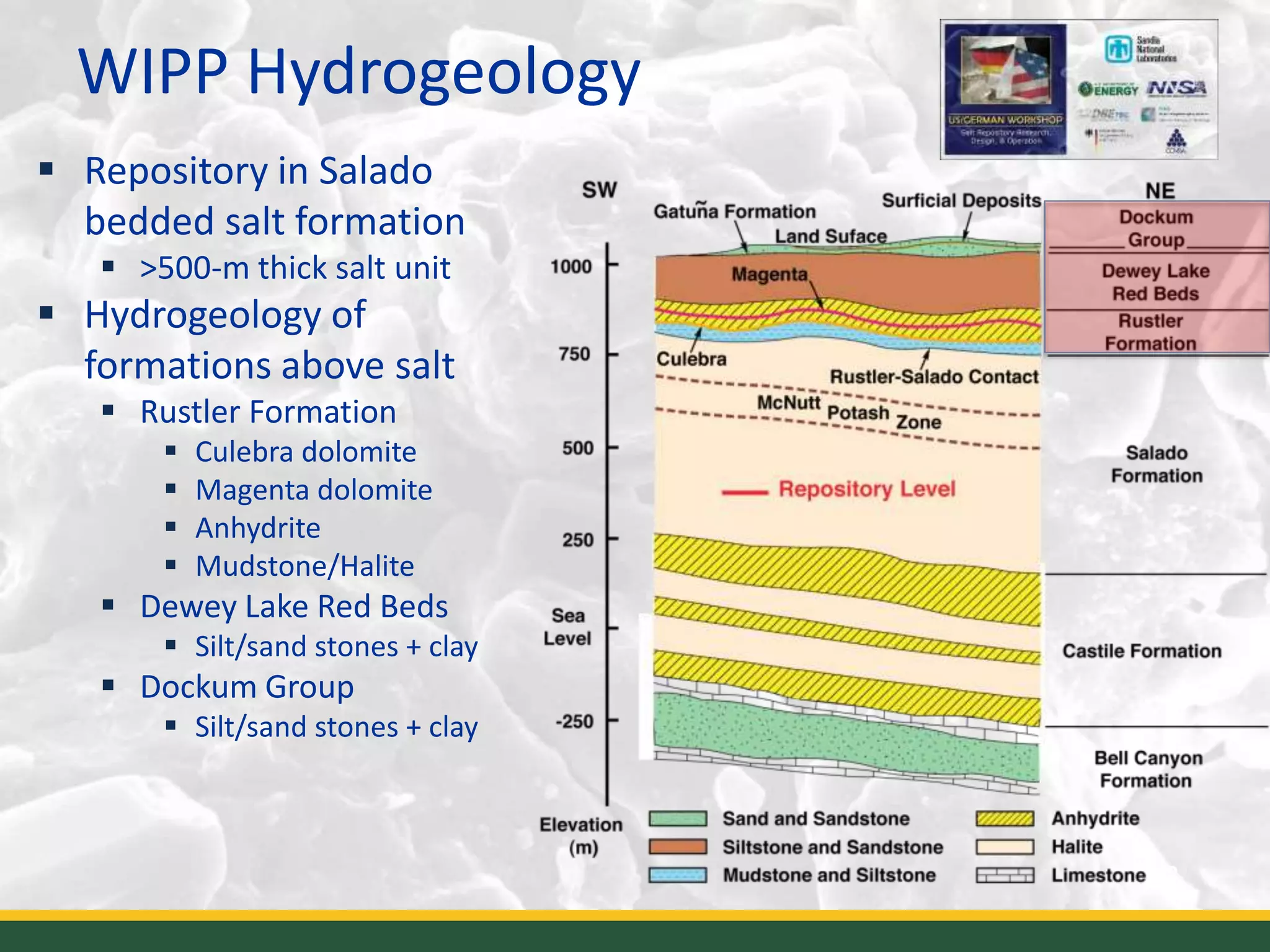
WIPP Hydrogeology
 Repository in Salado
bedded salt formation
 >500-m thick salt unit
 Hydrogeology of
formations above salt
 Rustler Formation
 Culebra dolomite
 Magenta dolomite
 Anhydrite
 Mudstone/Halite
 Dewey Lake Red Beds
 Silt/sand stones + clay
 Dockum Group
 Silt/sand stones + clay
2
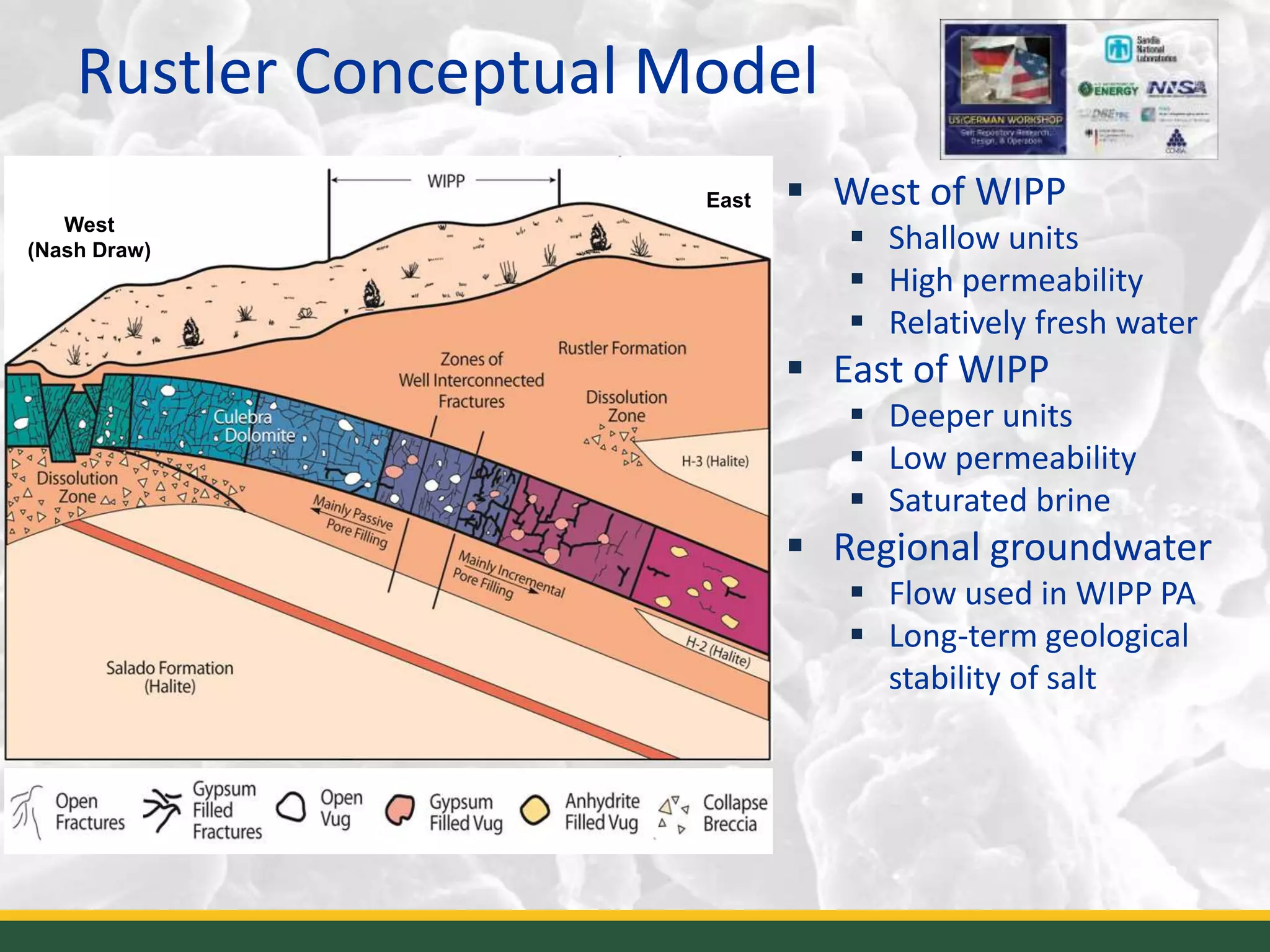
Rustler Conceptual Model
3
West
(Nash Draw)
East  West of WIPP
 Shallow units
 High permeability
 Relatively fresh water
 East of WIPP
 Deeper units
 Low permeability
 Saturated brine
 Regional groundwater
 Flow used in WIPP PA
 Long-term geological
stability of salt
4
Corbet (2000)
Model Domain
WIPP LWB
NM/TX Border
1996 WIPP PA Model
2004 PA Model
2014 WIPP PA Model
Scale [km]
0 10 20 4030
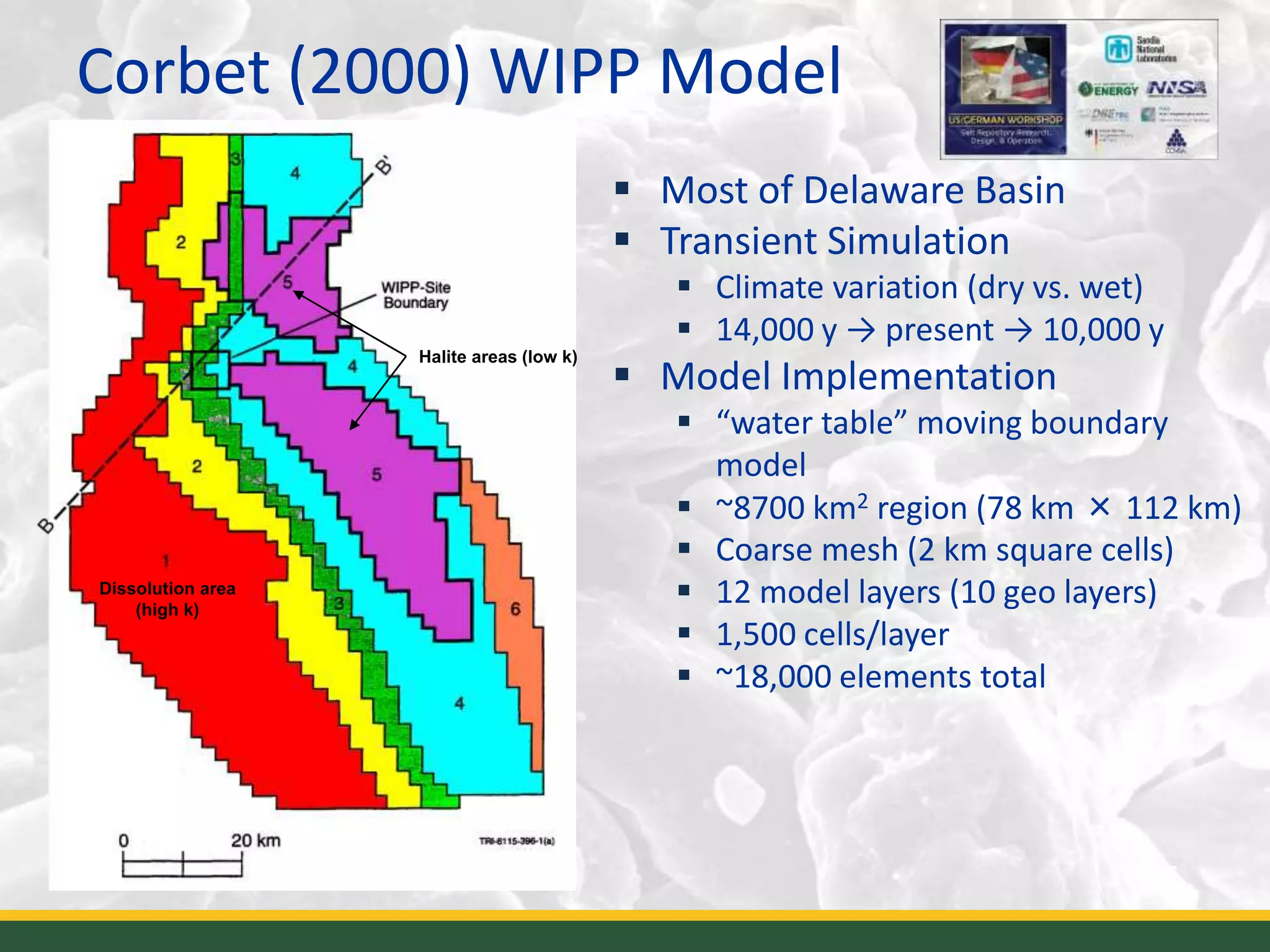
Corbet (2000) WIPP Model
5
 Most of Delaware Basin
 Transient Simulation
 Climate variation (dry vs. wet)
 14,000 y → present → 10,000 y
 Model Implementation
 “water table” moving boundary
model
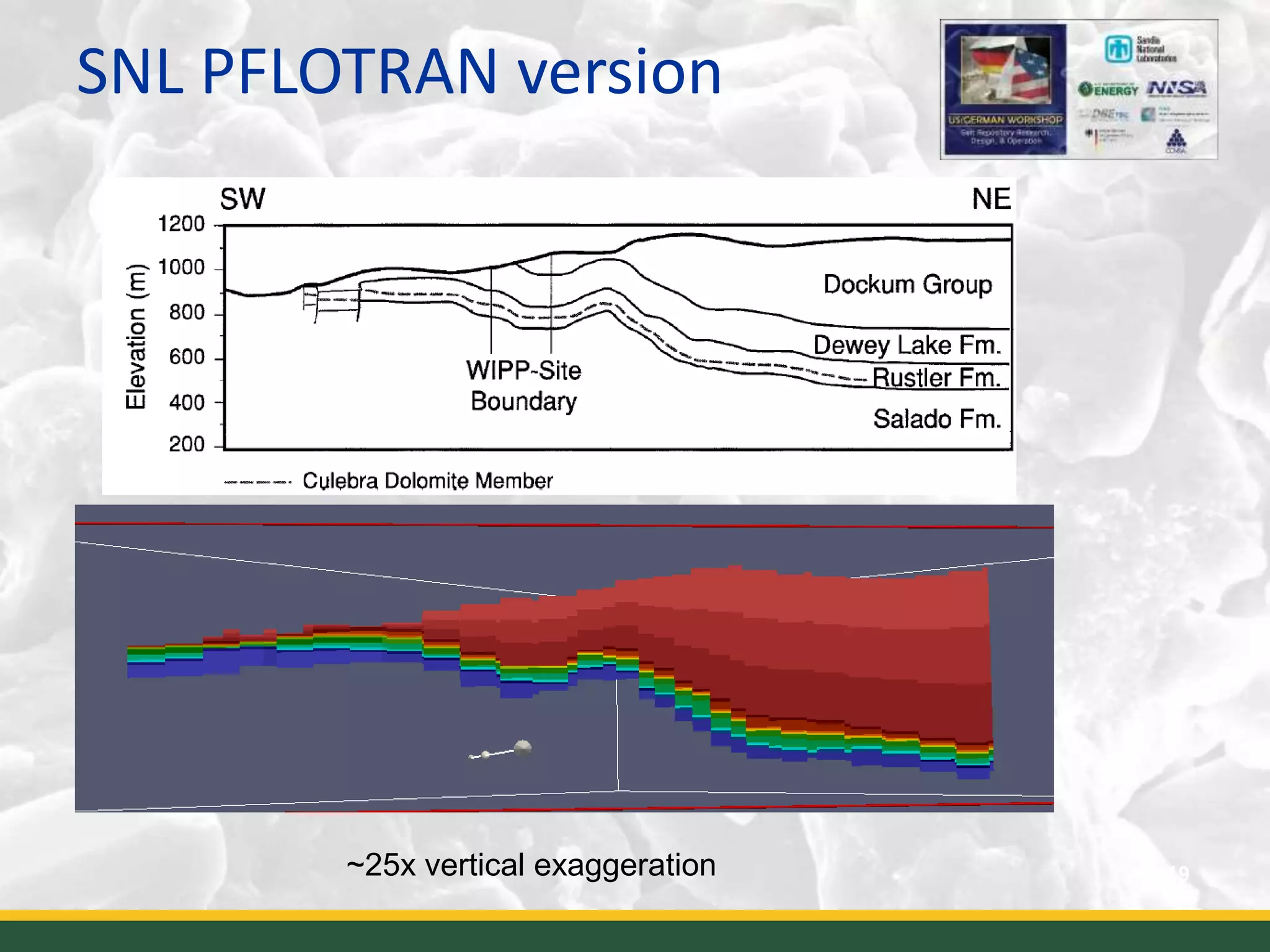
 ~8700 km2 region (78 km × 112 km)
 Coarse mesh (2 km square cells)
 12 model layers (10 geo layers)
 1,500 cells/layer
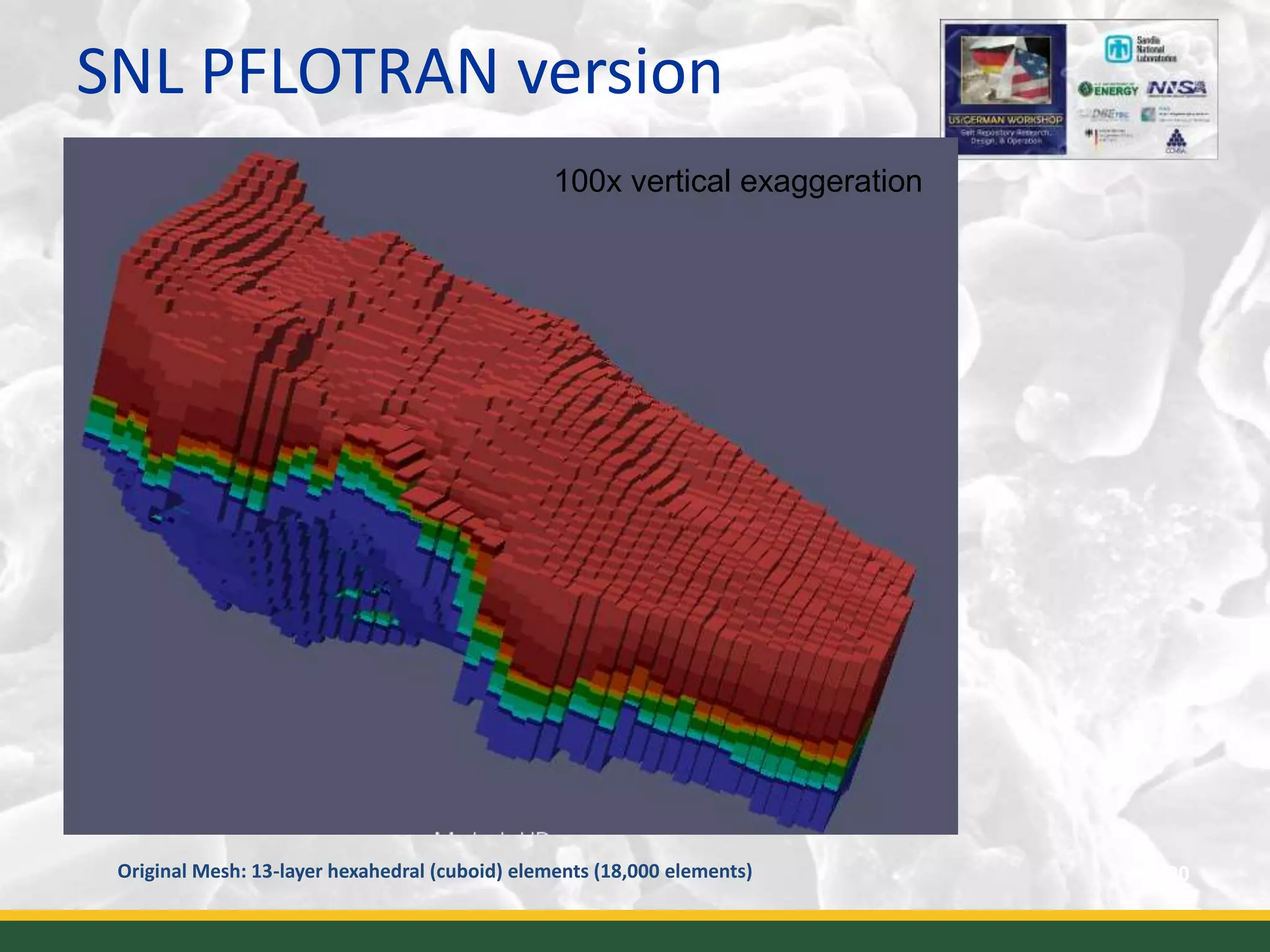
 ~18,000 elements total
Halite areas (low k)
Dissolution area
(high k)
Motivation
6
 Benchmark against existing solution (Corbet, 2000)
 Comparison with original model
 Old mesh, model parameters & boundary conditions
 Include new processes, features & data
 Include density-driven flow (e.g., Davies, 1989)
 Include chemistry & mineral dissolution
 Investigate flow & chemistry boundary conditions
 Test and update hydrogeological conceptual model
 Incoporate current data: 81Kr GW age data, water level data
 Comparison and Development of Models
 PFLOTRAN (SNL)
 Add density dependent flow
 d3f++ (GRS)
Update of Corbet model
7
Corbet (2000): Hydraulic conductivity [m/s]
d3f++/PFLOTRAN: Permeability [m2]
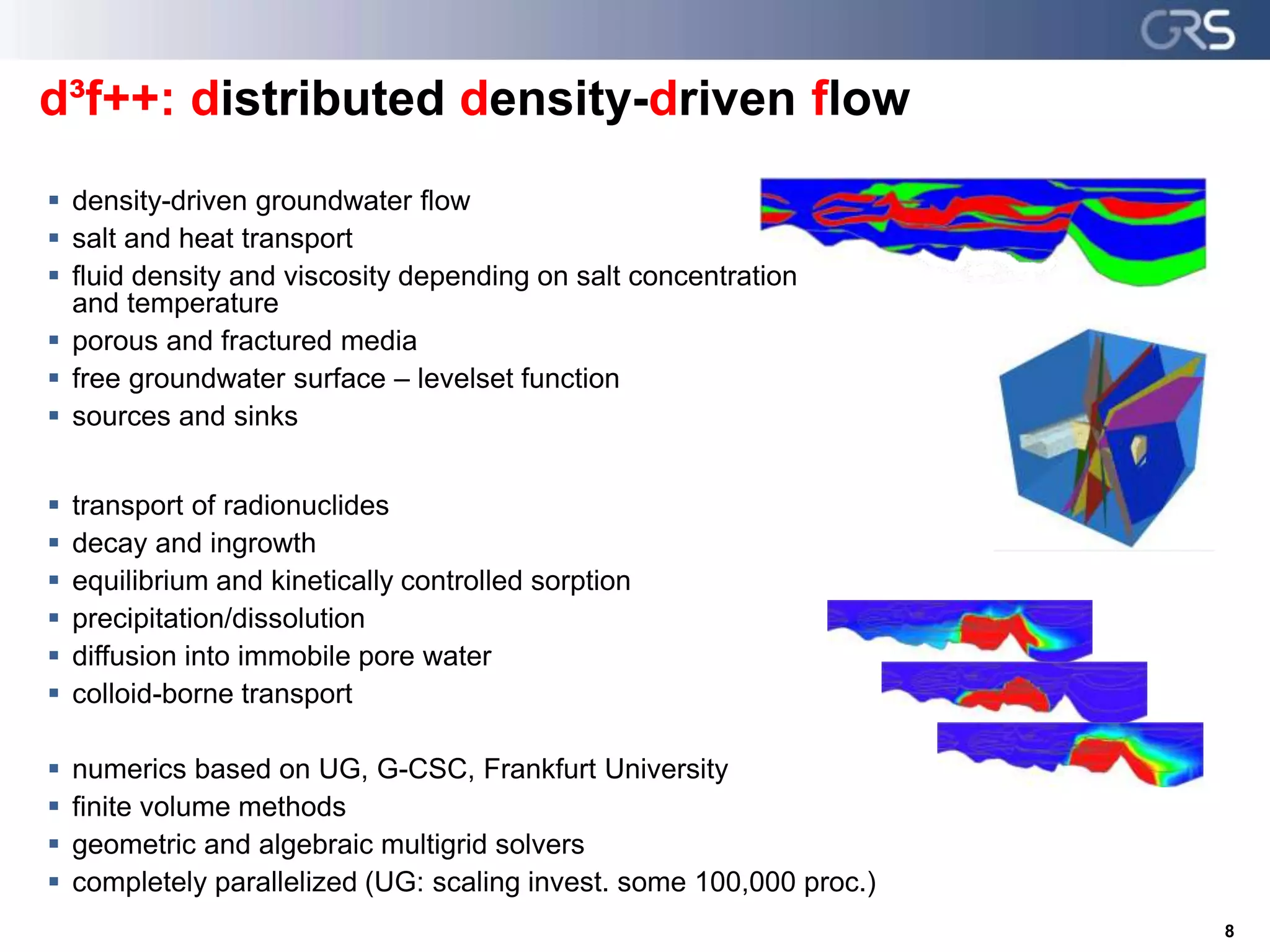
 density-driven groundwater flow
 salt and heat transport
 fluid density and viscosity depending on salt concentration
and temperature
 porous and fractured media
 free groundwater surface – levelset function
 sources and sinks
 transport of radionuclides
 decay and ingrowth
 equilibrium and kinetically controlled sorption
 precipitation/dissolution
 diffusion into immobile pore water
 colloid-borne transport
 numerics based on UG, G-CSC, Frankfurt University
 finite volume methods
 geometric and algebraic multigrid solvers
 completely parallelized (UG: scaling invest. some 100,000 proc.)
8
d³f++: distributed density-driven flow
Applications of d3f++
Applications 9
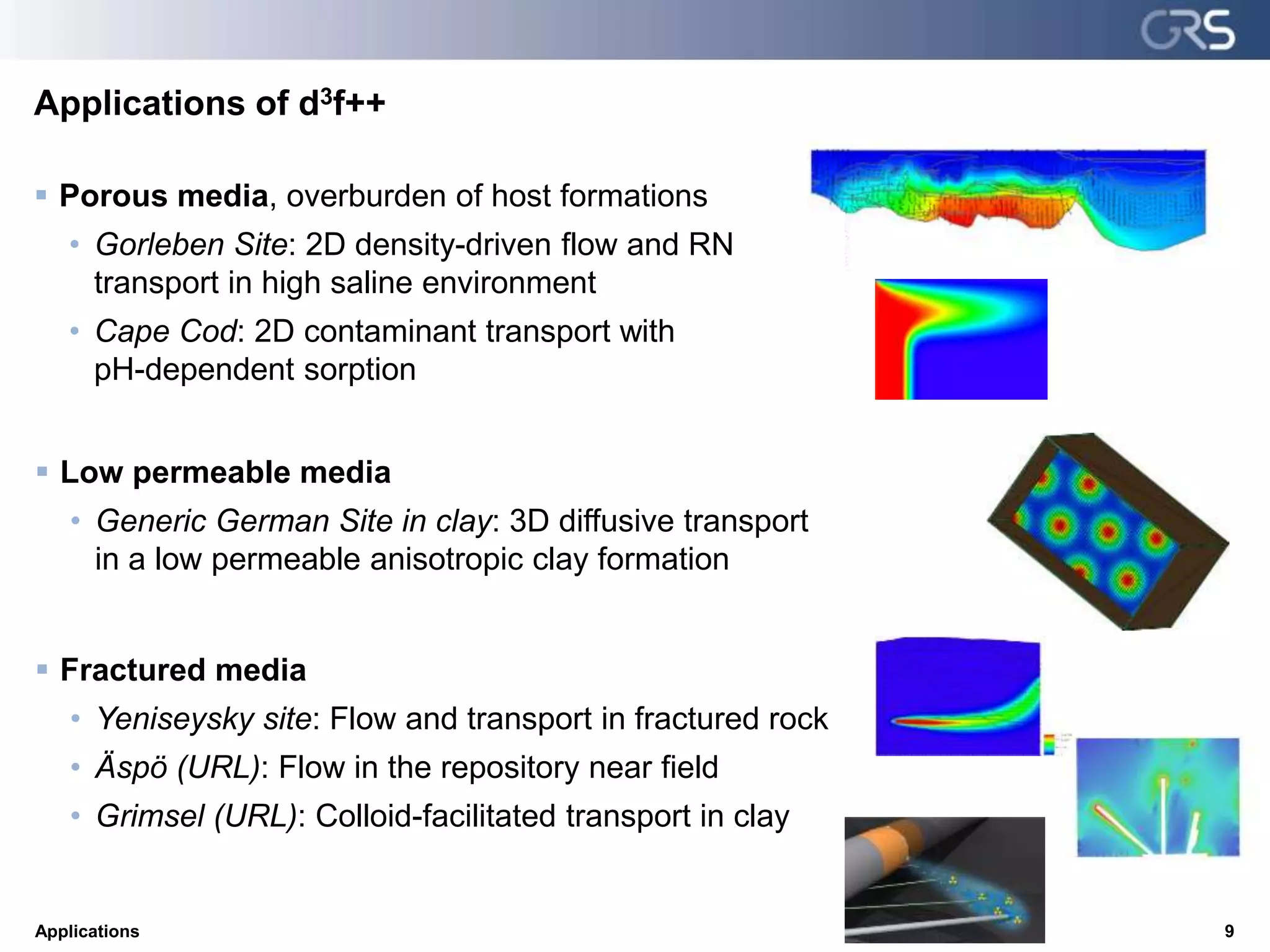
 Porous media, overburden of host formations
• Gorleben Site: 2D density-driven flow and RN
transport in high saline environment
• Cape Cod: 2D contaminant transport with
pH-dependent sorption
 Low permeable media
• Generic German Site in clay: 3D diffusive transport
in a low permeable anisotropic clay formation
 Fractured media
• Yeniseysky site: Flow and transport in fractured rock
• Äspö (URL): Flow in the repository near field
• Grimsel (URL): Colloid-facilitated transport in clay
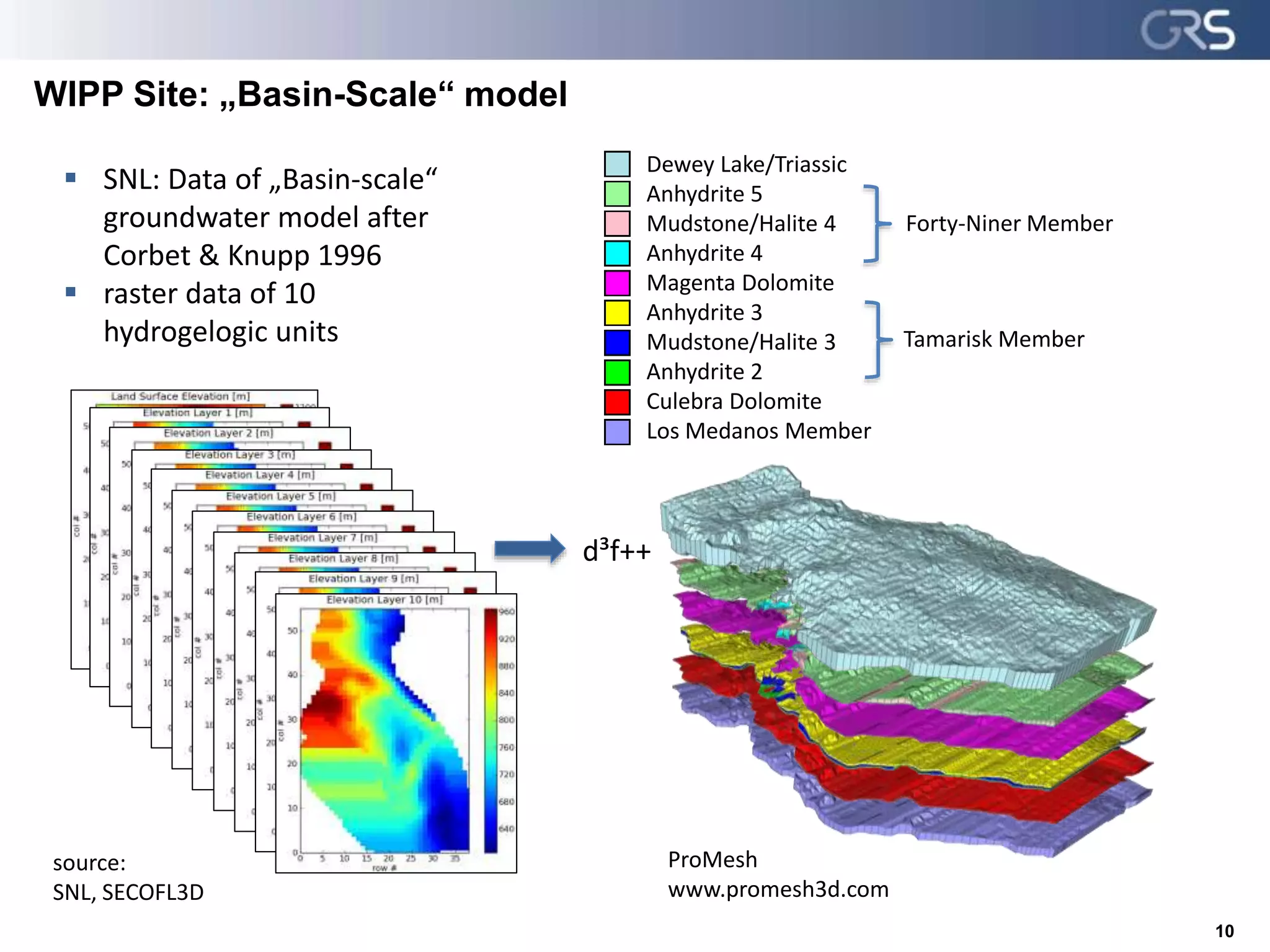
WIPP Site: „Basin-Scale“ model
 SNL: Data of „Basin-scale“
groundwater model after
Corbet & Knupp 1996
 raster data of 10
hydrogelogic units
source:
SNL, SECOFL3D
10
d³f++
ProMesh
www.promesh3d.com
Dewey Lake/Triassic
Anhydrite 5
Mudstone/Halite 4
Anhydrite 4
Magenta Dolomite
Anhydrite 3
Mudstone/Halite 3
Anhydrite 2
Culebra Dolomite
Los Medanos Member
Forty-Niner Member
Tamarisk Member
unit permeability [m²]
Dewey Lake/Triassic 10-14-10-12
Forty-Niner Member 10-20-10-12
Magenta Dolomite 10-18-10-12
Tamarisk Member 10-20-10-12
Culebra Dolomite 10-17-10-11
Los Medanos Member 10-17
WIPP-Site: Prism grid, 6 layers
N
example:
Culebra Dolomite
source: Corbet 2000
182,784 prisms (2x refined)  18,000 hexahedrons SECOFL3D
50x vertical exaggeration
11
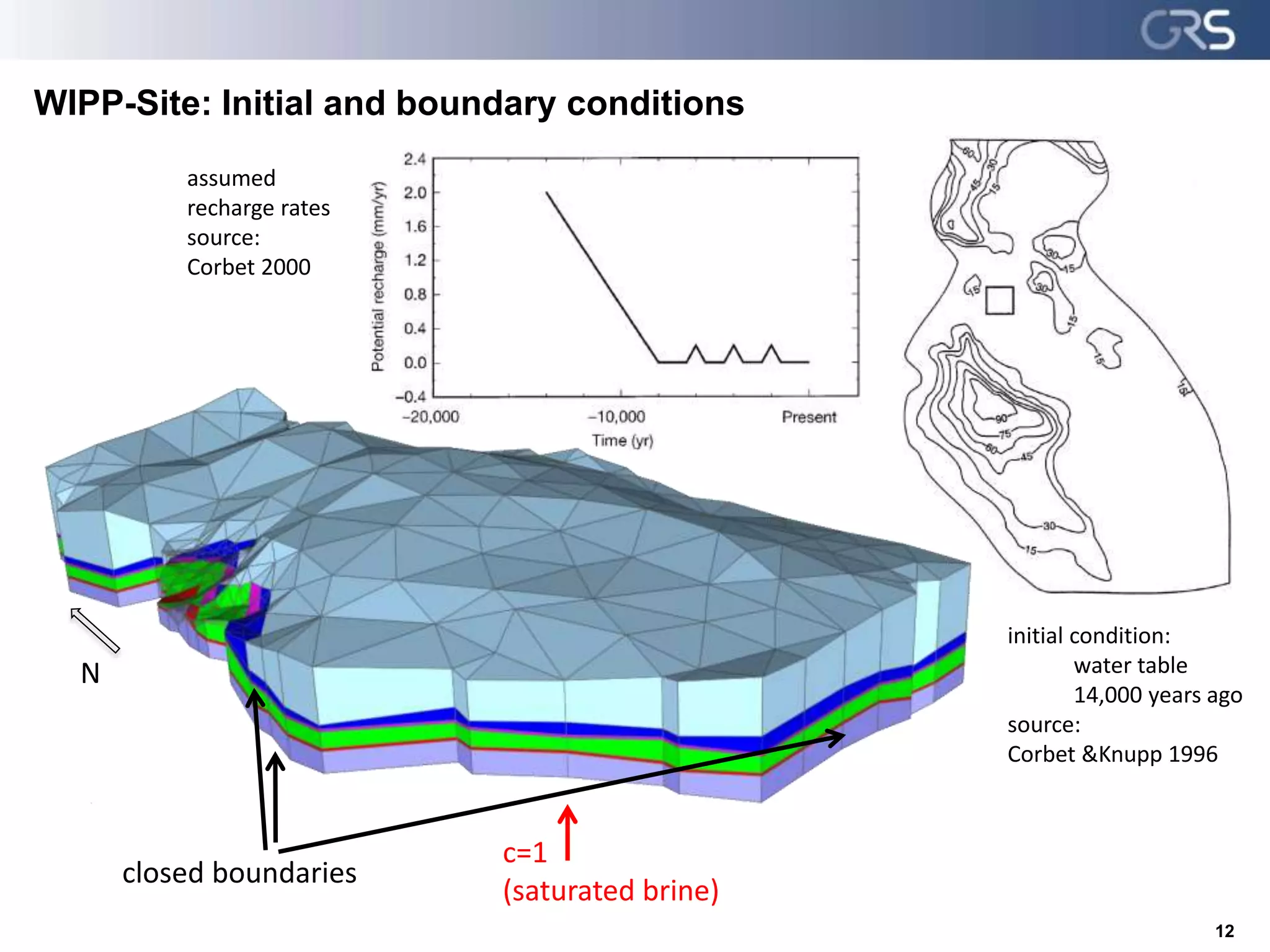
WIPP-Site: Initial and boundary conditions
N
closed boundaries
c=1
(saturated brine)
12
assumed
recharge rates
source:
Corbet 2000
initial condition:
water table
14,000 years ago
source:
Corbet &Knupp 1996
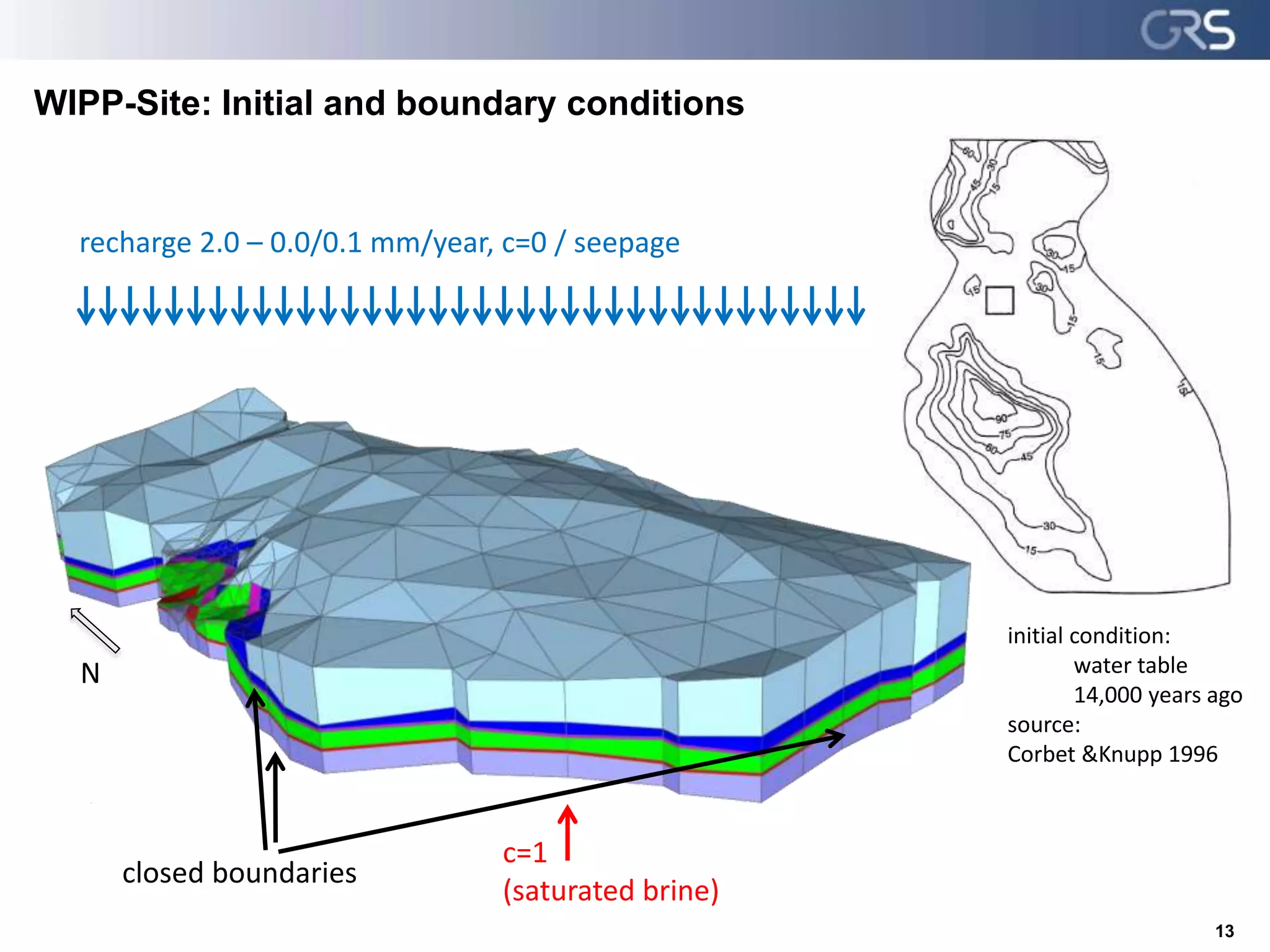
WIPP-Site: Initial and boundary conditions
N
closed boundaries
c=1
(saturated brine)
recharge 2.0 – 0.0/0.1 mm/year, c=0 / seepage
initial condition:
water table
14,000 years ago
source:
Corbet &Knupp 1996
13
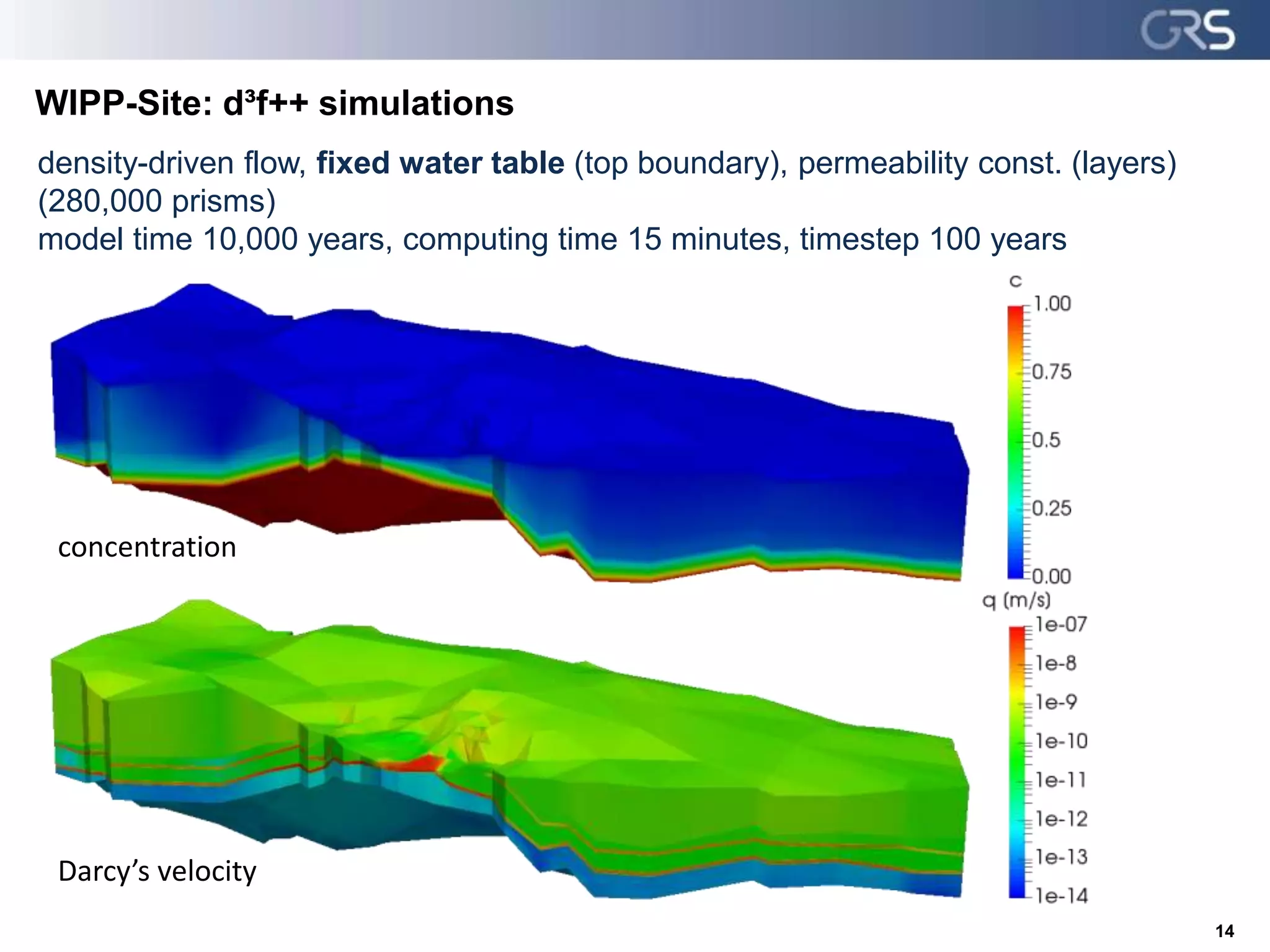
WIPP-Site: d³f++ simulations
14
density-driven flow, fixed water table (top boundary), permeability const. (layers)
(280,000 prisms)
model time 10,000 years, computing time 15 minutes, timestep 100 years
concentration
Darcy’s velocity
WIPP-Site: d³f++ simulations
15
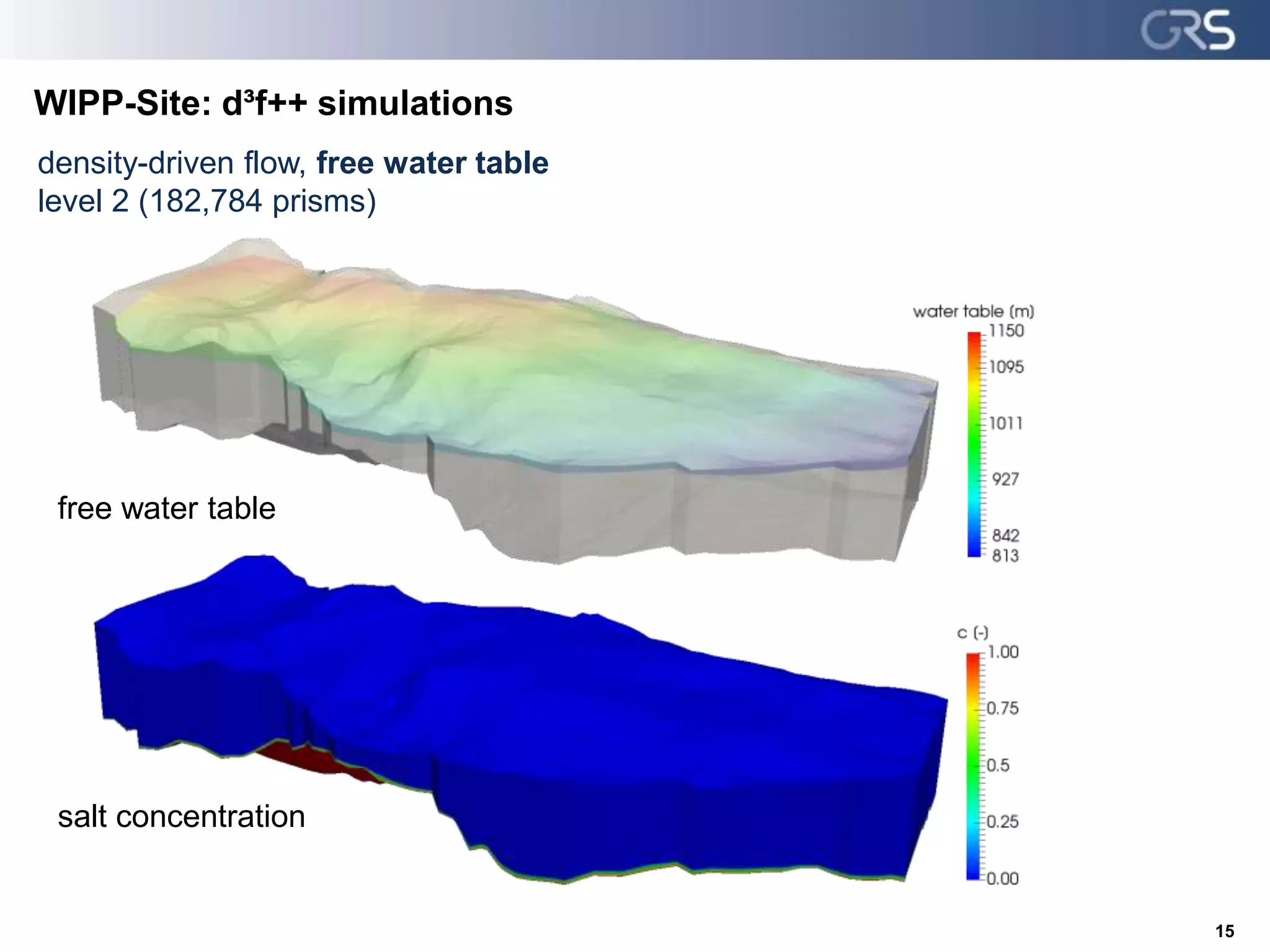
density-driven flow, free water table
level 2 (182,784 prisms)
free water table
salt concentration
WIPP-Site: d³f++ simulations
16
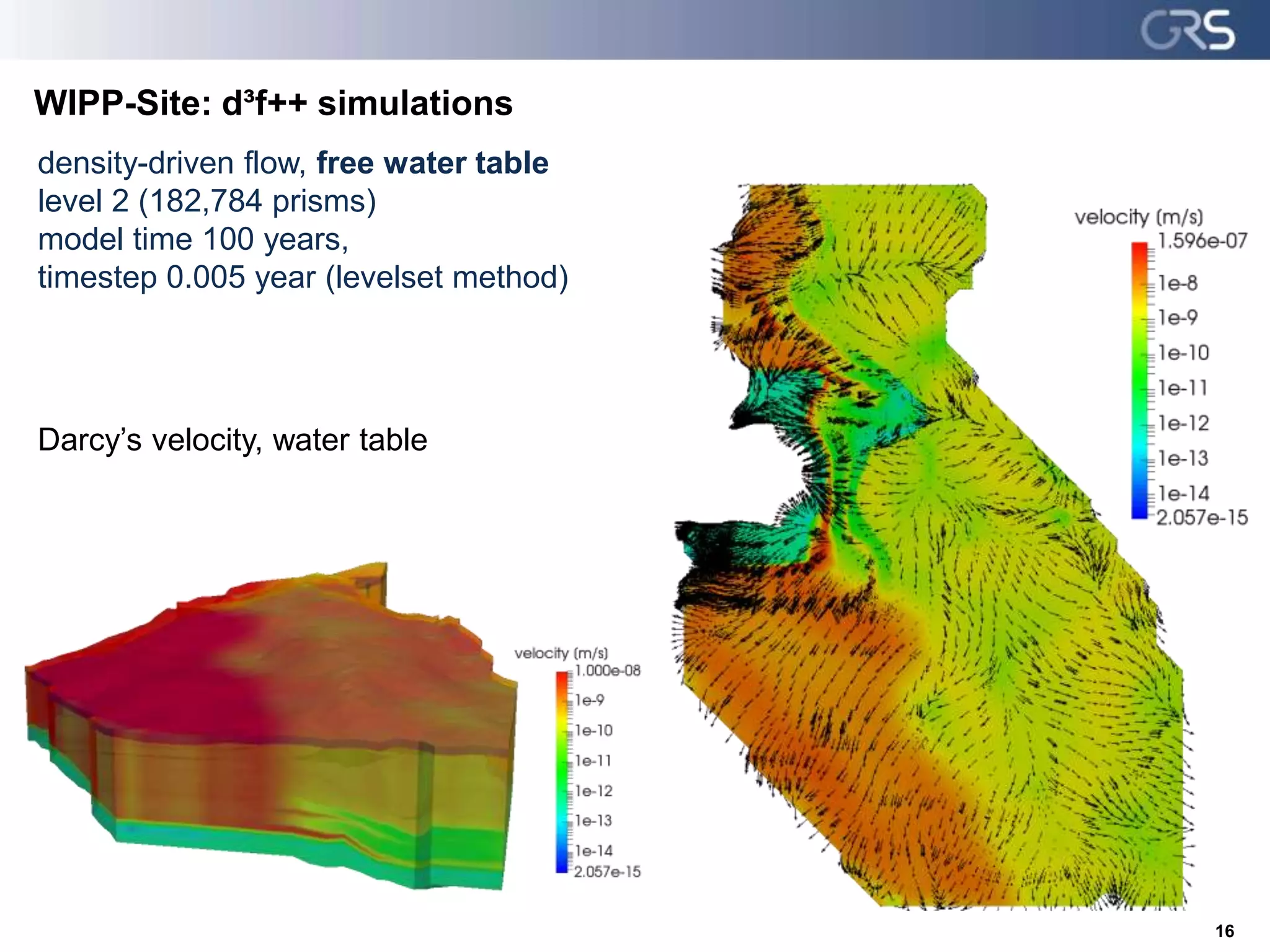
density-driven flow, free water table
level 2 (182,784 prisms)
model time 100 years,
timestep 0.005 year (levelset method)
Darcy’s velocity, water table
Summary and outlook
Difficulties:
 non steady-state density-driven flow model
 strongly anisotropic (thin layers, jumping coefficients)
 free groundwater surface 8,700 km²
Current work:
BMWi-funded joint project GRUSS (GRS, G-CSC Frankfurt University)
 improve grid generating/refinement
 improve robustness of solvers (convergence, timesteps)
 implement volume of fluid (VOF) method to speed-up free surface handling
Next steps:
 increase timestep levelset method
 simulation 14.000 years past
 reproduction of SECOFL3D results (Corbet & Knupp, 1996)
17
 Reactive multiphase flow and transport code for porous media
 Open source license (GNU LGPL 2.0)
 Object-oriented Fortran 2003/2008
 Pointers to procedures
 Classes (extendable derived types with
member procedures)
 Founded upon well-known (supported) open source libraries
 MPI, PETSc, HDF5, METIS/ParMETIS/CMAKE
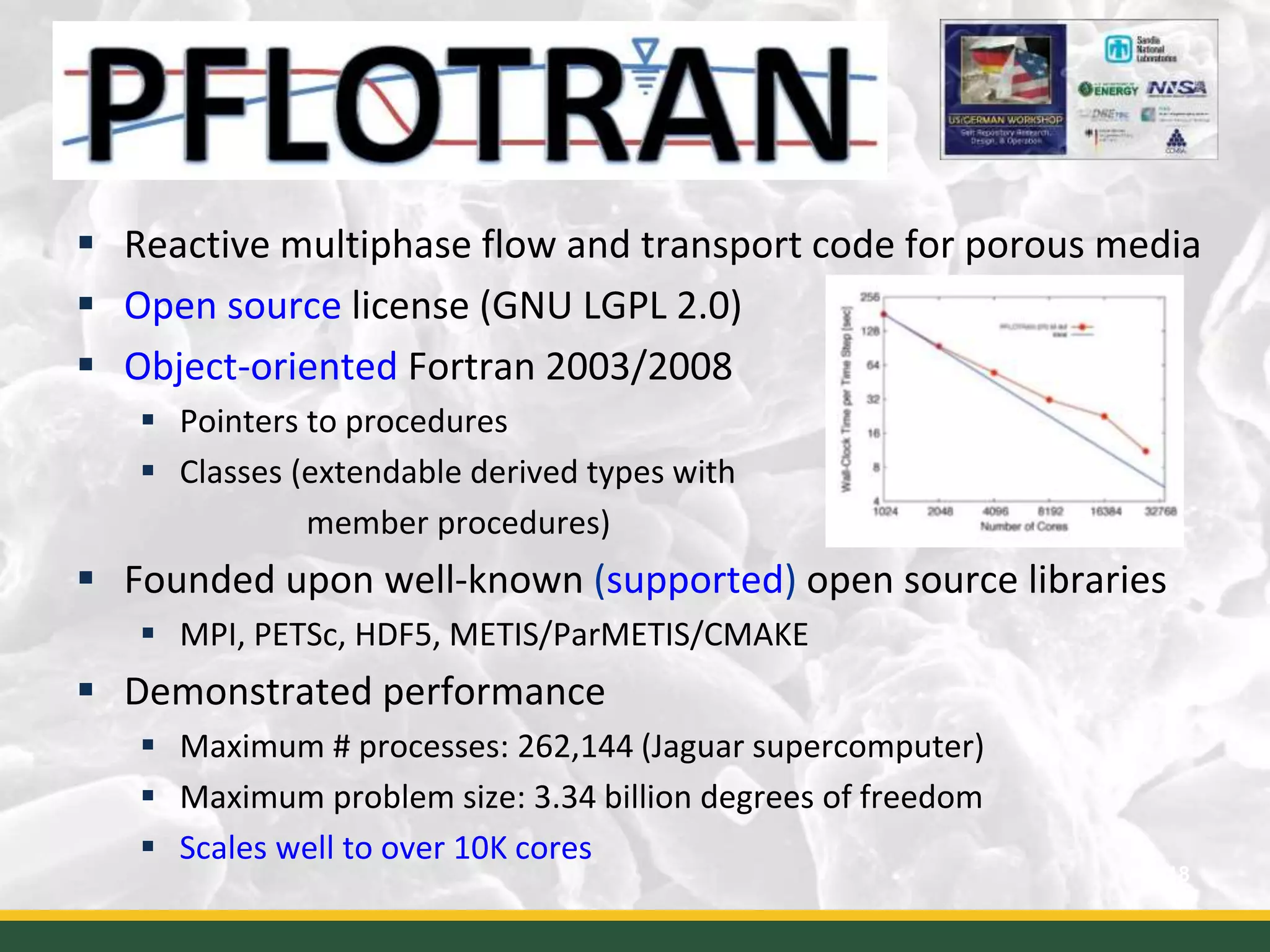
 Demonstrated performance
 Maximum # processes: 262,144 (Jaguar supercomputer)
 Maximum problem size: 3.34 billion degrees of freedom
 Scales well to over 10K cores
18
SNL PFLOTRAN version
19~25x vertical exaggeration
SNL PFLOTRAN version
20Original Mesh: 13-layer hexahedral (cuboid) elements (18,000 elements)
100x vertical exaggeration
Issues Encountered
21
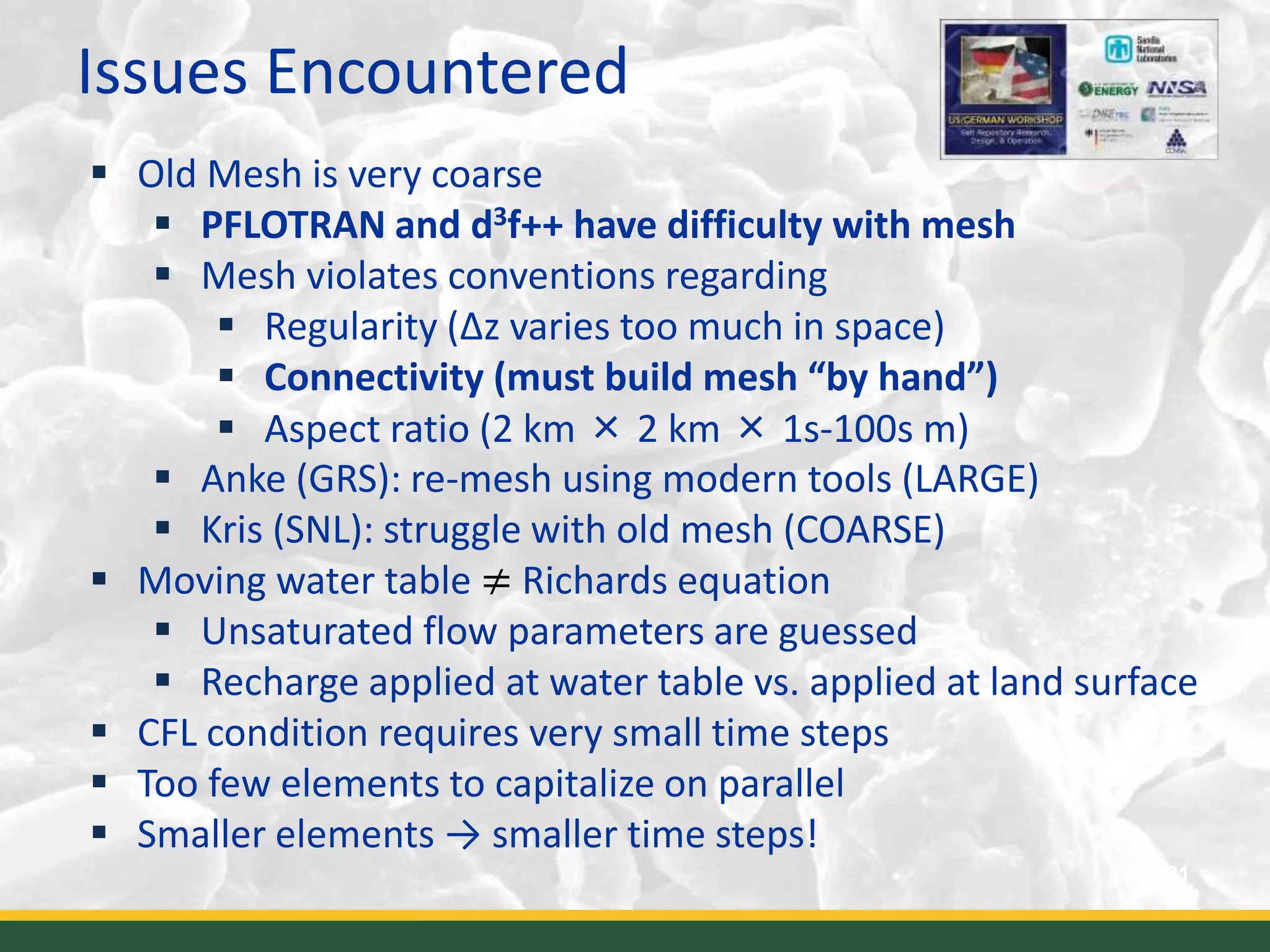
 Old Mesh is very coarse
 PFLOTRAN and d3f++ have difficulty with mesh
 Mesh violates conventions regarding
 Regularity (Δz varies too much in space)
 Connectivity (must build mesh “by hand”)
 Aspect ratio (2 km × 2 km × 1s-100s m)
 Anke (GRS): re-mesh using modern tools (LARGE)
 Kris (SNL): struggle with old mesh (COARSE)
 Moving water table ≠ Richards equation
 Unsaturated flow parameters are guessed
 Recharge applied at water table vs. applied at land surface
 CFL condition requires very small time steps
 Too few elements to capitalize on parallel
 Smaller elements → smaller time steps!
Schedule
22
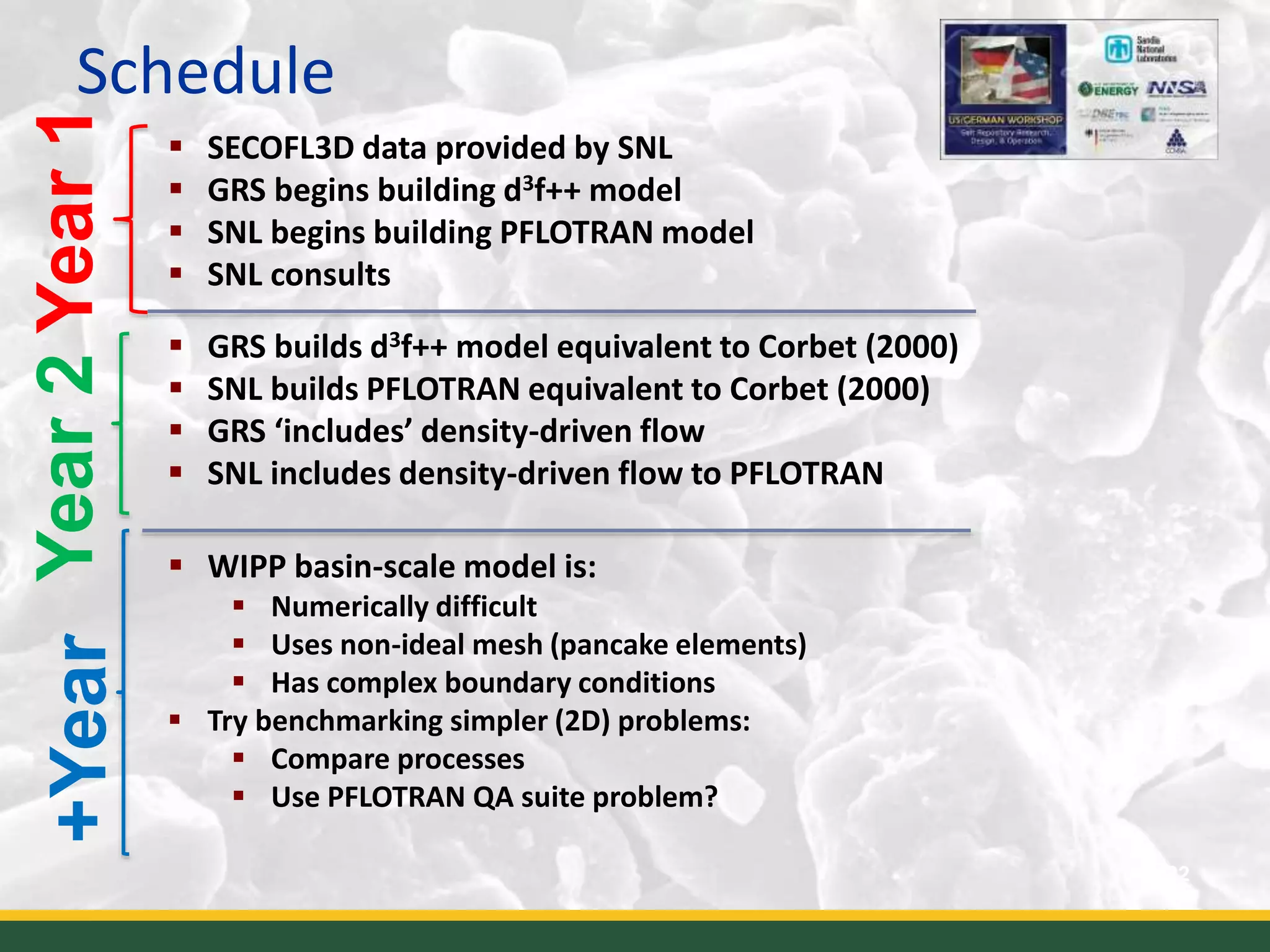
 SECOFL3D data provided by SNL
 GRS begins building d3f++ model
 SNL begins building PFLOTRAN model
 SNL consults
 GRS builds d3f++ model equivalent to Corbet (2000)
 SNL builds PFLOTRAN equivalent to Corbet (2000)
 GRS ‘includes’ density-driven flow
 SNL includes density-driven flow to PFLOTRAN
 WIPP basin-scale model is:
 Numerically difficult
 Uses non-ideal mesh (pancake elements)
 Has complex boundary conditions
 Try benchmarking simpler (2D) problems:
 Compare processes
 Use PFLOTRAN QA suite problem?
Year1Year2+Year
23
Thank you for your attention!

25 Basin-Scale Density-Dependent Groundwater Flow Near a Salt Repository

  • 1.
    Basin-Scale Density-Dependent Groundwater FlowNear a Salt Repository Anke Schneider Gesellschaft für Anlagen- und Reaktorsicherheit Kristopher L. Kuhlman Sandia National Laboratories Middelburg, The Netherlands September 5-7, 2017 Sandia National Laboratories is a multi-mission laboratory managed and operated by National Technology and Engineering Solutions of Sandia LLC, a wholly owned subsidiary of Honeywell International Inc. for the U.S. Department of Energy’s National Nuclear Security Administration under contract DE- NA0003525. SAND2017-9392 C.
  • 2.
    WIPP Hydrogeology  Repositoryin Salado bedded salt formation  >500-m thick salt unit  Hydrogeology of formations above salt  Rustler Formation  Culebra dolomite  Magenta dolomite  Anhydrite  Mudstone/Halite  Dewey Lake Red Beds  Silt/sand stones + clay  Dockum Group  Silt/sand stones + clay 2
  • 3.
    Rustler Conceptual Model 3 West (NashDraw) East  West of WIPP  Shallow units  High permeability  Relatively fresh water  East of WIPP  Deeper units  Low permeability  Saturated brine  Regional groundwater  Flow used in WIPP PA  Long-term geological stability of salt
  • 4.
    4 Corbet (2000) Model Domain WIPPLWB NM/TX Border 1996 WIPP PA Model 2004 PA Model 2014 WIPP PA Model Scale [km] 0 10 20 4030
  • 5.
    Corbet (2000) WIPPModel 5  Most of Delaware Basin  Transient Simulation  Climate variation (dry vs. wet)  14,000 y → present → 10,000 y  Model Implementation  “water table” moving boundary model  ~8700 km2 region (78 km × 112 km)  Coarse mesh (2 km square cells)  12 model layers (10 geo layers)  1,500 cells/layer  ~18,000 elements total Halite areas (low k) Dissolution area (high k)
  • 6.
    Motivation 6  Benchmark againstexisting solution (Corbet, 2000)  Comparison with original model  Old mesh, model parameters & boundary conditions  Include new processes, features & data  Include density-driven flow (e.g., Davies, 1989)  Include chemistry & mineral dissolution  Investigate flow & chemistry boundary conditions  Test and update hydrogeological conceptual model  Incoporate current data: 81Kr GW age data, water level data  Comparison and Development of Models  PFLOTRAN (SNL)  Add density dependent flow  d3f++ (GRS)
  • 7.
    Update of Corbetmodel 7 Corbet (2000): Hydraulic conductivity [m/s] d3f++/PFLOTRAN: Permeability [m2]
  • 8.
     density-driven groundwaterflow  salt and heat transport  fluid density and viscosity depending on salt concentration and temperature  porous and fractured media  free groundwater surface – levelset function  sources and sinks  transport of radionuclides  decay and ingrowth  equilibrium and kinetically controlled sorption  precipitation/dissolution  diffusion into immobile pore water  colloid-borne transport  numerics based on UG, G-CSC, Frankfurt University  finite volume methods  geometric and algebraic multigrid solvers  completely parallelized (UG: scaling invest. some 100,000 proc.) 8 d³f++: distributed density-driven flow
  • 9.
    Applications of d3f++ Applications9  Porous media, overburden of host formations • Gorleben Site: 2D density-driven flow and RN transport in high saline environment • Cape Cod: 2D contaminant transport with pH-dependent sorption  Low permeable media • Generic German Site in clay: 3D diffusive transport in a low permeable anisotropic clay formation  Fractured media • Yeniseysky site: Flow and transport in fractured rock • Äspö (URL): Flow in the repository near field • Grimsel (URL): Colloid-facilitated transport in clay
  • 10.
    WIPP Site: „Basin-Scale“model  SNL: Data of „Basin-scale“ groundwater model after Corbet & Knupp 1996  raster data of 10 hydrogelogic units source: SNL, SECOFL3D 10 d³f++ ProMesh www.promesh3d.com Dewey Lake/Triassic Anhydrite 5 Mudstone/Halite 4 Anhydrite 4 Magenta Dolomite Anhydrite 3 Mudstone/Halite 3 Anhydrite 2 Culebra Dolomite Los Medanos Member Forty-Niner Member Tamarisk Member
  • 11.
    unit permeability [m²] DeweyLake/Triassic 10-14-10-12 Forty-Niner Member 10-20-10-12 Magenta Dolomite 10-18-10-12 Tamarisk Member 10-20-10-12 Culebra Dolomite 10-17-10-11 Los Medanos Member 10-17 WIPP-Site: Prism grid, 6 layers N example: Culebra Dolomite source: Corbet 2000 182,784 prisms (2x refined)  18,000 hexahedrons SECOFL3D 50x vertical exaggeration 11
  • 12.
    WIPP-Site: Initial andboundary conditions N closed boundaries c=1 (saturated brine) 12 assumed recharge rates source: Corbet 2000 initial condition: water table 14,000 years ago source: Corbet &Knupp 1996
  • 13.
    WIPP-Site: Initial andboundary conditions N closed boundaries c=1 (saturated brine) recharge 2.0 – 0.0/0.1 mm/year, c=0 / seepage initial condition: water table 14,000 years ago source: Corbet &Knupp 1996 13
  • 14.
    WIPP-Site: d³f++ simulations 14 density-drivenflow, fixed water table (top boundary), permeability const. (layers) (280,000 prisms) model time 10,000 years, computing time 15 minutes, timestep 100 years concentration Darcy’s velocity
  • 15.
    WIPP-Site: d³f++ simulations 15 density-drivenflow, free water table level 2 (182,784 prisms) free water table salt concentration
  • 16.
    WIPP-Site: d³f++ simulations 16 density-drivenflow, free water table level 2 (182,784 prisms) model time 100 years, timestep 0.005 year (levelset method) Darcy’s velocity, water table
  • 17.
    Summary and outlook Difficulties: non steady-state density-driven flow model  strongly anisotropic (thin layers, jumping coefficients)  free groundwater surface 8,700 km² Current work: BMWi-funded joint project GRUSS (GRS, G-CSC Frankfurt University)  improve grid generating/refinement  improve robustness of solvers (convergence, timesteps)  implement volume of fluid (VOF) method to speed-up free surface handling Next steps:  increase timestep levelset method  simulation 14.000 years past  reproduction of SECOFL3D results (Corbet & Knupp, 1996) 17
  • 18.
     Reactive multiphaseflow and transport code for porous media  Open source license (GNU LGPL 2.0)  Object-oriented Fortran 2003/2008  Pointers to procedures  Classes (extendable derived types with member procedures)  Founded upon well-known (supported) open source libraries  MPI, PETSc, HDF5, METIS/ParMETIS/CMAKE  Demonstrated performance  Maximum # processes: 262,144 (Jaguar supercomputer)  Maximum problem size: 3.34 billion degrees of freedom  Scales well to over 10K cores 18
  • 19.
    SNL PFLOTRAN version 19~25xvertical exaggeration
  • 20.
    SNL PFLOTRAN version 20OriginalMesh: 13-layer hexahedral (cuboid) elements (18,000 elements) 100x vertical exaggeration
  • 21.
    Issues Encountered 21  OldMesh is very coarse  PFLOTRAN and d3f++ have difficulty with mesh  Mesh violates conventions regarding  Regularity (Δz varies too much in space)  Connectivity (must build mesh “by hand”)  Aspect ratio (2 km × 2 km × 1s-100s m)  Anke (GRS): re-mesh using modern tools (LARGE)  Kris (SNL): struggle with old mesh (COARSE)  Moving water table ≠ Richards equation  Unsaturated flow parameters are guessed  Recharge applied at water table vs. applied at land surface  CFL condition requires very small time steps  Too few elements to capitalize on parallel  Smaller elements → smaller time steps!
  • 22.
    Schedule 22  SECOFL3D dataprovided by SNL  GRS begins building d3f++ model  SNL begins building PFLOTRAN model  SNL consults  GRS builds d3f++ model equivalent to Corbet (2000)  SNL builds PFLOTRAN equivalent to Corbet (2000)  GRS ‘includes’ density-driven flow  SNL includes density-driven flow to PFLOTRAN  WIPP basin-scale model is:  Numerically difficult  Uses non-ideal mesh (pancake elements)  Has complex boundary conditions  Try benchmarking simpler (2D) problems:  Compare processes  Use PFLOTRAN QA suite problem? Year1Year2+Year
  • 23.
    23 Thank you foryour attention!

Editor's Notes

  • #12 Raster Layer Projector method Preserve geometric information (of the raster data) for grid refinement