Interaction between Operational Safety and
Long-Term Safety (Project BASEL)
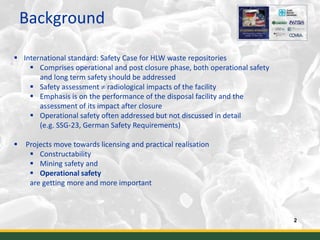
Wolf, J.1, Bertrams, N.2, Bollingerfehr, W.2,
Buhmann, D.1, Fahrenholz, C.1, Filbert, W.2,
Lommerzheim, A.2, Noseck, U.1 , Prignitz, S.2
1GRS gGmbH, 2DBE Technology GmbH
Middelburg, The Netherlands
September 5-7, 2017
Background
2
 International standard: Safety Case for HLW waste repositories
 Comprises operational and post closure phase, both operational safety
and long term safety should be addressed
 Safety assessment  radiological impacts of the facility
 Emphasis is on the performance of the disposal facility and the
assessment of its impact after closure
 Operational safety often addressed but not discussed in detail
(e.g. SSG-23, German Safety Requirements)
 Projects move towards licensing and practical realisation
 Constructability
 Mining safety and
 Operational safety
are getting more and more important
International Activities
3
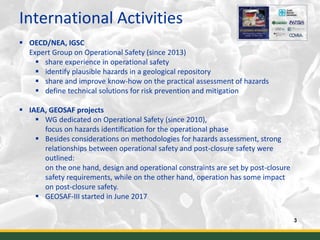
 OECD/NEA, IGSC
Expert Group on Operational Safety (since 2013)
 share experience in operational safety
 identify plausible hazards in a geological repository
 share and improve know-how on the practical assessment of hazards
 define technical solutions for risk prevention and mitigation
 IAEA, GEOSAF projects
 WG dedicated on Operational Safety (since 2010),
focus on hazards identification for the operational phase
 Besides considerations on methodologies for hazards assessment, strong
relationships between operational safety and post-closure safety were
outlined:
on the one hand, design and operational constraints are set by post-closure
safety requirements, while on the other hand, operation has some impact
on post-closure safety.
 GEOSAF-III started in June 2017
Challenges
4
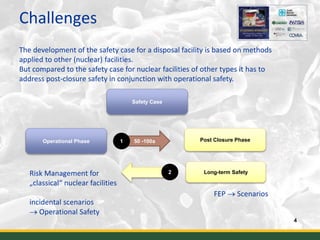
The development of the safety case for a disposal facility is based on methods
applied to other (nuclear) facilities.
But compared to the safety case for nuclear facilities of other types it has to
address post-closure safety in conjunction with operational safety.
Safety Case
Operational Phase Post Closure Phase
Risk Management for
„classical“ nuclear facilities
incidental scenarios
 Operational Safety
50 -100a
Long-term Safety
1
2
FEP  Scenarios
Tasks
5
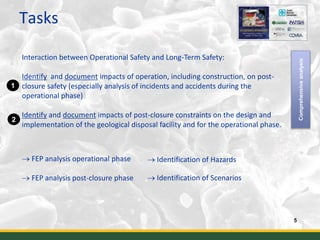
Interaction between Operational Safety and Long-Term Safety:
Identify and document impacts of operation, including construction, on post-
closure safety (especially analysis of incidents and accidents during the
operational phase)
Identify and document impacts of post-closure constraints on the design and
implementation of the geological disposal facility and for the operational phase.
Comprehensiveanalysis
 FEP analysis operational phase
 FEP analysis post-closure phase
1
2
 Identification of Scenarios
 Identification of Hazards
Project BASEL
6
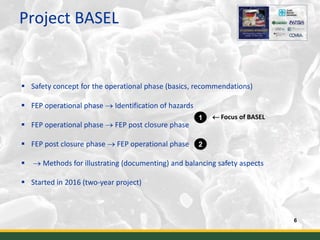
 Safety concept for the operational phase (basics, recommendations)
 FEP operational phase  Identification of hazards
 FEP operational phase  FEP post closure phase
 FEP post closure phase  FEP operational phase
  Methods for illustrating (documenting) and balancing safety aspects
 Started in 2016 (two-year project)
1
2
 Focus of BASEL
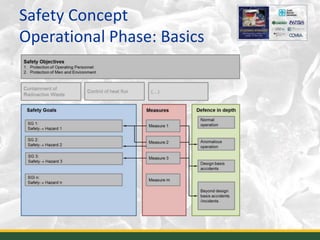
Safety Concept
Operational Phase: Basics
7
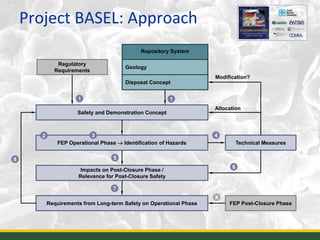
Project BASEL: Approach
8
Repository System
Regulatory
Requirements
Geology
Disposal Concept
Safety and Demonstration Concept
FEP Operational Phase  Identification of Hazards Technical Measures
Impacts on Post-Closure Phase /
Relevance for Post-Closure Safety
Requirements from Long-term Safety on Operational Phase FEP Post-Closure Phase
Allocation
Modification?
1 1
2 3 4
5
6
7
X
8
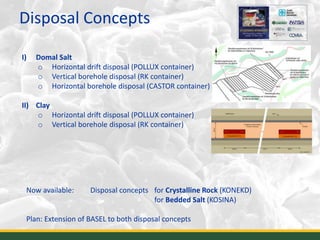
Disposal Concepts
9
I) Domal Salt
o Horizontal drift disposal (POLLUX container)
o Vertical borehole disposal (RK container)
o Horizontal borehole disposal (CASTOR container)
II) Clay
o Horizontal drift disposal (POLLUX container)
o Vertical borehole disposal (RK container)
Now available: Disposal concepts for Crystalline Rock (KONEKD)
for Bedded Salt (KOSINA)
Plan: Extension of BASEL to both disposal concepts
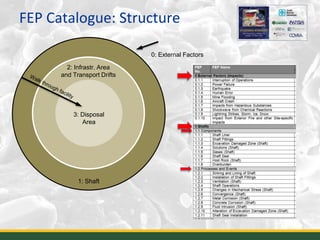
FEP Catalogue: Structure
10
1: Shaft
2: Infrastr. Area
and Transport Drifts
3: Disposal
Area
0: External Factors
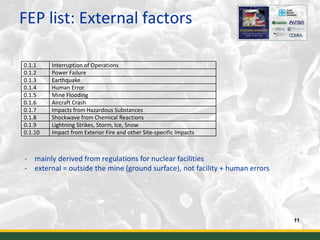
FEP list: External factors
11
0.1.1 Interruption of Operations
0.1.2 Power Failure
0.1.3 Earthquake
0.1.4 Human Error
0.1.5 Mine Flooding
0.1.6 Aircraft Crash
0.1.7 Impacts from Hazardous Substances
0.1.8 Shockwave from Chemical Reactions
0.1.9 Lightning Strikes, Storm, Ice, Snow
0.1.10 Impact from Exterior Fire and other Site-specific Impacts
- mainly derived from regulations for nuclear facilities
- external = outside the mine (ground surface), not facility + human errors
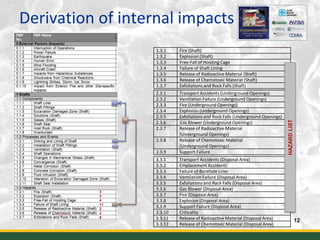
1.3.1 Fire (Shaft)
1.3.2 Explosion (Shaft)
1.3.3 Free-Fall of Hoisting Cage
1.3.4 Failure of Shaft Lining
1.3.5 Release of Radioactive Material (Shaft)
1.3.6 Release of Chemotoxic Material (Shaft)
1.3.7 Exfoliations and Rock Falls (Shaft)
Derivation of internal impacts
12
2.3.1 Transport Accidents (Underground Openings)
2.3.2 Ventilation Failure (Underground Openings)
2.3.3 Fire (Underground Openings)
2.3.4 Explosion (Underground Openings)
2.3.5 Exfoliations and Rock Falls (Underground Openings)
2.3.6 Gas Blower (Underground Openings)
2.3.7 Release of Radioactive Material
(Underground Openings)
2.3.8 Release of Chemotoxic Material
(Underground Openings)
2.3.9 Support Failure
3.3.1 Transport Accidents (Disposal Area)
3.3.2 Emplacement Accidents
3.3.3 Failure of Borehole Liner
3.3.4 Ventilation Failure (Disposal Area)
3.3.5 Exfoliations and Rock Falls (Disposal Area)
3.3.6 Gas Blower (Disposal Area)
3.3.7 Fire (Disposal Area)
3.3.8 Explosion (Disposal Area)
3.3.9 Support Failure (Disposal Area)
3.3.10 Criticality
3.3.11 Release of Radioactive Material (Disposal Area)
3.3.12 Release of Chemotoxic Material (Disposal Area)
HAZARDLIST
3
2
4
11
2
2
6
Impact on Long-term Safety:
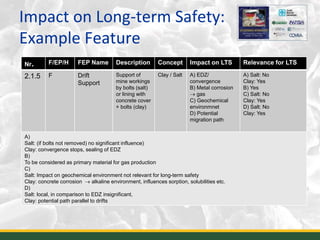
Example Feature
13
Nr. F/EP/H FEP Name Description Concept Impact on LTS Relevance for LTS
2.1.5 F Drift
Support
Support of
mine workings
by bolts (salt)
or lining with
concrete cover
+ bolts (clay)
Clay / Salt A) EDZ/
convergence
B) Metal corrosion
 gas
C) Geochemical
environmnet
D) Potential
migration path
A) Salt: No
Clay: Yes
B) Yes
C) Salt: No
Clay: Yes
D) Salt: No
Clay: Yes
A)
Salt: (if bolts not removed) no significant influence)
Clay: convergence stops, sealing of EDZ
B)
To be considered as primary material for gas production
C)
Salt: Impact on geochemical environment not relevant for long-term safety
Clay: concrete corrosion  alkaline environment, influences sorption, solubilities etc.
D)
Salt: local, in comparison to EDZ insignificant,
Clay: potential path parallel to drifts
Impact on Long-term Safety:
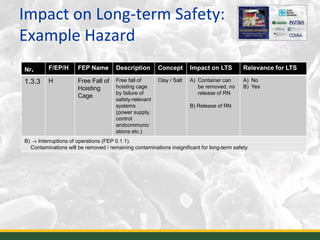
Example Hazard
14
Nr. F/EP/H FEP Name Description Concept Impact on LTS Relevance for LTS
1.3.3 H Free Fall of
Hoisting
Cage
Free fall of
hoisting cage
by failure of
safety-relevant
systems
(power supply,
control
andcommunic
ations etc.)
Clay / Salt A) Container can
be removed, no
release of RN
B) Release of RN
A) No
B) Yes
B)  Interruptions of operations (FEP 0.1.1).
Contaminations will be removed / remaining contaminations insignificant for long-term safety
Summary
15
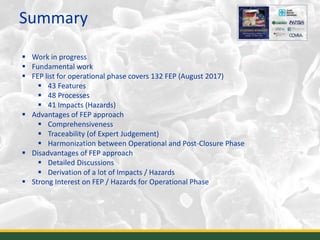
 Work in progress
 Fundamental work
 FEP list for operational phase covers 132 FEP (August 2017)
 43 Features
 48 Processes
 41 Impacts (Hazards)
 Advantages of FEP approach
 Comprehensiveness
 Traceability (of Expert Judgement)
 Harmonization between Operational and Post-Closure Phase
 Disadvantages of FEP approach
 Detailed Discussions
 Derivation of a lot of Impacts / Hazards
 Strong Interest on FEP / Hazards for Operational Phase
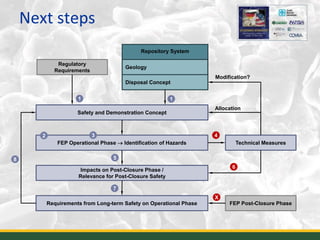
Next steps
16
Repository System
Regulatory
Requirements
Geology
Disposal Concept
Safety and Demonstration Concept
FEP Operational Phase  Identification of Hazards Technical Measures
Impacts on Post-Closure Phase /
Relevance for Post-Closure Safety
Requirements from Long-term Safety on Operational Phase FEP Post-Closure Phase
Allocation
Modification?
1 1
2 3 4
5
6
7
X
8
Acknowledgement
17

18 Interaction between Operational Safety and Long-Term Safety (Project BASEL)

  • 1.
    Interaction between OperationalSafety and Long-Term Safety (Project BASEL) Wolf, J.1, Bertrams, N.2, Bollingerfehr, W.2, Buhmann, D.1, Fahrenholz, C.1, Filbert, W.2, Lommerzheim, A.2, Noseck, U.1 , Prignitz, S.2 1GRS gGmbH, 2DBE Technology GmbH Middelburg, The Netherlands September 5-7, 2017
  • 2.
    Background 2  International standard:Safety Case for HLW waste repositories  Comprises operational and post closure phase, both operational safety and long term safety should be addressed  Safety assessment  radiological impacts of the facility  Emphasis is on the performance of the disposal facility and the assessment of its impact after closure  Operational safety often addressed but not discussed in detail (e.g. SSG-23, German Safety Requirements)  Projects move towards licensing and practical realisation  Constructability  Mining safety and  Operational safety are getting more and more important
  • 3.
    International Activities 3  OECD/NEA,IGSC Expert Group on Operational Safety (since 2013)  share experience in operational safety  identify plausible hazards in a geological repository  share and improve know-how on the practical assessment of hazards  define technical solutions for risk prevention and mitigation  IAEA, GEOSAF projects  WG dedicated on Operational Safety (since 2010), focus on hazards identification for the operational phase  Besides considerations on methodologies for hazards assessment, strong relationships between operational safety and post-closure safety were outlined: on the one hand, design and operational constraints are set by post-closure safety requirements, while on the other hand, operation has some impact on post-closure safety.  GEOSAF-III started in June 2017
  • 4.
    Challenges 4 The development ofthe safety case for a disposal facility is based on methods applied to other (nuclear) facilities. But compared to the safety case for nuclear facilities of other types it has to address post-closure safety in conjunction with operational safety. Safety Case Operational Phase Post Closure Phase Risk Management for „classical“ nuclear facilities incidental scenarios  Operational Safety 50 -100a Long-term Safety 1 2 FEP  Scenarios
  • 5.
    Tasks 5 Interaction between OperationalSafety and Long-Term Safety: Identify and document impacts of operation, including construction, on post- closure safety (especially analysis of incidents and accidents during the operational phase) Identify and document impacts of post-closure constraints on the design and implementation of the geological disposal facility and for the operational phase. Comprehensiveanalysis  FEP analysis operational phase  FEP analysis post-closure phase 1 2  Identification of Scenarios  Identification of Hazards
  • 6.
    Project BASEL 6  Safetyconcept for the operational phase (basics, recommendations)  FEP operational phase  Identification of hazards  FEP operational phase  FEP post closure phase  FEP post closure phase  FEP operational phase   Methods for illustrating (documenting) and balancing safety aspects  Started in 2016 (two-year project) 1 2  Focus of BASEL
  • 7.
  • 8.
    Project BASEL: Approach 8 RepositorySystem Regulatory Requirements Geology Disposal Concept Safety and Demonstration Concept FEP Operational Phase  Identification of Hazards Technical Measures Impacts on Post-Closure Phase / Relevance for Post-Closure Safety Requirements from Long-term Safety on Operational Phase FEP Post-Closure Phase Allocation Modification? 1 1 2 3 4 5 6 7 X 8
  • 9.
    Disposal Concepts 9 I) DomalSalt o Horizontal drift disposal (POLLUX container) o Vertical borehole disposal (RK container) o Horizontal borehole disposal (CASTOR container) II) Clay o Horizontal drift disposal (POLLUX container) o Vertical borehole disposal (RK container) Now available: Disposal concepts for Crystalline Rock (KONEKD) for Bedded Salt (KOSINA) Plan: Extension of BASEL to both disposal concepts
  • 10.
    FEP Catalogue: Structure 10 1:Shaft 2: Infrastr. Area and Transport Drifts 3: Disposal Area 0: External Factors
  • 11.
    FEP list: Externalfactors 11 0.1.1 Interruption of Operations 0.1.2 Power Failure 0.1.3 Earthquake 0.1.4 Human Error 0.1.5 Mine Flooding 0.1.6 Aircraft Crash 0.1.7 Impacts from Hazardous Substances 0.1.8 Shockwave from Chemical Reactions 0.1.9 Lightning Strikes, Storm, Ice, Snow 0.1.10 Impact from Exterior Fire and other Site-specific Impacts - mainly derived from regulations for nuclear facilities - external = outside the mine (ground surface), not facility + human errors
  • 12.
    1.3.1 Fire (Shaft) 1.3.2Explosion (Shaft) 1.3.3 Free-Fall of Hoisting Cage 1.3.4 Failure of Shaft Lining 1.3.5 Release of Radioactive Material (Shaft) 1.3.6 Release of Chemotoxic Material (Shaft) 1.3.7 Exfoliations and Rock Falls (Shaft) Derivation of internal impacts 12 2.3.1 Transport Accidents (Underground Openings) 2.3.2 Ventilation Failure (Underground Openings) 2.3.3 Fire (Underground Openings) 2.3.4 Explosion (Underground Openings) 2.3.5 Exfoliations and Rock Falls (Underground Openings) 2.3.6 Gas Blower (Underground Openings) 2.3.7 Release of Radioactive Material (Underground Openings) 2.3.8 Release of Chemotoxic Material (Underground Openings) 2.3.9 Support Failure 3.3.1 Transport Accidents (Disposal Area) 3.3.2 Emplacement Accidents 3.3.3 Failure of Borehole Liner 3.3.4 Ventilation Failure (Disposal Area) 3.3.5 Exfoliations and Rock Falls (Disposal Area) 3.3.6 Gas Blower (Disposal Area) 3.3.7 Fire (Disposal Area) 3.3.8 Explosion (Disposal Area) 3.3.9 Support Failure (Disposal Area) 3.3.10 Criticality 3.3.11 Release of Radioactive Material (Disposal Area) 3.3.12 Release of Chemotoxic Material (Disposal Area) HAZARDLIST 3 2 4 11 2 2 6
  • 13.
    Impact on Long-termSafety: Example Feature 13 Nr. F/EP/H FEP Name Description Concept Impact on LTS Relevance for LTS 2.1.5 F Drift Support Support of mine workings by bolts (salt) or lining with concrete cover + bolts (clay) Clay / Salt A) EDZ/ convergence B) Metal corrosion  gas C) Geochemical environmnet D) Potential migration path A) Salt: No Clay: Yes B) Yes C) Salt: No Clay: Yes D) Salt: No Clay: Yes A) Salt: (if bolts not removed) no significant influence) Clay: convergence stops, sealing of EDZ B) To be considered as primary material for gas production C) Salt: Impact on geochemical environment not relevant for long-term safety Clay: concrete corrosion  alkaline environment, influences sorption, solubilities etc. D) Salt: local, in comparison to EDZ insignificant, Clay: potential path parallel to drifts
  • 14.
    Impact on Long-termSafety: Example Hazard 14 Nr. F/EP/H FEP Name Description Concept Impact on LTS Relevance for LTS 1.3.3 H Free Fall of Hoisting Cage Free fall of hoisting cage by failure of safety-relevant systems (power supply, control andcommunic ations etc.) Clay / Salt A) Container can be removed, no release of RN B) Release of RN A) No B) Yes B)  Interruptions of operations (FEP 0.1.1). Contaminations will be removed / remaining contaminations insignificant for long-term safety
  • 15.
    Summary 15  Work inprogress  Fundamental work  FEP list for operational phase covers 132 FEP (August 2017)  43 Features  48 Processes  41 Impacts (Hazards)  Advantages of FEP approach  Comprehensiveness  Traceability (of Expert Judgement)  Harmonization between Operational and Post-Closure Phase  Disadvantages of FEP approach  Detailed Discussions  Derivation of a lot of Impacts / Hazards  Strong Interest on FEP / Hazards for Operational Phase
  • 16.
    Next steps 16 Repository System Regulatory Requirements Geology DisposalConcept Safety and Demonstration Concept FEP Operational Phase  Identification of Hazards Technical Measures Impacts on Post-Closure Phase / Relevance for Post-Closure Safety Requirements from Long-term Safety on Operational Phase FEP Post-Closure Phase Allocation Modification? 1 1 2 3 4 5 6 7 X 8
  • 17.