







8th US/German Workshop on Salt Repository
Research, Design, and Operation
Pierre Bérest
Ecole Polytechnique, France
Middelburg, The Netherlands
September 5-7, 2017
Very Slow Creep Tests
Based on: SMRI Research Report RR2017-1, available at SMRI
Pierre Bérest and Hakim Gharbi, Ecole Polytechnique, France
Benoit Brouard, Brouard Consulting, Paris, France
Gerd Hofer and Stefan Stimmisher, Salinen Austria AG, Ebensee, Austria
Dieter Bruckner, Institut für Gebirgsmechanik, Leipzig, Germany
Kerry DeVries, RESPEC, Rapid City, South Dakota, USA
Grégoire Hévin, Storengy, Bois Colombes, France
Christopher Spiers, Utrecht University, The Netherlands,
Janos L. Urai, RWTH Aachen University, Germany
2
1. WHY?
2. HOW?
3. RESULTS
4. THE CASE OF GORLEBEN SAMPLES
5. SOMEWHAT FASTER TESTS
3
1. WHY?
4
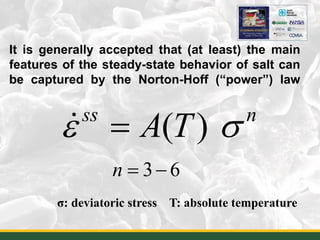
It is generally accepted that (at least) the main
features of the steady-state behavior of salt can
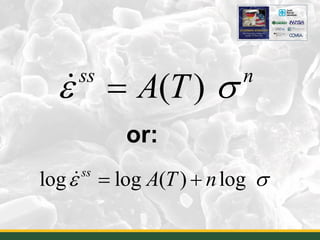
be captured by the Norton-Hoff (“power”) law
5
( )ss n
A Tε σ=
3 6n= −
σ: deviatoric stress T: absolute temperature
( )ss n
A Tε σ=
6
log log ( ) logss
A T nε σ= +
or:
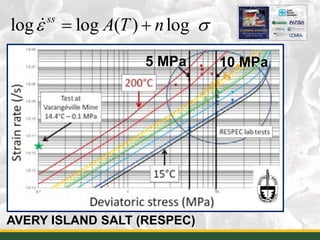
AVERY ISLAND SALT (RESPEC) 7
log log ( ) logss
A T nε σ= +
10 MPa5 MPa
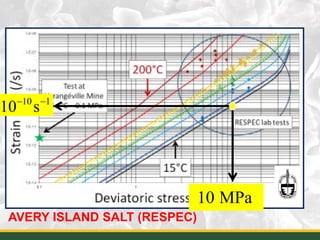
10 1
10 s− −
AVERY ISLAND SALT (RESPEC) 8
10 MPa
9
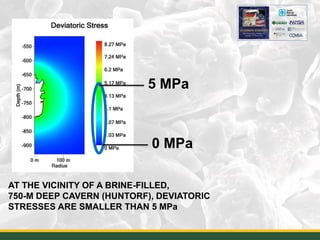
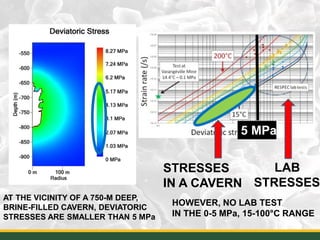
AT THE VICINITY OF A BRINE-FILLED,
750-M DEEP CAVERN (HUNTORF), DEVIATORIC
STRESSES ARE SMALLER THAN 5 MPa
5 MPa
0 MPa
10
LAB
STRESSES
STRESSES
IN A CAVERN
AT THE VICINITY OF A 750-M DEEP,
BRINE-FILLED CAVERN, DEVIATORIC
STRESSES ARE SMALLER THAN 5 MPa
HOWEVER, NO LAB TEST
IN THE 0-5 MPa, 15-100°C RANGE
5 MPa
Is extrapolation possible?
CREEP TESTS ARE PERFORMED IN A RANGE OF
DEVIATORIC STRESSES (LARGER THAN 5 MPa)
WHICH IS NOT THE RANGE ACTUALLY OBSERVED AT
THE VICINITY OF A CAVERN.
11
“…reliable extrapolation of the creep equations at
low deformation rates can be carried out only on
the basis of deformation mechanisms.” (Langer,
1984)
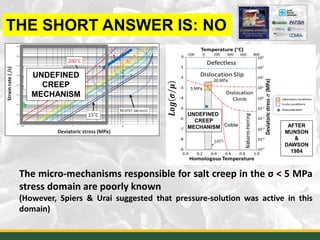
The micro-mechanisms responsible for salt creep in the σ < 5 MPa
stress domain are poorly known
(However, Spiers & Urai suggested that pressure-solution was active in this
domain)
THE SHORT ANSWER IS: NO
Altaussee
Tests
AFTER
MUNSON
&
DAWSON
1984
UNDEFINED
CREEP
MECHANISM
12
UNDEFINED
CREEP
MECHANISM
THE TREND IS TO TAKE INTO ACCOUNT THIS NOTION
‘’ …the stress levels in the large rock mass surrounding the cavity are well below
the stress levels used in laboratory investigations … This means creep behavior for
stresses levels σv < 8 MPa is not well based on observation in lab but based just on
extrapolation’’. K.H. Lux and U. Düsterloh, 8th Conf. Mech. Beh. Salt, 2015, p.280
“Nowadays the approaches are more complex (two power functions or exponential
function) … the differences between predicted and measured creep rates are much
smaller.” D. Brückner (personal communication, 2016)
“Laboratory data on the low stress (hence low strain rate) steady state creep
behavior of rock salt, however, are scarce as they are very difficult to obtain ...”
Marketos et al. J. Geophys. Res. Solid Earth, 121; 2016
“… even with small deviatoric stresses, the creep strain rates are larger than those
predicted by most creep laws. Because of this discrepancy, too small structural
responses are calculated as a consequence of using creep laws that under-predict
creep rates for small deviatoric stresses”. Van Sambeek and DiRienzo, Salzburg
SMRI Meting, 2016 13
WHY?
CREEP TESTS ARE PERFORMED IN A
RANGE OF DEVIATORIC STRESSES
(LARGER THAN 5 MPa) WHICH IS NOT
THE RANGE ACTUALLY OBSERVED AT
THE VICINITY OF A CAVERN.
14
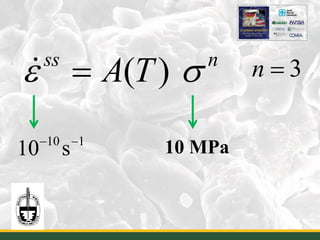
( )ss n
A Tε σ= 3n =
10 1
10 s− −
10 MPa
15
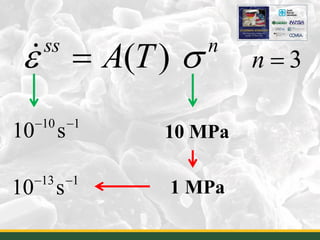
( )ss n
A Tε σ= 3n =
10 1
10 s− −
10 MPa
13 1
10 s− −
1 MPa
16
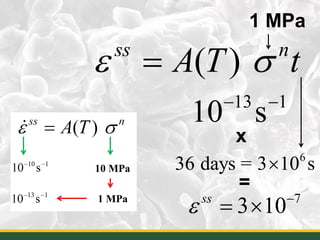
( )ss n
A T tε σ=
13 1
10 s− −
1 MPa
6
36 days = 3 10 s×
7
3 10ss
ε −
= ×
x
=
17
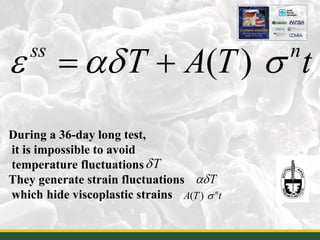
( )ss n
T A T tε αδ σ+
18
During a 36-day long test,
it is impossible to avoid
temperature fluctuations
They generate strain fluctuations
which hide viscoplastic strains ( ) n
A T tσ
Tδ
Tαδ
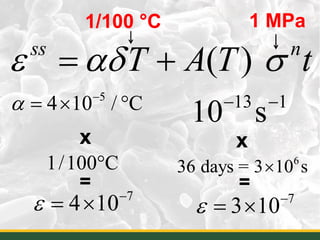
( )ss n
T A T tε αδ σ+
13 1
10 s− −
1 MPa
6
36 days = 3 10 s×
7
3 10ε −
= ×
x
=
1/100 °C
5
4 10 / °Cα −
= ×
1/100°C
7
4 10ε −
= ×
=
x
19
20
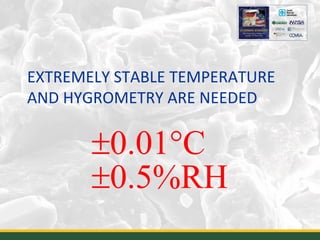
EXTREMELY STABLE TEMPERATURE
AND HYGROMETRY ARE NEEDED
0.01°C
0.5%RH
±
±
2. HOW?
21
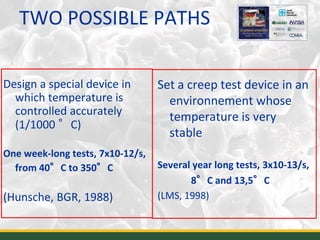
TWO POSSIBLE PATHS
Design a special device in
which temperature is
controlled accurately
(1/1000 °C)
One week-long tests, 7x10-12/s,
from 40°C to 350°C
(Hunsche, BGR, 1988)
Set a creep test device in an
environnement whose
temperature is very
stable
Several year long tests, 3x10-13/s,
8°C and 13,5°C
(LMS, 1998)
22
Creep testing devices are set in
remote, dead-end galleries of two
salt mines, in Austria and France,
where temperature fluctuations are
+/- 0.01°C
Acknowledgements: Salinen Austria AG, CSME
23
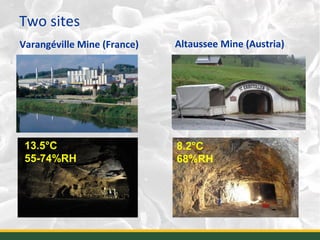
Two sites
Varangéville Mine (France) Altaussee Mine (Austria)
24
13.5°C
55-74%RH
8.2°C
68%RH
25
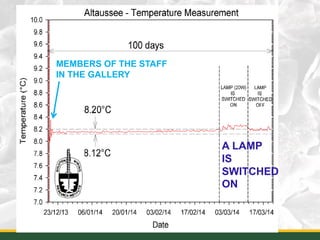
A LAMP
IS
SWITCHED
ON
MEMBERS OF THE STAFF
IN THE GALLERY
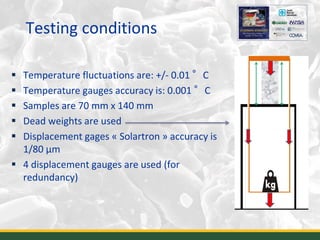
Testing conditions
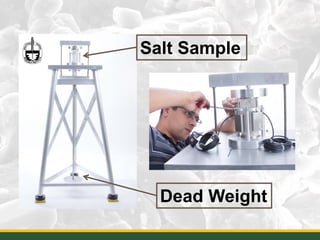
 Temperature fluctuations are: +/- 0.01 °C
 Temperature gauges accuracy is: 0.001 °C
 Samples are 70 mm x 140 mm
 Dead weights are used
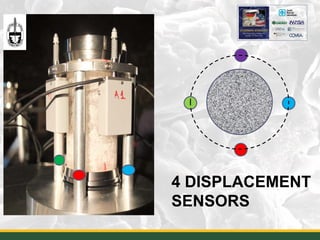
 Displacement gages « Solartron » accuracy is
1/80 µm
 4 displacement gauges are used (for
redundancy)
26
27
Dead Weight
Salt Sample
28
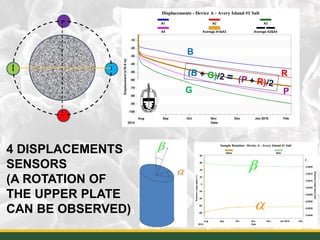
4 DISPLACEMENT
SENSORS
29
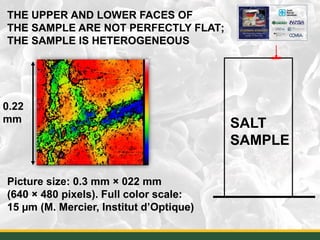
Picture size: 0.3 mm × 022 mm
(640 × 480 pixels). Full color scale:
15 µm (M. Mercier, Institut d’Optique)
THE UPPER AND LOWER FACES OF
THE SAMPLE ARE NOT PERFECTLY FLAT;
THE SAMPLE IS HETEROGENEOUS
0.22
mm SALT
SAMPLE
30
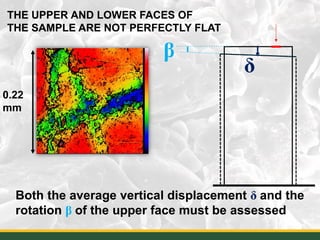
THE UPPER AND LOWER FACES OF
THE SAMPLE ARE NOT PERFECTLY FLAT
0.22
mm
Both the average vertical displacement δ and the
rotation β of the upper face must be assessed
δ
β
31
β
α
4 DISPLACEMENTS
SENSORS
(A ROTATION OF
THE UPPER PLATE
CAN BE OBSERVED)
B
R
PG
3. RESULTS
32
33
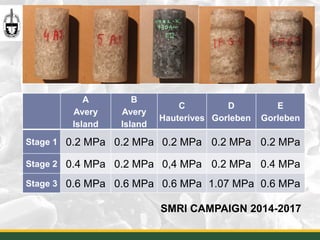
A
Avery
Island
B
Avery
Island
C
Hauterives
D
Gorleben
E
Gorleben
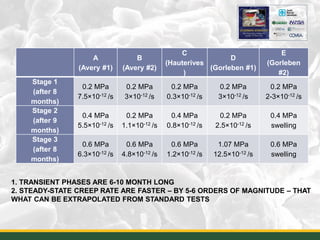
Stage 1 0.2 MPa 0.2 MPa 0.2 MPa 0.2 MPa 0.2 MPa
Stage 2 0.4 MPa 0.2 MPa 0,4 MPa 0.2 MPa 0.4 MPa
Stage 3 0.6 MPa 0.6 MPa 0.6 MPa 1.07 MPa 0.6 MPa
SMRI CAMPAIGN 2014-2017
34
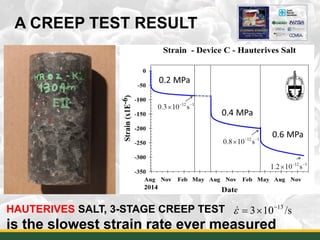
HAUTERIVES SALT, 3-STAGE CREEP TEST
is the slowest strain rate ever measured
A CREEP TEST RESULT
13
3 10 /sε −
= ×
35
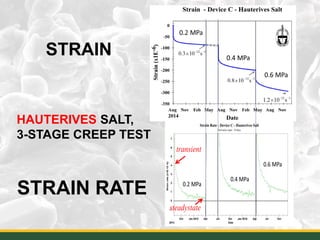
STRAIN
STRAIN RATE
transient
steadystate
HAUTERIVES SALT,
3-STAGE CREEP TEST
A
(Avery #1)
B
(Avery #2)
C
(Hauterives
)
D
(Gorleben #1)
E
(Gorleben
#2)
Stage 1
(after 8
months)
0.2 MPa
7.5×10⁻¹² /s
0.2 MPa
3×10-12 /s
0.2 MPa
0.3×10⁻¹² /s
0.2 MPa
3×10-12 /s
0.2 MPa
2-3×10-12 /s
Stage 2
(after 9
months)
0.4 MPa
5.5×10⁻¹² /s
0.2 MPa
1.1×10⁻¹² /s
0.4 MPa
0.8×10⁻¹² /s
0.2 MPa
2.5×10⁻¹² /s
0.4 MPa
swelling
Stage 3
(after 8
months)
0.6 MPa
6.3×10⁻¹² /s
0.6 MPa
4.8×10⁻¹² /s
0.6 MPa
1.2×10⁻¹² /s
1.07 MPa
12.5×10⁻¹² /s
0.6 MPa
swelling
36
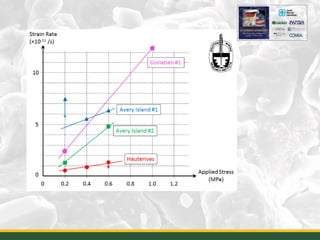
1. TRANSIENT PHASES ARE 6-10 MONTH LONG
2. STEADY-STATE CREEP RATE ARE FASTER – BY 5-6 ORDERS OF MAGNITUDE – THAT
WHAT CAN BE EXTRAPOLATED FROM STANDARD TESTS
37
38
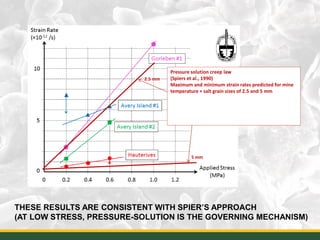
Pressure solution creep law
(Spiers et al., 1990)
Maximum and minimum strain rates predicted for mine
temperature + salt grain sizes of 2.5 and 5 mm
2.5 mm
5 mm
THESE RESULTS ARE CONSISTENT WITH SPIER’S APPROACH
(AT LOW STRESS, PRESSURE-SOLUTION IS THE GOVERNING MECHANISM)
39
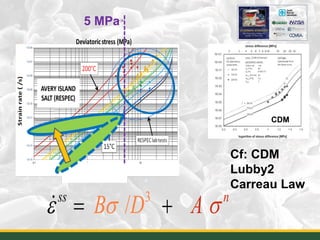
3
/ss n
B D A σε σ= +
5 MPa
Cf: CDM
Lubby2
Carreau Law
CDM
WHAT CAN BE EXPECTED
FROM THESE RESULTS?
 A much better agreement between lab test data and field
measurements, especially when caverns less than 3000 ft-deep
are concerned
 A better prediction of long-term behavior (when deviatoric
stresses are small)
 A better understanding of creep mechanisms
40
41
4. THE CASE OF THE GORLEBEN
SAMPLE
42
43
GORLEBEN D1: AFTER A COUPLE OF
MONTHS, OIL WAS FOUND AT SAMPLE BOTTOM
“blocks of primary rock salt crystals, and shredded and
crushed fragments of anhydrite lines, float in a matrix of
recrystallized rock salt”; … “[hydrocarbons] appear mostly
in the form of streaks, dispersed clouds, clusters and islands.
.. hydrocarbons are located 1) along grain boundaries of
halite and/or anhydrite crystals 2) in newly formed artificial
microcracks due to drilling and preparation 3) in µcapillary
tubes of anhydrite crystals and 4) rarely in µ-porous parts of
the Hauptsalz … the content (up to several hundreds ppm) is
too low to affect the geomechanical behavior of rock salt.”
(Hammer et al., 2012)”.
44
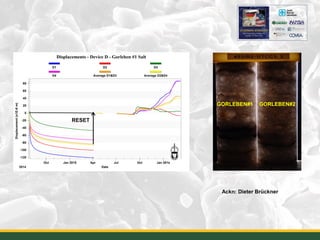
RESET
GORLEBEN#1 GORLEBEN#2
Ackn: Dieter Brückner
45
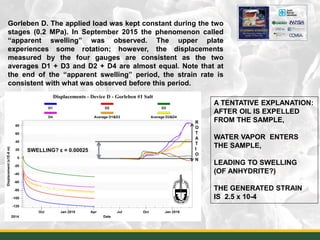
RESET
OIL
APPEARS
‘’SWELLING’’
A TENTATIVE EXPLANATION:
AFTER OIL IS EXPELLED
FROM THE SAMPLE,
WATER VAPOR ENTERS
THE SAMPLE,
LEADING TO SWELLING
(OF ANHYDRITE?)
THE GENERATED STRAIN
IS 2.5 x 10⁻⁴
Gorleben D. The applied load was kept constant during the two
stages (0.2 MPa). In September 2015 the phenomenon called
“apparent swelling” was observed. The upper plate
experiences some rotation; however, the displacements
measured by the four gauges are consistent as the two
averages D1 + D3 and D2 + D4 are almost equal. Note that at
the end of the “apparent swelling” period, the strain rate is
consistent with what was observed before this period.
SWELLING? ε = 0.00025
R
O
T
A
T
I
O
N
5. SOMEWHAT FASTER TESTS
46
47
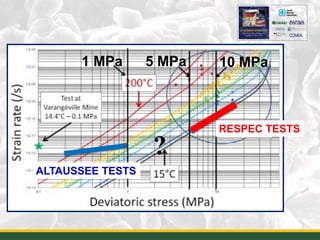
10 MPa5 MPa
RESPEC TESTS
?
1 MPa
ALTAUSSEE TESTS
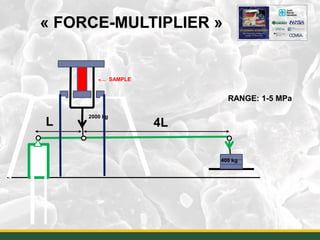
4LL
2000 kg
400 kg
SAMPLE
48
« FORCE-MULTIPLIER »
RANGE: 1-5 MPa
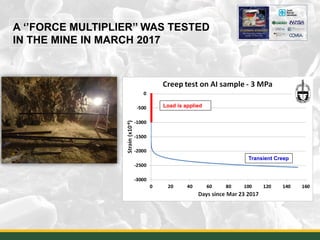
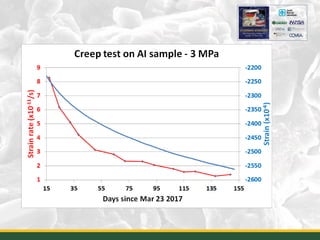
A ‘’FORCE MULTIPLIER’’ WAS TESTED
IN THE MINE IN MARCH 2017
49
Transient Creep
Load is applied
Transient Creep
50
QUESTIONS?
Full Report available at: https://www.solutionmining.org/
51

09 Invited Lecture: Salt Creep at Low Deviatoric Stress

  • 1.
    8th US/German Workshopon Salt Repository Research, Design, and Operation Pierre Bérest Ecole Polytechnique, France Middelburg, The Netherlands September 5-7, 2017
  • 2.
    Very Slow CreepTests Very Slow Creep Tests Based on: SMRI Research Report RR2017-1, available at SMRI Pierre Bérest and Hakim Gharbi, Ecole Polytechnique, France Benoit Brouard, Brouard Consulting, Paris, France Gerd Hofer and Stefan Stimmisher, Salinen Austria AG, Ebensee, Austria Dieter Bruckner, Institut für Gebirgsmechanik, Leipzig, Germany Kerry DeVries, RESPEC, Rapid City, South Dakota, USA Grégoire Hévin, Storengy, Bois Colombes, France Christopher Spiers, Utrecht University, The Netherlands, Janos L. Urai, RWTH Aachen University, Germany 2
  • 3.
    1. WHY? 2. HOW? 3.RESULTS 4. THE CASE OF GORLEBEN SAMPLES 5. SOMEWHAT FASTER TESTS 3
  • 4.
  • 5.
    It is generallyaccepted that (at least) the main features of the steady-state behavior of salt can be captured by the Norton-Hoff (“power”) law 5 ( )ss n A Tε σ= 3 6n= − σ: deviatoric stress T: absolute temperature
  • 6.
    ( )ss n ATε σ= 6 log log ( ) logss A T nε σ= + or:
  • 7.
    AVERY ISLAND SALT(RESPEC) 7 log log ( ) logss A T nε σ= + 10 MPa5 MPa
  • 8.
    10 1 10 s−− AVERY ISLAND SALT (RESPEC) 8 10 MPa
  • 9.
    9 AT THE VICINITYOF A BRINE-FILLED, 750-M DEEP CAVERN (HUNTORF), DEVIATORIC STRESSES ARE SMALLER THAN 5 MPa 5 MPa 0 MPa
  • 10.
    10 LAB STRESSES STRESSES IN A CAVERN ATTHE VICINITY OF A 750-M DEEP, BRINE-FILLED CAVERN, DEVIATORIC STRESSES ARE SMALLER THAN 5 MPa HOWEVER, NO LAB TEST IN THE 0-5 MPa, 15-100°C RANGE 5 MPa
  • 11.
    Is extrapolation possible? CREEPTESTS ARE PERFORMED IN A RANGE OF DEVIATORIC STRESSES (LARGER THAN 5 MPa) WHICH IS NOT THE RANGE ACTUALLY OBSERVED AT THE VICINITY OF A CAVERN. 11 “…reliable extrapolation of the creep equations at low deformation rates can be carried out only on the basis of deformation mechanisms.” (Langer, 1984)
  • 12.
    The micro-mechanisms responsiblefor salt creep in the σ < 5 MPa stress domain are poorly known (However, Spiers & Urai suggested that pressure-solution was active in this domain) THE SHORT ANSWER IS: NO Altaussee Tests AFTER MUNSON & DAWSON 1984 UNDEFINED CREEP MECHANISM 12 UNDEFINED CREEP MECHANISM
  • 13.
    THE TREND ISTO TAKE INTO ACCOUNT THIS NOTION ‘’ …the stress levels in the large rock mass surrounding the cavity are well below the stress levels used in laboratory investigations … This means creep behavior for stresses levels σv < 8 MPa is not well based on observation in lab but based just on extrapolation’’. K.H. Lux and U. Düsterloh, 8th Conf. Mech. Beh. Salt, 2015, p.280 “Nowadays the approaches are more complex (two power functions or exponential function) … the differences between predicted and measured creep rates are much smaller.” D. Brückner (personal communication, 2016) “Laboratory data on the low stress (hence low strain rate) steady state creep behavior of rock salt, however, are scarce as they are very difficult to obtain ...” Marketos et al. J. Geophys. Res. Solid Earth, 121; 2016 “… even with small deviatoric stresses, the creep strain rates are larger than those predicted by most creep laws. Because of this discrepancy, too small structural responses are calculated as a consequence of using creep laws that under-predict creep rates for small deviatoric stresses”. Van Sambeek and DiRienzo, Salzburg SMRI Meting, 2016 13
  • 14.
    WHY? CREEP TESTS AREPERFORMED IN A RANGE OF DEVIATORIC STRESSES (LARGER THAN 5 MPa) WHICH IS NOT THE RANGE ACTUALLY OBSERVED AT THE VICINITY OF A CAVERN. 14
  • 15.
    ( )ss n ATε σ= 3n = 10 1 10 s− − 10 MPa 15
  • 16.
    ( )ss n ATε σ= 3n = 10 1 10 s− − 10 MPa 13 1 10 s− − 1 MPa 16
  • 17.
    ( )ss n AT tε σ= 13 1 10 s− − 1 MPa 6 36 days = 3 10 s× 7 3 10ss ε − = × x = 17
  • 18.
    ( )ss n TA T tε αδ σ+ 18 During a 36-day long test, it is impossible to avoid temperature fluctuations They generate strain fluctuations which hide viscoplastic strains ( ) n A T tσ Tδ Tαδ
  • 19.
    ( )ss n TA T tε αδ σ+ 13 1 10 s− − 1 MPa 6 36 days = 3 10 s× 7 3 10ε − = × x = 1/100 °C 5 4 10 / °Cα − = × 1/100°C 7 4 10ε − = × = x 19
  • 20.
    20 EXTREMELY STABLE TEMPERATURE ANDHYGROMETRY ARE NEEDED 0.01°C 0.5%RH ± ±
  • 21.
  • 22.
    TWO POSSIBLE PATHS Designa special device in which temperature is controlled accurately (1/1000 °C) One week-long tests, 7x10-12/s, from 40°C to 350°C (Hunsche, BGR, 1988) Set a creep test device in an environnement whose temperature is very stable Several year long tests, 3x10-13/s, 8°C and 13,5°C (LMS, 1998) 22
  • 23.
    Creep testing devicesare set in remote, dead-end galleries of two salt mines, in Austria and France, where temperature fluctuations are +/- 0.01°C Acknowledgements: Salinen Austria AG, CSME 23
  • 24.
    Two sites Varangéville Mine(France) Altaussee Mine (Austria) 24 13.5°C 55-74%RH 8.2°C 68%RH
  • 25.
    25 A LAMP IS SWITCHED ON MEMBERS OFTHE STAFF IN THE GALLERY
  • 26.
    Testing conditions  Temperaturefluctuations are: +/- 0.01 °C  Temperature gauges accuracy is: 0.001 °C  Samples are 70 mm x 140 mm  Dead weights are used  Displacement gages « Solartron » accuracy is 1/80 µm  4 displacement gauges are used (for redundancy) 26
  • 27.
  • 28.
  • 29.
    29 Picture size: 0.3mm × 022 mm (640 × 480 pixels). Full color scale: 15 µm (M. Mercier, Institut d’Optique) THE UPPER AND LOWER FACES OF THE SAMPLE ARE NOT PERFECTLY FLAT; THE SAMPLE IS HETEROGENEOUS 0.22 mm SALT SAMPLE
  • 30.
    30 THE UPPER ANDLOWER FACES OF THE SAMPLE ARE NOT PERFECTLY FLAT 0.22 mm Both the average vertical displacement δ and the rotation β of the upper face must be assessed δ β
  • 31.
    31 β α 4 DISPLACEMENTS SENSORS (A ROTATIONOF THE UPPER PLATE CAN BE OBSERVED) B R PG
  • 32.
  • 33.
    33 A Avery Island B Avery Island C Hauterives D Gorleben E Gorleben Stage 1 0.2MPa 0.2 MPa 0.2 MPa 0.2 MPa 0.2 MPa Stage 2 0.4 MPa 0.2 MPa 0,4 MPa 0.2 MPa 0.4 MPa Stage 3 0.6 MPa 0.6 MPa 0.6 MPa 1.07 MPa 0.6 MPa SMRI CAMPAIGN 2014-2017
  • 34.
    34 HAUTERIVES SALT, 3-STAGECREEP TEST is the slowest strain rate ever measured A CREEP TEST RESULT 13 3 10 /sε − = ×
  • 35.
  • 36.
    A (Avery #1) B (Avery #2) C (Hauterives ) D (Gorleben#1) E (Gorleben #2) Stage 1 (after 8 months) 0.2 MPa 7.5×10⁻¹² /s 0.2 MPa 3×10-12 /s 0.2 MPa 0.3×10⁻¹² /s 0.2 MPa 3×10-12 /s 0.2 MPa 2-3×10-12 /s Stage 2 (after 9 months) 0.4 MPa 5.5×10⁻¹² /s 0.2 MPa 1.1×10⁻¹² /s 0.4 MPa 0.8×10⁻¹² /s 0.2 MPa 2.5×10⁻¹² /s 0.4 MPa swelling Stage 3 (after 8 months) 0.6 MPa 6.3×10⁻¹² /s 0.6 MPa 4.8×10⁻¹² /s 0.6 MPa 1.2×10⁻¹² /s 1.07 MPa 12.5×10⁻¹² /s 0.6 MPa swelling 36 1. TRANSIENT PHASES ARE 6-10 MONTH LONG 2. STEADY-STATE CREEP RATE ARE FASTER – BY 5-6 ORDERS OF MAGNITUDE – THAT WHAT CAN BE EXTRAPOLATED FROM STANDARD TESTS
  • 37.
  • 38.
    38 Pressure solution creeplaw (Spiers et al., 1990) Maximum and minimum strain rates predicted for mine temperature + salt grain sizes of 2.5 and 5 mm 2.5 mm 5 mm THESE RESULTS ARE CONSISTENT WITH SPIER’S APPROACH (AT LOW STRESS, PRESSURE-SOLUTION IS THE GOVERNING MECHANISM)
  • 39.
    39 3 /ss n B DA σε σ= + 5 MPa Cf: CDM Lubby2 Carreau Law CDM
  • 40.
    WHAT CAN BEEXPECTED FROM THESE RESULTS?  A much better agreement between lab test data and field measurements, especially when caverns less than 3000 ft-deep are concerned  A better prediction of long-term behavior (when deviatoric stresses are small)  A better understanding of creep mechanisms 40
  • 41.
  • 42.
    4. THE CASEOF THE GORLEBEN SAMPLE 42
  • 43.
    43 GORLEBEN D1: AFTERA COUPLE OF MONTHS, OIL WAS FOUND AT SAMPLE BOTTOM “blocks of primary rock salt crystals, and shredded and crushed fragments of anhydrite lines, float in a matrix of recrystallized rock salt”; … “[hydrocarbons] appear mostly in the form of streaks, dispersed clouds, clusters and islands. .. hydrocarbons are located 1) along grain boundaries of halite and/or anhydrite crystals 2) in newly formed artificial microcracks due to drilling and preparation 3) in µcapillary tubes of anhydrite crystals and 4) rarely in µ-porous parts of the Hauptsalz … the content (up to several hundreds ppm) is too low to affect the geomechanical behavior of rock salt.” (Hammer et al., 2012)”.
  • 44.
  • 45.
    45 RESET OIL APPEARS ‘’SWELLING’’ A TENTATIVE EXPLANATION: AFTEROIL IS EXPELLED FROM THE SAMPLE, WATER VAPOR ENTERS THE SAMPLE, LEADING TO SWELLING (OF ANHYDRITE?) THE GENERATED STRAIN IS 2.5 x 10⁻⁴ Gorleben D. The applied load was kept constant during the two stages (0.2 MPa). In September 2015 the phenomenon called “apparent swelling” was observed. The upper plate experiences some rotation; however, the displacements measured by the four gauges are consistent as the two averages D1 + D3 and D2 + D4 are almost equal. Note that at the end of the “apparent swelling” period, the strain rate is consistent with what was observed before this period. SWELLING? ε = 0.00025 R O T A T I O N
  • 46.
  • 47.
    47 10 MPa5 MPa RESPECTESTS ? 1 MPa ALTAUSSEE TESTS
  • 48.
    4LL 2000 kg 400 kg SAMPLE 48 «FORCE-MULTIPLIER » RANGE: 1-5 MPa
  • 49.
    A ‘’FORCE MULTIPLIER’’WAS TESTED IN THE MINE IN MARCH 2017 49 Transient Creep Load is applied Transient Creep
  • 50.
  • 51.
    QUESTIONS? Full Report availableat: https://www.solutionmining.org/ 51