CPFL´s 1st Microgrid Project
May 25th 2018
22
Agenda
B Projects around the world
i. Exemple of projects ang ongoning projects
C Scope
i. Some questions
ii. Our vision
A Microgrids and how they work
i. Categories
ii. Componentes, key carachteristics and drivers
PRELIMINARY
33
Agenda
B Projects around the world
i. Exemple of projects and ongoning projects
C Scope
i. Our vision
ii. Some questions
A Microgrids and how they work
i. Categories
ii. Componentes, key carachteristics and drivers
PRELIMINARY
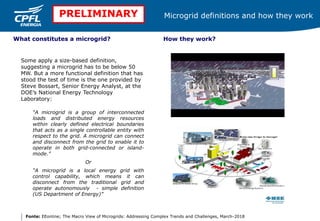
Microgrid definitions and how they work
Fonte: EEonline; The Macro View of Microgrids: Addressing Complex Trends and Challenges, March-2018
Some apply a size-based definition,
suggesting a microgrid has to be below 50
MW. But a more functional definition that has
stood the test of time is the one provided by
Steve Bossart, Senior Energy Analyst, at the
DOE’s National Energy Technology
Laboratory:
“A microgrid is a group of interconnected
loads and distributed energy resources
within clearly defined electrical boundaries
that acts as a single controllable entity with
respect to the grid. A microgrid can connect
and disconnect from the grid to enable it to
operate in both grid-connected or island-
mode.”
Or
“A microgrid is a local energy grid with
control capability, which means it can
disconnect from the traditional grid and
operate autonomously - simple definition
(US Department of Energy)”
What constitutes a microgrid? How they work?
PRELIMINARY
Microgrids categories
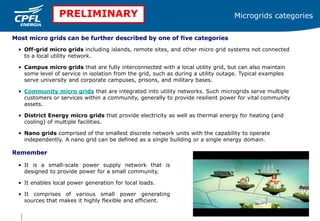
Most micro grids can be further described by one of five categories
• Off-grid micro grids including islands, remote sites, and other micro grid systems not connected
to a local utility network.
• Campus micro grids that are fully interconnected with a local utility grid, but can also maintain
some level of service in isolation from the grid, such as during a utility outage. Typical examples
serve university and corporate campuses, prisons, and military bases.
• Community micro grids that are integrated into utility networks. Such microgrids serve multiple
customers or services within a community, generally to provide resilient power for vital community
assets.
• District Energy micro grids that provide electricity as well as thermal energy for heating (and
cooling) of multiple facilities.
• Nano grids comprised of the smallest discrete network units with the capability to operate
independently. A nano grid can be defined as a single building or a single energy domain.
• It is a small-scale power supply network that is
designed to provide power for a small community.
• It enables local power generation for local loads.
• It comprises of various small power generating
sources that makes it highly flexible and efficient.
Remember
PRELIMINARY
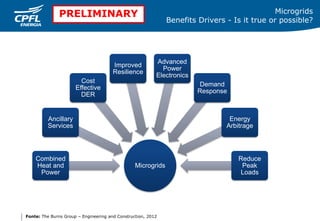
Microgrids
Benefits Drivers - Is it true or possible?
Microgrids
Combined
Heat and
Power
Ancillary
Services
Cost
Effective
DER
Improved
Resilience
Advanced
Power
Electronics
Demand
Response
Energy
Arbitrage
Reduce
Peak
Loads
Fonte: The Burns Group – Engineering and Construction, 2012
PRELIMINARY
Microgrids implementation drivers in USA
Fonte: US Microgrids, 2016: Market Drivers, Analysis and Forecast
PRELIMINARY
Agenda
B Projects around the world
i. Exemple of projects and ongoing projects
C Scope
i. Some questions
ii. Our vision
A Microgrids and how they work
i. Categories
ii. Componentes, key carachteristics and drivers
PRELIMINARY
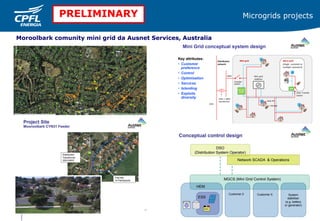
Microgrids projects
Moroolbark comunity mini grid da Ausnet Services, Australia
PRELIMINARY
Microgrids projects
Campus DC Microgrid project, Xiamen University, China.
Fonte: Guerrero, J. M., Microgrids Research Programme, Alborg University,July-2014.
PRELIMINARY
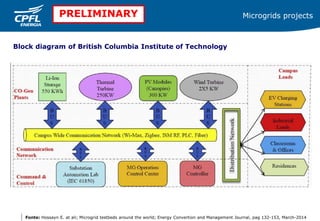
Block diagram of British Columbia Institute of Technology
Microgrids projects
Fonte: Hossayn E. at ali; Microgrid testbeds around the world; Energy Convertion and Management Journal, pag 132-153, March-2014
PRELIMINARY
Agenda
B Projects around the world
i. Exemple of projects and ongoing projects
C Scope
i. Some questions
ii. Our vision
A Microgrids and how they work
i. Categories
ii. Componentes, key carachteristics and drivers
PRELIMINARY
Motivation – why do a microgrid Project – which chalenges faces?
IN the new scenarios, megatrends, climate changes, resource scarcity, asset aging, massive penetration of
DISTRIBUTED ENERGY RESOURCES (DER), INCLUDING DISTRIBUTED GENERATION (DG) and distributed
storage (DS), a microgrid project is a great opportunity to plan, execute, implement and operate including
diferente kind of Energy sources and Storage, how to control and operate it analyse costs of fuel and of the
operation.
A microgrid Project is a great oportunity to antecipate trends, answer questions and helps defines if it is a
treat or an opportunity to CPFL in technical, regulatory and comercial aspects and and how to deal with this
issue.
Microgrid Project
Objective – what are the objectives?
The objective is study and modelling operation of a microgrid with different sources, including storages,
not only batteries, adavanced Technologies and systems control, comparation between AC na DC modes,
cost evaluation, benckmarks, new models of operation, safety aspects (technical and cyber) and
forecasting & curtailment, and/or demand response.
PRELIMINARY
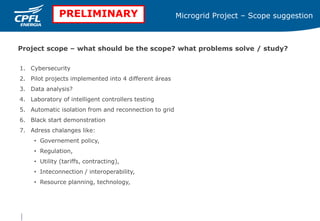
Project scope – what should be the scope? what problems solve / study?
1. Cybersecurity
2. Pilot projects implemented into 4 different áreas
3. Data analysis?
4. Laboratory of intelligent controllers testing
5. Automatic isolation from and reconnection to grid
6. Black start demonstration
7. Adress chalanges like:
• Governement policy,
• Regulation,
• Utility (tariffs, contracting),
• Inteconnection / interoperability,
• Resource planning, technology,
Microgrid Project – Scope suggestionPRELIMINARY
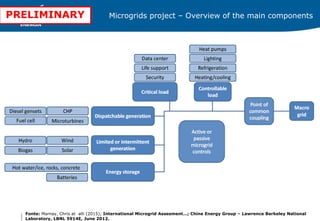
Microgrids project – Overview of the main components
Fonte: Marnay, Chris at alli (2015); International Microgrid Assesment…; Chine Energy Group – Lawrence Berkeley National
Laboratory, LBNL 5914E, June 2012.
PRELIMINARY
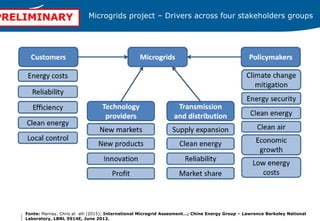
Microgrids project – Drivers across four stakeholders groupsPRELIMINARY
Fonte: Marnay, Chris at alli (2015); International Microgrid Assesment…; Chine Energy Group – Lawrence Berkeley National
Laboratory, LBNL 5914E, June 2012.
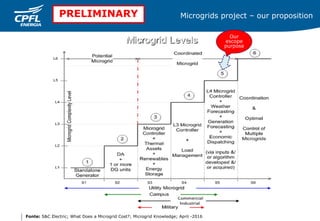
Microgrids project – our proposition
Fonte: S&C Electric; What Does a Microgrid Cost?; Microgrid Knowledge; April -2016
Our
escope
purpose
PRELIMINARY
Microgrids projects scope
Fonte: Micro Grid Concepts and Controls, Maulana Azad National Institute of Technology, Bhopal Department of Energy, May-2018
A good MicroGrid project should cover at least the list under, laboratory tests and facilities
implementation:
PRELIMINARY
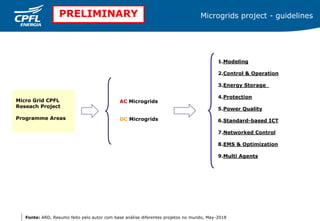
Microgrids project - guidelines
Fonte: ARD, Resumo feito pelo autor com base análise diferentes projetos no mundo, May-2018
1.Modeling
2.Control & Operation
3.Energy Storage
4.Protection
5.Power Quality
6.Standard-based ICT
7.Networked Control
8.EMS & Optimization
9.Multi Agents
AC Microgrids
DC Microgrids
Micro Grid CPFL
Reseach Project
Programme Areas
PRELIMINARY
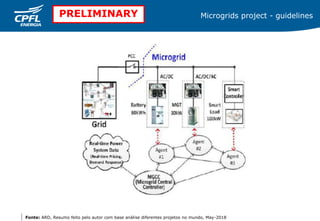
Microgrids project - guidelines
Fonte: ARD, Resumo feito pelo autor com base análise diferentes projetos no mundo, May-2018
PRELIMINARY
48
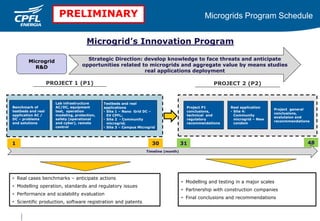
Microgrid’s Innovation Program
Benchmark of
testbeds and real
application AC /
DC – problems
and solutions
Lab infrastructure
AC/DC, equipment
test, operation
modeling, protection,
safety (operational
and cyber), remote
control
Project P1
conclusions,
technical and
regulatory
recommendations
Testbeds and real
applications
• Site 1 – Nano Grid DC –
EV CPFL;
• Site 2 - Community
microgrid;
• Site 3 – Campus Microgrid
Real application
• Site 4:
Community
microgrid – New
condom
Project general
conclusions,
evalutaion and
reconmmendations
• Modelling and testing in a major scales
• Partnership with construction companies
• Final conclusions and recommendations
PROJECT 1 (P1) PROJECT 2 (P2)
• Real cases benchmarks – anticipate actions
• Modelling operation, standards and regulatory issues
• Performance and scalability evaluation
• Scientific production, software registration and patents
Strategic Direction: develop knowledge to face threats and anticipate
opportunities related to microgrids and aggregate value by means studies
real applications deployment
Microgrid
R&D
Microgrids Program Schedule
Timeline (month)
1 30 31
PRELIMINARY
Microgrid Program
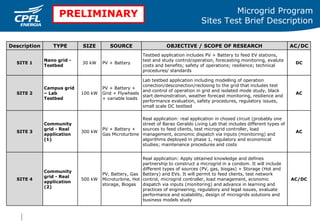
Sites Test Brief Description
Description TYPE SIZE SOURCE OBJECTIVE / SCOPE OF RESEARCH AC/DC
SITE 1
Nano grid -
Testbed
30 kW PV + Battery
Testbed application includes PV + Battery to feed EV stations,
test and study control/operation, forecasting monitoring, evalute
costs and benefits; safety of operations; resilience; technical
procedures/ standards
DC
SITE 2
Campus grid
– Lab
Testbed
100 kW
PV + Battery +
Grid + Flywheels
+ variable loads
Lab testbed application including modelling of operation
conection/desconection/reclosing to the grid that includes test
and control of operation in grid and isolated mode study, black
start demonstration, weather forecast monitoring, resilience and
performance evaluation, safety procedures, regulatory issues,
small scale DC testbed
AC
SITE 3
Community
grid - Real
application
(1)
300 kW
PV + Battery +
Gas Microturbine
Real application: real application in chosed circuit (probably one
street of Barao Geraldo Living Lab that includes different types of
sources to feed clients, test microgrid controller, load
management, economic dispatch via inputs (monitoring) and
algorithms deployed in phase 1, regulatory and economical
studies; maintenance procedures and costs
AC
SITE 4
Community
grid - Real
application
(2)
500 kW
PV, Battery, Gas
Microturbine, Hot
storage, Biogas
Real application: Apply obtained knowledge and defines
partnership to construct a microgrid in a condom. It will include
different types of sources (PV, gas, biogas) + Storage (Hot and
Battery) and EVs. It will permit to feed clients, test network
control, microgrid controller, load management, economic
dispatch via inputs (monitoring) and advance in learning and
practices of engineering, regulatory and legal issues, evaluate
performance and scalability, design of microgrids solutions and
business models study
AC/DC
PRELIMINARY
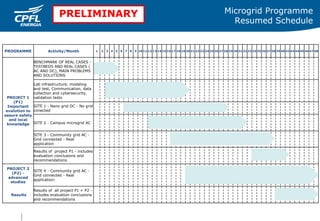
PROGRAMME Activity/Month 1 2 3 4 5 6 7 8 9 10 11 12 13 14 15 16 17 18 19 20 21 22 23 24 25 26 27 28 29 30 31 32 33 34 35 36 37 38 39 40 42 43 44 45 46 47 48
PROJECT 1
(P1)
Important
evalution to
assure safety
and local
knowledge
BENCHMARK OF REAL CASES -
TESTBEDS AND REAL CASES (
AC AND DC), MAIN PROBLEMS
AND SOLUTIONS
Lab infrastructure, modeling
and test, Communication, data
collection and cybersecurity,
validation tests
SITE 1 - Nano grid DC - No grid
conected
SITE 2 - Campus microgrid AC
SITE 3 - Community grid AC -
Grid connected - Real
application
Results of project P1 - includes
evaluation conclusions and
recommendations
PROJECT 2
(P2) -
advanced
studies
SITE 4 - Community grid AC -
Grid connected - Real
application:
Results
Results of all project P1 + P2 -
includes evaluation conclusions
and recommendations
Microgrid Programme
Resumed Schedule
PRELIMINARY
2424
Thank you

Microgrid project v12

  • 1.
    CPFL´s 1st MicrogridProject May 25th 2018
  • 2.
    22 Agenda B Projects aroundthe world i. Exemple of projects ang ongoning projects C Scope i. Some questions ii. Our vision A Microgrids and how they work i. Categories ii. Componentes, key carachteristics and drivers PRELIMINARY
  • 3.
    33 Agenda B Projects aroundthe world i. Exemple of projects and ongoning projects C Scope i. Our vision ii. Some questions A Microgrids and how they work i. Categories ii. Componentes, key carachteristics and drivers PRELIMINARY
  • 4.
    Microgrid definitions andhow they work Fonte: EEonline; The Macro View of Microgrids: Addressing Complex Trends and Challenges, March-2018 Some apply a size-based definition, suggesting a microgrid has to be below 50 MW. But a more functional definition that has stood the test of time is the one provided by Steve Bossart, Senior Energy Analyst, at the DOE’s National Energy Technology Laboratory: “A microgrid is a group of interconnected loads and distributed energy resources within clearly defined electrical boundaries that acts as a single controllable entity with respect to the grid. A microgrid can connect and disconnect from the grid to enable it to operate in both grid-connected or island- mode.” Or “A microgrid is a local energy grid with control capability, which means it can disconnect from the traditional grid and operate autonomously - simple definition (US Department of Energy)” What constitutes a microgrid? How they work? PRELIMINARY
  • 5.
    Microgrids categories Most microgrids can be further described by one of five categories • Off-grid micro grids including islands, remote sites, and other micro grid systems not connected to a local utility network. • Campus micro grids that are fully interconnected with a local utility grid, but can also maintain some level of service in isolation from the grid, such as during a utility outage. Typical examples serve university and corporate campuses, prisons, and military bases. • Community micro grids that are integrated into utility networks. Such microgrids serve multiple customers or services within a community, generally to provide resilient power for vital community assets. • District Energy micro grids that provide electricity as well as thermal energy for heating (and cooling) of multiple facilities. • Nano grids comprised of the smallest discrete network units with the capability to operate independently. A nano grid can be defined as a single building or a single energy domain. • It is a small-scale power supply network that is designed to provide power for a small community. • It enables local power generation for local loads. • It comprises of various small power generating sources that makes it highly flexible and efficient. Remember PRELIMINARY
  • 6.
    Microgrids Benefits Drivers -Is it true or possible? Microgrids Combined Heat and Power Ancillary Services Cost Effective DER Improved Resilience Advanced Power Electronics Demand Response Energy Arbitrage Reduce Peak Loads Fonte: The Burns Group – Engineering and Construction, 2012 PRELIMINARY
  • 7.
    Microgrids implementation driversin USA Fonte: US Microgrids, 2016: Market Drivers, Analysis and Forecast PRELIMINARY
  • 8.
    Agenda B Projects aroundthe world i. Exemple of projects and ongoing projects C Scope i. Some questions ii. Our vision A Microgrids and how they work i. Categories ii. Componentes, key carachteristics and drivers PRELIMINARY
  • 9.
    Microgrids projects Moroolbark comunitymini grid da Ausnet Services, Australia PRELIMINARY
  • 10.
    Microgrids projects Campus DCMicrogrid project, Xiamen University, China. Fonte: Guerrero, J. M., Microgrids Research Programme, Alborg University,July-2014. PRELIMINARY
  • 11.
    Block diagram ofBritish Columbia Institute of Technology Microgrids projects Fonte: Hossayn E. at ali; Microgrid testbeds around the world; Energy Convertion and Management Journal, pag 132-153, March-2014 PRELIMINARY
  • 12.
    Agenda B Projects aroundthe world i. Exemple of projects and ongoing projects C Scope i. Some questions ii. Our vision A Microgrids and how they work i. Categories ii. Componentes, key carachteristics and drivers PRELIMINARY
  • 13.
    Motivation – whydo a microgrid Project – which chalenges faces? IN the new scenarios, megatrends, climate changes, resource scarcity, asset aging, massive penetration of DISTRIBUTED ENERGY RESOURCES (DER), INCLUDING DISTRIBUTED GENERATION (DG) and distributed storage (DS), a microgrid project is a great opportunity to plan, execute, implement and operate including diferente kind of Energy sources and Storage, how to control and operate it analyse costs of fuel and of the operation. A microgrid Project is a great oportunity to antecipate trends, answer questions and helps defines if it is a treat or an opportunity to CPFL in technical, regulatory and comercial aspects and and how to deal with this issue. Microgrid Project Objective – what are the objectives? The objective is study and modelling operation of a microgrid with different sources, including storages, not only batteries, adavanced Technologies and systems control, comparation between AC na DC modes, cost evaluation, benckmarks, new models of operation, safety aspects (technical and cyber) and forecasting & curtailment, and/or demand response. PRELIMINARY
  • 14.
    Project scope –what should be the scope? what problems solve / study? 1. Cybersecurity 2. Pilot projects implemented into 4 different áreas 3. Data analysis? 4. Laboratory of intelligent controllers testing 5. Automatic isolation from and reconnection to grid 6. Black start demonstration 7. Adress chalanges like: • Governement policy, • Regulation, • Utility (tariffs, contracting), • Inteconnection / interoperability, • Resource planning, technology, Microgrid Project – Scope suggestionPRELIMINARY
  • 15.
    Microgrids project –Overview of the main components Fonte: Marnay, Chris at alli (2015); International Microgrid Assesment…; Chine Energy Group – Lawrence Berkeley National Laboratory, LBNL 5914E, June 2012. PRELIMINARY
  • 16.
    Microgrids project –Drivers across four stakeholders groupsPRELIMINARY Fonte: Marnay, Chris at alli (2015); International Microgrid Assesment…; Chine Energy Group – Lawrence Berkeley National Laboratory, LBNL 5914E, June 2012.
  • 17.
    Microgrids project –our proposition Fonte: S&C Electric; What Does a Microgrid Cost?; Microgrid Knowledge; April -2016 Our escope purpose PRELIMINARY
  • 18.
    Microgrids projects scope Fonte:Micro Grid Concepts and Controls, Maulana Azad National Institute of Technology, Bhopal Department of Energy, May-2018 A good MicroGrid project should cover at least the list under, laboratory tests and facilities implementation: PRELIMINARY
  • 19.
    Microgrids project -guidelines Fonte: ARD, Resumo feito pelo autor com base análise diferentes projetos no mundo, May-2018 1.Modeling 2.Control & Operation 3.Energy Storage 4.Protection 5.Power Quality 6.Standard-based ICT 7.Networked Control 8.EMS & Optimization 9.Multi Agents AC Microgrids DC Microgrids Micro Grid CPFL Reseach Project Programme Areas PRELIMINARY
  • 20.
    Microgrids project -guidelines Fonte: ARD, Resumo feito pelo autor com base análise diferentes projetos no mundo, May-2018 PRELIMINARY
  • 21.
    48 Microgrid’s Innovation Program Benchmarkof testbeds and real application AC / DC – problems and solutions Lab infrastructure AC/DC, equipment test, operation modeling, protection, safety (operational and cyber), remote control Project P1 conclusions, technical and regulatory recommendations Testbeds and real applications • Site 1 – Nano Grid DC – EV CPFL; • Site 2 - Community microgrid; • Site 3 – Campus Microgrid Real application • Site 4: Community microgrid – New condom Project general conclusions, evalutaion and reconmmendations • Modelling and testing in a major scales • Partnership with construction companies • Final conclusions and recommendations PROJECT 1 (P1) PROJECT 2 (P2) • Real cases benchmarks – anticipate actions • Modelling operation, standards and regulatory issues • Performance and scalability evaluation • Scientific production, software registration and patents Strategic Direction: develop knowledge to face threats and anticipate opportunities related to microgrids and aggregate value by means studies real applications deployment Microgrid R&D Microgrids Program Schedule Timeline (month) 1 30 31 PRELIMINARY
  • 22.
    Microgrid Program Sites TestBrief Description Description TYPE SIZE SOURCE OBJECTIVE / SCOPE OF RESEARCH AC/DC SITE 1 Nano grid - Testbed 30 kW PV + Battery Testbed application includes PV + Battery to feed EV stations, test and study control/operation, forecasting monitoring, evalute costs and benefits; safety of operations; resilience; technical procedures/ standards DC SITE 2 Campus grid – Lab Testbed 100 kW PV + Battery + Grid + Flywheels + variable loads Lab testbed application including modelling of operation conection/desconection/reclosing to the grid that includes test and control of operation in grid and isolated mode study, black start demonstration, weather forecast monitoring, resilience and performance evaluation, safety procedures, regulatory issues, small scale DC testbed AC SITE 3 Community grid - Real application (1) 300 kW PV + Battery + Gas Microturbine Real application: real application in chosed circuit (probably one street of Barao Geraldo Living Lab that includes different types of sources to feed clients, test microgrid controller, load management, economic dispatch via inputs (monitoring) and algorithms deployed in phase 1, regulatory and economical studies; maintenance procedures and costs AC SITE 4 Community grid - Real application (2) 500 kW PV, Battery, Gas Microturbine, Hot storage, Biogas Real application: Apply obtained knowledge and defines partnership to construct a microgrid in a condom. It will include different types of sources (PV, gas, biogas) + Storage (Hot and Battery) and EVs. It will permit to feed clients, test network control, microgrid controller, load management, economic dispatch via inputs (monitoring) and advance in learning and practices of engineering, regulatory and legal issues, evaluate performance and scalability, design of microgrids solutions and business models study AC/DC PRELIMINARY
  • 23.
    PROGRAMME Activity/Month 12 3 4 5 6 7 8 9 10 11 12 13 14 15 16 17 18 19 20 21 22 23 24 25 26 27 28 29 30 31 32 33 34 35 36 37 38 39 40 42 43 44 45 46 47 48 PROJECT 1 (P1) Important evalution to assure safety and local knowledge BENCHMARK OF REAL CASES - TESTBEDS AND REAL CASES ( AC AND DC), MAIN PROBLEMS AND SOLUTIONS Lab infrastructure, modeling and test, Communication, data collection and cybersecurity, validation tests SITE 1 - Nano grid DC - No grid conected SITE 2 - Campus microgrid AC SITE 3 - Community grid AC - Grid connected - Real application Results of project P1 - includes evaluation conclusions and recommendations PROJECT 2 (P2) - advanced studies SITE 4 - Community grid AC - Grid connected - Real application: Results Results of all project P1 + P2 - includes evaluation conclusions and recommendations Microgrid Programme Resumed Schedule PRELIMINARY
  • 24.