Codes
Computers and digital circuits processes information in the binary
format. Each character is assigned 7 or 8 bit binary code to indicate its character
which may be numeric, alphabet or special symbol. Example - Binary number
1000001 represents 65(decimal) in straight binary code, alphabet A in ASCII
code and 41(decimal) in BCD code.
Types of codes
• BCD (Binary-Coded Decimal) code :
• ASCII (American Standard Code Information Interchange) code :
• EBCDIC (Extended Binary Coded Decimal Interchange Code) code
• Gray code
• Excess-3 code
BCD (Binary-Coded Decimal) code :
• Four-bit code that represents one of the ten decimal digits from 0 to
9.
• Example - (37)10 is represented as 0011 0111 using BCD code, rather
than (100101)2 in straight binary code.
• Thus BCD code requires more bits than straight binary code.
• Still it is suitable for input and output operations in digital systems.
• Note: 1010, 1011, 1100, 1101, 1110, and 1111 are INVALID CODE in
BCD code.
ASCII (American Standard Code Information Interchange) code :
• It is 7-bit or 8-bit alphanumeric code.
• 7-bit code is standard ASCII supports 127 characters.
• Standard ASCII series starts from 00h to 7Fh, where 00h-1Fh are used
as control characters and 20h-7Fh as graphics symbols.
• 8-bit code is extended ASCII supports 256 symbols where special
graphics and math's symbols are added.
• Extended ASCII series starts from 80h to FFh.
EBCDIC (Extended Binary Coded Decimal Interchange Code) code
• 8-bit alphanumeric code developed by IBM, supports 256 symbols.
• It was mainly used in IBM mainframe computers.
Gray code
• Differs from leading and following number by a single bit.
• Gray code for 2 is 0011 and for 3 is 0010.
• No weights are assigned to the bit positions.
• Extensively used in shaft encoders.
Excess-3 code
• 4-bit code is obtained by adding binary 0011 to the natural BCD code
of the digit.
• Example - decimal 2 is coded as 0010 + 0011 = 0101 as Excess-3 code.
• It not weighted code.
• Its self-complimenting code, means 1's complement of the coded
number yields 9's complement of the number itself.
• Used in digital system for performing subtraction operations.
There are many methods or techniques which can be used to convert code from one
format to another.
We'll demonstrate here the following
• Binary to BCD Conversion
• BCD to Binary Conversion
• BCD to Excess-3
• Excess-3 to BCD
Binary to BCD Conversion
Steps
Step 1 -- Convert the binary number to decimal.
Step 2 -- Convert decimal number to BCD.
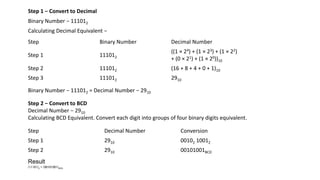
Example − convert (11101)2 to BCD.
Step 1 − Convert to Decimal
Binary Number − 111012
Calculating Decimal Equivalent −
Step Binary Number Decimal Number
Step 1 111012
((1 × 24) + (1 × 23) + (1 × 22)
+ (0 × 21) + (1 × 20))10
Step 2 111012 (16 + 8 + 4 + 0 + 1)10
Step 3 111012 2910
Binary Number − 111012 = Decimal Number − 2910
Step 2 − Convert to BCD
Decimal Number − 2910
Calculating BCD Equivalent. Convert each digit into groups of four binary digits equivalent.
Step Decimal Number Conversion
Step 1 2910 00102 10012
Step 2 2910 00101001BCD
Result
(11101)2 = (00101001)BCD
BCD to Binary Conversion
Steps
Step 1 -- Convert the BCD number to decimal.
Step 2 -- Convert decimal to binary.
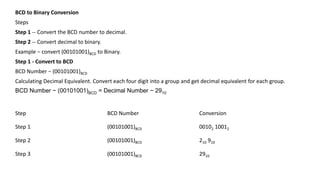
Example − convert (00101001)BCD to Binary.
Step 1 - Convert to BCD
BCD Number − (00101001)BCD
Calculating Decimal Equivalent. Convert each four digit into a group and get decimal equivalent for each group.
Step BCD Number Conversion
Step 1 (00101001)BCD 00102 10012
Step 2 (00101001)BCD 210 910
Step 3 (00101001)BCD 2910
BCD Number − (00101001)BCD = Decimal Number − 2910
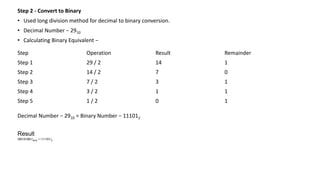
Step 2 - Convert to Binary
• Used long division method for decimal to binary conversion.
• Decimal Number − 2910
• Calculating Binary Equivalent −
Step Operation Result Remainder
Step 1 29 / 2 14 1
Step 2 14 / 2 7 0
Step 3 7 / 2 3 1
Step 4 3 / 2 1 1
Step 5 1 / 2 0 1
Decimal Number − 2910 = Binary Number − 111012
Result
(00101001)BCD = (11101)2
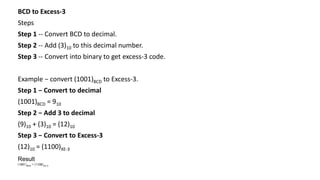
Result
(1001)BCD = (1100)XS-3
BCD to Excess-3
Steps
Step 1 -- Convert BCD to decimal.
Step 2 -- Add (3)10 to this decimal number.
Step 3 -- Convert into binary to get excess-3 code.
Example − convert (1001)BCD to Excess-3.
Step 1 − Convert to decimal
(1001)BCD = 910
Step 2 − Add 3 to decimal
(9)10 + (3)10 = (12)10
Step 3 − Convert to Excess-3
(12)10 = (1100)XE-3
Excess-3 to BCD Conversion
Steps
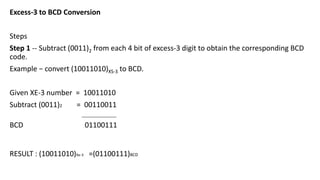
Step 1 -- Subtract (0011)2 from each 4 bit of excess-3 digit to obtain the corresponding BCD
code.
Example − convert (10011010)XS-3 to BCD.
Given XE-3 number = 10011010
Subtract (0011)2 = 00110011
_______________
BCD 01100111
RESULT : (10011010)Xe-3 =(01100111)BCD

Code conversion r006

  • 1.
    Codes Computers and digitalcircuits processes information in the binary format. Each character is assigned 7 or 8 bit binary code to indicate its character which may be numeric, alphabet or special symbol. Example - Binary number 1000001 represents 65(decimal) in straight binary code, alphabet A in ASCII code and 41(decimal) in BCD code.
  • 2.
    Types of codes •BCD (Binary-Coded Decimal) code : • ASCII (American Standard Code Information Interchange) code : • EBCDIC (Extended Binary Coded Decimal Interchange Code) code • Gray code • Excess-3 code
  • 3.
    BCD (Binary-Coded Decimal)code : • Four-bit code that represents one of the ten decimal digits from 0 to 9. • Example - (37)10 is represented as 0011 0111 using BCD code, rather than (100101)2 in straight binary code. • Thus BCD code requires more bits than straight binary code. • Still it is suitable for input and output operations in digital systems. • Note: 1010, 1011, 1100, 1101, 1110, and 1111 are INVALID CODE in BCD code.
  • 4.
    ASCII (American StandardCode Information Interchange) code : • It is 7-bit or 8-bit alphanumeric code. • 7-bit code is standard ASCII supports 127 characters. • Standard ASCII series starts from 00h to 7Fh, where 00h-1Fh are used as control characters and 20h-7Fh as graphics symbols. • 8-bit code is extended ASCII supports 256 symbols where special graphics and math's symbols are added. • Extended ASCII series starts from 80h to FFh.
  • 5.
    EBCDIC (Extended BinaryCoded Decimal Interchange Code) code • 8-bit alphanumeric code developed by IBM, supports 256 symbols. • It was mainly used in IBM mainframe computers. Gray code • Differs from leading and following number by a single bit. • Gray code for 2 is 0011 and for 3 is 0010. • No weights are assigned to the bit positions. • Extensively used in shaft encoders.
  • 6.
    Excess-3 code • 4-bitcode is obtained by adding binary 0011 to the natural BCD code of the digit. • Example - decimal 2 is coded as 0010 + 0011 = 0101 as Excess-3 code. • It not weighted code. • Its self-complimenting code, means 1's complement of the coded number yields 9's complement of the number itself. • Used in digital system for performing subtraction operations.
  • 7.
    There are manymethods or techniques which can be used to convert code from one format to another. We'll demonstrate here the following • Binary to BCD Conversion • BCD to Binary Conversion • BCD to Excess-3 • Excess-3 to BCD Binary to BCD Conversion Steps Step 1 -- Convert the binary number to decimal. Step 2 -- Convert decimal number to BCD. Example − convert (11101)2 to BCD.
  • 8.
    Step 1 −Convert to Decimal Binary Number − 111012 Calculating Decimal Equivalent − Step Binary Number Decimal Number Step 1 111012 ((1 × 24) + (1 × 23) + (1 × 22) + (0 × 21) + (1 × 20))10 Step 2 111012 (16 + 8 + 4 + 0 + 1)10 Step 3 111012 2910 Binary Number − 111012 = Decimal Number − 2910 Step 2 − Convert to BCD Decimal Number − 2910 Calculating BCD Equivalent. Convert each digit into groups of four binary digits equivalent. Step Decimal Number Conversion Step 1 2910 00102 10012 Step 2 2910 00101001BCD Result (11101)2 = (00101001)BCD
  • 9.
    BCD to BinaryConversion Steps Step 1 -- Convert the BCD number to decimal. Step 2 -- Convert decimal to binary. Example − convert (00101001)BCD to Binary. Step 1 - Convert to BCD BCD Number − (00101001)BCD Calculating Decimal Equivalent. Convert each four digit into a group and get decimal equivalent for each group. Step BCD Number Conversion Step 1 (00101001)BCD 00102 10012 Step 2 (00101001)BCD 210 910 Step 3 (00101001)BCD 2910 BCD Number − (00101001)BCD = Decimal Number − 2910
  • 10.
    Step 2 -Convert to Binary • Used long division method for decimal to binary conversion. • Decimal Number − 2910 • Calculating Binary Equivalent − Step Operation Result Remainder Step 1 29 / 2 14 1 Step 2 14 / 2 7 0 Step 3 7 / 2 3 1 Step 4 3 / 2 1 1 Step 5 1 / 2 0 1 Decimal Number − 2910 = Binary Number − 111012 Result (00101001)BCD = (11101)2
  • 11.
    Result (1001)BCD = (1100)XS-3 BCDto Excess-3 Steps Step 1 -- Convert BCD to decimal. Step 2 -- Add (3)10 to this decimal number. Step 3 -- Convert into binary to get excess-3 code. Example − convert (1001)BCD to Excess-3. Step 1 − Convert to decimal (1001)BCD = 910 Step 2 − Add 3 to decimal (9)10 + (3)10 = (12)10 Step 3 − Convert to Excess-3 (12)10 = (1100)XE-3
  • 12.
    Excess-3 to BCDConversion Steps Step 1 -- Subtract (0011)2 from each 4 bit of excess-3 digit to obtain the corresponding BCD code. Example − convert (10011010)XS-3 to BCD. Given XE-3 number = 10011010 Subtract (0011)2 = 00110011 _______________ BCD 01100111 RESULT : (10011010)Xe-3 =(01100111)BCD