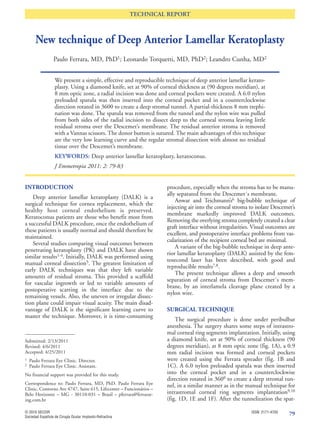
INTRODUCTION
Deep anterior lamellar keratoplasty (DALK) is a
surgical technique for cornea replacement, which the
healthy host corneal endothelium is preserved.
Keratoconus patients are those who benefit most from
a successful DALK procedure, once the endothelium of
these patients is usually normal and should therefore be
maintained.
Several studies comparing visual outcomes between
penetrating keratoplasty (PK) and DALK have shown
similar results1-4. Initially, DALK was performed using
manual corneal dissection5. The greatest limitation of
early DALK techniques was that they left variable
amounts of residual stroma. This provided a scaffold
for vascular ingrowth or led to variable amounts of
postoperative scarring in the interface due to the
remaining vessels. Also, the uneven or irregular dissec-
tion plane could impair visual acuity. The main disad-
vantage of DALK is the significant learning curve to
master the technique. Moreover, it is time-consuming
procedure, especially when the stroma has to be manu-
ally separated from the Descemet´s membrane.
Anwar and Teichmann’s6 big-bubble technique of
injecting air into the corneal stroma to isolate Descemet’s
membrane markedly improved DALK outcomes.
Removing the overlying stroma completely created a clear
graft interface without irregularities. Visual outcomes are
excellent, and postoperative interface problems from vas-
cularization of the recipient corneal bed are minimal.
A variant of the big-bubble technique in deep ante-
rior lamellar keratoplasty (DALK) assisted by the fem-
tosecond laser has been described, with good and
reproducible results7,8.
The present technique allows a deep and smooth
separation of corneal stroma from Descemet´s mem-
brane, by an interlamela cleavage plane created by a
nylon wire.
SURGICAL TECHNIQUE
The surgical procedure is done under peribulbar
anesthesia. The surgery shares some steps of intrastro-
mal corneal ring segments implantation. Initially, using
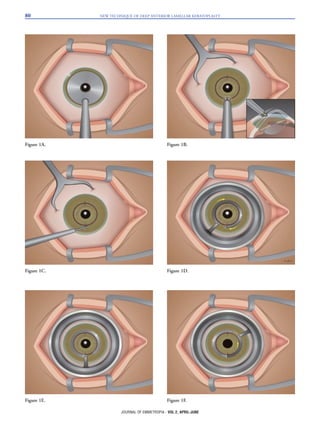
a diamond knife, set at 90% of corneal thickness (90
degrees meridian), at 8 mm optic zone (fig. 1A), a 0.9
mm radial incision was formed and corneal pockets
were created using the Ferrara spreader (fig. 1B and
1C). A 6.0 nylon preloaded spatula was then inserted
into the corneal pocket and in a counterclockwise
direction rotated in 3600 to create a deep stromal tun-
nel, in a similar manner as in the manual technique for
intrastromal corneal ring segments implantation9,10
(fig. 1D, 1E and 1F). After the tunnelization the spat-
79
TECHNICAL REPORT
New technique of Deep Anterior Lamellar Keratoplasty
Paulo Ferrara, MD, PhD1; Leonardo Torquetti, MD, PhD2; Leandro Cunha, MD2
We present a simple, effective and reproducible technique of deep anterior lamellar kerato-
plasty. Using a diamond knife, set at 90% of corneal thickness at (90 degrees meridian), at
8 mm optic zone, a radial incision was done and corneal pockets were created. A 6.0 nylon
preloaded spatula was then inserted into the corneal pocket and in a counterclockwise
direction rotated in 3600 to create a deep stromal tunnel. A partial-thickness 8 mm trephi-
nation was done. The spatula was removed from the tunnel and the nylon wire was pulled
from both sides of the radial incision to dissect deep to the corneal stroma leaving little
residual stroma over the Descemet’s membrane. The residual anterior stroma is removed
with a Vannas scissors. The donor button is sutured. The main advantages of this technique
are the very low learning curve and the regular stromal dissection with almost no residual
tissue over the Descemet’s membrane.
KEYWORDS: Deep anterior lamellar keratoplasty, keratoconus.
J Emmetropia 2011; 2: 79-83
Submitted: 2/13/2011
Revised: 4/6/2011
Accepted: 4/25/2011
1 Paulo Ferrara Eye Clinic. Director.
2 Paulo Ferrara Eye Clinic. Assistant.
No financial support was provided for this study.
Correspondence to: Paulo Ferrara, MD, PhD. Paulo Ferrara Eye
Clinic, Contorno Ave 4747, Suite 615, Lifecenter – Funcionários –
Belo Horizonte – MG - 30110-031 – Brasil – pferrara@ferrarar-
ing.com.br
© 2010 SECOIR
Sociedad Española de Cirugía Ocular Implanto-Refractiva
ISSN: 2171-4703
NEW TECHNIQUE OF DEEP ANTERIOR LAMELLAR KERATOPLASTY80
JOURNAL OF EMMETROPIA - VOL 2, APRIL-JUNE
Figure 1A.
Figure 1D.
Figure 1E. Figure 1F.
Figure 1B.
Figure 1C.
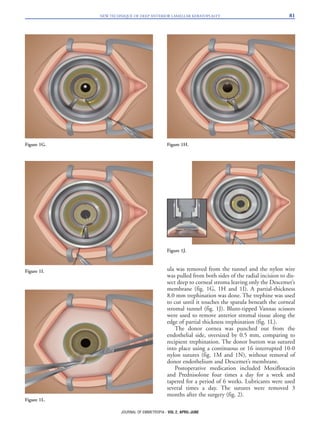
ula was removed from the tunnel and the nylon wire
was pulled from both sides of the radial incision to dis-
sect deep to corneal stroma leaving only the Descemet’s
membrane (fig. 1G, 1H and 1I). A partial-thickness
8.0 mm trephination was done. The trephine was used
to cut until it touches the spatula beneath the corneal
stromal tunnel (fig. 1J). Blunt-tipped Vannas scissors
were used to remove anterior stromal tissue along the
edge of partial thickness trephination (fig. 1L).
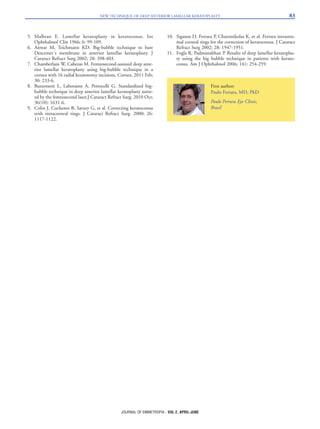
The donor cornea was punched out from the
endothelial side, oversized by 0.5 mm, comparing to
recipient trephination. The donor button was sutured
into place using a continuous or 16 interrupted 10-0
nylon sutures (fig. 1M and 1N), without removal of
donor endothelium and Descemet’s membrane.
Postoperative medication included Moxifloxacin
and Prednisolone four times a day for a week and
tapered for a period of 6 weeks. Lubricants were used
several times a day. The sutures were removed 3
months after the surgery (fig. 2).
NEW TECHNIQUE OF DEEP ANTERIOR LAMELLAR KERATOPLASTY 81
JOURNAL OF EMMETROPIA - VOL 2, APRIL-JUNE
Figure 1G. Figure 1H.
Figure 1L.
Figure 1I.
Figure 1J.
DISCUSSION
Several techniques of lamellar keratoplasty have
been described for keratoconus treatment. Anwar and
Teichmann described the big-bubble technique to
achieve separation of the Descemet´s membrane from
stroma after intrastromal air injection6. This technique
has been widely used as a technique which provides
rapid and satisfactory outcome that is comparable to
PK2. The technique allows a safe and direct access to
Descemet’s plane, with the advantages of shortening
the surgical time, reducing the risk for perforation, and
exposing a smooth, even surface of excellent optical
quality. However, a big bubble is not formed in all
cases6,11 and sometimes more than one injection of air
into the deep stroma is required before cleavage
between Descemet’s membrane and the stroma is
achieved. In these cases, repeated injections of air infil-
trating the corneal stroma may cause complete whiten-
ing of the central cornea within the area of trephina-
tion, making it difficult to recognize the line of separa-
tion between Descemet’s membrane and the stroma.
The increased safety of DALK and the potential for
better visual outcomes in expertly performed proce-
dures justifies the effort required for corneal surgeons
to master the procedure and the additional operating
room time. Another potential advantage is the utility of
using tissue that is less optimal for PKP with lower
endothelial cell counts or longer duration of death to
preservation and time in preservation to expand the
donor pool for optical keratoplasty.
The presented new technique of DALK eliminates
any potential difficulties in recognizing formation of
the big bubble during the surgery, which used to be the
main challenge in the most widely used technique
nowadays (big-bubble). Moreover, this new technique
has a shorter learning curve for the surgeon, which is
important as it can be a reliable technique when com-
pared to other DALK techniques or even the PK.
REFERENCES
1. Krumeich JH, Knülle A, Krumeich BM. Deep anterior lamel-
lar (DALK) vs. penetrating keratoplasty (PKP): a clinical and
statistical analysis. Klin Monbl Augenheilkd. 2008 Jul; 225:
637-648.
2. Javadi MA, Feizi S, Yazdani S, Mirbabaee F. Deep Anterior
Lamellar Keratoplasty Versus Penetrating Keratoplasty for
Keratoconus: A Clinical Trial. Cornea. 2010 Feb 17.
3. Jones MN, Armitage WJ, Ayliffe W, Larkin DF, Kaye SB;
NHSBT Ocular Tissue Advisory Group and Contributing
Ophthalmologists (OTAG Audit Study 5). Penetrating and
deep anterior lamellar keratoplasty for keratoconus: a compar-
ison of graft outcomes in the United kingdom. Invest
Ophthalmol Vis Sci. 2009 Dec; 50: 5625-5629.
4. Han DC, Mehta JS, Por YM, Htoon HM, Tan
DT.Comparison of outcomes of lamellar keratoplasty and
penetrating keratoplasty in keratoconus. Am J Ophthalmol.
2009 Nov; 148: 744-751.e1.
NEW TECHNIQUE OF DEEP ANTERIOR LAMELLAR KERATOPLASTY82
JOURNAL OF EMMETROPIA - VOL 2, APRIL-JUNE
Figure 1M. Figure 1N.
Figure 2.
5. Malbran E. Lamellar keratoplasty in keratoconus. Int
Ophthalmol Clin 1966; 6: 99-109.
6. Anwar M, Teichmann KD. Big-bubble technique to bare
Descemet´s membrane in anterior lamellar keratoplasty. J
Cataract Refract Surg 2002; 28: 398-403.
7. Chamberlain W, Cabezas M. Femtosecond-assisted deep ante-
rior lamellar keratoplasty using big-bubble technique in a
cornea with 16 radial keratotomy incisions. Cornea. 2011 Feb;
30: 233-6.
8. Buzzonetti L, Laborante A, Petrocelli G. Standardized big-
bubble technique in deep anterior lamellar keratoplasty assist-
ed by the femtosecond laser.J Cataract Refract Surg. 2010 Oct;
36(10): 1631-6.
9. Colin J, Cochener B, Savary G, et al. Correcting keratoconus
with intracorneal rings. J Cataract Refract Surg. 2000; 26:
1117-1122.
10. Siganos D, Ferrara P, Chatzinikolas K, et al. Ferrara intrastro-
mal corneal rings for the correction of keratoconus. J Cataract
Refract Surg 2002; 28: 1947-1951.
11. Fogla R, Padmanabhan P. Results of deep lamellar keratoplas-
ty using the big bubble technique in patients with kerato-
conus. Am J Ophthalmol 2006; 141: 254-259.
NEW TECHNIQUE OF DEEP ANTERIOR LAMELLAR KERATOPLASTY 83
JOURNAL OF EMMETROPIA - VOL 2, APRIL-JUNE
First author:
Paulo Ferrara, MD, PhD
Paulo Ferrara Eye Clinic,
Brasil

11 DALK

  • 1.
    INTRODUCTION Deep anterior lamellarkeratoplasty (DALK) is a surgical technique for cornea replacement, which the healthy host corneal endothelium is preserved. Keratoconus patients are those who benefit most from a successful DALK procedure, once the endothelium of these patients is usually normal and should therefore be maintained. Several studies comparing visual outcomes between penetrating keratoplasty (PK) and DALK have shown similar results1-4. Initially, DALK was performed using manual corneal dissection5. The greatest limitation of early DALK techniques was that they left variable amounts of residual stroma. This provided a scaffold for vascular ingrowth or led to variable amounts of postoperative scarring in the interface due to the remaining vessels. Also, the uneven or irregular dissec- tion plane could impair visual acuity. The main disad- vantage of DALK is the significant learning curve to master the technique. Moreover, it is time-consuming procedure, especially when the stroma has to be manu- ally separated from the Descemet´s membrane. Anwar and Teichmann’s6 big-bubble technique of injecting air into the corneal stroma to isolate Descemet’s membrane markedly improved DALK outcomes. Removing the overlying stroma completely created a clear graft interface without irregularities. Visual outcomes are excellent, and postoperative interface problems from vas- cularization of the recipient corneal bed are minimal. A variant of the big-bubble technique in deep ante- rior lamellar keratoplasty (DALK) assisted by the fem- tosecond laser has been described, with good and reproducible results7,8. The present technique allows a deep and smooth separation of corneal stroma from Descemet´s mem- brane, by an interlamela cleavage plane created by a nylon wire. SURGICAL TECHNIQUE The surgical procedure is done under peribulbar anesthesia. The surgery shares some steps of intrastro- mal corneal ring segments implantation. Initially, using a diamond knife, set at 90% of corneal thickness (90 degrees meridian), at 8 mm optic zone (fig. 1A), a 0.9 mm radial incision was formed and corneal pockets were created using the Ferrara spreader (fig. 1B and 1C). A 6.0 nylon preloaded spatula was then inserted into the corneal pocket and in a counterclockwise direction rotated in 3600 to create a deep stromal tun- nel, in a similar manner as in the manual technique for intrastromal corneal ring segments implantation9,10 (fig. 1D, 1E and 1F). After the tunnelization the spat- 79 TECHNICAL REPORT New technique of Deep Anterior Lamellar Keratoplasty Paulo Ferrara, MD, PhD1; Leonardo Torquetti, MD, PhD2; Leandro Cunha, MD2 We present a simple, effective and reproducible technique of deep anterior lamellar kerato- plasty. Using a diamond knife, set at 90% of corneal thickness at (90 degrees meridian), at 8 mm optic zone, a radial incision was done and corneal pockets were created. A 6.0 nylon preloaded spatula was then inserted into the corneal pocket and in a counterclockwise direction rotated in 3600 to create a deep stromal tunnel. A partial-thickness 8 mm trephi- nation was done. The spatula was removed from the tunnel and the nylon wire was pulled from both sides of the radial incision to dissect deep to the corneal stroma leaving little residual stroma over the Descemet’s membrane. The residual anterior stroma is removed with a Vannas scissors. The donor button is sutured. The main advantages of this technique are the very low learning curve and the regular stromal dissection with almost no residual tissue over the Descemet’s membrane. KEYWORDS: Deep anterior lamellar keratoplasty, keratoconus. J Emmetropia 2011; 2: 79-83 Submitted: 2/13/2011 Revised: 4/6/2011 Accepted: 4/25/2011 1 Paulo Ferrara Eye Clinic. Director. 2 Paulo Ferrara Eye Clinic. Assistant. No financial support was provided for this study. Correspondence to: Paulo Ferrara, MD, PhD. Paulo Ferrara Eye Clinic, Contorno Ave 4747, Suite 615, Lifecenter – Funcionários – Belo Horizonte – MG - 30110-031 – Brasil – pferrara@ferrarar- ing.com.br © 2010 SECOIR Sociedad Española de Cirugía Ocular Implanto-Refractiva ISSN: 2171-4703
  • 2.
    NEW TECHNIQUE OFDEEP ANTERIOR LAMELLAR KERATOPLASTY80 JOURNAL OF EMMETROPIA - VOL 2, APRIL-JUNE Figure 1A. Figure 1D. Figure 1E. Figure 1F. Figure 1B. Figure 1C.
  • 3.
    ula was removedfrom the tunnel and the nylon wire was pulled from both sides of the radial incision to dis- sect deep to corneal stroma leaving only the Descemet’s membrane (fig. 1G, 1H and 1I). A partial-thickness 8.0 mm trephination was done. The trephine was used to cut until it touches the spatula beneath the corneal stromal tunnel (fig. 1J). Blunt-tipped Vannas scissors were used to remove anterior stromal tissue along the edge of partial thickness trephination (fig. 1L). The donor cornea was punched out from the endothelial side, oversized by 0.5 mm, comparing to recipient trephination. The donor button was sutured into place using a continuous or 16 interrupted 10-0 nylon sutures (fig. 1M and 1N), without removal of donor endothelium and Descemet’s membrane. Postoperative medication included Moxifloxacin and Prednisolone four times a day for a week and tapered for a period of 6 weeks. Lubricants were used several times a day. The sutures were removed 3 months after the surgery (fig. 2). NEW TECHNIQUE OF DEEP ANTERIOR LAMELLAR KERATOPLASTY 81 JOURNAL OF EMMETROPIA - VOL 2, APRIL-JUNE Figure 1G. Figure 1H. Figure 1L. Figure 1I. Figure 1J.
  • 4.
    DISCUSSION Several techniques oflamellar keratoplasty have been described for keratoconus treatment. Anwar and Teichmann described the big-bubble technique to achieve separation of the Descemet´s membrane from stroma after intrastromal air injection6. This technique has been widely used as a technique which provides rapid and satisfactory outcome that is comparable to PK2. The technique allows a safe and direct access to Descemet’s plane, with the advantages of shortening the surgical time, reducing the risk for perforation, and exposing a smooth, even surface of excellent optical quality. However, a big bubble is not formed in all cases6,11 and sometimes more than one injection of air into the deep stroma is required before cleavage between Descemet’s membrane and the stroma is achieved. In these cases, repeated injections of air infil- trating the corneal stroma may cause complete whiten- ing of the central cornea within the area of trephina- tion, making it difficult to recognize the line of separa- tion between Descemet’s membrane and the stroma. The increased safety of DALK and the potential for better visual outcomes in expertly performed proce- dures justifies the effort required for corneal surgeons to master the procedure and the additional operating room time. Another potential advantage is the utility of using tissue that is less optimal for PKP with lower endothelial cell counts or longer duration of death to preservation and time in preservation to expand the donor pool for optical keratoplasty. The presented new technique of DALK eliminates any potential difficulties in recognizing formation of the big bubble during the surgery, which used to be the main challenge in the most widely used technique nowadays (big-bubble). Moreover, this new technique has a shorter learning curve for the surgeon, which is important as it can be a reliable technique when com- pared to other DALK techniques or even the PK. REFERENCES 1. Krumeich JH, Knülle A, Krumeich BM. Deep anterior lamel- lar (DALK) vs. penetrating keratoplasty (PKP): a clinical and statistical analysis. Klin Monbl Augenheilkd. 2008 Jul; 225: 637-648. 2. Javadi MA, Feizi S, Yazdani S, Mirbabaee F. Deep Anterior Lamellar Keratoplasty Versus Penetrating Keratoplasty for Keratoconus: A Clinical Trial. Cornea. 2010 Feb 17. 3. Jones MN, Armitage WJ, Ayliffe W, Larkin DF, Kaye SB; NHSBT Ocular Tissue Advisory Group and Contributing Ophthalmologists (OTAG Audit Study 5). Penetrating and deep anterior lamellar keratoplasty for keratoconus: a compar- ison of graft outcomes in the United kingdom. Invest Ophthalmol Vis Sci. 2009 Dec; 50: 5625-5629. 4. Han DC, Mehta JS, Por YM, Htoon HM, Tan DT.Comparison of outcomes of lamellar keratoplasty and penetrating keratoplasty in keratoconus. Am J Ophthalmol. 2009 Nov; 148: 744-751.e1. NEW TECHNIQUE OF DEEP ANTERIOR LAMELLAR KERATOPLASTY82 JOURNAL OF EMMETROPIA - VOL 2, APRIL-JUNE Figure 1M. Figure 1N. Figure 2.
  • 5.
    5. Malbran E.Lamellar keratoplasty in keratoconus. Int Ophthalmol Clin 1966; 6: 99-109. 6. Anwar M, Teichmann KD. Big-bubble technique to bare Descemet´s membrane in anterior lamellar keratoplasty. J Cataract Refract Surg 2002; 28: 398-403. 7. Chamberlain W, Cabezas M. Femtosecond-assisted deep ante- rior lamellar keratoplasty using big-bubble technique in a cornea with 16 radial keratotomy incisions. Cornea. 2011 Feb; 30: 233-6. 8. Buzzonetti L, Laborante A, Petrocelli G. Standardized big- bubble technique in deep anterior lamellar keratoplasty assist- ed by the femtosecond laser.J Cataract Refract Surg. 2010 Oct; 36(10): 1631-6. 9. Colin J, Cochener B, Savary G, et al. Correcting keratoconus with intracorneal rings. J Cataract Refract Surg. 2000; 26: 1117-1122. 10. Siganos D, Ferrara P, Chatzinikolas K, et al. Ferrara intrastro- mal corneal rings for the correction of keratoconus. J Cataract Refract Surg 2002; 28: 1947-1951. 11. Fogla R, Padmanabhan P. Results of deep lamellar keratoplas- ty using the big bubble technique in patients with kerato- conus. Am J Ophthalmol 2006; 141: 254-259. NEW TECHNIQUE OF DEEP ANTERIOR LAMELLAR KERATOPLASTY 83 JOURNAL OF EMMETROPIA - VOL 2, APRIL-JUNE First author: Paulo Ferrara, MD, PhD Paulo Ferrara Eye Clinic, Brasil