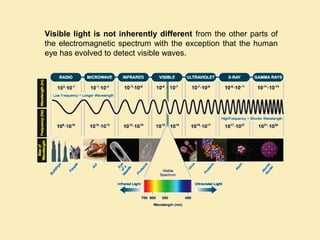
Visible light is not inherently different from the other parts of
the electromagnetic spectrum with the exception that the human
eye has evolved to detect visible waves.
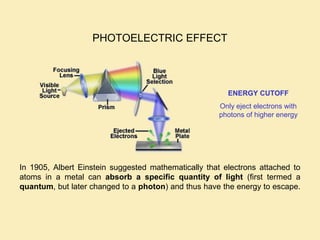
In 1905, Albert Einstein suggested mathematically that electrons attached to
atoms in a metal can absorb a specific quantity of light (first termed a
quantum, but later changed to a photon) and thus have the energy to escape.
ENERGY CUTOFF
Only eject electrons with
photons of higher energy
PHOTOELECTRIC EFFECT
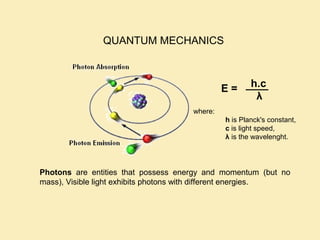
Photons are entities that possess energy and momentum (but no
mass), Visible light exhibits photons with different energies.
QUANTUM MECHANICS
where:
h is Planck's constant,
c is light speed,
λ is the wavelenght.
h.c
λ
E =
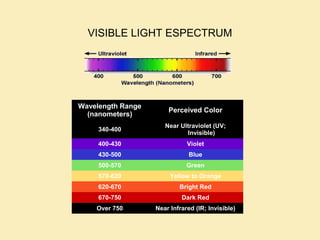
VISIBLE LIGHT ESPECTRUM
Wavelength Range
(nanometers)
Perceived Color
340-400
Near Ultraviolet (UV;
Invisible)
400-430 Violet
430-500 Blue
500-570 Green
570-620 Yellow to Orange
620-670 Bright Red
670-750 Dark Red
Over 750 Near Infrared (IR; Invisible)
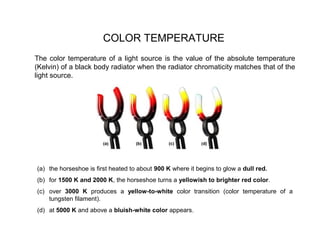
COLOR TEMPERATURE
The color temperature of a light source is the value of the absolute temperature
(Kelvin) of a black body radiator when the radiator chromaticity matches that of the
light source.
(a) the horseshoe is first heated to about 900 K where it begins to glow a dull red.
(b) for 1500 K and 2000 K, the horseshoe turns a yellowish to brighter red color.
(c) over 3000 K produces a yellow-to-white color transition (color temperature of a
tungsten filament).
(d) at 5000 K and above a bluish-white color appears.
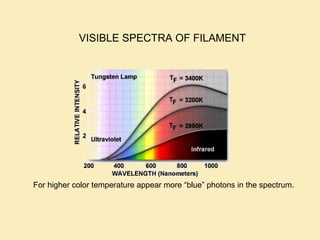
For higher color temperature appear more “blue” photons in the spectrum.
VISIBLE SPECTRA OF FILAMENT
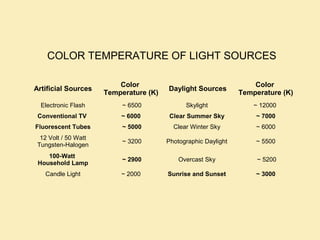
Artificial Sources
Color
Temperature (K)
Daylight Sources
Color
Temperature (K)
Electronic Flash ~ 6500 Skylight ~ 12000
Conventional TV ~ 6000 Clear Summer Sky ~ 7000
Fluorescent Tubes ~ 5000 Clear Winter Sky ~ 6000
12 Volt / 50 Watt
Tungsten-Halogen
~ 3200 Photographic Daylight ~ 5500
100-Watt
Household Lamp
~ 2900 Overcast Sky ~ 5200
Candle Light ~ 2000 Sunrise and Sunset ~ 3000
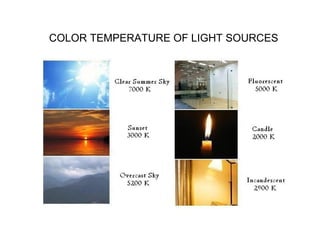
COLOR TEMPERATURE OF LIGHT SOURCES
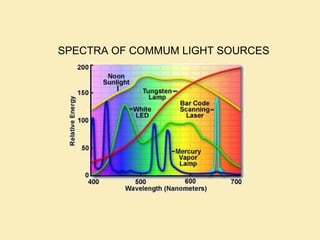
SPECTRA OF COMMUM LIGHT SOURCES
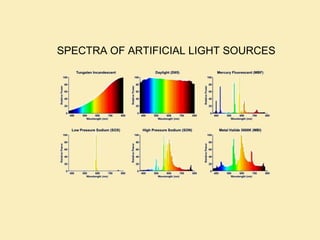
SPECTRA OF ARTIFICIAL LIGHT SOURCES
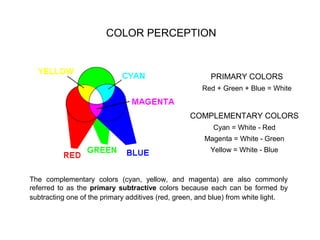
COMPLEMENTARY COLORS
Cyan = White - Red
Magenta = White - Green
Yellow = White - Blue
The complementary colors (cyan, yellow, and magenta) are also commonly
referred to as the primary subtractive colors because each can be formed by
subtracting one of the primary additives (red, green, and blue) from white light.
PRIMARY COLORS
Red + Green + Blue = White
COLOR PERCEPTION
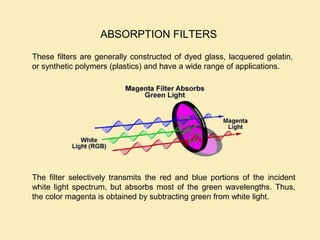
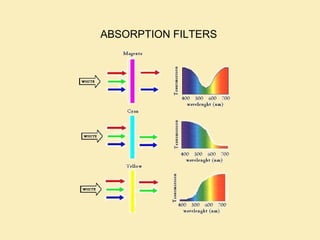
These filters are generally constructed of dyed glass, lacquered gelatin,
or synthetic polymers (plastics) and have a wide range of applications.
The filter selectively transmits the red and blue portions of the incident
white light spectrum, but absorbs most of the green wavelengths. Thus,
the color magenta is obtained by subtracting green from white light.
ABSORPTION FILTERS
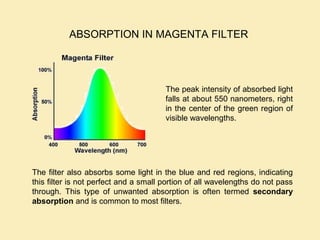
ABSORPTION IN MAGENTA FILTER
The filter also absorbs some light in the blue and red regions, indicating
this filter is not perfect and a small portion of all wavelengths do not pass
through. This type of unwanted absorption is often termed secondary
absorption and is common to most filters.
The peak intensity of absorbed light
falls at about 550 nanometers, right
in the center of the green region of
visible wavelengths.
ABSORPTION FILTERS
DAY AND NIGHT VISION – COLOR SENSIBILITY
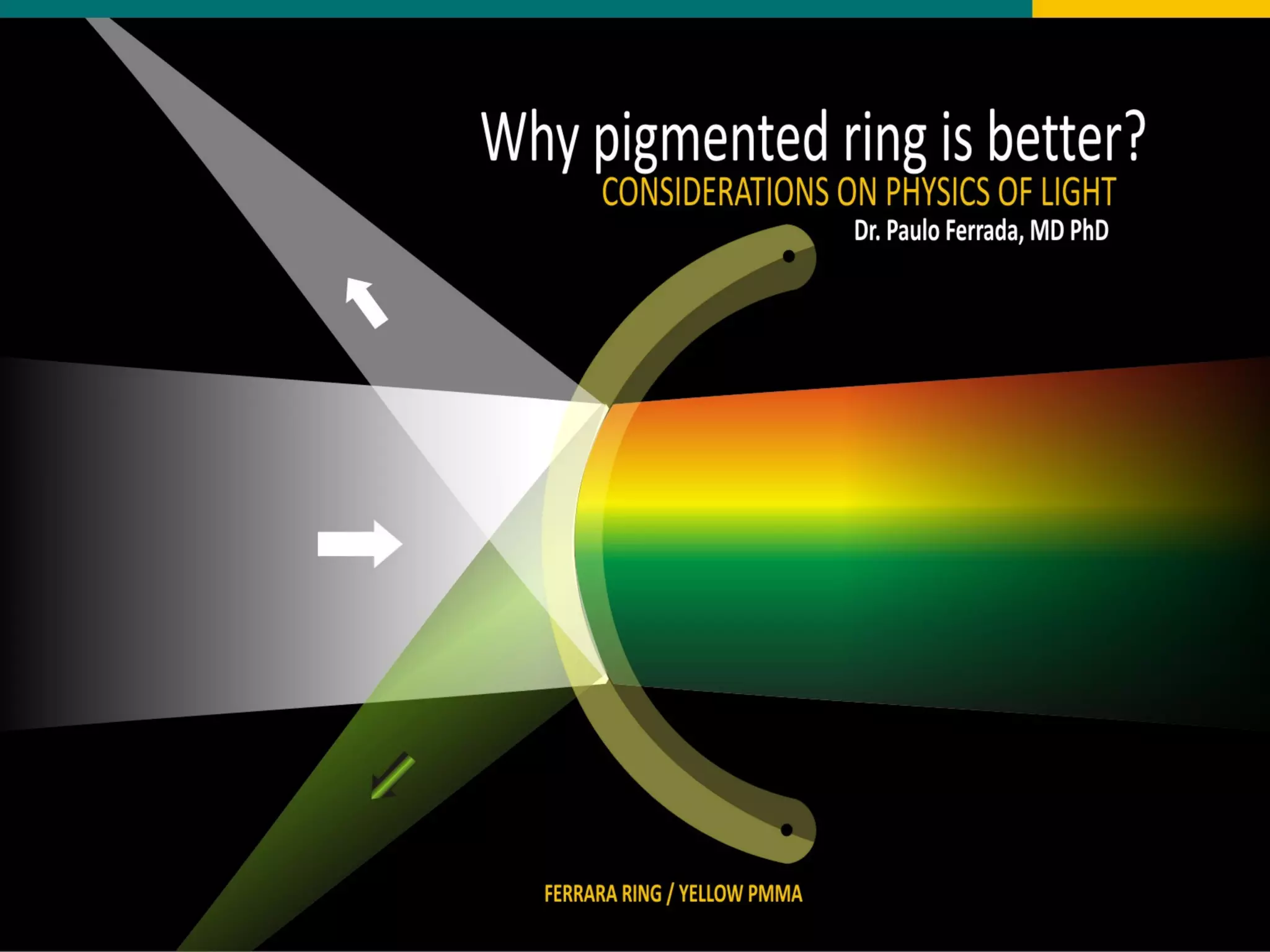
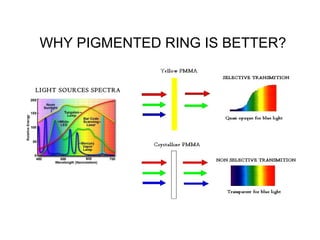
WHY PIGMENTED RING IS BETTER?
LIGHT SOURCES SPECTRA

O Filtro Amarelo

  • 2.
    Visible light isnot inherently different from the other parts of the electromagnetic spectrum with the exception that the human eye has evolved to detect visible waves.
  • 3.
    In 1905, AlbertEinstein suggested mathematically that electrons attached to atoms in a metal can absorb a specific quantity of light (first termed a quantum, but later changed to a photon) and thus have the energy to escape. ENERGY CUTOFF Only eject electrons with photons of higher energy PHOTOELECTRIC EFFECT
  • 4.
    Photons are entitiesthat possess energy and momentum (but no mass), Visible light exhibits photons with different energies. QUANTUM MECHANICS where: h is Planck's constant, c is light speed, λ is the wavelenght. h.c λ E =
  • 5.
    VISIBLE LIGHT ESPECTRUM WavelengthRange (nanometers) Perceived Color 340-400 Near Ultraviolet (UV; Invisible) 400-430 Violet 430-500 Blue 500-570 Green 570-620 Yellow to Orange 620-670 Bright Red 670-750 Dark Red Over 750 Near Infrared (IR; Invisible)
  • 6.
    COLOR TEMPERATURE The colortemperature of a light source is the value of the absolute temperature (Kelvin) of a black body radiator when the radiator chromaticity matches that of the light source. (a) the horseshoe is first heated to about 900 K where it begins to glow a dull red. (b) for 1500 K and 2000 K, the horseshoe turns a yellowish to brighter red color. (c) over 3000 K produces a yellow-to-white color transition (color temperature of a tungsten filament). (d) at 5000 K and above a bluish-white color appears.
  • 7.
    For higher colortemperature appear more “blue” photons in the spectrum. VISIBLE SPECTRA OF FILAMENT
  • 8.
    Artificial Sources Color Temperature (K) DaylightSources Color Temperature (K) Electronic Flash ~ 6500 Skylight ~ 12000 Conventional TV ~ 6000 Clear Summer Sky ~ 7000 Fluorescent Tubes ~ 5000 Clear Winter Sky ~ 6000 12 Volt / 50 Watt Tungsten-Halogen ~ 3200 Photographic Daylight ~ 5500 100-Watt Household Lamp ~ 2900 Overcast Sky ~ 5200 Candle Light ~ 2000 Sunrise and Sunset ~ 3000 COLOR TEMPERATURE OF LIGHT SOURCES
  • 9.
    COLOR TEMPERATURE OFLIGHT SOURCES
  • 10.
    SPECTRA OF COMMUMLIGHT SOURCES
  • 11.
    SPECTRA OF ARTIFICIALLIGHT SOURCES
  • 12.
    COMPLEMENTARY COLORS Cyan =White - Red Magenta = White - Green Yellow = White - Blue The complementary colors (cyan, yellow, and magenta) are also commonly referred to as the primary subtractive colors because each can be formed by subtracting one of the primary additives (red, green, and blue) from white light. PRIMARY COLORS Red + Green + Blue = White COLOR PERCEPTION
  • 13.
    These filters aregenerally constructed of dyed glass, lacquered gelatin, or synthetic polymers (plastics) and have a wide range of applications. The filter selectively transmits the red and blue portions of the incident white light spectrum, but absorbs most of the green wavelengths. Thus, the color magenta is obtained by subtracting green from white light. ABSORPTION FILTERS
  • 14.
    ABSORPTION IN MAGENTAFILTER The filter also absorbs some light in the blue and red regions, indicating this filter is not perfect and a small portion of all wavelengths do not pass through. This type of unwanted absorption is often termed secondary absorption and is common to most filters. The peak intensity of absorbed light falls at about 550 nanometers, right in the center of the green region of visible wavelengths.
  • 15.
  • 16.
    DAY AND NIGHTVISION – COLOR SENSIBILITY
  • 17.
    WHY PIGMENTED RINGIS BETTER? LIGHT SOURCES SPECTRA