114
Leonardo Torquetti et al
ABSTRACT
The Ferrara intrastromal corneal ring segments (ICRS) are
designed to treat ectatic corneal disorders, especially kerato-
conus. They have been used to reshape keratoconic corneas to
improve uncorrected visual acuity, best-corrected visual acuity,
contact lens tolerance and to delay or prevent the need for
keratoplasty. Intrastromal corneal ring segments have several
distinct and important advantages. The Ferrara ICRS have been
used largely in several countries for the treatment of primary
and secondary ectatic corneal disorders. This article reviews
the latest data published and the clinical experience/findings on
the treatment of keratoconus by the Ferrara ICRS implantation.
Keywords: Ferrara, Intrastromal corneal ring segments,
Keratoconus.
How to cite this article: Torquetti L, Sandes J, Ferrara G,
Ferrara P. Ferrara Intrastromal Corneal Ring Segments. Int
J Kerat Ect Cor Dis 2016;5(3):114-127.
Source of support: Nil
Conflict of interest: Dr. Paulo Ferrara and Guilherme Ferrara
have proprietary interest in the Ferrara ICRS. Dr. Leonardo
Torquetti does not have financial interest in any device cited
in this review.
INTRODUCTION
The implantation of intrastromal corneal ring segments
(ICRS) is a minimally invasive surgical option for reshap-
ing the cornea in keratoconus and other secondary
ectasias. Intrastromal corneal ring segments have been
used to correct ectatic corneal diseases in order to reduce
corneal steepening and irregular astigmatism and
improve the visual acuity.1-6
Besides, the ICRS are a surgi-
cal alternative to at least delay, if not eliminate, the need for
lamellar keratoplasty or penetrating keratoplasty (PKP).7
In 1986, Ferrara started implanting modified poly­
methylmethacrylate (PMMA) ICRS in rabbit corneas, and
in 1994, he developed a better technique of corneal tunnel
construction for implanting the ICRS.8
The Ferrara ICRS are made of PMMA Perspex
camphorquinone (CQ) acrylic segments. They vary in
thickness and are available in 0.15, 0.20, 0.25, and 0.30 mm.
The segment cross-section is triangular, and the base for
every thickness and diameter is 0.60 mm. The segments
have 90, 120, 140, 160, or 210° of arc.
Many studies have demonstrated the efficacy of
ICRS to treat many corneal conditions as keratoconus,1-7
post-LASIK corneal ectasia,9,10
postradial keratotomy
ectasia,11
astigmatism,12
and myopia.13-15
The changes in
corneal structure induced by additive technologies can
be roughly predicted by Barraquer’s thickness law, which
states that when material is added to the periphery of the
cornea or an equal amount of material is removed from
the central area, a flattening effect is achieved. The cor-
rective result varies in direct proportion to the thickness
of the implant and in inverse proportion to its diameter.
The thicker and smaller is the diameter of the device, the
higher is the corrective result.16
Preliminary investigations have demonstrated that
ICRS are effective in the treatment of astigmatism and
myopia with astigmatism, with the preservation of cor-
rected distance visual acuity (CDVA) and stable results
over time.2,17-20
The objective of the addictive technology
is to reinforce the cornea, decrease the corneal irregular-
ity, and provide improvement of visual acuity in affected
patients.
The research about the Ferrara ICRS began in 1985.
In 1986, Dr. Paulo Ferrara (P.F) realized that to keep the
implant in place, a large hole was needed in the center
of the lens which resulted in an annular prostheses.
Since then, several annular shapes and diameters were
tried. From these researches, it was concluded that the
best design would be the one, i.e., used nowadays, made
of PMMA, with a total diameter of 5.0 mm, arch length
ranging from 90 to 210°, and thickness ranging from 150
to 300 μm.
The ICRS were implanted in rabbit eyes, through a
free hand dissection technique, at 50% depth of measured
central corneal thickness. The eyes were examined for
12 months, and the animals were sacrificed for histo­
pathological exams. The histopathological results
revealed excellent tolerance of the cornea to the orthesis
since there was only slight inflammatory reaction sur-
rounding the implant and no evidence of extrusion.
The techniques, traditionally, used for the implant of
corneal prostheses, free hand dissection, and keratectomy
with a microkeratome showed some negative points,
such as interface deposits, delay in refractive stability,
Ferrara Intrastromal Corneal Ring Segments
1
Leonardo Torquetti, 2
Jordana Sandes, 3
Guilherme Ferrara, 4
Paulo Ferrara
IJKECD
REVIEW ARTICLE
10.5005/jp-journals-10025-1132
1,4
Head, 2,3
Assistant Surgeon
1
Department of Ophthalmology, Center for Excellence in
Ophthalmology, Pará de Minas, Brazil
2
Department of Ophthalmology, Center of Reference in
Ophthalmology, Goiânia, Brazil
3,4
Department of Ophthalmology, Paulo Ferrara Eye Clinic
Belo Horizonte, Brazil
CorrespondingAuthor: LeonardoTorquetti, Head, Department
of Ophthalmology, Center for Excellence in Ophthalmology, Pará
de Minas, Brazil, e-mail: leonardo@ceoclinica.med.br
International Journal of Keratoconus and Ectatic Corneal Diseases, September-December 2016;5(3):114-127 115
IJKECD
Ferrara Intrastromal Corneal Ring Segments
besides the high costs of microkeratomes and slow learn-
ing curves.
In order to improve the ICRS implantation technique,
reduce its complications, and make it accessible to a large
number of anterior segment surgeons, we (P.F) developed
in 1994 a stromal tunnel and ICRS implantation tech-
nique, which completely eliminates the disadvantages
of the conventional techniques.
In 1995, we (P.F) implanted the first patient who had
undergone PKP and radial keratotomy. This patient was
forwarded to the Cornea Service at Hospital Sao Geraldo
in Federal University of Minas Gerais (UFMG) for a new
transplantation. We decided, with formal authorization
of the patient, to test the ICRS before performing the PKP.
The result was satisfactory, yielding ametropia correction
and good corneal tolerance to the orthesis.
The excellent tolerance to the implant by the trans-
planted cornea gave us the needed confidence to apply the
technique in keratoconic corneas. Therefore, we decided
in 1996, to implant the ICRS in patients’ intolerant to
contact lenses that had the PKP indicated.
MECHANISM OF ACTION
The ICRS complies with Barraquer and Blavatskaya
postulates, according to which, an addition in the cornea
periphery results in its flattening, and the ICRS diameter
determines how much the cornea will be flattened. Thus,
the more tissue is added (increasing ICRS thickness), and
the smaller is the diameter, the greater will be the myopia
correction obtained.21,22
Besides these mechanisms of action, there are some
additional changes induced by the ICRS:
•	 Regularization of the corneal surface through a tilting
movement caused by the flatness in the surface of the
ICRS base, making the cornea flattened at the areas
corresponding to the segment extremities and making
it curve at the ICRS body area.
•	 Interruption, or at least delay of keratoconus evolu-
tion,17,19
reduction of opacity on the cone apex, and
reduction of related symptoms as itching, photopho-
bia, and pain/ocular discomfort.
•	 Lack of correspondence between uncorrected visual
acuity after the ICRS implantation and residual
ametropia. Sometimes, good visual acuity coex-
isting with high residual refractive errors can be
observed.
•	 The prisma effect generated by the triangular section
reduces halos and glare, which could result from the
small diameter of the orthesis.
•	 The yellow filter introduced in the plastic prevents the
ultraviolet (UV) light to go into the eye, reducing
the halos and reflections at night.
INDICATIONS
The main indication for the Ferrara ICRS implantation
is keratoconus. In patients with keratoconus, the Ferrara
ICRS should be indicated when: (1) There is an evidence
of progressive worsening of the disease, with the gradual
decrease of UDVA and CDVA; (2) progressive corneal
steepening, and (3) progressive contact lens intolerance.
In post-LASIK corneal ectasia,9
the Ferrara ICRS
implantation is indicated when there is worsening of
the condition. The main indications for the Ferrara ICRS
implantation are listed in Table 1.
CONTRAINDICATIONS
The main contraindications for the Ferrara ICRS implanta-
tion are the presence of apical opacities in very advanced
keratoconus, usually with K readings above 60 Diopters
(D). The postoperative results in these cases are usually
poor, and the best treatment for these cases is lamellar
keratoplasty or PKP.8,23
The main contraindications for
the Ferrara ICRS implantation are listed in Table 2.
NOMOGRAM
The nomogram has evolved as the knowledge about the
predictability of results has grown. Initially, surgeons
implanted a pair of symmetrical segments in every case.
The incision was always placed on the steep meridian to
take advantage of the coupling effect achieved by the ICRS.
First, only the grade of keratoconus was considered
for the ICRS selection, which means that in keratoconus
grade I, the more suitable Ferrara ICRS for implantation
was that of 150 μm, and in keratoconus grade IV, the
more appropriate ICRS was of 350 μm (Table 3). However,
some cases of extrusion could be observed in keratoconus
grade IV in which the cornea is usually very thin, and
the thick ICRS sometimes were not properly fitted into
the corneal stroma.
Table 1: Ferrara ICRS indications
1 Keratoconus
2  High irregular astigmatism after PKP or lamellar keratoplasty
3  Irregular astigmatisms after radial keratotomy
4  Pellucid marginal degeneration
5  Corneal ectasia after excimer laser
Table 2: Ferrara ICRS contraindications
1 Very advanced keratoconus with curvatures over 60 D and
significant apical opacity and scar ICRS
2 Hydropsis
3 Thin corneas, with thickness below 300 μm in the ICRS
track
4 Patients with intense atopia (these should be treated before
the implant)
5  Any ongoing infectious process, local or systemic
116
Leonardo Torquetti et al
Table 3: Ferrara ICRS first-generation nomogram
Diameter 5.00 mm Thickness (mm) Diopters to be corrected
Fruste 0.150 –2.00 to –4.00
Cone I 0.200 –4.25 to –6.00
Cone II 0.250 –6.25 to –8.00
Cone III 0.300 –8.25 to –10.00
Cone IV 0.350 –10.25 to –12.00
Table 4: Distribution of the area of corneal ectasia
Map
Distribution
of ectasia Description
0/100% All the ectatic area is located at one
side of the cornea
25/75% 75% of the ectatic area is located at
one side of the cornea
33/66% 66% of the ectatic area is located at
one side of the cornea
50/50% The ectatic area is symmetrically
distributed on the cornea
The second generation of the nomogram considered
the refraction for ICRS selection, besides the distribution
of the ectatic area on the cornea. Therefore, as the spheri-
cal equivalent increased, the selected ICRS thickness
also increased. However, in many keratoconus cases,
the myopia and astigmatism could not be caused by the
ectasia itself but by an increase in the axial length of the
eye (axial myopia). In these cases, hypercorrection by
implanting a thick ICRS was observed in a keratoconus
in which a thinner segment should be indicated.
In the third generation of the Ferrara ICRS nomogram,
the ICRS selection depends on the type of keratoconus, its
location in the cornea (Table 4), topographic astigmatism
(Tables 5 to 7), and pachymetry.17,24
Table 5: Segment thickness choice in symmetric
bow-tie keratoconus
Topographic astigmatism (D) Segment thickness
1.00 150/150
1.25–2.00 200/200
2.25–3.00 250/250
3.25 300/300
Table 6: Asymmetrical segment thickness choice in sag cones
with 0/100 and 25/75% of asymmetry index (Graph 1)
Topographic astigmatism (D) Segment thickness
1.00 none/150
1.25–2.00 none/200
2.25–3.00 none/250
3.25–4.00 none/300
4.25–5.00 150/250
6.25–6.00 200/300
Table 7: Asymmetrical segment thickness choice in sag cones
with 0/100 and 33/66% of asymmetry index (Graph 1)
Topographic astigmatism (D) Segment thickness
1.00 none/150
1.25–2.00 150/200
2.25–3.00 200/250
3.25–4.00 250/300
For symmetric bow-tie patterns of keratoconus, two
equal segments are selected. For the nipple type of kera-
toconus, a single 210 μm segment is chosen based on
the nomogram (Table 8). For peripheral cones, the most
common type asymmetrical segments are selected. It is
important to emphasize that the ICRS thickness cannot
exceed 50% of the thickness of the cornea on the track
of the ICRS.
Using this third generation of the nomogram, we
usually found that in some patients, there was significant
corneal flattening without considerable improvement of
visual acuity. We realized that, in these cases, the cornea
usually presented oblate (positive Q values) postopera-
tively, what could explain the lack of significant improve-
ment in these cases.25-27
This finding led us to retrospectively review the
charts of 147 eyes operated in 2008, and we evaluated
the asphericity changes induced by the implantation of
each thickness of ICRS (or pair of ICRS). Surprisingly, we
found a direct correlation between ICRS thickness and
change of Q values; i.e., the thicker is the ICRS the more
is the effect in the change of Q value.
One paper published by our group27
showed that,
using the previous nomograms, the CDVA was 20/60
or better in 70% of patients. When using the Q-based
nomogram, we found a CDVA of 20/40 or better in 70%
of patients.
The asphericity should be the first parameter to be
considered in the ICRS selection. However, all the other
parameters are considered secondarily (topographic
astigmatism and pachymetry).
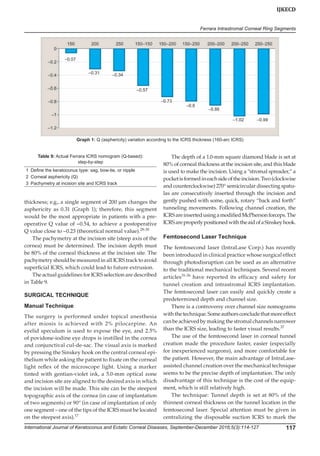
We have described27
that for each ICRS segment, there
is a correspondent Q value change (Graph 1). A target
postoperative Q value as close as possible of –0.23 is the
goal after the Ferrara ICRS implantation.28-30
Based on
this nomogram, one could predict the Q value change
after the implantation of a specific ICRS (or pair of ICRS)
Table 8: Segment thickness choice in Nipple
cones (210 μm ICRS)
Spherical equivalent (D) Segment thickness
Up to 2.00 150
2.25–4.00 200
4.25–6.00 250
6.25 300
International Journal of Keratoconus and Ectatic Corneal Diseases, September-December 2016;5(3):114-127 117
IJKECD
Ferrara Intrastromal Corneal Ring Segments
thickness; e.g., a single segment of 200 μm changes the
asphericity as 0.31 (Graph 1); therefore, this segment
would be the most appropriate in patients with a pre-
operative Q value of –0.54, to achieve a postoperative
Q value close to –0.23 (theoretical normal value).28-30
The pachymetry at the incision site (steep axis of the
cornea) must be determined. The incision depth must
be 80% of the corneal thickness at the incision site. The
pachymetry should be measured in all ICRS track to avoid
superficial ICRS, which could lead to future extrusion.
The actual guidelines for ICRS selection are described
in Table 9.
SURGICAL TECHNIQUE
Manual Technique
The surgery is performed under topical anesthesia
after miosis is achieved with 2% pilocarpine. An
eyelid speculum is used to expose the eye, and 2.5%
of povidone-iodine eye drops is instilled in the cornea
and conjunctival cul-de-sac. The visual axis is marked
by pressing the Sinskey hook on the central corneal epi-
thelium while asking the patient to fixate on the corneal
light reflex of the microscope light. Using a marker
tinted with gentian-violet ink, a 5.0-mm optical zone
and incision site are aligned to the desired axis in which
the incision will be made. This site can be the steepest
topographic axis of the cornea (in case of implantation
of two segments) or 90° (in case of implantation of only
one segment – one of the tips of the ICRS must be located
on the steepest axis).17
The depth of a 1.0-mm square diamond blade is set at
80% of corneal thickness at the incision site, and this blade
is used to make the incision. Using a “stromal spreader,” a
pocketisformedineachsideoftheincision.Two(clockwise
and counterclockwise) 270° semicircular dissecting spatu-
las are consecutively inserted through the incision and
gently pushed with some, quick, rotary “back and forth”
tunneling movements. Following channel creation, the
ICRSareinsertedusingamodifiedMcPhersonforceps.The
ICRSareproperlypositionedwiththeaidofaSinskeyhook.
Femtosecond Laser Technique
The femtosecond laser (IntraLase Corp.) has recently
been introduced in clinical practice whose surgical effect
through photodisruption can be used as an alternative
to the traditional mechanical techniques. Several recent
articles31-36
have reported its efficacy and safety for
tunnel creation and intrastromal ICRS implantation.
The femtosecond laser can easily and quickly create a
predetermined depth and channel size.
There is a controversy over channel size nomograms
withthetechnique.Someauthorsconcludethatmoreeffect
can be achieved by making the stromal channels narrower
than the ICRS size, leading to faster visual results.37
The use of the femtosecond laser in corneal tunnel
creation made the procedure faster, easier (especially
for inexperienced surgeons), and more comfortable for
the patient. However, the main advantage of IntraLase-
assisted channel creation over the mechanical technique
seems to be the precise depth of implantation. The only
disadvantage of this technique is the cost of the equip-
ment, which is still relatively high.
The technique: Tunnel depth is set at 80% of the
thinnest corneal thickness on the tunnel location in the
femtosecond laser. Special attention must be given in
centralizing the disposable suction ICRS to mark the
Graph 1: Q (asphericity) variation according to the ICRS thickness (160-arc ICRS)
Table 9: Actual Ferrara ICRS nomogram (Q-based):
step-by-step
1  Define the keratoconus type: sag, bow-tie, or nipple
2  Corneal asphericity (Q)
3  Pachymetry at incision site and ICRS track
118
Leonardo Torquetti et al
central point to minimize decentration. The channel’s
inner diameter is set to 4.4 mm, the outer diameter is
5.6 mm, the entry cut thickness is 1 m (at the steepest
topographic axis), the ICRS energy used for channel
creation is 1.30j, and the entry cut energy is 1.30j. Channel
creation timing with the femtosecond laser is 15 seconds.
The intracorneal ICRS are implanted immediately
after the channel creation before the disappearance of
the bubbles, which reveals the exact tunnel location. The
segments are placed in the final position with a Sinskey
hook through a dialing hole at both ends of the segment.
The postoperative regimen, for both techniques, con-
sists of moxifloxacin 0.5% (Vigamox®
, Alcon, USA) and
dexamethasone 0.1% (Maxidex®
, Alcon, USA) eye drops
fourtimesperdayfor2weeks.Thepatientswereinstructed
to avoid rubbing the eye and to use preservative-free
artificial tears frequently – polyethylene glycol 400 0.4%
(Oftane®
, Alcon, USA).
Manual × Femtosecond Laser Technique
Initially, the tunnel for ICRS implantation was created
manually with a mechanical spreader in every case. The
complications of ICRS implantation with mechanical
devices include epithelial defects, perforation, asym-
metric segment placement, and extension of the incision
toward the central visual axis or the limbus.38-41
More recently, surgeons began using a femtosecond
laser to create the tunnel. It has been proposed that this
method results in precise tunnel and keratotomy depth,
width, and location as well as a uniform 360° channel;
causes minimum haze and edema; and minimizes sur-
gical complications. The femtosecond laser acts through
photodisruption and can be programmed to create
tunnels for segment placement at predictable corneal
depths. Studies show that tunnel creation with the femto-
second laser is easier, more precise, and more predictable
than with the traditional mechanical spreaders.36
Some studies have compared the visual and refractive
outcomes and the complications of mechanical tunnel
creation and femtosecond-assisted tunnel creation for
ICRS implantation to manage keratoconus.31,33,42,43
Theresultsoftheseclinicaltrialssuggestthatvisualand
refractive results of femtosecond-assisted tunnel creation
are comparable to those of mechanical tunnel creation.31
However, the femtosecond method is faster, easier, and
more comfortable for both patient and surgeon. Another
potential advantage of the femtosecond method is the
precisedepthofimplantation,especiallyinthinnercorneas.
LONG-TERM FOLLOW-UP AFTER FERRARA
ICRS IMPLANTATION IN KERATOCONUS
We retrospectively reviewed patient records of 94 eyes
of 76 patients, which were consecutively operated
(Ferrara ICRS implantation).17
There were 33 females and
61 males. The average age of the patients was 28.1 years.
All procedures were performed by the same surgeon
(P.F) between June 1996 and September 2007. Patients
included in the study presented clear cornea and a
minimal corneal thickness of 300 μm at the ICRS track.
Patients were intolerant to contact lens and/or showed
progression of ectasia.
Fifty-eight subjects underwent a single eye treatment,
whereas 18 subjects had both eye treated. Seventy-three
eyes had a 2-year follow-up, 66 eyes had a 3-year follow-up,
48 eyes had a 4-year follow-up, and 34 eyes had a 5-year
follow-up. All patients completed at least a 2-year
follow-up. No intraoperative complications occurred.
All patients returned for ocular examination on day one,
1 week and a month after the surgery, and then 3, 6, and
12 months. Thereafter, the following eye examinations
occurred yearly.
Preoperative and postoperative UDVA, CDVA, and
keratometry data were collected from all patients. The
mean UDVA (decimal) at the preoperative period was
0.12, and the mean CDVA (decimal) was 0.41. At the
first month, the mean UDVA improved to 0.25, and
the mean CDVA improved to 0.56. At 2-year follow-up,
the mean UDVA improved from 0.12 preoperatively to
0.29. At 3-year follow-up, the mean UDVA improved
to 0.34, at 4-year follow-up, the mean UDVA improved to
0.42, and at 5-year follow-up, the mean UDVA decreased
to 0.31 postoperatively. The mean CDVA, at the first
month, improved to 0.56. At 2-year follow-up, the mean
CDVA improved from 0.41 preoperatively to 0.68. At the
third-year follow-up, the mean CDVA decreased to 0.63;
at the fourth-year follow-up, the mean CDVA improved
to 0.65; and at the fifth-year follow-up, the mean CDVA
decreased to 0.59 postoperatively.
The mean keratometry decreased significantly from
the preoperative to the last postoperative follow-up.
Preoperativemeankeratometrywas50.36,whichdecreased
to 47.29 at the first-month postoperative follow-up. The
meankeratometryfollow-upalongthesecondtofifthyears
was 45.96, 45.83, 46.44, and 46.24 respectively.
As shown in previous studies, the intrastromal ICRS
flatten the cornea and keep this effect for a long period
of time. There is no significant resteepening of the cornea
over time.
A study published by Pesando et al44
found similar
results in a 5-year follow-up. A total of 93.84% (122
patients) of the eyes gained lines of UDVA, and only 1.53%
(2 eyes) lost them. A total of 97.69% (127 patients) of the
treated eyes gained lines of CDVA, and no eyes lost them.
The values of K1 and K2 were considerably reduced over
5 years. The preoperative value of K average of 49.27 D
became 4.68 D postoperatively. Both UDVA and the CDVA
International Journal of Keratoconus and Ectatic Corneal Diseases, September-December 2016;5(3):114-127 119
IJKECD
Ferrara Intrastromal Corneal Ring Segments
showed an increase. The UDVA changed from 0.14 lines
preoperatively to 0.32 lines postoperatively, while the
best-corrected visual acuity (BCVA) changing from 0.40
to 0.59. The spherical equivalent changed from –8.34 D
before the operation to –2.83 D after the operation.
In 2014, we published a paper19
with the longest follow-
up ever described, after ICRS implantation. The mean
UDVA (logMAR) improved from 1.01 ± 0.28 to 0.71° ± °0.38
at 5 years (p = 0.000) and 0.67° ± °0.25 at 10 years (p = 0.735).
The mean CDVA (logMAR) improved from 0.45° ± °0.45 to
0.24° ± °0.19 at 5 years (p = 0.004) and 0.29° ± °0.09 at 10 years
(p = 0.292). The mean maximum K value decreased from
54.99° ± °6.33 to 50.58° ± °5.11 D at 5 years (p = 0.000) and
50.65° ± °5.17 D at 10 years (p = 0.854). The mean minimum
K value decreased from 48.85° ± °5.70 to 46.90° ± °5.08
D at 5 years (p = 0.000) and 47.12° ± °4.22 D at 10 years
(p = 0.945). The central corneal thickness decreased from
457.42° ± °58.21 to 421.34° ± °74.12 μm at 5 years (p = 0.039)
and 434.32° ± °77.65 μm at 10 years (p = 0.427).
These studies showed that the Ferrara ICRS could be
a valuable tool to provide topographic and visual stabil-
ity, delay the progression of keratoconus, and postpone a
corneal grafting surgery to more physiological position.4,18
THE 140 FERRARA ICRS
There are different models of Ferrara ICRS with varying
sizes and arc thickness. These segments induce an arch
shortening effect in the lamella, leading to central flat-
tening of the cornea. There are three main corneal ring
arc diameters, 140, 160, and 210°. The shorter the segment,
the greater the astigmatic correction, the lesser the asphe-
ricity change.27
A new Ferrara intrastromal ring model
has a short arc length of 140° (140-ICRS) and has been
recently used. The main advantage of this 140 arc length
is its effect in astigmatism reduction. That is why, they
have as a main indication, pellucid marginal degenera-
tion,45
which leads to high astigmatism, besides corneal
deformity. It has also been used in cases of astigmatic
cones. These are central cones with high astigmatism
and high keratometry.
We retrospectively reviewed the chart records of 65
consecutive patients implanted with Ferrara ICRS, which
has a 140° arch length (unpublished study). Patients
included in the study presented with clear corneas and
minimum corneal thickness of 300 μm at the ring track.
Patients were contact lens intolerant and/or showed pro-
gression of ectasia. The average follow-up was 16 months.
The average age was 33.38 (±13.25), 54 females (80.6%)
and 13 males (19.4%).
The UDVA improved from 0.22 (decimal) preopera-
tively (±0.15) to 0.42 postoperatively (±0.42) (p  0.001).
The CDVA improved from 0.38 (±0.20) to 0.59 (±0.21)
(p  0.001). The mean minimum keratometry (K1) did
not change significantly; it reduced from 45.49 (±6.38) to
45.14 (±5.10) (p = 0.354). The mean K2 decreased from 54.11
(±8.40) to 49.54 (±5.11) (p  0.001). The average keratometry
reduced from 49.87 (±7.018) to 47.34 (±4.90) (p  0.001). The
average asphericity changed from –0.60 (±0.86) to –0.23
(±0.67) (p  0.001). The refractive astigmatism decreased
from –4.95 (±1.61) to –2.55 D (±1.31) (p  0.001). The mean
preoperative astigmatism topography decreased from
–8.00 (±3.45) to –4.53 (±2.52) (p  0.001).
In selected cases of keratoconus with high astigma-
tism, the short arch segments (140 arch) seem to be more
effective, in order to get a significant astigmatic reduction.
THE 210 FERRARA ICRS
The 210° of arc Ferrara intrastromal ICRS have three
major advantages over the conventional ICRS (160°):
(1) Minimal astigmatic induction; (2) corneal flattening,
and (3) implantation of a single segment. These ICRS are
especially useful for the nipple type of keratoconus. The
210-ICRS are an efficient method for keratoconus correc-
tion, significantly decreasing the keratometric values and
spherical equivalent and improving UDVA and CDVA.
We retrospectively reviewed patient records of
80 eyes of 76 patients, which were consecutively oper-
ated, in which the 210-ICRS were implanted.24
Statistical
analysis included preoperative and postoperative UDVA,
BCVA, spherical equivalent, and keratometry.
The mean follow-up time was 6.65 months. The mean
UDVA increased from 20/350 to 20/136 (p° = °0.001). The
mean CDVA increased from 20/125 to 20/55 (p° = °0.0001).
Themeanpreoperativesphericalequivalentdecreasedfrom
–5.22D,preoperative,to–2.26D(p° = °0.050),postoperative.
Corneal tomography (Pentacam®
) showed corneal flat-
tening in all eyes. The mean K1 decreased from 51.49 D to
47.40 D (p° = °0.00014), and the mean K2 decreased from
54.33 D to 49.14 D (p° = °0.00022). The mean keratometric
astigmatismdecreasedfrom3.65D(preoperative)to2.69D
(postoperative) (p° = °0.0001).
IMPLANTATION OF FERRARA ICRS
IN POSTREFRACTIVE SURGERY
CORNEAL ECTASIA
We evaluated 25 eyes of 20 patients with corneal ectasia
(13 males [15 eyes] and 7 females [10 eyes]) who under-
went Ferrara intracorneal ICRS implantation.46
The mean follow-up time was 39.8° ± °21.1 months
(Table 1). All patients had implanted only one segment of
ICRS. A 160° arc ICRS (160-ICRS) was implanted in 18 eyes,
and the 210° arc ICRS (210-ICRS) was implanted in 7 eyes.
The mean UDVA increased from 20/185 to 20/66
(p = 0.005). The mean CDVA increased from 20/125 to
20/40 (p = 0.008) (Graph 1). The mean asphericity values
120
Leonardo Torquetti et al
decreased from –0.95, preoperatively, to –0.23 (p = 0.006),
postoperatively.
The mean pachymetry at the apex of the cornea
increased from (mean) 457.7 ± 48.7 μm (361–542) to 466.2 ± 
49.8 μm (381–559) (p = 0.025), and the pachymetry at the
thinnest point of the cornea increased from 436.3 ± 46.2 μm
(348–533) to 453.9 ± 49.3 μm (370–548) (p = 0.000). A signifi-
cant reduction in keratometric values was found at the last
follow-up examination; mean preoperative keratometry
was decreased from 45.41 ± 5.63 D (37.3–55.5) and changed
significantly to 42.88 ± 4.44 D (31.2–54.1) (p = 0.000).
Our postoperative results show a significant improve-
ment in UDVA and CDVA. Moreover, there was signifi-
cant increase in corneal thickness. This can be explained
by a theoretical cornea collagen remodeling induced by
the implantation of ICRS.
We found a significant increase in asphericity values
after the implantation of ICRS in this study. Interest-
ingly, the mean postoperative value was –0.23, which is
considered the “normal” value for the general popula-
tion.25,28-30,47
This value means that the normal physiologic
asphericity of the cornea shows a significant individual
variation ranging from mild oblate to moderate prolate.
In an unpublished study, where we evaluated the corneal
asphericity changes induced by the ICRS in keratoconus,
we found that the Ferrara intrastromal ICRS implanta-
tion significantly increased the mean corneal asphericity
from –0.85 to –0.32. It is well known that most corneas
after ablation laser procedures tend to become oblate,
and when ectasia develops these corneas usually become
prolate. However, the excess of prolatism usually found
in keratoconus (primary) is usually of a much larger
amount that that found in postrefractive surgery ectasia.
The probable reason is that the Q value after Ferrara ICRS
becomes much closer to “normal” values than when the
ICRS is used for keratoconus. As asphericity is one of the
markers of visual quality, turning it “normal” can be a
predictor of improvement of visual quality.
Thekeratometryvaluesreducedsignificantlyinalleyes.
It can be realized that the mean preoperative values are
usually lower than ones found in keratoconus (primary).
This can be explained somewhat by the corneal flattening
induced by the refractive procedure, usually in an optic
zone of greater extent than the location of the ectasia.
Most of the implanted ICRS were 160-ICRS, the “con-
ventional” ICRS. The remainder of eyes received the 210-
ICRS. The latter is usually reserved for central cones of
nipple type.24
Some ectasia assume the same topographi-
cal pattern of nipple cones, in which we usually use the
210-ICRS with excellent results. These ICRS are reserved
for cases with low astigmatism, in which we desire to
flatten the cornea with minimal astigmatic induction.
The potential advantages of ICRS implantation
over keratoplasty in eyes with post-LASIK ectasia are
many.23,48
First, it avoids further laser treatment, eliminat-
ing central corneal wound healing. This leaves the optical
center of the cornea untouched, enhancing the refractive
outcome. Second, the technique is reversible in cases of an
unsatisfactory refractive or clinical outcome, and minimal
postoperative care is required. Third, adjustment can
be performed using thinner or thicker ICRS. In cases of
unexpected corneal shape changes, one segment can be
removed or exchanged.49
Fourth, it avoids the complica-
tions of intraocular surgery.
These data are confirmed by several studies.9,50-52
Some long-term studies (ICRS in ectasia after LASIK)
showed that ICRS yielded improvements in visual acuity,
refractive status, and keratometric values without any
progression in cases with post-LASIK corneal ectasia.53
ENDOTHELIUM EVALUATION AFTER
FERRARA ICRS IMPLANTATION
We retrospectively reviewed patient records of 102 eyes
of 81 patients, which were followed for a period of at least
1 year (mean follow-up: 45.7 months, standard deviation:
16.4 months; range: 13–71 months).54
All patients had the
diagnosis of keratoconus, post-LASIK ectasia, or pellucid
degeneration.Statisticalanalysisincludedpreoperativeand
postoperative keratometry and endothelial characteristics
(cell count, average cell size, and coefficient of variation).
All patients completed at least 1 year of follow-up
(13–71 months). Mean age was 30.5 ± 8 years. The mean
cell count decreased from (mean ± standard deviation
[SD]) 2714 ± 372 to 2562 ± 406 cells/mm2
(p  0.001). The
calculated exponential cell loss rate over the mean inter-
val of follow-up (4 years) was 1.4% per year. The average
cell size increased from (mean ± SD) 375 ± 56 to –399 ± 61 µ2
(p  0.001). The coefficient of variation increased from
(mean ± SD) 0.22 ± 0.075 to 0.26 ± 0.010 (p = 0.001).
The mean maximum cell size increased from (mean ± 
SD)529 ± 116to639 ± 225µ2
(p  0.001).Themeanminimum
cell size varied from (mean ± SD) 225 ± 36 to 226 ± 54 µ2
(p = 0.936).
There was significant corneal flattening as shown
by keratometry changes. The mean K decreased from
47.70 ± 2.29 (43.70–53.80) to 44.86 ± 2.02 (41.20–51.20)
(p = 0.0001).
In our study, we found a 1.4% loss of endothelial cells
per year. Considering that most of the studied patients
were young, the rate of endothelial cell loss was slightly
higher than in normal eyes (1.1%).55,56
Moreover, there is no
study in the current literature that shows the profile of the
“normal” endothelial loss in keratoconus corneas, which
could be higher than in normal corneas. The only report
in the literature regarding the endothelium profile of
keratoconus is nonprospective and studied only 12 eyes.57
International Journal of Keratoconus and Ectatic Corneal Diseases, September-December 2016;5(3):114-127 121
IJKECD
Ferrara Intrastromal Corneal Ring Segments
Endothelial cell loss after PKP is known to be an
ongoing process even years after surgery. It is well known
that the cell loss is higher than in the early time course
after surgery and decreases 3 to 5 years after surgery.
There is a great variation of rates of cell loss after PKP,
ranging from 4.230
to 9.4% per year, at the long-term
follow-up.58-60
Even after deep anterior lamellar kerato-
plasty (DALK), which is a surgical technique that spares
the receptor endothelium, cell loss has been reported. In
one study, a decrease in average preoperative endothelial
cell count of approximately 200 cells/mm2
was observed
during the first 12 months of surgery.61,62
The only study that assessed the endothelial after
intrastromal ICRS (Intacs, Addition Technology Inc.)
implantation reported that after 24 months of surgery, all
corneal regions had a slight decrease in cell density.63
In all
eyes, mean central and peripheral endothelial cell counts
remained above 2,495 cells/mm2
. Our results are similar,
we obtained a higher average postoperative cell count
(2,562 cells/mm2
), and we had a longer follow-up (4 years).
Wollensak et al,64
in a collagen cross-linking study
in keratoconus, showed that the corneal transparency
and the endothelial cell density (p = 0.45) remained
unchanged. The follow-up was 23 months, and the sample
was only 23 eyes. The same author, in an experimental
study in rabbits,23
showed that riboflavin–ultraviolet A
(UVA) treatment should be safe as long as the dose is
less than the endothelial cytotoxic dose of 0.65 J/cm2
.
In human corneas, the endothelial cytotoxic UVA dose
is reached in corneas thinner than 400 µ, which is not
uncommon in keratoconus patients. Moreover, the data
obtained from normal corneas of rabbit cannot be extra­
polated to human keratoconic corneas, which can have a
different metabolism and response to cross-linking. The
study has a limitation of measure the endothelial toxic-
ity only at 4 and 24 hours after treatment. The long-term
endothelial cytotoxicity was not evaluated by the study.
Our study suggests that some endothelial changes
occur after Ferrara ICRS implantation. However, these
changes are minimal and nonclinically significant, since
the endothelial cell loss rate is not much higher than that
normally expected for normal corneas. In contrast, the
long-term endothelial cell loss after other therapies for
keratoconus is much higher (as in PKP, or even DALK, in
which the receptor endothelium is spared) or unknown
(as in cross-linking).
CONTACT LENS FITTING AFTER FERRARA
ICRS IMPLANTATION
Contact lens fitting in keratoconus patients can be consid-
erably facilitated after Ferrara ICRS implantation. Once
there is corneal surface regularization with reduction of
the excess of prolatism, the majority of patients can be
well fitted with contact lens after the surgery.
The contact lens trial must be done after 3 months of
surgery, which is the period required for keratometry and
refraction stabilization. It is very common that patients
that usually were intolerant to rigid gas-permeable
contact lens in the preoperative period become toler-
ant after the surgery. It is frequently possible to fit soft
contact lenses in these patients. Moreover, there is a very
good stability of the contact lenses after the surgery,
with “losses of lenses” caused by instability (a common
complaint before the surgery) not occurring anymore.
There are a few studies about contact lens fitting after
ICRS implantation. One study evaluated the fitting of a
lathed soft toric contact lens (STCL) after the implant of
ICRS to treat keratoconus. It was found that STCL fitting
was successful in 75, 66.66, and 0% of the ICRS implanted
eyes with stages I–III keratoconus respectively. Spectacle-
CDVA was 1.5 lines better, and mean corneal power was
3.62 D lower in the successful STCL group. Piggy-back
(PB) refitting achieved a PB-CDVA ≤ 0.2 logMAR in all
cases. A similar difference in the CDVA change achieved
by contact lenses vs spectacles was observed in the suc-
cessful STCL and PB refitted groups. They concluded
that STCL fitting is a feasible option in a large proportion
of patients implanted with ICRS. When these lenses are
unsatisfactory, a PB system is a good alternative.65
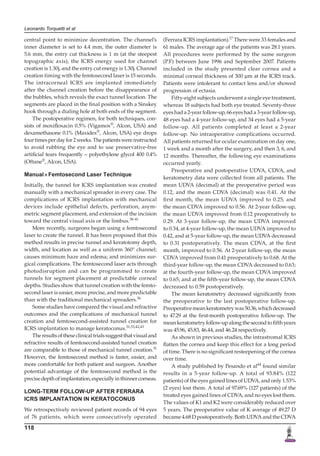
Scleral contact lenses (ScCl) are used for improving
vision in patients with high or irregular astigmatism,
such as keratoconus, pellucid marginal degeneration, ker-
atoglobus, and post-keratoplasty astigmatism (Fig. 1).66
Scleral lenses are lenses with bearing only on the sclera
with diameter of the lens being 15 mm and above. Mini-
scleral lenses have diameters between 15 and 18 mm, and
true scleral lenses have 18 mm diameter (more than 6 mm
bearing on sclera). Mini-scleral lenses have less corneal
clearance as compared with true sclerals. They were
Fig. 1: Scleral contact lens in a patient implanted
with Ferrara ICRS
122
Leonardo Torquetti et al
used for a long time and then abandoned. Recently, after
significant improvement in its manufacturing process, it
has been used with great success in keratoconus patients
with or without previous ICRS implantation.
High cost and the special training required in assess-
ing the fitting and then modifying the design is quite
challenging. Still, with the advances in technology, the
field of ScCl has led to its resurgence as specialized lenses.
Despite these challenges, improvement in visual acuity
with scleral lenses is significant and worth its fitting.66
SURGICAL CORRECTION OF RESIDUAL
AMETROPIA AFTER FERRARA ICRS
IMPLANTATION
Keratoconus patients frequently have high myopia.
Although the corneal shape in these eyes may improve
after ICRS implantation, most patients require contact
lenses or spectacles to correct the residual refractive error.
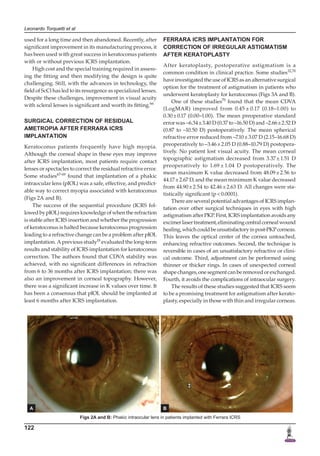
Some studies67-69
found that implantation of a phakic
intraocular lens (pIOL) was a safe, effective, and predict-
able way to correct myopia associated with keratoconus
(Figs 2A and B).
The success of the sequential procedure (ICRS fol-
lowedbypIOL)requiresknowledgeofwhentherefraction
is stable after ICRS insertion and whether the progression
of keratoconus is halted because keratoconus progression
leading to a refractive change can be a problem after pIOL
implantation. A previous study18
evaluated the long-term
results and stability of ICRS implantation for keratoconus
correction. The authors found that CDVA stability was
achieved, with no significant differences in refraction
from 6 to 36 months after ICRS implantation; there was
also an improvement in corneal topography. However,
there was a significant increase in K values over time. It
has been a consensus that pIOL should be implanted at
least 6 months after ICRS implantation.
FERRARA ICRS IMPLANTATION FOR
CORRECTION OF IRREGULAR ASTIGMATISM
AFTER KERATOPLASTY
After keratoplasty, postoperative astigmatism is a
common condition in clinical practice. Some studies32,70
have investigated the use of ICRS as an alternative surgical
option for the treatment of astigmatism in patients who
underwent keratoplasty for keratoconus (Figs 3A and B).
One of these studies70
found that the mean CDVA
(LogMAR) improved from 0.45 ± 0.17 (0.18–1.00) to
0.30 ± 0.17 (0.00–1.00). The mean preoperative standard
error was –6.34 ± 3.40 D (0.37 to –16.50 D) and –2.66 ± 2.52 D
(0.87 to –10.50 D) postoperatively. The mean spherical
refractive error reduced from –7.10 ± 3.07 D (2.15–16.68 D)
preoperatively to –3.46 ± 2.05 D (0.88–10.79 D) postopera-
tively. No patient lost visual acuity. The mean corneal
topographic astigmatism decreased from 3.37 ± 1.51 D
preoperatively to 1.69 ± 1.04 D postoperatively. The
mean maximum K value decreased from 48.09 ± 2.56 to
44.17 ± 2.67 D, and the mean minimum K value decreased
from 44.90 ± 2.54 to 42.46 ± 2.63 D. All changes were sta-
tistically significant (p  0.0001).
There are several potential advantages of ICRS implan-
tation over other surgical techniques in eyes with high
astigmatism after PKP. First, ICRS implantation avoids any
excimerlasertreatment,eliminatingcentralcornealwound
healing,whichcouldbeunsatisfactoryinpost-PKPcorneas.
This leaves the optical center of the cornea untouched,
enhancing refractive outcomes. Second, the technique is
reversible in cases of an unsatisfactory refractive or clini-
cal outcome. Third, adjustment can be performed using
thinner or thicker rings. In cases of unexpected corneal
shapechanges,onesegmentcanberemovedorexchanged.
Fourth, it avoids the complications of intraocular surgery.
The results of these studies suggested that ICRS seem
to be a promising treatment for astigmatism after kerato-
plasty, especially in those with thin and irregular corneas.
Figs 2A and B: Phakic intraocular lens in patients implanted with Ferrara ICRS
A B
International Journal of Keratoconus and Ectatic Corneal Diseases, September-December 2016;5(3):114-127 123
IJKECD
Ferrara Intrastromal Corneal Ring Segments
ABERROMETRY AFTER FERRARA
ICRS IMPLANTATION
The wavefront corneal changes induced by the implanta-
tion of the Ferrara ICRS have been evaluated by several
studies.33,70
The decrease of vision in patients with kerato-
conus is caused not only by sphero-cylindrical refractive
errors (low-order aberrations), but also to a significant
extent by high-order ones. This is clearly explained by the
fact that spectacles in most cases are not able to provide
full correction. The predominant defect is in the coma
aberration, specifically its vertical component.
The studies describe a statistically significant reduc-
tion of all evaluated aberrations, not only the reduction
of wavefront aberrations, but also the prediction of pos-
sible surgical-induced aberrations. These data (reduction
and induction of aberrations) could be considered in a
nomogram to assist in the ring (or pair of rings) selection
for the best visual quality results.
FERRARA ICRS × KERATOPLASTY
Barbara and Barbara71
have published the only paper
that compares the clinical outcomes between ICRS
implantation and keratoplasty in keratoconus patients.
They found better UDVA and CDVA in the ICRS group
of patients; the PKP group has more myopia and astigma-
tism but lower keratometry readings; all these differences
were not statistically significant. intrastromal corneal
ring segments implantation has been shown to be a less
invasive procedure with less postoperative complications
than PKP.
COMPLICATIONS
The incidence of complications after the learning curve
is very low.72
Postoperative complications can be related
to (1) The surgical technique, (2) the nomogram, and
(3) the ICRS itself. The complications related to the surgi-
cal technique are as follows: Extrusion (due to a shallow
tunnel), infection, bad centration of the segment (wrong
placement of the ICRS), migration, and misplacement or
asymmetry of the segments.
The complications related to the nomogram are
linked to the corneal biomechanics and can be (1) Over-
correction and (2) undercorrection. Although the predict-
ability of postoperative results is high, in some cases,
overcorrection and undercorrection can occur due to
viscoelastic and biomechanic profile of the different
keratoconic corneas.
The complications related to the ICRS itself are as
follows: (1) Halos and glare, (2) periannular deposits,
and (3) neovascularization. Halos are reported by 10%
of patients and can be related to the pupil size. This
symptom tends to fade or at least diminish over time. In
very symptomatic cases, we usually prescribe pilocarpine
or brimonidine tartarate at night, to constrict the pupil
and alleviate the undesired reflexes. The periannular
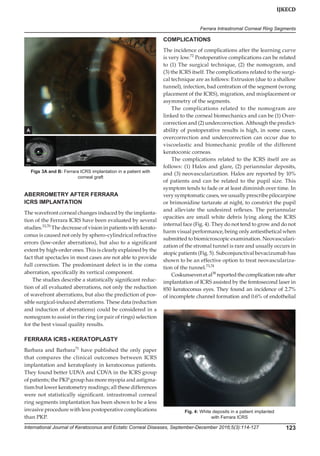
opacities are small white debris lying along the ICRS
internal face (Fig. 4). They do not tend to grow and do not
harm visual performance, being only antiesthetical when
submitted to biomicroscopic examination. Neovasculari-
zation of the stromal tunnel is rare and usually occurs in
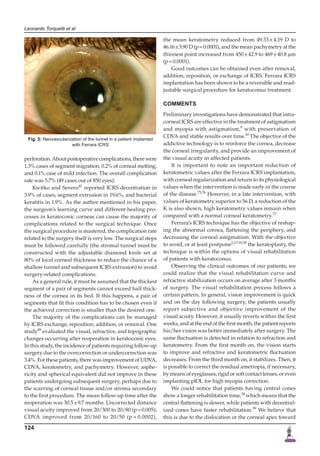
atopic patients (Fig. 5). Subconjunctival bevacizumab has
shown to be an effective option to treat neovasculariza-
tion of the tunnel.73,74
Coskunsevenetal38
reportedthecomplicationrateafter
implantation of ICRS assisted by the femtosecond laser in
850 keratoconus eyes. They found an incidence of 2.7%
of incomplete channel formation and 0.6% of endothelial
Fig. 4: White deposits in a patient implanted
with Ferrara ICRS
Figs 3A and B: Ferrara ICRS implantation in a patient with
corneal graft
A
B
124
Leonardo Torquetti et al
perforation.Aboutpostoperativecomplications,therewere
1.3% cases of segment migration, 0.2% of corneal melting,
and 0.1% case of mild infection. The overall complication
rate was 5.7% (49 cases out of 850 eyes).
Kwitko and Severo41
reported ICRS decentration in
3.9% of cases, segment extrusion in 19.6%, and bacterial
keratitis in 1.9%. As the author mentioned in his paper,
the surgeon’s learning curve and different healing pro-
cesses in keratoconic corneas can cause the majority of
complications related to the surgical technique. Once
the surgical procedure is mastered, the complication rate
related to the surgery itself is very low. The surgical steps
must be followed carefully (the stromal tunnel must be
constructed with the adjustable diamond knife set at
80% of local corneal thickness to reduce the chance of a
shallow tunnel and subsequent ICRS extrusion) to avoid
surgery-related complications.
As a general rule, it must be assumed that the thickest
segment of a pair of segments cannot exceed half thick-
ness of the cornea in its bed. If this happens, a pair of
segments that fit this condition has to be chosen even if
the achieved correction is smaller than the desired one.
The majority of the complications can be managed
by ICRS exchange, reposition, addition, or removal. One
study49
evaluated the visual, refractive, and topographic
changes occurring after reoperation in keratoconic eyes.
In this study, the incidence of patients requiring follow-up
surgery due to the overcorrection or undercorrection was
3.4%. For these patients, there was improvement of UDVA,
CDVA, keratometry, and pachymetry. However, asphe-
ricity and spherical equivalent did not improve in these
patients undergoing subsequent surgery, perhaps due to
the scarring of corneal tissue and/or stroma secondary
to the first procedure. The mean follow-up time after the
reoperation was 30.5 ± 9.7 months. Uncorrected distance
visual acuity improved from 20/300 to 20/80 (p = 0.005);
CDVA improved from 20/160 to 20/50 (p = 0.0002),
the mean keratometry reduced from 49.33 ± 4.19 D to
46.16 ± 3.90 D (p = 0.0001), and the mean pachymetry at the
thinnest point increased from 450 ± 42.9 to 469 ± 40.8 µm
(p = 0.0001).
Good outcomes can be obtained even after removal,
addition, reposition, or exchange of ICRS. Ferrara ICRS
implantation has been shown to be a reversible and read-
justable surgical procedure for keratoconus treatment.
COMMENTS
Preliminary investigations have demonstrated that intra-
corneal ICRS are effective in the treatment of astigmatism
and myopia with astigmatism,9
with preservation of
CDVA and stable results over time.10
The objective of the
addictive technology is to reinforce the cornea, decrease
the corneal irregularity, and provide an improvement of
the visual acuity in affected patients.
It is important to note an important reduction of
keratometric values after the Ferrara ICRS implantation,
with corneal regularization and return to its physiological
values when the intervention is made early in the course
of the disease.75,76
However, in a late intervention, with
values of keratometry superior to 56 D, a reduction of the
K is also shown, high keratometry values remain when
compared with a normal corneal keratometry.77
Ferrara’s ICRS technique has the objective of reshap-
ing the abnormal cornea, flattening the periphery, and
decreasing the corneal astigmatism. With the objective
to avoid, or at least postpone2,17-19,39
the keratoplasty, the
technique is within the options of visual rehabilitation
of patients with keratoconus.
Observing the clinical outcomes of our patients, we
could realize that the visual rehabilitation curve and
refractive stabilization occurs on average after 3 months
of surgery. The visual rehabilitation process follows a
certain pattern. In general, vision improvement is quick
and on the day following surgery, the patients usually
report subjective and objective improvement of the
visual acuity. However, it usually reverts within the first
weeks, and at the end of the first month, the patient reports
his/her vision was better immediately after surgery. The
same fluctuation is detected in relation to refraction and
keratometry. From the first month on, the vision starts
to improve and refractive and keratometric fluctuation
decreases. From the third month on, it stabilizes. Then, it
is possible to correct the residual ametropia, if necessary,
by means of eyeglasses, rigid or soft contact lenses, or even
implanting plOL for high myopia correction.
We could notice that patients having central cones
show a longer rehabilitation time,24
which means that the
central flattening is slower, while patients with decentral-
ized cones have faster rehabilitation.39
We believe that
this is due to the dislocation or the corneal apex toward
Fig. 5: Neovascularization of the tunnel in a patient implanted
with Ferrara ICRS
International Journal of Keratoconus and Ectatic Corneal Diseases, September-December 2016;5(3):114-127 125
IJKECD
Ferrara Intrastromal Corneal Ring Segments
its physiological position in front of the pupil. In some
cases, we could observe that after ICRS implantation,
there was an increase in myopia and in the keratometric
readings, caused by this same phenomenon.
Symptoms, such as photophobia, visual discomfort,
eye strain, and itching reduce or disappear after surgery.
Most of the keratoconus patients are allergic; therefore, we
recommend strongly that they should not rub their eyes,
which could displace the segments, and stimulate the
disease progression. In addition, rubbing could theoreti-
cally change the regularity of the corneal surface leading
to visual acuity loss. In some cases, it is necessary to use
eye shields at night to prevent the patient from rubbing
the eyes compulsively and unwarily.
The satisfaction level is high. We could observe that the
fearofbecomingblindinthosepatients,alongwiththefear-
some possibility of a transplant in case of a con­tinuously
evolving condition, is very common. The possibility of
postponing those eventualities generates great relief in
the patients. Our cases show that, besides correcting the
corneal deformity, the cone evolution is interrupted. Along
with this interruption, we could also observe a decrease in
corneal opacity and the other symptoms aforementioned.
The surgery is simple and well reproducible, although
it is not an easy procedure. As in any other procedure, it
must be well executed to attain a consistent result.
The incidence of complications is very low, around
3 to 5%, compatible with the levels required for refractive
procedures. It should be emphasized that the corneal
ICRS implant is essentially an orthopedic technique
designed to enable the correction of a structural deform-
ity. As an advantage, it provides simultaneous refractive
correction, although not well predictable, as with other
refractive procedures.
Whenever it was necessary to perform keratoplasty,
the ICRS not only helped the procedure, but also provided
a better centralization during trephination.
We could also notice that, after surgery, there was a
decrease in the corneal sensitivity, resulting in greater
comfort in contact lens fitting, which was not possible
before the operation.
The incidence of complications is greater in more
advanced stages, because the cornea is thinner, and the
pressure generated inside the stroma after the ICRS
implantation can cause the displacement of segments
toward the incisions, eventually extruding the segments.
CONCLUSION
From the results obtained, we can state that this thera-
peutic approach has the following benefits:
•	 Low morbidity, because it preserves the corneal struc-
ture and has a low rate of complications,38,39
allowing
95% of the operated patients to quickly reintegrate
themselves to their everyday activities.
•	 Reversibility, because it enables the cornea to revert
to the preoperative dimensions when the segments
are removed.49
•	 Readjustability through segment replacement. In
some cases, it was possible to correct hypercorrection
removing just one of the segments.49
•	 Lack of rejection – the acrylic which the ICRS is made
of is inert and biocompatible.
•	 Patients’ high satisfaction rate.
•	 As an orthopedic technique, it corrects corneal deform-
ity and restores the physiologic curvature. After the
surgery it is possible to correct the residual ametropia
with conventional optical correction or contact lenses.65
•	 Stabilization or delay of cone progression.19
•	 Lack of a minimum age for surgery, thus making
it possible to reduce the waitlists for transplants in
eye banks (30% of the transplants in eye banks are
attributed to keratoconus).
•	 Possibility of association with other procedures like
contact lens fitting and intraocular lenses.
•	 No interference whatsoever with corneal transplant.
REFERENCES
	 1.	 Colin J, Velou S. Implantation of Intacs and a refractive
intraocular lens to correct keratoconus. J Cataract Refract
Surg 2003 Apr;29(4):832-834.
	 2.	 Kymionis GD, Siganos CS, Tsiklis NS, Anastasakis A, Yoo SH,
Pallikaris AI, Astyrakakis N, Pallikaris IG. Long-term
follow-up of Intacs in keratoconus. Am J Ophthalmol 2007
Feb;143(2):236-244.
	 3.	 Colin J, Cochener B, Savary G, Malet F. Correcting kerato-
conus with intracorneal rings. J Cataract Refract Surg 2000
Aug;26(8):1117-1122.
	 4.	 Colin J, Cochener B, Savary G, Malet F, Holmes-Higgin D.
INTACS inserts for treating keratoconus: one-year results.
Ophthalmology 2001 Aug;108(8):1409-1414.
	 5.	 Siganos CS, Kymionis GD, Kartakis N, Theodorakis MA,
Astyrakakis N, Pallikaris IG. Management of keratoconus
with Intacs. Am J Ophthalmol 2003 Jan;135(1):64-70.
	 6.	 SiganosD,FerraraP,ChatzinikolasK,BessisN,PapastergiouG.
Ferrara intrastromal corneal rings for the correction of kera-
toconus. J Cataract Refract Surg 2002 Nov;28(11):1947-1951.
	 7.	 Beniz LA, Queiroz GH, Queiroz CF, Lopes WL, Moraes LF,
Beniz J. Intrastromal corneal ring segments delay corneal
grafting in patients with keratoconus. Arq Bras Oftalmol
2016 Feb;79(1):30-32.
	 8.	 Miranda D, Ferrara P. Ferrara intrastromal corneal ring seg-
ments for severe keratoconus. J Refract Surg 2003 Nov-Dec;
19(6):645-653.
	 9.	 Brenner LF, Alió JL, Vega-Estrada A, Baviera J, Beltrán J, Cobo-
Soriano R. Indications for intrastromal corneal ring segments
in ectasia after laser in situ keratomileusis. J Cataract Refract
Surg 2012 Dec;38(12):2117-2124.
	 10.	 SuiterBG,TwaMD,RuckhoferJ,SchanzlinDJ.Acomparisonof
visualacuity,predictability,andvisualfunctionoutcomesafter
intracorneal ring segments and laser in situ keratomileusis.
Trans Am Ophthalmol Soc 2000;98:51-55; discussion 55-57.
126
Leonardo Torquetti et al
	 11.	 Baïkoff G, Maia N, Poulhalec D, Fontaine A, Giusiano B.
Diurnal variations in keratometry and refraction with intra-
corneal ring segments. J Cataract Refract Surg 1999 Aug;25(8):
1056-1061.
	12.	 Ruckhofer J, Stoiber J, Twa MD, Grabner G. Correction of
astigmatism with short arc-length intrastromal corneal
ring segments: preliminary results. Ophthalmology 2003
Mar;110(3):516-524.
	 13.	 Ruckhofer J, Stoiber J, Alzner E, Grabner G. One year results of
European multicenter study of intrastromal corneal ring seg-
ments. Part 2: complications, visual symptoms, and patient
satisfaction. J Cataract Refract Surg 2001 Feb;27(2):287-296.
	 14.	 Nosé W, Neves RA, Burris TE, Schanzlin DJ, Belfort Júnior R.
Intrastromal corneal ring: 12-month sighted myopic eyes.
J Refract Surg 1996 Jan-Feb;12(1):20-28.
	 15.	 Burris TE, Ayer CT, Evensen DA, Davenport JM. Effects of
intrastromal corneal ring size and thickness on corneal flat-
tening in human eyes. Refract Surg 1991 Jan-Feb;7(1):46-50.
	 16.	 Zare MA, Hashemi H, Salari MR. Intracorneal ring segment
implantation for the management of keratoconus: safety and
efficacy. J Cataract Refract Surg 2007 Nov;33(11):1886-1891.
	 17.	 Torquetti L, Berbel RF, Ferrara P. Long-term follow-up of
intrastromal corneal ring segments in keratoconus. J Cataract
Refract Surg 2009 Oct;35(10):1768-1773.
	 18.	 Alió JL, Shabayek MH, Artola A. Intracorneal ring segments
for keratoconus correction: long-term follow-up. J Cataract
Refract Surg 2006 Jun;32(6):978-985.
	 19.	 Torquetti L, Ferrara G, Almeida F, Cunha L, Araujo LP,
Machado A, Marcelo Lyra J, Merayo-Lloves J, Ferrara P.
Intrastromal corneal ring segments implantation in patients
with keratoconus: 10-year follow-up. J Refract Surg 2014
Jan;30(1):22-26.
	 20.	 Barbara A, Barbara R. Long-term follow-up of Ferrara rings
segments for the treatment of keratoconus. Int J Keratoconus
Ectatic Corneal Dis 2013 Jan-Apr;2(1):34-39.
	 21.	 Holmes-Higgin DK, Burris TE. Corneal surface topography
and associated visual performance with INTACS for myopia:
phase III clinical trial results. The INTACS Study Group.
Ophthalmology 2000 Nov;107(11):2061-2071.
	 22.	 Rabinowitz YS. Keratoconus. Surv Ophthalmol 1998 Jan-Feb;
42(4):297-319.
	 23.	 Rodríguez LA, Guillén PB, Benavides MA, Garcia L, Porras D,
Daqui-GarayRM.Penetratingkeratoplastyversusintrastromal
corneal ring segments to correct bilateral corneal ectasia: pre-
liminarystudy.JCataractRefractSurg2007Mar;33(3):488-496.
	 24.	 Ferrara P, Torquetti L. Clinical outcomes after implantation of
a new intrastromal corneal ring with a 210-degree arc length.
J Cataract Refract Surg 2009 Sep;35(9):1604-1608.
	 25.	 Bottos KM, Leite MT, Aventura-Isidro M, Bernabe-Ko J,
WongpitoonpiyaN,Ong-CamaraNH,PurcellTL,SchanzlinDJ.
Corneal asphericity and spherical aberration after refractive
surgery. J Cataract Refract Surg 2011 Jun;37(6):1109-1115.
	 26.	 Koller T, Iseli HP, Hafezi F, Mrochen M, Seiler T. Q-factor
customized ablation profile for the correction of myopic
astigmatism. J Cataract Refract Surg 2006 Apr;32(4):584-589.
	 27.	 Torquetti L, Ferrara P. Corneal asphericity changes after
implantation of intrastromal corneal ring segments in kera-
toconus. J Emmetropia 2010;1:178-181.
	 28.	 Yebra-PimentelE,Gonzalez-JeijomeJM,CervinoA,GiraldezMJ,
Gonzalez-Perez J, Parafita MA. Corneal asphericity in a
young adult population. Clinical implications. Arch Soc Esp
Oftalmol 2004 Aug;79(8):385-392.
	 29.	 Calossi A. Corneal asphericity and spherical aberration.
J Refract Surg 2007 May;23(5):505-514.
	 30.	 Sheridan M, Douthwaite WA. Corneal asphericity and refrac-
tive error. Ophthalmic Physiol Opt 1989 Jul;9(3):235-238.
	 31.	 Kubaloglu A, Sari ES, Cinar Y, Cingu K, Koytak A, Coşkun E,
Ozertürk Y. Comparison of mechanical and femtosecond
laser tunnel creation for intrastromal corneal ring segment
implantation in keratoconus: prospective randomized clini-
cal trial. J Cataract Refract Surg 2010 Sep;36(9):1556-1561.
	 32.	 Lisa C, García-Fernández M, Madrid-Costa D, Torquetti L,
Merayo-Lloves J, Alfonso JF. Femtosecond laser-assisted
intrastromal corneal ring segment implantation for high astig-
matism correction after penetrating keratoplasty. J Cataract
Refract Surg 2013 Nov;39(11):1660-1667.
	 33.	 Piñero DP, Alio JL, El Kady B, Coskunseven E, Morbelli H,
Uceda-Montanes A, Maldonado MJ, Cuevas D, Pascual I.
Refractive and aberrometric outcomes of intracorneal ring
segments for keratoconus: mechanical versus femtosecond-
assistedprocedures.Ophthalmology2009Sep;116(9):1675-1687.
	 34.	 Coskunseven E, Kymionis GD, Bouzoukis DI, Aslan E, Pal-
likarisI.Singleintrastromalcornealringsegmentimplantation
using the femtosecond laser after radial keratotomy in a kera-
toconic patient. J Cataract Refract Surg 2009 Jan;35(1):197-199.
	 35.	 YeungSN,KuJYF,LichtingerA,LowSAW,KimP,RootmanDS.
Efficacy of single or paired intrastromal corneal ring segment
implantation combined with collagen crosslinking in kerato-
conus. J Cataract Refract Surg 2013 Aug;39(8):1146-1151.
	36.	 Pinero DP, Alio JL, El Kady B, Pascual I. Corneal aberro-
metric and refractive performance of 2 intrastromal corneal
ring segment models in early and moderate ectatic disease.
J Cataract Refract Surg 2010 Jan;36(1):102-109.
	 37.	 Shabayek MH, Alió JL. Intrastromal corneal ring segment
implantation by femtosecond laser for keratoconus correc-
tion. Ophthalmology 2007 Sep;114(9):1643-1652.
	 38.	 Coskunseven E, Kymionis GD, Tsiklis NS, Atun S, Arslan E,
Siganos CS, Jankov M, Pallikaris IG. Complications of intras-
tromal corneal ring segment implantation using a femto-
second laser for channel creation: a survey of 850 eyes with
keratoconus. Acta Ophthalmol 2011 Feb;89(1):54-57.
	 39.	 Ferrara G, Torquetti L, Ferrara P, Merayo-Lloves J. Intrastro-
mal corneal ring segments: visual outcomes from a large case
series. Clin Exp Ophthalmol 2012 Jul;40(5):433-439.
	 40.	 Coskunseven E, Kymionis GD, Talu H, Aslan E, Diakonis VF,
Bouzoukis DI, Pallikaris I. Intrastromal corneal ring seg­
ment implantation with the femtosecond laser in a post-
keratoplasty patient with recurrent keratoconus. J Cataract
Refract Surg 2007 Oct;33(10):1808-1810.
	 41.	 Kwitko S, Severo NS. Ferrara intracorneal ring segments for
keratoconus. J Cataract Refract Surg 2004 Apr;30(4):812-820.
	 42.	 Rabinowitz YS, Li X, Ignacio TS, Maguen E. INTACS inserts
using the femtosecond laser compared to the mechanical
spreader in the treatment of keratoconus. J Refract Surg 2006
Oct;22(8):764-771.
	 43.	 Kouassi F-X, Buestel C, Raman B, Melinte D, Touboul D,
Gallois A, Colin J. Comparison of the depth predictability
of intra corneal ring segment implantation by mechanical
versus femtosecond laser-assisted techniques using optical
coherence tomography (OCT Visante®
). J Fr Ophtalmol 2012
Feb;35(2):94-99.
	 44.	 Pesando PM, Ghiringhello MP, Di Meglio G, Romeo S. Treat-
ment of keratoconus with Ferrara ICRS and consideration of
the efficacy of the Ferrara nomogram in a 5-year follow-up.
Eur J Ophthalmol 2010 Sep-Oct;20(5):865-873.
International Journal of Keratoconus and Ectatic Corneal Diseases, September-December 2016;5(3):114-127 127
IJKECD
Ferrara Intrastromal Corneal Ring Segments
	 45.	 Rodriguez-Prats J, Galal A, Garcia-Lledo M, De La Hoz F,
Alió JL. Intracorneal rings for the correction of pellucid
marginal degeneration. J Cataract Refract Surg 2003 Jul;29(7):
1421-1424.
	46.	 Torquetti L, Ferrara P. Intrastromal corneal ring segment
implantation for ectasia after refractive surgery. J Cataract
Refract Surg 2010 Jun;36(6):986-990.
	 47.	 Gonzalez-Meijome JM, Villa-Collar C, Montés-Micó R,
GomesA.Asphericityoftheanteriorhumancorneawithdiffer-
ent corneal diameters. J Cataract Refract Surg 2007 Mar;33(3):
465-473.
	 48.	 OzertürkY,SariES,KubalogluA,KoytakA,PiñeroD,AkyolS.
Comparison of deep anterior lamellar keratoplasty and
intrastromal corneal ring segment implantation in advanced
keratoconus. J Cataract Refract Surg 2012 Feb;38(2):324-332.
	 49.	 Torquetti L, Ferrara G, Almeida F, Cunha L, Ferrara P, Merayo-
Lloves J. Clinical outcomes after intrastromal corneal ring
segments reoperation in keratoconus patients. Int J Ophthal-
mol 2013 Dec;6(6):796-800.
	 50.	 Stival LR, Nassaralla BR, Figueiredo MN, Bicalho F,
Nassaralla JJ Jr. Intrastromal corneal ring segment implanta-
tion for ectasia after refractive surgery. Arq Bras Oftalmol
2015 Jul-Aug;78(4):212-215.
	 51.	 Tunc Z, Helvacioglu F, Sencan S. Evaluation of intrastromal
corneal ring segments for treatment of post-LASIK ectasia
patients with a mechanical implantation technique. Indian
J Ophthalmol 2011 Nov-Dec;59(6):437-443.
	 52.	 Piñero DP, Alio JL, Uceda-Montanes A, El Kady B, Pascual I.
Intracorneal ring segment implantation in corneas with post-
laser in situ keratomileusis keratectasia. Ophthalmology 2009
Sep;116(9):1665-1674.
	 53.	 Yildirim A, Cakir H, Kara N, Uslu H. Long-term outcomes
of intrastromal corneal ring segment implantation for post-
LASIK ectasia. Cont Lens Anterior Eye 2014 Dec;37(6):469-472.
	54.	 Ferrara P, Torquetti L. Corneal endothelial profile after
Ferrara Ring implantation. J Emmetropia 2010;1:29-32.
	 55.	 Patel SV, McLaren JW, Bachman LA, Bourne WM. Com-
parison of flex-center, center, and corner methods of corneal
endothelial cell analysis. Cornea 2010 Sep;29(9):1042-1047.
	56.	 Higa A, Sakai H, Sawaguchi S, Iwase A, Tomidokoro A,
Amano S, Araie M. Corneal endothelial cell density and
associated factors in a population-based study in Japan: the
Kumejima study. Am J Ophthalmol 2010 May;149(5):794-799.
	 57.	 Laing RA, Sandstrom MM, Berrospi AR, Leibowitz HM. The
human corneal endothelium in keratoconus: a specular micro-
scopic study. Arch Ophthalmol 1979 Oct;97(10):1867-1869.
	 58.	 Regis-Pacheco LF, Binder PS. What happens to the corneal
transplantendotheliumafterpenetratingkeratoplasty?Cornea
2014 Jun;33(6):587-596.
	 59.	 Langenbucher A, Seitz B, Nguyen NX, Naumann GO. Corneal
endothelial cell loss after nonmechanical penetrating kerato-
plasty depends on diagnosis: a regression analysis. Graefes
Arch Clin Exp Ophthalmol 2002 May;240(5):387-392.
	 60.	 Seitz B, Langenbucher A, Nguyen NX, Kus MM, Küchle M,
Naumann GO. Graft endothelium and thickness after pene­
trating keratoplasty, comparing mechanical and excimer laser
trephination: a prospective randomised study. Graefes Arch
Clin Exp Ophthalmol 2001 Jan;239(1):12-17.
	 61.	 Sarnicola V, Toro P, Sarnicola C, Sarnicola E, Ruggiero A.
Long-term graft survival in deep anterior lamellar kerato-
plasty. Cornea 2012 Jun;31(6):621-626.
	 62.	 Reinhart WJ, Musch DC, Jacobs DS, Lee WB, Kaufman SC,
Shtein RM. Deep anterior lamellar keratoplasty as an alter-
native to penetrating keratoplasty a report by the American
Academy of Ophthalmology. Ophthalmology 2011 Jan;118(1):
209-218.
	 63.	 Azar RG, Holdbrook MJ, Lemp M, Edelhauser HF. Two-
year corneal endothelial cell assessment following INTACS
implantation. J Refract Surg 2001 Sep-Oct;17(5):542-548.
	 64.	 Wollensak G, Spoerl E, Wilsch M, Seiler T. Endothelial cell
damage after riboflavin-ultraviolet – a treatment in the rabbit.
J Cataract Refract Surg 2003 Sep;29(9):1786-1790.
	 65.	 Carballo-Alvarez J, Puell MC, Cuiña R, Diaz-Valle D,
Vazquez JM, Benitez-Del-Castillo JM. Soft contact lens fitting
after intrastromal corneal ring segment implantation to treat
keratoconus. Cont Lens Anterior Eye 2014 Oct;37(5):377-381.
	 66.	 RathiVM,MandatharaPS,TanejaM,DumpatiS,SangwanVS.
Scleral lens for keratoconus: technology update. Clin Oph-
thalmol 2015 Oct 28;9:2013-2018.
	 67.	 Alfonso JF, Lisa C, Fernández-Vega L, Madrid-Costa D, Poo-
López A, Montés-Micó R. Intrastromal corneal ring segments
and posterior chamber phakic intraocular lens implantation
for keratoconus correction. J Cataract Refract Surg 2011
Apr;37(4):706-713.
	 68.	 CoskunsevenE,OnderM,KymionisGD,DiakonisVF,ArslanE,
Tsiklis N, Bouzoukis DI, Pallikaris I. Combined Intacs and
posterior chamber toric implantable Collamer lens implan-
tation for keratoconic patients with extreme myopia. Am J
Ophthalmol 2007 Sep;144(3):387-389.
	 69.	 El-RaggalTM,AbdelFattahAA.SequentialIntacsandVerisyse
phakic intraocular lens for refractive improvement in kerato-
conic eyes. J Cataract Refract Surg 2007 Jun;33(6):966-970.
	 70.	 Coscarelli S, Ferrara G, Alfonso JF, Ferrara P, Merayo-Lloves J,
Araújo LP, Machado AP, Lyra JM, Torquetti L. Intrastromal
corneal ring segment implantation to correct astigmatism
after penetrating keratoplasty. J Cataract Refract Surg 2012
Jun;38(6):1006-1013.
	 71.	 Barbara R, Barbara A. Intrastromal corneal ring segment with
and without collagen corneal crosslinking vs penetrating
keratoplasty for the treatment of keratoconus – case series.
Int J Kerat Ect Cor Dis 2014 May-Aug;3(2):88-94.
	72.	 Barbara A, Barbara R. Intacs intracorneal ring segments
complications in patients suffering from keratoconus. Int J
Kerat Ect Cor Dis 2013 Sep-Dec;2(3):121-128.
	 73.	 Bahar I, Kaiserman I, McAllum P, Rootman D, Slomovic A.
Subconjunctival bevacizumab injection for corneal neo-
vascularization in recurrent pterygium. Curr Eye Res 2008
Jan;33(1):23-28.
	 74.	 Bahar I, Kaiserman I, McAllum P, Rootman D, Slomovic A.
Subconjunctival bevacizumab injection for corneal neovas-
cularization. Cornea 2008 Feb;27(2):142-147.
	 75.	 Rodrigues P, Ferrara G, Ferrara P, Dias W, Torquetti L.
Intrastromal corneal ring segments implantation in patients
with mild keratoconus. Int J Kerat Ect Cor Dis 2014;3(3):
122-126.
	 76.	 Torquetti L, Ferrara G, Ferrara P. Predictors of clinical out-
comes after intrastromal corneal ring segments implantation.
Int J Kerat Ect Cor Dis 2012;1(1):26-30.
	 77.	 Khan MI, Injarie A, Muhtaseb M. Intrastromal corneal
ring segments for advanced keratoconus and cases with
high keratometric asymmetry. J Cataract Refract Surg 2012
Jan;38(1):129-136.

Ferrara ring review (2017)

  • 1.
    114 Leonardo Torquetti etal ABSTRACT The Ferrara intrastromal corneal ring segments (ICRS) are designed to treat ectatic corneal disorders, especially kerato- conus. They have been used to reshape keratoconic corneas to improve uncorrected visual acuity, best-corrected visual acuity, contact lens tolerance and to delay or prevent the need for keratoplasty. Intrastromal corneal ring segments have several distinct and important advantages. The Ferrara ICRS have been used largely in several countries for the treatment of primary and secondary ectatic corneal disorders. This article reviews the latest data published and the clinical experience/findings on the treatment of keratoconus by the Ferrara ICRS implantation. Keywords: Ferrara, Intrastromal corneal ring segments, Keratoconus. How to cite this article: Torquetti L, Sandes J, Ferrara G, Ferrara P. Ferrara Intrastromal Corneal Ring Segments. Int J Kerat Ect Cor Dis 2016;5(3):114-127. Source of support: Nil Conflict of interest: Dr. Paulo Ferrara and Guilherme Ferrara have proprietary interest in the Ferrara ICRS. Dr. Leonardo Torquetti does not have financial interest in any device cited in this review. INTRODUCTION The implantation of intrastromal corneal ring segments (ICRS) is a minimally invasive surgical option for reshap- ing the cornea in keratoconus and other secondary ectasias. Intrastromal corneal ring segments have been used to correct ectatic corneal diseases in order to reduce corneal steepening and irregular astigmatism and improve the visual acuity.1-6 Besides, the ICRS are a surgi- cal alternative to at least delay, if not eliminate, the need for lamellar keratoplasty or penetrating keratoplasty (PKP).7 In 1986, Ferrara started implanting modified poly­ methylmethacrylate (PMMA) ICRS in rabbit corneas, and in 1994, he developed a better technique of corneal tunnel construction for implanting the ICRS.8 The Ferrara ICRS are made of PMMA Perspex camphorquinone (CQ) acrylic segments. They vary in thickness and are available in 0.15, 0.20, 0.25, and 0.30 mm. The segment cross-section is triangular, and the base for every thickness and diameter is 0.60 mm. The segments have 90, 120, 140, 160, or 210° of arc. Many studies have demonstrated the efficacy of ICRS to treat many corneal conditions as keratoconus,1-7 post-LASIK corneal ectasia,9,10 postradial keratotomy ectasia,11 astigmatism,12 and myopia.13-15 The changes in corneal structure induced by additive technologies can be roughly predicted by Barraquer’s thickness law, which states that when material is added to the periphery of the cornea or an equal amount of material is removed from the central area, a flattening effect is achieved. The cor- rective result varies in direct proportion to the thickness of the implant and in inverse proportion to its diameter. The thicker and smaller is the diameter of the device, the higher is the corrective result.16 Preliminary investigations have demonstrated that ICRS are effective in the treatment of astigmatism and myopia with astigmatism, with the preservation of cor- rected distance visual acuity (CDVA) and stable results over time.2,17-20 The objective of the addictive technology is to reinforce the cornea, decrease the corneal irregular- ity, and provide improvement of visual acuity in affected patients. The research about the Ferrara ICRS began in 1985. In 1986, Dr. Paulo Ferrara (P.F) realized that to keep the implant in place, a large hole was needed in the center of the lens which resulted in an annular prostheses. Since then, several annular shapes and diameters were tried. From these researches, it was concluded that the best design would be the one, i.e., used nowadays, made of PMMA, with a total diameter of 5.0 mm, arch length ranging from 90 to 210°, and thickness ranging from 150 to 300 μm. The ICRS were implanted in rabbit eyes, through a free hand dissection technique, at 50% depth of measured central corneal thickness. The eyes were examined for 12 months, and the animals were sacrificed for histo­ pathological exams. The histopathological results revealed excellent tolerance of the cornea to the orthesis since there was only slight inflammatory reaction sur- rounding the implant and no evidence of extrusion. The techniques, traditionally, used for the implant of corneal prostheses, free hand dissection, and keratectomy with a microkeratome showed some negative points, such as interface deposits, delay in refractive stability, Ferrara Intrastromal Corneal Ring Segments 1 Leonardo Torquetti, 2 Jordana Sandes, 3 Guilherme Ferrara, 4 Paulo Ferrara IJKECD REVIEW ARTICLE 10.5005/jp-journals-10025-1132 1,4 Head, 2,3 Assistant Surgeon 1 Department of Ophthalmology, Center for Excellence in Ophthalmology, Pará de Minas, Brazil 2 Department of Ophthalmology, Center of Reference in Ophthalmology, Goiânia, Brazil 3,4 Department of Ophthalmology, Paulo Ferrara Eye Clinic Belo Horizonte, Brazil CorrespondingAuthor: LeonardoTorquetti, Head, Department of Ophthalmology, Center for Excellence in Ophthalmology, Pará de Minas, Brazil, e-mail: leonardo@ceoclinica.med.br
  • 2.
    International Journal ofKeratoconus and Ectatic Corneal Diseases, September-December 2016;5(3):114-127 115 IJKECD Ferrara Intrastromal Corneal Ring Segments besides the high costs of microkeratomes and slow learn- ing curves. In order to improve the ICRS implantation technique, reduce its complications, and make it accessible to a large number of anterior segment surgeons, we (P.F) developed in 1994 a stromal tunnel and ICRS implantation tech- nique, which completely eliminates the disadvantages of the conventional techniques. In 1995, we (P.F) implanted the first patient who had undergone PKP and radial keratotomy. This patient was forwarded to the Cornea Service at Hospital Sao Geraldo in Federal University of Minas Gerais (UFMG) for a new transplantation. We decided, with formal authorization of the patient, to test the ICRS before performing the PKP. The result was satisfactory, yielding ametropia correction and good corneal tolerance to the orthesis. The excellent tolerance to the implant by the trans- planted cornea gave us the needed confidence to apply the technique in keratoconic corneas. Therefore, we decided in 1996, to implant the ICRS in patients’ intolerant to contact lenses that had the PKP indicated. MECHANISM OF ACTION The ICRS complies with Barraquer and Blavatskaya postulates, according to which, an addition in the cornea periphery results in its flattening, and the ICRS diameter determines how much the cornea will be flattened. Thus, the more tissue is added (increasing ICRS thickness), and the smaller is the diameter, the greater will be the myopia correction obtained.21,22 Besides these mechanisms of action, there are some additional changes induced by the ICRS: • Regularization of the corneal surface through a tilting movement caused by the flatness in the surface of the ICRS base, making the cornea flattened at the areas corresponding to the segment extremities and making it curve at the ICRS body area. • Interruption, or at least delay of keratoconus evolu- tion,17,19 reduction of opacity on the cone apex, and reduction of related symptoms as itching, photopho- bia, and pain/ocular discomfort. • Lack of correspondence between uncorrected visual acuity after the ICRS implantation and residual ametropia. Sometimes, good visual acuity coex- isting with high residual refractive errors can be observed. • The prisma effect generated by the triangular section reduces halos and glare, which could result from the small diameter of the orthesis. • The yellow filter introduced in the plastic prevents the ultraviolet (UV) light to go into the eye, reducing the halos and reflections at night. INDICATIONS The main indication for the Ferrara ICRS implantation is keratoconus. In patients with keratoconus, the Ferrara ICRS should be indicated when: (1) There is an evidence of progressive worsening of the disease, with the gradual decrease of UDVA and CDVA; (2) progressive corneal steepening, and (3) progressive contact lens intolerance. In post-LASIK corneal ectasia,9 the Ferrara ICRS implantation is indicated when there is worsening of the condition. The main indications for the Ferrara ICRS implantation are listed in Table 1. CONTRAINDICATIONS The main contraindications for the Ferrara ICRS implanta- tion are the presence of apical opacities in very advanced keratoconus, usually with K readings above 60 Diopters (D). The postoperative results in these cases are usually poor, and the best treatment for these cases is lamellar keratoplasty or PKP.8,23 The main contraindications for the Ferrara ICRS implantation are listed in Table 2. NOMOGRAM The nomogram has evolved as the knowledge about the predictability of results has grown. Initially, surgeons implanted a pair of symmetrical segments in every case. The incision was always placed on the steep meridian to take advantage of the coupling effect achieved by the ICRS. First, only the grade of keratoconus was considered for the ICRS selection, which means that in keratoconus grade I, the more suitable Ferrara ICRS for implantation was that of 150 μm, and in keratoconus grade IV, the more appropriate ICRS was of 350 μm (Table 3). However, some cases of extrusion could be observed in keratoconus grade IV in which the cornea is usually very thin, and the thick ICRS sometimes were not properly fitted into the corneal stroma. Table 1: Ferrara ICRS indications 1 Keratoconus 2  High irregular astigmatism after PKP or lamellar keratoplasty 3  Irregular astigmatisms after radial keratotomy 4  Pellucid marginal degeneration 5  Corneal ectasia after excimer laser Table 2: Ferrara ICRS contraindications 1 Very advanced keratoconus with curvatures over 60 D and significant apical opacity and scar ICRS 2 Hydropsis 3 Thin corneas, with thickness below 300 μm in the ICRS track 4 Patients with intense atopia (these should be treated before the implant) 5  Any ongoing infectious process, local or systemic
  • 3.
    116 Leonardo Torquetti etal Table 3: Ferrara ICRS first-generation nomogram Diameter 5.00 mm Thickness (mm) Diopters to be corrected Fruste 0.150 –2.00 to –4.00 Cone I 0.200 –4.25 to –6.00 Cone II 0.250 –6.25 to –8.00 Cone III 0.300 –8.25 to –10.00 Cone IV 0.350 –10.25 to –12.00 Table 4: Distribution of the area of corneal ectasia Map Distribution of ectasia Description 0/100% All the ectatic area is located at one side of the cornea 25/75% 75% of the ectatic area is located at one side of the cornea 33/66% 66% of the ectatic area is located at one side of the cornea 50/50% The ectatic area is symmetrically distributed on the cornea The second generation of the nomogram considered the refraction for ICRS selection, besides the distribution of the ectatic area on the cornea. Therefore, as the spheri- cal equivalent increased, the selected ICRS thickness also increased. However, in many keratoconus cases, the myopia and astigmatism could not be caused by the ectasia itself but by an increase in the axial length of the eye (axial myopia). In these cases, hypercorrection by implanting a thick ICRS was observed in a keratoconus in which a thinner segment should be indicated. In the third generation of the Ferrara ICRS nomogram, the ICRS selection depends on the type of keratoconus, its location in the cornea (Table 4), topographic astigmatism (Tables 5 to 7), and pachymetry.17,24 Table 5: Segment thickness choice in symmetric bow-tie keratoconus Topographic astigmatism (D) Segment thickness 1.00 150/150 1.25–2.00 200/200 2.25–3.00 250/250 3.25 300/300 Table 6: Asymmetrical segment thickness choice in sag cones with 0/100 and 25/75% of asymmetry index (Graph 1) Topographic astigmatism (D) Segment thickness 1.00 none/150 1.25–2.00 none/200 2.25–3.00 none/250 3.25–4.00 none/300 4.25–5.00 150/250 6.25–6.00 200/300 Table 7: Asymmetrical segment thickness choice in sag cones with 0/100 and 33/66% of asymmetry index (Graph 1) Topographic astigmatism (D) Segment thickness 1.00 none/150 1.25–2.00 150/200 2.25–3.00 200/250 3.25–4.00 250/300 For symmetric bow-tie patterns of keratoconus, two equal segments are selected. For the nipple type of kera- toconus, a single 210 μm segment is chosen based on the nomogram (Table 8). For peripheral cones, the most common type asymmetrical segments are selected. It is important to emphasize that the ICRS thickness cannot exceed 50% of the thickness of the cornea on the track of the ICRS. Using this third generation of the nomogram, we usually found that in some patients, there was significant corneal flattening without considerable improvement of visual acuity. We realized that, in these cases, the cornea usually presented oblate (positive Q values) postopera- tively, what could explain the lack of significant improve- ment in these cases.25-27 This finding led us to retrospectively review the charts of 147 eyes operated in 2008, and we evaluated the asphericity changes induced by the implantation of each thickness of ICRS (or pair of ICRS). Surprisingly, we found a direct correlation between ICRS thickness and change of Q values; i.e., the thicker is the ICRS the more is the effect in the change of Q value. One paper published by our group27 showed that, using the previous nomograms, the CDVA was 20/60 or better in 70% of patients. When using the Q-based nomogram, we found a CDVA of 20/40 or better in 70% of patients. The asphericity should be the first parameter to be considered in the ICRS selection. However, all the other parameters are considered secondarily (topographic astigmatism and pachymetry). We have described27 that for each ICRS segment, there is a correspondent Q value change (Graph 1). A target postoperative Q value as close as possible of –0.23 is the goal after the Ferrara ICRS implantation.28-30 Based on this nomogram, one could predict the Q value change after the implantation of a specific ICRS (or pair of ICRS) Table 8: Segment thickness choice in Nipple cones (210 μm ICRS) Spherical equivalent (D) Segment thickness Up to 2.00 150 2.25–4.00 200 4.25–6.00 250 6.25 300
  • 4.
    International Journal ofKeratoconus and Ectatic Corneal Diseases, September-December 2016;5(3):114-127 117 IJKECD Ferrara Intrastromal Corneal Ring Segments thickness; e.g., a single segment of 200 μm changes the asphericity as 0.31 (Graph 1); therefore, this segment would be the most appropriate in patients with a pre- operative Q value of –0.54, to achieve a postoperative Q value close to –0.23 (theoretical normal value).28-30 The pachymetry at the incision site (steep axis of the cornea) must be determined. The incision depth must be 80% of the corneal thickness at the incision site. The pachymetry should be measured in all ICRS track to avoid superficial ICRS, which could lead to future extrusion. The actual guidelines for ICRS selection are described in Table 9. SURGICAL TECHNIQUE Manual Technique The surgery is performed under topical anesthesia after miosis is achieved with 2% pilocarpine. An eyelid speculum is used to expose the eye, and 2.5% of povidone-iodine eye drops is instilled in the cornea and conjunctival cul-de-sac. The visual axis is marked by pressing the Sinskey hook on the central corneal epi- thelium while asking the patient to fixate on the corneal light reflex of the microscope light. Using a marker tinted with gentian-violet ink, a 5.0-mm optical zone and incision site are aligned to the desired axis in which the incision will be made. This site can be the steepest topographic axis of the cornea (in case of implantation of two segments) or 90° (in case of implantation of only one segment – one of the tips of the ICRS must be located on the steepest axis).17 The depth of a 1.0-mm square diamond blade is set at 80% of corneal thickness at the incision site, and this blade is used to make the incision. Using a “stromal spreader,” a pocketisformedineachsideoftheincision.Two(clockwise and counterclockwise) 270° semicircular dissecting spatu- las are consecutively inserted through the incision and gently pushed with some, quick, rotary “back and forth” tunneling movements. Following channel creation, the ICRSareinsertedusingamodifiedMcPhersonforceps.The ICRSareproperlypositionedwiththeaidofaSinskeyhook. Femtosecond Laser Technique The femtosecond laser (IntraLase Corp.) has recently been introduced in clinical practice whose surgical effect through photodisruption can be used as an alternative to the traditional mechanical techniques. Several recent articles31-36 have reported its efficacy and safety for tunnel creation and intrastromal ICRS implantation. The femtosecond laser can easily and quickly create a predetermined depth and channel size. There is a controversy over channel size nomograms withthetechnique.Someauthorsconcludethatmoreeffect can be achieved by making the stromal channels narrower than the ICRS size, leading to faster visual results.37 The use of the femtosecond laser in corneal tunnel creation made the procedure faster, easier (especially for inexperienced surgeons), and more comfortable for the patient. However, the main advantage of IntraLase- assisted channel creation over the mechanical technique seems to be the precise depth of implantation. The only disadvantage of this technique is the cost of the equip- ment, which is still relatively high. The technique: Tunnel depth is set at 80% of the thinnest corneal thickness on the tunnel location in the femtosecond laser. Special attention must be given in centralizing the disposable suction ICRS to mark the Graph 1: Q (asphericity) variation according to the ICRS thickness (160-arc ICRS) Table 9: Actual Ferrara ICRS nomogram (Q-based): step-by-step 1  Define the keratoconus type: sag, bow-tie, or nipple 2  Corneal asphericity (Q) 3  Pachymetry at incision site and ICRS track
  • 5.
    118 Leonardo Torquetti etal central point to minimize decentration. The channel’s inner diameter is set to 4.4 mm, the outer diameter is 5.6 mm, the entry cut thickness is 1 m (at the steepest topographic axis), the ICRS energy used for channel creation is 1.30j, and the entry cut energy is 1.30j. Channel creation timing with the femtosecond laser is 15 seconds. The intracorneal ICRS are implanted immediately after the channel creation before the disappearance of the bubbles, which reveals the exact tunnel location. The segments are placed in the final position with a Sinskey hook through a dialing hole at both ends of the segment. The postoperative regimen, for both techniques, con- sists of moxifloxacin 0.5% (Vigamox® , Alcon, USA) and dexamethasone 0.1% (Maxidex® , Alcon, USA) eye drops fourtimesperdayfor2weeks.Thepatientswereinstructed to avoid rubbing the eye and to use preservative-free artificial tears frequently – polyethylene glycol 400 0.4% (Oftane® , Alcon, USA). Manual × Femtosecond Laser Technique Initially, the tunnel for ICRS implantation was created manually with a mechanical spreader in every case. The complications of ICRS implantation with mechanical devices include epithelial defects, perforation, asym- metric segment placement, and extension of the incision toward the central visual axis or the limbus.38-41 More recently, surgeons began using a femtosecond laser to create the tunnel. It has been proposed that this method results in precise tunnel and keratotomy depth, width, and location as well as a uniform 360° channel; causes minimum haze and edema; and minimizes sur- gical complications. The femtosecond laser acts through photodisruption and can be programmed to create tunnels for segment placement at predictable corneal depths. Studies show that tunnel creation with the femto- second laser is easier, more precise, and more predictable than with the traditional mechanical spreaders.36 Some studies have compared the visual and refractive outcomes and the complications of mechanical tunnel creation and femtosecond-assisted tunnel creation for ICRS implantation to manage keratoconus.31,33,42,43 Theresultsoftheseclinicaltrialssuggestthatvisualand refractive results of femtosecond-assisted tunnel creation are comparable to those of mechanical tunnel creation.31 However, the femtosecond method is faster, easier, and more comfortable for both patient and surgeon. Another potential advantage of the femtosecond method is the precisedepthofimplantation,especiallyinthinnercorneas. LONG-TERM FOLLOW-UP AFTER FERRARA ICRS IMPLANTATION IN KERATOCONUS We retrospectively reviewed patient records of 94 eyes of 76 patients, which were consecutively operated (Ferrara ICRS implantation).17 There were 33 females and 61 males. The average age of the patients was 28.1 years. All procedures were performed by the same surgeon (P.F) between June 1996 and September 2007. Patients included in the study presented clear cornea and a minimal corneal thickness of 300 μm at the ICRS track. Patients were intolerant to contact lens and/or showed progression of ectasia. Fifty-eight subjects underwent a single eye treatment, whereas 18 subjects had both eye treated. Seventy-three eyes had a 2-year follow-up, 66 eyes had a 3-year follow-up, 48 eyes had a 4-year follow-up, and 34 eyes had a 5-year follow-up. All patients completed at least a 2-year follow-up. No intraoperative complications occurred. All patients returned for ocular examination on day one, 1 week and a month after the surgery, and then 3, 6, and 12 months. Thereafter, the following eye examinations occurred yearly. Preoperative and postoperative UDVA, CDVA, and keratometry data were collected from all patients. The mean UDVA (decimal) at the preoperative period was 0.12, and the mean CDVA (decimal) was 0.41. At the first month, the mean UDVA improved to 0.25, and the mean CDVA improved to 0.56. At 2-year follow-up, the mean UDVA improved from 0.12 preoperatively to 0.29. At 3-year follow-up, the mean UDVA improved to 0.34, at 4-year follow-up, the mean UDVA improved to 0.42, and at 5-year follow-up, the mean UDVA decreased to 0.31 postoperatively. The mean CDVA, at the first month, improved to 0.56. At 2-year follow-up, the mean CDVA improved from 0.41 preoperatively to 0.68. At the third-year follow-up, the mean CDVA decreased to 0.63; at the fourth-year follow-up, the mean CDVA improved to 0.65; and at the fifth-year follow-up, the mean CDVA decreased to 0.59 postoperatively. The mean keratometry decreased significantly from the preoperative to the last postoperative follow-up. Preoperativemeankeratometrywas50.36,whichdecreased to 47.29 at the first-month postoperative follow-up. The meankeratometryfollow-upalongthesecondtofifthyears was 45.96, 45.83, 46.44, and 46.24 respectively. As shown in previous studies, the intrastromal ICRS flatten the cornea and keep this effect for a long period of time. There is no significant resteepening of the cornea over time. A study published by Pesando et al44 found similar results in a 5-year follow-up. A total of 93.84% (122 patients) of the eyes gained lines of UDVA, and only 1.53% (2 eyes) lost them. A total of 97.69% (127 patients) of the treated eyes gained lines of CDVA, and no eyes lost them. The values of K1 and K2 were considerably reduced over 5 years. The preoperative value of K average of 49.27 D became 4.68 D postoperatively. Both UDVA and the CDVA
  • 6.
    International Journal ofKeratoconus and Ectatic Corneal Diseases, September-December 2016;5(3):114-127 119 IJKECD Ferrara Intrastromal Corneal Ring Segments showed an increase. The UDVA changed from 0.14 lines preoperatively to 0.32 lines postoperatively, while the best-corrected visual acuity (BCVA) changing from 0.40 to 0.59. The spherical equivalent changed from –8.34 D before the operation to –2.83 D after the operation. In 2014, we published a paper19 with the longest follow- up ever described, after ICRS implantation. The mean UDVA (logMAR) improved from 1.01 ± 0.28 to 0.71° ± °0.38 at 5 years (p = 0.000) and 0.67° ± °0.25 at 10 years (p = 0.735). The mean CDVA (logMAR) improved from 0.45° ± °0.45 to 0.24° ± °0.19 at 5 years (p = 0.004) and 0.29° ± °0.09 at 10 years (p = 0.292). The mean maximum K value decreased from 54.99° ± °6.33 to 50.58° ± °5.11 D at 5 years (p = 0.000) and 50.65° ± °5.17 D at 10 years (p = 0.854). The mean minimum K value decreased from 48.85° ± °5.70 to 46.90° ± °5.08 D at 5 years (p = 0.000) and 47.12° ± °4.22 D at 10 years (p = 0.945). The central corneal thickness decreased from 457.42° ± °58.21 to 421.34° ± °74.12 μm at 5 years (p = 0.039) and 434.32° ± °77.65 μm at 10 years (p = 0.427). These studies showed that the Ferrara ICRS could be a valuable tool to provide topographic and visual stabil- ity, delay the progression of keratoconus, and postpone a corneal grafting surgery to more physiological position.4,18 THE 140 FERRARA ICRS There are different models of Ferrara ICRS with varying sizes and arc thickness. These segments induce an arch shortening effect in the lamella, leading to central flat- tening of the cornea. There are three main corneal ring arc diameters, 140, 160, and 210°. The shorter the segment, the greater the astigmatic correction, the lesser the asphe- ricity change.27 A new Ferrara intrastromal ring model has a short arc length of 140° (140-ICRS) and has been recently used. The main advantage of this 140 arc length is its effect in astigmatism reduction. That is why, they have as a main indication, pellucid marginal degenera- tion,45 which leads to high astigmatism, besides corneal deformity. It has also been used in cases of astigmatic cones. These are central cones with high astigmatism and high keratometry. We retrospectively reviewed the chart records of 65 consecutive patients implanted with Ferrara ICRS, which has a 140° arch length (unpublished study). Patients included in the study presented with clear corneas and minimum corneal thickness of 300 μm at the ring track. Patients were contact lens intolerant and/or showed pro- gression of ectasia. The average follow-up was 16 months. The average age was 33.38 (±13.25), 54 females (80.6%) and 13 males (19.4%). The UDVA improved from 0.22 (decimal) preopera- tively (±0.15) to 0.42 postoperatively (±0.42) (p  0.001). The CDVA improved from 0.38 (±0.20) to 0.59 (±0.21) (p  0.001). The mean minimum keratometry (K1) did not change significantly; it reduced from 45.49 (±6.38) to 45.14 (±5.10) (p = 0.354). The mean K2 decreased from 54.11 (±8.40) to 49.54 (±5.11) (p  0.001). The average keratometry reduced from 49.87 (±7.018) to 47.34 (±4.90) (p  0.001). The average asphericity changed from –0.60 (±0.86) to –0.23 (±0.67) (p  0.001). The refractive astigmatism decreased from –4.95 (±1.61) to –2.55 D (±1.31) (p  0.001). The mean preoperative astigmatism topography decreased from –8.00 (±3.45) to –4.53 (±2.52) (p  0.001). In selected cases of keratoconus with high astigma- tism, the short arch segments (140 arch) seem to be more effective, in order to get a significant astigmatic reduction. THE 210 FERRARA ICRS The 210° of arc Ferrara intrastromal ICRS have three major advantages over the conventional ICRS (160°): (1) Minimal astigmatic induction; (2) corneal flattening, and (3) implantation of a single segment. These ICRS are especially useful for the nipple type of keratoconus. The 210-ICRS are an efficient method for keratoconus correc- tion, significantly decreasing the keratometric values and spherical equivalent and improving UDVA and CDVA. We retrospectively reviewed patient records of 80 eyes of 76 patients, which were consecutively oper- ated, in which the 210-ICRS were implanted.24 Statistical analysis included preoperative and postoperative UDVA, BCVA, spherical equivalent, and keratometry. The mean follow-up time was 6.65 months. The mean UDVA increased from 20/350 to 20/136 (p° = °0.001). The mean CDVA increased from 20/125 to 20/55 (p° = °0.0001). Themeanpreoperativesphericalequivalentdecreasedfrom –5.22D,preoperative,to–2.26D(p° = °0.050),postoperative. Corneal tomography (Pentacam® ) showed corneal flat- tening in all eyes. The mean K1 decreased from 51.49 D to 47.40 D (p° = °0.00014), and the mean K2 decreased from 54.33 D to 49.14 D (p° = °0.00022). The mean keratometric astigmatismdecreasedfrom3.65D(preoperative)to2.69D (postoperative) (p° = °0.0001). IMPLANTATION OF FERRARA ICRS IN POSTREFRACTIVE SURGERY CORNEAL ECTASIA We evaluated 25 eyes of 20 patients with corneal ectasia (13 males [15 eyes] and 7 females [10 eyes]) who under- went Ferrara intracorneal ICRS implantation.46 The mean follow-up time was 39.8° ± °21.1 months (Table 1). All patients had implanted only one segment of ICRS. A 160° arc ICRS (160-ICRS) was implanted in 18 eyes, and the 210° arc ICRS (210-ICRS) was implanted in 7 eyes. The mean UDVA increased from 20/185 to 20/66 (p = 0.005). The mean CDVA increased from 20/125 to 20/40 (p = 0.008) (Graph 1). The mean asphericity values
  • 7.
    120 Leonardo Torquetti etal decreased from –0.95, preoperatively, to –0.23 (p = 0.006), postoperatively. The mean pachymetry at the apex of the cornea increased from (mean) 457.7 ± 48.7 μm (361–542) to 466.2 ±  49.8 μm (381–559) (p = 0.025), and the pachymetry at the thinnest point of the cornea increased from 436.3 ± 46.2 μm (348–533) to 453.9 ± 49.3 μm (370–548) (p = 0.000). A signifi- cant reduction in keratometric values was found at the last follow-up examination; mean preoperative keratometry was decreased from 45.41 ± 5.63 D (37.3–55.5) and changed significantly to 42.88 ± 4.44 D (31.2–54.1) (p = 0.000). Our postoperative results show a significant improve- ment in UDVA and CDVA. Moreover, there was signifi- cant increase in corneal thickness. This can be explained by a theoretical cornea collagen remodeling induced by the implantation of ICRS. We found a significant increase in asphericity values after the implantation of ICRS in this study. Interest- ingly, the mean postoperative value was –0.23, which is considered the “normal” value for the general popula- tion.25,28-30,47 This value means that the normal physiologic asphericity of the cornea shows a significant individual variation ranging from mild oblate to moderate prolate. In an unpublished study, where we evaluated the corneal asphericity changes induced by the ICRS in keratoconus, we found that the Ferrara intrastromal ICRS implanta- tion significantly increased the mean corneal asphericity from –0.85 to –0.32. It is well known that most corneas after ablation laser procedures tend to become oblate, and when ectasia develops these corneas usually become prolate. However, the excess of prolatism usually found in keratoconus (primary) is usually of a much larger amount that that found in postrefractive surgery ectasia. The probable reason is that the Q value after Ferrara ICRS becomes much closer to “normal” values than when the ICRS is used for keratoconus. As asphericity is one of the markers of visual quality, turning it “normal” can be a predictor of improvement of visual quality. Thekeratometryvaluesreducedsignificantlyinalleyes. It can be realized that the mean preoperative values are usually lower than ones found in keratoconus (primary). This can be explained somewhat by the corneal flattening induced by the refractive procedure, usually in an optic zone of greater extent than the location of the ectasia. Most of the implanted ICRS were 160-ICRS, the “con- ventional” ICRS. The remainder of eyes received the 210- ICRS. The latter is usually reserved for central cones of nipple type.24 Some ectasia assume the same topographi- cal pattern of nipple cones, in which we usually use the 210-ICRS with excellent results. These ICRS are reserved for cases with low astigmatism, in which we desire to flatten the cornea with minimal astigmatic induction. The potential advantages of ICRS implantation over keratoplasty in eyes with post-LASIK ectasia are many.23,48 First, it avoids further laser treatment, eliminat- ing central corneal wound healing. This leaves the optical center of the cornea untouched, enhancing the refractive outcome. Second, the technique is reversible in cases of an unsatisfactory refractive or clinical outcome, and minimal postoperative care is required. Third, adjustment can be performed using thinner or thicker ICRS. In cases of unexpected corneal shape changes, one segment can be removed or exchanged.49 Fourth, it avoids the complica- tions of intraocular surgery. These data are confirmed by several studies.9,50-52 Some long-term studies (ICRS in ectasia after LASIK) showed that ICRS yielded improvements in visual acuity, refractive status, and keratometric values without any progression in cases with post-LASIK corneal ectasia.53 ENDOTHELIUM EVALUATION AFTER FERRARA ICRS IMPLANTATION We retrospectively reviewed patient records of 102 eyes of 81 patients, which were followed for a period of at least 1 year (mean follow-up: 45.7 months, standard deviation: 16.4 months; range: 13–71 months).54 All patients had the diagnosis of keratoconus, post-LASIK ectasia, or pellucid degeneration.Statisticalanalysisincludedpreoperativeand postoperative keratometry and endothelial characteristics (cell count, average cell size, and coefficient of variation). All patients completed at least 1 year of follow-up (13–71 months). Mean age was 30.5 ± 8 years. The mean cell count decreased from (mean ± standard deviation [SD]) 2714 ± 372 to 2562 ± 406 cells/mm2 (p  0.001). The calculated exponential cell loss rate over the mean inter- val of follow-up (4 years) was 1.4% per year. The average cell size increased from (mean ± SD) 375 ± 56 to –399 ± 61 µ2 (p  0.001). The coefficient of variation increased from (mean ± SD) 0.22 ± 0.075 to 0.26 ± 0.010 (p = 0.001). The mean maximum cell size increased from (mean ±  SD)529 ± 116to639 ± 225µ2 (p  0.001).Themeanminimum cell size varied from (mean ± SD) 225 ± 36 to 226 ± 54 µ2 (p = 0.936). There was significant corneal flattening as shown by keratometry changes. The mean K decreased from 47.70 ± 2.29 (43.70–53.80) to 44.86 ± 2.02 (41.20–51.20) (p = 0.0001). In our study, we found a 1.4% loss of endothelial cells per year. Considering that most of the studied patients were young, the rate of endothelial cell loss was slightly higher than in normal eyes (1.1%).55,56 Moreover, there is no study in the current literature that shows the profile of the “normal” endothelial loss in keratoconus corneas, which could be higher than in normal corneas. The only report in the literature regarding the endothelium profile of keratoconus is nonprospective and studied only 12 eyes.57
  • 8.
    International Journal ofKeratoconus and Ectatic Corneal Diseases, September-December 2016;5(3):114-127 121 IJKECD Ferrara Intrastromal Corneal Ring Segments Endothelial cell loss after PKP is known to be an ongoing process even years after surgery. It is well known that the cell loss is higher than in the early time course after surgery and decreases 3 to 5 years after surgery. There is a great variation of rates of cell loss after PKP, ranging from 4.230 to 9.4% per year, at the long-term follow-up.58-60 Even after deep anterior lamellar kerato- plasty (DALK), which is a surgical technique that spares the receptor endothelium, cell loss has been reported. In one study, a decrease in average preoperative endothelial cell count of approximately 200 cells/mm2 was observed during the first 12 months of surgery.61,62 The only study that assessed the endothelial after intrastromal ICRS (Intacs, Addition Technology Inc.) implantation reported that after 24 months of surgery, all corneal regions had a slight decrease in cell density.63 In all eyes, mean central and peripheral endothelial cell counts remained above 2,495 cells/mm2 . Our results are similar, we obtained a higher average postoperative cell count (2,562 cells/mm2 ), and we had a longer follow-up (4 years). Wollensak et al,64 in a collagen cross-linking study in keratoconus, showed that the corneal transparency and the endothelial cell density (p = 0.45) remained unchanged. The follow-up was 23 months, and the sample was only 23 eyes. The same author, in an experimental study in rabbits,23 showed that riboflavin–ultraviolet A (UVA) treatment should be safe as long as the dose is less than the endothelial cytotoxic dose of 0.65 J/cm2 . In human corneas, the endothelial cytotoxic UVA dose is reached in corneas thinner than 400 µ, which is not uncommon in keratoconus patients. Moreover, the data obtained from normal corneas of rabbit cannot be extra­ polated to human keratoconic corneas, which can have a different metabolism and response to cross-linking. The study has a limitation of measure the endothelial toxic- ity only at 4 and 24 hours after treatment. The long-term endothelial cytotoxicity was not evaluated by the study. Our study suggests that some endothelial changes occur after Ferrara ICRS implantation. However, these changes are minimal and nonclinically significant, since the endothelial cell loss rate is not much higher than that normally expected for normal corneas. In contrast, the long-term endothelial cell loss after other therapies for keratoconus is much higher (as in PKP, or even DALK, in which the receptor endothelium is spared) or unknown (as in cross-linking). CONTACT LENS FITTING AFTER FERRARA ICRS IMPLANTATION Contact lens fitting in keratoconus patients can be consid- erably facilitated after Ferrara ICRS implantation. Once there is corneal surface regularization with reduction of the excess of prolatism, the majority of patients can be well fitted with contact lens after the surgery. The contact lens trial must be done after 3 months of surgery, which is the period required for keratometry and refraction stabilization. It is very common that patients that usually were intolerant to rigid gas-permeable contact lens in the preoperative period become toler- ant after the surgery. It is frequently possible to fit soft contact lenses in these patients. Moreover, there is a very good stability of the contact lenses after the surgery, with “losses of lenses” caused by instability (a common complaint before the surgery) not occurring anymore. There are a few studies about contact lens fitting after ICRS implantation. One study evaluated the fitting of a lathed soft toric contact lens (STCL) after the implant of ICRS to treat keratoconus. It was found that STCL fitting was successful in 75, 66.66, and 0% of the ICRS implanted eyes with stages I–III keratoconus respectively. Spectacle- CDVA was 1.5 lines better, and mean corneal power was 3.62 D lower in the successful STCL group. Piggy-back (PB) refitting achieved a PB-CDVA ≤ 0.2 logMAR in all cases. A similar difference in the CDVA change achieved by contact lenses vs spectacles was observed in the suc- cessful STCL and PB refitted groups. They concluded that STCL fitting is a feasible option in a large proportion of patients implanted with ICRS. When these lenses are unsatisfactory, a PB system is a good alternative.65 Scleral contact lenses (ScCl) are used for improving vision in patients with high or irregular astigmatism, such as keratoconus, pellucid marginal degeneration, ker- atoglobus, and post-keratoplasty astigmatism (Fig. 1).66 Scleral lenses are lenses with bearing only on the sclera with diameter of the lens being 15 mm and above. Mini- scleral lenses have diameters between 15 and 18 mm, and true scleral lenses have 18 mm diameter (more than 6 mm bearing on sclera). Mini-scleral lenses have less corneal clearance as compared with true sclerals. They were Fig. 1: Scleral contact lens in a patient implanted with Ferrara ICRS
  • 9.
    122 Leonardo Torquetti etal used for a long time and then abandoned. Recently, after significant improvement in its manufacturing process, it has been used with great success in keratoconus patients with or without previous ICRS implantation. High cost and the special training required in assess- ing the fitting and then modifying the design is quite challenging. Still, with the advances in technology, the field of ScCl has led to its resurgence as specialized lenses. Despite these challenges, improvement in visual acuity with scleral lenses is significant and worth its fitting.66 SURGICAL CORRECTION OF RESIDUAL AMETROPIA AFTER FERRARA ICRS IMPLANTATION Keratoconus patients frequently have high myopia. Although the corneal shape in these eyes may improve after ICRS implantation, most patients require contact lenses or spectacles to correct the residual refractive error. Some studies67-69 found that implantation of a phakic intraocular lens (pIOL) was a safe, effective, and predict- able way to correct myopia associated with keratoconus (Figs 2A and B). The success of the sequential procedure (ICRS fol- lowedbypIOL)requiresknowledgeofwhentherefraction is stable after ICRS insertion and whether the progression of keratoconus is halted because keratoconus progression leading to a refractive change can be a problem after pIOL implantation. A previous study18 evaluated the long-term results and stability of ICRS implantation for keratoconus correction. The authors found that CDVA stability was achieved, with no significant differences in refraction from 6 to 36 months after ICRS implantation; there was also an improvement in corneal topography. However, there was a significant increase in K values over time. It has been a consensus that pIOL should be implanted at least 6 months after ICRS implantation. FERRARA ICRS IMPLANTATION FOR CORRECTION OF IRREGULAR ASTIGMATISM AFTER KERATOPLASTY After keratoplasty, postoperative astigmatism is a common condition in clinical practice. Some studies32,70 have investigated the use of ICRS as an alternative surgical option for the treatment of astigmatism in patients who underwent keratoplasty for keratoconus (Figs 3A and B). One of these studies70 found that the mean CDVA (LogMAR) improved from 0.45 ± 0.17 (0.18–1.00) to 0.30 ± 0.17 (0.00–1.00). The mean preoperative standard error was –6.34 ± 3.40 D (0.37 to –16.50 D) and –2.66 ± 2.52 D (0.87 to –10.50 D) postoperatively. The mean spherical refractive error reduced from –7.10 ± 3.07 D (2.15–16.68 D) preoperatively to –3.46 ± 2.05 D (0.88–10.79 D) postopera- tively. No patient lost visual acuity. The mean corneal topographic astigmatism decreased from 3.37 ± 1.51 D preoperatively to 1.69 ± 1.04 D postoperatively. The mean maximum K value decreased from 48.09 ± 2.56 to 44.17 ± 2.67 D, and the mean minimum K value decreased from 44.90 ± 2.54 to 42.46 ± 2.63 D. All changes were sta- tistically significant (p  0.0001). There are several potential advantages of ICRS implan- tation over other surgical techniques in eyes with high astigmatism after PKP. First, ICRS implantation avoids any excimerlasertreatment,eliminatingcentralcornealwound healing,whichcouldbeunsatisfactoryinpost-PKPcorneas. This leaves the optical center of the cornea untouched, enhancing refractive outcomes. Second, the technique is reversible in cases of an unsatisfactory refractive or clini- cal outcome. Third, adjustment can be performed using thinner or thicker rings. In cases of unexpected corneal shapechanges,onesegmentcanberemovedorexchanged. Fourth, it avoids the complications of intraocular surgery. The results of these studies suggested that ICRS seem to be a promising treatment for astigmatism after kerato- plasty, especially in those with thin and irregular corneas. Figs 2A and B: Phakic intraocular lens in patients implanted with Ferrara ICRS A B
  • 10.
    International Journal ofKeratoconus and Ectatic Corneal Diseases, September-December 2016;5(3):114-127 123 IJKECD Ferrara Intrastromal Corneal Ring Segments ABERROMETRY AFTER FERRARA ICRS IMPLANTATION The wavefront corneal changes induced by the implanta- tion of the Ferrara ICRS have been evaluated by several studies.33,70 The decrease of vision in patients with kerato- conus is caused not only by sphero-cylindrical refractive errors (low-order aberrations), but also to a significant extent by high-order ones. This is clearly explained by the fact that spectacles in most cases are not able to provide full correction. The predominant defect is in the coma aberration, specifically its vertical component. The studies describe a statistically significant reduc- tion of all evaluated aberrations, not only the reduction of wavefront aberrations, but also the prediction of pos- sible surgical-induced aberrations. These data (reduction and induction of aberrations) could be considered in a nomogram to assist in the ring (or pair of rings) selection for the best visual quality results. FERRARA ICRS × KERATOPLASTY Barbara and Barbara71 have published the only paper that compares the clinical outcomes between ICRS implantation and keratoplasty in keratoconus patients. They found better UDVA and CDVA in the ICRS group of patients; the PKP group has more myopia and astigma- tism but lower keratometry readings; all these differences were not statistically significant. intrastromal corneal ring segments implantation has been shown to be a less invasive procedure with less postoperative complications than PKP. COMPLICATIONS The incidence of complications after the learning curve is very low.72 Postoperative complications can be related to (1) The surgical technique, (2) the nomogram, and (3) the ICRS itself. The complications related to the surgi- cal technique are as follows: Extrusion (due to a shallow tunnel), infection, bad centration of the segment (wrong placement of the ICRS), migration, and misplacement or asymmetry of the segments. The complications related to the nomogram are linked to the corneal biomechanics and can be (1) Over- correction and (2) undercorrection. Although the predict- ability of postoperative results is high, in some cases, overcorrection and undercorrection can occur due to viscoelastic and biomechanic profile of the different keratoconic corneas. The complications related to the ICRS itself are as follows: (1) Halos and glare, (2) periannular deposits, and (3) neovascularization. Halos are reported by 10% of patients and can be related to the pupil size. This symptom tends to fade or at least diminish over time. In very symptomatic cases, we usually prescribe pilocarpine or brimonidine tartarate at night, to constrict the pupil and alleviate the undesired reflexes. The periannular opacities are small white debris lying along the ICRS internal face (Fig. 4). They do not tend to grow and do not harm visual performance, being only antiesthetical when submitted to biomicroscopic examination. Neovasculari- zation of the stromal tunnel is rare and usually occurs in atopic patients (Fig. 5). Subconjunctival bevacizumab has shown to be an effective option to treat neovasculariza- tion of the tunnel.73,74 Coskunsevenetal38 reportedthecomplicationrateafter implantation of ICRS assisted by the femtosecond laser in 850 keratoconus eyes. They found an incidence of 2.7% of incomplete channel formation and 0.6% of endothelial Fig. 4: White deposits in a patient implanted with Ferrara ICRS Figs 3A and B: Ferrara ICRS implantation in a patient with corneal graft A B
  • 11.
    124 Leonardo Torquetti etal perforation.Aboutpostoperativecomplications,therewere 1.3% cases of segment migration, 0.2% of corneal melting, and 0.1% case of mild infection. The overall complication rate was 5.7% (49 cases out of 850 eyes). Kwitko and Severo41 reported ICRS decentration in 3.9% of cases, segment extrusion in 19.6%, and bacterial keratitis in 1.9%. As the author mentioned in his paper, the surgeon’s learning curve and different healing pro- cesses in keratoconic corneas can cause the majority of complications related to the surgical technique. Once the surgical procedure is mastered, the complication rate related to the surgery itself is very low. The surgical steps must be followed carefully (the stromal tunnel must be constructed with the adjustable diamond knife set at 80% of local corneal thickness to reduce the chance of a shallow tunnel and subsequent ICRS extrusion) to avoid surgery-related complications. As a general rule, it must be assumed that the thickest segment of a pair of segments cannot exceed half thick- ness of the cornea in its bed. If this happens, a pair of segments that fit this condition has to be chosen even if the achieved correction is smaller than the desired one. The majority of the complications can be managed by ICRS exchange, reposition, addition, or removal. One study49 evaluated the visual, refractive, and topographic changes occurring after reoperation in keratoconic eyes. In this study, the incidence of patients requiring follow-up surgery due to the overcorrection or undercorrection was 3.4%. For these patients, there was improvement of UDVA, CDVA, keratometry, and pachymetry. However, asphe- ricity and spherical equivalent did not improve in these patients undergoing subsequent surgery, perhaps due to the scarring of corneal tissue and/or stroma secondary to the first procedure. The mean follow-up time after the reoperation was 30.5 ± 9.7 months. Uncorrected distance visual acuity improved from 20/300 to 20/80 (p = 0.005); CDVA improved from 20/160 to 20/50 (p = 0.0002), the mean keratometry reduced from 49.33 ± 4.19 D to 46.16 ± 3.90 D (p = 0.0001), and the mean pachymetry at the thinnest point increased from 450 ± 42.9 to 469 ± 40.8 µm (p = 0.0001). Good outcomes can be obtained even after removal, addition, reposition, or exchange of ICRS. Ferrara ICRS implantation has been shown to be a reversible and read- justable surgical procedure for keratoconus treatment. COMMENTS Preliminary investigations have demonstrated that intra- corneal ICRS are effective in the treatment of astigmatism and myopia with astigmatism,9 with preservation of CDVA and stable results over time.10 The objective of the addictive technology is to reinforce the cornea, decrease the corneal irregularity, and provide an improvement of the visual acuity in affected patients. It is important to note an important reduction of keratometric values after the Ferrara ICRS implantation, with corneal regularization and return to its physiological values when the intervention is made early in the course of the disease.75,76 However, in a late intervention, with values of keratometry superior to 56 D, a reduction of the K is also shown, high keratometry values remain when compared with a normal corneal keratometry.77 Ferrara’s ICRS technique has the objective of reshap- ing the abnormal cornea, flattening the periphery, and decreasing the corneal astigmatism. With the objective to avoid, or at least postpone2,17-19,39 the keratoplasty, the technique is within the options of visual rehabilitation of patients with keratoconus. Observing the clinical outcomes of our patients, we could realize that the visual rehabilitation curve and refractive stabilization occurs on average after 3 months of surgery. The visual rehabilitation process follows a certain pattern. In general, vision improvement is quick and on the day following surgery, the patients usually report subjective and objective improvement of the visual acuity. However, it usually reverts within the first weeks, and at the end of the first month, the patient reports his/her vision was better immediately after surgery. The same fluctuation is detected in relation to refraction and keratometry. From the first month on, the vision starts to improve and refractive and keratometric fluctuation decreases. From the third month on, it stabilizes. Then, it is possible to correct the residual ametropia, if necessary, by means of eyeglasses, rigid or soft contact lenses, or even implanting plOL for high myopia correction. We could notice that patients having central cones show a longer rehabilitation time,24 which means that the central flattening is slower, while patients with decentral- ized cones have faster rehabilitation.39 We believe that this is due to the dislocation or the corneal apex toward Fig. 5: Neovascularization of the tunnel in a patient implanted with Ferrara ICRS
  • 12.
    International Journal ofKeratoconus and Ectatic Corneal Diseases, September-December 2016;5(3):114-127 125 IJKECD Ferrara Intrastromal Corneal Ring Segments its physiological position in front of the pupil. In some cases, we could observe that after ICRS implantation, there was an increase in myopia and in the keratometric readings, caused by this same phenomenon. Symptoms, such as photophobia, visual discomfort, eye strain, and itching reduce or disappear after surgery. Most of the keratoconus patients are allergic; therefore, we recommend strongly that they should not rub their eyes, which could displace the segments, and stimulate the disease progression. In addition, rubbing could theoreti- cally change the regularity of the corneal surface leading to visual acuity loss. In some cases, it is necessary to use eye shields at night to prevent the patient from rubbing the eyes compulsively and unwarily. The satisfaction level is high. We could observe that the fearofbecomingblindinthosepatients,alongwiththefear- some possibility of a transplant in case of a con­tinuously evolving condition, is very common. The possibility of postponing those eventualities generates great relief in the patients. Our cases show that, besides correcting the corneal deformity, the cone evolution is interrupted. Along with this interruption, we could also observe a decrease in corneal opacity and the other symptoms aforementioned. The surgery is simple and well reproducible, although it is not an easy procedure. As in any other procedure, it must be well executed to attain a consistent result. The incidence of complications is very low, around 3 to 5%, compatible with the levels required for refractive procedures. It should be emphasized that the corneal ICRS implant is essentially an orthopedic technique designed to enable the correction of a structural deform- ity. As an advantage, it provides simultaneous refractive correction, although not well predictable, as with other refractive procedures. Whenever it was necessary to perform keratoplasty, the ICRS not only helped the procedure, but also provided a better centralization during trephination. We could also notice that, after surgery, there was a decrease in the corneal sensitivity, resulting in greater comfort in contact lens fitting, which was not possible before the operation. The incidence of complications is greater in more advanced stages, because the cornea is thinner, and the pressure generated inside the stroma after the ICRS implantation can cause the displacement of segments toward the incisions, eventually extruding the segments. CONCLUSION From the results obtained, we can state that this thera- peutic approach has the following benefits: • Low morbidity, because it preserves the corneal struc- ture and has a low rate of complications,38,39 allowing 95% of the operated patients to quickly reintegrate themselves to their everyday activities. • Reversibility, because it enables the cornea to revert to the preoperative dimensions when the segments are removed.49 • Readjustability through segment replacement. In some cases, it was possible to correct hypercorrection removing just one of the segments.49 • Lack of rejection – the acrylic which the ICRS is made of is inert and biocompatible. • Patients’ high satisfaction rate. • As an orthopedic technique, it corrects corneal deform- ity and restores the physiologic curvature. After the surgery it is possible to correct the residual ametropia with conventional optical correction or contact lenses.65 • Stabilization or delay of cone progression.19 • Lack of a minimum age for surgery, thus making it possible to reduce the waitlists for transplants in eye banks (30% of the transplants in eye banks are attributed to keratoconus). • Possibility of association with other procedures like contact lens fitting and intraocular lenses. • No interference whatsoever with corneal transplant. REFERENCES 1. Colin J, Velou S. Implantation of Intacs and a refractive intraocular lens to correct keratoconus. J Cataract Refract Surg 2003 Apr;29(4):832-834. 2. Kymionis GD, Siganos CS, Tsiklis NS, Anastasakis A, Yoo SH, Pallikaris AI, Astyrakakis N, Pallikaris IG. Long-term follow-up of Intacs in keratoconus. Am J Ophthalmol 2007 Feb;143(2):236-244. 3. Colin J, Cochener B, Savary G, Malet F. Correcting kerato- conus with intracorneal rings. J Cataract Refract Surg 2000 Aug;26(8):1117-1122. 4. Colin J, Cochener B, Savary G, Malet F, Holmes-Higgin D. INTACS inserts for treating keratoconus: one-year results. Ophthalmology 2001 Aug;108(8):1409-1414. 5. Siganos CS, Kymionis GD, Kartakis N, Theodorakis MA, Astyrakakis N, Pallikaris IG. Management of keratoconus with Intacs. Am J Ophthalmol 2003 Jan;135(1):64-70. 6. SiganosD,FerraraP,ChatzinikolasK,BessisN,PapastergiouG. Ferrara intrastromal corneal rings for the correction of kera- toconus. J Cataract Refract Surg 2002 Nov;28(11):1947-1951. 7. Beniz LA, Queiroz GH, Queiroz CF, Lopes WL, Moraes LF, Beniz J. Intrastromal corneal ring segments delay corneal grafting in patients with keratoconus. Arq Bras Oftalmol 2016 Feb;79(1):30-32. 8. Miranda D, Ferrara P. Ferrara intrastromal corneal ring seg- ments for severe keratoconus. J Refract Surg 2003 Nov-Dec; 19(6):645-653. 9. Brenner LF, Alió JL, Vega-Estrada A, Baviera J, Beltrán J, Cobo- Soriano R. Indications for intrastromal corneal ring segments in ectasia after laser in situ keratomileusis. J Cataract Refract Surg 2012 Dec;38(12):2117-2124. 10. SuiterBG,TwaMD,RuckhoferJ,SchanzlinDJ.Acomparisonof visualacuity,predictability,andvisualfunctionoutcomesafter intracorneal ring segments and laser in situ keratomileusis. Trans Am Ophthalmol Soc 2000;98:51-55; discussion 55-57.
  • 13.
    126 Leonardo Torquetti etal 11. Baïkoff G, Maia N, Poulhalec D, Fontaine A, Giusiano B. Diurnal variations in keratometry and refraction with intra- corneal ring segments. J Cataract Refract Surg 1999 Aug;25(8): 1056-1061. 12. Ruckhofer J, Stoiber J, Twa MD, Grabner G. Correction of astigmatism with short arc-length intrastromal corneal ring segments: preliminary results. Ophthalmology 2003 Mar;110(3):516-524. 13. Ruckhofer J, Stoiber J, Alzner E, Grabner G. One year results of European multicenter study of intrastromal corneal ring seg- ments. Part 2: complications, visual symptoms, and patient satisfaction. J Cataract Refract Surg 2001 Feb;27(2):287-296. 14. Nosé W, Neves RA, Burris TE, Schanzlin DJ, Belfort Júnior R. Intrastromal corneal ring: 12-month sighted myopic eyes. J Refract Surg 1996 Jan-Feb;12(1):20-28. 15. Burris TE, Ayer CT, Evensen DA, Davenport JM. Effects of intrastromal corneal ring size and thickness on corneal flat- tening in human eyes. Refract Surg 1991 Jan-Feb;7(1):46-50. 16. Zare MA, Hashemi H, Salari MR. Intracorneal ring segment implantation for the management of keratoconus: safety and efficacy. J Cataract Refract Surg 2007 Nov;33(11):1886-1891. 17. Torquetti L, Berbel RF, Ferrara P. Long-term follow-up of intrastromal corneal ring segments in keratoconus. J Cataract Refract Surg 2009 Oct;35(10):1768-1773. 18. Alió JL, Shabayek MH, Artola A. Intracorneal ring segments for keratoconus correction: long-term follow-up. J Cataract Refract Surg 2006 Jun;32(6):978-985. 19. Torquetti L, Ferrara G, Almeida F, Cunha L, Araujo LP, Machado A, Marcelo Lyra J, Merayo-Lloves J, Ferrara P. Intrastromal corneal ring segments implantation in patients with keratoconus: 10-year follow-up. J Refract Surg 2014 Jan;30(1):22-26. 20. Barbara A, Barbara R. Long-term follow-up of Ferrara rings segments for the treatment of keratoconus. Int J Keratoconus Ectatic Corneal Dis 2013 Jan-Apr;2(1):34-39. 21. Holmes-Higgin DK, Burris TE. Corneal surface topography and associated visual performance with INTACS for myopia: phase III clinical trial results. The INTACS Study Group. Ophthalmology 2000 Nov;107(11):2061-2071. 22. Rabinowitz YS. Keratoconus. Surv Ophthalmol 1998 Jan-Feb; 42(4):297-319. 23. Rodríguez LA, Guillén PB, Benavides MA, Garcia L, Porras D, Daqui-GarayRM.Penetratingkeratoplastyversusintrastromal corneal ring segments to correct bilateral corneal ectasia: pre- liminarystudy.JCataractRefractSurg2007Mar;33(3):488-496. 24. Ferrara P, Torquetti L. Clinical outcomes after implantation of a new intrastromal corneal ring with a 210-degree arc length. J Cataract Refract Surg 2009 Sep;35(9):1604-1608. 25. Bottos KM, Leite MT, Aventura-Isidro M, Bernabe-Ko J, WongpitoonpiyaN,Ong-CamaraNH,PurcellTL,SchanzlinDJ. Corneal asphericity and spherical aberration after refractive surgery. J Cataract Refract Surg 2011 Jun;37(6):1109-1115. 26. Koller T, Iseli HP, Hafezi F, Mrochen M, Seiler T. Q-factor customized ablation profile for the correction of myopic astigmatism. J Cataract Refract Surg 2006 Apr;32(4):584-589. 27. Torquetti L, Ferrara P. Corneal asphericity changes after implantation of intrastromal corneal ring segments in kera- toconus. J Emmetropia 2010;1:178-181. 28. Yebra-PimentelE,Gonzalez-JeijomeJM,CervinoA,GiraldezMJ, Gonzalez-Perez J, Parafita MA. Corneal asphericity in a young adult population. Clinical implications. Arch Soc Esp Oftalmol 2004 Aug;79(8):385-392. 29. Calossi A. Corneal asphericity and spherical aberration. J Refract Surg 2007 May;23(5):505-514. 30. Sheridan M, Douthwaite WA. Corneal asphericity and refrac- tive error. Ophthalmic Physiol Opt 1989 Jul;9(3):235-238. 31. Kubaloglu A, Sari ES, Cinar Y, Cingu K, Koytak A, Coşkun E, Ozertürk Y. Comparison of mechanical and femtosecond laser tunnel creation for intrastromal corneal ring segment implantation in keratoconus: prospective randomized clini- cal trial. J Cataract Refract Surg 2010 Sep;36(9):1556-1561. 32. Lisa C, García-Fernández M, Madrid-Costa D, Torquetti L, Merayo-Lloves J, Alfonso JF. Femtosecond laser-assisted intrastromal corneal ring segment implantation for high astig- matism correction after penetrating keratoplasty. J Cataract Refract Surg 2013 Nov;39(11):1660-1667. 33. Piñero DP, Alio JL, El Kady B, Coskunseven E, Morbelli H, Uceda-Montanes A, Maldonado MJ, Cuevas D, Pascual I. Refractive and aberrometric outcomes of intracorneal ring segments for keratoconus: mechanical versus femtosecond- assistedprocedures.Ophthalmology2009Sep;116(9):1675-1687. 34. Coskunseven E, Kymionis GD, Bouzoukis DI, Aslan E, Pal- likarisI.Singleintrastromalcornealringsegmentimplantation using the femtosecond laser after radial keratotomy in a kera- toconic patient. J Cataract Refract Surg 2009 Jan;35(1):197-199. 35. YeungSN,KuJYF,LichtingerA,LowSAW,KimP,RootmanDS. Efficacy of single or paired intrastromal corneal ring segment implantation combined with collagen crosslinking in kerato- conus. J Cataract Refract Surg 2013 Aug;39(8):1146-1151. 36. Pinero DP, Alio JL, El Kady B, Pascual I. Corneal aberro- metric and refractive performance of 2 intrastromal corneal ring segment models in early and moderate ectatic disease. J Cataract Refract Surg 2010 Jan;36(1):102-109. 37. Shabayek MH, Alió JL. Intrastromal corneal ring segment implantation by femtosecond laser for keratoconus correc- tion. Ophthalmology 2007 Sep;114(9):1643-1652. 38. Coskunseven E, Kymionis GD, Tsiklis NS, Atun S, Arslan E, Siganos CS, Jankov M, Pallikaris IG. Complications of intras- tromal corneal ring segment implantation using a femto- second laser for channel creation: a survey of 850 eyes with keratoconus. Acta Ophthalmol 2011 Feb;89(1):54-57. 39. Ferrara G, Torquetti L, Ferrara P, Merayo-Lloves J. Intrastro- mal corneal ring segments: visual outcomes from a large case series. Clin Exp Ophthalmol 2012 Jul;40(5):433-439. 40. Coskunseven E, Kymionis GD, Talu H, Aslan E, Diakonis VF, Bouzoukis DI, Pallikaris I. Intrastromal corneal ring seg­ ment implantation with the femtosecond laser in a post- keratoplasty patient with recurrent keratoconus. J Cataract Refract Surg 2007 Oct;33(10):1808-1810. 41. Kwitko S, Severo NS. Ferrara intracorneal ring segments for keratoconus. J Cataract Refract Surg 2004 Apr;30(4):812-820. 42. Rabinowitz YS, Li X, Ignacio TS, Maguen E. INTACS inserts using the femtosecond laser compared to the mechanical spreader in the treatment of keratoconus. J Refract Surg 2006 Oct;22(8):764-771. 43. Kouassi F-X, Buestel C, Raman B, Melinte D, Touboul D, Gallois A, Colin J. Comparison of the depth predictability of intra corneal ring segment implantation by mechanical versus femtosecond laser-assisted techniques using optical coherence tomography (OCT Visante® ). J Fr Ophtalmol 2012 Feb;35(2):94-99. 44. Pesando PM, Ghiringhello MP, Di Meglio G, Romeo S. Treat- ment of keratoconus with Ferrara ICRS and consideration of the efficacy of the Ferrara nomogram in a 5-year follow-up. Eur J Ophthalmol 2010 Sep-Oct;20(5):865-873.
  • 14.
    International Journal ofKeratoconus and Ectatic Corneal Diseases, September-December 2016;5(3):114-127 127 IJKECD Ferrara Intrastromal Corneal Ring Segments 45. Rodriguez-Prats J, Galal A, Garcia-Lledo M, De La Hoz F, Alió JL. Intracorneal rings for the correction of pellucid marginal degeneration. J Cataract Refract Surg 2003 Jul;29(7): 1421-1424. 46. Torquetti L, Ferrara P. Intrastromal corneal ring segment implantation for ectasia after refractive surgery. J Cataract Refract Surg 2010 Jun;36(6):986-990. 47. Gonzalez-Meijome JM, Villa-Collar C, Montés-Micó R, GomesA.Asphericityoftheanteriorhumancorneawithdiffer- ent corneal diameters. J Cataract Refract Surg 2007 Mar;33(3): 465-473. 48. OzertürkY,SariES,KubalogluA,KoytakA,PiñeroD,AkyolS. Comparison of deep anterior lamellar keratoplasty and intrastromal corneal ring segment implantation in advanced keratoconus. J Cataract Refract Surg 2012 Feb;38(2):324-332. 49. Torquetti L, Ferrara G, Almeida F, Cunha L, Ferrara P, Merayo- Lloves J. Clinical outcomes after intrastromal corneal ring segments reoperation in keratoconus patients. Int J Ophthal- mol 2013 Dec;6(6):796-800. 50. Stival LR, Nassaralla BR, Figueiredo MN, Bicalho F, Nassaralla JJ Jr. Intrastromal corneal ring segment implanta- tion for ectasia after refractive surgery. Arq Bras Oftalmol 2015 Jul-Aug;78(4):212-215. 51. Tunc Z, Helvacioglu F, Sencan S. Evaluation of intrastromal corneal ring segments for treatment of post-LASIK ectasia patients with a mechanical implantation technique. Indian J Ophthalmol 2011 Nov-Dec;59(6):437-443. 52. Piñero DP, Alio JL, Uceda-Montanes A, El Kady B, Pascual I. Intracorneal ring segment implantation in corneas with post- laser in situ keratomileusis keratectasia. Ophthalmology 2009 Sep;116(9):1665-1674. 53. Yildirim A, Cakir H, Kara N, Uslu H. Long-term outcomes of intrastromal corneal ring segment implantation for post- LASIK ectasia. Cont Lens Anterior Eye 2014 Dec;37(6):469-472. 54. Ferrara P, Torquetti L. Corneal endothelial profile after Ferrara Ring implantation. J Emmetropia 2010;1:29-32. 55. Patel SV, McLaren JW, Bachman LA, Bourne WM. Com- parison of flex-center, center, and corner methods of corneal endothelial cell analysis. Cornea 2010 Sep;29(9):1042-1047. 56. Higa A, Sakai H, Sawaguchi S, Iwase A, Tomidokoro A, Amano S, Araie M. Corneal endothelial cell density and associated factors in a population-based study in Japan: the Kumejima study. Am J Ophthalmol 2010 May;149(5):794-799. 57. Laing RA, Sandstrom MM, Berrospi AR, Leibowitz HM. The human corneal endothelium in keratoconus: a specular micro- scopic study. Arch Ophthalmol 1979 Oct;97(10):1867-1869. 58. Regis-Pacheco LF, Binder PS. What happens to the corneal transplantendotheliumafterpenetratingkeratoplasty?Cornea 2014 Jun;33(6):587-596. 59. Langenbucher A, Seitz B, Nguyen NX, Naumann GO. Corneal endothelial cell loss after nonmechanical penetrating kerato- plasty depends on diagnosis: a regression analysis. Graefes Arch Clin Exp Ophthalmol 2002 May;240(5):387-392. 60. Seitz B, Langenbucher A, Nguyen NX, Kus MM, Küchle M, Naumann GO. Graft endothelium and thickness after pene­ trating keratoplasty, comparing mechanical and excimer laser trephination: a prospective randomised study. Graefes Arch Clin Exp Ophthalmol 2001 Jan;239(1):12-17. 61. Sarnicola V, Toro P, Sarnicola C, Sarnicola E, Ruggiero A. Long-term graft survival in deep anterior lamellar kerato- plasty. Cornea 2012 Jun;31(6):621-626. 62. Reinhart WJ, Musch DC, Jacobs DS, Lee WB, Kaufman SC, Shtein RM. Deep anterior lamellar keratoplasty as an alter- native to penetrating keratoplasty a report by the American Academy of Ophthalmology. Ophthalmology 2011 Jan;118(1): 209-218. 63. Azar RG, Holdbrook MJ, Lemp M, Edelhauser HF. Two- year corneal endothelial cell assessment following INTACS implantation. J Refract Surg 2001 Sep-Oct;17(5):542-548. 64. Wollensak G, Spoerl E, Wilsch M, Seiler T. Endothelial cell damage after riboflavin-ultraviolet – a treatment in the rabbit. J Cataract Refract Surg 2003 Sep;29(9):1786-1790. 65. Carballo-Alvarez J, Puell MC, Cuiña R, Diaz-Valle D, Vazquez JM, Benitez-Del-Castillo JM. Soft contact lens fitting after intrastromal corneal ring segment implantation to treat keratoconus. Cont Lens Anterior Eye 2014 Oct;37(5):377-381. 66. RathiVM,MandatharaPS,TanejaM,DumpatiS,SangwanVS. Scleral lens for keratoconus: technology update. Clin Oph- thalmol 2015 Oct 28;9:2013-2018. 67. Alfonso JF, Lisa C, Fernández-Vega L, Madrid-Costa D, Poo- López A, Montés-Micó R. Intrastromal corneal ring segments and posterior chamber phakic intraocular lens implantation for keratoconus correction. J Cataract Refract Surg 2011 Apr;37(4):706-713. 68. CoskunsevenE,OnderM,KymionisGD,DiakonisVF,ArslanE, Tsiklis N, Bouzoukis DI, Pallikaris I. Combined Intacs and posterior chamber toric implantable Collamer lens implan- tation for keratoconic patients with extreme myopia. Am J Ophthalmol 2007 Sep;144(3):387-389. 69. El-RaggalTM,AbdelFattahAA.SequentialIntacsandVerisyse phakic intraocular lens for refractive improvement in kerato- conic eyes. J Cataract Refract Surg 2007 Jun;33(6):966-970. 70. Coscarelli S, Ferrara G, Alfonso JF, Ferrara P, Merayo-Lloves J, Araújo LP, Machado AP, Lyra JM, Torquetti L. Intrastromal corneal ring segment implantation to correct astigmatism after penetrating keratoplasty. J Cataract Refract Surg 2012 Jun;38(6):1006-1013. 71. Barbara R, Barbara A. Intrastromal corneal ring segment with and without collagen corneal crosslinking vs penetrating keratoplasty for the treatment of keratoconus – case series. Int J Kerat Ect Cor Dis 2014 May-Aug;3(2):88-94. 72. Barbara A, Barbara R. Intacs intracorneal ring segments complications in patients suffering from keratoconus. Int J Kerat Ect Cor Dis 2013 Sep-Dec;2(3):121-128. 73. Bahar I, Kaiserman I, McAllum P, Rootman D, Slomovic A. Subconjunctival bevacizumab injection for corneal neo- vascularization in recurrent pterygium. Curr Eye Res 2008 Jan;33(1):23-28. 74. Bahar I, Kaiserman I, McAllum P, Rootman D, Slomovic A. Subconjunctival bevacizumab injection for corneal neovas- cularization. Cornea 2008 Feb;27(2):142-147. 75. Rodrigues P, Ferrara G, Ferrara P, Dias W, Torquetti L. Intrastromal corneal ring segments implantation in patients with mild keratoconus. Int J Kerat Ect Cor Dis 2014;3(3): 122-126. 76. Torquetti L, Ferrara G, Ferrara P. Predictors of clinical out- comes after intrastromal corneal ring segments implantation. Int J Kerat Ect Cor Dis 2012;1(1):26-30. 77. Khan MI, Injarie A, Muhtaseb M. Intrastromal corneal ring segments for advanced keratoconus and cases with high keratometric asymmetry. J Cataract Refract Surg 2012 Jan;38(1):129-136.