163
FERRARARING
C H A P T E R 16
Ferrara Ring
Paulo Ferrara, Leonardo Torquetti
Keratoconus is a corneal ectatic disease characterized
by non-inflammatory progressive thinning of unknown
cause in which the cornea assumes a conical shape.
Intrastromal corneal ring segments (ICRS) have been
used to correct ectatic corneal diseases in order to reduce
the corneal steepening, reduce the irregular astigmatism
and improve the visual acuity.1-7
Besides, the ring is a
surgical alternative to at least delay, if not eliminate,
the need of lamellar or penetrating keratoplasty.
The Ferrara ring segments are made of PMMA
Perspex CQ acrylic segments. They vary in thickness,
and are available in 0.15, 0.20, 0.25 and 0.30 mm. The
segment cross-section is triangular, and the base for
every thickness and diameter is 0.60 mm. The segments
have 90, 120, 160 or 210 degrees of arc.
Many studies have demonstrated the efficacy of
intrastromal rings to treat many corneal conditions as
keratoconus,1-7
post–LASIK corneal ectasia,8
post-radial
keratotomy ectasia,9
astigmatism10
and myopia.11-14
The
changes in corneal structure induced by additive
technologies can be roughly predicted by the Barraquer´s
thickness law; that is when material is added to the
periphery of the cornea or an equal amount of material
is removed from the central area, a flattening effect is
achieved. The corrective result varies in direct proportion
to the thickness of the implant and in inverse proportion
to its diameter. The thicker and smaller the diameter
of the device, the higher the corrective result.15
Preliminary investigations have demonstrated that
ICRS are effective in the treatment of astigmatism and
myopia with astigmatism,15
with preservation of visual
acuity and stable results over time.16
The objective of
the addictive technology is to reinforce the cornea,
decrease the corneal irregularity and to provide an
improvement of the visual acuity in affected patients.
The research about the Ferrara ring began in 1985.
In 1986 we (PF) realized that to keep the implant in
place it was necessary a large hole in the center of the
lens what resulted in an annular prostheses. Since then
we started trying several annular shapes and diameters
and from these researches we concluded that the best
project is the one we are using nowadays, made of
PMMA, with a total diameter of 5.0 mm, arc length
ranging from 90 to 210 degree and thickness ranging
from 100 to 400 micra.
The rings were implanted in rabbit eyes, through a
free hand dissection technique, at 50% depth of measured
central corneal thickness. The eyes were examined for
12 months and the animals were sacrificed and the eyes
examined by hystopathology. The hystopathological
results revealed excellent tolerance of the cornea to the
prostheses since there were only slight inflammatory
reaction surrounding the implant and no evidence of
extrusion.
The techniques traditionally used for the implant of
corneal prostheses, free hand dissection and keratectomy
with a microkeratome showed some negative points,
such as interface deposits, delay in refractive stability,
besides the high costs of the microkeratomes and slow
learning curves.
In order to improve the ring implantation technique,
reducing its complications and making it accessible to
a large number of anterior segment surgeons, we (PF)
developed in 1994 a stromal tunnel and ring implantation
technique, which completely eliminates the disadvan-
tages of the conventional techniques.
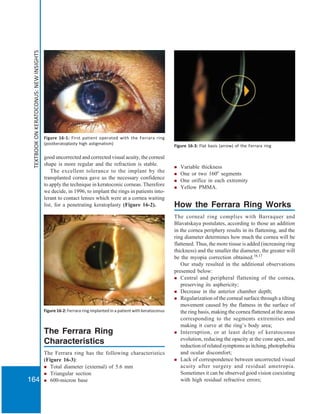
In 1995 we (PF) implanted the first patient who had
undergone penetrating keratoplasty and radial kerato-
tomy (Figure 16-1). This patient was referred to the
Cornea Service at Hospital Sao Geraldo in UFMG
(Federal University of Minas Gerais) for a new transplan-
tation. We decided, with formal authorization of the
patient, to test the ring before performing the penetrating
keratoplasty. The result was satisfactory, yielding
ametropia correction and perfect corneal tolerance to
the orthesis. After a 6-year follow-up, the patient has
TEXTBOOKONKERATOCONUS:NEWINSIGHTS
164
Figure 16-1: First patient operated with the Ferrara ring
(postkeratoplasty high astigmatism)
good uncorrected and corrected visual acuity, the corneal
shape is more regular and the refraction is stable.
The excellent tolerance to the implant by the
transplanted cornea gave us the necessary confidence
to apply the technique in keratoconic corneas. Therefore
we decide, in 1996, to implant the rings in patients into-
lerant to contact lenses which were at a cornea waiting
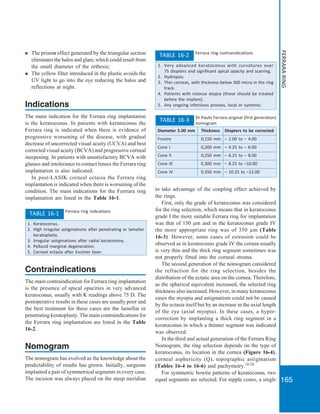
list, for a penetrating keratoplasty (Figure 16-2).
Figure 16-2: Ferrara ring implanted in a patient with keratoconus
The Ferrara Ring
Characteristics
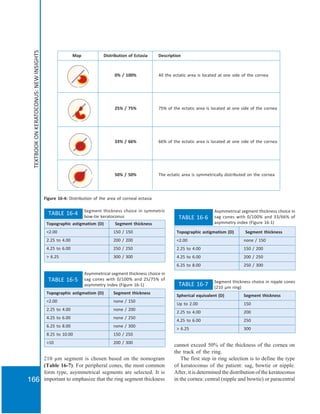
The Ferrara ring has the following characteristics
(Figure 16-3):
 Total diameter (external) of 5.6 mm
 Triangular section
 600-micron base
Figure 16-3: Flat basis (arrow) of the Ferrara ring
 Variable thickness
 One or two 160o
segments
 One orifice in each extremity
 Yellow PMMA.
How the Ferrara Ring Works
The corneal ring complies with Barraquer and
Blavatskaya postulates, according to those an addition
in the cornea periphery results in its flattening, and the
ring diameter determines how much the cornea will be
flattened. Thus, the more tissue is added (increasing ring
thickness) and the smaller the diameter, the greater will
be the myopia correction obtained.16,17
Our study resulted in the additional observations
presented below:
 Central and peripheral flattening of the cornea,
preserving its asphericity;
 Decrease in the anterior chamber depth;
 Regularization of the corneal surface through a tilting
movement caused by the flatness in the surface of
the ring basis, making the cornea flattened at the areas
corresponding to the segments extremities and
making it curve at the ring’s body area;
 Interruption, or at least delay of keratoconus
evolution, reducing the opacity at the cone apex, and
reduction of related symptoms as itching, photophobia
and ocular discomfort;
 Lack of correspondence between uncorrected visual
acuity after surgery and residual ametropia.
Sometimes it can be observed good vision coexisting
with high residual refractive errors;
165
FERRARARING
 The prisma effect generated by the triangular section
eliminates the halos and glare, which could result from
the small diameter of the orthesis;
 The yellow filter introduced in the plastic avoids the
UV light to go into the eye reducing the halos and
reflections at night.
Indications
The main indication for the Ferrara ring implantation
is the keratoconus. In patients with keratoconus the
Ferrara ring is indicated when there is evidence of
progressive worsening of the disease, with gradual
decrease of uncorrected visual acuity (UCVA) and best
corrected visual acuity (BCVA) and progressive corneal
steepening. In patients with unsatisfactory BCVA with
glasses and intolerance to contact lenses the Ferrara ring
implantation is also indicated.
In post-LASIK corneal ectasia the Ferrara ring
implantation is indicated when there is worsening of the
condition. The main indications for the Ferrrara ring
implantation are listed in the Table 16-1.
TABLE 16-1 Ferrara ring indications
1. Keratoconus.
2. High irregular astigmatisms after penetrating or lamellar
keratoplasty.
3. Irregular astigmatisms after radial keratotomy.
4. Pellucid marginal degeneration.
5. Corneal ectasia after Excimer laser.
Contraindications
The main contraindication for Ferrara ring implantation
is the presence of apical opacities in very advanced
keratoconus, usually with K readings above 75 D. The
postoperative results in these cases are usually poor and
the best treatment for these cases are the lamellar or
penetrating keratoplasty. The main contraindications for
the Ferrara ring implantation are listed in the Table
16-2.
Nomogram
The nomogram has evolved as the knowledge about the
predictability of results has grown. Initially, surgeons
implanted a pair of symmetrical segments in every case.
The incision was always placed on the steep meridian
TABLE 16-2 Ferrara ring contraindications
1. Very advanced keratoconus with curvatures over
75 diopters and significant apical opacity and scarring.
2. Hydropsis.
3. Thin corneas, with thickness below 300 micra in the ring
track.
4. Patients with intense atopia (these should be treated
before the implant).
5. Any ongoing infectious process, local or systemic.
TABLE 16-3 Dr Paulo Ferrara original (first generation)
nomogram
Diameter 5.00 mm Thickness Diopters to be corrected
Frustre 0,150 mm – 2.00 to – 4.00
Cone I 0,200 mm – 4.25 to – 6.00
Cone II 0,250 mm – 6.25 to – 8.00
Cone III 0,300 mm – 8.25 to –10.00
Cone IV 0,350 mm – 10.25 to –12.00
to take advantage of the coupling effect achieved by
the rings.
First, only the grade of keratoconus was considered
for the ring selection, which means that in keratoconus
grade I the more suitable Ferrara ring for implantation
was that of 150 µm and in the keratoconus grade IV
the more appropriate ring was of 350 µm (Table
16-3). However, some cases of extrusion could be
observed as in keratoconus grade IV the cornea usually
is very thin and the thick ring segment sometimes was
not properly fitted into the corneal stroma.
The second generation of the nomogram considered
the refraction for the ring selection, besides the
distribution of the ectatic area on the cornea. Therefore,
as the spherical equivalent increased, the selected ring
thickness also increased. However, in many keratoconus
cases the myopia and astigmatism could not be caused
by the ectasia itself but by an increase in the axial length
of the eye (axial myopia). In these cases, a hyper-
correction by implanting a thick ring segment in a
keratoconus in which a thinner segment was indicated
was observed.
In the third and actual generation of the Ferrara Ring
Nomogram, the ring selection depends on the type of
keratoconus, its location in the cornea (Figure 16-4),
corneal asphericity (Q), topographic astigmatism
(Tables 16-4 to 16-6) and pachymetry.18-20
For symmetric bowtie patterns of keratoconus, two
equal segments are selected. For nipple cones, a single
TEXTBOOKONKERATOCONUS:NEWINSIGHTS
166
Map Distribution of Ectasia Description
0% / 100% All the ectatic area is located at one side of the cornea
25% / 75% 75% of the ectatic area is located at one side of the cornea
33% / 66% 66% of the ectatic area is located at one side of the cornea
50% / 50% The ectatic area is symmetrically distributed on the cornea
Figure 16-4: Distribution of the area of corneal ectasia
TABLE 16-4 Segment thickness choice in symmetric
bow-tie keratoconus
Topographic astigmatism (D) Segment thickness
<2.00 150 / 150
2.25 to 4.00 200 / 200
4.25 to 6.00 250 / 250
> 6.25 300 / 300
TABLE 16-5
Asymmetrical segment thickness choice in
sag cones with 0/100% and 25/75% of
asymmetry index (Figure 16-1)
Topographic astigmatism (D) Segment thickness
<2.00 none / 150
2.25 to 4.00 none / 200
4.25 to 6.00 none / 250
6.25 to 8.00 none / 300
8.25 to 10.00 150 / 250
>10 200 / 300
TABLE 16-6
Asymmetrical segment thickness choice in
sag cones with 0/100% and 33/66% of
asymmetry index (Figure 16-1)
Topographic astigmatism (D) Segment thickness
<2.00 none / 150
2.25 to 4.00 150 / 200
4.25 to 6.00 200 / 250
6.25 to 8.00 250 / 300
210 µm segment is chosen based on the nomogram
(Table 16-7). For peripheral cones, the most common
form type, asymmetrical segments are selected. It is
important to emphasize that the ring segment thickness
TABLE 16-7 Segment thickness choice in nipple cones
(210 µm ring)
Spherical equivalent (D) Segment thickness
Up to 2.00 150
2.25 to 4.00 200
4.25 to 6.00 250
> 6.25 300
cannot exceed 50% of the thickness of the cornea on
the track of the ring.
The first step in ring selection is to define the type
of keratoconus of the patient: sag, bowtie or nipple.
After, it is determined the distribution of the keratoconus
in the cornea: central (nipple and bowtie) or paracentral
167
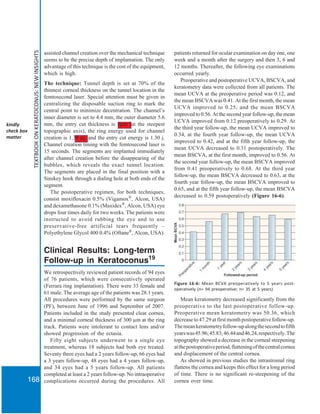
FERRARARINGFigure 16-5: Q (asphericity) variation according to ring thickness
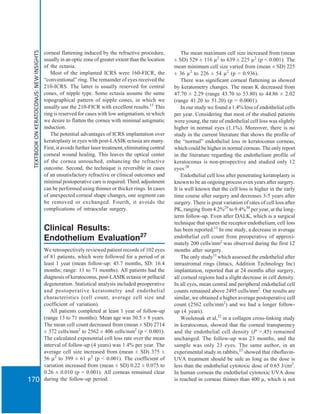
TABLE 16-8 Ferrara ring Nomogram: step-by-step
1. Define the keratoconus type: sag, bowtie or nipple.
2. Distribution of the ectasic area in the cornea: 0/100, 25/
75, 50/50 and 33/66.
3. Corneal asphericity (Q).
4. Topographic astigmatism.
5. Pachymetry at incision site and ring track.
(asymmetric) – (0/100, 25/75 and 33/66 – Figure
16-2). The next step is to evaluate the preoperative
corneal asphericity value (Q), which is desirable but not
indispensable, as most corneal topographers do not show
this data. However, preliminary data shows that the
corneal asphericity may be linked to quality of vision,
therefore, when possible this data should be obtained
by corneal tomographers (Orbscan® and Pentacam®),
to achieve the best possible visual results. We have
described (unpublished study) that for each ring segment
there is a correspondent Q value reduction (Figure
16-5). A target postoperative Q value closest possible
of -0.23 is the goal after Ferrara ring implantation.
The topographic astigmatism defines the thickness
of the rings to be implanted (Tables 16-4 to 16-6). The
only type of keratoconus that does not depend on the
topographic astigmatism for ring selection is the nipple
conus. In this case the spherical equivalent defines the
thickness of the ring to be implanted, which should be
a 210-arc ring, which is indicated exclusively for this
type of keratoconus.18
The pachymetry at the incision site (steep axis of the
cornea) must be determined. The incision depth must
be 80% of the cornea thickness at the incision site. The
pachymetry should me measured in all ring track to avoid
superficial rings, which could lead to future extrusion.
Surgical Techniques
MANUAL TECHNIQUES
The surgery is performed under topical anesthesia after
miosis achieved with 2% pilocarpine. An eyelid
speculum is used to expose the eye and 2.5% povidone
iodine eyedrops is instilled into the cornea and
conjunctival cul-de-sac. The visual axis is marked by
pressing the Sinskey hook on the central corneal
epithelium while asking the patient to fixate on the
corneal light reflex of the microscope light. Using a
marker tinted with gentian-violet tinted, a 5.0 mm optical
zone and incision site are aligned to the desired axis
in which the incision will be made. This site can be the
steepest topographic axis of the cornea (in case of
implantation of two segments) or 90° (in case of
implantation of only one segment – one of the tips of
the ring must be located on the steepest axis).
The depth of a 1.0 mm, square diamond blade is set
at 80% of corneal thickness at the incision site and this
blade is used to make the incision. Using a “stromal
spreader”, a pocket is formed in each side of the incision.
Two(clockwiseandcounterclockwise)270°semicircular
dissecting spatulas are consecutively inserted through
the incision and gently pushed with some, quick, rotary
“back and forth” tunneling movements. Following
channel creation, the ring segments are inserted using
a modified McPherson forceps. The rings are properly
positioned with the aid of a Sinskey hook.
FEMTOSECOND LASER TECHNIQUE
The femtosecond laser (IntraLase Corp.) has been
recently introduced in clinical practice whose surgical
effect via photodisruption can be used as an alternative
to traditional mechanical techniques. Several recent
papers21-24
have reported its efficacy and safety for tunnel
creation and intrastromal rings implantation. The
femtosecond laser can easily and quickly create a
predetermined depth and channel size.
There is controversy over channel size nomograms
with the technique. Some authors conclude that more
effect can be achieved by making the stromal channels
narrower than the ring size, leading to faster visual
results.25
The use of the femtosecond laser in corneal tunnel
creation made the procedure faster, easier (especially
for inexperienced surgeons), and more comfortable for
the patient. However, the main advantage of IntraLase-
TEXTBOOKONKERATOCONUS:NEWINSIGHTS
168
patients returned for ocular examination on day one, one
week and a month after the surgery and then 3, 6 and
12 months. Thereafter, the following eye examinations
occurred yearly.
Preoperative and postoperative UCVA, BSCVA, and
keratometry data were collected from all patients. The
mean UCVA at the preoperative period was 0.12, and
the mean BSCVA was 0.41. At the first month, the mean
UCVA improved to 0.25, and the mean BSCVA
improved to 0.56. At the second year follow-up, the mean
UCVA improved from 0.12 preoperatively to 0.29. At
the third year follow-up, the mean UCVA improved to
0.34, at the fourth year follow-up, the mean UCVA
improved to 0.42, and at the fifth year follow-up, the
mean UCVA decreased to 0.31 postoperatively. The
mean BSCVA, at the first month, improved to 0.56. At
the second year follow-up, the mean BSCVA improved
from 0.41 preoperatively to 0.68. At the third year
follow-up, the mean BSCVA decreased to 0.63, at the
fourth year follow-up, the mean BSCVA improved to
0.65, and at the fifth year follow-up, the mean BSCVA
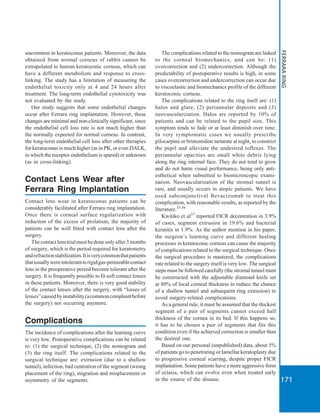
decreased to 0.59 postoperatively (Figure 16-6).
assisted channel creation over the mechanical technique
seems to be the precise depth of implantation. The only
advantage of this technique is the cost of the equipment,
which is high.
The technique: Tunnel depth is set at 70% of the
thinnest corneal thickness on the tunnel location in the
femtosecond laser. Special attention must be given in
centralizing the disposable suction ring to mark the
central point to minimize decentration. The channel’s
inner diameter is set to 4.4 mm, the outer diameter 5.6
mm, the entry cut thickness is 1m (at the steepest
topographic axis), the ring energy used for channel
creation is 1.30 j, and the entry cut energy is 1.30 j.
Channel creation timing with the femtosecond laser is
15 seconds. The segments are implanted immediately
after channel creation before the disappearing of the
bubbles, which reveals the exact tunnel location.
The segments are placed in the final position with a
Sinskey hook through a dialing hole at both ends of the
segment.
The postoperative regimen, for both techniques,
consist moxifloxacin 0.5% (Vigamox®
, Alcon, USA)
and dexamethasone 0.1% (Maxidex®
, Alcon, USA) eye
drops four times daily for two weeks. The patients were
instructed to avoid rubbing the eye and to use
preservative-free artificial tears frequently –
Polyethylene Glycol 400 0.4% (Oftane®
, Alcon, USA).
Clinical Results: Long-term
Follow-up in Keratoconus19
We retrospectively reviewed patient records of 94 eyes
of 76 patients, which were consecutively operated
(Ferrara ring implantation). There were 33 female and
61 male. The average age of the patients was 28.1 years.
All procedures were performed by the same surgeon
(PF), between June of 1996 and September of 2007.
Patients included in the study presented clear cornea,
and a minimal corneal thickness of 300 µm at the ring
track. Patients were intolerant to contact lens and/or
showed progression of the ectasia.
Fifty eight subjects underwent to a single eye
treatment, whereas 18 subjects had both eye treated.
Seventy three eyes had a 2 years follow-up, 66 eyes had
a 3 years follow-up, 48 eyes had a 4 years follow-up,
and 34 eyes had a 5 years follow-up. All patients
completed at least a 2 years follow-up. No intraoperative
complications occurred during the procedures. All
Figure 16-6: Mean BCVA preoperatively to 5 years post-
operatively (n= 94 preoperative; n= 35 at 5 years)
Mean keratometry decreased significantly from the
preoperative to the last postoperative follow-up.
Preoperative mean keratometry was 50.36, which
decrease to 47.29 at first month postoperative follow-up.
Themeankeratometryfollow-upalongthesecondtofifth
yearswas45.96;45.83;46.44and46.24,respectively.The
topography showed a decrease in the corneal steepening
atthepostoperativeperiod,flatteningofthecentralcornea
and displacement of the central cornea.
As showed in previous studies the intrastromal ring
flattens the cornea and keeps this effect for a long period
of time. There is no significant re-steepening of the
cornea over time.
kindly
check box
matter
169
FERRARARING
The present study showed that the Ferrara ring,
despite the small sample of patients, can be a valuable
tool to provide topographic and visual stability, delay
the progression of keratoconus and postpone a corneal
grafting surgery to more physiological position.
Clinical Results:
The 210 Ferrara Ring18
The 210-degrees of arc Ferrara intrastromal corneal ring
(210-FICR), which is a novel FICR, has 3 major
advantages over the conventional ring: (1) minimal
astigmatic induction; (2) corneal flattening and (3)
implantation of a single segment. This ring is especially
useful for the nipple type of keratoconus. The 210-FICR
is an efficient method for keratoconus correction,
significantly decreasing the keratometric values,
spherical equivalent and improving UCVA and BCVA.
We retrospectively reviewed patient records of 80
eyes of 76 patients, which were consecutively operated,
in which the 210-FICR was implanted. Statistical
analysis included preoperative and postoperative
uncorrected visual acuity (UCVA), best-corrected visual
acuity (BCVA), spherical equivalent and keratometry.
The mean follow-up time was 6.65 months. The mean
UCVA increased from 20/350 to 20/136 (p=0.001). The
mean BCVA increased from 20/125 to 20/55
(p=0.0001). The mean preoperative spherical equivalent
decreased from – 5.22 D, preoperative, to – 2.26 D
(p=0.050), postoperative.
Corneal tomography (Pentacam®
) showed corneal
flattening in all eyes. The mean K1 decreased from 51.49
D to 47.40 D (p = 0.00014) and the mean K2 decreased
from 54.33 D to 49.14 D (p = 0.00022). The mean
keratometric astigmatism decreased from 3.65 D
(preoperative) to 2.69 D (postoperative) (p = 0.0001).
ClinicalResults:Post-refractive
Surgery Corneal Ectasia26
Twenty-five eyes of 20 patients with corneal ectasia (13
males [15 eyes] and 7 females [10 eyes]) who underwent
Ferrara intracorneal ring segments (ICRS) implantation
were included in this study.
The mean follow-up time was 39.8 ± 21.1 months
(Table 16-1). All patients had implanted only one
segment of ICRS. A 160 degree of arc ring (160-ICRS)
was implanted in 18 eyes and the 210 degree of arc ring
(210-ICRS) was implanted in 7 eyes.
The mean UCVA increased from 20/185 to 20/66
(p=0.005). The mean BCVA increased from 20/125 to
20/40 (p=0.008) (Figure 16-5). The mean asphericity
values decreased from – 0.95, preoperatively, to – 0.23
(p=0.006), postoperatively.
The mean pachymetry at the apex of the cornea
increased from (mean) 457.7 ± 48.7 µm (range 361 to
542) to 466.2 ± 49.8 µm (range 381 to 559) (p =0.025)
and the pachymetry at thinnest point of the cornea
increased from 436.3 ± 46.2 µm (range 348 to 533) to
453.9 ± 49.3 µm (range 370 to 548) (p = 0.000). A
significant reduction in keratometric values was found
at the last follow-up examination; mean preoperative
keratometry was decreased from 45.41 ± 5.63 D (range
37.3 to 55.5) and changed significantly to 42.88 ± 4.44
D (range 31.2 to 54.1) (p = 0.000) (Figure 16-6).
Our postoperative results show a significant
improvement in UCVA and BCVA. Moreover, there
was significant increase in corneal thickness. This can
be explained by a theoretically cornea collagen
remodeling induced by the implantation of ICRS.
We found a significant decrease in asphericity values
after implantation of ICRS in this study. Interestingly,
the mean postoperative value was – 0.23, which is
considered the “normal” value for the general
population. This value means that the normal physiologic
asphericity of the cornea shows a significant individual
variation ranging from mild oblate to moderate
prolate. In an unpublished study, where we evaluated
the corneal asphericity changes induced by the ICRS
in keratoconus we found that the Ferrara intrastromal
ring implantation significantly reduced the mean corneal
asphericity from – 0.85 to -0.32. It is well known that
most corneas after ablation laser procedures tend to
become oblate, and when the ectasia develops these
corneas usually become prolate. However, the excess
of prolatism usually found in keratoconus (primary) is
usually of a much larger amount that one found in post-
refractive surgery ectasia. That is the probable reason
the Q value after FICR becomes much closer to “normal”
values than when the ring is used for keratoconus. As
the asphericity is one of markers of visual quality, turning
it “normal” can be a predictor of improvement of visual
quality.
The keratometry values reduced significantly in all
eyes. It can be realized that the mean preoperative values
are usually lower than ones found in keratoconus
(primary). This can be explained somewhat by the
kindly check
TEXTBOOKONKERATOCONUS:NEWINSIGHTS
170
corneal flattening induced by the refractive procedure,
usually in an optic zone of greater extent than the location
of the ectasia.
Most of the implanted ICRS were 160-FICR, the
“conventional” ring. The remainder of eyes received the
210-ICRS. The latter is usually reserved for central
cones, of nipple type. Some ectasia assume the same
topographical pattern of nipple cones, in which we
usually use the 210-FICR with excellent results.15
This
ring is reserved for cases with low astigmatism, in which
we desire to flatten the cornea with minimal astigmatic
induction.
The potential advantages of ICRS implantation over
keratoplasty in eyes with post-LASIK ectasia are many.
First, it avoids further laser treatment, eliminating central
corneal wound healing. This leaves the optical center
of the cornea untouched, enhancing the refractive
outcome. Second, the technique is reversible in cases
of an unsatisfactory refractive or clinical outcomes and
minimal postoperative care is required. Third, adjustment
can be performed using thinner or thicker rings. In cases
of unexpected corneal shape changes, one segment can
be removed or exchanged. Fourth, it avoids the
complications of intraocular surgery.
Clinical Results:
Endothelium Evaluation27
We retrospectively reviewed patient records of 102 eyes
of 81 patients, which were followed for a period of at
least 1 year (mean follow-up: 45.7 months, SD: 16.4
months; range: 13 to 71 months). All patients had the
diagnosis of keratoconus, post-LASIK ectasia or pellucid
degeneration. Statistical analysis included preoperative
and postoperative keratometry and endothelial
characteristics (cell count, average cell size and
coefficient of variation).
All patients completed at least 1 year of follow-up
(range 13 to 71 months). Mean age was 30.5 ± 8 years.
The mean cell count decreased from (mean ± SD) 2714
± 372 cells/mm2
to 2562 ± 406 cells/mm2
(p < 0.001).
The calculated exponential cell loss rate over the mean
interval of follow-up (4 years) was 1.4% per year. The
average cell size increased from (mean ± SD) 375 ±
56 µ2
to 399 ± 61 µ2
(p < 0.001). The coefficient of
variation increased from (mean ± SD) 0.22 ± 0.075 to
0.26 ± 0.010 (p = 0.001). All corneas remained clear
during the follow-up period.
The mean maximum cell size increased from (mean
± SD) 529 ± 116 µ2
to 639 ± 225 µ2
(p < 0.001). The
mean minimum cell size varied from (mean ± SD) 225
± 36 µ2
to 226 ± 54 µ2
(p = 0.936).
There was significant corneal flattening as showed
by keratometry changes. The mean K decreased from
47.70 ± 2.29 (range 43.70 to 53.80) to 44.86 ± 2.02
(range 41.20 to 51.20) (p = 0.0001).
In our study we found a 1.4% loss of endothelial cells
per year. Considering that most of the studied patients
were young, the rate of endothelial cell loss was slightly
higher in normal eyes (1.1%). Moreover, there is no
study in the current literature that shows the profile of
the “normal” endothelial loss in keratoconus corneas,
which could be higher in normal corneas. The only report
in the literature regarding the endothelium profile of
keratoconus is non-prospective and studied only 12
eyes.28
Endothelial cell loss after penetrating keratoplasty is
known to be an ongoing process even years after surgery.
It is well known that the cell loss is higher in the early
time course after surgery and decreases 3-5 years after
surgery. There is great variation of rates of cell loss after
PK, ranging from 4.2%29
to 9.4%30
per year, at the long-
term follow-up. Even after DALK, which is a surgical
technique that spares the receptor endothelium, cell loss
has been reported.15
In one study, a decrease in average
endothelial cell count from preoperative of approxi-
mately 200 cells/mm2
was observed during the first 12
months after surgery.
The only study31
which assessed the endothelial after
intrastromal rings (Intacs, Addition Technology Inc)
implantation, reported that at 24 months after surgery,
all corneal regions had a slight decrease in cell density.
In all eyes, mean central and peripheral endothelial cell
counts remained above 2495 cells/mm2
. Our results are
similar, we obtained a higher average postoperative cell
count (2562 cells/mm2
) and we had a longer follow-
up (4 years).
Woolensak et al,32
in a collagen cross-linking study
in keratoconus, showed that the corneal transparency
and the endothelial cell density (P =.45) remained
unchanged. The follow-up was 23 months, and the
sample was only 23 eyes. The same author, in an
experimental study in rabbits,23
showed that riboflavin-
UVA treatment should be safe as long as the dose is
less than the endothelial cytotoxic dose of 0.65 J/cm2
.
In human corneas the endothelial cytotoxic UVA dose
is reached in corneas thinner than 400 µ, which is not
171
FERRARARING
uncommon in keratoconus patients. Moreover, the data
obtained from normal corneas of rabbit cannot be
extrapolated to human keratoconic corneas, which can
have a different metabolism and response to cross-
linking. The study has a limitation of measuring the
endothelial toxicity only at 4 and 24 hours after
treatment. The long-term endothelial cytotoxicity was
not evaluated by the study.
Our study suggests that some endothelial changes
occur after Ferrara ring implantation. However, these
changes are minimal and non-clinically significant, since
the endothelial cell loss rate is not much higher than
the normally expected for normal corneas. In contrast,
the long-term endothelial cell loss after other therapies
for keratoconus is much higher (as in PK, or even DALK,
in which the receptor endothelium is spared) or unknown
(as in cross-linking).
Contact Lens Wear after
Ferrara Ring Implantation
Contact lens wear in keratoconus patients can be
considerably facilitated after Ferrara ring implantation.
Once there is corneal surface regularization with
reduction of the excess of prolatism, the majority of
patients can be well fitted with contact lens after the
surgery.
Thecontactlenstrialmustbedoneonlyafter3months
of surgery, which is the period required for keratometry
andrefractionstabilization.Itisverycommonthatpatients
thatusuallywereintoleranttorigidgas-permeablecontact
lens in the preoperative period become tolerant after the
surgery. It is frequently possible to fit soft contact lenses
in these patients. Moreover, there is very good stability
of the contact lenses after the surgery, with “losses of
lenses”causedbyinstability(acommoncomplaintbefore
the surgery) not occurring anymore.
Complications
The incidence of complications after the learning curve
is very low. Postoperative complications can be related
to: (1) the surgical technique, (2) the nomogram and
(3) the ring itself. The complications related to the
surgical technique are: extrusion (due to a shallow
tunnel), infection, bad centration of the segment (wrong
placement of the ring), migration and misplacement or
asymmetry of the segments.
The complications related to the nomogram are linked
to the corneal biomechanics, and can be: (1)
overcorrection and (2) undercorrection. Although the
predictability of postoperative results is high, in some
cases overcorrection and undercorrection can occur due
to viscoelastic and biomechanics profile of the different
keratoconic corneas.
The complications related to the ring itself are: (1)
halos and glare, (2) periannular deposits and (3)
neovascularization. Halos are reported by 10% of
patients and can be related to the pupil size. This
symptom tends to fade or at least diminish over time.
In very symptomatic cases we usually prescribe
pilocarpine or brimonidine tartarate at night, to constrict
the pupil and alleviate the undesired reflexes. The
periannular opacities are small white debris lying
along the ring internal face. They do not tend to grow
and do not harm visual performance, being only anti-
esthetical when submitted to biomicroscopic exami-
nation. Neovascularization of the stromal tunnel is
rare, and usually occurs in atopic patients. We have
used subconjunctival Bevacizumab to treat this
complication, with reasonable results, as reported by the
literature.33-36
Kwitiko et al37
reported FICR decentration in 3.9%
of cases, segment extrusion in 19.6% and bacterial
keratitis in 1.9%. As the author mention in his paper,
the surgeon’s learning curve and different healing
processes in keratoconic corneas can cause the majority
of complications related to the surgical technique. Once
the surgical procedure is mastered, the complications
rate related to the surgery itself is very low. The surgical
steps must be followed carefully (the stromal tunnel must
be constructed with the adjustable diamond knife set
at 80% of local corneal thickness to reduce the chance
of a shallow tunnel and subsequent ring extrusion) to
avoid surgery-related complications.
As a general rule, it must be assumed that the thickest
segment of a pair of segments cannot exceed half
thickness of the cornea in its bed. If this happens so,
it has to be chosen a pair of segments that fits this
condition even if the achieved correction is smaller than
the desired one.
Based on our personal (unpublished) data, about 5%
of patients go to penetrating or lamellar keratoplasty due
to progressive corneal scarring, despite proper FICR
implantation. Some patients have a more aggressive form
of ectasia, which can evolve even when treated early
in the course of the disease.
TEXTBOOKONKERATOCONUS:NEWINSIGHTS
172
Comments
Preliminary investigations have demonstrated that
intracorneal rings are effective in the treatment of
astigmatism and myopia with astigmatism,9
with
preservation of BCVA and stable results over time.10
The objective of the addictive technology is to reinforce
the cornea, decrease the corneal irregularity and to
provide an improvement of the visual acuity in affected
patients.
It is important to note an important reduction of
keratometric values after the Ferrara ring implantation,
with corneal regularization and return to its physiological
values when the intervention is made early in the course
of the disease. However, in a late intervention, with
values of keratometry superior to 56 D, it is also showed
a reduction of the K, high keratometry values remain
when compared to a normal cornea.
Our clinical findings are in agreement with other
studies: Miranda et al38
obtained on their study a signi-
ficant reduction in the mean central corneal curvature
postoperatively. BSCVA and UCVA improved in 87.1%
and 80.6% of the eyes, respectively. Siganos et al4
showed an increase of the mean UCVA from 0.07 +
0.08 preoperatively to 0.20 + 0.13 and 0.30 + 0.21 after
1 and 6 months, respectively, and the mean
BSCVA improved from 0.37 + 0.25 preoperatively to
0.50 + 0.43 and 0.60 + 0.17 after 1 and 6 months,
respectively.
The Ferrara’s ring technique has the objective of
reshape the abnormal cornea, flattening the periphery
and decreasing the corneal astigmatism. With the
objective to avoid, or at least postpone the keratoplasty,
the technique is within the options of visual rehabilitation
of patients with keratoconus.
Observing the clinical outcomes of our patients, we
could realize that the visual rehabilitation curve and
refractive stabilization, occurs on average, after three
months of surgery. The visual rehabilitation process
follows a certain pattern. In general, vision improvement
is quick and, on the day following surgery, the patients
usually report subjective and objective improvement of
the visual acuity. However, it usually reverts within the
first weeks and at the end of the first month the patient
reports his/her vision was better immediately after
surgery. The same fluctuation is detected in relation to
refraction and keratometry. From the first month on, the
vision starts to improve and refractive and keratometric
fluctuation decreases. From the third month on, it
stabilizes. Then, it is possible to correct the residual
ametropia, if necessary, by means of eyeglasses, rigid
or soft contact lenses or even implanting phakic
intraocular lenses for high myopia correction.
We could notice that patients having central cones
show a longer rehabilitation time, which means, the
central flattening is slower, while patients with
decentralized cones have faster rehabilitation. We
believe this is due to the dislocation or the corneal apex
towards its physiological position in front of the pupil.
In some cases, we could observe that after the ring
implantation there was an increase in myopia and in the
keratometric readings, caused by this same phenomenon.
As the 210-FICR study showed, the results in these types
of cones, especially nipple cones, are satisfactory.
The endothelial study showed that the Ferrara ring
has minimal effect on the cornea endothelium. In our
study we found a 1.4% loss of endothelial cells per year.
Consideringthatmostofthestudiedpatientswereyoung,
the rate of endothelial cell loss was slightly higher than
in normal eyes (1.1%). Moreover, there is no study in
thecurrentliteraturethatshowstheprofileofthe“normal”
endothelial loss in keratoconus corneas, which could be
higher than in normal corneas. The only report in the
literature regarding the endothelium profile of kerato-
conus is non-prospective and studied only 12 eyes.28
Symptoms like photophobia, visual discomfort, eye
strain and itching diminish or disappear after surgery.
Most of our patients are allergic, therefore we
recommend strongly that they should not rub their eyes,
which could displace the segments, and stimulate the
disease progression. In addition, rubbing could
theoretically change the regularity of the cornea surface
leading to visual acuity loss. In some cases can be
necessary to use eye shields at night to prevent the patient
from rubbing the eyes compulsively and unwarily.
The satisfaction level is high. We could observe that
the fear of becoming blind in those patients, along with
the fearsome possibility of a transplant in case of a
continuously evolving condition is very common. The
possibility of postponing those eventualities generates
great relief, by the patients. Our cases show that, besides
correcting the corneal deformity, the cone evolution is
interrupted. Along with this interruption, we could also
observe a decrease in corneal opacity and the other
symptoms aforementioned.
The surgery is simple and well reproducible, although
it is not an easy procedure. As in any other procedure,
it must be well executed to attain a consistent result.
173
FERRARARING
The incidence of complications is very low, around
3 to 5%, compatible with the levels required for refractive
procedures. It should be emphasized that the corneal
ring implant is essentially an orthopedic technique
designed to enable the correction of a structural
deformity. As an advantage, it provides simultaneous
refractive correction, although not well predictable, as
with other refractive procedures.
The analysis of the results reveals that the visual
rehabilitation without correction is satisfactory on initial
stages of keratoconus (I and II), and it decreases in more
advanced stages “nipple” type of keratoconus take longer
to rehabilitate than those of the “sag” type. Conventional
optical correction allows a high rate of visual correction
– equal or greater than 20/60 – and the resulting
flattening enable the use of toric or spherical soft lenses,
as well as re-fitting of rigid contact lenses, with an
improvement in tolerance.
Whenever it was necessary to perform the kerato-
plasty, the ring not only helped the procedure, but also
provided a better centralization during trephination.
We could also notice that, after surgery, there was
a decrease in the corneal sensitivity, resulting in greater
comfort in contact lens fitting, which was not possible
before the operation.
The incidence of complications is greater in more
advanced stages, because the cornea is thinner and the
pressure generated inside the stroma after the ring
implantation can cause the displacement of segments
toward the incisions, eventually extruding the segments.
Conclusion
From the results obtained, we can state that this
therapeutic approach has the following benefits:
1. Low morbidity, because it preserves the cornea
structure and has a low rate of complications,
allowing 95% of the operated patients to quickly
reintegrate themselves to their everyday activities
2. Reversibility, because it enables the cornea to
revert to the preoperative dimensions when the
segments are removed.
3. Readjustability through segment replacement. In
some cases, it was possible to correct hyper-
correction removing just one of the segments.
4. Lack of rejection, the acrylic which the ring is
made is inert and biocompatible.
5. Patients´ high satisfaction rate.
6. As an orthopedic technique, it corrects corneal
deformity and restores the physiologic curvature.
After the surgery it is possible to correct the
residual ametropia with conventional optical
correction or contact lenses.
7. Stabilization or delay of cone progression.
8. Lack of a minimum age for surgery, thus making
it possible to reduce the wait lists for transplants
in eye banks (30% of the transplants in eye banks
are attributed to keratoconus).
9. Possibility of association with other procedures
like contact lens fitting and intraocular lenses.
10. No interference whatsoever with corneal
transplant.
For all the reasons above, we believe the corneal
intrastromal ring implant technique should be formally
adopted as an extra option in treating corneal diseases
which otherwise have had corneal transplant as a sole
and ultimate solution.
References
1. Colin J, Velou S. Implantation of Intacs and a refractive
intraocular lens to correct keratoconus. J Cataract Refract
Surg 2003;29:832–4
2. Asbell PA, Ucakhan O. Long-term follow-up of Intacs from
a single center. J Cataract Refract Surg 2001;27:1456–68
3. Colin J, Cochener B, Savary G, et al. Correcting
keratoconus with intracorneal rings. J Cataract Refract Surg
2000;26:1117–22.
4. Siganos D, Ferrara P, Chatzinikolas K, et al. Ferrara
intrastromal corneal rings for the correction of keratoconus.
J Cataract Refract Surg 2002;28:1947–51.
5. Colin J, Cochener B, SavaryG, et al. INTACS inserts for
treating keratoconus; one-year results. Ophthalmology
2001;108:1409–14
6. Siganos CS, Kymionis GD, Kartakis N, et al. Management
of keratoconus with Intacs. Am J Ophthalmol 2003;135:64–
70.
7. Assil KK, Barrett AM, Fouraker BD, Schanzlin DJ. One-
year results of the intrastromal corneal ring in nonfunctional
human eyes; the Intrastromal Corneal Ring Study Group.
Arch Ophthalmol 1995;113:159–67.
8. Siganos CS, Kymionis GD, Astyrakakis N, et al.
Management of corneal ectasia after laser in situ kerato-
mileusis with INTACS. J Refract Surg 2002;18:43–46.
9. Silva FBD, Alves EAF, Cunha PFA. Utilização do Anel
de Ferrara na estabilização e correção da ectasia corneana
pós PRK. Arq Bras Oftalmol 2000;63:215–8.
10. Ruckhofer J, Stoiber J, Twa MD, et al. Correction of
astigmatism with short arc-length intrastromal corneal ring
segments: preliminary results. Ophthalmology 2003;110:
516–24.
TEXTBOOKONKERATOCONUS:NEWINSIGHTS
174
11. Nose W, Neves RA, Burris TE, et al. Intrastromal corneal
ring: 12-month sighted myopic eyes. J Refract Surg
1996;12:20–28.
12. Schanzlin DJ, Asbell PA, Burris TE, Durrie DS. The
intrastromal ring segments; phase II results for the
correction of myopia. Ophthalmology 1997;104:1067–78.
13. Holmes-Higgin DK, Burris TE, Lapidus JA, Greenlick MR.
Risk factors for self-reported visual symptoms with Intacs
inserts for myopia. Ophthalmology 2002;109:46–56.
14. Asbell PA, Ucakhan O, Abbott RL, et al. Intrastromal
corneal ring segments: reversibility of refractive effect. J
Refract Surg 2001;17:25–31.
15. Barraquer JI. Modification of refraction by means of
intracorneal inclusions. Int Ophthalmol Clin 1966;6(1)53-
78.
16. Barraquer JL. Cirurgia Refractiva de La Cornea Instituto
Barraquer de America – Bogota – Tomo I, 1989.
17. Barraquer JI. Modification of refraction by means of
intracorneal inclusion. Int Ophth Clin 1966;6:53.
18. Ferrara P, Torquetti L. Clinical outcomes after implantation
of a new intrastromal ring with a 210-degree of arch. J
Cataract Refract Surg 2009;35:1604–8.
19. Torquetti L, Ferrara P. Long term follow-up of intrastromal
corneal ring segments in keratoconus. J Cataract Refract
Surg 2009;35:1768–73.
20. Ferrara P, Torquetti L. Ferrara Ring. An Overview. Cataract
and Refractive Surgery Today – Europe October 2009:27–
30.
21. Ertan A, Kamburoglu G, Akgun U. Comparison of
outcomes of 2 channel sizes for intrastromal ring segment
implantation with a femtosecond laser in eyes with
keratoconus. J Cataract Refract Surg 2007;33:648–53.
22. Ertan A, Kamburoglu G, Bahadir M. Intacs insertion with
the femtosecond laser for the management of keratoconus:
one-year results. J Cataract Refract Surg 2006;32:2039–
42.
23. Rabinowitz YS, Li X, Ignacio TS, Maguen E. Intacs inserts
using the femtosecond laser compared to the mechanical
spreader in the treatment of keratoconus. J Refract Surg
2006;22:764–71.
24. Shabayek MH, Alió JL. Intrastromal corneal ring segment
implantation by femtosecond laser for keratoconus
correction. Ophthalmology 2007;114:1643–52.
25. Rabinowitz YS. INTACS for keratoconus. Int Ophthalmol
Clin 2006;46(3):91–103.
26. Torquetti L, Ferrara P. Intrastromal corneal ring segments
implantation in post-refractive surgery ectasia. J Cataract
Refract Surg 2010. In Press.
27. Ferrara P, Torquetti L. Corneal endothelial profile after
Ferrara ring implantation. Journal of Emmetropia. In Press.
28. Bourne WM, Nelson LR, Hodge DO. Continued endo-
thelial cell loss ten years after implantation. Ophthalmology
1994;101:1014–23.
29. Laing RA, Sandstrom MM, Berrospi AR, Leibowitz HM.
The human corneal endothelium in keratoconus: A specular
microscopic study. Arch Ophthalmol 1979;97(10): 1867–
9.
30. Langenbucher A, Nguyen NX, Seitz B. Predictive donor
factors for chronic endothelial cell loss after nonmechanical
penetrating keratoplasty in a regression model. Graefe’s
Arch Clin Exp Ophtalmol 2003;241:975–81.
31. Azar RG, Holdbrook MJ, Lemp M, Edelhauser HF.
KeraVision Stduy Group. Two-year corneal endothelial cell
assessment following INTACS implantation. J Refract Surg
2001;17(5):542–8.
32. Wollensak G, Spoerl E, Wilsch M, Seiler T. Endothelial
cell damage after riboflavin-ultraviolet-A treatment in the
rabbit. J Cataract Refract Surg 2003;29:1786–90.
33. Dastjerdi MH, Al-Arfaj KM, Nallasamy N, Hamrah P,
Jurkunas UV, Pineda R 2nd, et al. Topical bevacizumab
in the treatment of corneal neovascularization: results of
a prospective, open-label, noncomparative study. Arch
Ophthalmol 2009;127(4):381–9.
34. Mackenzie SE, Tucker WR, Poole TR. Bevacizumab
(avastin) for corneal neovascularization—corneal light
shield soaked application. Cornea 2009;28(2):246–7.
35. Chen WL, Lin CT, Lin NT, Tu IH, Li JW, Chow LP, et
al.Subconjunctival injection of bevacizumab (avastin) on
corneal neovascularization in different rabbit models of
corneal angiogenesis. Invest Ophthalmol Vis Sci 2009;
50(4):1659–65.
36. Doctor PP, Bhat PV, Foster CS. Subconjunctival
bevacizumab for corneal neovascularization. Cornea 2008;
27(9):992–5.
37. Kwitko S, Severo N. Ferrara intracorneal ring segments
for keratoconus. J Cataract Refract Surg 2004;30:812–20.
38. Miranda D, Sartori M, Francesconi C, Allemann N, Ferrara
P, Campos M. Ferrara intrastromal corneal ring segments
for severe keratoconus. J Refract Surg. 2003;19(6):
645–53.

Book Chapter

  • 1.
    163 FERRARARING C H AP T E R 16 Ferrara Ring Paulo Ferrara, Leonardo Torquetti Keratoconus is a corneal ectatic disease characterized by non-inflammatory progressive thinning of unknown cause in which the cornea assumes a conical shape. Intrastromal corneal ring segments (ICRS) have been used to correct ectatic corneal diseases in order to reduce the corneal steepening, reduce the irregular astigmatism and improve the visual acuity.1-7 Besides, the ring is a surgical alternative to at least delay, if not eliminate, the need of lamellar or penetrating keratoplasty. The Ferrara ring segments are made of PMMA Perspex CQ acrylic segments. They vary in thickness, and are available in 0.15, 0.20, 0.25 and 0.30 mm. The segment cross-section is triangular, and the base for every thickness and diameter is 0.60 mm. The segments have 90, 120, 160 or 210 degrees of arc. Many studies have demonstrated the efficacy of intrastromal rings to treat many corneal conditions as keratoconus,1-7 post–LASIK corneal ectasia,8 post-radial keratotomy ectasia,9 astigmatism10 and myopia.11-14 The changes in corneal structure induced by additive technologies can be roughly predicted by the Barraquer´s thickness law; that is when material is added to the periphery of the cornea or an equal amount of material is removed from the central area, a flattening effect is achieved. The corrective result varies in direct proportion to the thickness of the implant and in inverse proportion to its diameter. The thicker and smaller the diameter of the device, the higher the corrective result.15 Preliminary investigations have demonstrated that ICRS are effective in the treatment of astigmatism and myopia with astigmatism,15 with preservation of visual acuity and stable results over time.16 The objective of the addictive technology is to reinforce the cornea, decrease the corneal irregularity and to provide an improvement of the visual acuity in affected patients. The research about the Ferrara ring began in 1985. In 1986 we (PF) realized that to keep the implant in place it was necessary a large hole in the center of the lens what resulted in an annular prostheses. Since then we started trying several annular shapes and diameters and from these researches we concluded that the best project is the one we are using nowadays, made of PMMA, with a total diameter of 5.0 mm, arc length ranging from 90 to 210 degree and thickness ranging from 100 to 400 micra. The rings were implanted in rabbit eyes, through a free hand dissection technique, at 50% depth of measured central corneal thickness. The eyes were examined for 12 months and the animals were sacrificed and the eyes examined by hystopathology. The hystopathological results revealed excellent tolerance of the cornea to the prostheses since there were only slight inflammatory reaction surrounding the implant and no evidence of extrusion. The techniques traditionally used for the implant of corneal prostheses, free hand dissection and keratectomy with a microkeratome showed some negative points, such as interface deposits, delay in refractive stability, besides the high costs of the microkeratomes and slow learning curves. In order to improve the ring implantation technique, reducing its complications and making it accessible to a large number of anterior segment surgeons, we (PF) developed in 1994 a stromal tunnel and ring implantation technique, which completely eliminates the disadvan- tages of the conventional techniques. In 1995 we (PF) implanted the first patient who had undergone penetrating keratoplasty and radial kerato- tomy (Figure 16-1). This patient was referred to the Cornea Service at Hospital Sao Geraldo in UFMG (Federal University of Minas Gerais) for a new transplan- tation. We decided, with formal authorization of the patient, to test the ring before performing the penetrating keratoplasty. The result was satisfactory, yielding ametropia correction and perfect corneal tolerance to the orthesis. After a 6-year follow-up, the patient has
  • 2.
    TEXTBOOKONKERATOCONUS:NEWINSIGHTS 164 Figure 16-1: Firstpatient operated with the Ferrara ring (postkeratoplasty high astigmatism) good uncorrected and corrected visual acuity, the corneal shape is more regular and the refraction is stable. The excellent tolerance to the implant by the transplanted cornea gave us the necessary confidence to apply the technique in keratoconic corneas. Therefore we decide, in 1996, to implant the rings in patients into- lerant to contact lenses which were at a cornea waiting list, for a penetrating keratoplasty (Figure 16-2). Figure 16-2: Ferrara ring implanted in a patient with keratoconus The Ferrara Ring Characteristics The Ferrara ring has the following characteristics (Figure 16-3):  Total diameter (external) of 5.6 mm  Triangular section  600-micron base Figure 16-3: Flat basis (arrow) of the Ferrara ring  Variable thickness  One or two 160o segments  One orifice in each extremity  Yellow PMMA. How the Ferrara Ring Works The corneal ring complies with Barraquer and Blavatskaya postulates, according to those an addition in the cornea periphery results in its flattening, and the ring diameter determines how much the cornea will be flattened. Thus, the more tissue is added (increasing ring thickness) and the smaller the diameter, the greater will be the myopia correction obtained.16,17 Our study resulted in the additional observations presented below:  Central and peripheral flattening of the cornea, preserving its asphericity;  Decrease in the anterior chamber depth;  Regularization of the corneal surface through a tilting movement caused by the flatness in the surface of the ring basis, making the cornea flattened at the areas corresponding to the segments extremities and making it curve at the ring’s body area;  Interruption, or at least delay of keratoconus evolution, reducing the opacity at the cone apex, and reduction of related symptoms as itching, photophobia and ocular discomfort;  Lack of correspondence between uncorrected visual acuity after surgery and residual ametropia. Sometimes it can be observed good vision coexisting with high residual refractive errors;
  • 3.
    165 FERRARARING  The prismaeffect generated by the triangular section eliminates the halos and glare, which could result from the small diameter of the orthesis;  The yellow filter introduced in the plastic avoids the UV light to go into the eye reducing the halos and reflections at night. Indications The main indication for the Ferrara ring implantation is the keratoconus. In patients with keratoconus the Ferrara ring is indicated when there is evidence of progressive worsening of the disease, with gradual decrease of uncorrected visual acuity (UCVA) and best corrected visual acuity (BCVA) and progressive corneal steepening. In patients with unsatisfactory BCVA with glasses and intolerance to contact lenses the Ferrara ring implantation is also indicated. In post-LASIK corneal ectasia the Ferrara ring implantation is indicated when there is worsening of the condition. The main indications for the Ferrrara ring implantation are listed in the Table 16-1. TABLE 16-1 Ferrara ring indications 1. Keratoconus. 2. High irregular astigmatisms after penetrating or lamellar keratoplasty. 3. Irregular astigmatisms after radial keratotomy. 4. Pellucid marginal degeneration. 5. Corneal ectasia after Excimer laser. Contraindications The main contraindication for Ferrara ring implantation is the presence of apical opacities in very advanced keratoconus, usually with K readings above 75 D. The postoperative results in these cases are usually poor and the best treatment for these cases are the lamellar or penetrating keratoplasty. The main contraindications for the Ferrara ring implantation are listed in the Table 16-2. Nomogram The nomogram has evolved as the knowledge about the predictability of results has grown. Initially, surgeons implanted a pair of symmetrical segments in every case. The incision was always placed on the steep meridian TABLE 16-2 Ferrara ring contraindications 1. Very advanced keratoconus with curvatures over 75 diopters and significant apical opacity and scarring. 2. Hydropsis. 3. Thin corneas, with thickness below 300 micra in the ring track. 4. Patients with intense atopia (these should be treated before the implant). 5. Any ongoing infectious process, local or systemic. TABLE 16-3 Dr Paulo Ferrara original (first generation) nomogram Diameter 5.00 mm Thickness Diopters to be corrected Frustre 0,150 mm – 2.00 to – 4.00 Cone I 0,200 mm – 4.25 to – 6.00 Cone II 0,250 mm – 6.25 to – 8.00 Cone III 0,300 mm – 8.25 to –10.00 Cone IV 0,350 mm – 10.25 to –12.00 to take advantage of the coupling effect achieved by the rings. First, only the grade of keratoconus was considered for the ring selection, which means that in keratoconus grade I the more suitable Ferrara ring for implantation was that of 150 µm and in the keratoconus grade IV the more appropriate ring was of 350 µm (Table 16-3). However, some cases of extrusion could be observed as in keratoconus grade IV the cornea usually is very thin and the thick ring segment sometimes was not properly fitted into the corneal stroma. The second generation of the nomogram considered the refraction for the ring selection, besides the distribution of the ectatic area on the cornea. Therefore, as the spherical equivalent increased, the selected ring thickness also increased. However, in many keratoconus cases the myopia and astigmatism could not be caused by the ectasia itself but by an increase in the axial length of the eye (axial myopia). In these cases, a hyper- correction by implanting a thick ring segment in a keratoconus in which a thinner segment was indicated was observed. In the third and actual generation of the Ferrara Ring Nomogram, the ring selection depends on the type of keratoconus, its location in the cornea (Figure 16-4), corneal asphericity (Q), topographic astigmatism (Tables 16-4 to 16-6) and pachymetry.18-20 For symmetric bowtie patterns of keratoconus, two equal segments are selected. For nipple cones, a single
  • 4.
    TEXTBOOKONKERATOCONUS:NEWINSIGHTS 166 Map Distribution ofEctasia Description 0% / 100% All the ectatic area is located at one side of the cornea 25% / 75% 75% of the ectatic area is located at one side of the cornea 33% / 66% 66% of the ectatic area is located at one side of the cornea 50% / 50% The ectatic area is symmetrically distributed on the cornea Figure 16-4: Distribution of the area of corneal ectasia TABLE 16-4 Segment thickness choice in symmetric bow-tie keratoconus Topographic astigmatism (D) Segment thickness <2.00 150 / 150 2.25 to 4.00 200 / 200 4.25 to 6.00 250 / 250 > 6.25 300 / 300 TABLE 16-5 Asymmetrical segment thickness choice in sag cones with 0/100% and 25/75% of asymmetry index (Figure 16-1) Topographic astigmatism (D) Segment thickness <2.00 none / 150 2.25 to 4.00 none / 200 4.25 to 6.00 none / 250 6.25 to 8.00 none / 300 8.25 to 10.00 150 / 250 >10 200 / 300 TABLE 16-6 Asymmetrical segment thickness choice in sag cones with 0/100% and 33/66% of asymmetry index (Figure 16-1) Topographic astigmatism (D) Segment thickness <2.00 none / 150 2.25 to 4.00 150 / 200 4.25 to 6.00 200 / 250 6.25 to 8.00 250 / 300 210 µm segment is chosen based on the nomogram (Table 16-7). For peripheral cones, the most common form type, asymmetrical segments are selected. It is important to emphasize that the ring segment thickness TABLE 16-7 Segment thickness choice in nipple cones (210 µm ring) Spherical equivalent (D) Segment thickness Up to 2.00 150 2.25 to 4.00 200 4.25 to 6.00 250 > 6.25 300 cannot exceed 50% of the thickness of the cornea on the track of the ring. The first step in ring selection is to define the type of keratoconus of the patient: sag, bowtie or nipple. After, it is determined the distribution of the keratoconus in the cornea: central (nipple and bowtie) or paracentral
  • 5.
    167 FERRARARINGFigure 16-5: Q(asphericity) variation according to ring thickness TABLE 16-8 Ferrara ring Nomogram: step-by-step 1. Define the keratoconus type: sag, bowtie or nipple. 2. Distribution of the ectasic area in the cornea: 0/100, 25/ 75, 50/50 and 33/66. 3. Corneal asphericity (Q). 4. Topographic astigmatism. 5. Pachymetry at incision site and ring track. (asymmetric) – (0/100, 25/75 and 33/66 – Figure 16-2). The next step is to evaluate the preoperative corneal asphericity value (Q), which is desirable but not indispensable, as most corneal topographers do not show this data. However, preliminary data shows that the corneal asphericity may be linked to quality of vision, therefore, when possible this data should be obtained by corneal tomographers (Orbscan® and Pentacam®), to achieve the best possible visual results. We have described (unpublished study) that for each ring segment there is a correspondent Q value reduction (Figure 16-5). A target postoperative Q value closest possible of -0.23 is the goal after Ferrara ring implantation. The topographic astigmatism defines the thickness of the rings to be implanted (Tables 16-4 to 16-6). The only type of keratoconus that does not depend on the topographic astigmatism for ring selection is the nipple conus. In this case the spherical equivalent defines the thickness of the ring to be implanted, which should be a 210-arc ring, which is indicated exclusively for this type of keratoconus.18 The pachymetry at the incision site (steep axis of the cornea) must be determined. The incision depth must be 80% of the cornea thickness at the incision site. The pachymetry should me measured in all ring track to avoid superficial rings, which could lead to future extrusion. Surgical Techniques MANUAL TECHNIQUES The surgery is performed under topical anesthesia after miosis achieved with 2% pilocarpine. An eyelid speculum is used to expose the eye and 2.5% povidone iodine eyedrops is instilled into the cornea and conjunctival cul-de-sac. The visual axis is marked by pressing the Sinskey hook on the central corneal epithelium while asking the patient to fixate on the corneal light reflex of the microscope light. Using a marker tinted with gentian-violet tinted, a 5.0 mm optical zone and incision site are aligned to the desired axis in which the incision will be made. This site can be the steepest topographic axis of the cornea (in case of implantation of two segments) or 90° (in case of implantation of only one segment – one of the tips of the ring must be located on the steepest axis). The depth of a 1.0 mm, square diamond blade is set at 80% of corneal thickness at the incision site and this blade is used to make the incision. Using a “stromal spreader”, a pocket is formed in each side of the incision. Two(clockwiseandcounterclockwise)270°semicircular dissecting spatulas are consecutively inserted through the incision and gently pushed with some, quick, rotary “back and forth” tunneling movements. Following channel creation, the ring segments are inserted using a modified McPherson forceps. The rings are properly positioned with the aid of a Sinskey hook. FEMTOSECOND LASER TECHNIQUE The femtosecond laser (IntraLase Corp.) has been recently introduced in clinical practice whose surgical effect via photodisruption can be used as an alternative to traditional mechanical techniques. Several recent papers21-24 have reported its efficacy and safety for tunnel creation and intrastromal rings implantation. The femtosecond laser can easily and quickly create a predetermined depth and channel size. There is controversy over channel size nomograms with the technique. Some authors conclude that more effect can be achieved by making the stromal channels narrower than the ring size, leading to faster visual results.25 The use of the femtosecond laser in corneal tunnel creation made the procedure faster, easier (especially for inexperienced surgeons), and more comfortable for the patient. However, the main advantage of IntraLase-
  • 6.
    TEXTBOOKONKERATOCONUS:NEWINSIGHTS 168 patients returned forocular examination on day one, one week and a month after the surgery and then 3, 6 and 12 months. Thereafter, the following eye examinations occurred yearly. Preoperative and postoperative UCVA, BSCVA, and keratometry data were collected from all patients. The mean UCVA at the preoperative period was 0.12, and the mean BSCVA was 0.41. At the first month, the mean UCVA improved to 0.25, and the mean BSCVA improved to 0.56. At the second year follow-up, the mean UCVA improved from 0.12 preoperatively to 0.29. At the third year follow-up, the mean UCVA improved to 0.34, at the fourth year follow-up, the mean UCVA improved to 0.42, and at the fifth year follow-up, the mean UCVA decreased to 0.31 postoperatively. The mean BSCVA, at the first month, improved to 0.56. At the second year follow-up, the mean BSCVA improved from 0.41 preoperatively to 0.68. At the third year follow-up, the mean BSCVA decreased to 0.63, at the fourth year follow-up, the mean BSCVA improved to 0.65, and at the fifth year follow-up, the mean BSCVA decreased to 0.59 postoperatively (Figure 16-6). assisted channel creation over the mechanical technique seems to be the precise depth of implantation. The only advantage of this technique is the cost of the equipment, which is high. The technique: Tunnel depth is set at 70% of the thinnest corneal thickness on the tunnel location in the femtosecond laser. Special attention must be given in centralizing the disposable suction ring to mark the central point to minimize decentration. The channel’s inner diameter is set to 4.4 mm, the outer diameter 5.6 mm, the entry cut thickness is 1m (at the steepest topographic axis), the ring energy used for channel creation is 1.30 j, and the entry cut energy is 1.30 j. Channel creation timing with the femtosecond laser is 15 seconds. The segments are implanted immediately after channel creation before the disappearing of the bubbles, which reveals the exact tunnel location. The segments are placed in the final position with a Sinskey hook through a dialing hole at both ends of the segment. The postoperative regimen, for both techniques, consist moxifloxacin 0.5% (Vigamox® , Alcon, USA) and dexamethasone 0.1% (Maxidex® , Alcon, USA) eye drops four times daily for two weeks. The patients were instructed to avoid rubbing the eye and to use preservative-free artificial tears frequently – Polyethylene Glycol 400 0.4% (Oftane® , Alcon, USA). Clinical Results: Long-term Follow-up in Keratoconus19 We retrospectively reviewed patient records of 94 eyes of 76 patients, which were consecutively operated (Ferrara ring implantation). There were 33 female and 61 male. The average age of the patients was 28.1 years. All procedures were performed by the same surgeon (PF), between June of 1996 and September of 2007. Patients included in the study presented clear cornea, and a minimal corneal thickness of 300 µm at the ring track. Patients were intolerant to contact lens and/or showed progression of the ectasia. Fifty eight subjects underwent to a single eye treatment, whereas 18 subjects had both eye treated. Seventy three eyes had a 2 years follow-up, 66 eyes had a 3 years follow-up, 48 eyes had a 4 years follow-up, and 34 eyes had a 5 years follow-up. All patients completed at least a 2 years follow-up. No intraoperative complications occurred during the procedures. All Figure 16-6: Mean BCVA preoperatively to 5 years post- operatively (n= 94 preoperative; n= 35 at 5 years) Mean keratometry decreased significantly from the preoperative to the last postoperative follow-up. Preoperative mean keratometry was 50.36, which decrease to 47.29 at first month postoperative follow-up. Themeankeratometryfollow-upalongthesecondtofifth yearswas45.96;45.83;46.44and46.24,respectively.The topography showed a decrease in the corneal steepening atthepostoperativeperiod,flatteningofthecentralcornea and displacement of the central cornea. As showed in previous studies the intrastromal ring flattens the cornea and keeps this effect for a long period of time. There is no significant re-steepening of the cornea over time. kindly check box matter
  • 7.
    169 FERRARARING The present studyshowed that the Ferrara ring, despite the small sample of patients, can be a valuable tool to provide topographic and visual stability, delay the progression of keratoconus and postpone a corneal grafting surgery to more physiological position. Clinical Results: The 210 Ferrara Ring18 The 210-degrees of arc Ferrara intrastromal corneal ring (210-FICR), which is a novel FICR, has 3 major advantages over the conventional ring: (1) minimal astigmatic induction; (2) corneal flattening and (3) implantation of a single segment. This ring is especially useful for the nipple type of keratoconus. The 210-FICR is an efficient method for keratoconus correction, significantly decreasing the keratometric values, spherical equivalent and improving UCVA and BCVA. We retrospectively reviewed patient records of 80 eyes of 76 patients, which were consecutively operated, in which the 210-FICR was implanted. Statistical analysis included preoperative and postoperative uncorrected visual acuity (UCVA), best-corrected visual acuity (BCVA), spherical equivalent and keratometry. The mean follow-up time was 6.65 months. The mean UCVA increased from 20/350 to 20/136 (p=0.001). The mean BCVA increased from 20/125 to 20/55 (p=0.0001). The mean preoperative spherical equivalent decreased from – 5.22 D, preoperative, to – 2.26 D (p=0.050), postoperative. Corneal tomography (Pentacam® ) showed corneal flattening in all eyes. The mean K1 decreased from 51.49 D to 47.40 D (p = 0.00014) and the mean K2 decreased from 54.33 D to 49.14 D (p = 0.00022). The mean keratometric astigmatism decreased from 3.65 D (preoperative) to 2.69 D (postoperative) (p = 0.0001). ClinicalResults:Post-refractive Surgery Corneal Ectasia26 Twenty-five eyes of 20 patients with corneal ectasia (13 males [15 eyes] and 7 females [10 eyes]) who underwent Ferrara intracorneal ring segments (ICRS) implantation were included in this study. The mean follow-up time was 39.8 ± 21.1 months (Table 16-1). All patients had implanted only one segment of ICRS. A 160 degree of arc ring (160-ICRS) was implanted in 18 eyes and the 210 degree of arc ring (210-ICRS) was implanted in 7 eyes. The mean UCVA increased from 20/185 to 20/66 (p=0.005). The mean BCVA increased from 20/125 to 20/40 (p=0.008) (Figure 16-5). The mean asphericity values decreased from – 0.95, preoperatively, to – 0.23 (p=0.006), postoperatively. The mean pachymetry at the apex of the cornea increased from (mean) 457.7 ± 48.7 µm (range 361 to 542) to 466.2 ± 49.8 µm (range 381 to 559) (p =0.025) and the pachymetry at thinnest point of the cornea increased from 436.3 ± 46.2 µm (range 348 to 533) to 453.9 ± 49.3 µm (range 370 to 548) (p = 0.000). A significant reduction in keratometric values was found at the last follow-up examination; mean preoperative keratometry was decreased from 45.41 ± 5.63 D (range 37.3 to 55.5) and changed significantly to 42.88 ± 4.44 D (range 31.2 to 54.1) (p = 0.000) (Figure 16-6). Our postoperative results show a significant improvement in UCVA and BCVA. Moreover, there was significant increase in corneal thickness. This can be explained by a theoretically cornea collagen remodeling induced by the implantation of ICRS. We found a significant decrease in asphericity values after implantation of ICRS in this study. Interestingly, the mean postoperative value was – 0.23, which is considered the “normal” value for the general population. This value means that the normal physiologic asphericity of the cornea shows a significant individual variation ranging from mild oblate to moderate prolate. In an unpublished study, where we evaluated the corneal asphericity changes induced by the ICRS in keratoconus we found that the Ferrara intrastromal ring implantation significantly reduced the mean corneal asphericity from – 0.85 to -0.32. It is well known that most corneas after ablation laser procedures tend to become oblate, and when the ectasia develops these corneas usually become prolate. However, the excess of prolatism usually found in keratoconus (primary) is usually of a much larger amount that one found in post- refractive surgery ectasia. That is the probable reason the Q value after FICR becomes much closer to “normal” values than when the ring is used for keratoconus. As the asphericity is one of markers of visual quality, turning it “normal” can be a predictor of improvement of visual quality. The keratometry values reduced significantly in all eyes. It can be realized that the mean preoperative values are usually lower than ones found in keratoconus (primary). This can be explained somewhat by the kindly check
  • 8.
    TEXTBOOKONKERATOCONUS:NEWINSIGHTS 170 corneal flattening inducedby the refractive procedure, usually in an optic zone of greater extent than the location of the ectasia. Most of the implanted ICRS were 160-FICR, the “conventional” ring. The remainder of eyes received the 210-ICRS. The latter is usually reserved for central cones, of nipple type. Some ectasia assume the same topographical pattern of nipple cones, in which we usually use the 210-FICR with excellent results.15 This ring is reserved for cases with low astigmatism, in which we desire to flatten the cornea with minimal astigmatic induction. The potential advantages of ICRS implantation over keratoplasty in eyes with post-LASIK ectasia are many. First, it avoids further laser treatment, eliminating central corneal wound healing. This leaves the optical center of the cornea untouched, enhancing the refractive outcome. Second, the technique is reversible in cases of an unsatisfactory refractive or clinical outcomes and minimal postoperative care is required. Third, adjustment can be performed using thinner or thicker rings. In cases of unexpected corneal shape changes, one segment can be removed or exchanged. Fourth, it avoids the complications of intraocular surgery. Clinical Results: Endothelium Evaluation27 We retrospectively reviewed patient records of 102 eyes of 81 patients, which were followed for a period of at least 1 year (mean follow-up: 45.7 months, SD: 16.4 months; range: 13 to 71 months). All patients had the diagnosis of keratoconus, post-LASIK ectasia or pellucid degeneration. Statistical analysis included preoperative and postoperative keratometry and endothelial characteristics (cell count, average cell size and coefficient of variation). All patients completed at least 1 year of follow-up (range 13 to 71 months). Mean age was 30.5 ± 8 years. The mean cell count decreased from (mean ± SD) 2714 ± 372 cells/mm2 to 2562 ± 406 cells/mm2 (p < 0.001). The calculated exponential cell loss rate over the mean interval of follow-up (4 years) was 1.4% per year. The average cell size increased from (mean ± SD) 375 ± 56 µ2 to 399 ± 61 µ2 (p < 0.001). The coefficient of variation increased from (mean ± SD) 0.22 ± 0.075 to 0.26 ± 0.010 (p = 0.001). All corneas remained clear during the follow-up period. The mean maximum cell size increased from (mean ± SD) 529 ± 116 µ2 to 639 ± 225 µ2 (p < 0.001). The mean minimum cell size varied from (mean ± SD) 225 ± 36 µ2 to 226 ± 54 µ2 (p = 0.936). There was significant corneal flattening as showed by keratometry changes. The mean K decreased from 47.70 ± 2.29 (range 43.70 to 53.80) to 44.86 ± 2.02 (range 41.20 to 51.20) (p = 0.0001). In our study we found a 1.4% loss of endothelial cells per year. Considering that most of the studied patients were young, the rate of endothelial cell loss was slightly higher in normal eyes (1.1%). Moreover, there is no study in the current literature that shows the profile of the “normal” endothelial loss in keratoconus corneas, which could be higher in normal corneas. The only report in the literature regarding the endothelium profile of keratoconus is non-prospective and studied only 12 eyes.28 Endothelial cell loss after penetrating keratoplasty is known to be an ongoing process even years after surgery. It is well known that the cell loss is higher in the early time course after surgery and decreases 3-5 years after surgery. There is great variation of rates of cell loss after PK, ranging from 4.2%29 to 9.4%30 per year, at the long- term follow-up. Even after DALK, which is a surgical technique that spares the receptor endothelium, cell loss has been reported.15 In one study, a decrease in average endothelial cell count from preoperative of approxi- mately 200 cells/mm2 was observed during the first 12 months after surgery. The only study31 which assessed the endothelial after intrastromal rings (Intacs, Addition Technology Inc) implantation, reported that at 24 months after surgery, all corneal regions had a slight decrease in cell density. In all eyes, mean central and peripheral endothelial cell counts remained above 2495 cells/mm2 . Our results are similar, we obtained a higher average postoperative cell count (2562 cells/mm2 ) and we had a longer follow- up (4 years). Woolensak et al,32 in a collagen cross-linking study in keratoconus, showed that the corneal transparency and the endothelial cell density (P =.45) remained unchanged. The follow-up was 23 months, and the sample was only 23 eyes. The same author, in an experimental study in rabbits,23 showed that riboflavin- UVA treatment should be safe as long as the dose is less than the endothelial cytotoxic dose of 0.65 J/cm2 . In human corneas the endothelial cytotoxic UVA dose is reached in corneas thinner than 400 µ, which is not
  • 9.
    171 FERRARARING uncommon in keratoconuspatients. Moreover, the data obtained from normal corneas of rabbit cannot be extrapolated to human keratoconic corneas, which can have a different metabolism and response to cross- linking. The study has a limitation of measuring the endothelial toxicity only at 4 and 24 hours after treatment. The long-term endothelial cytotoxicity was not evaluated by the study. Our study suggests that some endothelial changes occur after Ferrara ring implantation. However, these changes are minimal and non-clinically significant, since the endothelial cell loss rate is not much higher than the normally expected for normal corneas. In contrast, the long-term endothelial cell loss after other therapies for keratoconus is much higher (as in PK, or even DALK, in which the receptor endothelium is spared) or unknown (as in cross-linking). Contact Lens Wear after Ferrara Ring Implantation Contact lens wear in keratoconus patients can be considerably facilitated after Ferrara ring implantation. Once there is corneal surface regularization with reduction of the excess of prolatism, the majority of patients can be well fitted with contact lens after the surgery. Thecontactlenstrialmustbedoneonlyafter3months of surgery, which is the period required for keratometry andrefractionstabilization.Itisverycommonthatpatients thatusuallywereintoleranttorigidgas-permeablecontact lens in the preoperative period become tolerant after the surgery. It is frequently possible to fit soft contact lenses in these patients. Moreover, there is very good stability of the contact lenses after the surgery, with “losses of lenses”causedbyinstability(acommoncomplaintbefore the surgery) not occurring anymore. Complications The incidence of complications after the learning curve is very low. Postoperative complications can be related to: (1) the surgical technique, (2) the nomogram and (3) the ring itself. The complications related to the surgical technique are: extrusion (due to a shallow tunnel), infection, bad centration of the segment (wrong placement of the ring), migration and misplacement or asymmetry of the segments. The complications related to the nomogram are linked to the corneal biomechanics, and can be: (1) overcorrection and (2) undercorrection. Although the predictability of postoperative results is high, in some cases overcorrection and undercorrection can occur due to viscoelastic and biomechanics profile of the different keratoconic corneas. The complications related to the ring itself are: (1) halos and glare, (2) periannular deposits and (3) neovascularization. Halos are reported by 10% of patients and can be related to the pupil size. This symptom tends to fade or at least diminish over time. In very symptomatic cases we usually prescribe pilocarpine or brimonidine tartarate at night, to constrict the pupil and alleviate the undesired reflexes. The periannular opacities are small white debris lying along the ring internal face. They do not tend to grow and do not harm visual performance, being only anti- esthetical when submitted to biomicroscopic exami- nation. Neovascularization of the stromal tunnel is rare, and usually occurs in atopic patients. We have used subconjunctival Bevacizumab to treat this complication, with reasonable results, as reported by the literature.33-36 Kwitiko et al37 reported FICR decentration in 3.9% of cases, segment extrusion in 19.6% and bacterial keratitis in 1.9%. As the author mention in his paper, the surgeon’s learning curve and different healing processes in keratoconic corneas can cause the majority of complications related to the surgical technique. Once the surgical procedure is mastered, the complications rate related to the surgery itself is very low. The surgical steps must be followed carefully (the stromal tunnel must be constructed with the adjustable diamond knife set at 80% of local corneal thickness to reduce the chance of a shallow tunnel and subsequent ring extrusion) to avoid surgery-related complications. As a general rule, it must be assumed that the thickest segment of a pair of segments cannot exceed half thickness of the cornea in its bed. If this happens so, it has to be chosen a pair of segments that fits this condition even if the achieved correction is smaller than the desired one. Based on our personal (unpublished) data, about 5% of patients go to penetrating or lamellar keratoplasty due to progressive corneal scarring, despite proper FICR implantation. Some patients have a more aggressive form of ectasia, which can evolve even when treated early in the course of the disease.
  • 10.
    TEXTBOOKONKERATOCONUS:NEWINSIGHTS 172 Comments Preliminary investigations havedemonstrated that intracorneal rings are effective in the treatment of astigmatism and myopia with astigmatism,9 with preservation of BCVA and stable results over time.10 The objective of the addictive technology is to reinforce the cornea, decrease the corneal irregularity and to provide an improvement of the visual acuity in affected patients. It is important to note an important reduction of keratometric values after the Ferrara ring implantation, with corneal regularization and return to its physiological values when the intervention is made early in the course of the disease. However, in a late intervention, with values of keratometry superior to 56 D, it is also showed a reduction of the K, high keratometry values remain when compared to a normal cornea. Our clinical findings are in agreement with other studies: Miranda et al38 obtained on their study a signi- ficant reduction in the mean central corneal curvature postoperatively. BSCVA and UCVA improved in 87.1% and 80.6% of the eyes, respectively. Siganos et al4 showed an increase of the mean UCVA from 0.07 + 0.08 preoperatively to 0.20 + 0.13 and 0.30 + 0.21 after 1 and 6 months, respectively, and the mean BSCVA improved from 0.37 + 0.25 preoperatively to 0.50 + 0.43 and 0.60 + 0.17 after 1 and 6 months, respectively. The Ferrara’s ring technique has the objective of reshape the abnormal cornea, flattening the periphery and decreasing the corneal astigmatism. With the objective to avoid, or at least postpone the keratoplasty, the technique is within the options of visual rehabilitation of patients with keratoconus. Observing the clinical outcomes of our patients, we could realize that the visual rehabilitation curve and refractive stabilization, occurs on average, after three months of surgery. The visual rehabilitation process follows a certain pattern. In general, vision improvement is quick and, on the day following surgery, the patients usually report subjective and objective improvement of the visual acuity. However, it usually reverts within the first weeks and at the end of the first month the patient reports his/her vision was better immediately after surgery. The same fluctuation is detected in relation to refraction and keratometry. From the first month on, the vision starts to improve and refractive and keratometric fluctuation decreases. From the third month on, it stabilizes. Then, it is possible to correct the residual ametropia, if necessary, by means of eyeglasses, rigid or soft contact lenses or even implanting phakic intraocular lenses for high myopia correction. We could notice that patients having central cones show a longer rehabilitation time, which means, the central flattening is slower, while patients with decentralized cones have faster rehabilitation. We believe this is due to the dislocation or the corneal apex towards its physiological position in front of the pupil. In some cases, we could observe that after the ring implantation there was an increase in myopia and in the keratometric readings, caused by this same phenomenon. As the 210-FICR study showed, the results in these types of cones, especially nipple cones, are satisfactory. The endothelial study showed that the Ferrara ring has minimal effect on the cornea endothelium. In our study we found a 1.4% loss of endothelial cells per year. Consideringthatmostofthestudiedpatientswereyoung, the rate of endothelial cell loss was slightly higher than in normal eyes (1.1%). Moreover, there is no study in thecurrentliteraturethatshowstheprofileofthe“normal” endothelial loss in keratoconus corneas, which could be higher than in normal corneas. The only report in the literature regarding the endothelium profile of kerato- conus is non-prospective and studied only 12 eyes.28 Symptoms like photophobia, visual discomfort, eye strain and itching diminish or disappear after surgery. Most of our patients are allergic, therefore we recommend strongly that they should not rub their eyes, which could displace the segments, and stimulate the disease progression. In addition, rubbing could theoretically change the regularity of the cornea surface leading to visual acuity loss. In some cases can be necessary to use eye shields at night to prevent the patient from rubbing the eyes compulsively and unwarily. The satisfaction level is high. We could observe that the fear of becoming blind in those patients, along with the fearsome possibility of a transplant in case of a continuously evolving condition is very common. The possibility of postponing those eventualities generates great relief, by the patients. Our cases show that, besides correcting the corneal deformity, the cone evolution is interrupted. Along with this interruption, we could also observe a decrease in corneal opacity and the other symptoms aforementioned. The surgery is simple and well reproducible, although it is not an easy procedure. As in any other procedure, it must be well executed to attain a consistent result.
  • 11.
    173 FERRARARING The incidence ofcomplications is very low, around 3 to 5%, compatible with the levels required for refractive procedures. It should be emphasized that the corneal ring implant is essentially an orthopedic technique designed to enable the correction of a structural deformity. As an advantage, it provides simultaneous refractive correction, although not well predictable, as with other refractive procedures. The analysis of the results reveals that the visual rehabilitation without correction is satisfactory on initial stages of keratoconus (I and II), and it decreases in more advanced stages “nipple” type of keratoconus take longer to rehabilitate than those of the “sag” type. Conventional optical correction allows a high rate of visual correction – equal or greater than 20/60 – and the resulting flattening enable the use of toric or spherical soft lenses, as well as re-fitting of rigid contact lenses, with an improvement in tolerance. Whenever it was necessary to perform the kerato- plasty, the ring not only helped the procedure, but also provided a better centralization during trephination. We could also notice that, after surgery, there was a decrease in the corneal sensitivity, resulting in greater comfort in contact lens fitting, which was not possible before the operation. The incidence of complications is greater in more advanced stages, because the cornea is thinner and the pressure generated inside the stroma after the ring implantation can cause the displacement of segments toward the incisions, eventually extruding the segments. Conclusion From the results obtained, we can state that this therapeutic approach has the following benefits: 1. Low morbidity, because it preserves the cornea structure and has a low rate of complications, allowing 95% of the operated patients to quickly reintegrate themselves to their everyday activities 2. Reversibility, because it enables the cornea to revert to the preoperative dimensions when the segments are removed. 3. Readjustability through segment replacement. In some cases, it was possible to correct hyper- correction removing just one of the segments. 4. Lack of rejection, the acrylic which the ring is made is inert and biocompatible. 5. Patients´ high satisfaction rate. 6. As an orthopedic technique, it corrects corneal deformity and restores the physiologic curvature. After the surgery it is possible to correct the residual ametropia with conventional optical correction or contact lenses. 7. Stabilization or delay of cone progression. 8. Lack of a minimum age for surgery, thus making it possible to reduce the wait lists for transplants in eye banks (30% of the transplants in eye banks are attributed to keratoconus). 9. Possibility of association with other procedures like contact lens fitting and intraocular lenses. 10. No interference whatsoever with corneal transplant. For all the reasons above, we believe the corneal intrastromal ring implant technique should be formally adopted as an extra option in treating corneal diseases which otherwise have had corneal transplant as a sole and ultimate solution. References 1. Colin J, Velou S. Implantation of Intacs and a refractive intraocular lens to correct keratoconus. J Cataract Refract Surg 2003;29:832–4 2. Asbell PA, Ucakhan O. Long-term follow-up of Intacs from a single center. J Cataract Refract Surg 2001;27:1456–68 3. Colin J, Cochener B, Savary G, et al. Correcting keratoconus with intracorneal rings. J Cataract Refract Surg 2000;26:1117–22. 4. Siganos D, Ferrara P, Chatzinikolas K, et al. Ferrara intrastromal corneal rings for the correction of keratoconus. J Cataract Refract Surg 2002;28:1947–51. 5. Colin J, Cochener B, SavaryG, et al. INTACS inserts for treating keratoconus; one-year results. Ophthalmology 2001;108:1409–14 6. Siganos CS, Kymionis GD, Kartakis N, et al. Management of keratoconus with Intacs. Am J Ophthalmol 2003;135:64– 70. 7. Assil KK, Barrett AM, Fouraker BD, Schanzlin DJ. One- year results of the intrastromal corneal ring in nonfunctional human eyes; the Intrastromal Corneal Ring Study Group. Arch Ophthalmol 1995;113:159–67. 8. Siganos CS, Kymionis GD, Astyrakakis N, et al. Management of corneal ectasia after laser in situ kerato- mileusis with INTACS. J Refract Surg 2002;18:43–46. 9. Silva FBD, Alves EAF, Cunha PFA. Utilização do Anel de Ferrara na estabilização e correção da ectasia corneana pós PRK. Arq Bras Oftalmol 2000;63:215–8. 10. Ruckhofer J, Stoiber J, Twa MD, et al. Correction of astigmatism with short arc-length intrastromal corneal ring segments: preliminary results. Ophthalmology 2003;110: 516–24.
  • 12.
    TEXTBOOKONKERATOCONUS:NEWINSIGHTS 174 11. Nose W,Neves RA, Burris TE, et al. Intrastromal corneal ring: 12-month sighted myopic eyes. J Refract Surg 1996;12:20–28. 12. Schanzlin DJ, Asbell PA, Burris TE, Durrie DS. The intrastromal ring segments; phase II results for the correction of myopia. Ophthalmology 1997;104:1067–78. 13. Holmes-Higgin DK, Burris TE, Lapidus JA, Greenlick MR. Risk factors for self-reported visual symptoms with Intacs inserts for myopia. Ophthalmology 2002;109:46–56. 14. Asbell PA, Ucakhan O, Abbott RL, et al. Intrastromal corneal ring segments: reversibility of refractive effect. J Refract Surg 2001;17:25–31. 15. Barraquer JI. Modification of refraction by means of intracorneal inclusions. Int Ophthalmol Clin 1966;6(1)53- 78. 16. Barraquer JL. Cirurgia Refractiva de La Cornea Instituto Barraquer de America – Bogota – Tomo I, 1989. 17. Barraquer JI. Modification of refraction by means of intracorneal inclusion. Int Ophth Clin 1966;6:53. 18. Ferrara P, Torquetti L. Clinical outcomes after implantation of a new intrastromal ring with a 210-degree of arch. J Cataract Refract Surg 2009;35:1604–8. 19. Torquetti L, Ferrara P. Long term follow-up of intrastromal corneal ring segments in keratoconus. J Cataract Refract Surg 2009;35:1768–73. 20. Ferrara P, Torquetti L. Ferrara Ring. An Overview. Cataract and Refractive Surgery Today – Europe October 2009:27– 30. 21. Ertan A, Kamburoglu G, Akgun U. Comparison of outcomes of 2 channel sizes for intrastromal ring segment implantation with a femtosecond laser in eyes with keratoconus. J Cataract Refract Surg 2007;33:648–53. 22. Ertan A, Kamburoglu G, Bahadir M. Intacs insertion with the femtosecond laser for the management of keratoconus: one-year results. J Cataract Refract Surg 2006;32:2039– 42. 23. Rabinowitz YS, Li X, Ignacio TS, Maguen E. Intacs inserts using the femtosecond laser compared to the mechanical spreader in the treatment of keratoconus. J Refract Surg 2006;22:764–71. 24. Shabayek MH, Alió JL. Intrastromal corneal ring segment implantation by femtosecond laser for keratoconus correction. Ophthalmology 2007;114:1643–52. 25. Rabinowitz YS. INTACS for keratoconus. Int Ophthalmol Clin 2006;46(3):91–103. 26. Torquetti L, Ferrara P. Intrastromal corneal ring segments implantation in post-refractive surgery ectasia. J Cataract Refract Surg 2010. In Press. 27. Ferrara P, Torquetti L. Corneal endothelial profile after Ferrara ring implantation. Journal of Emmetropia. In Press. 28. Bourne WM, Nelson LR, Hodge DO. Continued endo- thelial cell loss ten years after implantation. Ophthalmology 1994;101:1014–23. 29. Laing RA, Sandstrom MM, Berrospi AR, Leibowitz HM. The human corneal endothelium in keratoconus: A specular microscopic study. Arch Ophthalmol 1979;97(10): 1867– 9. 30. Langenbucher A, Nguyen NX, Seitz B. Predictive donor factors for chronic endothelial cell loss after nonmechanical penetrating keratoplasty in a regression model. Graefe’s Arch Clin Exp Ophtalmol 2003;241:975–81. 31. Azar RG, Holdbrook MJ, Lemp M, Edelhauser HF. KeraVision Stduy Group. Two-year corneal endothelial cell assessment following INTACS implantation. J Refract Surg 2001;17(5):542–8. 32. Wollensak G, Spoerl E, Wilsch M, Seiler T. Endothelial cell damage after riboflavin-ultraviolet-A treatment in the rabbit. J Cataract Refract Surg 2003;29:1786–90. 33. Dastjerdi MH, Al-Arfaj KM, Nallasamy N, Hamrah P, Jurkunas UV, Pineda R 2nd, et al. Topical bevacizumab in the treatment of corneal neovascularization: results of a prospective, open-label, noncomparative study. Arch Ophthalmol 2009;127(4):381–9. 34. Mackenzie SE, Tucker WR, Poole TR. Bevacizumab (avastin) for corneal neovascularization—corneal light shield soaked application. Cornea 2009;28(2):246–7. 35. Chen WL, Lin CT, Lin NT, Tu IH, Li JW, Chow LP, et al.Subconjunctival injection of bevacizumab (avastin) on corneal neovascularization in different rabbit models of corneal angiogenesis. Invest Ophthalmol Vis Sci 2009; 50(4):1659–65. 36. Doctor PP, Bhat PV, Foster CS. Subconjunctival bevacizumab for corneal neovascularization. Cornea 2008; 27(9):992–5. 37. Kwitko S, Severo N. Ferrara intracorneal ring segments for keratoconus. J Cataract Refract Surg 2004;30:812–20. 38. Miranda D, Sartori M, Francesconi C, Allemann N, Ferrara P, Campos M. Ferrara intrastromal corneal ring segments for severe keratoconus. J Refract Surg. 2003;19(6): 645–53.