Launch: 11/17
  Grab your binder and immediately take a seat!
  Place homework (practice questions) on desk.

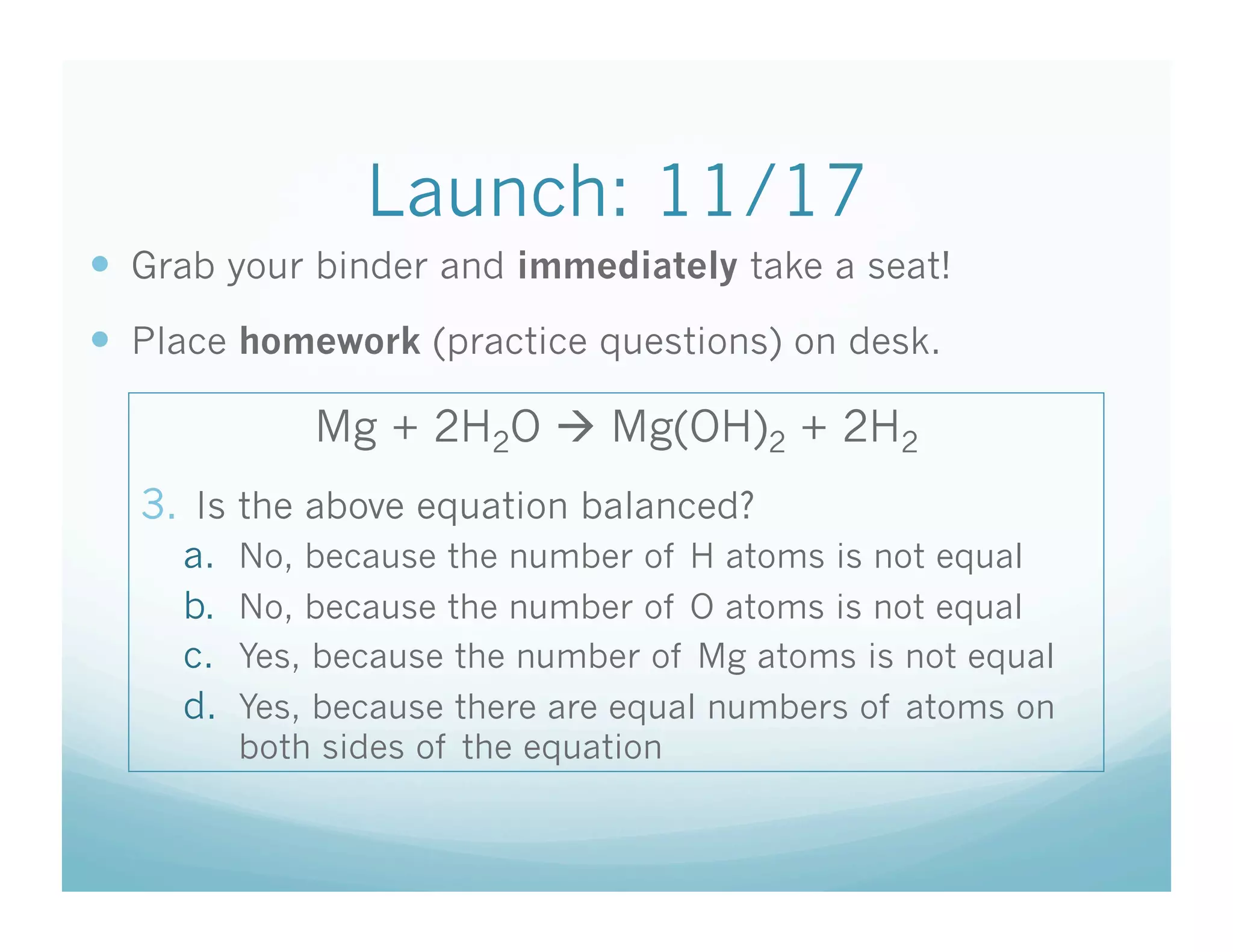
               Mg + 2H2O  Mg(OH)2 + 2H2
  3.  Is the above equation balanced?
     a.    No, because the number of H atoms is not equal
     b.    No, because the number of O atoms is not equal
     c.    Yes, because the number of Mg atoms is not equal
     d.    Yes, because there are equal numbers of atoms on
           both sides of the equation
Launch 11/17
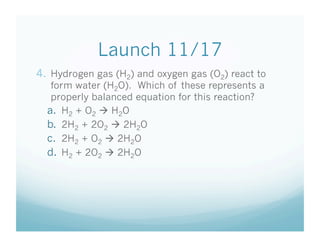
4.  Hydrogen gas (H2) and oxygen gas (O2) react to
   form water (H2O). Which of these represents a
   properly balanced equation for this reaction?
  a.  H2 + O2  H2O
  b.  2H2 + 2O2  2H2O
  c.  2H2 + O2  2H2O
  d.  H2 + 2O2  2H2O
Announcements
  Unit #5: Chemical Reactions & Stoichiometry
  Class points end next week
    Get your HW done
    Be respectful
  Quiz on Friday!
How are equations
   balanced?
      Mr. Heffner
      11/17/09
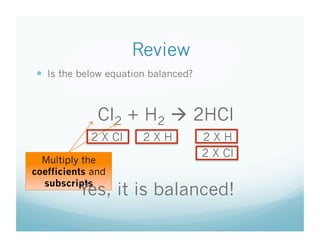
Review
  Is the below equation balanced?


              Cl2 + H2  2HCl
            2 X Cl     2XH           2XH
                                     2 X Cl
  Multiply the
coefficients and
  subscripts
          Yes, it is balanced!
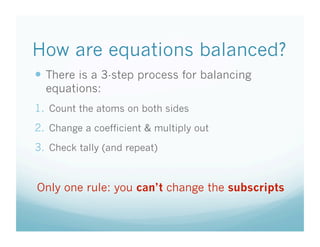
How are equations balanced?
  There is a 3-step process for balancing
  equations:
1.  Count the atoms on both sides
2.  Change a coefficient & multiply out
3.  Check tally (and repeat)


Only one rule: you can’t change the subscripts
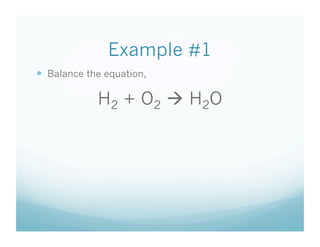
Example #1
  Balance the equation,

             H2 + O2  H2O
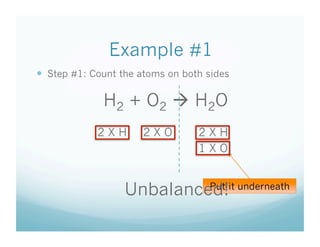
Example #1
  Step #1: Count the atoms on both sides

              H2 + O2  H2O
            2XH       2XO         2XH
                                  1XO


                  Unbalanced!it underneath
                           Put
Example #1
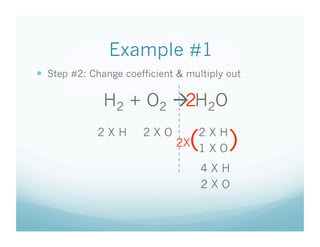
  Step #2: Change coefficient & multiply out

              H2 + O2  H2O
                       2
             2XH       2XO
                                 (
                                 2XH
                              2X 1 X O    )
                                     4XH
                                     2XO
Example #1
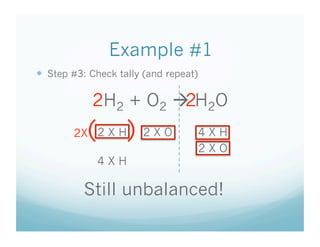
  Step #3: Check tally (and repeat)

            2H2 + O2  H2O
                      2
           (
        2X 2 X H    )   2XO            4XH
                                       2XO
               4XH

          Still unbalanced!
Example #1
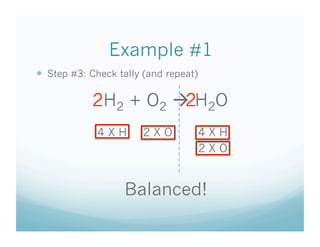
  Step #3: Check tally (and repeat)

            2H2 + O2  H2O
                      2
             4XH       2XO             4XH
                                       2XO


                   Balanced!
Activity
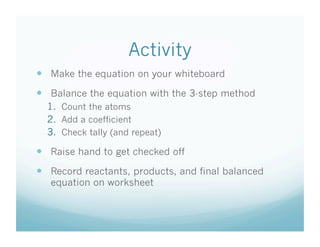
  Make the equation on your whiteboard
  Balance the equation with the 3-step method
  1.  Count the atoms
  2.  Add a coefficient
  3.  Check tally (and repeat)

  Raise hand to get checked off
  Record reactants, products, and final balanced
   equation on worksheet
Practice Questions
  Practice question handouts
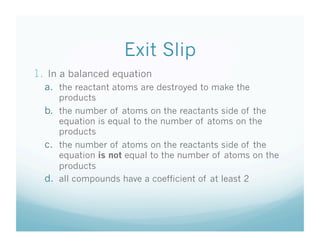
Exit Slip
1.  In a balanced equation
  a.  the reactant atoms are destroyed to make the
      products
  b.  the number of atoms on the reactants side of the
      equation is equal to the number of atoms on the
      products
  c.  the number of atoms on the reactants side of the
      equation is not equal to the number of atoms on the
      products
  d.  all compounds have a coefficient of at least 2
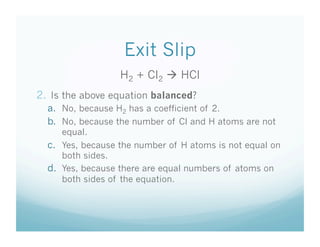
Exit Slip
                  H2 + Cl2  HCl
2.  Is the above equation balanced?
  a.  No, because H2 has a coefficient of 2.
  b.  No, because the number of Cl and H atoms are not
      equal.
  c.  Yes, because the number of H atoms is not equal on
      both sides.
  d.  Yes, because there are equal numbers of atoms on
      both sides of the equation.
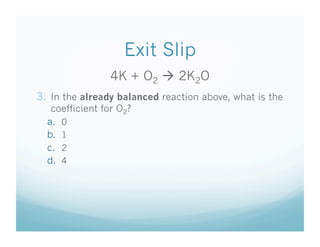
Exit Slip
                 4K + O2  2K2O
3.  In the already balanced reaction above, what is the
   coefficient for O2?
  a.  0
  b.  1
  c.  2
  d.  4
Exit Slip
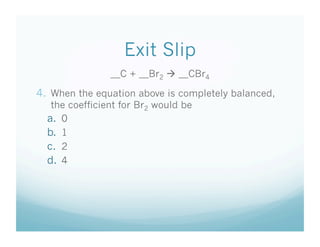
                __C + __Br2  __CBr4

4.  When the equation above is completely balanced,
   the coefficient for Br2 would be
  a.  0
  b.  1
  c.  2
  d.  4
Exit Slip
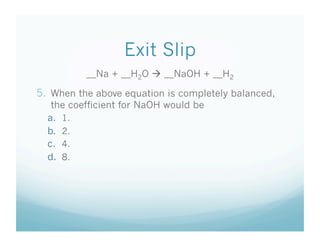
          __Na + __H2O  __NaOH + __H2

5.  When the above equation is completely balanced,
   the coefficient for NaOH would be
  a.  1.
  b.  2.
  c.  4.
  d.  8.
Homework
  Finish practice question worksheet

11 17 How Are Equations Balanced

  • 1.
    Launch: 11/17   Grabyour binder and immediately take a seat!   Place homework (practice questions) on desk. Mg + 2H2O  Mg(OH)2 + 2H2 3.  Is the above equation balanced? a.  No, because the number of H atoms is not equal b.  No, because the number of O atoms is not equal c.  Yes, because the number of Mg atoms is not equal d.  Yes, because there are equal numbers of atoms on both sides of the equation
  • 2.
    Launch 11/17 4.  Hydrogengas (H2) and oxygen gas (O2) react to form water (H2O). Which of these represents a properly balanced equation for this reaction? a.  H2 + O2  H2O b.  2H2 + 2O2  2H2O c.  2H2 + O2  2H2O d.  H2 + 2O2  2H2O
  • 3.
    Announcements   Unit #5:Chemical Reactions & Stoichiometry   Class points end next week   Get your HW done   Be respectful   Quiz on Friday!
  • 4.
    How are equations balanced? Mr. Heffner 11/17/09
  • 5.
    Review   Is thebelow equation balanced? Cl2 + H2  2HCl 2 X Cl 2XH 2XH 2 X Cl Multiply the coefficients and subscripts Yes, it is balanced!
  • 6.
    How are equationsbalanced?   There is a 3-step process for balancing equations: 1.  Count the atoms on both sides 2.  Change a coefficient & multiply out 3.  Check tally (and repeat) Only one rule: you can’t change the subscripts
  • 7.
    Example #1   Balancethe equation, H2 + O2  H2O
  • 8.
    Example #1   Step#1: Count the atoms on both sides H2 + O2  H2O 2XH 2XO 2XH 1XO Unbalanced!it underneath Put
  • 9.
    Example #1   Step#2: Change coefficient & multiply out H2 + O2  H2O 2 2XH 2XO ( 2XH 2X 1 X O ) 4XH 2XO
  • 10.
    Example #1   Step#3: Check tally (and repeat) 2H2 + O2  H2O 2 ( 2X 2 X H ) 2XO 4XH 2XO 4XH Still unbalanced!
  • 11.
    Example #1   Step#3: Check tally (and repeat) 2H2 + O2  H2O 2 4XH 2XO 4XH 2XO Balanced!
  • 12.
    Activity   Make theequation on your whiteboard   Balance the equation with the 3-step method 1.  Count the atoms 2.  Add a coefficient 3.  Check tally (and repeat)   Raise hand to get checked off   Record reactants, products, and final balanced equation on worksheet
  • 13.
  • 14.
    Exit Slip 1.  Ina balanced equation a.  the reactant atoms are destroyed to make the products b.  the number of atoms on the reactants side of the equation is equal to the number of atoms on the products c.  the number of atoms on the reactants side of the equation is not equal to the number of atoms on the products d.  all compounds have a coefficient of at least 2
  • 15.
    Exit Slip H2 + Cl2  HCl 2.  Is the above equation balanced? a.  No, because H2 has a coefficient of 2. b.  No, because the number of Cl and H atoms are not equal. c.  Yes, because the number of H atoms is not equal on both sides. d.  Yes, because there are equal numbers of atoms on both sides of the equation.
  • 16.
    Exit Slip 4K + O2  2K2O 3.  In the already balanced reaction above, what is the coefficient for O2? a.  0 b.  1 c.  2 d.  4
  • 17.
    Exit Slip __C + __Br2  __CBr4 4.  When the equation above is completely balanced, the coefficient for Br2 would be a.  0 b.  1 c.  2 d.  4
  • 18.
    Exit Slip __Na + __H2O  __NaOH + __H2 5.  When the above equation is completely balanced, the coefficient for NaOH would be a.  1. b.  2. c.  4. d.  8.
  • 19.