Launch: 11/13
  Grab your binder and immediately take a seat!
1.  How many of each atom are in the following molecules:
  i.  Br2
  ii.  H2S
  iii. CCl4
  iv.  H2SO4
  v.  C6H12O6
Announcements
  Binder checks are worth a decent number of
  points!

  It is really important that you
    Do your launches
    Finish your homework (and get a stamp)
    Make-up all work from absences
       lpschem.wordpress.com
What are chemical
   equations?
      Mr. Heffner
      11/13/09
What are chemical equations?
    A chemical equation is…
       a representation of a chemical reaction


                2H2 + O2  2H2O

    Reactants                                     Products
•  The substances that react        •  The substances that
   •  Left                            are produced (made)
                                       •  Right
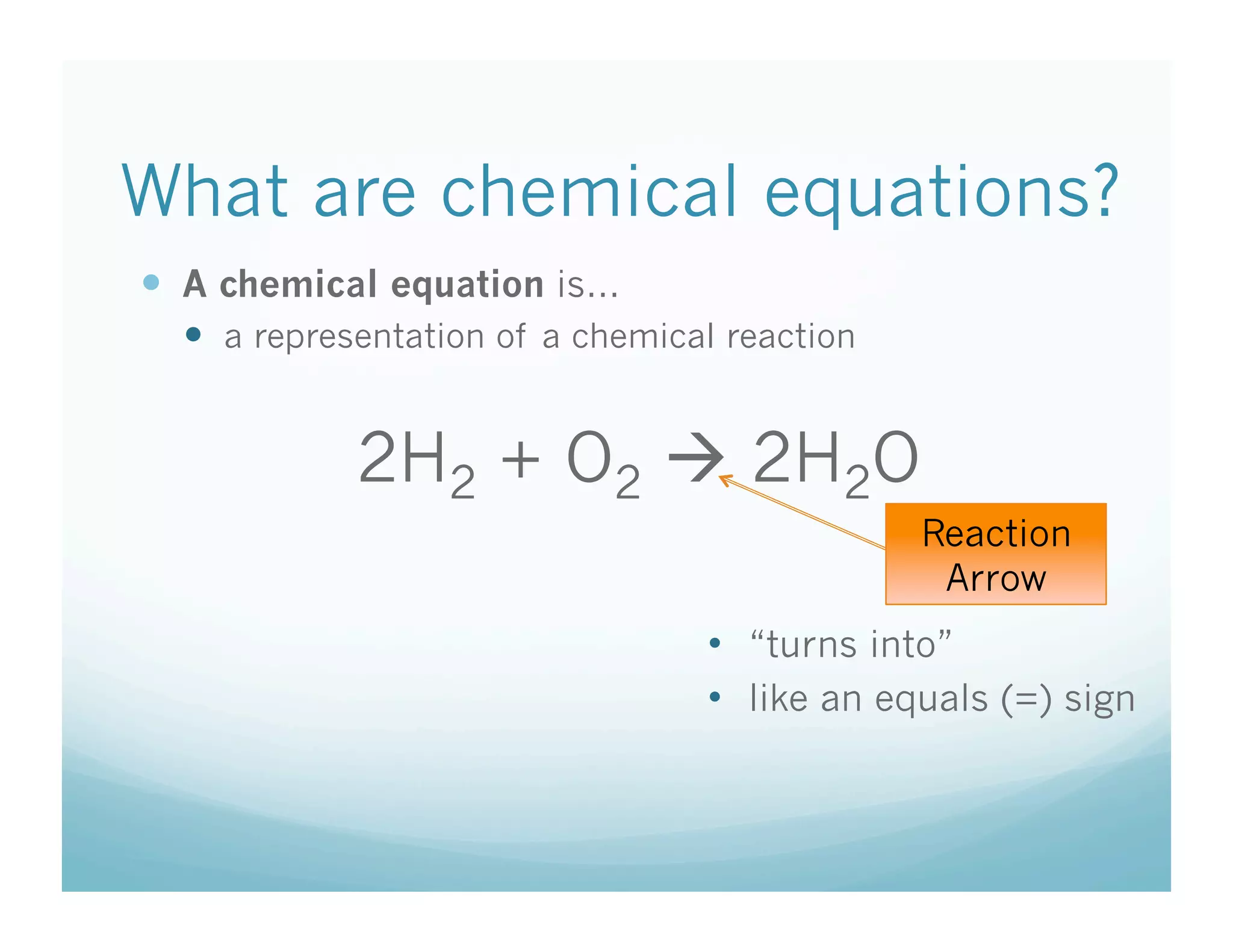
What are chemical equations?
  A chemical equation is…
    a representation of a chemical reaction


            2H2 + O2  2H2O
                                               Reaction
                                                Arrow
                                  •  “turns into”
                                  •  like an equals (=) sign
What are chemical equations?
    A chemical equation is…
      a representation of a chemical reaction


               2H2 + O2  2H2O

    Coefficients                                 Subscripts
•  Comes before the                 •  Comes after the atom
  compound                              •  Sub = below
   •  distributed to all
Example
1.  How many H atoms does 2H2 have?
    multiply the subscript and the coefficient
       Coefficient = 2
       Subscript = 2
    2 X 2 = 4 hydrogen atoms
Example
2.  How many H atoms does 2H2O have?
    multiply the subscript and the coefficient
       Coefficient = 2
       Subscript = 2
    2 X 2 = 4 hydrogen atoms
Example
3.  How many O atoms does 2H2O have?
    multiply the subscript and the coefficient
       Coefficient = 2
       Subscript = not there = 1
    2 X 1 = 2 oxygen atoms
Example
4.  How many O atoms does Mg(OH)2 have?
    multiply the subscript and the coefficient
       Coefficient = not there = 1
       Subscript = 2
    1 X 2 = 2 oxygen atoms
Foldable
  Make foldable and define terms. Draw an
   illustration if necessary.
  1.  Chemical equation
  2.  Reactants
  3.  Products
  4.  Coefficient
  5.  Subscript
  6.  Chemical reaction
  7.  Chemical bond
  8.  Molecule/compound
Practice Question
  Practice question handout
Exit Slip
1.  What are chemical equations?
   a.  Representations of chemical reactions in which the
      reactants are listed to the left of a reaction arrow.

   b.  Representations of chemical bonds in which 2
      valence electrons are depicted by a straight line

   c.  Representations of chemical reactions in which the.
      products are listed to the left of the reaction arrow.

   d.  A way to show how reaction arrows turn into
      reactants.
Exit Slip
  HC2H3O2 + NaHCO3  NaC2H3O2 + H2CO3
2.  Which of the following correctly identifies all of
   the reactants in the above chemical equation.
  a.  NaC2H3O2
  b.  NaHCO3
  c.  NaC2H3O2 and HC2H3O2
  d.  HC2H3O2 and NaHCO3
Exit Slip
          4Na + 4H2O  4NaOH + 2H2
3.  Which of the following identifies the coefficient for
   H2O in the above chemical equation?
  a.  1
  b.  2
  c.  4
  d.  8
Exit Slip
4.  How many C atoms are there in 3C2H4?
  a.    2
  b.    3
  c.    5
  d.    6
Exit Slip
5.  Which of the following identifies the correct
   number of atoms in 3H2SO4?
  a.  3 H atoms, 3 S atoms, 3 O atoms
  b.  2 H atoms, 1 S atom, 4 O atoms
  c.  6 H atoms, 3 S atoms, 4 O atoms
  d.  6 H atoms, 3 S atom, 12 O atoms
Homework
  Finish practice question worksheet

11 13 What Is A Chemical Equation

  • 1.
    Launch: 11/13   Grabyour binder and immediately take a seat! 1.  How many of each atom are in the following molecules: i.  Br2 ii.  H2S iii. CCl4 iv.  H2SO4 v.  C6H12O6
  • 2.
    Announcements   Binder checksare worth a decent number of points!   It is really important that you   Do your launches   Finish your homework (and get a stamp)   Make-up all work from absences   lpschem.wordpress.com
  • 3.
    What are chemical equations? Mr. Heffner 11/13/09
  • 5.
    What are chemicalequations?   A chemical equation is…   a representation of a chemical reaction 2H2 + O2  2H2O Reactants Products •  The substances that react •  The substances that •  Left are produced (made) •  Right
  • 6.
    What are chemicalequations?   A chemical equation is…   a representation of a chemical reaction 2H2 + O2  2H2O Reaction Arrow •  “turns into” •  like an equals (=) sign
  • 7.
    What are chemicalequations?   A chemical equation is…   a representation of a chemical reaction 2H2 + O2  2H2O Coefficients Subscripts •  Comes before the •  Comes after the atom compound •  Sub = below •  distributed to all
  • 8.
    Example 1.  How manyH atoms does 2H2 have?   multiply the subscript and the coefficient   Coefficient = 2   Subscript = 2   2 X 2 = 4 hydrogen atoms
  • 9.
    Example 2.  How manyH atoms does 2H2O have?   multiply the subscript and the coefficient   Coefficient = 2   Subscript = 2   2 X 2 = 4 hydrogen atoms
  • 10.
    Example 3.  How manyO atoms does 2H2O have?   multiply the subscript and the coefficient   Coefficient = 2   Subscript = not there = 1   2 X 1 = 2 oxygen atoms
  • 11.
    Example 4.  How manyO atoms does Mg(OH)2 have?   multiply the subscript and the coefficient   Coefficient = not there = 1   Subscript = 2   1 X 2 = 2 oxygen atoms
  • 12.
    Foldable   Make foldableand define terms. Draw an illustration if necessary. 1.  Chemical equation 2.  Reactants 3.  Products 4.  Coefficient 5.  Subscript 6.  Chemical reaction 7.  Chemical bond 8.  Molecule/compound
  • 13.
  • 14.
    Exit Slip 1.  Whatare chemical equations? a.  Representations of chemical reactions in which the reactants are listed to the left of a reaction arrow. b.  Representations of chemical bonds in which 2 valence electrons are depicted by a straight line c.  Representations of chemical reactions in which the. products are listed to the left of the reaction arrow. d.  A way to show how reaction arrows turn into reactants.
  • 15.
    Exit Slip HC2H3O2 + NaHCO3  NaC2H3O2 + H2CO3 2.  Which of the following correctly identifies all of the reactants in the above chemical equation. a.  NaC2H3O2 b.  NaHCO3 c.  NaC2H3O2 and HC2H3O2 d.  HC2H3O2 and NaHCO3
  • 16.
    Exit Slip 4Na + 4H2O  4NaOH + 2H2 3.  Which of the following identifies the coefficient for H2O in the above chemical equation? a.  1 b.  2 c.  4 d.  8
  • 17.
    Exit Slip 4.  Howmany C atoms are there in 3C2H4? a.  2 b.  3 c.  5 d.  6
  • 18.
    Exit Slip 5.  Whichof the following identifies the correct number of atoms in 3H2SO4? a.  3 H atoms, 3 S atoms, 3 O atoms b.  2 H atoms, 1 S atom, 4 O atoms c.  6 H atoms, 3 S atoms, 4 O atoms d.  6 H atoms, 3 S atom, 12 O atoms
  • 19.