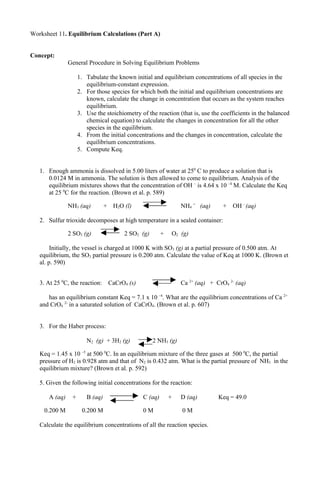
Worksheet 11. Equilibrium Calculations (Part A)


Concept:
               General Procedure in Solving Equilibrium Problems

                    1. Tabulate the known initial and equilibrium concentrations of all species in the
                       equilibrium-constant expression.
                    2. For those species for which both the initial and equilibrium concentrations are
                       known, calculate the change in concentration that occurs as the system reaches
                       equilibrium.
                    3. Use the stoichiometry of the reaction (that is, use the coefficients in the balanced
                       chemical equation) to calculate the changes in concentration for all the other
                       species in the equilibrium.
                    4. From the initial concentrations and the changes in concentration, calculate the
                       equilibrium concentrations.
                    5. Compute Keq.


   1. Enough ammonia is dissolved in 5.00 liters of water at 250 C to produce a solution that is
      0.0124 M in ammonia. The solution is then allowed to come to equilibrium. Analysis of the
      equilibrium mixtures shows that the concentration of OH – is 4.64 x 10 –4 M. Calculate the Keq
      at 25 0C for the reaction. (Brown et al. p. 589)

               NH3 (aq)         + H2O (l)                       NH4 + (aq)      + OH - (aq)

   2. Sulfur trioxide decomposes at high temperature in a sealed container:

               2 SO3 (g)               2 SO2 (g)        +   O2 (g)

        Initially, the vessel is charged at 1000 K with SO3 (g) at a partial pressure of 0.500 atm. At
   equilibrium, the SO3 partial pressure is 0.200 atm. Calculate the value of Keq at 1000 K. (Brown et
   al. p. 590)


   3. At 25 0C, the reaction:    CaCrO4 (s)                     Ca 2+ (aq) + CrO4 2- (aq)

      has an equilibrium constant Keq = 7.1 x 10 –4. What are the equilibrium concentrations of Ca 2+
   and CrO4 2- in a saturated solution of CaCrO4. (Brown et al. p. 607)


   3. For the Haber process:

                       N2 (g) + 3H2 (g)            2 NH3 (g)

   Keq = 1.45 x 10 –5 at 500 0C. In an equilibrium mixture of the three gases at 500 0C, the partial
   pressure of H2 is 0.928 atm and that of N2 is 0.432 atm. What is the partial pressure of NH3 in the
   equilibrium mixture? (Brown et al. p. 592)

   5. Given the following initial concentrations for the reaction:

      A (aq)    +      B (aq)                  C (aq)       +   D (aq)        Keq = 49.0

     0.200 M         0.200 M                   0M               0M

   Calculate the equilibrium concentrations of all the reaction species.
Worksheet 11  equilibrium calculations

Worksheet 11 equilibrium calculations

  • 1.
    Worksheet 11. EquilibriumCalculations (Part A) Concept: General Procedure in Solving Equilibrium Problems 1. Tabulate the known initial and equilibrium concentrations of all species in the equilibrium-constant expression. 2. For those species for which both the initial and equilibrium concentrations are known, calculate the change in concentration that occurs as the system reaches equilibrium. 3. Use the stoichiometry of the reaction (that is, use the coefficients in the balanced chemical equation) to calculate the changes in concentration for all the other species in the equilibrium. 4. From the initial concentrations and the changes in concentration, calculate the equilibrium concentrations. 5. Compute Keq. 1. Enough ammonia is dissolved in 5.00 liters of water at 250 C to produce a solution that is 0.0124 M in ammonia. The solution is then allowed to come to equilibrium. Analysis of the equilibrium mixtures shows that the concentration of OH – is 4.64 x 10 –4 M. Calculate the Keq at 25 0C for the reaction. (Brown et al. p. 589) NH3 (aq) + H2O (l) NH4 + (aq) + OH - (aq) 2. Sulfur trioxide decomposes at high temperature in a sealed container: 2 SO3 (g) 2 SO2 (g) + O2 (g) Initially, the vessel is charged at 1000 K with SO3 (g) at a partial pressure of 0.500 atm. At equilibrium, the SO3 partial pressure is 0.200 atm. Calculate the value of Keq at 1000 K. (Brown et al. p. 590) 3. At 25 0C, the reaction: CaCrO4 (s) Ca 2+ (aq) + CrO4 2- (aq) has an equilibrium constant Keq = 7.1 x 10 –4. What are the equilibrium concentrations of Ca 2+ and CrO4 2- in a saturated solution of CaCrO4. (Brown et al. p. 607) 3. For the Haber process: N2 (g) + 3H2 (g) 2 NH3 (g) Keq = 1.45 x 10 –5 at 500 0C. In an equilibrium mixture of the three gases at 500 0C, the partial pressure of H2 is 0.928 atm and that of N2 is 0.432 atm. What is the partial pressure of NH3 in the equilibrium mixture? (Brown et al. p. 592) 5. Given the following initial concentrations for the reaction: A (aq) + B (aq) C (aq) + D (aq) Keq = 49.0 0.200 M 0.200 M 0M 0M Calculate the equilibrium concentrations of all the reaction species.