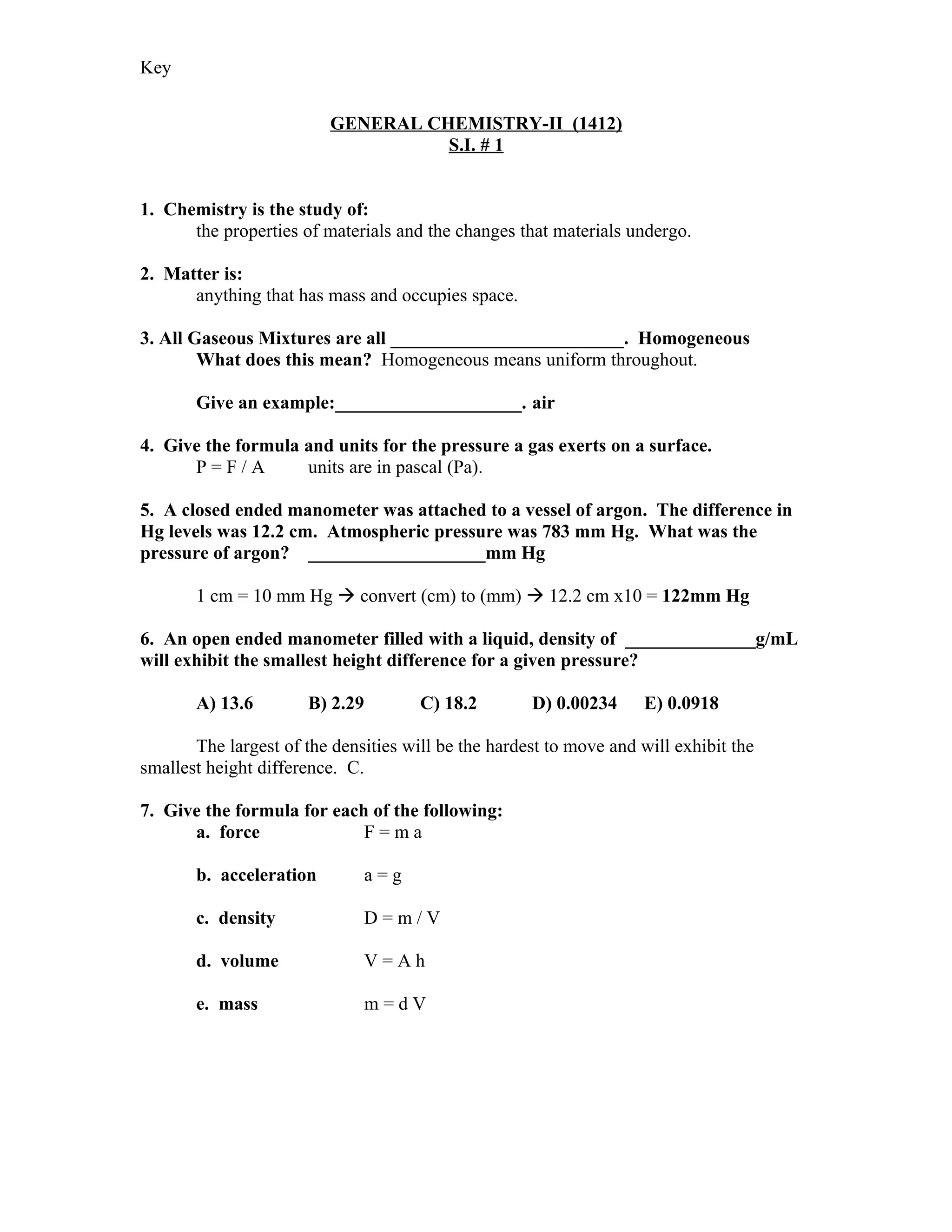
Key


                          GENERAL CHEMISTRY-II (1412)
                                    S.I. # 1


1. Chemistry is the study of:
      the properties of materials and the changes that materials undergo.

2. Matter is:
      anything that has mass and occupies space.

3. All Gaseous Mixtures are all _________________________. Homogeneous
        What does this mean? Homogeneous means uniform throughout.

       Give an example:____________________. air

4. Give the formula and units for the pressure a gas exerts on a surface.
      P=F/A         units are in pascal (Pa).

5. A closed ended manometer was attached to a vessel of argon. The difference in
Hg levels was 12.2 cm. Atmospheric pressure was 783 mm Hg. What was the
pressure of argon? ___________________mm Hg

       1 cm = 10 mm Hg  convert (cm) to (mm)  12.2 cm x10 = 122mm Hg

6. An open ended manometer filled with a liquid, density of ______________g/mL
will exhibit the smallest height difference for a given pressure?

       A) 13.6        B) 2.29         C) 18.2        D) 0.00234     E) 0.0918

       The largest of the densities will be the hardest to move and will exhibit the
smallest height difference. C.

7. Give the formula for each of the following:
      a. force              F=ma

       b. acceleration        a=g

       c. density             D=m/V

       d. volume              V=Ah

       e. mass                m=dV
Key


8. Show how the definition of Pressure can be transformed from P = F/A to P = gdh.

                                        P = F/A
                                      P = (m a) /A
                                     P = (d V)(g) /A
                                   P = (d)(A h)(g) / A
                                        P=gdh

9. Who first investigated the relationship between P & V of a gas? Robert Boyle

10. Pressure is _________________ proportional to Volume of a gas. Inversely

11. Define an equation of State: Relates The Properties Of A Material To Each Other
Mathematically

12. Use words and an equation to define Boyle’s law.

       Pressure is inversely proportional to volume at a fixed temperature and amount.
              P α 1/V         P1 V1 = P2 V2 = A constant
              (Constant n,T)

13. Use words and an equation to define Charles’ Law.

      Volume is directly proportional to absolute temperature at fixed pressure and
amount.      VαT            V1/T1 = V2/T2           T must be in Kelvin
             (Constant n,P)
14. Use words and an equation to define Avogadro’s law.

       Vm = 22.4 L / mol at STP
Another way of saying that is : 22.4 L of ANY GAS at STP
contains 6.02 x 10²³ gas molecules.
       Vαn             V = constant x n     (V1/n1) = (V2/n2)
       (Constant P,T)

15. 5.0 mol of gas at 1.0 atm expands at a constant Temperature from 10L to 15L.
What is the final pressure of the gas? _________________ atm.

       PV = nRT       V1 = 10L       V2 = 15L       P1 = 1atm     P2 = ?

       V1 / V2 = P1 / P2 =>
       P2 = (P1 V2) / V1 =>
       P2 = (1atm x 15L) / 10L = 1.5 atm

16. The volume of an ideal gas is zero at what temperature? ____________         -273°C

SI #1 Key

  • 1.
    Key GENERAL CHEMISTRY-II (1412) S.I. # 1 1. Chemistry is the study of: the properties of materials and the changes that materials undergo. 2. Matter is: anything that has mass and occupies space. 3. All Gaseous Mixtures are all _________________________. Homogeneous What does this mean? Homogeneous means uniform throughout. Give an example:____________________. air 4. Give the formula and units for the pressure a gas exerts on a surface. P=F/A units are in pascal (Pa). 5. A closed ended manometer was attached to a vessel of argon. The difference in Hg levels was 12.2 cm. Atmospheric pressure was 783 mm Hg. What was the pressure of argon? ___________________mm Hg 1 cm = 10 mm Hg  convert (cm) to (mm)  12.2 cm x10 = 122mm Hg 6. An open ended manometer filled with a liquid, density of ______________g/mL will exhibit the smallest height difference for a given pressure? A) 13.6 B) 2.29 C) 18.2 D) 0.00234 E) 0.0918 The largest of the densities will be the hardest to move and will exhibit the smallest height difference. C. 7. Give the formula for each of the following: a. force F=ma b. acceleration a=g c. density D=m/V d. volume V=Ah e. mass m=dV
  • 2.
    Key 8. Show howthe definition of Pressure can be transformed from P = F/A to P = gdh. P = F/A P = (m a) /A P = (d V)(g) /A P = (d)(A h)(g) / A P=gdh 9. Who first investigated the relationship between P & V of a gas? Robert Boyle 10. Pressure is _________________ proportional to Volume of a gas. Inversely 11. Define an equation of State: Relates The Properties Of A Material To Each Other Mathematically 12. Use words and an equation to define Boyle’s law. Pressure is inversely proportional to volume at a fixed temperature and amount. P α 1/V P1 V1 = P2 V2 = A constant (Constant n,T) 13. Use words and an equation to define Charles’ Law. Volume is directly proportional to absolute temperature at fixed pressure and amount. VαT V1/T1 = V2/T2 T must be in Kelvin (Constant n,P) 14. Use words and an equation to define Avogadro’s law. Vm = 22.4 L / mol at STP Another way of saying that is : 22.4 L of ANY GAS at STP contains 6.02 x 10²³ gas molecules. Vαn V = constant x n (V1/n1) = (V2/n2) (Constant P,T) 15. 5.0 mol of gas at 1.0 atm expands at a constant Temperature from 10L to 15L. What is the final pressure of the gas? _________________ atm. PV = nRT V1 = 10L V2 = 15L P1 = 1atm P2 = ? V1 / V2 = P1 / P2 => P2 = (P1 V2) / V1 => P2 = (1atm x 15L) / 10L = 1.5 atm 16. The volume of an ideal gas is zero at what temperature? ____________ -273°C