Name: _________________________________                                 Period: ________
Date: _______
                            How to Count Atoms
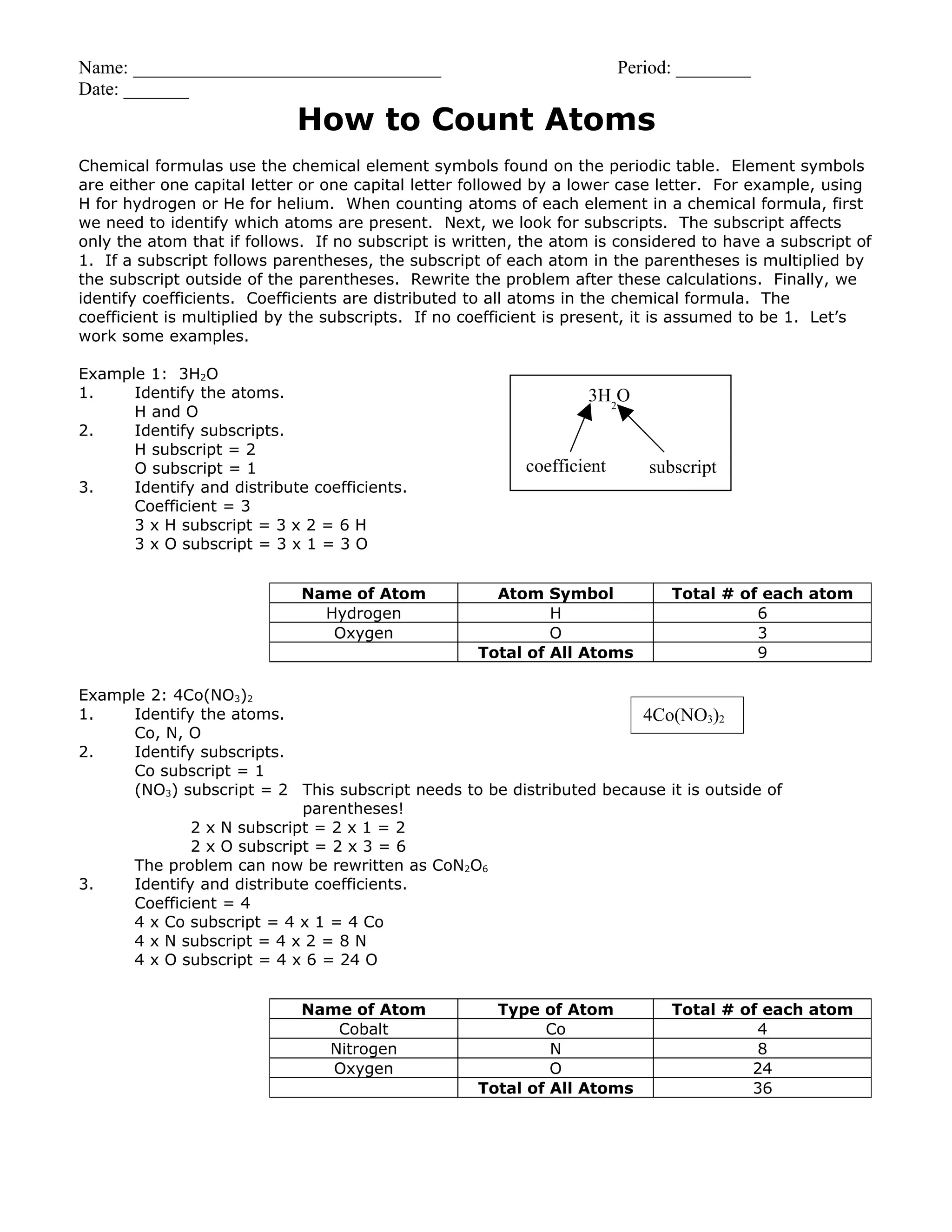
Chemical formulas use the chemical element symbols found on the periodic table. Element symbols
are either one capital letter or one capital letter followed by a lower case letter. For example, using
H for hydrogen or He for helium. When counting atoms of each element in a chemical formula, first
we need to identify which atoms are present. Next, we look for subscripts. The subscript affects
only the atom that if follows. If no subscript is written, the atom is considered to have a subscript of
1. If a subscript follows parentheses, the subscript of each atom in the parentheses is multiplied by
the subscript outside of the parentheses. Rewrite the problem after these calculations. Finally, we
identify coefficients. Coefficients are distributed to all atoms in the chemical formula. The
coefficient is multiplied by the subscripts. If no coefficient is present, it is assumed to be 1. Let’s
work some examples.

Example 1: 3H2O
1.    Identify the atoms.                                         3H2O
      H and O
2.    Identify subscripts.
      H subscript = 2
      O subscript = 1                                     coefficient      subscript
3.    Identify and distribute coefficients.
      Coefficient = 3
      3 x H subscript = 3 x 2 = 6 H
      3 x O subscript = 3 x 1 = 3 O


                             Name of Atom             Atom Symbol             Total # of each atom
                               Hydrogen                      H                          6
                                Oxygen                       O                          3
                                                    Total of All Atoms                  9

Example 2: 4Co(NO3)2
1.    Identify the atoms.                                            4Co(NO3)2
      Co, N, O
2.    Identify subscripts.
      Co subscript = 1
      (NO3) subscript = 2 This subscript needs to be distributed because it is outside of
                            parentheses!
              2 x N subscript = 2 x 1 = 2
              2 x O subscript = 2 x 3 = 6
      The problem can now be rewritten as CoN2O6
3.    Identify and distribute coefficients.
      Coefficient = 4
      4 x Co subscript = 4 x 1 = 4 Co
      4 x N subscript = 4 x 2 = 8 N
      4 x O subscript = 4 x 6 = 24 O


                             Name of Atom             Type of Atom            Total # of each atom
                                Cobalt                      Co                          4
                               Nitrogen                      N                          8
                                Oxygen                       O                         24
                                                    Total of All Atoms                 36
Name: _________________________________                          Period: ________
 Date: _______


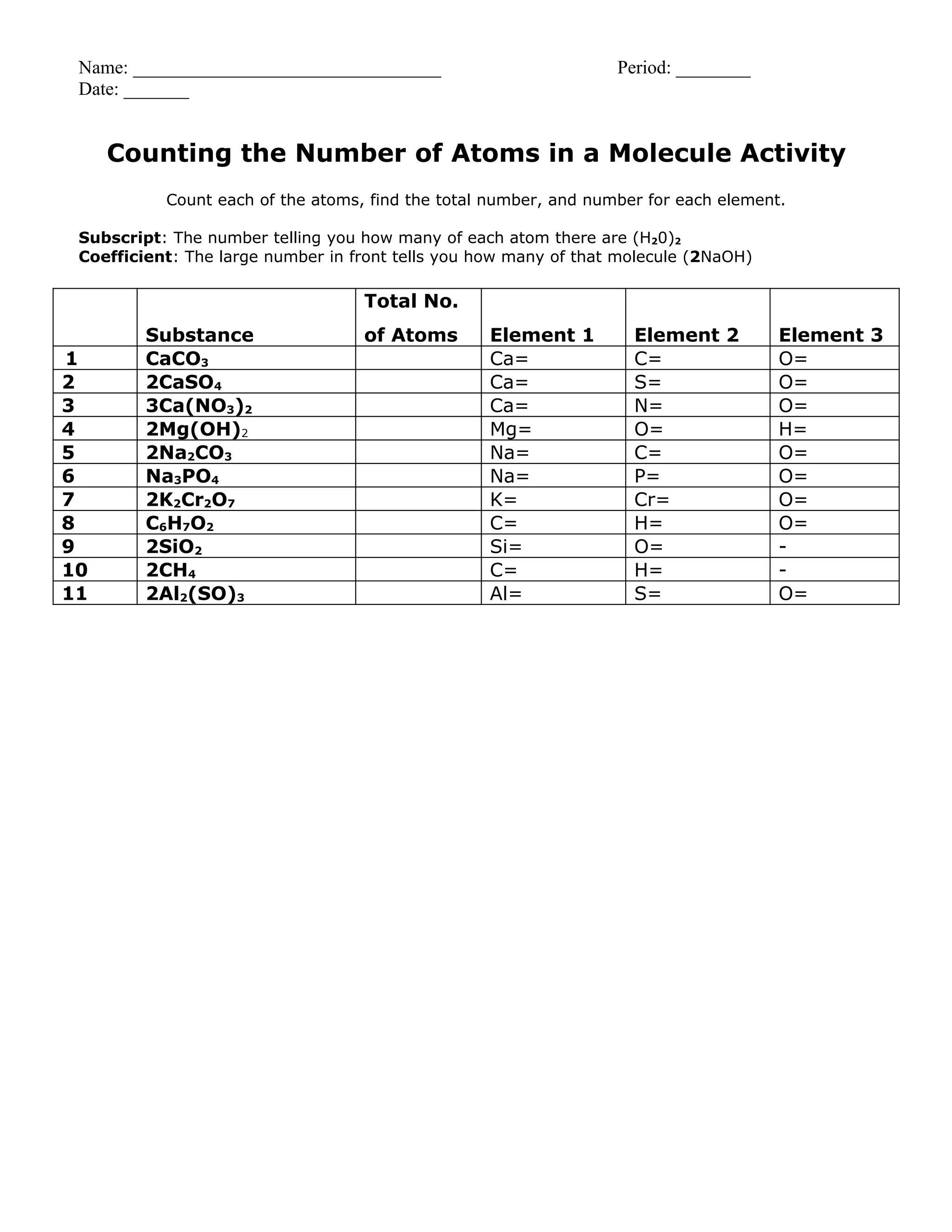
     Counting the Number of Atoms in a Molecule Activity
           Count each of the atoms, find the total number, and number for each element.

 Subscript: The number telling you how many of each atom there are (H20)2
 Coefficient: The large number in front tells you how many of that molecule (2NaOH)

                                   Total No.
         Substance                 of Atoms        Element 1        Element 2         Element 3
1        CaCO3                                     Ca=              C=                O=
2        2CaSO4                                    Ca=              S=                O=
3        3Ca(NO3)2                                 Ca=              N=                O=
4        2Mg(OH)2                                  Mg=              O=                H=
5        2Na2CO3                                   Na=              C=                O=
6        Na3PO4                                    Na=              P=                O=
7        2K2Cr2O7                                  K=               Cr=               O=
8        C6H7O2                                    C=               H=                O=
9        2SiO2                                     Si=              O=                -
10       2CH4                                      C=               H=                -
11       2Al2(SO)3                                 Al=              S=                O=

Counting atoms homework

  • 1.
    Name: _________________________________ Period: ________ Date: _______ How to Count Atoms Chemical formulas use the chemical element symbols found on the periodic table. Element symbols are either one capital letter or one capital letter followed by a lower case letter. For example, using H for hydrogen or He for helium. When counting atoms of each element in a chemical formula, first we need to identify which atoms are present. Next, we look for subscripts. The subscript affects only the atom that if follows. If no subscript is written, the atom is considered to have a subscript of 1. If a subscript follows parentheses, the subscript of each atom in the parentheses is multiplied by the subscript outside of the parentheses. Rewrite the problem after these calculations. Finally, we identify coefficients. Coefficients are distributed to all atoms in the chemical formula. The coefficient is multiplied by the subscripts. If no coefficient is present, it is assumed to be 1. Let’s work some examples. Example 1: 3H2O 1. Identify the atoms. 3H2O H and O 2. Identify subscripts. H subscript = 2 O subscript = 1 coefficient subscript 3. Identify and distribute coefficients. Coefficient = 3 3 x H subscript = 3 x 2 = 6 H 3 x O subscript = 3 x 1 = 3 O Name of Atom Atom Symbol Total # of each atom Hydrogen H 6 Oxygen O 3 Total of All Atoms 9 Example 2: 4Co(NO3)2 1. Identify the atoms. 4Co(NO3)2 Co, N, O 2. Identify subscripts. Co subscript = 1 (NO3) subscript = 2 This subscript needs to be distributed because it is outside of parentheses! 2 x N subscript = 2 x 1 = 2 2 x O subscript = 2 x 3 = 6 The problem can now be rewritten as CoN2O6 3. Identify and distribute coefficients. Coefficient = 4 4 x Co subscript = 4 x 1 = 4 Co 4 x N subscript = 4 x 2 = 8 N 4 x O subscript = 4 x 6 = 24 O Name of Atom Type of Atom Total # of each atom Cobalt Co 4 Nitrogen N 8 Oxygen O 24 Total of All Atoms 36
  • 2.
    Name: _________________________________ Period: ________ Date: _______ Counting the Number of Atoms in a Molecule Activity Count each of the atoms, find the total number, and number for each element. Subscript: The number telling you how many of each atom there are (H20)2 Coefficient: The large number in front tells you how many of that molecule (2NaOH) Total No. Substance of Atoms Element 1 Element 2 Element 3 1 CaCO3 Ca= C= O= 2 2CaSO4 Ca= S= O= 3 3Ca(NO3)2 Ca= N= O= 4 2Mg(OH)2 Mg= O= H= 5 2Na2CO3 Na= C= O= 6 Na3PO4 Na= P= O= 7 2K2Cr2O7 K= Cr= O= 8 C6H7O2 C= H= O= 9 2SiO2 Si= O= - 10 2CH4 C= H= - 11 2Al2(SO)3 Al= S= O=