By: Oscar Garcia
 An ice box is a table that is used for equilibrium calculations when
we are given starting concentrations for chemicals.
 The starting concentrations have to be changed to equilibrium
concentrations before they can be used in an equilibrium
expression.
 The I stands for initial, the C for change and the E for equilibrium.
 An ice box looks like this:
Molarity H+
Cl-
HCl
Initial 1.0M 0.5M 0M
Change -0.3M -0.3M +0.3M
Equilibrium 0.7M 0.2M 0.3M
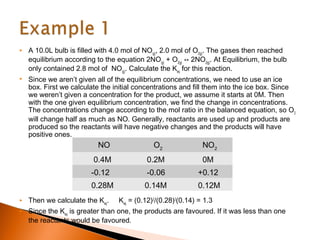
 A 10.0L bulb is filled with 4.0 mol of NO(g)
, 2.0 mol of O2(g)
. The gases then reached
equilibrium according to the equation 2NO(g)
+ O2(g)
↔ 2NO2(g)
. At Equilibrium, the bulb
only contained 2.8 mol of NO(g)
. Calculate the Keq
for this reaction.
 Since we aren’t given all of the equilibrium concentrations, we need to use an ice
box. First we calculate the initial concentrations and fill them into the ice box. Since
we weren’t given a concentration for the product, we assume it starts at 0M. Then
with the one given equilibrium concentration, we find the change in concentrations.
The concentrations change according to the mol ratio in the balanced equation, so O2
will change half as much as NO. Generally, reactants are used up and products are
produced so the reactants will have negative changes and the products will have
positive ones.
 Then we calculate the Keq
. Keq
= (0.12)2
/(0.28)2
(0.14) = 1.3
 Since the Keq
is greater than one, the products are favoured. If it was less than one
the reactants would be favoured.
NO O2
NO2
0.4M 0.2M 0M
-0.12 -0.06 +0.12
0.28M 0.14M 0.12M
 You can also use variables to represent the change in concentrations in an ice
box.
 You know you need to use variables if the starting concentrations are given but
no equilibrium concentrations are given.
 For the following reaction, find all equilibrium concentrations if you started off
with 0.5M of H2
and 0.5M of I2
0.5M and Keq
= 32. H2(g)
+ I2(g)
↔ 2HI(g)
 You start by setting up your equilibrium expression. 32 = (2x)2
/(0.5-x)2
 Solve for x and you get x = 0.37. Then you go back to the equilibrium
concentrations and plug in x to get 0.13M for H2
and I2
and 0.74M for HI.
H2
I2
HI
0.5M 0.5M 0M
-x -x +2x
0.5-x 0.5-x 2x
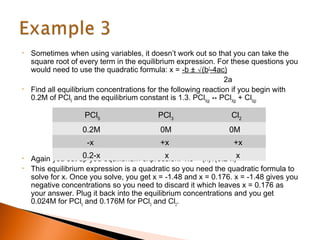
• Sometimes when using variables, it doesn’t work out so that you can take the
square root of every term in the equilibrium expression. For these questions you
would need to use the quadratic formula: x = -b ± √(b2
-4ac)
2a
• Find all equilibrium concentrations for the following reaction if you begin with
0.2M of PCl5
and the equilibrium constant is 1.3. PCl5(g)
↔ PCl3(g)
+ Cl2(g)
• Again you set up you equilibrium expression. 1.3 = (x)2
/(0.2-x)
• This equilibrium expression is a quadratic so you need the quadratic formula to
solve for x. Once you solve, you get x = -1.48 and x = 0.176. x = -1.48 gives you
negative concentrations so you need to discard it which leaves x = 0.176 as
your answer. Plug it back into the equilibrium concentrations and you get
0.024M for PCl5
and 0.176M for PCl3
and Cl2
.
PCl5
PCl3
Cl2
0.2M 0M 0M
-x +x +x
0.2-x x x
 Ice boxes are often needed for finding the ionization constants for acids or
bases.
 You can use ice boxes to calculate the pH or ionization percentage of an acid.
 Example: An unknown acid HX has a concentration of 10M and its Ka
= 0.25.
Find its pH.
 For this example, you would need the quadratic formula to solve for x but in
some cases you can disregard the –x in the ice box.
 The rule is: if the molarity of the acid divided by the Ka
is greater than 1000,
you can drop the –x because it does not make a significant difference in the
calculation. If the number is less than 1000, you need to keep the –x and use
the quadratic equation to solve for x.
HX H+
X-
10M 0M 0M
-x +x +x
10-x x x
 Ice boxes are used often for equilibrium calculations and ionization
constants for acids and bases.
 You know you need an ice box when:
1) You are given starting concentrations instead of equilibrium
calculations.
2) You are dealing with ionization constants for weak acids or
bases (Ka
or Kb
)
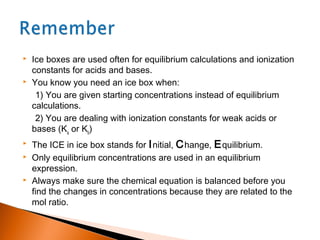
 The ICE in ice box stands for Initial, Change, Equilibrium.
 Only equilibrium concentrations are used in an equilibrium
expression.
 Always make sure the chemical equation is balanced before you
find the changes in concentrations because they are related to the
mol ratio.
 Information provided by Mr. Therrien’s Chemistry
12 booklet.
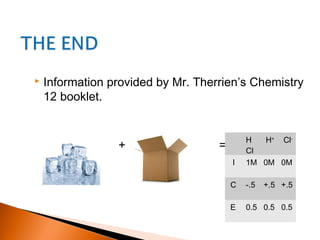
+ =
H
Cl
H+
Cl-
I 1M 0M 0M
C -.5 +.5 +.5
E 0.5 0.5 0.5

Chemistry ICE Box Equilibrium Problems

  • 1.
  • 2.
     An icebox is a table that is used for equilibrium calculations when we are given starting concentrations for chemicals.  The starting concentrations have to be changed to equilibrium concentrations before they can be used in an equilibrium expression.  The I stands for initial, the C for change and the E for equilibrium.  An ice box looks like this: Molarity H+ Cl- HCl Initial 1.0M 0.5M 0M Change -0.3M -0.3M +0.3M Equilibrium 0.7M 0.2M 0.3M
  • 3.
     A 10.0Lbulb is filled with 4.0 mol of NO(g) , 2.0 mol of O2(g) . The gases then reached equilibrium according to the equation 2NO(g) + O2(g) ↔ 2NO2(g) . At Equilibrium, the bulb only contained 2.8 mol of NO(g) . Calculate the Keq for this reaction.  Since we aren’t given all of the equilibrium concentrations, we need to use an ice box. First we calculate the initial concentrations and fill them into the ice box. Since we weren’t given a concentration for the product, we assume it starts at 0M. Then with the one given equilibrium concentration, we find the change in concentrations. The concentrations change according to the mol ratio in the balanced equation, so O2 will change half as much as NO. Generally, reactants are used up and products are produced so the reactants will have negative changes and the products will have positive ones.  Then we calculate the Keq . Keq = (0.12)2 /(0.28)2 (0.14) = 1.3  Since the Keq is greater than one, the products are favoured. If it was less than one the reactants would be favoured. NO O2 NO2 0.4M 0.2M 0M -0.12 -0.06 +0.12 0.28M 0.14M 0.12M
  • 4.
     You canalso use variables to represent the change in concentrations in an ice box.  You know you need to use variables if the starting concentrations are given but no equilibrium concentrations are given.  For the following reaction, find all equilibrium concentrations if you started off with 0.5M of H2 and 0.5M of I2 0.5M and Keq = 32. H2(g) + I2(g) ↔ 2HI(g)  You start by setting up your equilibrium expression. 32 = (2x)2 /(0.5-x)2  Solve for x and you get x = 0.37. Then you go back to the equilibrium concentrations and plug in x to get 0.13M for H2 and I2 and 0.74M for HI. H2 I2 HI 0.5M 0.5M 0M -x -x +2x 0.5-x 0.5-x 2x
  • 5.
    • Sometimes whenusing variables, it doesn’t work out so that you can take the square root of every term in the equilibrium expression. For these questions you would need to use the quadratic formula: x = -b ± √(b2 -4ac) 2a • Find all equilibrium concentrations for the following reaction if you begin with 0.2M of PCl5 and the equilibrium constant is 1.3. PCl5(g) ↔ PCl3(g) + Cl2(g) • Again you set up you equilibrium expression. 1.3 = (x)2 /(0.2-x) • This equilibrium expression is a quadratic so you need the quadratic formula to solve for x. Once you solve, you get x = -1.48 and x = 0.176. x = -1.48 gives you negative concentrations so you need to discard it which leaves x = 0.176 as your answer. Plug it back into the equilibrium concentrations and you get 0.024M for PCl5 and 0.176M for PCl3 and Cl2 . PCl5 PCl3 Cl2 0.2M 0M 0M -x +x +x 0.2-x x x
  • 6.
     Ice boxesare often needed for finding the ionization constants for acids or bases.  You can use ice boxes to calculate the pH or ionization percentage of an acid.  Example: An unknown acid HX has a concentration of 10M and its Ka = 0.25. Find its pH.  For this example, you would need the quadratic formula to solve for x but in some cases you can disregard the –x in the ice box.  The rule is: if the molarity of the acid divided by the Ka is greater than 1000, you can drop the –x because it does not make a significant difference in the calculation. If the number is less than 1000, you need to keep the –x and use the quadratic equation to solve for x. HX H+ X- 10M 0M 0M -x +x +x 10-x x x
  • 7.
     Ice boxesare used often for equilibrium calculations and ionization constants for acids and bases.  You know you need an ice box when: 1) You are given starting concentrations instead of equilibrium calculations. 2) You are dealing with ionization constants for weak acids or bases (Ka or Kb )  The ICE in ice box stands for Initial, Change, Equilibrium.  Only equilibrium concentrations are used in an equilibrium expression.  Always make sure the chemical equation is balanced before you find the changes in concentrations because they are related to the mol ratio.
  • 8.
     Information providedby Mr. Therrien’s Chemistry 12 booklet. + = H Cl H+ Cl- I 1M 0M 0M C -.5 +.5 +.5 E 0.5 0.5 0.5