EQUILIBRIUM AND SOLUBILITY
EQUILIBRIUM AND SOLUBILITY Solids form from solution when: a solution is saturated two solutions are mixed to form a precipitate Both are dependent on an equilibrium between the solution and the solid.
EQUILIBRIUM AND SOLUBILITY K sp K sp  is the  solubility product constant  for solutions that can form a solid. This is true for  saturated solutions . Why? Only at saturation point is equilibrium achieved.
EQUILIBRIUM AND SOLUBILITY Example #1 Determine the K sp  expressions for the following equilibria: Ag 2 CrO 4(s)  <===> 2 Ag + (aq)  + CrO 4 2- (aq) BaCrO 4(s)  <===> Ba 2+ (aq)  + CrO 4 2- (aq) Ag 3 PO 4(s)  <===> 3 Ag + (aq)  + PO 4 3- (aq) K sp  = [Ag + (aq) ] 2  [CrO 4 2- (aq) ] K sp  = [Ba 2+ (aq) ][CrO 4 2- (aq) ] K sp  = [Ag + (aq) ] 3 [PO 4 3- (aq) ]
EQUILIBRIUM AND SOLUBILITY Molar Solubility The  molar solubility  for a compound is the concentration that is necessary for a solution to become saturated. Ex. One litre of water can dissolve 7.1x10 -7  mol of AgBr K sp  values may be used to calculate molar solubility and vice versa.
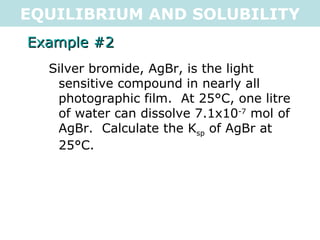
EQUILIBRIUM AND SOLUBILITY Example #2 Silver bromide, AgBr, is the light sensitive compound in nearly all photographic film.  At 25°C, one litre of water can dissolve 7.1x10 -7  mol of AgBr.  Calculate the K sp  of AgBr at 25°C.
EQUILIBRIUM AND SOLUBILITY Example #2 Silver bromide, AgBr, is the light sensitive compound in nearly all photographic film.  At 25°C, one litre of water can dissolve 7.1x10 -7  mol of AgBr.  Calculate the K sp  of AgBr at 25°C. AgBr (s)  <=> Ag + (aq)  + Br - (aq) I  0  0 C  +7.1x10 -7  +7.1x10 -7   E  7.1x10 -7   7.1x10 -7   Changes when it dissolves, but it is a solid. K sp  = [7.1x10 -7 ][7.1x10 -7 ] K sp  = 5.0x10 -13 .: K sp  = 5.0x10 -13
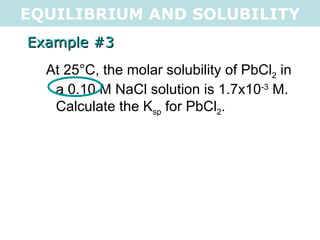
EQUILIBRIUM AND SOLUBILITY Example #3 At 25°C, the molar solubility of PbCl 2  in a 0.10 M NaCl solution is 1.7x10 -3  M.  Calculate the K sp  for PbCl 2 .
EQUILIBRIUM AND SOLUBILITY Example #3 At 25°C, the molar solubility of PbCl 2  in a 0.10 M NaCl solution is 1.7x10 -3  M.  Calculate the K sp  for PbCl 2 . PbCl 2(s)  <=> Pb 2+ (aq)  + 2Cl - (aq) I  0  0.1 C  +1.7x10 -3  +2(1.7x10 -3 )   E  1.7x10 -3   0.1034  NOTE:  0.1M Na +  does not affect equilibrium K sp  = [1.7x10 -3 ][0.1034] 2 K sp  = 1.8x10 -5 .: K sp  = 1.8x10 -5
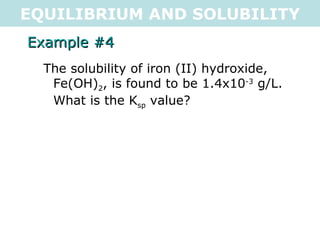
EQUILIBRIUM AND SOLUBILITY Example #4 The solubility of iron (II) hydroxide, Fe(OH) 2 , is found to be 1.4x10 -3  g/L.  What is the K sp  value?
EQUILIBRIUM AND SOLUBILITY Example #4 The solubility of iron (II) hydroxide, Fe(OH) 2 , is found to be 1.4x10 -3  g/L.  What is the K sp  value? n =  m M =  (1.4x10 -3 g) (89.861g/mol) = 1.557961741x10 -5 mol Fe(OH) 2(s)  <=> Fe 2+ (aq)   +  2OH - (aq) I  0  0 C  +1.55796x10 -5  +2(1.55796x10 -5 )   E  1.55796x10 -5   3.11592x10 -5   K sp  = [1.55796x10 -5 ][3.11592x10 -5 ] 2 K sp  = 1.5x10 -14 .: K sp  = 1.5x10 -14
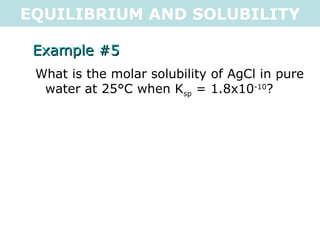
EQUILIBRIUM AND SOLUBILITY Example #5 What is the molar solubility of AgCl in pure water at 25°C when K sp  = 1.8x10 -10 ?
EQUILIBRIUM AND SOLUBILITY Example #5 What is the molar solubility of AgCl in pure water at 25°C when K sp  = 1.8x10 -10 . AgCl (s)  <=> Ag + (aq)   +  Cl - (aq) I  0  0 C  +x   +x E  x  x K sp  = [x][x] K sp  = x 2 1.8x10 -10  = x 2 1.34x10 -5 M = x .: the molar solubility is 1.34x10 -5 mol/L
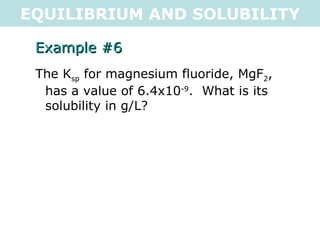
EQUILIBRIUM AND SOLUBILITY Example #6 The K sp  for magnesium fluoride, MgF 2 , has a value of 6.4x10 -9 .  What is its solubility in g/L?
EQUILIBRIUM AND SOLUBILITY Example #6 The K sp  for magnesium fluoride, MgF 2 , has a value of 6.4x10 -9 .  What is its solubility in g/L? MgF 2(s)  <=> Mg 2+ (aq)  +  2F - (aq) I  0  0 C  +x   +2x E  x  2x K sp  = [x][2x] 2  = 6.4x10 -9 4x 3  = 6.4x10 -9 x   =  6.4x10 -9 4 x   =  1.16x10 -3 mol/L .: the solubility is 7.2x10 -2 g/L 3
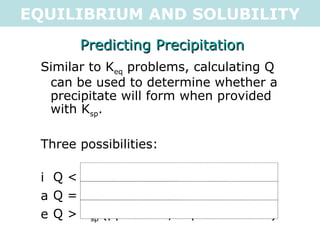
EQUILIBRIUM AND SOLUBILITY Predicting Precipitation Similar to K eq  problems, calculating Q can be used to determine whether a precipitate will form when provided with K sp . Three possibilities: Q < K sp (no ppt, unsaturated) Q = K sp (no ppt, saturated) Q > K sp (ppt forms, supersaturated)
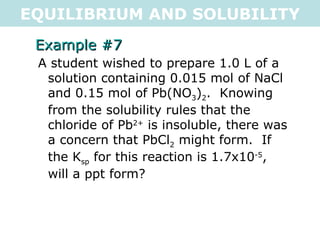
EQUILIBRIUM AND SOLUBILITY Example #7 A student wished to prepare 1.0 L of a solution containing 0.015 mol of NaCl and 0.15 mol of Pb(NO 3 ) 2 .  Knowing from the solubility rules that the chloride of Pb 2+  is insoluble, there was a concern that PbCl 2  might form.  If the K sp  for this reaction is 1.7x10 -5 , will a ppt form?
EQUILIBRIUM AND SOLUBILITY Example #7 A student wished to prepare 1.0 L of a solution containing 0.015 mol of NaCl and 0.15 mol of Pb(NO 3 ) 2 .  Knowing from the solubility rules that the chloride of Pb 2+  is insoluble, there was a concern that PbCl 2  might form.  If the K sp  for this reaction is 1.7x10 -5 , will a ppt form? PbCl 2(s)  <=> Pb 2+ (aq)  +  2Cl - (aq) 0.15  0.015 K sp  = [Pb 2+ (aq) ][Cl - (aq) ] 2 Q = [Pb 2+ (aq) ][Cl - (aq) ] 2 Q = [0.15][0.015] 2 Q = 3.375x10 -5 Q > K sp , so a precipitate WILL form .: a precipitate will form
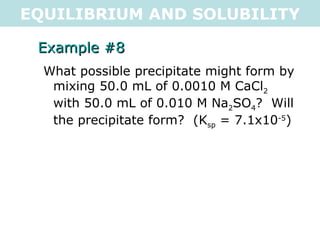
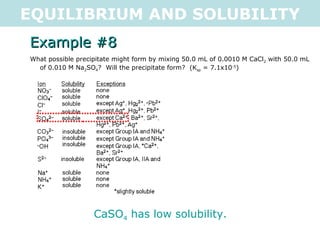
EQUILIBRIUM AND SOLUBILITY Example #8 What possible precipitate might form by mixing 50.0 mL of 0.0010 M CaCl 2  with 50.0 mL of 0.010 M Na 2 SO 4 ?  Will the precipitate form?  (K sp  = 7.1x10 -5 )
EQUILIBRIUM AND SOLUBILITY Example #8 What possible precipitate might form by mixing 50.0 mL of 0.0010 M CaCl 2  with 50.0 mL of 0.010 M Na 2 SO 4 ?  Will the precipitate form?  (K sp  = 7.1x10 -5 ) CaSO 4  has low solubility.
EQUILIBRIUM AND SOLUBILITY Example #8 What possible precipitate might form by mixing 50.0 mL of 0.0010 M CaCl 2  with 50.0 mL of 0.010 M Na 2 SO 4 ?  Will the precipitate form?  (K sp  = 7.1x10 -5 ) CaSO 4(s)  <=> Ca 2+ (aq)  +  SO 4 2- (aq) C 1 V 1 =C 2 V 2 C 2 = C 1 V 1 V 2 C 2 = 0.0010M x 0.050L 0.100L C 2 = 5x10 -4 M C 2 = C 1 V 1 V 2 C 2 = 5x10 -3 M Q = [Ca 2+ (aq) ][SO 4 2- (aq) ] Q = [0.0005][0.005] Q = 2.5x10 -6 Q < K sp , so a precipitate will NOT form (unsaturated) .: the possible precipitate, CaSO 4 , will not form
EQUILIBRIUM AND SOLUBILITY Example #9 Will a precipitate form if 20.0 mL of  0.010 M CaCl 2  are mixed with 30.0 mL of 0.0080 M Na 2 SO 4 ?  (K sp  = 2.45x10 -5 )
EQUILIBRIUM AND SOLUBILITY Example #9 Will a precipitate form if 20.0 mL of 0.010 M CaCl 2  are mixed with 30.0 mL of 0.0080 M Na 2 SO 4 ? (K sp  = 2.45x10 -5 ) CaSO 4(s)  <=> Ca 2+ (aq)  +  SO 4 2- (aq) C 2 = C 1 V 1 V 2 C 2 = 0.010M x 0.020L 0.050L C 2 = 4x10 -3 M C 2 = C 1 V 1 V 2 C 2 = 0.0080M x 0.030L 0.050L C 2 = 4.8x10 -3 M Q = [Ca 2+ (aq) ][SO 4 2- (aq) ] Q = [0.004][0.0048] Q = 1.92x10 -5 Q < K sp , so a precipitate will NOT form (unsaturated) .: a precipitate will not form

Tang 07 equilibrium and solubility 2

  • 1.
  • 2.
    EQUILIBRIUM AND SOLUBILITYSolids form from solution when: a solution is saturated two solutions are mixed to form a precipitate Both are dependent on an equilibrium between the solution and the solid.
  • 3.
    EQUILIBRIUM AND SOLUBILITYK sp K sp is the solubility product constant for solutions that can form a solid. This is true for saturated solutions . Why? Only at saturation point is equilibrium achieved.
  • 4.
    EQUILIBRIUM AND SOLUBILITYExample #1 Determine the K sp expressions for the following equilibria: Ag 2 CrO 4(s) <===> 2 Ag + (aq) + CrO 4 2- (aq) BaCrO 4(s) <===> Ba 2+ (aq) + CrO 4 2- (aq) Ag 3 PO 4(s) <===> 3 Ag + (aq) + PO 4 3- (aq) K sp = [Ag + (aq) ] 2 [CrO 4 2- (aq) ] K sp = [Ba 2+ (aq) ][CrO 4 2- (aq) ] K sp = [Ag + (aq) ] 3 [PO 4 3- (aq) ]
  • 5.
    EQUILIBRIUM AND SOLUBILITYMolar Solubility The molar solubility for a compound is the concentration that is necessary for a solution to become saturated. Ex. One litre of water can dissolve 7.1x10 -7 mol of AgBr K sp values may be used to calculate molar solubility and vice versa.
  • 6.
    EQUILIBRIUM AND SOLUBILITYExample #2 Silver bromide, AgBr, is the light sensitive compound in nearly all photographic film. At 25°C, one litre of water can dissolve 7.1x10 -7 mol of AgBr. Calculate the K sp of AgBr at 25°C.
  • 7.
    EQUILIBRIUM AND SOLUBILITYExample #2 Silver bromide, AgBr, is the light sensitive compound in nearly all photographic film. At 25°C, one litre of water can dissolve 7.1x10 -7 mol of AgBr. Calculate the K sp of AgBr at 25°C. AgBr (s) <=> Ag + (aq) + Br - (aq) I 0 0 C +7.1x10 -7 +7.1x10 -7 E 7.1x10 -7 7.1x10 -7 Changes when it dissolves, but it is a solid. K sp = [7.1x10 -7 ][7.1x10 -7 ] K sp = 5.0x10 -13 .: K sp = 5.0x10 -13
  • 8.
    EQUILIBRIUM AND SOLUBILITYExample #3 At 25°C, the molar solubility of PbCl 2 in a 0.10 M NaCl solution is 1.7x10 -3 M. Calculate the K sp for PbCl 2 .
  • 9.
    EQUILIBRIUM AND SOLUBILITYExample #3 At 25°C, the molar solubility of PbCl 2 in a 0.10 M NaCl solution is 1.7x10 -3 M. Calculate the K sp for PbCl 2 . PbCl 2(s) <=> Pb 2+ (aq) + 2Cl - (aq) I 0 0.1 C +1.7x10 -3 +2(1.7x10 -3 ) E 1.7x10 -3 0.1034 NOTE: 0.1M Na + does not affect equilibrium K sp = [1.7x10 -3 ][0.1034] 2 K sp = 1.8x10 -5 .: K sp = 1.8x10 -5
  • 10.
    EQUILIBRIUM AND SOLUBILITYExample #4 The solubility of iron (II) hydroxide, Fe(OH) 2 , is found to be 1.4x10 -3 g/L. What is the K sp value?
  • 11.
    EQUILIBRIUM AND SOLUBILITYExample #4 The solubility of iron (II) hydroxide, Fe(OH) 2 , is found to be 1.4x10 -3 g/L. What is the K sp value? n = m M = (1.4x10 -3 g) (89.861g/mol) = 1.557961741x10 -5 mol Fe(OH) 2(s) <=> Fe 2+ (aq) + 2OH - (aq) I 0 0 C +1.55796x10 -5 +2(1.55796x10 -5 ) E 1.55796x10 -5 3.11592x10 -5 K sp = [1.55796x10 -5 ][3.11592x10 -5 ] 2 K sp = 1.5x10 -14 .: K sp = 1.5x10 -14
  • 12.
    EQUILIBRIUM AND SOLUBILITYExample #5 What is the molar solubility of AgCl in pure water at 25°C when K sp = 1.8x10 -10 ?
  • 13.
    EQUILIBRIUM AND SOLUBILITYExample #5 What is the molar solubility of AgCl in pure water at 25°C when K sp = 1.8x10 -10 . AgCl (s) <=> Ag + (aq) + Cl - (aq) I 0 0 C +x +x E x x K sp = [x][x] K sp = x 2 1.8x10 -10 = x 2 1.34x10 -5 M = x .: the molar solubility is 1.34x10 -5 mol/L
  • 14.
    EQUILIBRIUM AND SOLUBILITYExample #6 The K sp for magnesium fluoride, MgF 2 , has a value of 6.4x10 -9 . What is its solubility in g/L?
  • 15.
    EQUILIBRIUM AND SOLUBILITYExample #6 The K sp for magnesium fluoride, MgF 2 , has a value of 6.4x10 -9 . What is its solubility in g/L? MgF 2(s) <=> Mg 2+ (aq) + 2F - (aq) I 0 0 C +x +2x E x 2x K sp = [x][2x] 2 = 6.4x10 -9 4x 3 = 6.4x10 -9 x = 6.4x10 -9 4 x = 1.16x10 -3 mol/L .: the solubility is 7.2x10 -2 g/L 3
  • 16.
    EQUILIBRIUM AND SOLUBILITYPredicting Precipitation Similar to K eq problems, calculating Q can be used to determine whether a precipitate will form when provided with K sp . Three possibilities: Q < K sp (no ppt, unsaturated) Q = K sp (no ppt, saturated) Q > K sp (ppt forms, supersaturated)
  • 17.
    EQUILIBRIUM AND SOLUBILITYExample #7 A student wished to prepare 1.0 L of a solution containing 0.015 mol of NaCl and 0.15 mol of Pb(NO 3 ) 2 . Knowing from the solubility rules that the chloride of Pb 2+ is insoluble, there was a concern that PbCl 2 might form. If the K sp for this reaction is 1.7x10 -5 , will a ppt form?
  • 18.
    EQUILIBRIUM AND SOLUBILITYExample #7 A student wished to prepare 1.0 L of a solution containing 0.015 mol of NaCl and 0.15 mol of Pb(NO 3 ) 2 . Knowing from the solubility rules that the chloride of Pb 2+ is insoluble, there was a concern that PbCl 2 might form. If the K sp for this reaction is 1.7x10 -5 , will a ppt form? PbCl 2(s) <=> Pb 2+ (aq) + 2Cl - (aq) 0.15 0.015 K sp = [Pb 2+ (aq) ][Cl - (aq) ] 2 Q = [Pb 2+ (aq) ][Cl - (aq) ] 2 Q = [0.15][0.015] 2 Q = 3.375x10 -5 Q > K sp , so a precipitate WILL form .: a precipitate will form
  • 19.
    EQUILIBRIUM AND SOLUBILITYExample #8 What possible precipitate might form by mixing 50.0 mL of 0.0010 M CaCl 2 with 50.0 mL of 0.010 M Na 2 SO 4 ? Will the precipitate form? (K sp = 7.1x10 -5 )
  • 20.
    EQUILIBRIUM AND SOLUBILITYExample #8 What possible precipitate might form by mixing 50.0 mL of 0.0010 M CaCl 2 with 50.0 mL of 0.010 M Na 2 SO 4 ? Will the precipitate form? (K sp = 7.1x10 -5 ) CaSO 4 has low solubility.
  • 21.
    EQUILIBRIUM AND SOLUBILITYExample #8 What possible precipitate might form by mixing 50.0 mL of 0.0010 M CaCl 2 with 50.0 mL of 0.010 M Na 2 SO 4 ? Will the precipitate form? (K sp = 7.1x10 -5 ) CaSO 4(s) <=> Ca 2+ (aq) + SO 4 2- (aq) C 1 V 1 =C 2 V 2 C 2 = C 1 V 1 V 2 C 2 = 0.0010M x 0.050L 0.100L C 2 = 5x10 -4 M C 2 = C 1 V 1 V 2 C 2 = 5x10 -3 M Q = [Ca 2+ (aq) ][SO 4 2- (aq) ] Q = [0.0005][0.005] Q = 2.5x10 -6 Q < K sp , so a precipitate will NOT form (unsaturated) .: the possible precipitate, CaSO 4 , will not form
  • 22.
    EQUILIBRIUM AND SOLUBILITYExample #9 Will a precipitate form if 20.0 mL of 0.010 M CaCl 2 are mixed with 30.0 mL of 0.0080 M Na 2 SO 4 ? (K sp = 2.45x10 -5 )
  • 23.
    EQUILIBRIUM AND SOLUBILITYExample #9 Will a precipitate form if 20.0 mL of 0.010 M CaCl 2 are mixed with 30.0 mL of 0.0080 M Na 2 SO 4 ? (K sp = 2.45x10 -5 ) CaSO 4(s) <=> Ca 2+ (aq) + SO 4 2- (aq) C 2 = C 1 V 1 V 2 C 2 = 0.010M x 0.020L 0.050L C 2 = 4x10 -3 M C 2 = C 1 V 1 V 2 C 2 = 0.0080M x 0.030L 0.050L C 2 = 4.8x10 -3 M Q = [Ca 2+ (aq) ][SO 4 2- (aq) ] Q = [0.004][0.0048] Q = 1.92x10 -5 Q < K sp , so a precipitate will NOT form (unsaturated) .: a precipitate will not form