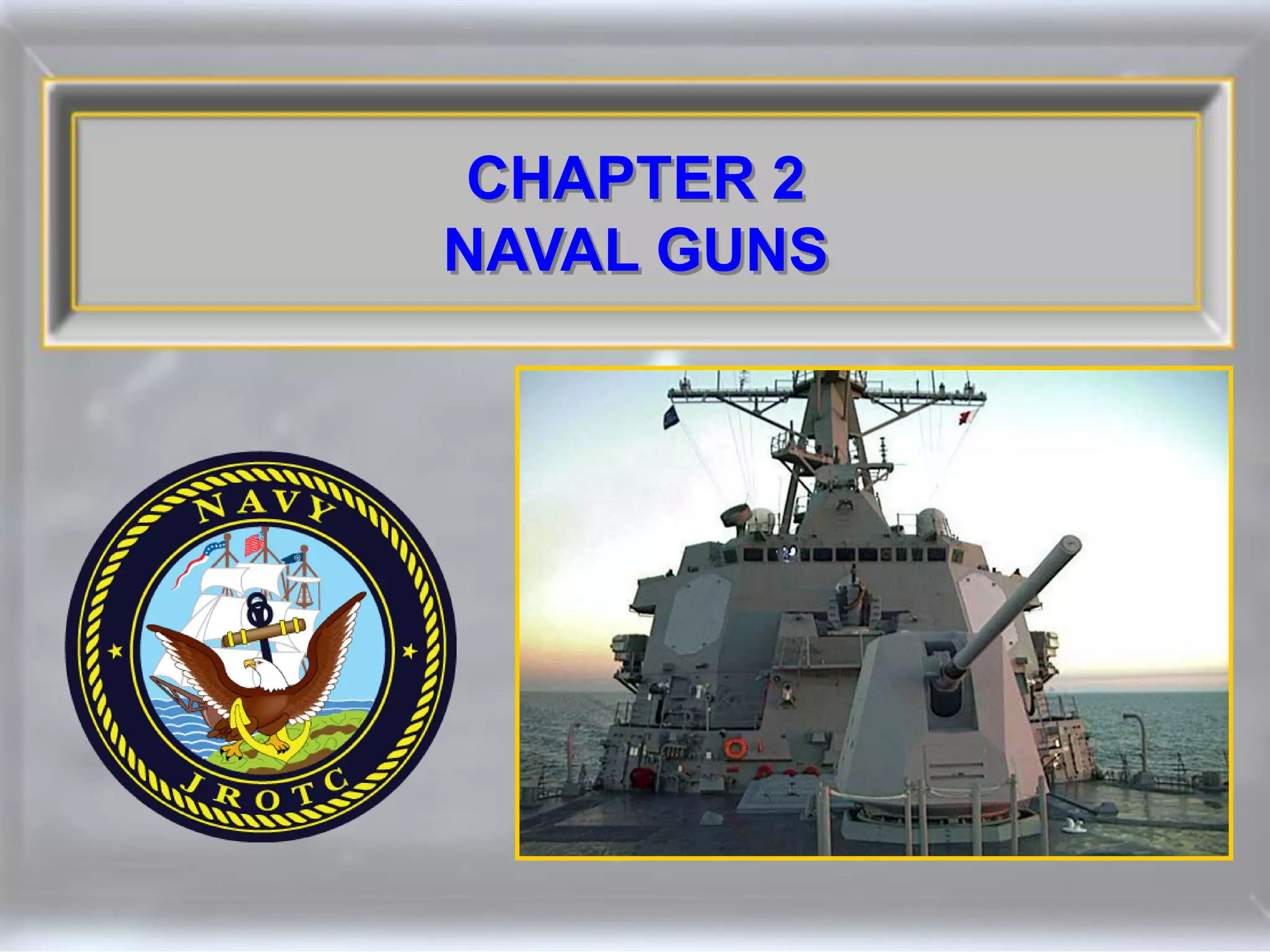
CHAPTER 2
NAVAL GUNS
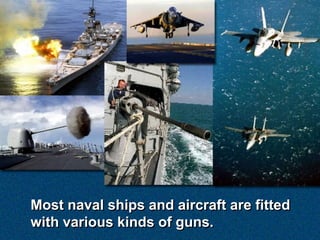
Most naval ships and aircraft are fitted
with various kinds of guns.
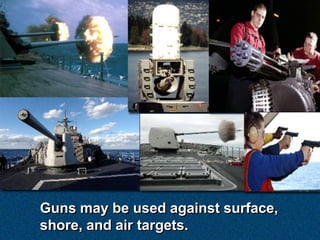
Guns may be used against surface,
shore, and air targets.
Dual-Purpose Systems

Ship guns designed for engaging
both air and surface targets
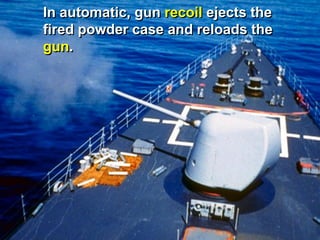
In automatic, gun recoil ejects the
fired powder case and reloads the
gun.
Gun

A weapon consisting of a metal tube
or barrel closed at one end, with
mechanical attachments from which
projectiles are shot by the force of an
explosive.
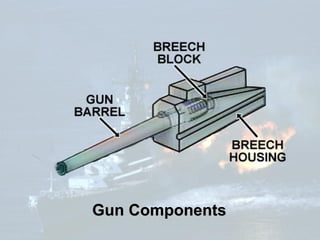
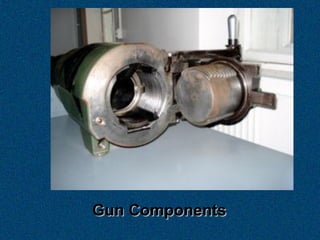
Gun Components
Gun Components
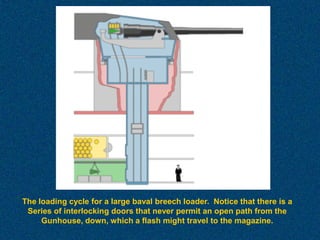
The loading cycle for a large baval breech loader. Notice that there is a
 Series of interlocking doors that never permit an open path from the
     Gunhouse, down, which a flash might travel to the magazine.
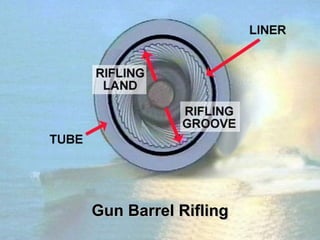
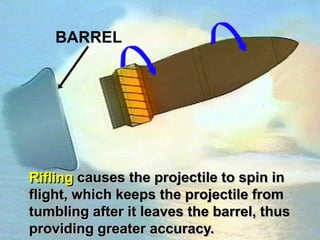
Gun Barrel Rifling
Rifled Barrel
Spiral grooves cut in the inner
surface of the gun barrel to give
the projectile a rotating motion
and thus a more precise trajectory

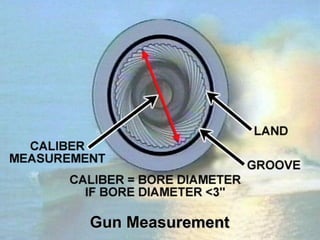
       Rifling Lands
   The system of rifling spiral
   grooves cut inside the bore
BARREL


Rifling causes the projectile to spin in
flight, which keeps the projectile from
tumbling after it leaves the barrel, thus
providing greater accuracy.
Gun Measurement
Caliber

The diameter of the bore of a gun
taken as a unit of measurement
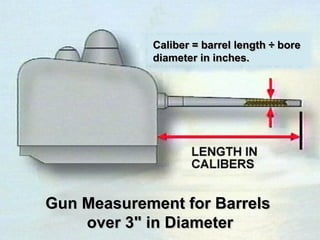
Caliber = barrel length ÷ bore
            diameter in inches.


Gun Measurement for Barrels
    over 3" in Diameter
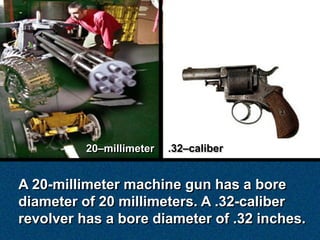
20–millimeter   .32–caliber


A 20-millimeter machine gun has a bore
diameter of 20 millimeters. A .32-caliber
revolver has a bore diameter of .32 inches.
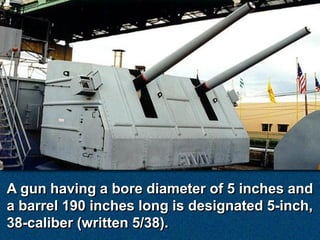
A gun having a bore diameter of 5 inches and
a barrel 190 inches long is designated 5-inch,
38-caliber (written 5/38).
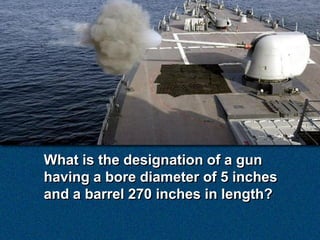
What is the designation of a gun
having a bore diameter of 5 inches
and a barrel 270 inches in length?
What is the designation of a gun
having a bore diameter of 5 inches
and a barrel 270 inches in length?
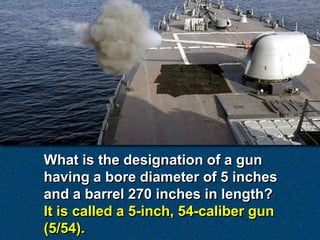
It is called a 5-inch, 54-caliber gun
(5/54).
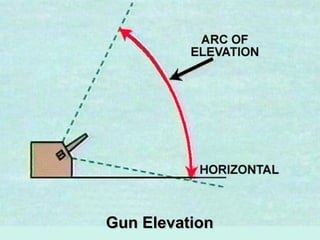
Gun Elevation
Arc of Elevation

The total vertical arc through which a
gun barrel can be raised and lowered
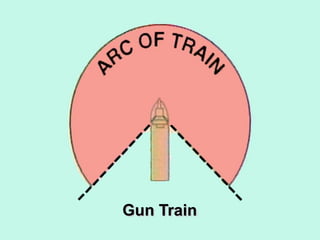
Gun Train
Arc of Train

The total horizontal arc through which
a gun mount may be rotated
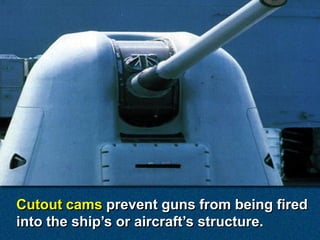
Cutout cams prevent guns from being fired
into the ship’s or aircraft’s structure.
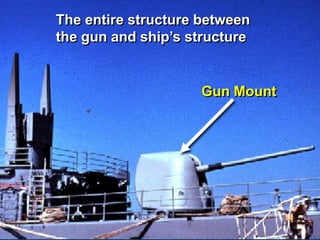
The entire structure between
the gun and ship’s structure


                    Gun Mount
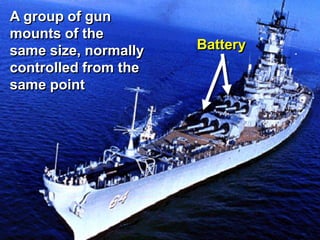
A group of gun
mounts of the
same size, normally   Battery
controlled from the
same point
Main Battery

Consists of the largest size gun
on board a ship


    Secondary Battery

Consists of dual-purpose guns,
or guns of the next smaller size
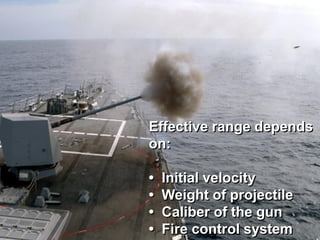
Effective range depends
on:

•   Initial velocity
•   Weight of projectile
•   Caliber of the gun
•   Fire control system
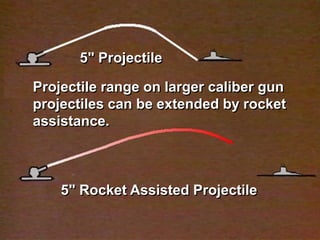
5" Projectile

Projectile range on larger caliber gun
projectiles can be extended by rocket
assistance.


    5" Rocket Assisted Projectile
Rocket-Assisted Projectiles (RAP)


  They are designed to extend the
  range of the projectiles and are
  filled with high explosive (HE)
  material.
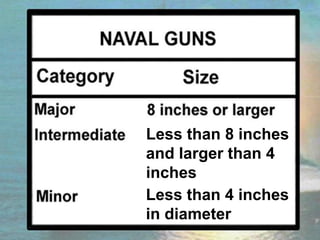
Less than 8 inches
and larger than 4
inches
Less than 4 inches
in diameter
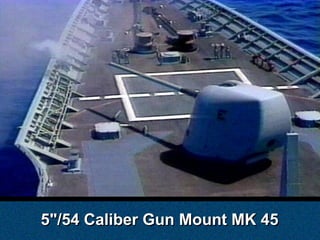
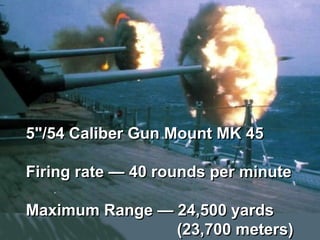
5"/54 Caliber Gun Mount MK 45

Firing rate — 40 rounds per minute

Maximum Range — 24,500 yards
                (23,700 meters)
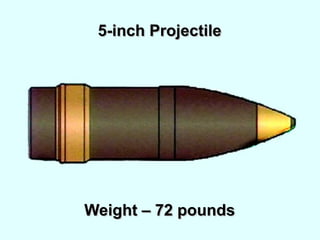
5-inch Projectile


Weight – 72 pounds
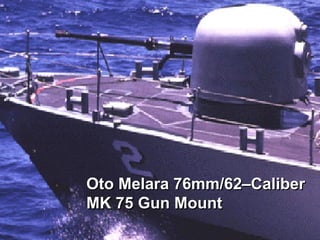
Oto Melara 76mm/62–Caliber
MK 75 Gun Mount
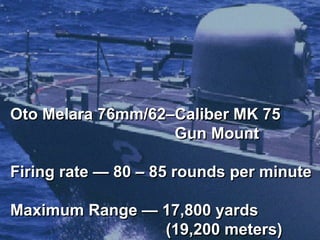
Oto Melara 76mm/62–Caliber MK 75
                   Gun Mount

Firing rate — 80 – 85 rounds per minute

Maximum Range — 17,800 yards
                (19,200 meters)
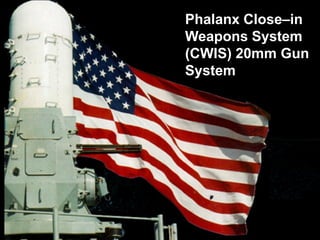
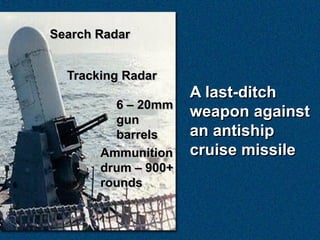
Phalanx Close–in
Weapons System
(CWIS) 20mm Gun
System
Search Radar


  Tracking Radar
                     A last-ditch
         6 – 20mm
         gun
                     weapon against
         barrels     an antiship
       Ammunition    cruise missile
       drum – 900+
       rounds
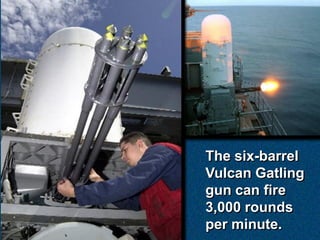
The six-barrel
Vulcan Gatling
gun can fire
3,000 rounds
per minute.
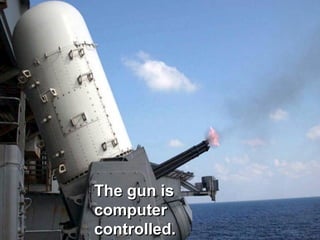
The gun is
computer
controlled.
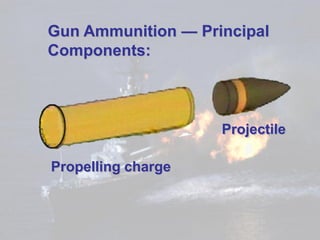
Gun Ammunition — Principal
Components:


                    Projectile

Propelling charge
Projectile

An object fired from a gun with an
explosive propelling charge, such
as a bullet, shell, rocket, or grenade
DER

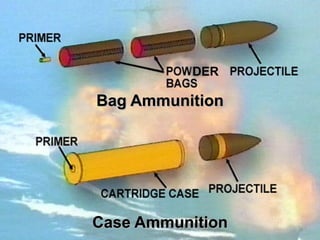
Bag Ammunition


Case Ammunition
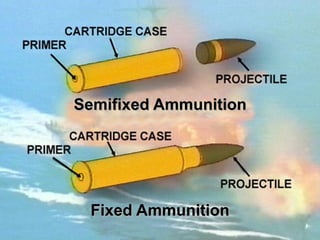
Semifixed Ammunition


 Fixed Ammunition
Semifixed Ammunition
 Refers to a round that consists of a
 projectile and a separate case charge
 loaded one after the other


         Fixed Ammunition
Refers to a round in which the projectile
and powder case are permanently
attached (standard in 3‖ and smaller guns)
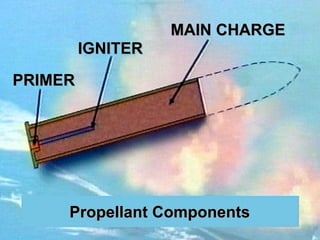
MAIN CHARGE
         IGNITER
PRIMER


     Propellant Components
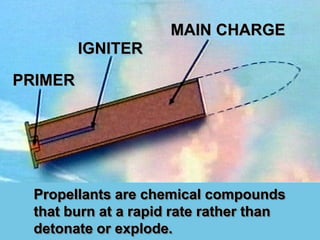
MAIN CHARGE
         IGNITER
PRIMER


  Propellants are chemical compounds
  that burn at a rapid rate rather than
  detonate or explode.
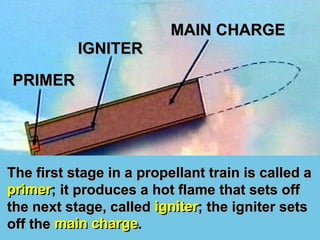
MAIN CHARGE
           IGNITER
PRIMER


The first stage in a propellant train is called a
primer
primer; it produces a hot flame that sets off
                       igniter
the next stage, called igniter; the igniter sets
off the main charge
              charge.
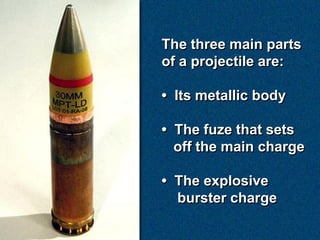
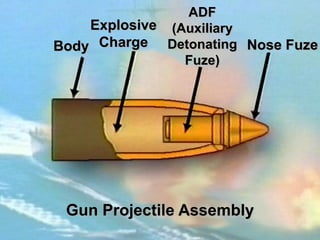
The three main parts
of a projectile are:

• Its metallic body

• The fuze that sets
  off the main charge

• The explosive
  burster charge
ADF
    Explosive (Auxiliary
Body Charge Detonating Nose Fuze
                Fuze)


 Gun Projectile Assembly
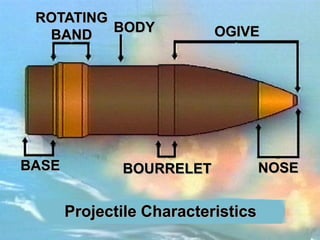
ROTATING
          BODY             OGIVE
  BAND


BASE          BOURRELET             NOSE


       Projectile Characteristics
Ogive

The curved nose of a missile or rocket
Bourrelet

The widest part of the projectile, located
immediately to the rear of the ogive
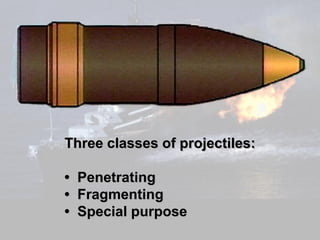
Three classes of projectiles:

• Penetrating
• Fragmenting
• Special purpose
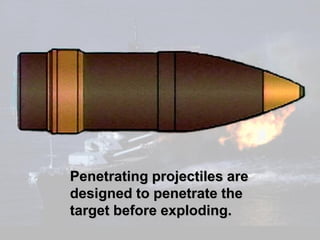
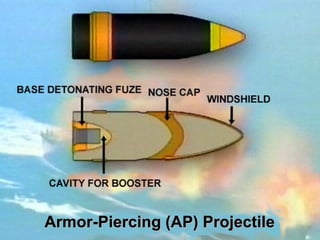
Penetrating projectiles are
designed to penetrate the
target before exploding.
Armor-Piercing (AP) Projectile
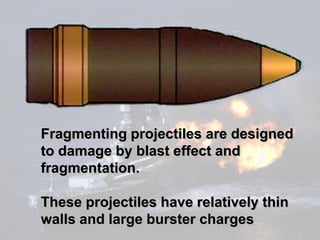
Fragmenting projectiles are designed
to damage by blast effect and
fragmentation.

These projectiles have relatively thin
walls and large burster charges
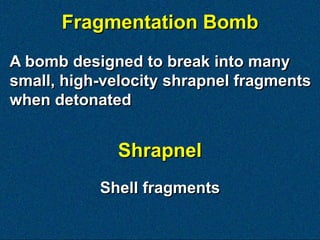
Fragmentation Bomb
A bomb designed to break into many
small, high-velocity shrapnel fragments
when detonated


              Shrapnel
           Shell fragments
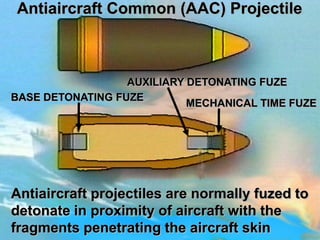
Antiaircraft Common (AAC) Projectile


                  AUXILIARY DETONATING FUZE
BASE DETONATING FUZE
                            MECHANICAL TIME FUZE


Antiaircraft projectiles are normally fuzed to
detonate in proximity of aircraft with the
fragments penetrating the aircraft skin
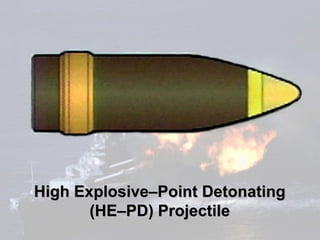
High Explosive–Point Detonating
       (HE–PD) Projectile
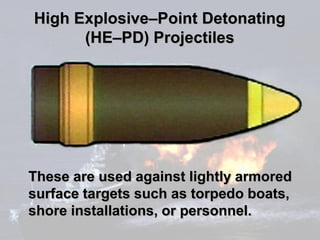
High Explosive–Point Detonating
      (HE–PD) Projectiles


These are used against lightly armored
surface targets such as torpedo boats,
shore installations, or personnel.
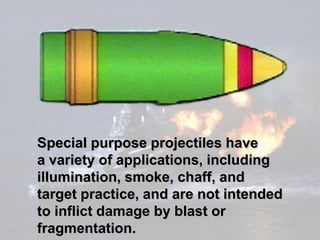
Special purpose projectiles have
a variety of applications, including
illumination, smoke, chaff, and
target practice, and are not intended
to inflict damage by blast or
fragmentation.
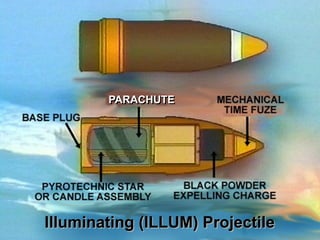
PARACHUTE


Illuminating (ILLUM) Projectile
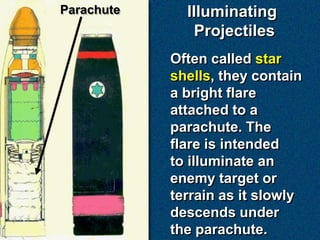
Parachute     Illuminating
               Projectiles
            Often called star
            shells, they contain
            a bright flare
            attached to a
            parachute. The
            flare is intended
            to illuminate an
            enemy target or
            terrain as it slowly
            descends under
            the parachute.
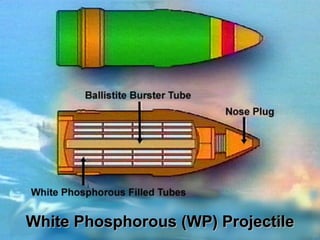
White Phosphorous (WP) Projectile
Ballistite

A smokeless powder consisting of
nitroglycerine and cellulose nitrate
chiefly in a 40 to 60 percent ratio;
used as a solid fuel for rockets
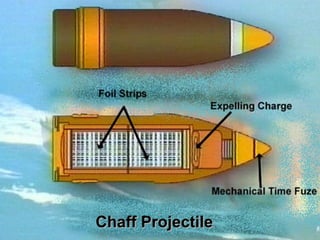
Chaff Projectile
Chaff

Strips of metal foil dropped by an
aircraft to confuse enemy radar by
creating false blips
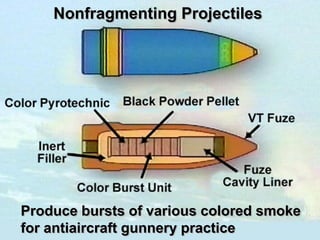
Nonfragmenting Projectiles


Produce bursts of various colored smoke
for antiaircraft gunnery practice
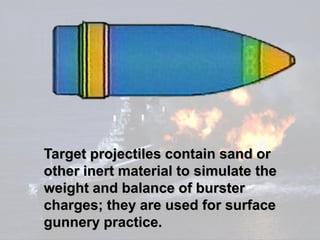
Target projectiles contain sand or
other inert material to simulate the
weight and balance of burster
charges; they are used for surface
gunnery practice.
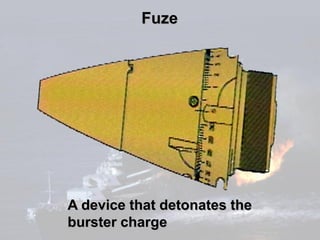
Fuze


A device that detonates the
burster charge
Fuze
A mechanical or electronic device to
detonate an explosive charge,
especially as contained in an artillery
shell, a missile, projectile, or the like

    Fuse (different spelling)
 A tube, cord, or the like, filled or
 saturated with combustible matter,
 for igniting an explosive
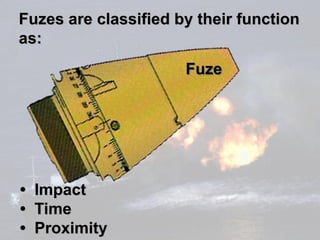
Fuzes are classified by their function
as:
                      Fuze


• Impact
• Time
• Proximity
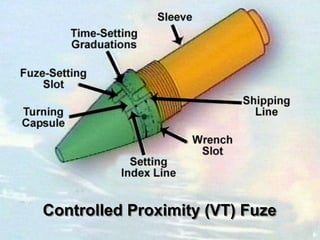
Controlled Proximity (VT) Fuze
Proximity Fuze

A design for detonating a charge, as
in a projectile, within a predesignated
radius of a target
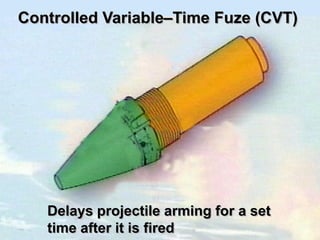
Controlled Variable–Time Fuze (CVT)


   Delays projectile arming for a set
   time after it is fired
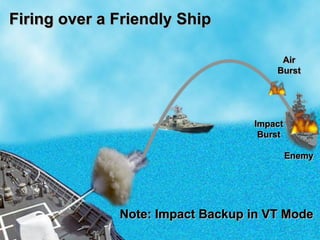
Firing over a Friendly Ship

                                       Air
                                      Burst


                                  Impact
                                   Burst

                                           Enemy


              Note: Impact Backup in VT Mode
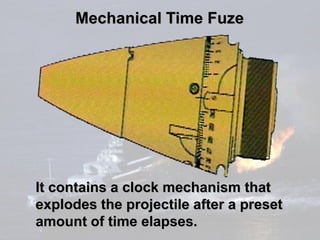
Mechanical Time Fuze


It contains a clock mechanism that
explodes the projectile after a preset
amount of time elapses.
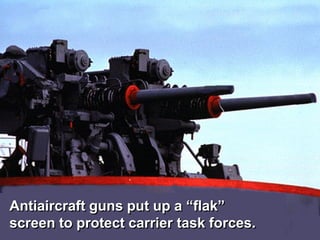
Antiaircraft guns put up a ―flak‖
screen to protect carrier task forces.
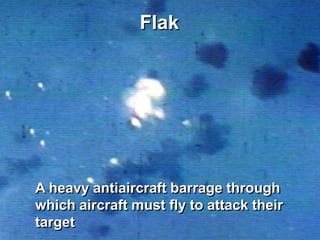
Flak


A heavy antiaircraft barrage through
which aircraft must fly to attack their
target
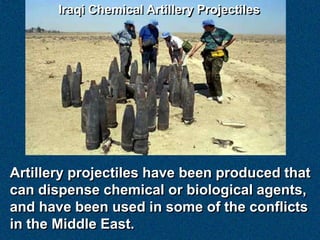
Iraqi Chemical Artillery Projectiles


Artillery projectiles have been produced that
can dispense chemical or biological agents,
and have been used in some of the conflicts
in the Middle East.
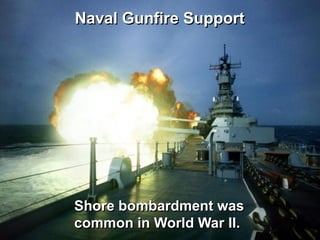
Naval Gunfire Support


Shore bombardment was
common in World War II.
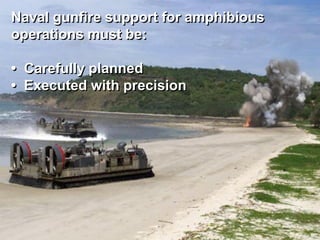
Naval gunfire support for amphibious
operations must be:

• Carefully planned
• Executed with precision
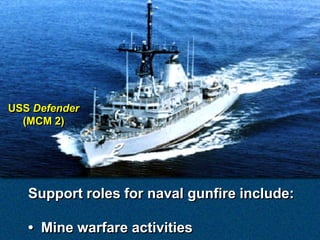
USS Defender
  (MCM 2)


   Support roles for naval gunfire include:

   • Mine warfare activities
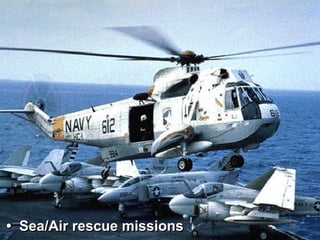
• Sea/Air rescue missions
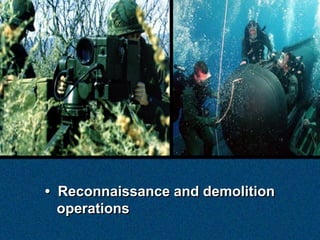
• Reconnaissance and demolition
  operations
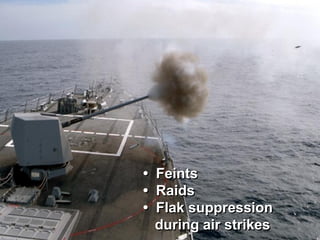
• Feints
• Raids
• Flak suppression
  during air strikes
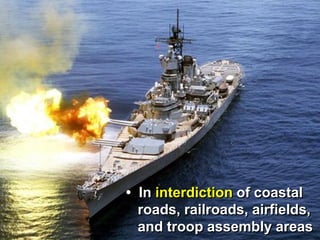
• In interdiction of coastal
  roads, railroads, airfields,
  and troop assembly areas
Interdiction
            THE END
Steady bombardment of enemy positions
and communications lines for the
purpose of delaying and disorganizing
progress

Naval Guns