TECHNICAL SEMINAR REPORT 
National Institute of Science & Technology 1 
10 GIGABIT ETHERNET 
TECHNOLOGY 
Presented by 
RRaammoottaarr PPrraassaadd SSaahhoooo 
Roll No:CS200118210 
Under the Guidance 
of 
MMrr.. PPrraaddeeeepp KKuummaarr JJeennaa..
10 GIGABIT ETHERNET TECHNOLOGY 
INTRODUCTION 
National Institute of Science & Technology 2 
• Ethernet essential for internet. 
• 10 Gigabit Ethernet is the latest. 
• It finds its applications in LAN, MAN, WAN and SAN. 
• Provides high speed and reliable network. 
• Provides low installation and maintenance cost. 
Presented By: Ramotar Prasad Sahoo
10 GIGABIT ETHERNET TECHNOLOGY 
HISTORY 
National Institute of Science & Technology 3 
• Developed by Robert Metcalfe and David Boggs in 1973 
at Xerox PARC. 
• In June 2002 IEEE adopted 10 Gigabit Ethernet 
Standard(802.3ae). 
Presented By: Ramotar Prasad Sahoo
10 GIGABIT ETHERNET TECHNOLOGY 
10 GbE TECHNOLOGY OVERVIEW 
National Institute of Science & Technology 4 
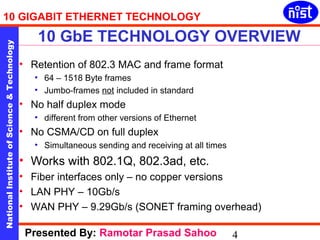
• Retention of 802.3 MAC and frame format 
• 64 – 1518 Byte frames 
• Jumbo-frames not included in standard 
• No half duplex mode 
• different from other versions of Ethernet 
• No CSMA/CD on full duplex 
• Simultaneous sending and receiving at all times 
• Works with 802.1Q, 802.3ad, etc. 
• Fiber interfaces only – no copper versions 
• LAN PHY – 10Gb/s 
• WAN PHY – 9.29Gb/s (SONET framing overhead) 
Presented By: Ramotar Prasad Sahoo
10 GIGABIT ETHERNET TECHNOLOGY 
10 GbE STANDARD 
National Institute of Science & Technology 5 
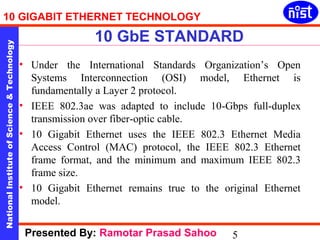
• Under the International Standards Organization’s Open 
Systems Interconnection (OSI) model, Ethernet is 
fundamentally a Layer 2 protocol. 
• IEEE 802.3ae was adapted to include 10-Gbps full-duplex 
transmission over fiber-optic cable. 
• 10 Gigabit Ethernet uses the IEEE 802.3 Ethernet Media 
Access Control (MAC) protocol, the IEEE 802.3 Ethernet 
frame format, and the minimum and maximum IEEE 802.3 
frame size. 
• 10 Gigabit Ethernet remains true to the original Ethernet 
model. 
Presented By: Ramotar Prasad Sahoo
10 GIGABIT ETHERNET TECHNOLOGY 
10 GbE ARCHITECTURES 
National Institute of Science & Technology 6 
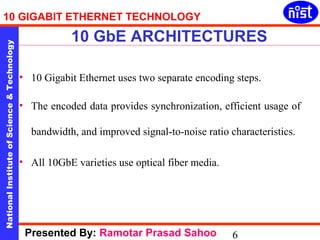
• 10 Gigabit Ethernet uses two separate encoding steps. 
• The encoded data provides synchronization, efficient usage of 
bandwidth, and improved signal-to-noise ratio characteristics. 
• All 10GbE varieties use optical fiber media. 
Presented By: Ramotar Prasad Sahoo
10 GIGABIT ETHERNET TECHNOLOGY 
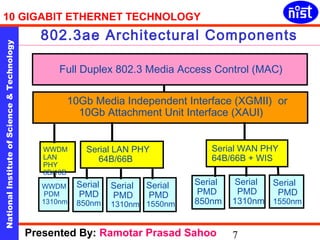
802.3ae Architectural Components 
National Institute of Science & Technology 7 
Full Duplex 802.3 Media Access Control (MAC) 
10Gb Media Independent Interface (XGMII) or 
10Gb Attachment Unit Interface (XAUI) 
WWDM 
LAN 
PHY 
8B/10B 
WWDM 
PDM 
1310nm 
Serial LAN PHY 
64B/66B 
Serial 
PMD 
850nm 
Serial 
PMD 
1310nm 
Serial 
PMD 
1550nm 
Serial WAN PHY 
64B/66B + WIS 
Serial 
PMD 
850nm 
Serial 
PMD 
1310nm 
Serial 
PMD 
1550nm 
Presented By: Ramotar Prasad Sahoo
10 GIGABIT ETHERNET TECHNOLOGY 
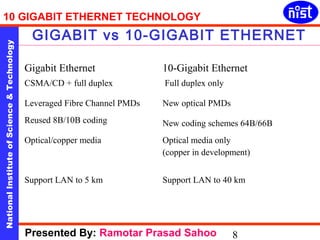
GIGABIT vs 10-GIGABIT ETHERNET 
National Institute of Science & Technology 8 
Gigabit Ethernet 10-Gigabit Ethernet 
CSMA/CD + full duplex Full duplex only 
Leveraged Fibre Channel PMDs New optical PMDs 
Reused 8B/10B coding New coding schemes 64B/66B 
Optical/copper media Optical media only 
(copper in development) 
Support LAN to 5 km Support LAN to 40 km 
Presented By: Ramotar Prasad Sahoo
10 GIGABIT ETHERNET TECHNOLOGY 
CHIP INTERFACE(XAUI) 
National Institute of Science & Technology 9 
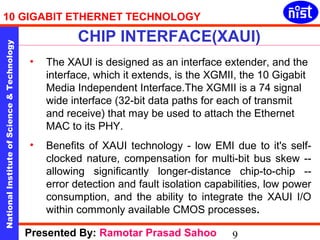
• The XAUI is designed as an interface extender, and the 
interface, which it extends, is the XGMII, the 10 Gigabit 
Media Independent Interface.The XGMII is a 74 signal 
wide interface (32-bit data paths for each of transmit 
and receive) that may be used to attach the Ethernet 
MAC to its PHY. 
• Benefits of XAUI technology - low EMI due to it's self-clocked 
nature, compensation for multi-bit bus skew -- 
allowing significantly longer-distance chip-to-chip -- 
error detection and fault isolation capabilities, low power 
consumption, and the ability to integrate the XAUI I/O 
within commonly available CMOS processes. 
Presented By: Ramotar Prasad Sahoo
10 GIGABIT ETHERNET TECHNOLOGY 
PHYSICAL MEDIA DEPENDENTS(PMDs) 
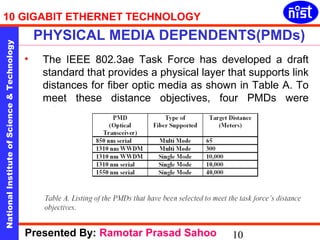
• The IEEE 802.3ae Task Force has developed a draft 
National Institute of Science & Technology 10 
standard that provides a physical layer that supports link 
distances for fiber optic media as shown in Table A. To 
meet these distance objectives, four PMDs were 
selected. 
Presented By: Ramotar Prasad Sahoo
10 GIGABIT ETHERNET TECHNOLOGY 
PHYSICAL LAYER(PHYs) 
National Institute of Science & Technology 11 
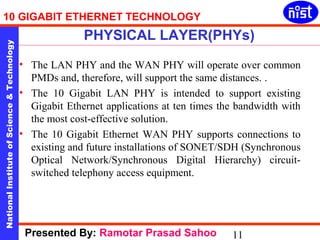
• The LAN PHY and the WAN PHY will operate over common 
PMDs and, therefore, will support the same distances. . 
• The 10 Gigabit LAN PHY is intended to support existing 
Gigabit Ethernet applications at ten times the bandwidth with 
the most cost-effective solution. 
• The 10 Gigabit Ethernet WAN PHY supports connections to 
existing and future installations of SONET/SDH (Synchronous 
Optical Network/Synchronous Digital Hierarchy) circuit-switched 
telephony access equipment. 
Presented By: Ramotar Prasad Sahoo
10 GIGABIT ETHERNET TECHNOLOGY 
APPLICATIONS FOR 10 GbE 
National Institute of Science & Technology 12 
10 Gigabit Ethernet in Local Area Networks 
• Ethernet technology is already the most deployed technology for 
high performance LAN environments. 
• With the extension of 10 Gigabit Ethernet into the family of 
Ethernet technologies, the LAN now can reach farther and 
support up coming bandwidth hungry applications. 
• With 10 Gigabit backbones installed, companies will have the 
capability to begin Gigabit Ethernet service to workstations and, 
eventually, to the desktop in order to support applications such as 
streaming video, medical imaging, centralized applications, and 
high-end graphics. 
Presented By: Ramotar Prasad Sahoo
10 GIGABIT ETHERNET TECHNOLOGY 
APPLICATIONS FOR 10 GbE 
National Institute of Science & Technology 13 
10 GbE in Metropolitan and Storage Area Networks 
• Gigabit Ethernet is already being deployed as a 
backbone technology for dark fiber metropolitan 
networks. With appropriate 10 Gigabit Ethernet 
interfaces, optical transceivers and single mode fiber, 
service providers will be able to build links reaching 
40km or more. 
• 10 Gigabit Ethernet will provide infrastructure for both 
network-attached storage (NAS) and storage area 
networks (SAN). 
Presented By: Ramotar Prasad Sahoo
10 GIGABIT ETHERNET TECHNOLOGY 
APPLICATIONS FOR 10 GbE 
National Institute of Science & Technology 14 
10 Gigabit Ethernet in Wide Area Networks 
• 10 Gigabit Ethernet will enable Internet service 
providers (ISP) and network service providers (NSPs) 
to create very high-speed links at a very low cost, 
between co-located, carrier-class switches and routers 
and optical equipment that is directly attached to the 
SONET/SDH cloud. 
• 10 Gigabit Ethernet with the WAN PHY will also allow 
the construction of WANs that connect geographically 
dispersed LANs between campuses or POPs (points of 
presence) over existing SONET/SDH/TDM networks. 
Presented By: Ramotar Prasad Sahoo
10 GIGABIT ETHERNET TECHNOLOGY 
APPLICATIONS FOR 10 GbE 
National Institute of Science & Technology 15 
10 Gigabit Ethernet as a Fabric Interconnect 
10 Gigabit Ethernet is in a position to replace all these 
proprietary technologies as a next-generation interconnect 
for both server and storage-area networks for several 
reasons: 
• Cost-Saving Server Consolidation. 
• 10 Gigabit Ethernet Offers the Necessary Bandwidth. 
• Planned Growth of 10 Gigabit Network Features. 
Presented By: Ramotar Prasad Sahoo
10 GIGABIT ETHERNET TECHNOLOGY 
USING FIBER IN 10GbE 
National Institute of Science & Technology 16 
• There are two types of optical fiber, multimode and 
single mode fiber, that are currently used in data 
networking and telecommunications applications. 
• The 10 Gigabit Ethernet technology, as defined in the 
IEEE 802.3ae standard, supports both optical fiber 
types. 
• However, the distances supported vary based on the 
type of fiber and wavelength (nm) is implemented in the 
application. 
Presented By: Ramotar Prasad Sahoo
10 GIGABIT ETHERNET TECHNOLOGY 
THE FUTURE OF 10GbE 
National Institute of Science & Technology 17 
Will There be Copper? 
• IEEE 802.3 has recently formed two new study groups 
to investigate 10 Gigabit Ethernet over copper cabling. 
• The 10GBASE-CX4 study group is developing a 
standard for transmitting and receiving XAUI signals via 
a 4-pair twinax cable, commonly referred to as a 4x 
InfiniBand cable. 
• The 10GBASE-T study group is developing a standard 
for the transmission and reception of 10 Gigabit 
Ethernet via a Category 5 or better unshielded twisted 
pair (UTP) copper cable up to 100 m. 
Presented By: Ramotar Prasad Sahoo
10 GIGABIT ETHERNET TECHNOLOGY 
10 GbE MARKET OVERVIEW 
National Institute of Science & Technology 18 
• Extension of existing Ethernet family of standards 
• Another 10x jump for higher capacity 
• Typical Ethernet applications at higher speed 
• Also positioned as a MAN/WAN technology for use over 
dark fiber or SONET/SDH 
Presented By: Ramotar Prasad Sahoo
10 GIGABIT ETHERNET TECHNOLOGY 
CONCLUSION 
National Institute of Science & Technology 19 
• 10 Gigabit Ethernet is very much necessary for 
today’s network and is viable now. 
• 10 Gigabit Ethernet forms the backbone of 
today’s network due to its enhanced features. 
• In future it will provide more better networking 
solutions as continuous efforts have been put 
into it to upgrade it. 
Presented By: Ramotar Prasad Sahoo
National Institute of Science & Technology 20 
TTHHAANNKKYYOOUU !!!!!!!!!!!!!!!!

10 gigabit ethernet technology

  • 1.
    TECHNICAL SEMINAR REPORT National Institute of Science & Technology 1 10 GIGABIT ETHERNET TECHNOLOGY Presented by RRaammoottaarr PPrraassaadd SSaahhoooo Roll No:CS200118210 Under the Guidance of MMrr.. PPrraaddeeeepp KKuummaarr JJeennaa..
  • 2.
    10 GIGABIT ETHERNETTECHNOLOGY INTRODUCTION National Institute of Science & Technology 2 • Ethernet essential for internet. • 10 Gigabit Ethernet is the latest. • It finds its applications in LAN, MAN, WAN and SAN. • Provides high speed and reliable network. • Provides low installation and maintenance cost. Presented By: Ramotar Prasad Sahoo
  • 3.
    10 GIGABIT ETHERNETTECHNOLOGY HISTORY National Institute of Science & Technology 3 • Developed by Robert Metcalfe and David Boggs in 1973 at Xerox PARC. • In June 2002 IEEE adopted 10 Gigabit Ethernet Standard(802.3ae). Presented By: Ramotar Prasad Sahoo
  • 4.
    10 GIGABIT ETHERNETTECHNOLOGY 10 GbE TECHNOLOGY OVERVIEW National Institute of Science & Technology 4 • Retention of 802.3 MAC and frame format • 64 – 1518 Byte frames • Jumbo-frames not included in standard • No half duplex mode • different from other versions of Ethernet • No CSMA/CD on full duplex • Simultaneous sending and receiving at all times • Works with 802.1Q, 802.3ad, etc. • Fiber interfaces only – no copper versions • LAN PHY – 10Gb/s • WAN PHY – 9.29Gb/s (SONET framing overhead) Presented By: Ramotar Prasad Sahoo
  • 5.
    10 GIGABIT ETHERNETTECHNOLOGY 10 GbE STANDARD National Institute of Science & Technology 5 • Under the International Standards Organization’s Open Systems Interconnection (OSI) model, Ethernet is fundamentally a Layer 2 protocol. • IEEE 802.3ae was adapted to include 10-Gbps full-duplex transmission over fiber-optic cable. • 10 Gigabit Ethernet uses the IEEE 802.3 Ethernet Media Access Control (MAC) protocol, the IEEE 802.3 Ethernet frame format, and the minimum and maximum IEEE 802.3 frame size. • 10 Gigabit Ethernet remains true to the original Ethernet model. Presented By: Ramotar Prasad Sahoo
  • 6.
    10 GIGABIT ETHERNETTECHNOLOGY 10 GbE ARCHITECTURES National Institute of Science & Technology 6 • 10 Gigabit Ethernet uses two separate encoding steps. • The encoded data provides synchronization, efficient usage of bandwidth, and improved signal-to-noise ratio characteristics. • All 10GbE varieties use optical fiber media. Presented By: Ramotar Prasad Sahoo
  • 7.
    10 GIGABIT ETHERNETTECHNOLOGY 802.3ae Architectural Components National Institute of Science & Technology 7 Full Duplex 802.3 Media Access Control (MAC) 10Gb Media Independent Interface (XGMII) or 10Gb Attachment Unit Interface (XAUI) WWDM LAN PHY 8B/10B WWDM PDM 1310nm Serial LAN PHY 64B/66B Serial PMD 850nm Serial PMD 1310nm Serial PMD 1550nm Serial WAN PHY 64B/66B + WIS Serial PMD 850nm Serial PMD 1310nm Serial PMD 1550nm Presented By: Ramotar Prasad Sahoo
  • 8.
    10 GIGABIT ETHERNETTECHNOLOGY GIGABIT vs 10-GIGABIT ETHERNET National Institute of Science & Technology 8 Gigabit Ethernet 10-Gigabit Ethernet CSMA/CD + full duplex Full duplex only Leveraged Fibre Channel PMDs New optical PMDs Reused 8B/10B coding New coding schemes 64B/66B Optical/copper media Optical media only (copper in development) Support LAN to 5 km Support LAN to 40 km Presented By: Ramotar Prasad Sahoo
  • 9.
    10 GIGABIT ETHERNETTECHNOLOGY CHIP INTERFACE(XAUI) National Institute of Science & Technology 9 • The XAUI is designed as an interface extender, and the interface, which it extends, is the XGMII, the 10 Gigabit Media Independent Interface.The XGMII is a 74 signal wide interface (32-bit data paths for each of transmit and receive) that may be used to attach the Ethernet MAC to its PHY. • Benefits of XAUI technology - low EMI due to it's self-clocked nature, compensation for multi-bit bus skew -- allowing significantly longer-distance chip-to-chip -- error detection and fault isolation capabilities, low power consumption, and the ability to integrate the XAUI I/O within commonly available CMOS processes. Presented By: Ramotar Prasad Sahoo
  • 10.
    10 GIGABIT ETHERNETTECHNOLOGY PHYSICAL MEDIA DEPENDENTS(PMDs) • The IEEE 802.3ae Task Force has developed a draft National Institute of Science & Technology 10 standard that provides a physical layer that supports link distances for fiber optic media as shown in Table A. To meet these distance objectives, four PMDs were selected. Presented By: Ramotar Prasad Sahoo
  • 11.
    10 GIGABIT ETHERNETTECHNOLOGY PHYSICAL LAYER(PHYs) National Institute of Science & Technology 11 • The LAN PHY and the WAN PHY will operate over common PMDs and, therefore, will support the same distances. . • The 10 Gigabit LAN PHY is intended to support existing Gigabit Ethernet applications at ten times the bandwidth with the most cost-effective solution. • The 10 Gigabit Ethernet WAN PHY supports connections to existing and future installations of SONET/SDH (Synchronous Optical Network/Synchronous Digital Hierarchy) circuit-switched telephony access equipment. Presented By: Ramotar Prasad Sahoo
  • 12.
    10 GIGABIT ETHERNETTECHNOLOGY APPLICATIONS FOR 10 GbE National Institute of Science & Technology 12 10 Gigabit Ethernet in Local Area Networks • Ethernet technology is already the most deployed technology for high performance LAN environments. • With the extension of 10 Gigabit Ethernet into the family of Ethernet technologies, the LAN now can reach farther and support up coming bandwidth hungry applications. • With 10 Gigabit backbones installed, companies will have the capability to begin Gigabit Ethernet service to workstations and, eventually, to the desktop in order to support applications such as streaming video, medical imaging, centralized applications, and high-end graphics. Presented By: Ramotar Prasad Sahoo
  • 13.
    10 GIGABIT ETHERNETTECHNOLOGY APPLICATIONS FOR 10 GbE National Institute of Science & Technology 13 10 GbE in Metropolitan and Storage Area Networks • Gigabit Ethernet is already being deployed as a backbone technology for dark fiber metropolitan networks. With appropriate 10 Gigabit Ethernet interfaces, optical transceivers and single mode fiber, service providers will be able to build links reaching 40km or more. • 10 Gigabit Ethernet will provide infrastructure for both network-attached storage (NAS) and storage area networks (SAN). Presented By: Ramotar Prasad Sahoo
  • 14.
    10 GIGABIT ETHERNETTECHNOLOGY APPLICATIONS FOR 10 GbE National Institute of Science & Technology 14 10 Gigabit Ethernet in Wide Area Networks • 10 Gigabit Ethernet will enable Internet service providers (ISP) and network service providers (NSPs) to create very high-speed links at a very low cost, between co-located, carrier-class switches and routers and optical equipment that is directly attached to the SONET/SDH cloud. • 10 Gigabit Ethernet with the WAN PHY will also allow the construction of WANs that connect geographically dispersed LANs between campuses or POPs (points of presence) over existing SONET/SDH/TDM networks. Presented By: Ramotar Prasad Sahoo
  • 15.
    10 GIGABIT ETHERNETTECHNOLOGY APPLICATIONS FOR 10 GbE National Institute of Science & Technology 15 10 Gigabit Ethernet as a Fabric Interconnect 10 Gigabit Ethernet is in a position to replace all these proprietary technologies as a next-generation interconnect for both server and storage-area networks for several reasons: • Cost-Saving Server Consolidation. • 10 Gigabit Ethernet Offers the Necessary Bandwidth. • Planned Growth of 10 Gigabit Network Features. Presented By: Ramotar Prasad Sahoo
  • 16.
    10 GIGABIT ETHERNETTECHNOLOGY USING FIBER IN 10GbE National Institute of Science & Technology 16 • There are two types of optical fiber, multimode and single mode fiber, that are currently used in data networking and telecommunications applications. • The 10 Gigabit Ethernet technology, as defined in the IEEE 802.3ae standard, supports both optical fiber types. • However, the distances supported vary based on the type of fiber and wavelength (nm) is implemented in the application. Presented By: Ramotar Prasad Sahoo
  • 17.
    10 GIGABIT ETHERNETTECHNOLOGY THE FUTURE OF 10GbE National Institute of Science & Technology 17 Will There be Copper? • IEEE 802.3 has recently formed two new study groups to investigate 10 Gigabit Ethernet over copper cabling. • The 10GBASE-CX4 study group is developing a standard for transmitting and receiving XAUI signals via a 4-pair twinax cable, commonly referred to as a 4x InfiniBand cable. • The 10GBASE-T study group is developing a standard for the transmission and reception of 10 Gigabit Ethernet via a Category 5 or better unshielded twisted pair (UTP) copper cable up to 100 m. Presented By: Ramotar Prasad Sahoo
  • 18.
    10 GIGABIT ETHERNETTECHNOLOGY 10 GbE MARKET OVERVIEW National Institute of Science & Technology 18 • Extension of existing Ethernet family of standards • Another 10x jump for higher capacity • Typical Ethernet applications at higher speed • Also positioned as a MAN/WAN technology for use over dark fiber or SONET/SDH Presented By: Ramotar Prasad Sahoo
  • 19.
    10 GIGABIT ETHERNETTECHNOLOGY CONCLUSION National Institute of Science & Technology 19 • 10 Gigabit Ethernet is very much necessary for today’s network and is viable now. • 10 Gigabit Ethernet forms the backbone of today’s network due to its enhanced features. • In future it will provide more better networking solutions as continuous efforts have been put into it to upgrade it. Presented By: Ramotar Prasad Sahoo
  • 20.
    National Institute ofScience & Technology 20 TTHHAANNKKYYOOUU !!!!!!!!!!!!!!!!