V o I P
A Study On Voice-Over-Internet-Protocol
By – Yasin Virani
Content
 What isVOIP?
 Why useVOIP?
 When can I considerVOIP?
 PSTN vs. INTERNET
 HowVoIP works
 Components
 Advantages
 Disadvantages
 VOIP Alternatives
 Future
By – Yasin Virani
What isVOIP?
 VoIP stands for “ Voice over Internet Protocol” .
 Voice over IP technology allows telephone calls to be
made over digital computer networks including the
Internet.
 VoIP converts analogue voice signals into digital data
packets and supports real-time, two-way transmission of
conversations using Internet Protocol (IP).
 Some VoIP services may only allow you to call other
people using the same service, but others may allow
you to call anyone who has a telephone number -
including local, long distance, mobile, and international
numbers.
CONTINUED …
By – Yasin Virani
By – Yasin Virani
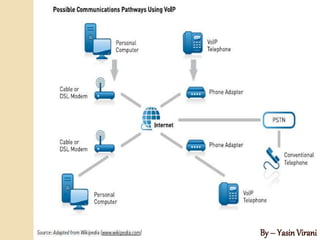
Explanation On Terms Used In Previous Diagram
 A digital subscriber line (DSL) modem is a device used to
connect a computer or router to a telephone line which provides
the digital subscriber line service for connectivity to the Internet,
which is often called DSL broadband.
 The public switched telephone network (PSTN) is the aggregate
of the world's circuit-switched telephone networks that are operated
by national, regional, or local telephony operators,
providing infrastructure and services for public telecommunication.
The PSTN consists of telephone lines, fiber optic
cables, microwave transmission links, cellular
networks, communications satellites, and undersea telephone
cables, all interconnected by switching centers, thus allowing most
telephones to communicate with each other.
Conventional Phone IP Phone
By – Yasin Virani
Why useVOIP?
 Save a lot of money - If you don’t use VoIP for voice
communication, then you are most certainly using the good old
phone line that of PSTN.
 More than two persons - On the phone line, only two persons
can speak at a time. With VoIP, you can setup a conference with a
whole team communicating in real time.
 Cheap user hardware and software - If you are an Internet user
wishing to use VoIP for voice communication, the only additional
hardware you require besides your computer and Internet
connection are a sound card, speakers and a microphone.
 More than voice - VoIP is based on the Internet Protocol (IP),
which is in fact, along with TCP, the basic underlying protocol for
the Internet. By virtue of this, VoIP also handles media types other
than voice: you can transfer images, video and text along with the
voice.
 More efficient use of bandwidth - It is known that about 50 % of
a voice conversation is silence. VoIP fills the ‘empty’ silence
spaces with data so that bandwidth in data communication
channels is not wasted. By – Yasin Virani
When can I considerVOIP?
 Business Continuity - With VoIP based communications they
allow businesses to incorporate continuity options. In the case of a
disastrous events such as fires or floods, your call data and
information is stored safely.
 Scalability Benefits - Businesses naturally grow and shrink as the
years go by. VoIP systems function on a peer to seat basis. You
can speedily add or remove new people to the businesses when
they come or go.
 Capital Saving - When it comes to internal calls (peer to peer) they
can be very costly, however what can be more detrimental to a
business is ineffective communication systems.
 Great Audio Quality - VoIP systems will use up much more
bandwidth compared to a traditional telephone systems, but VoIP
delivers better quality audio, this is refereed to as HD telephony.
 Conferencing Options - VoIP can use collaborative features,
allowing your business to hold conferences with clients or internal
staff without having them in the same room.
By – Yasin Virani
PSTN vs. INTERNET
 First learn about PSTN.
What is PSTN ?
 PSTN stands for “Public Switched Telephone Network”.
 The public switched telephone network (PSTN) is the
aggregate of the world's circuit-switched telephone networks
that are operated by national, regional, or local telephony
operators, providing infrastructure and services for public
telecommunication.
 Public switched telephone network gateways are third-party
hardware components that translate signaling and media between
the Enterprise Voice infrastructure and the PSTN, either directly
or through connection to SIP trunks. In either topology,
the gateway terminates the PSTN.
 A telephone network is a telecommunications network used
for telephone calls between two or more parties. A
landline network where the telephones must be directly wired
into a single telephone exchange. This is known as the public
switched telephone network . By – Yasin Virani
SIP call flow with PSTN gateway
By – Yasin Virani
PSTN vs. INTERNET
PSTN INTERNET
 Voice network use circuit
switching.
 Dedicated path between
calling and called party.
 Bandwidth reserved in
advance.
 Cost is based on
distance and time.
 Data network use packet
switching.
 No dedicated path
between sender and
receiver.
 It acquires and releases
bandwidth, as it needed.
 Cost is not based on
distance and time.
By – Yasin Virani
HowVoIP works?
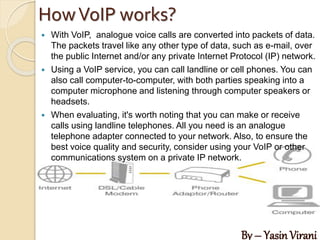
 With VoIP, analogue voice calls are converted into packets of data.
The packets travel like any other type of data, such as e-mail, over
the public Internet and/or any private Internet Protocol (IP) network.
 Using a VoIP service, you can call landline or cell phones. You can
also call computer-to-computer, with both parties speaking into a
computer microphone and listening through computer speakers or
headsets.
 When evaluating, it's worth noting that you can make or receive
calls using landline telephones. All you need is an analogue
telephone adapter connected to your network. Also, to ensure the
best voice quality and security, consider using your VoIP or other
communications system on a private IP network.
By – Yasin Virani
Components ofVoIP
 Signalling Gateway Controller
 Media Gateway
By – Yasin Virani
Components ofVoIP
 Media Server – The sharing of any media file is done through this
server.
 Application Server – Each application which is capable of
communicating with network has its own application server .
By – Yasin Virani
Advantages of VoIP
 VoIP Is Easier to Install, Configure, and Maintain.
 VoIP Scales Up or Down Easily ( easy to add or remove customers
).
 A Range of Call Features Are Supported.
 Even Older Technology Like Fax Is Supported.
 Hosted VoIP Saves Businesses Money.
 VoIP Integrates With Other Business Systems.
By – Yasin Virani
Dis - Advantages of VoIP
 Loss of service during outages.
 Without power VOIP phones are useless, so in case of
emergencies during power cuts it can be a major disadvantage.
 With VOIP emergency calls, it is hard to locate you and send help
in time.
 Some times during calls, there may be periods of silence when
data is lost while it is being unscrambled.
 Latency and traffic.
 No standard protocol is applicable.
By – Yasin Virani
VOIP Alternatives
 Apple’s FaceTime
 Join.Me
 Bria
 Skype
 Google+ Hangouts
 Vox.io
 ooVoo
By – Yasin Virani
Future Of VoIP
 I don’t think that VoIP is going anywhere. With this technology
being much easier to access now with a range of voice calling
providers, voice calling with become a new feature in many apps in
verticals we had not considered before. Dating has a great
potential, businesses can start offering responsive, mobile friendly
customer service and travel businesses can revolutionize the app,
mobile and digital experience offering VoIP powered calling.
 The future of VoIP looks promising and I can’t wait to see what
developers and businesses do with it!
By – Yasin Virani
Thank you !!!
your participation is appreciated .
Greetings By – Yasin Virani
Follow onInstagram- @iamyasinvirani

Voip

  • 1.
    V o IP A Study On Voice-Over-Internet-Protocol By – Yasin Virani
  • 2.
    Content  What isVOIP? Why useVOIP?  When can I considerVOIP?  PSTN vs. INTERNET  HowVoIP works  Components  Advantages  Disadvantages  VOIP Alternatives  Future By – Yasin Virani
  • 3.
    What isVOIP?  VoIPstands for “ Voice over Internet Protocol” .  Voice over IP technology allows telephone calls to be made over digital computer networks including the Internet.  VoIP converts analogue voice signals into digital data packets and supports real-time, two-way transmission of conversations using Internet Protocol (IP).  Some VoIP services may only allow you to call other people using the same service, but others may allow you to call anyone who has a telephone number - including local, long distance, mobile, and international numbers. CONTINUED … By – Yasin Virani
  • 4.
  • 5.
    Explanation On TermsUsed In Previous Diagram  A digital subscriber line (DSL) modem is a device used to connect a computer or router to a telephone line which provides the digital subscriber line service for connectivity to the Internet, which is often called DSL broadband.  The public switched telephone network (PSTN) is the aggregate of the world's circuit-switched telephone networks that are operated by national, regional, or local telephony operators, providing infrastructure and services for public telecommunication. The PSTN consists of telephone lines, fiber optic cables, microwave transmission links, cellular networks, communications satellites, and undersea telephone cables, all interconnected by switching centers, thus allowing most telephones to communicate with each other. Conventional Phone IP Phone By – Yasin Virani
  • 6.
    Why useVOIP?  Savea lot of money - If you don’t use VoIP for voice communication, then you are most certainly using the good old phone line that of PSTN.  More than two persons - On the phone line, only two persons can speak at a time. With VoIP, you can setup a conference with a whole team communicating in real time.  Cheap user hardware and software - If you are an Internet user wishing to use VoIP for voice communication, the only additional hardware you require besides your computer and Internet connection are a sound card, speakers and a microphone.  More than voice - VoIP is based on the Internet Protocol (IP), which is in fact, along with TCP, the basic underlying protocol for the Internet. By virtue of this, VoIP also handles media types other than voice: you can transfer images, video and text along with the voice.  More efficient use of bandwidth - It is known that about 50 % of a voice conversation is silence. VoIP fills the ‘empty’ silence spaces with data so that bandwidth in data communication channels is not wasted. By – Yasin Virani
  • 7.
    When can IconsiderVOIP?  Business Continuity - With VoIP based communications they allow businesses to incorporate continuity options. In the case of a disastrous events such as fires or floods, your call data and information is stored safely.  Scalability Benefits - Businesses naturally grow and shrink as the years go by. VoIP systems function on a peer to seat basis. You can speedily add or remove new people to the businesses when they come or go.  Capital Saving - When it comes to internal calls (peer to peer) they can be very costly, however what can be more detrimental to a business is ineffective communication systems.  Great Audio Quality - VoIP systems will use up much more bandwidth compared to a traditional telephone systems, but VoIP delivers better quality audio, this is refereed to as HD telephony.  Conferencing Options - VoIP can use collaborative features, allowing your business to hold conferences with clients or internal staff without having them in the same room. By – Yasin Virani
  • 8.
    PSTN vs. INTERNET First learn about PSTN. What is PSTN ?  PSTN stands for “Public Switched Telephone Network”.  The public switched telephone network (PSTN) is the aggregate of the world's circuit-switched telephone networks that are operated by national, regional, or local telephony operators, providing infrastructure and services for public telecommunication.  Public switched telephone network gateways are third-party hardware components that translate signaling and media between the Enterprise Voice infrastructure and the PSTN, either directly or through connection to SIP trunks. In either topology, the gateway terminates the PSTN.  A telephone network is a telecommunications network used for telephone calls between two or more parties. A landline network where the telephones must be directly wired into a single telephone exchange. This is known as the public switched telephone network . By – Yasin Virani
  • 9.
    SIP call flowwith PSTN gateway By – Yasin Virani
  • 10.
    PSTN vs. INTERNET PSTNINTERNET  Voice network use circuit switching.  Dedicated path between calling and called party.  Bandwidth reserved in advance.  Cost is based on distance and time.  Data network use packet switching.  No dedicated path between sender and receiver.  It acquires and releases bandwidth, as it needed.  Cost is not based on distance and time. By – Yasin Virani
  • 11.
    HowVoIP works?  WithVoIP, analogue voice calls are converted into packets of data. The packets travel like any other type of data, such as e-mail, over the public Internet and/or any private Internet Protocol (IP) network.  Using a VoIP service, you can call landline or cell phones. You can also call computer-to-computer, with both parties speaking into a computer microphone and listening through computer speakers or headsets.  When evaluating, it's worth noting that you can make or receive calls using landline telephones. All you need is an analogue telephone adapter connected to your network. Also, to ensure the best voice quality and security, consider using your VoIP or other communications system on a private IP network. By – Yasin Virani
  • 12.
    Components ofVoIP  SignallingGateway Controller  Media Gateway By – Yasin Virani
  • 13.
    Components ofVoIP  MediaServer – The sharing of any media file is done through this server.  Application Server – Each application which is capable of communicating with network has its own application server . By – Yasin Virani
  • 14.
    Advantages of VoIP VoIP Is Easier to Install, Configure, and Maintain.  VoIP Scales Up or Down Easily ( easy to add or remove customers ).  A Range of Call Features Are Supported.  Even Older Technology Like Fax Is Supported.  Hosted VoIP Saves Businesses Money.  VoIP Integrates With Other Business Systems. By – Yasin Virani
  • 15.
    Dis - Advantagesof VoIP  Loss of service during outages.  Without power VOIP phones are useless, so in case of emergencies during power cuts it can be a major disadvantage.  With VOIP emergency calls, it is hard to locate you and send help in time.  Some times during calls, there may be periods of silence when data is lost while it is being unscrambled.  Latency and traffic.  No standard protocol is applicable. By – Yasin Virani
  • 16.
    VOIP Alternatives  Apple’sFaceTime  Join.Me  Bria  Skype  Google+ Hangouts  Vox.io  ooVoo By – Yasin Virani
  • 17.
    Future Of VoIP I don’t think that VoIP is going anywhere. With this technology being much easier to access now with a range of voice calling providers, voice calling with become a new feature in many apps in verticals we had not considered before. Dating has a great potential, businesses can start offering responsive, mobile friendly customer service and travel businesses can revolutionize the app, mobile and digital experience offering VoIP powered calling.  The future of VoIP looks promising and I can’t wait to see what developers and businesses do with it! By – Yasin Virani
  • 18.
    Thank you !!! yourparticipation is appreciated . Greetings By – Yasin Virani Follow onInstagram- @iamyasinvirani