Welcome to my Presentation
Topics:
Second Generation of Cellular Telephone
Technology(2G)
7/24/2016 2
2G TECHNOLOGY
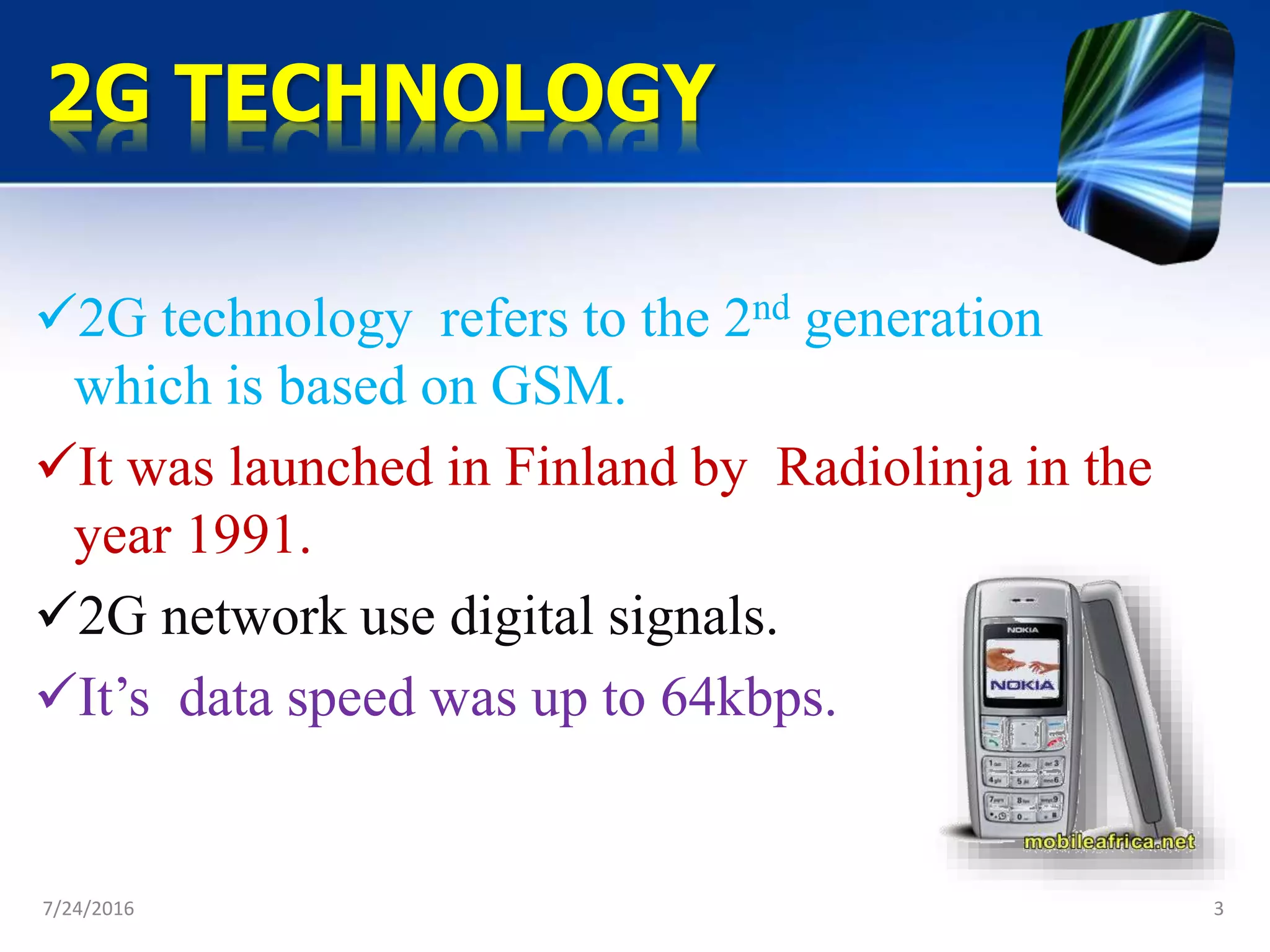
2G technology refers to the 2nd generation
which is based on GSM.
It was launched in Finland by Radiolinja in the
year 1991.
2G network use digital signals.
It’s data speed was up to 64kbps.
7/24/2016 3
Features Includes:
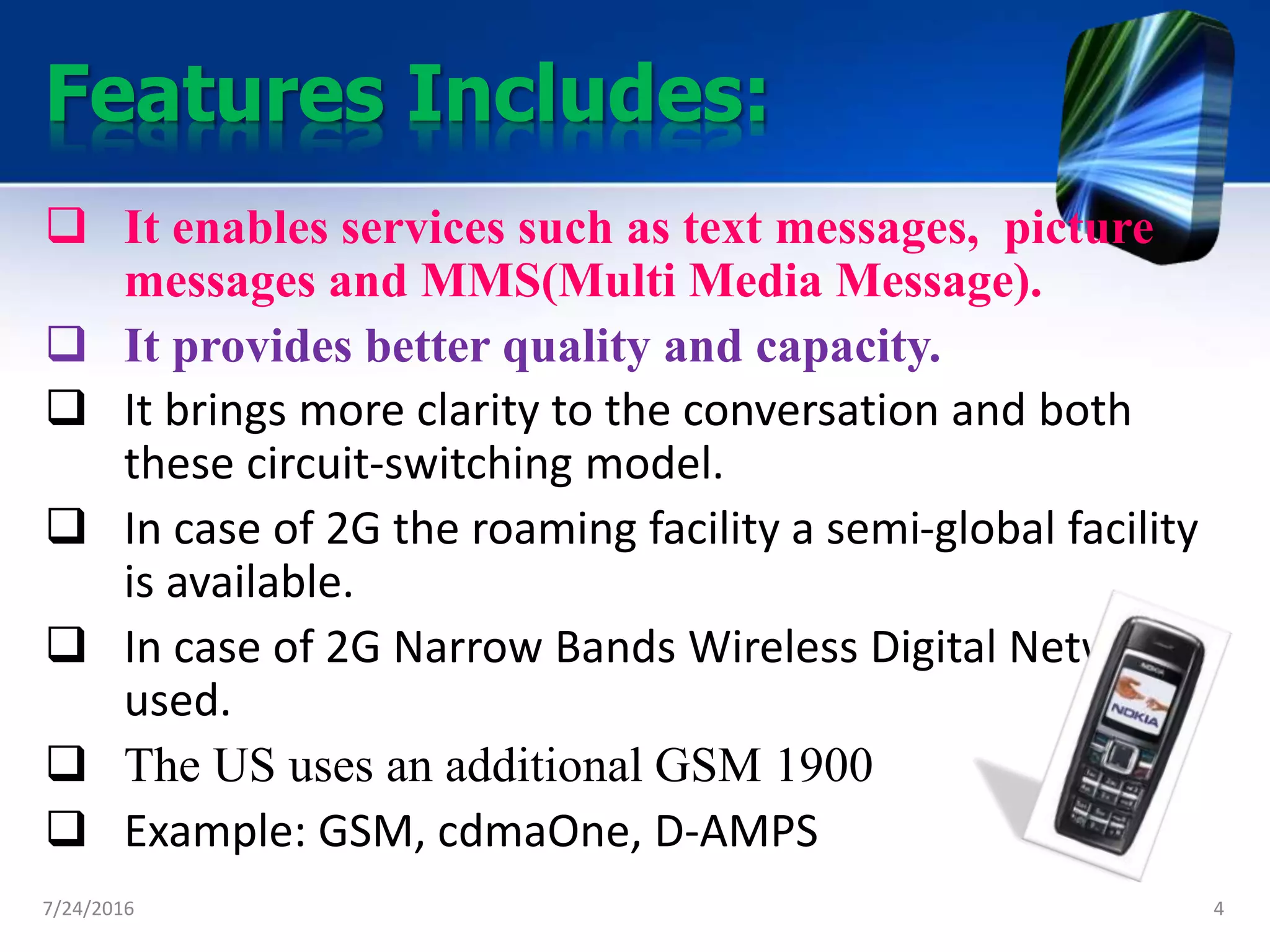
 It enables services such as text messages, picture
messages and MMS(Multi Media Message).
 It provides better quality and capacity.
 It brings more clarity to the conversation and both
these circuit-switching model.
 In case of 2G the roaming facility a semi-global facility
is available.
 In case of 2G Narrow Bands Wireless Digital Network is
used.
 The US uses an additional GSM 1900
 Example: GSM, cdmaOne, D-AMPS
7/24/2016 4
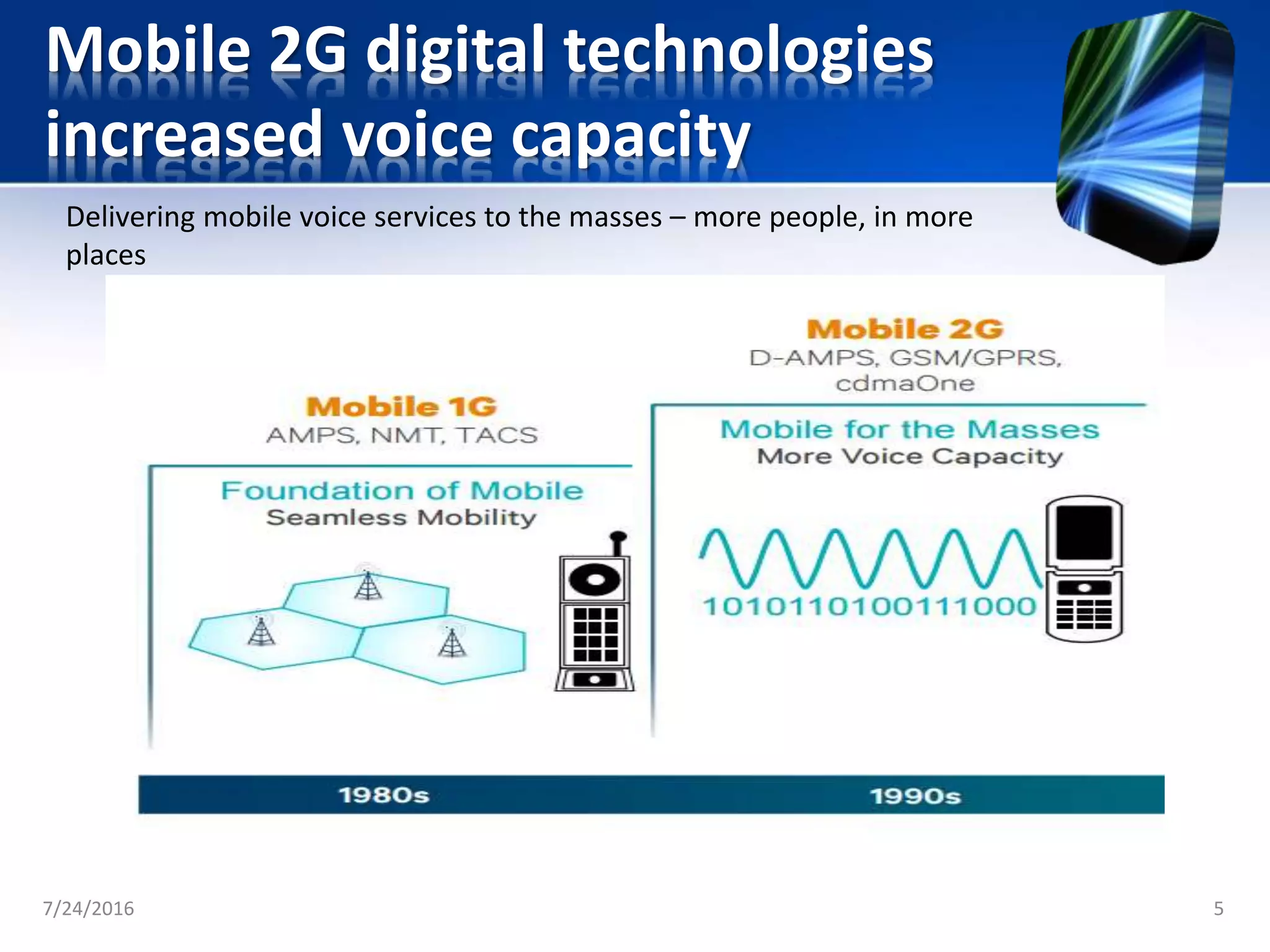
Mobile 2G digital technologies
increased voice capacity
7/24/2016 5
Delivering mobile voice services to the masses – more people, in more
places
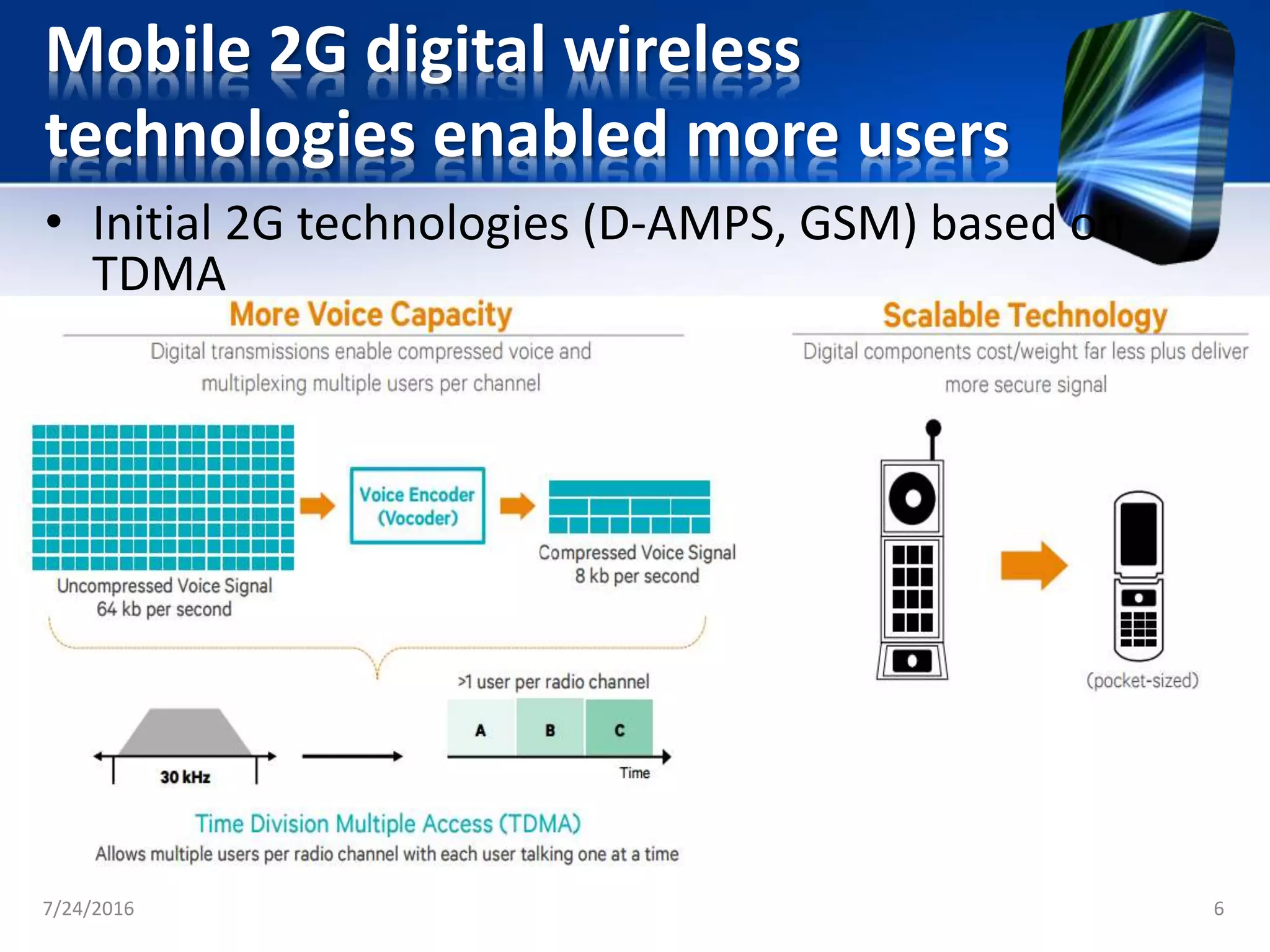
Mobile 2G digital wireless
technologies enabled more users
• Initial 2G technologies (D-AMPS, GSM) based on
TDMA
7/24/2016 6
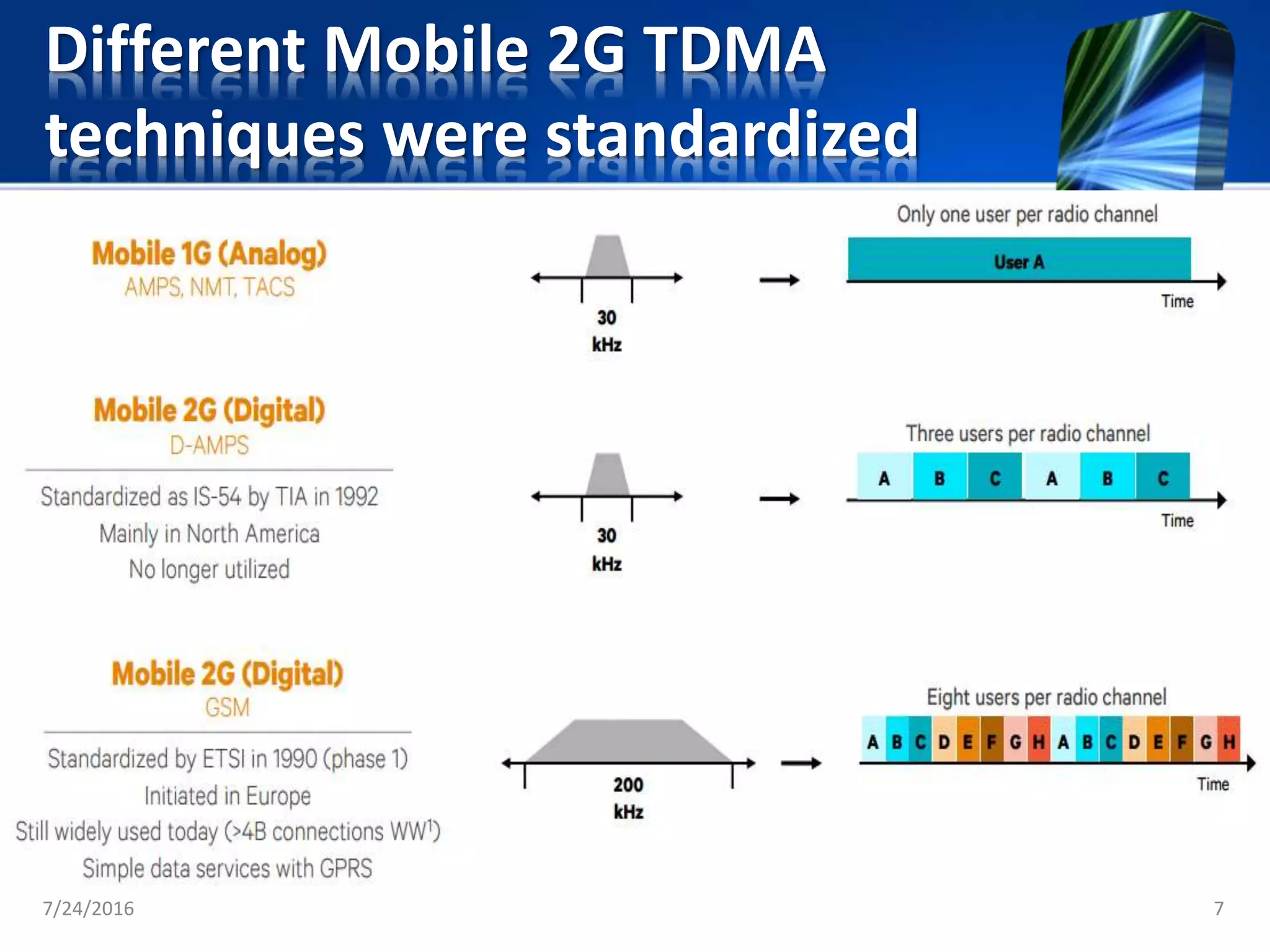
Different Mobile 2G TDMA
techniques were standardized
7/24/2016 7
8
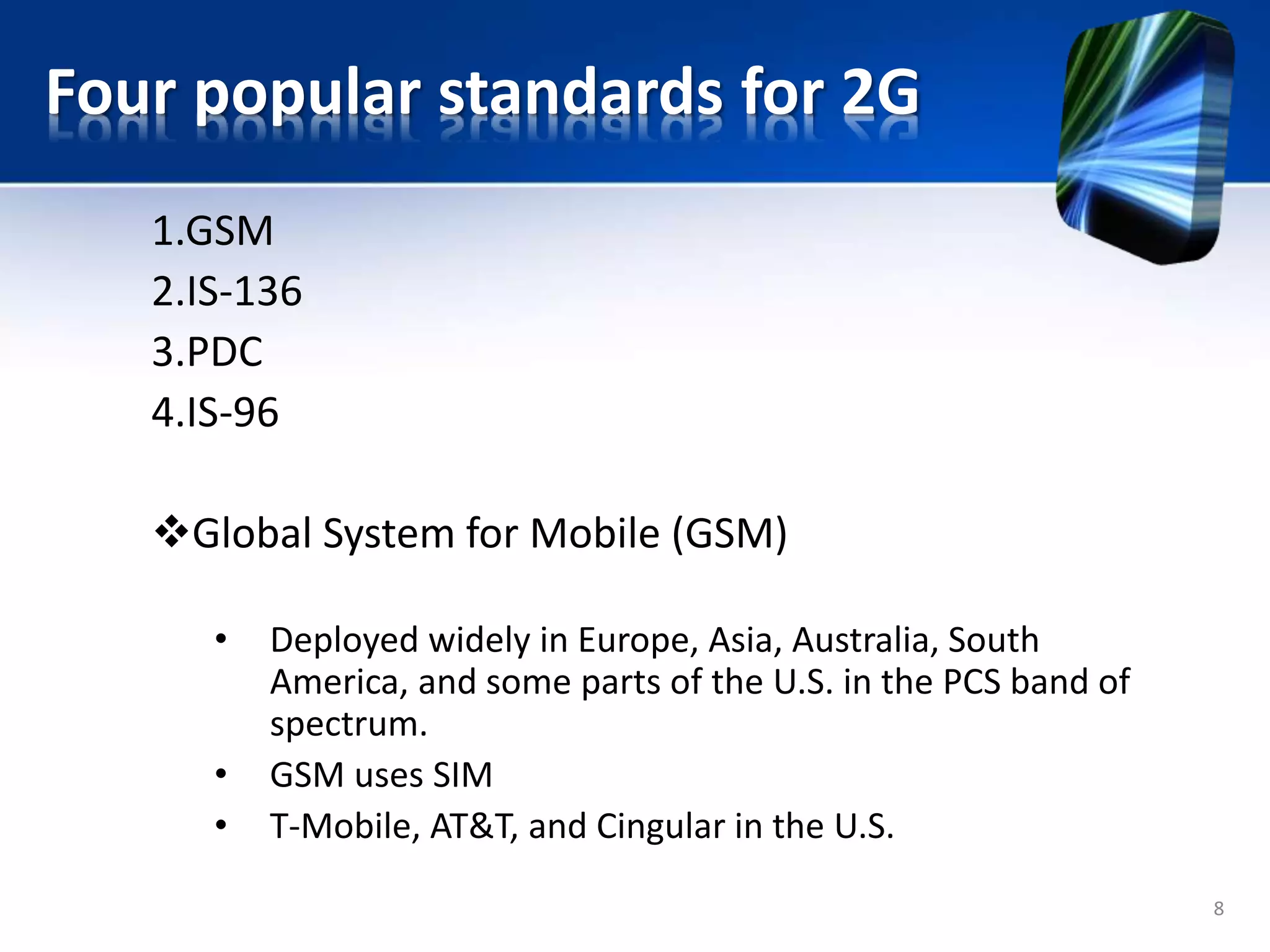
Four popular standards for 2G
1.GSM
2.IS-136
3.PDC
4.IS-96
Global System for Mobile (GSM)
• Deployed widely in Europe, Asia, Australia, South
America, and some parts of the U.S. in the PCS band of
spectrum.
• GSM uses SIM
• T-Mobile, AT&T, and Cingular in the U.S.
9
 Interim Standard 136 (IS-136)
• Popular in North America, South America, and
Australia.
• Cingular and AT&T in the U.S. Both companies
have larger areas for their TDMA networks
10
 Pacific Digital Cellular (PDC)
• Japanese standard
 Interim Standard 95 (IS-95)
• CDMA
• Also known as cdmaOne
• Sprint and Verizon in the U.S.
11
New standards for data over 2G
– Called 2.5G technology
– Allows existing 2G equipment to be modified for
higher data-rate transmissions.
– More advanced applications are possible.
• Web browsing
– Wireless Application Protocol (WAP) that allows standard
web pages to be viewed in a compressed format.
• E-mail
• Mobile commerce
• Location-based services (maps, directions, etc.)
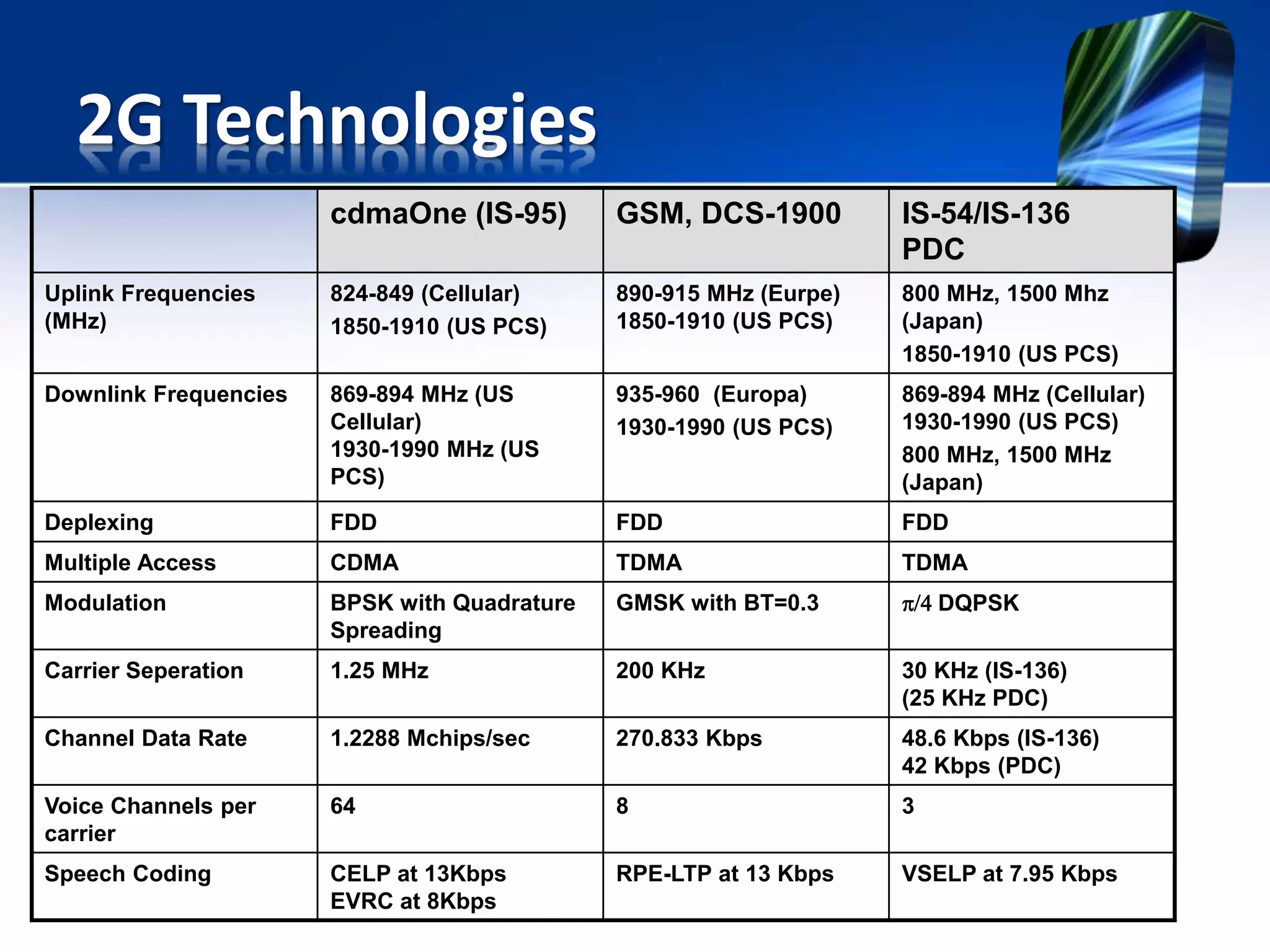
2G Technologies
cdmaOne (IS-95) GSM, DCS-1900 IS-54/IS-136
PDC
Uplink Frequencies
(MHz)
824-849 (Cellular)
1850-1910 (US PCS)
890-915 MHz (Eurpe)
1850-1910 (US PCS)
800 MHz, 1500 Mhz
(Japan)
1850-1910 (US PCS)
Downlink Frequencies 869-894 MHz (US
Cellular)
1930-1990 MHz (US
PCS)
935-960 (Europa)
1930-1990 (US PCS)
869-894 MHz (Cellular)
1930-1990 (US PCS)
800 MHz, 1500 MHz
(Japan)
Deplexing FDD FDD FDD
Multiple Access CDMA TDMA TDMA
Modulation BPSK with Quadrature
Spreading
GMSK with BT=0.3 p/4 DQPSK
Carrier Seperation 1.25 MHz 200 KHz 30 KHz (IS-136)
(25 KHz PDC)
Channel Data Rate 1.2288 Mchips/sec 270.833 Kbps 48.6 Kbps (IS-136)
42 Kbps (PDC)
Voice Channels per
carrier
64 8 3
Speech Coding CELP at 13Kbps
EVRC at 8Kbps
RPE-LTP at 13 Kbps VSELP at 7.95 Kbps
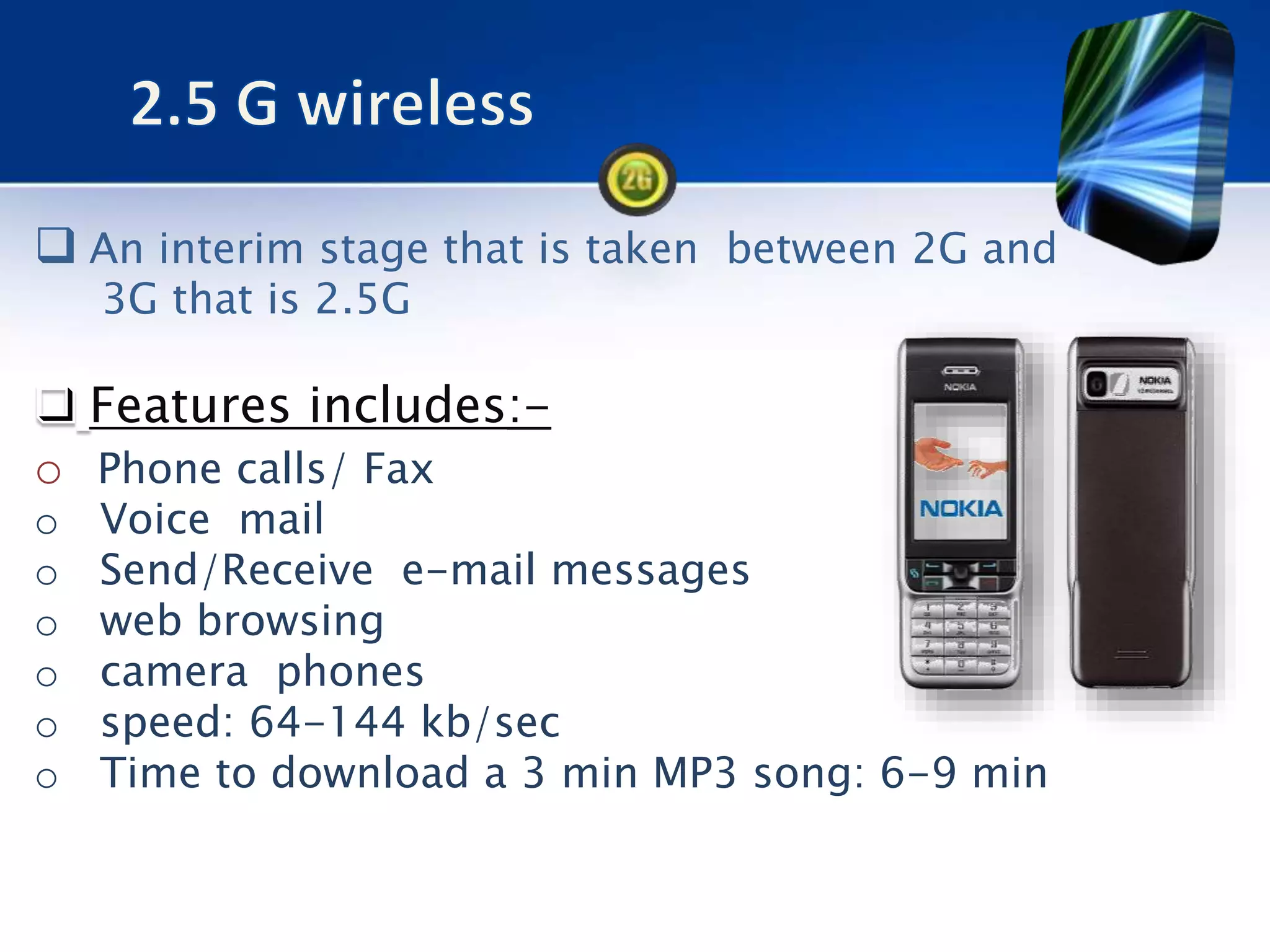
 An interim stage that is taken between 2G and
3G that is 2.5G
Features includes:-
o Phone calls/ Fax
o Voice mail
o Send/Receive e-mail messages
o web browsing
o camera phones
o speed: 64-144 kb/sec
o Time to download a 3 min MP3 song: 6-9 min
2G Capacity
• Digital voice data can be compressed and
multiplexed much more effectively than analog voice
encodings through the use of various codecs,
allowing more calls to be packed into the same
amount of radio bandwidth.
• The digital systems were designed to emit less radio
power from the handsets. This meant that cells had
to be smaller, so more cells had to be placed in the
same amount of space. This was made possible
by cell towers and related equipment getting less
expensive.
7/24/2016 14
2G Advantage
• The lower power emissions helped address health
concerns.
• Going all-digital allowed for the introduction of digital data
services, such as SMS and email.
* The lower powered radio signals require less battery
power, so phones last much longer between charges, and
batteries can be smaller.
* The digital voice encoding allowed digital error checking
which could increase sound quality by reducing dynamic
and lowering the noise floor.
* The lower power emissions helped address health
concerns.
* Going all-digital allowed for the introduction of digital
data services, such as SMS and email.
7/24/2016 15
 2G requires strong digital signals to help
mobile phones work. If there is no network
coverage in any specific area , digital
signals would weak.
 These systems are unable to handle
complex data such as Videos.
LIMITATIONS-
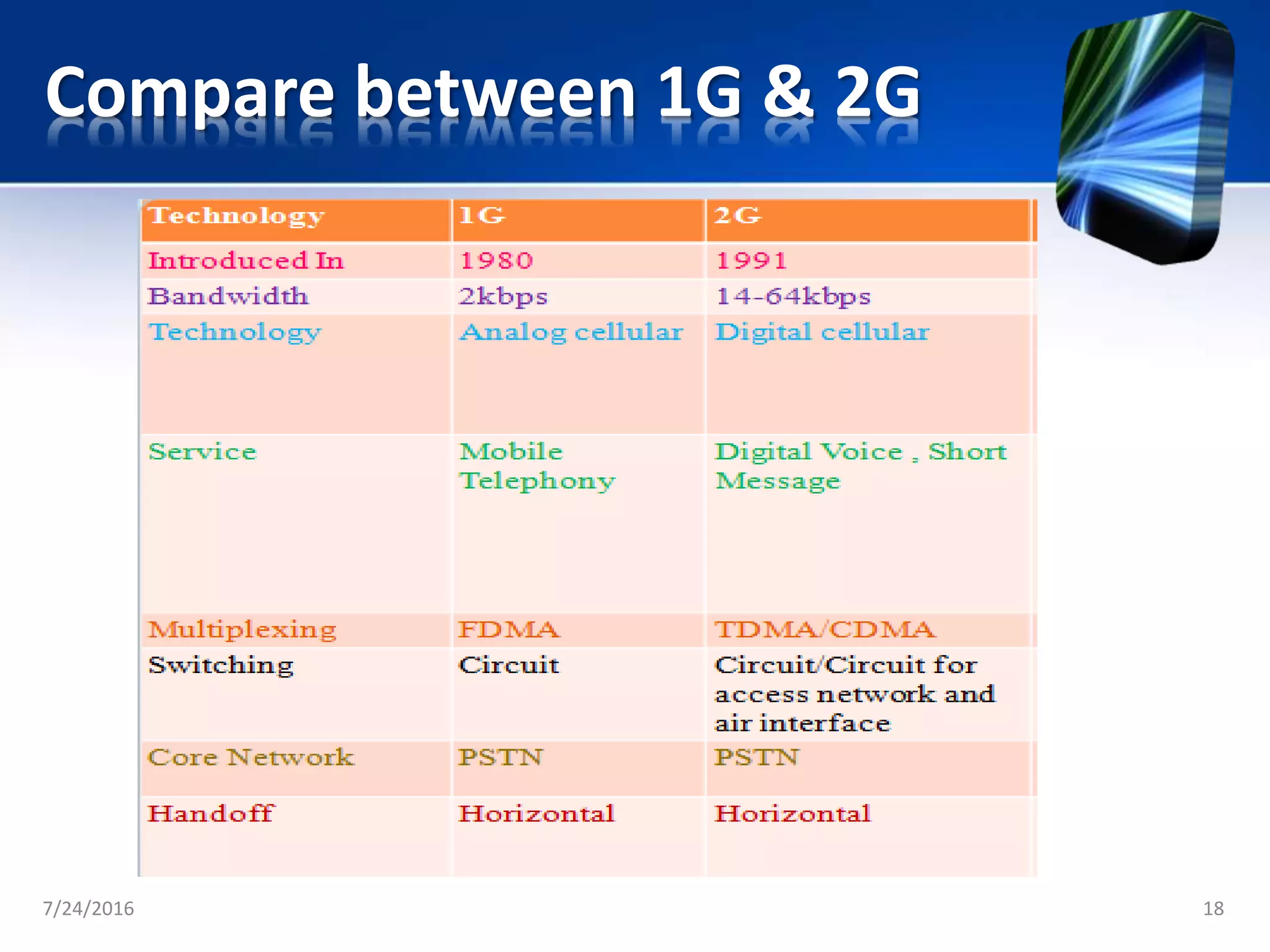
1G vs 2G
The primary differences between first and second generation
cellular networks are:
• Digital traffic channels – first-generation systems are
almost purely analog; second generation systems are
digital.
• Encryption – all second generation systems provide
encryption to prevent eavesdropping.
• Error detection and correction – second-generation digital
traffic allows for detection and correction, giving clear
voice reception.
• Channel access – second-generation systems allow
channels to be dynamically shared by a number of users.
7/24/2016 17
Compare between 1G & 2G
7/24/2016 18
Question??
7/24/2016 19
7/24/2016 20

Second Generation of Cellular Telephone Technology(2G)

  • 1.
    Welcome to myPresentation
  • 2.
    Topics: Second Generation ofCellular Telephone Technology(2G) 7/24/2016 2
  • 3.
    2G TECHNOLOGY 2G technologyrefers to the 2nd generation which is based on GSM. It was launched in Finland by Radiolinja in the year 1991. 2G network use digital signals. It’s data speed was up to 64kbps. 7/24/2016 3
  • 4.
    Features Includes:  Itenables services such as text messages, picture messages and MMS(Multi Media Message).  It provides better quality and capacity.  It brings more clarity to the conversation and both these circuit-switching model.  In case of 2G the roaming facility a semi-global facility is available.  In case of 2G Narrow Bands Wireless Digital Network is used.  The US uses an additional GSM 1900  Example: GSM, cdmaOne, D-AMPS 7/24/2016 4
  • 5.
    Mobile 2G digitaltechnologies increased voice capacity 7/24/2016 5 Delivering mobile voice services to the masses – more people, in more places
  • 6.
    Mobile 2G digitalwireless technologies enabled more users • Initial 2G technologies (D-AMPS, GSM) based on TDMA 7/24/2016 6
  • 7.
    Different Mobile 2GTDMA techniques were standardized 7/24/2016 7
  • 8.
    8 Four popular standardsfor 2G 1.GSM 2.IS-136 3.PDC 4.IS-96 Global System for Mobile (GSM) • Deployed widely in Europe, Asia, Australia, South America, and some parts of the U.S. in the PCS band of spectrum. • GSM uses SIM • T-Mobile, AT&T, and Cingular in the U.S.
  • 9.
    9  Interim Standard136 (IS-136) • Popular in North America, South America, and Australia. • Cingular and AT&T in the U.S. Both companies have larger areas for their TDMA networks
  • 10.
    10  Pacific DigitalCellular (PDC) • Japanese standard  Interim Standard 95 (IS-95) • CDMA • Also known as cdmaOne • Sprint and Verizon in the U.S.
  • 11.
    11 New standards fordata over 2G – Called 2.5G technology – Allows existing 2G equipment to be modified for higher data-rate transmissions. – More advanced applications are possible. • Web browsing – Wireless Application Protocol (WAP) that allows standard web pages to be viewed in a compressed format. • E-mail • Mobile commerce • Location-based services (maps, directions, etc.)
  • 12.
    2G Technologies cdmaOne (IS-95)GSM, DCS-1900 IS-54/IS-136 PDC Uplink Frequencies (MHz) 824-849 (Cellular) 1850-1910 (US PCS) 890-915 MHz (Eurpe) 1850-1910 (US PCS) 800 MHz, 1500 Mhz (Japan) 1850-1910 (US PCS) Downlink Frequencies 869-894 MHz (US Cellular) 1930-1990 MHz (US PCS) 935-960 (Europa) 1930-1990 (US PCS) 869-894 MHz (Cellular) 1930-1990 (US PCS) 800 MHz, 1500 MHz (Japan) Deplexing FDD FDD FDD Multiple Access CDMA TDMA TDMA Modulation BPSK with Quadrature Spreading GMSK with BT=0.3 p/4 DQPSK Carrier Seperation 1.25 MHz 200 KHz 30 KHz (IS-136) (25 KHz PDC) Channel Data Rate 1.2288 Mchips/sec 270.833 Kbps 48.6 Kbps (IS-136) 42 Kbps (PDC) Voice Channels per carrier 64 8 3 Speech Coding CELP at 13Kbps EVRC at 8Kbps RPE-LTP at 13 Kbps VSELP at 7.95 Kbps
  • 13.
     An interimstage that is taken between 2G and 3G that is 2.5G Features includes:- o Phone calls/ Fax o Voice mail o Send/Receive e-mail messages o web browsing o camera phones o speed: 64-144 kb/sec o Time to download a 3 min MP3 song: 6-9 min
  • 14.
    2G Capacity • Digitalvoice data can be compressed and multiplexed much more effectively than analog voice encodings through the use of various codecs, allowing more calls to be packed into the same amount of radio bandwidth. • The digital systems were designed to emit less radio power from the handsets. This meant that cells had to be smaller, so more cells had to be placed in the same amount of space. This was made possible by cell towers and related equipment getting less expensive. 7/24/2016 14
  • 15.
    2G Advantage • Thelower power emissions helped address health concerns. • Going all-digital allowed for the introduction of digital data services, such as SMS and email. * The lower powered radio signals require less battery power, so phones last much longer between charges, and batteries can be smaller. * The digital voice encoding allowed digital error checking which could increase sound quality by reducing dynamic and lowering the noise floor. * The lower power emissions helped address health concerns. * Going all-digital allowed for the introduction of digital data services, such as SMS and email. 7/24/2016 15
  • 16.
     2G requiresstrong digital signals to help mobile phones work. If there is no network coverage in any specific area , digital signals would weak.  These systems are unable to handle complex data such as Videos. LIMITATIONS-
  • 17.
    1G vs 2G Theprimary differences between first and second generation cellular networks are: • Digital traffic channels – first-generation systems are almost purely analog; second generation systems are digital. • Encryption – all second generation systems provide encryption to prevent eavesdropping. • Error detection and correction – second-generation digital traffic allows for detection and correction, giving clear voice reception. • Channel access – second-generation systems allow channels to be dynamically shared by a number of users. 7/24/2016 17
  • 18.
    Compare between 1G& 2G 7/24/2016 18
  • 19.
  • 20.