Introduction to Engineering Economics
Lecture 1, Chapter 1
1
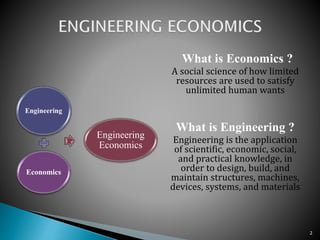
What is Economics ?
A social science of how limited
resources are used to satisfy
unlimited human wants
What is Engineering ?
Engineering is the application
of scientific, economic, social,
and practical knowledge, in
order to design, build, and
maintain structures, machines,
devices, systems, and materials
2
Engineering
Economics
Engineering
Economics
3
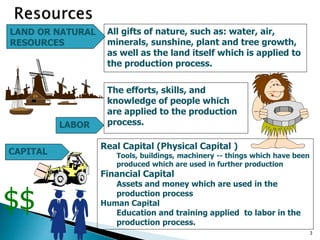
All gifts of nature, such as: water, air,
minerals, sunshine, plant and tree growth,
as well as the land itself which is applied to
the production process.
The efforts, skills, and
knowledge of people which
are applied to the production
process.
LAND OR NATURAL
RESOURCES
LABOR
Real Capital (Physical Capital )
Tools, buildings, machinery -- things which have been
produced which are used in further production
Financial Capital
Assets and money which are used in the
production process
Human Capital
Education and training applied to labor in the
production process.
CAPITAL
$$
4
$$
$$
$$
$$
5
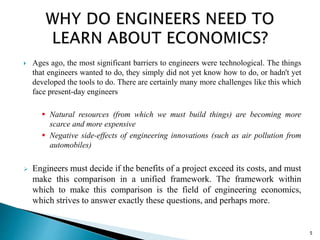
 Ages ago, the most significant barriers to engineers were technological. The things
that engineers wanted to do, they simply did not yet know how to do, or hadn't yet
developed the tools to do. There are certainly many more challenges like this which
face present-day engineers
 Natural resources (from which we must build things) are becoming more
scarce and more expensive
 Negative side-effects of engineering innovations (such as air pollution from
automobiles)
 Engineers must decide if the benefits of a project exceed its costs, and must
make this comparison in a unified framework. The framework within
which to make this comparison is the field of engineering economics,
which strives to answer exactly these questions, and perhaps more.
6
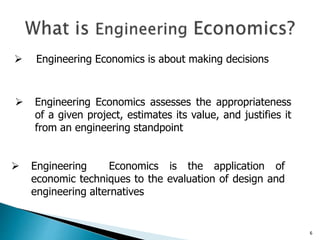
 Engineering Economics is about making decisions
 Engineering Economics is the application of
economic techniques to the evaluation of design and
engineering alternatives
 Engineering Economics assesses the appropriateness
of a given project, estimates its value, and justifies it
from an engineering standpoint
7
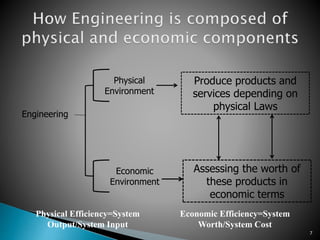
Engineering
Assessing the worth of
these products in
economic terms
Produce products and
services depending on
physical Laws
Physical
Environment
Economic
Environment
Physical Efficiency=System
Output/System Input
Economic Efficiency=System
Worth/System Cost
8
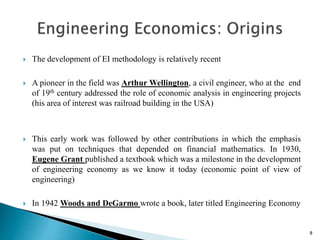
 The development of EI methodology is relatively recent
 A pioneer in the field was Arthur Wellington, a civil engineer, who at the end
of 19th century addressed the role of economic analysis in engineering projects
(his area of interest was railroad building in the USA)
 This early work was followed by other contributions in which the emphasis
was put on techniques that depended on financial mathematics. In 1930,
Eugene Grant published a textbook which was a milestone in the development
of engineering economy as we know it today (economic point of view of
engineering)
 In 1942 Woods and DeGarmo wrote a book, later titled Engineering Economy
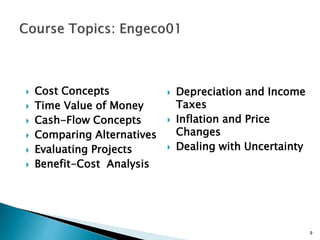
 Cost Concepts
 Time Value of Money
 Cash-Flow Concepts
 Comparing Alternatives
 Evaluating Projects
 Benefit-Cost Analysis
9
 Depreciation and Income
Taxes
 Inflation and Price
Changes
 Dealing with Uncertainty
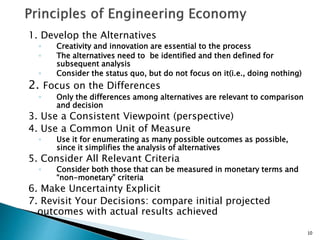
1. Develop the Alternatives
◦ Creativity and innovation are essential to the process
◦ The alternatives need to be identified and then defined for
subsequent analysis
◦ Consider the status quo, but do not focus on it(i.e., doing nothing)
2. Focus on the Differences
◦ Only the differences among alternatives are relevant to comparison
and decision
3. Use a Consistent Viewpoint (perspective)
4. Use a Common Unit of Measure
◦ Use it for enumerating as many possible outcomes as possible,
since it simplifies the analysis of alternatives
5. Consider All Relevant Criteria
◦ Consider both those that can be measured in monetary terms and
“non-monetary” criteria
6. Make Uncertainty Explicit
7. Revisit Your Decisions: compare initial projected
outcomes with actual results achieved
10
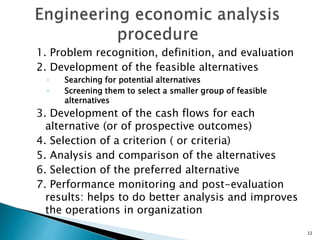
1. Problem recognition, definition, and evaluation
2. Development of the feasible alternatives
◦ Searching for potential alternatives
◦ Screening them to select a smaller group of feasible
alternatives
3. Development of the cash flows for each
alternative (or of prospective outcomes)
4. Selection of a criterion ( or criteria)
5. Analysis and comparison of the alternatives
6. Selection of the preferred alternative
7. Performance monitoring and post-evaluation
results: helps to do better analysis and improves
the operations in organization
11
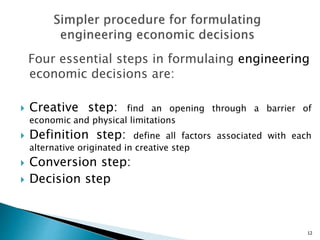
Four essential steps in formulaing engineering
economic decisions are:
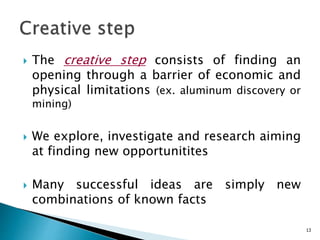
 Creative step: find an opening through a barrier of
economic and physical limitations
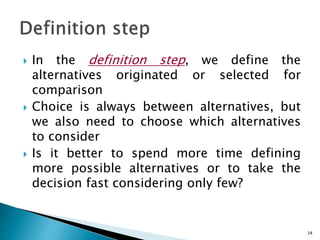
 Definition step: define all factors associated with each
alternative originated in creative step
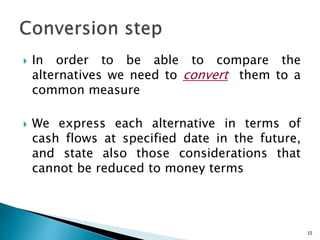
 Conversion step:
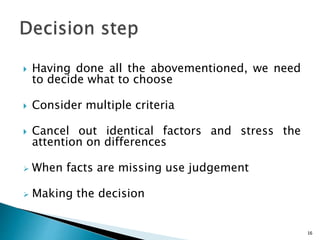
 Decision step
12
 The creative step consists of finding an
opening through a barrier of economic and
physical limitations (ex. aluminum discovery or
mining)
 We explore, investigate and research aiming
at finding new opportunitites
 Many successful ideas are simply new
combinations of known facts
13
 In the definition step, we define the
alternatives originated or selected for
comparison
 Choice is always between alternatives, but
we also need to choose which alternatives
to consider
 Is it better to spend more time defining
more possible alternatives or to take the
decision fast considering only few?
14
 In order to be able to compare the
alternatives we need to convert them to a
common measure
 We express each alternative in terms of
cash flows at specified date in the future,
and state also those considerations that
cannot be reduced to money terms
15
 Having done all the abovementioned, we need
to decide what to choose
 Consider multiple criteria
 Cancel out identical factors and stress the
attention on differences
 When facts are missing use judgement
 Making the decision
16
 Engineering economics is needed for many
kinds of decision making
◦ Example: Buying a car
 Alternatives:
 $18,000 now, or
 $600 per month for 3 years
 Which is better?
17
◦ Example: Buying a car
 Alternatives:
 $18,000 now, or
 $600 per month for 3 years
(= $21,600 total)
 Which is better?
 It depends!
 Issue: how much is money now worth compared to money
in the future?
 Leads to idea of time value of money!
18
 Would you rather have:
◦ $100 today, or
◦ $100 a year from now?
19
 Would you rather have:
◦ $100 today, or
◦ $100 a year from now?
 Basic assumption:
◦ Given a fixed amount of money, and
◦ A choice of having it now or in the future,
 Most people would prefer to have it sooner
rather than later
20
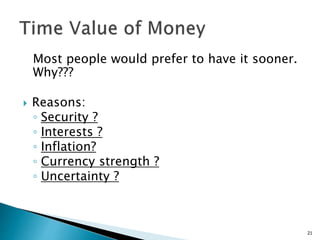
Most people would prefer to have it sooner.
Why???
 Reasons:
◦ Security ?
◦ Interests ?
◦ Inflation?
◦ Currency strength ?
◦ Uncertainty ?
21
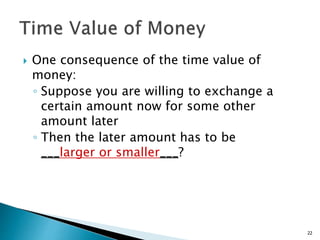
 One consequence of the time value of
money:
◦ Suppose you are willing to exchange a
certain amount now for some other
amount later
◦ Then the later amount has to be
___larger or smaller___?
22
23
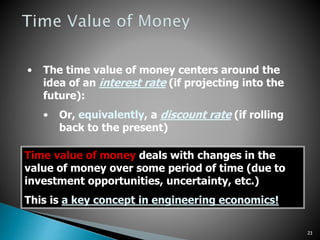
• The time value of money centers around the
idea of an interest rate (if projecting into the
future):
• Or, equivalently, a discount rate (if rolling
back to the present)
Time value of money deals with changes in the
value of money over some period of time (due to
investment opportunities, uncertainty, etc.)
This is a key concept in engineering economics!
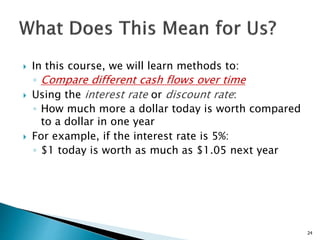
 In this course, we will learn methods to:
◦ Compare different cash flows over time
 Using the interest rate or discount rate:
◦ How much more a dollar today is worth compared
to a dollar in one year
 For example, if the interest rate is 5%:
◦ $1 today is worth as much as $1.05 next year
24
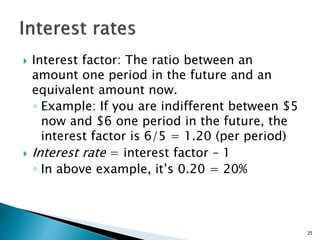
 Interest factor: The ratio between an
amount one period in the future and an
equivalent amount now.
◦ Example: If you are indifferent between $5
now and $6 one period in the future, the
interest factor is 6/5 = 1.20 (per period)
 Interest rate = interest factor – 1
◦ In above example, it’s 0.20 = 20%
25
26
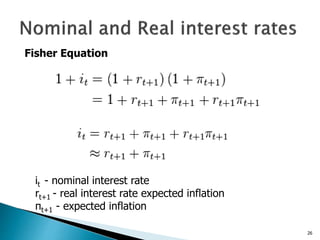
Fisher Equation
it - nominal interest rate
rt+1 - real interest rate expected inflation
πt+1 - expected inflation
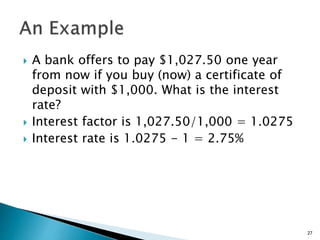
 A bank offers to pay $1,027.50 one year
from now if you buy (now) a certificate of
deposit with $1,000. What is the interest
rate?
 Interest factor is 1,027.50/1,000 = 1.0275
 Interest rate is 1.0275 - 1 = 2.75%
27
28
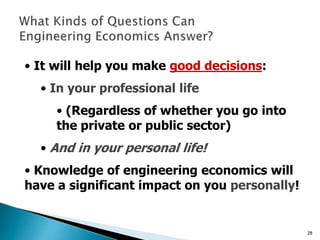
• It will help you make good decisions:
• In your professional life
• (Regardless of whether you go into
the private or public sector)
• And in your personal life!
• Knowledge of engineering economics will
have a significant impact on you personally!
29
ENGINEERING ECONOMICS INVOLVES:
FORMULATING, ESTIMATING, AND
EVALUATING ECONOMIC OUTCOMES
WHEN CHOICES OR ALTERNATIVES ARE
AVAILABLE
30
BY USING SPECIFIC
MATHEMATICAL RELATIONSHIPS
TO COMPARE THE CASH FLOWS OF THE
DIFFERENT ALTERNATIVES
(typically using spreadsheets)
31
• Engineering economics is based mainly on
estimates of future costs and benefits:
• So it has to deal with risk and uncertainty
• The costs, benefits, and other parameters are
typically unknown, and can vary over time:
• The values of these parameters will dictate a
particular numerical outcome
• And therefore a particular decision!
• Sensitivity analysis can be used to explore how
the decision changes as our estimates change
32
 Value is the worth that a person attaches
to a good or service
 Value is inherent in a regard a person has
for it, not in the item itself
 Value is not the cost of the item
 Utility is a power to satisfy human wants
and is determined subjectively
 Utility is the satisfaction that a person
derives from an item
33
 Without the subjectivity of the concepts
“value” and “utility” there would hardly be
any room for exchange between people.
Why?
 Through exchange we can increase the total
utility of the goods and services. How?
 Exchange is possible when it is mutually
benefitial
34
35
• Remember:
• “Tools” don’t make decisions
• People make decisions, based on values
• Engineering economics is just a set of
tools:
• It can help in decision making
• But it won’t make the decision for you
• Which alternative is “best” is up to you!

Engineering Economy

  • 1.
    Introduction to EngineeringEconomics Lecture 1, Chapter 1 1
  • 2.
    What is Economics? A social science of how limited resources are used to satisfy unlimited human wants What is Engineering ? Engineering is the application of scientific, economic, social, and practical knowledge, in order to design, build, and maintain structures, machines, devices, systems, and materials 2 Engineering Economics Engineering Economics
  • 3.
    3 All gifts ofnature, such as: water, air, minerals, sunshine, plant and tree growth, as well as the land itself which is applied to the production process. The efforts, skills, and knowledge of people which are applied to the production process. LAND OR NATURAL RESOURCES LABOR Real Capital (Physical Capital ) Tools, buildings, machinery -- things which have been produced which are used in further production Financial Capital Assets and money which are used in the production process Human Capital Education and training applied to labor in the production process. CAPITAL $$
  • 4.
  • 5.
    5  Ages ago,the most significant barriers to engineers were technological. The things that engineers wanted to do, they simply did not yet know how to do, or hadn't yet developed the tools to do. There are certainly many more challenges like this which face present-day engineers  Natural resources (from which we must build things) are becoming more scarce and more expensive  Negative side-effects of engineering innovations (such as air pollution from automobiles)  Engineers must decide if the benefits of a project exceed its costs, and must make this comparison in a unified framework. The framework within which to make this comparison is the field of engineering economics, which strives to answer exactly these questions, and perhaps more.
  • 6.
    6  Engineering Economicsis about making decisions  Engineering Economics is the application of economic techniques to the evaluation of design and engineering alternatives  Engineering Economics assesses the appropriateness of a given project, estimates its value, and justifies it from an engineering standpoint
  • 7.
    7 Engineering Assessing the worthof these products in economic terms Produce products and services depending on physical Laws Physical Environment Economic Environment Physical Efficiency=System Output/System Input Economic Efficiency=System Worth/System Cost
  • 8.
    8  The developmentof EI methodology is relatively recent  A pioneer in the field was Arthur Wellington, a civil engineer, who at the end of 19th century addressed the role of economic analysis in engineering projects (his area of interest was railroad building in the USA)  This early work was followed by other contributions in which the emphasis was put on techniques that depended on financial mathematics. In 1930, Eugene Grant published a textbook which was a milestone in the development of engineering economy as we know it today (economic point of view of engineering)  In 1942 Woods and DeGarmo wrote a book, later titled Engineering Economy
  • 9.
     Cost Concepts Time Value of Money  Cash-Flow Concepts  Comparing Alternatives  Evaluating Projects  Benefit-Cost Analysis 9  Depreciation and Income Taxes  Inflation and Price Changes  Dealing with Uncertainty
  • 10.
    1. Develop theAlternatives ◦ Creativity and innovation are essential to the process ◦ The alternatives need to be identified and then defined for subsequent analysis ◦ Consider the status quo, but do not focus on it(i.e., doing nothing) 2. Focus on the Differences ◦ Only the differences among alternatives are relevant to comparison and decision 3. Use a Consistent Viewpoint (perspective) 4. Use a Common Unit of Measure ◦ Use it for enumerating as many possible outcomes as possible, since it simplifies the analysis of alternatives 5. Consider All Relevant Criteria ◦ Consider both those that can be measured in monetary terms and “non-monetary” criteria 6. Make Uncertainty Explicit 7. Revisit Your Decisions: compare initial projected outcomes with actual results achieved 10
  • 11.
    1. Problem recognition,definition, and evaluation 2. Development of the feasible alternatives ◦ Searching for potential alternatives ◦ Screening them to select a smaller group of feasible alternatives 3. Development of the cash flows for each alternative (or of prospective outcomes) 4. Selection of a criterion ( or criteria) 5. Analysis and comparison of the alternatives 6. Selection of the preferred alternative 7. Performance monitoring and post-evaluation results: helps to do better analysis and improves the operations in organization 11
  • 12.
    Four essential stepsin formulaing engineering economic decisions are:  Creative step: find an opening through a barrier of economic and physical limitations  Definition step: define all factors associated with each alternative originated in creative step  Conversion step:  Decision step 12
  • 13.
     The creativestep consists of finding an opening through a barrier of economic and physical limitations (ex. aluminum discovery or mining)  We explore, investigate and research aiming at finding new opportunitites  Many successful ideas are simply new combinations of known facts 13
  • 14.
     In thedefinition step, we define the alternatives originated or selected for comparison  Choice is always between alternatives, but we also need to choose which alternatives to consider  Is it better to spend more time defining more possible alternatives or to take the decision fast considering only few? 14
  • 15.
     In orderto be able to compare the alternatives we need to convert them to a common measure  We express each alternative in terms of cash flows at specified date in the future, and state also those considerations that cannot be reduced to money terms 15
  • 16.
     Having doneall the abovementioned, we need to decide what to choose  Consider multiple criteria  Cancel out identical factors and stress the attention on differences  When facts are missing use judgement  Making the decision 16
  • 17.
     Engineering economicsis needed for many kinds of decision making ◦ Example: Buying a car  Alternatives:  $18,000 now, or  $600 per month for 3 years  Which is better? 17
  • 18.
    ◦ Example: Buyinga car  Alternatives:  $18,000 now, or  $600 per month for 3 years (= $21,600 total)  Which is better?  It depends!  Issue: how much is money now worth compared to money in the future?  Leads to idea of time value of money! 18
  • 19.
     Would yourather have: ◦ $100 today, or ◦ $100 a year from now? 19
  • 20.
     Would yourather have: ◦ $100 today, or ◦ $100 a year from now?  Basic assumption: ◦ Given a fixed amount of money, and ◦ A choice of having it now or in the future,  Most people would prefer to have it sooner rather than later 20
  • 21.
    Most people wouldprefer to have it sooner. Why???  Reasons: ◦ Security ? ◦ Interests ? ◦ Inflation? ◦ Currency strength ? ◦ Uncertainty ? 21
  • 22.
     One consequenceof the time value of money: ◦ Suppose you are willing to exchange a certain amount now for some other amount later ◦ Then the later amount has to be ___larger or smaller___? 22
  • 23.
    23 • The timevalue of money centers around the idea of an interest rate (if projecting into the future): • Or, equivalently, a discount rate (if rolling back to the present) Time value of money deals with changes in the value of money over some period of time (due to investment opportunities, uncertainty, etc.) This is a key concept in engineering economics!
  • 24.
     In thiscourse, we will learn methods to: ◦ Compare different cash flows over time  Using the interest rate or discount rate: ◦ How much more a dollar today is worth compared to a dollar in one year  For example, if the interest rate is 5%: ◦ $1 today is worth as much as $1.05 next year 24
  • 25.
     Interest factor:The ratio between an amount one period in the future and an equivalent amount now. ◦ Example: If you are indifferent between $5 now and $6 one period in the future, the interest factor is 6/5 = 1.20 (per period)  Interest rate = interest factor – 1 ◦ In above example, it’s 0.20 = 20% 25
  • 26.
    26 Fisher Equation it -nominal interest rate rt+1 - real interest rate expected inflation πt+1 - expected inflation
  • 27.
     A bankoffers to pay $1,027.50 one year from now if you buy (now) a certificate of deposit with $1,000. What is the interest rate?  Interest factor is 1,027.50/1,000 = 1.0275  Interest rate is 1.0275 - 1 = 2.75% 27
  • 28.
    28 • It willhelp you make good decisions: • In your professional life • (Regardless of whether you go into the private or public sector) • And in your personal life! • Knowledge of engineering economics will have a significant impact on you personally!
  • 29.
    29 ENGINEERING ECONOMICS INVOLVES: FORMULATING,ESTIMATING, AND EVALUATING ECONOMIC OUTCOMES WHEN CHOICES OR ALTERNATIVES ARE AVAILABLE
  • 30.
    30 BY USING SPECIFIC MATHEMATICALRELATIONSHIPS TO COMPARE THE CASH FLOWS OF THE DIFFERENT ALTERNATIVES (typically using spreadsheets)
  • 31.
    31 • Engineering economicsis based mainly on estimates of future costs and benefits: • So it has to deal with risk and uncertainty • The costs, benefits, and other parameters are typically unknown, and can vary over time: • The values of these parameters will dictate a particular numerical outcome • And therefore a particular decision! • Sensitivity analysis can be used to explore how the decision changes as our estimates change
  • 32.
  • 33.
     Value isthe worth that a person attaches to a good or service  Value is inherent in a regard a person has for it, not in the item itself  Value is not the cost of the item  Utility is a power to satisfy human wants and is determined subjectively  Utility is the satisfaction that a person derives from an item 33
  • 34.
     Without thesubjectivity of the concepts “value” and “utility” there would hardly be any room for exchange between people. Why?  Through exchange we can increase the total utility of the goods and services. How?  Exchange is possible when it is mutually benefitial 34
  • 35.
    35 • Remember: • “Tools”don’t make decisions • People make decisions, based on values • Engineering economics is just a set of tools: • It can help in decision making • But it won’t make the decision for you • Which alternative is “best” is up to you!