MG6863- ENGINEERING ECONOMICS
Dr. P.MANIMARAN
PROFESSOR
DEPARTMENT OF MECHANICAL ENGINEERING
KAMARAJ COLLEGE OF ENGINEERING AND
TECHNOLOGY
VIRUDHUNAGAR – 626 001
ECONOMICS: Science that deals with the
production and consumption of goods and
services and the distribution and rendering of
these for human welfare.
ECONOMIC GOALS:
1. Generating a high level of employment
2. Stabilizing the price levels
3. Economic efficiency
4. Equitable distribution in income
5. Economic growth
FLOW IN ECONOMY
•
Money payments for consumer goods and services
Consumer goods, services
Money payments for resources, rents,
wages, salaries, interest and profit
Economic Resources: Land, Labour, capital
Households
1. Consume final goods and
services produced by
businesses and services
2. Provide productive inputs
to businesses
Businesses
1. Provide goods and services
to consumers
2. Use resources, inputs
provided by house holds
LAW OF SUPPLY AND DEMAND
• Elasticity of Demand: the degree of responsiveness of
quantity demanded to a change in price
• Elastic demand: when the quantity demanded
responds greatly to price changes
• Inelastic demand: when the quantity demanded
responds very little to price changes
• Elasticity of Supply: the degree of responsiveness of
change in supply to a change in price
Factors influencing Demand
• Income of the People
• Price of related goods
• Tastes of consumers
Factors influencing Supply
• Cost of the inputs
• Technology
• Weather
• Prices of related goods
CONCEPT OF ENGINEERING ECONOMCIS
Organization's point of view: Efficient and
effective functioning of the organization would
certainly help it to provide goods/services at a
lower cost which in turn will enable it to fix a
lower price for its goods or services.
Principles of Engineering Economics
• Develop the alternatives
• Focus on the differences
• Use of consistent view point
• Use a common unit of measure
• Consider all relevant criteria
• Make uncertainty explicit
• Revisit your decisions.
• Develop the alternatives : Decisions are made out of
alternatives. The alternatives need to be identified and then
defined for subsequent analysis
• Focus on the differences : Only the differences is expected
future outcomes among the alternatives are relevant to their
comparison and should be considered in the decision
• Use a consistent viewpoint: The prospective outcomes of
the alternatives economic and other should be consistently
developed from a defined perspective
• Use a common unit of measure : Using a common unit of
measure to enumerate as many of the prospective outcomes
as possible will make easier the analysis and comparison of
alternatives.
• Consider all relevant criteria : Selection of a preferred
alternative requires the use of a criterion. The decision
process should consider the outcomes enumerated in the
monetary unit and those expressed in some other unit of
measurement or made explicit in a descriptive manner.
• Make uncertainty explicit : Uncertainty is inherent in
projecting(or estimating) the future outcomes of the
alternatives and should be recognized in their analysis and
comparison.
• Revisit your decisions : Improved decision making results
from an adaptive process to the extent practicable, the initial
projected outcomes of the selected alternatives should be
subsequently compared with actual results achieved.
Engineering Economics Analysis Procedure
• Problem recognition, formulation, and evaluation
• Development of the feasible alternatives
• Development of the cash flows for each alternative
• Selection of a criterion
• Analysis and comparison of the alternatives
• Selection of the preferred alternative
• Performance monitoring and post evaluation results
Types of Efficiency
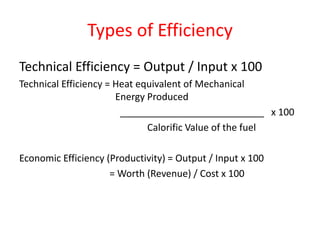
Technical Efficiency = Output / Input x 100
Technical Efficiency = Heat equivalent of Mechanical
Energy Produced
___________________________ x 100
Calorific Value of the fuel
Economic Efficiency (Productivity) = Output / Input x 100
= Worth (Revenue) / Cost x 100
Ways of Improving Productivity
• Increased output for the same input
• Decreased input for the same output
• By a proportionate increase in the output which is
more than the proportionate increase in the input
• By a proportionate decrease in the input which is
more than the proportionate decrease in the output
• Through simultaneous increase in the output and
decrease in the input
Engineering Economics
In the process of managing organizations, the managers
at different levels should take appropriate economic
decisions which will help in
• minimizing investment
• operating and maintenance expenditures
besides
• increasing the revenue
• savings and other related gains of the organisation
Definition:
• deals with the methods that enable one to
take economic decisions towards minimizing
costs and/or maximizing benefits to business
organizations.
SCOPE OF ENGINEERING ECONOMICS
1. plays a very important role in all engineering decisions.
2. concerned with the monetary consequences of the projects,
products and processes.
3. helps an engineer to assess and compare the overall cost of
available alternatives for engineering projects or plants or
machine etc.
4. According to the analysis an engineer can take a decision from
an alternative in most economical one as the best.
5. Decisions require engineering economics are important
because capital investment have significant cost and lives over
several years.
6.concepts are used in the important fields like increasing
production, improving productivity reducing human efforts,
increasing wealth.
7. provides a number of tools and techniques to solve
engineering problems related to product mix, output level,
pricing the product etc.
8. helps to understand the market conditions general economic
environment in which the firm is working.
9. provides basis for resource allocation problem.
Elements of cost
Elements of cost
MARGINAL COST
• the cost of producing an additional unit of that product.
• Let the cost of producing 20 units of a product be
Rs 10,000 and the cost of producing 21 units of the same
product be Rs 10,045.
• Then the marginal cost of producing the 21st unit is Rs
45/-
SUNK COST
• This is known as the past cost of an equipment
or asset.
• If an equipment is purchased for Rs 1,00,000
about three years back, the present worth of
the equipment is not the same today.
• The purchase value of the equipment in the
past - sunk cost.
MARGINAL REVENUE
• the incremental revenue of selling an additional unit of
that product.
• Let the revenue of selling 20 units of a product be Rs
15,000 and the revenue of selling 21 units of the same
product be Rs 15,085.
• the marginal revenue of selling the 21st unit is Rs 85.
OPPORTUNITY COST
• Opportunity cost of an alternative is the return that will
be foregone by not investing the same money in another
alternative
• Person invested a sum of Rs 50,000 in shares. Expected
return is Rs.7500/-If the same amount is invested in fixed
deposit the bank at the interest rate of 18% will pay Rs
9000/-.
• The investor has to forego the amount of Rs 1500/- for
not investing in the bank.
BREAK EVEN ANALYSIS
• Break even analysis is concerned with finding
the point at which revenues and costs agree
exactly.
• Break even point(BEP) is therefore the volume
of output at which neither a profit or loss is
incurred.
• BEP is a point where the total sales are equal
to the total cost.
BREAK EVEN CHART
BREAK EVEN CHART
BREAK EVEN ANALYSIS
CONTRIBUTION
P/V RATIO
Sequences in which operations will be performed
with the raw materials
Names of equipment which the operations will be
performed
Standard time for each operation
Timing of performing overall operations.
ELEMENTARY ECONOMIC ANALYSIS
• Price of raw material
• Transportation cost of the raw material
• Availability of the raw material
• Quality of the raw material
EXAMPLES
• Material Selection for a product
• Design Selection for a product
• Design Selection for a process industry
• Building material selection for a construction
activities
• Process planning/process modification
PROCESS PLANNING
To identify the most economical sequence of operations
to produce a component.
STEPS
Analyse the part drawing to get an overall picture of
what is required
Make recommendations to or consult with product
engineers on product design changes
List the basic operations required to produce the part to
the drawing or specifications
 Determine the most practical and economical
manufacturing method and the form or tooling
required for each operation.
 Devise the best way to combine the operations and
put them in sequence
 Specify the gauging required for the process.
INFORMATION REQUIRED
Desired quantity of output
Desired quality of product
Nature of raw materials
type of technology
Available capital resources
Availability of equipments, tools and personnel

MG6863 Engineering Economics

  • 1.
    MG6863- ENGINEERING ECONOMICS Dr.P.MANIMARAN PROFESSOR DEPARTMENT OF MECHANICAL ENGINEERING KAMARAJ COLLEGE OF ENGINEERING AND TECHNOLOGY VIRUDHUNAGAR – 626 001
  • 2.
    ECONOMICS: Science thatdeals with the production and consumption of goods and services and the distribution and rendering of these for human welfare. ECONOMIC GOALS: 1. Generating a high level of employment 2. Stabilizing the price levels 3. Economic efficiency 4. Equitable distribution in income 5. Economic growth
  • 3.
    FLOW IN ECONOMY • Moneypayments for consumer goods and services Consumer goods, services Money payments for resources, rents, wages, salaries, interest and profit Economic Resources: Land, Labour, capital Households 1. Consume final goods and services produced by businesses and services 2. Provide productive inputs to businesses Businesses 1. Provide goods and services to consumers 2. Use resources, inputs provided by house holds
  • 4.
    LAW OF SUPPLYAND DEMAND
  • 5.
    • Elasticity ofDemand: the degree of responsiveness of quantity demanded to a change in price • Elastic demand: when the quantity demanded responds greatly to price changes • Inelastic demand: when the quantity demanded responds very little to price changes • Elasticity of Supply: the degree of responsiveness of change in supply to a change in price
  • 6.
    Factors influencing Demand •Income of the People • Price of related goods • Tastes of consumers
  • 7.
    Factors influencing Supply •Cost of the inputs • Technology • Weather • Prices of related goods
  • 8.
    CONCEPT OF ENGINEERINGECONOMCIS Organization's point of view: Efficient and effective functioning of the organization would certainly help it to provide goods/services at a lower cost which in turn will enable it to fix a lower price for its goods or services.
  • 9.
    Principles of EngineeringEconomics • Develop the alternatives • Focus on the differences • Use of consistent view point • Use a common unit of measure • Consider all relevant criteria • Make uncertainty explicit • Revisit your decisions.
  • 10.
    • Develop thealternatives : Decisions are made out of alternatives. The alternatives need to be identified and then defined for subsequent analysis • Focus on the differences : Only the differences is expected future outcomes among the alternatives are relevant to their comparison and should be considered in the decision • Use a consistent viewpoint: The prospective outcomes of the alternatives economic and other should be consistently developed from a defined perspective • Use a common unit of measure : Using a common unit of measure to enumerate as many of the prospective outcomes as possible will make easier the analysis and comparison of alternatives.
  • 11.
    • Consider allrelevant criteria : Selection of a preferred alternative requires the use of a criterion. The decision process should consider the outcomes enumerated in the monetary unit and those expressed in some other unit of measurement or made explicit in a descriptive manner. • Make uncertainty explicit : Uncertainty is inherent in projecting(or estimating) the future outcomes of the alternatives and should be recognized in their analysis and comparison. • Revisit your decisions : Improved decision making results from an adaptive process to the extent practicable, the initial projected outcomes of the selected alternatives should be subsequently compared with actual results achieved.
  • 12.
    Engineering Economics AnalysisProcedure • Problem recognition, formulation, and evaluation • Development of the feasible alternatives • Development of the cash flows for each alternative • Selection of a criterion • Analysis and comparison of the alternatives • Selection of the preferred alternative • Performance monitoring and post evaluation results
  • 13.
    Types of Efficiency TechnicalEfficiency = Output / Input x 100 Technical Efficiency = Heat equivalent of Mechanical Energy Produced ___________________________ x 100 Calorific Value of the fuel Economic Efficiency (Productivity) = Output / Input x 100 = Worth (Revenue) / Cost x 100
  • 14.
    Ways of ImprovingProductivity • Increased output for the same input • Decreased input for the same output • By a proportionate increase in the output which is more than the proportionate increase in the input • By a proportionate decrease in the input which is more than the proportionate decrease in the output • Through simultaneous increase in the output and decrease in the input
  • 15.
    Engineering Economics In theprocess of managing organizations, the managers at different levels should take appropriate economic decisions which will help in • minimizing investment • operating and maintenance expenditures besides • increasing the revenue • savings and other related gains of the organisation
  • 16.
    Definition: • deals withthe methods that enable one to take economic decisions towards minimizing costs and/or maximizing benefits to business organizations.
  • 17.
    SCOPE OF ENGINEERINGECONOMICS 1. plays a very important role in all engineering decisions. 2. concerned with the monetary consequences of the projects, products and processes. 3. helps an engineer to assess and compare the overall cost of available alternatives for engineering projects or plants or machine etc. 4. According to the analysis an engineer can take a decision from an alternative in most economical one as the best. 5. Decisions require engineering economics are important because capital investment have significant cost and lives over several years.
  • 18.
    6.concepts are usedin the important fields like increasing production, improving productivity reducing human efforts, increasing wealth. 7. provides a number of tools and techniques to solve engineering problems related to product mix, output level, pricing the product etc. 8. helps to understand the market conditions general economic environment in which the firm is working. 9. provides basis for resource allocation problem.
  • 19.
  • 20.
  • 21.
    MARGINAL COST • thecost of producing an additional unit of that product. • Let the cost of producing 20 units of a product be Rs 10,000 and the cost of producing 21 units of the same product be Rs 10,045. • Then the marginal cost of producing the 21st unit is Rs 45/-
  • 22.
    SUNK COST • Thisis known as the past cost of an equipment or asset. • If an equipment is purchased for Rs 1,00,000 about three years back, the present worth of the equipment is not the same today. • The purchase value of the equipment in the past - sunk cost.
  • 23.
    MARGINAL REVENUE • theincremental revenue of selling an additional unit of that product. • Let the revenue of selling 20 units of a product be Rs 15,000 and the revenue of selling 21 units of the same product be Rs 15,085. • the marginal revenue of selling the 21st unit is Rs 85.
  • 24.
    OPPORTUNITY COST • Opportunitycost of an alternative is the return that will be foregone by not investing the same money in another alternative • Person invested a sum of Rs 50,000 in shares. Expected return is Rs.7500/-If the same amount is invested in fixed deposit the bank at the interest rate of 18% will pay Rs 9000/-. • The investor has to forego the amount of Rs 1500/- for not investing in the bank.
  • 25.
    BREAK EVEN ANALYSIS •Break even analysis is concerned with finding the point at which revenues and costs agree exactly. • Break even point(BEP) is therefore the volume of output at which neither a profit or loss is incurred. • BEP is a point where the total sales are equal to the total cost.
  • 26.
  • 27.
  • 28.
  • 29.
  • 30.
  • 31.
    Sequences in whichoperations will be performed with the raw materials Names of equipment which the operations will be performed Standard time for each operation Timing of performing overall operations.
  • 32.
    ELEMENTARY ECONOMIC ANALYSIS •Price of raw material • Transportation cost of the raw material • Availability of the raw material • Quality of the raw material
  • 33.
    EXAMPLES • Material Selectionfor a product • Design Selection for a product • Design Selection for a process industry • Building material selection for a construction activities • Process planning/process modification
  • 34.
    PROCESS PLANNING To identifythe most economical sequence of operations to produce a component. STEPS Analyse the part drawing to get an overall picture of what is required Make recommendations to or consult with product engineers on product design changes List the basic operations required to produce the part to the drawing or specifications
  • 35.
     Determine themost practical and economical manufacturing method and the form or tooling required for each operation.  Devise the best way to combine the operations and put them in sequence  Specify the gauging required for the process.
  • 36.
    INFORMATION REQUIRED Desired quantityof output Desired quality of product Nature of raw materials type of technology Available capital resources Availability of equipments, tools and personnel