© 2012 by McGraw-Hill All Rights Reserved
11-1
Lecture slides to accompany
Engineering Economy
7th
edition
Leland Blank
Anthony Tarquin
Chapter 11Chapter 11
ReplacementReplacement
& Retention& Retention
11-2
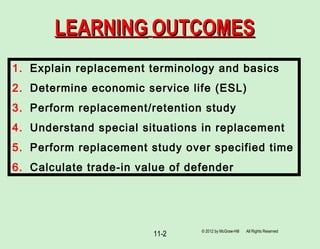
LEARNINGLEARNING OUTCOMESOUTCOMES
1. Explain replacement terminology and basics
2. Determine economic service life (ESL)
3. Perform replacement/retention study
4. Understand special situations in replacement
5. Perform replacement study over specified time
6. Calculate trade-in value of defender
© 2012 by McGraw-Hill All Rights Reserved
11-3
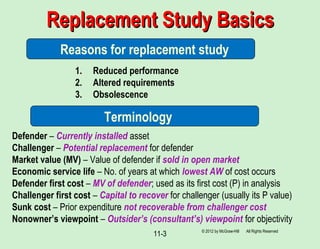
Replacement Study BasicsReplacement Study Basics
1. Reduced performance
2. Altered requirements
3. Obsolescence
Terminology
Defender – Currently installed asset
Challenger – Potential replacement for defender
Market value (MV) – Value of defender if sold in open market
Economic service life – No. of years at which lowest AW of cost occurs
Defender first cost – MV of defender; used as its first cost (P) in analysis
Challenger first cost – Capital to recover for challenger (usually its P value)
Sunk cost – Prior expenditure not recoverable from challenger cost
Nonowner’s viewpoint – Outsider’s (consultant’s) viewpoint for objectivity
Reasons for replacement study
© 2012 by McGraw-Hill All Rights Reserved
11-4
Example: Replacement BasicsExample: Replacement Basics
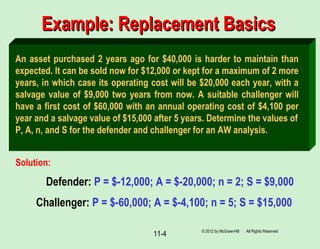
An asset purchased 2 years ago for $40,000 is harder to maintain than
expected. It can be sold now for $12,000 or kept for a maximum of 2 more
years, in which case its operating cost will be $20,000 each year, with a
salvage value of $9,000 two years from now. A suitable challenger will
have a first cost of $60,000 with an annual operating cost of $4,100 per
year and a salvage value of $15,000 after 5 years. Determine the values of
P, A, n, and S for the defender and challenger for an AW analysis.
Solution:
Defender: P = $-12,000; A = $-20,000; n = 2; S = $9,000
Challenger: P = $-60,000; A = $-4,100; n = 5; S = $15,000
© 2012 by McGraw-Hill All Rights Reserved
Overview of a Replacement StudyOverview of a Replacement Study
 Replacement studies are applications of the AW method
 Study periods (planning horizons) are either specified or
unlimited
 Assumptions for unlimited study period:
1. Services provided for indefinite future
2. Challenger is best available now and for future, and will be
repeated in future life cycles
3. Cost estimates for each life cycle for defender and challenger
remain the same
 If study period is specified, assumptions do not hold
 Replacement study procedures differ for the two cases
© 2012 by McGraw-Hill All Rights Reserved
11-5
11-6
Economic Service LifeEconomic Service Life
Economic service life (ESL) refers to the asset
retention time (n) that yields its lowest equivalent AW
Determined by calculating AW for 1, 2, 3,…n years
General equation is:
Total AW = capital recovery – AW of annual operating costs
= CR – AW of AOC
© 2012 by McGraw-Hill All Rights Reserved
11-7
Example: Economic Service LifeExample: Economic Service Life
Determine the ESL of an asset which has the costs shown below. Let i = 10%
Year Cost,$/year Salvage value,$
0 - 20,000 -
1 -5,000 10,000
2 -6,500 8,000
3 - 9,000 5,000
4 -11,000 5,000
5 -15,000 3,000
AW1 = - 20,000(A/P,10%,1) – 5000(P/F,10%,1)(A/P,10%,1) + 10,000(A/F,10%,1) = $ -17,000
AW2 = - 20,000(A/P,10%,2) – [5000(P/F,10%,1) + 6500(P/F,10%,2)](A/P,10%,2)
+ 8000(A/F,10%,2)
= $ -13,429
Similarly, AW3 = $ -13,239 AW4 = $ -12,864 AW5 = $ -13,623
Economic service life is 4 years
Solution:
© 2012 by McGraw-Hill All Rights Reserved
11-8
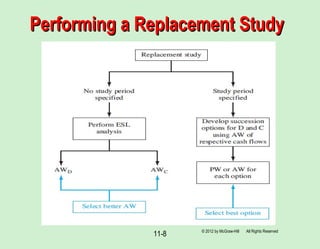
Performing a Replacement StudyPerforming a Replacement Study
© 2012 by McGraw-Hill All Rights Reserved
11-9
Performing a Replacement Study --Performing a Replacement Study --
Unlimited Study PeriodUnlimited Study Period
1. Calculate AWD and AWC based on their ESL; select lower AW
2. If AWC was selected in step (1), keep for nC years (i.e.,
economic service life of challenger); if AWD was selected, keep
defender one more year and then repeat analysis (i.e., one-
year-later analysis)
3. As long as all estimates remain current in succeeding years,
keep defender until nD is reached, and then replace defender
with best challenger
4. If any estimates change before nD is reached, repeat steps (1)
through (4)
Note: If study period is specified, perform steps (1) through
(4) only through end of study period (discussed later)© 2012 by McGraw-Hill All Rights Reserved
11-10
Example: Replacement AnalysisExample: Replacement Analysis
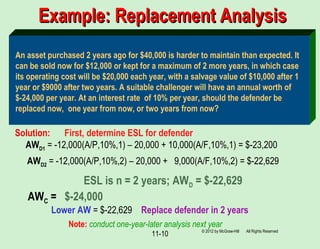
An asset purchased 2 years ago for $40,000 is harder to maintain than expected. It
can be sold now for $12,000 or kept for a maximum of 2 more years, in which case
its operating cost will be $20,000 each year, with a salvage value of $10,000 after 1
year or $9000 after two years. A suitable challenger will have an annual worth of
$-24,000 per year. At an interest rate of 10% per year, should the defender be
replaced now, one year from now, or two years from now?
Solution: First, determine ESL for defender
AWD1 = -12,000(A/P,10%,1) – 20,000 + 10,000(A/F,10%,1) = $-23,200
AWD2 = -12,000(A/P,10%,2) – 20,000 + 9,000(A/F,10%,2) = $-22,629
ESL is n = 2 years; AWD = $-22,629
Lower AW = $-22,629 Replace defender in 2 years
AWC = $-24,000
Note: conduct one-year-later analysis next year
© 2012 by McGraw-Hill All Rights Reserved
11-11
Additional ConsiderationsAdditional Considerations
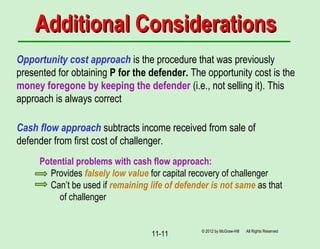
Opportunity cost approach is the procedure that was previously
presented for obtaining P for the defender. The opportunity cost is the
money foregone by keeping the defender (i.e., not selling it). This
approach is always correct
Cash flow approach subtracts income received from sale of
defender from first cost of challenger.
Potential problems with cash flow approach:
Provides falsely low value for capital recovery of challenger
Can’t be used if remaining life of defender is not same as that
of challenger
© 2012 by McGraw-Hill All Rights Reserved
11-12
Replacement Analysis Over Specified Study PeriodReplacement Analysis Over Specified Study Period
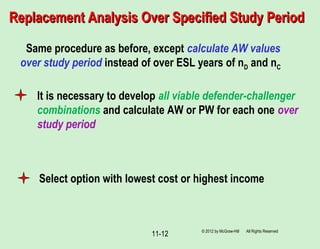
Same procedure as before, except calculate AW values
over study period instead of over ESL years of nD and nC
It is necessary to develop all viable defender-challenger
combinations and calculate AW or PW for each one over
study period
Select option with lowest cost or highest income
© 2012 by McGraw-Hill All Rights Reserved
11-13
Example: Replacement Analysis; Specified PeriodExample: Replacement Analysis; Specified Period
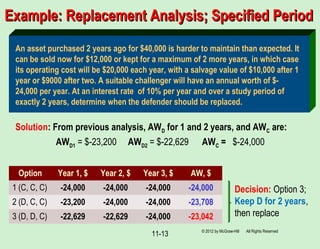
An asset purchased 2 years ago for $40,000 is harder to maintain than expected. It
can be sold now for $12,000 or kept for a maximum of 2 more years, in which case
its operating cost will be $20,000 each year, with a salvage value of $10,000 after 1
year or $9000 after two. A suitable challenger will have an annual worth of $-
24,000 per year. At an interest rate of 10% per year and over a study period of
exactly 2 years, determine when the defender should be replaced.
Solution: From previous analysis, AWD for 1 and 2 years, and AWC are:
AWD2 = $-22,629 AWC = $-24,000
© 2012 by McGraw-Hill All Rights Reserved
AWD1 = $-23,200
Option Year 1, $ Year 2, $ Year 3, $ AW, $
1 (C, C, C) -24,000 -24,000 -24,000 -24,000
2 (D, C, C) -23,200 -24,000 -24,000 -23,708
3 (D, D, C) -22,629 -22,629 -24,000 -23,042
Decision: Option 3;
Keep D for 2 years,
then replace
11-14
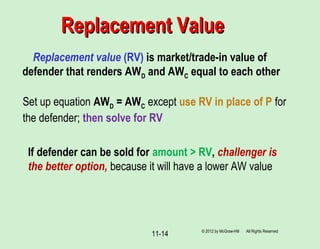
Replacement ValueReplacement Value
Replacement value (RV) is market/trade-in value of
defender that renders AWD and AWC equal to each other
If defender can be sold for amount > RV, challenger is
the better option, because it will have a lower AW value
Set up equation AWD = AWC except use RV in place of P for
the defender; then solve for RV
© 2012 by McGraw-Hill All Rights Reserved
11-15
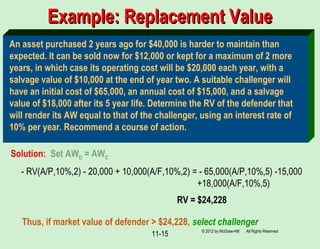
Example: Replacement ValueExample: Replacement Value
An asset purchased 2 years ago for $40,000 is harder to maintain than
expected. It can be sold now for $12,000 or kept for a maximum of 2 more
years, in which case its operating cost will be $20,000 each year, with a
salvage value of $10,000 at the end of year two. A suitable challenger will
have an initial cost of $65,000, an annual cost of $15,000, and a salvage
value of $18,000 after its 5 year life. Determine the RV of the defender that
will render its AW equal to that of the challenger, using an interest rate of
10% per year. Recommend a course of action.
- RV(A/P,10%,2) - 20,000 + 10,000(A/F,10%,2) = - 65,000(A/P,10%,5) -15,000
+18,000(A/F,10%,5)
RV = $24,228
Solution: Set AWD = AWC
Thus, if market value of defender > $24,228, select challenger
© 2012 by McGraw-Hill All Rights Reserved
11-16
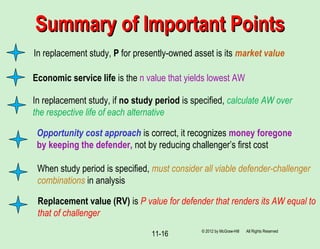
In replacement study, P for presently-owned asset is its market value
Summary of Important PointsSummary of Important Points
Economic service life is the n value that yields lowest AW
In replacement study, if no study period is specified, calculate AW over
the respective life of each alternative
When study period is specified, must consider all viable defender-challenger
combinations in analysis
Replacement value (RV) is P value for defender that renders its AW equal to
that of challenger
© 2012 by McGraw-Hill All Rights Reserved
Opportunity cost approach is correct, it recognizes money foregone
by keeping the defender, not by reducing challenger’s first cost

Chapter 11 replacement & retention decisions

  • 1.
    © 2012 byMcGraw-Hill All Rights Reserved 11-1 Lecture slides to accompany Engineering Economy 7th edition Leland Blank Anthony Tarquin Chapter 11Chapter 11 ReplacementReplacement & Retention& Retention
  • 2.
    11-2 LEARNINGLEARNING OUTCOMESOUTCOMES 1. Explainreplacement terminology and basics 2. Determine economic service life (ESL) 3. Perform replacement/retention study 4. Understand special situations in replacement 5. Perform replacement study over specified time 6. Calculate trade-in value of defender © 2012 by McGraw-Hill All Rights Reserved
  • 3.
    11-3 Replacement Study BasicsReplacementStudy Basics 1. Reduced performance 2. Altered requirements 3. Obsolescence Terminology Defender – Currently installed asset Challenger – Potential replacement for defender Market value (MV) – Value of defender if sold in open market Economic service life – No. of years at which lowest AW of cost occurs Defender first cost – MV of defender; used as its first cost (P) in analysis Challenger first cost – Capital to recover for challenger (usually its P value) Sunk cost – Prior expenditure not recoverable from challenger cost Nonowner’s viewpoint – Outsider’s (consultant’s) viewpoint for objectivity Reasons for replacement study © 2012 by McGraw-Hill All Rights Reserved
  • 4.
    11-4 Example: Replacement BasicsExample:Replacement Basics An asset purchased 2 years ago for $40,000 is harder to maintain than expected. It can be sold now for $12,000 or kept for a maximum of 2 more years, in which case its operating cost will be $20,000 each year, with a salvage value of $9,000 two years from now. A suitable challenger will have a first cost of $60,000 with an annual operating cost of $4,100 per year and a salvage value of $15,000 after 5 years. Determine the values of P, A, n, and S for the defender and challenger for an AW analysis. Solution: Defender: P = $-12,000; A = $-20,000; n = 2; S = $9,000 Challenger: P = $-60,000; A = $-4,100; n = 5; S = $15,000 © 2012 by McGraw-Hill All Rights Reserved
  • 5.
    Overview of aReplacement StudyOverview of a Replacement Study  Replacement studies are applications of the AW method  Study periods (planning horizons) are either specified or unlimited  Assumptions for unlimited study period: 1. Services provided for indefinite future 2. Challenger is best available now and for future, and will be repeated in future life cycles 3. Cost estimates for each life cycle for defender and challenger remain the same  If study period is specified, assumptions do not hold  Replacement study procedures differ for the two cases © 2012 by McGraw-Hill All Rights Reserved 11-5
  • 6.
    11-6 Economic Service LifeEconomicService Life Economic service life (ESL) refers to the asset retention time (n) that yields its lowest equivalent AW Determined by calculating AW for 1, 2, 3,…n years General equation is: Total AW = capital recovery – AW of annual operating costs = CR – AW of AOC © 2012 by McGraw-Hill All Rights Reserved
  • 7.
    11-7 Example: Economic ServiceLifeExample: Economic Service Life Determine the ESL of an asset which has the costs shown below. Let i = 10% Year Cost,$/year Salvage value,$ 0 - 20,000 - 1 -5,000 10,000 2 -6,500 8,000 3 - 9,000 5,000 4 -11,000 5,000 5 -15,000 3,000 AW1 = - 20,000(A/P,10%,1) – 5000(P/F,10%,1)(A/P,10%,1) + 10,000(A/F,10%,1) = $ -17,000 AW2 = - 20,000(A/P,10%,2) – [5000(P/F,10%,1) + 6500(P/F,10%,2)](A/P,10%,2) + 8000(A/F,10%,2) = $ -13,429 Similarly, AW3 = $ -13,239 AW4 = $ -12,864 AW5 = $ -13,623 Economic service life is 4 years Solution: © 2012 by McGraw-Hill All Rights Reserved
  • 8.
    11-8 Performing a ReplacementStudyPerforming a Replacement Study © 2012 by McGraw-Hill All Rights Reserved
  • 9.
    11-9 Performing a ReplacementStudy --Performing a Replacement Study -- Unlimited Study PeriodUnlimited Study Period 1. Calculate AWD and AWC based on their ESL; select lower AW 2. If AWC was selected in step (1), keep for nC years (i.e., economic service life of challenger); if AWD was selected, keep defender one more year and then repeat analysis (i.e., one- year-later analysis) 3. As long as all estimates remain current in succeeding years, keep defender until nD is reached, and then replace defender with best challenger 4. If any estimates change before nD is reached, repeat steps (1) through (4) Note: If study period is specified, perform steps (1) through (4) only through end of study period (discussed later)© 2012 by McGraw-Hill All Rights Reserved
  • 10.
    11-10 Example: Replacement AnalysisExample:Replacement Analysis An asset purchased 2 years ago for $40,000 is harder to maintain than expected. It can be sold now for $12,000 or kept for a maximum of 2 more years, in which case its operating cost will be $20,000 each year, with a salvage value of $10,000 after 1 year or $9000 after two years. A suitable challenger will have an annual worth of $-24,000 per year. At an interest rate of 10% per year, should the defender be replaced now, one year from now, or two years from now? Solution: First, determine ESL for defender AWD1 = -12,000(A/P,10%,1) – 20,000 + 10,000(A/F,10%,1) = $-23,200 AWD2 = -12,000(A/P,10%,2) – 20,000 + 9,000(A/F,10%,2) = $-22,629 ESL is n = 2 years; AWD = $-22,629 Lower AW = $-22,629 Replace defender in 2 years AWC = $-24,000 Note: conduct one-year-later analysis next year © 2012 by McGraw-Hill All Rights Reserved
  • 11.
    11-11 Additional ConsiderationsAdditional Considerations Opportunitycost approach is the procedure that was previously presented for obtaining P for the defender. The opportunity cost is the money foregone by keeping the defender (i.e., not selling it). This approach is always correct Cash flow approach subtracts income received from sale of defender from first cost of challenger. Potential problems with cash flow approach: Provides falsely low value for capital recovery of challenger Can’t be used if remaining life of defender is not same as that of challenger © 2012 by McGraw-Hill All Rights Reserved
  • 12.
    11-12 Replacement Analysis OverSpecified Study PeriodReplacement Analysis Over Specified Study Period Same procedure as before, except calculate AW values over study period instead of over ESL years of nD and nC It is necessary to develop all viable defender-challenger combinations and calculate AW or PW for each one over study period Select option with lowest cost or highest income © 2012 by McGraw-Hill All Rights Reserved
  • 13.
    11-13 Example: Replacement Analysis;Specified PeriodExample: Replacement Analysis; Specified Period An asset purchased 2 years ago for $40,000 is harder to maintain than expected. It can be sold now for $12,000 or kept for a maximum of 2 more years, in which case its operating cost will be $20,000 each year, with a salvage value of $10,000 after 1 year or $9000 after two. A suitable challenger will have an annual worth of $- 24,000 per year. At an interest rate of 10% per year and over a study period of exactly 2 years, determine when the defender should be replaced. Solution: From previous analysis, AWD for 1 and 2 years, and AWC are: AWD2 = $-22,629 AWC = $-24,000 © 2012 by McGraw-Hill All Rights Reserved AWD1 = $-23,200 Option Year 1, $ Year 2, $ Year 3, $ AW, $ 1 (C, C, C) -24,000 -24,000 -24,000 -24,000 2 (D, C, C) -23,200 -24,000 -24,000 -23,708 3 (D, D, C) -22,629 -22,629 -24,000 -23,042 Decision: Option 3; Keep D for 2 years, then replace
  • 14.
    11-14 Replacement ValueReplacement Value Replacementvalue (RV) is market/trade-in value of defender that renders AWD and AWC equal to each other If defender can be sold for amount > RV, challenger is the better option, because it will have a lower AW value Set up equation AWD = AWC except use RV in place of P for the defender; then solve for RV © 2012 by McGraw-Hill All Rights Reserved
  • 15.
    11-15 Example: Replacement ValueExample:Replacement Value An asset purchased 2 years ago for $40,000 is harder to maintain than expected. It can be sold now for $12,000 or kept for a maximum of 2 more years, in which case its operating cost will be $20,000 each year, with a salvage value of $10,000 at the end of year two. A suitable challenger will have an initial cost of $65,000, an annual cost of $15,000, and a salvage value of $18,000 after its 5 year life. Determine the RV of the defender that will render its AW equal to that of the challenger, using an interest rate of 10% per year. Recommend a course of action. - RV(A/P,10%,2) - 20,000 + 10,000(A/F,10%,2) = - 65,000(A/P,10%,5) -15,000 +18,000(A/F,10%,5) RV = $24,228 Solution: Set AWD = AWC Thus, if market value of defender > $24,228, select challenger © 2012 by McGraw-Hill All Rights Reserved
  • 16.
    11-16 In replacement study,P for presently-owned asset is its market value Summary of Important PointsSummary of Important Points Economic service life is the n value that yields lowest AW In replacement study, if no study period is specified, calculate AW over the respective life of each alternative When study period is specified, must consider all viable defender-challenger combinations in analysis Replacement value (RV) is P value for defender that renders its AW equal to that of challenger © 2012 by McGraw-Hill All Rights Reserved Opportunity cost approach is correct, it recognizes money foregone by keeping the defender, not by reducing challenger’s first cost