Information Systems Overview (COIS 20024) Lecture : Week 5 Networks & Telecommunications   (Information Systems Resources)
Week 5: Resources Study Guide   Module  5 :  Networks & Telecommunications Textbook   Chapter  6 :  Telecommunications & Networks Resource Materials   Reading 5-1 & 5-2
Objectives Describe the concepts of telecommunications networks & their application Discuss the importance of telecommunications networks for an organisation
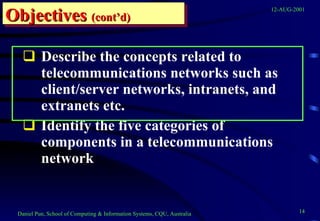
Describe the concepts related to telecommunications networks such as client/server networks, intranets, and extranets etc. Identify the five categories of components in a telecommunications network  Objectives   (cont’d)
Identify & describe different ways to configure a telecommunications network Discuss the concepts related to telecommunications protocols & architectures Describe the major trends in telecommunications Objectives   (cont’d)
Identify & give examples of several major ways that organisations are using the Internet for their business activities Identify & give examples of several ways that the Internet applications provide significant business value to an organisation & its customers Objectives   (cont’d)
Objectives Describe the concepts of telecommunications networks & their application Discuss the importance of telecommunications networks for an organisation
Communication  is the process of  sending and receiving verbal and nonverbal messages  between, at least, two entities.  Data Communications  is the process of  electronically sending and receiving data  from one place to another  over communication links between one or more computer systems  and a variety of input/output terminals. Telecommunications  is the  transmission of information in any form  (e.g., voice, data, text, image) from one place to another using electronic or light-emitting media.  Basic Definitions
A  Communications network  is any arrangement where a sender transmits a message to a receiver  over a medium . A  Telecommunications network  is any arrangement of  interconnected computers and peripheral devices  to process and exchange data and information.  Basic Definitions  (cont’d)
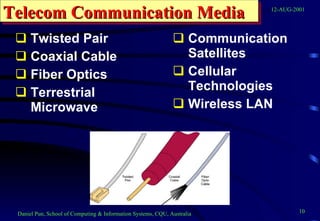
Twisted Pair Coaxial Cable Fiber Optics Terrestrial Microwave Communication Satellites Cellular Technologies Wireless LAN Telecom Communication Media
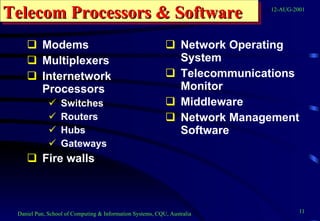
Modems Multiplexers Internetwork Processors Switches Routers Hubs Gateways Fire walls Network Operating System Telecommunications Monitor Middleware Network Management Software Telecom Processors & Software
Objectives  (cont’d) Describe the concepts of telecommunications networks & their application Discuss the importance of telecommunications networks for an organisation
Connectivity : allows exchange of data  &  information K eeps the various system elements  working together effectively and efficiently  by exchanging data and information A llows informed  decisions to be made B etter management of organisational resources and activities B etter decisions and higher productivity I mproved services to customers and clients I ncreased competitive advantages Importance of Telecom for Orgs.
Describe the concepts related to telecommunications networks such as client/server networks, intranets, and extranets etc. Identify the five categories of components in a telecommunications network  Objectives   (cont’d)
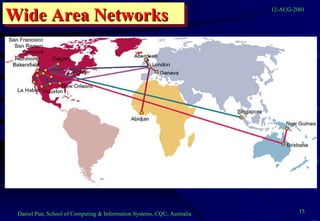
Wide Area Networks
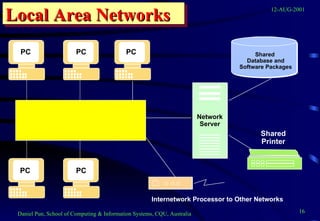
Local Area Networks Network Server Shared  Database and Software Packages Shared Printer PC PC PC PC PC Internetwork Processor to Other Networks
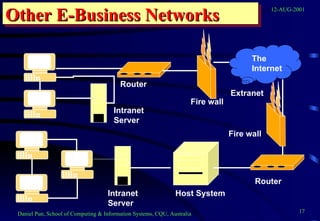
Other E-Business Networks Router Intranet Server Host System Intranet Server The Internet Fire wall Fire wall Router Extranet
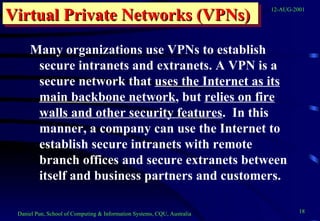
Virtual Private Networks (VPNs) Many organizations use VPNs to establish secure intranets and extranets. A VPN is a secure network that  uses the Internet as its main backbone network , but  relies on fire walls and other security features .  In this manner, a company can use the Internet to establish secure intranets with remote branch offices and secure extranets between itself and business partners and customers.
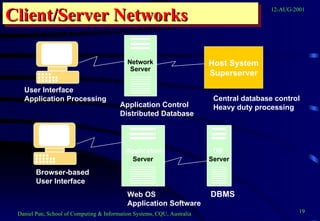
Client/Server Networks Network Server Host System Superserver Client User Interface Application Processing Application Control Distributed Database Central database control Heavy duty processing Server Server NetPC Browser-based User Interface Web OS Application Software Application DBMS DB
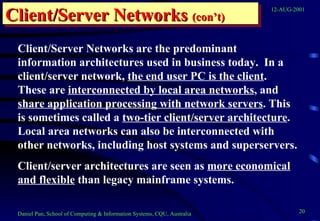
Client/Server Networks  (con’t) Client/Server Networks are the predominant information architectures used in business today.  In a client/server network,  the end user PC is the client .  These are  interconnected by local area networks , and  share application processing with network servers . This is sometimes called a  two-tier client/server architecture .  Local area networks can also be interconnected with other networks, including host systems and superservers. Client/server architectures are seen as  more economical and flexible  than legacy mainframe systems.
Describe the concepts related to telecommunications networks such as client/server networks, intranets, and extranets etc. Identify the five categories of components in a telecommunications network  Objectives   (cont’d)
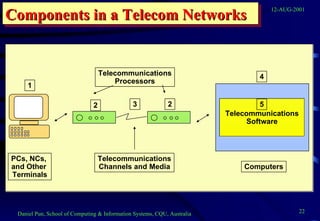
Components in a Telecom Networks Telecommunications Software 1 2 3 4 5 2 PCs, NCs,  and Other  Terminals Computers Telecommunications Channels and Media Telecommunications Processors
Components in a Telecom Networks  (cont’d) Like any communications model, a telecommunications network connects a sender to a receiver over a channel for sharing messages.  The basic components of a telecommunications network are: Terminals:   These are networked microcomputer workstations or video input/output stations that provide the sending and receiving endpoints for the network. Telecommunications Processors:   These are specialized hardware components that support data transmission and reception between terminals and computers.  Examples include modems, routers, and switches.
Components in a Telecom Networks  (cont’d) Telecommunications Channels and Media:   A channel connects two or more parties in a network.  Media are the particular way a channel is connected.  Telecommunications channels use combinations of media such as copper wires, coaxial cables, fiber optic cables, and microwave carriers to transmit information. Computers:   All sizes and types of computers can and are connected to telecommunications networks.  Typical arrangements include using a mainframe as a host for the network, a minicomputer as a front-end processor, with a dedicated microcomputer as a network server to a smaller local group of networked microcomputer workstations. Telecommunications Control Software:  Consists of programs that control telecommunications activities and manage the functions of telecommunications networks.  Examples include network operating systems, browsers and telecommunications monitors.
Identify & describe different ways to configure a telecommunications network Discuss the concepts related to telecommunications protocols & architectures Describe the major trends in telecommunications Objectives   (cont’d)
Network Topologies
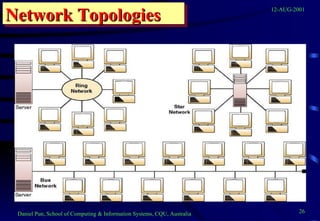
Network Topologies  (cont’d) There are three basic topologies used in telecommunications networks: Star Topologies:   Connect end user computers to a central computer.  Used for centralizing processing. Since the network is reliant on the performance of the central computer, this topology is less reliable than either ring or bus. If the central computer fails, the network fails. May be used in WANs and LANs. Ring Topologies:  Connect end user computers together in a ring on a more equal basis. It is more reliable and has no single point of failure. Used mostly in LANs. Bus Topologies:  Connect end user computers on a common channel.  Used commonly in business LANs.  It also has no single point of failure.  It is cheaper than ring networks, but sometimes less reliable.
Identify & describe different ways to configure a telecommunications network Discuss the concepts related to telecommunications protocols & architectures Describe the major trends in telecommunications Objectives   (cont’d)
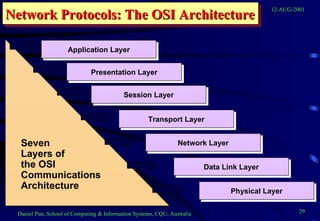
Network Protocols: The OSI Architecture Application Layer Presentation Layer Session Layer Transport Layer Network Layer Data Link Layer Physical Layer Seven Layers of the OSI Communications Architecture
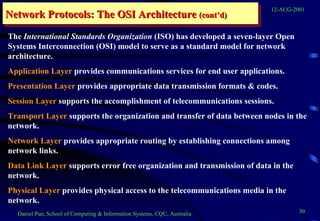
Network Protocols: The OSI Architecture  (cont’d) The  International Standards Organization  (ISO) has developed a seven-layer Open Systems Interconnection (OSI) model to serve as a standard model for network architecture. Application Layer  provides communications services for end user applications. Presentation Layer  provides appropriate data transmission formats & codes.  Session Layer  supports the accomplishment of telecommunications sessions. Transport Layer  supports the organization and transfer of data between nodes in the network. Network Layer  provides appropriate routing by establishing connections among network links. Data Link Layer  supports error free organization and transmission of data in the network. Physical Layer  provides physical access to the telecommunications media in the network.
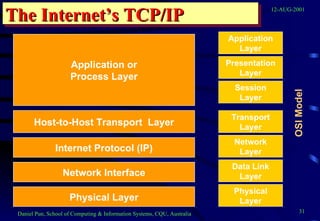
The Internet’s TCP/IP Application or Process Layer Internet Protocol (IP) Host-to-Host Transport  Layer Network Interface Physical Layer Application Layer Presentation Layer Session Layer Transport Layer Network Layer Data Link Layer Physical Layer OSI Model
Identify & describe different ways to configure a telecommunications network Discuss the concepts related to telecommunications protocols & architectures Describe the major trends in telecommunications Objectives   (cont’d)
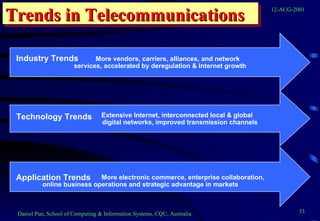
Trends in Telecommunications More electronic commerce, enterprise collaboration, online business operations and strategic advantage in markets  More vendors, carriers, alliances, and network  services, accelerated by deregulation & Internet growth  Extensive Internet, interconnected local & global digital networks, improved transmission channels Industry Trends Technology Trends Application Trends
Identify & give examples of several major ways that organisations are using the Internet for their business activities Identify & give examples of several ways that the Internet applications provide significant business value to an organisation & its customers Objectives   (cont’d)
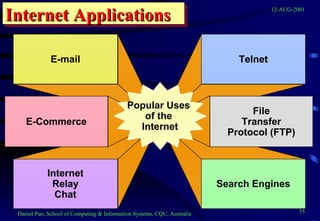
Popular Uses  of the  Internet Internet Applications E-mail Internet Relay Chat Telnet Search Engines E-Commerce File Transfer Protocol (FTP)
By 1995, over 1.5 million host networks on the Internet belonged to businesses.  Businesses on the Internet are there in part to take advantage of the easy, worldwide communications available  through E-mail and file transfer protocols (FTPs) .  But business is also on the Net to help shape the network as a channel for  conducting business transactions -- buying and selling goods and services in cyberspace to distant customers  linked by computers and modems.  Business uses of the Internet are rapidly developing in areas such as  electronic commerce . Business Use of the Internet
Identify & give examples of several major ways that organisations are using the Internet for their business activities Identify & give examples of several ways that the Internet applications provide significant business value to an organisation & its customers Objectives   (cont’d)
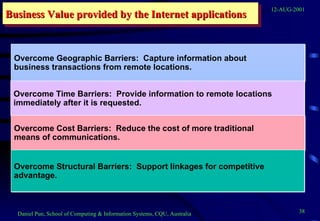
Business Value provided by the Internet applications Overcome Geographic Barriers:  Capture information about  business transactions from remote locations. Overcome Time Barriers:  Provide information to remote locations immediately after it is requested. Overcome Cost Barriers:  Reduce the cost of more traditional  means of communications. Overcome Structural Barriers:  Support linkages for competitive  advantage.
Organizations are becoming internetworked enterprises  that use the Internet, intranets, and other telecommunications networks to support E-Business. Telecommunications has entered a deregulated and fiercely competitive environment  with many vendors, carriers, and services A major trend is towards pervasive use of the Internet and its technologies  to build interconnected enterprise and global networks. Summary
The  major components of any telecom network  are:  Terminals, Telecommunications processors,  Communication channels,  Computers, and  Telecommunications software. There are several  basic types of telecomm networks , including wide area networks (WANs) and local area networks (LANs). Summary   (cont’d)
Key telecommunications network alternatives include telecommunications media, processors, software, channels, and architectures. Summary   (cont’d)
Information Systems for  Enterprise Collaboration   (Information Systems Applications) Next Week

IRM GROUP 2 CHAPTER 2

  • 1.
    Information Systems Overview(COIS 20024) Lecture : Week 5 Networks & Telecommunications (Information Systems Resources)
  • 2.
    Week 5: ResourcesStudy Guide Module 5 : Networks & Telecommunications Textbook Chapter 6 : Telecommunications & Networks Resource Materials Reading 5-1 & 5-2
  • 3.
    Objectives Describe theconcepts of telecommunications networks & their application Discuss the importance of telecommunications networks for an organisation
  • 4.
    Describe the conceptsrelated to telecommunications networks such as client/server networks, intranets, and extranets etc. Identify the five categories of components in a telecommunications network Objectives (cont’d)
  • 5.
    Identify & describedifferent ways to configure a telecommunications network Discuss the concepts related to telecommunications protocols & architectures Describe the major trends in telecommunications Objectives (cont’d)
  • 6.
    Identify & giveexamples of several major ways that organisations are using the Internet for their business activities Identify & give examples of several ways that the Internet applications provide significant business value to an organisation & its customers Objectives (cont’d)
  • 7.
    Objectives Describe theconcepts of telecommunications networks & their application Discuss the importance of telecommunications networks for an organisation
  • 8.
    Communication isthe process of sending and receiving verbal and nonverbal messages between, at least, two entities. Data Communications is the process of electronically sending and receiving data from one place to another over communication links between one or more computer systems and a variety of input/output terminals. Telecommunications is the transmission of information in any form (e.g., voice, data, text, image) from one place to another using electronic or light-emitting media. Basic Definitions
  • 9.
    A Communicationsnetwork is any arrangement where a sender transmits a message to a receiver over a medium . A Telecommunications network is any arrangement of interconnected computers and peripheral devices to process and exchange data and information. Basic Definitions (cont’d)
  • 10.
    Twisted Pair CoaxialCable Fiber Optics Terrestrial Microwave Communication Satellites Cellular Technologies Wireless LAN Telecom Communication Media
  • 11.
    Modems Multiplexers InternetworkProcessors Switches Routers Hubs Gateways Fire walls Network Operating System Telecommunications Monitor Middleware Network Management Software Telecom Processors & Software
  • 12.
    Objectives (cont’d)Describe the concepts of telecommunications networks & their application Discuss the importance of telecommunications networks for an organisation
  • 13.
    Connectivity : allowsexchange of data & information K eeps the various system elements working together effectively and efficiently by exchanging data and information A llows informed decisions to be made B etter management of organisational resources and activities B etter decisions and higher productivity I mproved services to customers and clients I ncreased competitive advantages Importance of Telecom for Orgs.
  • 14.
    Describe the conceptsrelated to telecommunications networks such as client/server networks, intranets, and extranets etc. Identify the five categories of components in a telecommunications network Objectives (cont’d)
  • 15.
  • 16.
    Local Area NetworksNetwork Server Shared Database and Software Packages Shared Printer PC PC PC PC PC Internetwork Processor to Other Networks
  • 17.
    Other E-Business NetworksRouter Intranet Server Host System Intranet Server The Internet Fire wall Fire wall Router Extranet
  • 18.
    Virtual Private Networks(VPNs) Many organizations use VPNs to establish secure intranets and extranets. A VPN is a secure network that uses the Internet as its main backbone network , but relies on fire walls and other security features . In this manner, a company can use the Internet to establish secure intranets with remote branch offices and secure extranets between itself and business partners and customers.
  • 19.
    Client/Server Networks NetworkServer Host System Superserver Client User Interface Application Processing Application Control Distributed Database Central database control Heavy duty processing Server Server NetPC Browser-based User Interface Web OS Application Software Application DBMS DB
  • 20.
    Client/Server Networks (con’t) Client/Server Networks are the predominant information architectures used in business today. In a client/server network, the end user PC is the client . These are interconnected by local area networks , and share application processing with network servers . This is sometimes called a two-tier client/server architecture . Local area networks can also be interconnected with other networks, including host systems and superservers. Client/server architectures are seen as more economical and flexible than legacy mainframe systems.
  • 21.
    Describe the conceptsrelated to telecommunications networks such as client/server networks, intranets, and extranets etc. Identify the five categories of components in a telecommunications network Objectives (cont’d)
  • 22.
    Components in aTelecom Networks Telecommunications Software 1 2 3 4 5 2 PCs, NCs, and Other Terminals Computers Telecommunications Channels and Media Telecommunications Processors
  • 23.
    Components in aTelecom Networks (cont’d) Like any communications model, a telecommunications network connects a sender to a receiver over a channel for sharing messages. The basic components of a telecommunications network are: Terminals: These are networked microcomputer workstations or video input/output stations that provide the sending and receiving endpoints for the network. Telecommunications Processors: These are specialized hardware components that support data transmission and reception between terminals and computers. Examples include modems, routers, and switches.
  • 24.
    Components in aTelecom Networks (cont’d) Telecommunications Channels and Media: A channel connects two or more parties in a network. Media are the particular way a channel is connected. Telecommunications channels use combinations of media such as copper wires, coaxial cables, fiber optic cables, and microwave carriers to transmit information. Computers: All sizes and types of computers can and are connected to telecommunications networks. Typical arrangements include using a mainframe as a host for the network, a minicomputer as a front-end processor, with a dedicated microcomputer as a network server to a smaller local group of networked microcomputer workstations. Telecommunications Control Software: Consists of programs that control telecommunications activities and manage the functions of telecommunications networks. Examples include network operating systems, browsers and telecommunications monitors.
  • 25.
    Identify & describedifferent ways to configure a telecommunications network Discuss the concepts related to telecommunications protocols & architectures Describe the major trends in telecommunications Objectives (cont’d)
  • 26.
  • 27.
    Network Topologies (cont’d) There are three basic topologies used in telecommunications networks: Star Topologies: Connect end user computers to a central computer. Used for centralizing processing. Since the network is reliant on the performance of the central computer, this topology is less reliable than either ring or bus. If the central computer fails, the network fails. May be used in WANs and LANs. Ring Topologies: Connect end user computers together in a ring on a more equal basis. It is more reliable and has no single point of failure. Used mostly in LANs. Bus Topologies: Connect end user computers on a common channel. Used commonly in business LANs. It also has no single point of failure. It is cheaper than ring networks, but sometimes less reliable.
  • 28.
    Identify & describedifferent ways to configure a telecommunications network Discuss the concepts related to telecommunications protocols & architectures Describe the major trends in telecommunications Objectives (cont’d)
  • 29.
    Network Protocols: TheOSI Architecture Application Layer Presentation Layer Session Layer Transport Layer Network Layer Data Link Layer Physical Layer Seven Layers of the OSI Communications Architecture
  • 30.
    Network Protocols: TheOSI Architecture (cont’d) The International Standards Organization (ISO) has developed a seven-layer Open Systems Interconnection (OSI) model to serve as a standard model for network architecture. Application Layer provides communications services for end user applications. Presentation Layer provides appropriate data transmission formats & codes. Session Layer supports the accomplishment of telecommunications sessions. Transport Layer supports the organization and transfer of data between nodes in the network. Network Layer provides appropriate routing by establishing connections among network links. Data Link Layer supports error free organization and transmission of data in the network. Physical Layer provides physical access to the telecommunications media in the network.
  • 31.
    The Internet’s TCP/IPApplication or Process Layer Internet Protocol (IP) Host-to-Host Transport Layer Network Interface Physical Layer Application Layer Presentation Layer Session Layer Transport Layer Network Layer Data Link Layer Physical Layer OSI Model
  • 32.
    Identify & describedifferent ways to configure a telecommunications network Discuss the concepts related to telecommunications protocols & architectures Describe the major trends in telecommunications Objectives (cont’d)
  • 33.
    Trends in TelecommunicationsMore electronic commerce, enterprise collaboration, online business operations and strategic advantage in markets More vendors, carriers, alliances, and network services, accelerated by deregulation & Internet growth Extensive Internet, interconnected local & global digital networks, improved transmission channels Industry Trends Technology Trends Application Trends
  • 34.
    Identify & giveexamples of several major ways that organisations are using the Internet for their business activities Identify & give examples of several ways that the Internet applications provide significant business value to an organisation & its customers Objectives (cont’d)
  • 35.
    Popular Uses of the Internet Internet Applications E-mail Internet Relay Chat Telnet Search Engines E-Commerce File Transfer Protocol (FTP)
  • 36.
    By 1995, over1.5 million host networks on the Internet belonged to businesses. Businesses on the Internet are there in part to take advantage of the easy, worldwide communications available through E-mail and file transfer protocols (FTPs) . But business is also on the Net to help shape the network as a channel for conducting business transactions -- buying and selling goods and services in cyberspace to distant customers linked by computers and modems. Business uses of the Internet are rapidly developing in areas such as electronic commerce . Business Use of the Internet
  • 37.
    Identify & giveexamples of several major ways that organisations are using the Internet for their business activities Identify & give examples of several ways that the Internet applications provide significant business value to an organisation & its customers Objectives (cont’d)
  • 38.
    Business Value providedby the Internet applications Overcome Geographic Barriers: Capture information about business transactions from remote locations. Overcome Time Barriers: Provide information to remote locations immediately after it is requested. Overcome Cost Barriers: Reduce the cost of more traditional means of communications. Overcome Structural Barriers: Support linkages for competitive advantage.
  • 39.
    Organizations are becominginternetworked enterprises that use the Internet, intranets, and other telecommunications networks to support E-Business. Telecommunications has entered a deregulated and fiercely competitive environment with many vendors, carriers, and services A major trend is towards pervasive use of the Internet and its technologies to build interconnected enterprise and global networks. Summary
  • 40.
    The majorcomponents of any telecom network are: Terminals, Telecommunications processors, Communication channels, Computers, and Telecommunications software. There are several basic types of telecomm networks , including wide area networks (WANs) and local area networks (LANs). Summary (cont’d)
  • 41.
    Key telecommunications networkalternatives include telecommunications media, processors, software, channels, and architectures. Summary (cont’d)
  • 42.
    Information Systems for Enterprise Collaboration (Information Systems Applications) Next Week