IPv6 Talal A. Alsubaie App. & DB Department Saudi FDA
Special Thanks… To  Saad A. Al-Maleki  for his assessment in this work.
Outlines IPv4 Addressing. Features of IPv6. IPv6 Addressing. Transition Mechanisms. Software Support. IPv6 Market Conclusion.
IPv4 Addressing INTERNET  is the world largest public network. ~320 million users in 2000 : ~550 million users by 2005 IPv4 defines a 32 bit, that will give us ( 4,294,967,296 ) IP addresses. The first problem is concerned with the eventual running out of the IP address space.
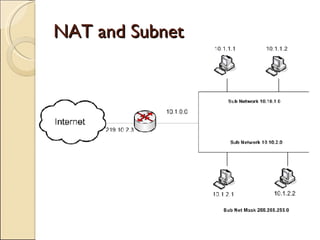
IPv4 Addressing (cont.) Techniques was used with address shortage in IPv4: Subnettin. Classless Inter Domain  Routing (CIDR) Network Address Translation (NAT)
NAT and Subnet
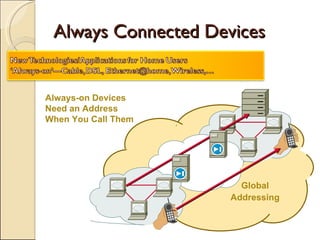
IPv4 Addressing (cont.) P2P applications. Need to reserve an IP address to each peer. Always-on devices. Mobile Phones, ADSL, and Intelligent Home ...ect.
Always Connected Devices Global Addressing Always-on Devices Need an Address When You Call Them
Features of IPv6 Large Address Space. 128 bit vs. 32 bit in IPv4. Stateless auto configuration of hosts. Plug and play. Multicast. It is part of IPv6, unlike IPv4 was introduced later.
Features of IPv6 Link-local addresses. Never change, unlike global address. Jumbograms. IPv4, packets are limited to 64 KB, Jumbograms can be as large as 4GB.  in high speed networks Network-layer security. IP Security is  built-in  IPv6, unlike IPv4  built-on . Mobility. Make IPv6 node to be mobile to change it’s location in an IPv6 network.  (May change IPv6 Address Dynamically).
Features of IPv6 Mobility Mobile Operators using 3GPP UMTS / Internet Multimedia Services (IMS) Nokia, Motorola and others making use of mobile IPv6 in their devices Ad-hoc networks – think police, fire and emergency services – push to talk requirements
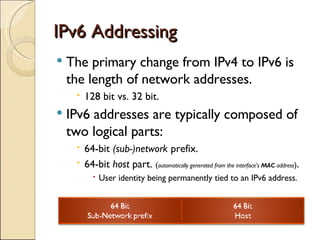
IPv6 Addressing The primary change from IPv4 to IPv6 is the length of network addresses. 128 bit vs. 32 bit. IPv6 addresses are typically composed of two logical parts: 64-bit  (sub-)network  prefix. 64-bit  host  part.  ( automatically generated from the interface's  MAC  address ) . User identity being permanently tied to an IPv6 address.
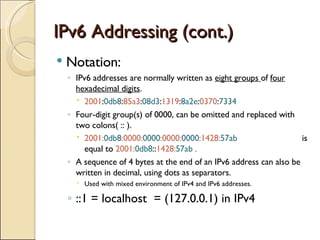
IPv6 Addressing (cont.) Notation: IPv6 addresses are normally written as  eight groups  of  four hexadecimal digits . 2001 : 0db8 : 85a3 : 08d3 : 1319 : 8a2e : 0370 : 7334   Four-digit group(s) of 0000, can be omitted and replaced with two colons( :: ).  2001: 0db8 :0000: 0000 :0000: 0000 :1428: 57ab   is equal to  2001: 0db8 :: 1428: 57ab . A sequence of 4 bytes at the end of an IPv6 address can also be written in decimal, using dots as separators.  Used with mixed environment of IPv4 and IPv6 addresses. ::1 = localhost  = (127.0.0.1) in IPv4
IPv6 Addressing (cont.) IPv6 addresses in URL: In a URL the IPv6-Address is enclosed in brackets. http://[2001:0db8:85a3:08d3:1319:8a2e:0370:7344]/  https://[2001:0db8:85a3:08d3:1319:8a2e:0370:7344]:443/  ‘ A’ record of DNS(IPv4) www.talals.net  A   203.178.141.212 ‘ Qaud A’ “AAAA” record of DNS(IPv6) www.talals.net  AAAA  3ffe:501:4819:2000:5254:ff:fedc:50d2
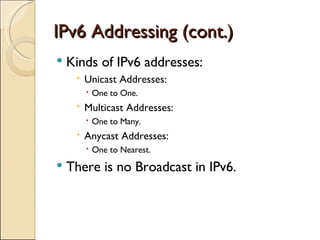
IPv6 Addressing (cont.) Kinds of IPv6 addresses: Unicast Addresses:  One to One. Multicast Addresses:  One to Many. Anycast Addresses: One to Nearest. There is no Broadcast in IPv6.
Transition Mechanisms Transition mechanisms are needed for IPv6 only host to reach IPv4 services. Dual stack. Tunneling. Translation.
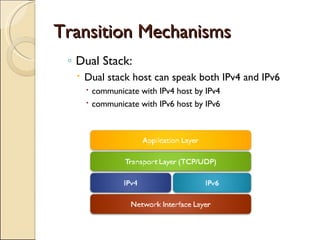
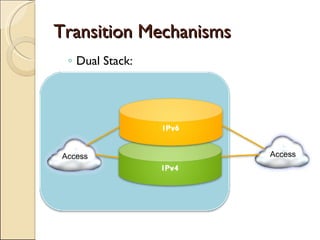
Transition Mechanisms Dual Stack: Dual stack host can speak both IPv4 and IPv6 communicate with IPv4 host by IPv4 communicate with IPv6 host by IPv6
Transition Mechanisms Dual Stack: Access Access
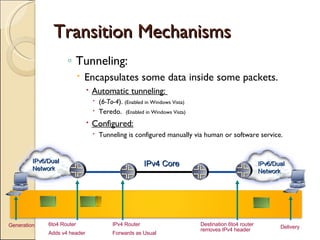
Transition Mechanisms Tunneling: Encapsulates some data inside some packets. Automatic tunneling:  ( 6-To-4 ).  (Enabled in Windows Vista) Teredo.  ( Enabled in  Windows Vista) Configured: Tunneling is configured manually via human or software service. IPv6/Dual Network 6to4 Router Adds v4 header IPv6/Dual Network IPv4 Core IPv4 Router Forwards as Usual Destination 6to4 router removes IPv4 header Delivery Generation
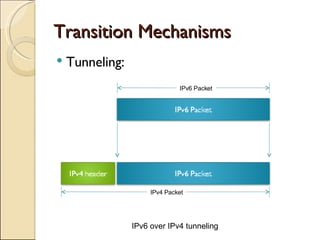
Transition Mechanisms Tunneling: IPv6 over IPv4 tunneling IPv4 Packet IPv6 Packet
Transition Mechanisms Translation: This is a simple extension to NAT techniques, to translate header format as well as addresses Translate IPv6 only host to IPv4 only host(vice versa) protocol translation mapping address Unreliable
Software Support Any modern O/S has IPv6 support Most common applications and tools have IPv6 support: Apache IIS FTP  Ping Telnet IE  Mozilla Firefox Opera Outlook  Windows Media Player and  more … Some applications need to be recompiled.
IPv6 Market Home Networking. Gaming. Mobile Devices. Enterprise PC’s. Consumer Devices. i.e. Sony. ISP. …
Conclusion IPv6 is NEW … –  built on the experiences learned from IPv4 –  new features –  large address space –  autoconfiguration …  and OLD –  still IP –  build on a solid base –  started in 1995, a lot of implementations and tests done
 

IPv6

  • 1.
    IPv6 Talal A.Alsubaie App. & DB Department Saudi FDA
  • 2.
    Special Thanks… To Saad A. Al-Maleki for his assessment in this work.
  • 3.
    Outlines IPv4 Addressing.Features of IPv6. IPv6 Addressing. Transition Mechanisms. Software Support. IPv6 Market Conclusion.
  • 4.
    IPv4 Addressing INTERNET is the world largest public network. ~320 million users in 2000 : ~550 million users by 2005 IPv4 defines a 32 bit, that will give us ( 4,294,967,296 ) IP addresses. The first problem is concerned with the eventual running out of the IP address space.
  • 5.
    IPv4 Addressing (cont.)Techniques was used with address shortage in IPv4: Subnettin. Classless Inter Domain Routing (CIDR) Network Address Translation (NAT)
  • 6.
  • 7.
    IPv4 Addressing (cont.)P2P applications. Need to reserve an IP address to each peer. Always-on devices. Mobile Phones, ADSL, and Intelligent Home ...ect.
  • 8.
    Always Connected DevicesGlobal Addressing Always-on Devices Need an Address When You Call Them
  • 9.
    Features of IPv6Large Address Space. 128 bit vs. 32 bit in IPv4. Stateless auto configuration of hosts. Plug and play. Multicast. It is part of IPv6, unlike IPv4 was introduced later.
  • 10.
    Features of IPv6Link-local addresses. Never change, unlike global address. Jumbograms. IPv4, packets are limited to 64 KB, Jumbograms can be as large as 4GB. in high speed networks Network-layer security. IP Security is built-in IPv6, unlike IPv4 built-on . Mobility. Make IPv6 node to be mobile to change it’s location in an IPv6 network. (May change IPv6 Address Dynamically).
  • 11.
    Features of IPv6Mobility Mobile Operators using 3GPP UMTS / Internet Multimedia Services (IMS) Nokia, Motorola and others making use of mobile IPv6 in their devices Ad-hoc networks – think police, fire and emergency services – push to talk requirements
  • 12.
    IPv6 Addressing Theprimary change from IPv4 to IPv6 is the length of network addresses. 128 bit vs. 32 bit. IPv6 addresses are typically composed of two logical parts: 64-bit (sub-)network prefix. 64-bit host part. ( automatically generated from the interface's MAC address ) . User identity being permanently tied to an IPv6 address.
  • 13.
    IPv6 Addressing (cont.)Notation: IPv6 addresses are normally written as eight groups of four hexadecimal digits . 2001 : 0db8 : 85a3 : 08d3 : 1319 : 8a2e : 0370 : 7334 Four-digit group(s) of 0000, can be omitted and replaced with two colons( :: ). 2001: 0db8 :0000: 0000 :0000: 0000 :1428: 57ab is equal to 2001: 0db8 :: 1428: 57ab . A sequence of 4 bytes at the end of an IPv6 address can also be written in decimal, using dots as separators. Used with mixed environment of IPv4 and IPv6 addresses. ::1 = localhost = (127.0.0.1) in IPv4
  • 14.
    IPv6 Addressing (cont.)IPv6 addresses in URL: In a URL the IPv6-Address is enclosed in brackets. http://[2001:0db8:85a3:08d3:1319:8a2e:0370:7344]/ https://[2001:0db8:85a3:08d3:1319:8a2e:0370:7344]:443/ ‘ A’ record of DNS(IPv4) www.talals.net A 203.178.141.212 ‘ Qaud A’ “AAAA” record of DNS(IPv6) www.talals.net AAAA 3ffe:501:4819:2000:5254:ff:fedc:50d2
  • 15.
    IPv6 Addressing (cont.)Kinds of IPv6 addresses: Unicast Addresses: One to One. Multicast Addresses: One to Many. Anycast Addresses: One to Nearest. There is no Broadcast in IPv6.
  • 16.
    Transition Mechanisms Transitionmechanisms are needed for IPv6 only host to reach IPv4 services. Dual stack. Tunneling. Translation.
  • 17.
    Transition Mechanisms DualStack: Dual stack host can speak both IPv4 and IPv6 communicate with IPv4 host by IPv4 communicate with IPv6 host by IPv6
  • 18.
    Transition Mechanisms DualStack: Access Access
  • 19.
    Transition Mechanisms Tunneling:Encapsulates some data inside some packets. Automatic tunneling: ( 6-To-4 ). (Enabled in Windows Vista) Teredo. ( Enabled in Windows Vista) Configured: Tunneling is configured manually via human or software service. IPv6/Dual Network 6to4 Router Adds v4 header IPv6/Dual Network IPv4 Core IPv4 Router Forwards as Usual Destination 6to4 router removes IPv4 header Delivery Generation
  • 20.
    Transition Mechanisms Tunneling:IPv6 over IPv4 tunneling IPv4 Packet IPv6 Packet
  • 21.
    Transition Mechanisms Translation:This is a simple extension to NAT techniques, to translate header format as well as addresses Translate IPv6 only host to IPv4 only host(vice versa) protocol translation mapping address Unreliable
  • 22.
    Software Support Anymodern O/S has IPv6 support Most common applications and tools have IPv6 support: Apache IIS FTP Ping Telnet IE Mozilla Firefox Opera Outlook Windows Media Player and more … Some applications need to be recompiled.
  • 23.
    IPv6 Market HomeNetworking. Gaming. Mobile Devices. Enterprise PC’s. Consumer Devices. i.e. Sony. ISP. …
  • 24.
    Conclusion IPv6 isNEW … – built on the experiences learned from IPv4 – new features – large address space – autoconfiguration … and OLD – still IP – build on a solid base – started in 1995, a lot of implementations and tests done
  • 25.