Drugs that accelerate the rate of urine formation. Result:  removal of sodium and water
Where sodium goes, water follows. 20 to 25% of all sodium is reabsorbed  into the bloodstream in the loop of Henle,  5 to 10% in the distal tubules, and 3%  in collecting ducts. If it is not absorbed, it is excreted with  the urine.
Carbonic anhydrase inhibitors Loop diuretics Osmotic diuretics Potassium-sparing diuretics Thiazide and thiazide-like diuretics
(CAIs) acetazolamide (Diamox) methazolamide dichlorphenamide
The enzyme carbonic anhydrase helps to make  H+ ions available for exchange with sodium and water in the proximal tubules. CAIs block the action of carbonic anhydrase, thus preventing the exchange of H+ ions with sodium  and water.
Inhibition of carbonic anhydrase reduces H+ ion concentration in renal tubules. As a result, there is increased excretion of  bicarbonate, sodium, water, and potassium. Resorption of water is decreased and urine  volume is increased.
Adjunct agents in the long-term management  of open-angle glaucoma Used with miotics to lower intraocular pressure before ocular surgery in certain cases Also useful in the treatment of: Glaucoma Edema Epilepsy High-altitude sickness
Acetazolamide is used in the management of  edema secondary to CHF when other diuretics  are not effective. CAIs are less potent diuretics than loop diuretics  or thiazides—the metabolic acidosis they induce reduces their diuretic effect in 2 to 4 days.
Metabolic acidosis Drowsiness Anorexia Paresthesias Hematuria Urticaria Photosensitivity Melena
bumetanide (Bumex) ethacrynic acid (Edecrin) furosemide (Lasix)
Act directly on the ascending limb of the  loop of Henle to inhibit sodium and chloride resorption. Increase renal prostaglandins, resulting in the dilation of blood vessels and reduced peripheral vascular resistance.
Potent diuresis and subsequent loss of fluid Decreased fluid volume causes: Reduced BP Reduced pulmonary vascular resistance Reduced systemic vascular resistance Reduced central venous pressure Reduced left ventricular end-diastolic pressure Potassium depletion
Edema associated with CHF or hepatic  or renal disease Control of hypertension
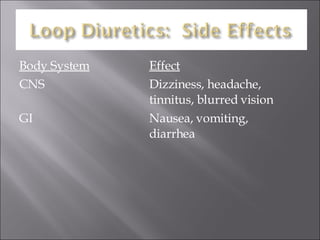
Body System Effect CNS Dizziness, headache,  tinnitus, blurred vision GI Nausea, vomiting,  diarrhea
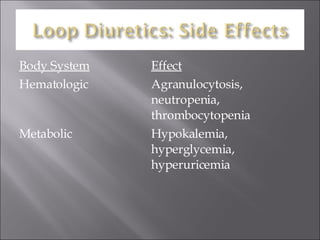
Body System Effect Hematologic Agranulocytosis,  neutropenia,  thrombocytopenia Metabolic Hypokalemia,  hyperglycemia, hyperuricemia
mannitol (Resectisol, Osmitrol)
Work in the proximal tubule Nonabsorbable, producing an osmotic effect Pull water into the blood vessels and nephrons from the surrounding tissues
Reduced cellular edema Increased urine production, causing diuresis Rapid excretion of water, sodium, and other electrolytes, as well as excretion of toxic substances from the kidney Reduces excessive intraocular pressure
Used in the treatment of patients in the early, oliguric phase of ARF To promote the excretion of toxic substances Reduction of intracranial pressure Treatment of cerebral edema
Convulsions Thrombophlebitis Pulmonary congestion   Also headaches, chest pains, tachycardia, blurred vision, chills, and fever
amiloride (Midamor) spironolactone (Aldactone) triamterene (Dyrenium)
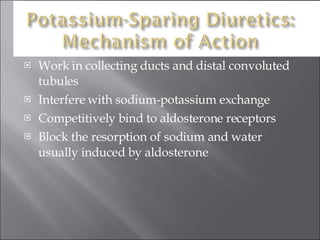
Work in collecting ducts and distal convoluted tubules Interfere with sodium-potassium exchange Competitively bind to aldosterone receptors Block the resorption of sodium and water usually induced by aldosterone
Prevent potassium from being pumped into the tubule, thus preventing its secretion Competitively block the aldosterone receptors and inhibit its action The excretion of sodium and water  is promoted
spironolactone and triamterene Hyperaldosteronism Hypertension Reversing the potassium loss caused by  potassium-losing drugs amiloride Treatment of CHF
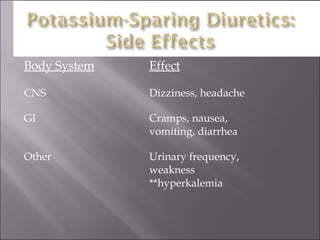
Body System Effect CNS Dizziness, headache GI Cramps, nausea,  vomiting, diarrhea Other Urinary frequency, weakness **hyperkalemia
spironolactone gynecomastia, amenorrhea, irregular menses
hydrochlorothiazide (Esidrix, HydroDIURIL) chlorothiazide (Diuril) trichlormethiazide (Metahydrin) Thiazide-like chlorthalidone (Hygroton) metolazone (Mykrox, Zaroxolyn)
Inhibit tubular resorption of sodium and chloride ions Action primarily in the ascending loop of Henle and early distal tubule Result:  water, sodium, and chloride are excreted Potassium is also excreted to a lesser extent Dilate the arterioles by direct relaxation
Lowered peripheral vascular resistance Depletion of sodium and water
Hypertension  (one of the most prescribed group of agents for this) Edematous states Idiopathic hypercalciuria Diabetes insipidus Adjunct agents in treatment of CHF, hepatic cirrhosis
Body System Effect CNS Dizziness, headache,  blurred vision, paresthesias, decreased libido GI Anorexia, nausea, vomiting, diarrhea
Body System Effect GU Impotence Integumentary Urticaria, photosensitivity Metabolic Hypokalemia, glycosuria, hyperglycemia
Perform a thorough patient history and physical examination. Assess baseline fluid volume status, intake and output, serum electrolyte values, weight, and vital signs. Assess for disorders that may contraindicate the use of, or necessitate cautious use of, these agents.
Instruct patients to take in the morning as much as possible to avoid interference with sleep patterns. Monitor serum potassium levels during therapy. Potassium supplements are usually not recommended when potassium levels exceed  3.0 mEq/L.
Teach patients to maintain proper nutritional and fluid volume status. Teach patients to eat more potassium-rich foods when taking any but the potassium-sparing agents. Foods high in potassium include bananas, oranges, dates, raisins, plums, fresh vegetables, potatoes, meat, and fish.
Patients taking diuretics along with a digitalis preparation should be taught to monitor for  digitalis toxicity. Diabetic patients who are taking thiazide and/or  loop diuretics should be told to monitor blood glucose and watch for elevated levels.
Teach patients to change positions slowly, and to rise slowly after sitting or lying to prevent dizziness and possible fainting related to orthostatic hypotension. Encourage patients to keep a log of their  daily weight. Encourage patients to return for follow-up visits  and lab work.
Patients who have been ill with nausea, vomiting, and/or diarrhea should notify their physician as fluid loss may be dangerous. Signs and symptoms of hypokalemia include muscle weakness, constipation, irregular pulse rate, and overall feeling of lethargy.
Instruct patients to notify the physician immediately if they experience rapid heart rates or syncope (reflects hypotension or fluid loss). A weight gain of 2 or more pounds a day  or 5 or more pounds a week should be  reported immediately.
Monitor for adverse effects: metabolic alkalosis, drowsiness, lethargy, hypokalemia, tachycardia, hypotension, leg  cramps, restlessness, decreased mental alertness
Monitor for therapeutic effects: Reduction in edema, fluid volume overload, CHF  Reduction of hypertension Return to normal intraocular pressures

09 Diuretics Upd

  • 1.
  • 2.
    Drugs that acceleratethe rate of urine formation. Result: removal of sodium and water
  • 3.
    Where sodium goes,water follows. 20 to 25% of all sodium is reabsorbed into the bloodstream in the loop of Henle, 5 to 10% in the distal tubules, and 3% in collecting ducts. If it is not absorbed, it is excreted with the urine.
  • 4.
    Carbonic anhydrase inhibitorsLoop diuretics Osmotic diuretics Potassium-sparing diuretics Thiazide and thiazide-like diuretics
  • 5.
    (CAIs) acetazolamide (Diamox)methazolamide dichlorphenamide
  • 6.
    The enzyme carbonicanhydrase helps to make H+ ions available for exchange with sodium and water in the proximal tubules. CAIs block the action of carbonic anhydrase, thus preventing the exchange of H+ ions with sodium and water.
  • 7.
    Inhibition of carbonicanhydrase reduces H+ ion concentration in renal tubules. As a result, there is increased excretion of bicarbonate, sodium, water, and potassium. Resorption of water is decreased and urine volume is increased.
  • 8.
    Adjunct agents inthe long-term management of open-angle glaucoma Used with miotics to lower intraocular pressure before ocular surgery in certain cases Also useful in the treatment of: Glaucoma Edema Epilepsy High-altitude sickness
  • 9.
    Acetazolamide is usedin the management of edema secondary to CHF when other diuretics are not effective. CAIs are less potent diuretics than loop diuretics or thiazides—the metabolic acidosis they induce reduces their diuretic effect in 2 to 4 days.
  • 10.
    Metabolic acidosis DrowsinessAnorexia Paresthesias Hematuria Urticaria Photosensitivity Melena
  • 11.
    bumetanide (Bumex) ethacrynicacid (Edecrin) furosemide (Lasix)
  • 12.
    Act directly onthe ascending limb of the loop of Henle to inhibit sodium and chloride resorption. Increase renal prostaglandins, resulting in the dilation of blood vessels and reduced peripheral vascular resistance.
  • 13.
    Potent diuresis andsubsequent loss of fluid Decreased fluid volume causes: Reduced BP Reduced pulmonary vascular resistance Reduced systemic vascular resistance Reduced central venous pressure Reduced left ventricular end-diastolic pressure Potassium depletion
  • 14.
    Edema associated withCHF or hepatic or renal disease Control of hypertension
  • 15.
    Body System EffectCNS Dizziness, headache, tinnitus, blurred vision GI Nausea, vomiting, diarrhea
  • 16.
    Body System EffectHematologic Agranulocytosis, neutropenia, thrombocytopenia Metabolic Hypokalemia, hyperglycemia, hyperuricemia
  • 17.
  • 18.
    Work in theproximal tubule Nonabsorbable, producing an osmotic effect Pull water into the blood vessels and nephrons from the surrounding tissues
  • 19.
    Reduced cellular edemaIncreased urine production, causing diuresis Rapid excretion of water, sodium, and other electrolytes, as well as excretion of toxic substances from the kidney Reduces excessive intraocular pressure
  • 20.
    Used in thetreatment of patients in the early, oliguric phase of ARF To promote the excretion of toxic substances Reduction of intracranial pressure Treatment of cerebral edema
  • 21.
    Convulsions Thrombophlebitis Pulmonarycongestion Also headaches, chest pains, tachycardia, blurred vision, chills, and fever
  • 22.
    amiloride (Midamor) spironolactone(Aldactone) triamterene (Dyrenium)
  • 23.
    Work in collectingducts and distal convoluted tubules Interfere with sodium-potassium exchange Competitively bind to aldosterone receptors Block the resorption of sodium and water usually induced by aldosterone
  • 24.
    Prevent potassium frombeing pumped into the tubule, thus preventing its secretion Competitively block the aldosterone receptors and inhibit its action The excretion of sodium and water is promoted
  • 25.
    spironolactone and triamtereneHyperaldosteronism Hypertension Reversing the potassium loss caused by potassium-losing drugs amiloride Treatment of CHF
  • 26.
    Body System EffectCNS Dizziness, headache GI Cramps, nausea, vomiting, diarrhea Other Urinary frequency, weakness **hyperkalemia
  • 27.
  • 28.
    hydrochlorothiazide (Esidrix, HydroDIURIL)chlorothiazide (Diuril) trichlormethiazide (Metahydrin) Thiazide-like chlorthalidone (Hygroton) metolazone (Mykrox, Zaroxolyn)
  • 29.
    Inhibit tubular resorptionof sodium and chloride ions Action primarily in the ascending loop of Henle and early distal tubule Result: water, sodium, and chloride are excreted Potassium is also excreted to a lesser extent Dilate the arterioles by direct relaxation
  • 30.
    Lowered peripheral vascularresistance Depletion of sodium and water
  • 31.
    Hypertension (oneof the most prescribed group of agents for this) Edematous states Idiopathic hypercalciuria Diabetes insipidus Adjunct agents in treatment of CHF, hepatic cirrhosis
  • 32.
    Body System EffectCNS Dizziness, headache, blurred vision, paresthesias, decreased libido GI Anorexia, nausea, vomiting, diarrhea
  • 33.
    Body System EffectGU Impotence Integumentary Urticaria, photosensitivity Metabolic Hypokalemia, glycosuria, hyperglycemia
  • 34.
    Perform a thoroughpatient history and physical examination. Assess baseline fluid volume status, intake and output, serum electrolyte values, weight, and vital signs. Assess for disorders that may contraindicate the use of, or necessitate cautious use of, these agents.
  • 35.
    Instruct patients totake in the morning as much as possible to avoid interference with sleep patterns. Monitor serum potassium levels during therapy. Potassium supplements are usually not recommended when potassium levels exceed 3.0 mEq/L.
  • 36.
    Teach patients tomaintain proper nutritional and fluid volume status. Teach patients to eat more potassium-rich foods when taking any but the potassium-sparing agents. Foods high in potassium include bananas, oranges, dates, raisins, plums, fresh vegetables, potatoes, meat, and fish.
  • 37.
    Patients taking diureticsalong with a digitalis preparation should be taught to monitor for digitalis toxicity. Diabetic patients who are taking thiazide and/or loop diuretics should be told to monitor blood glucose and watch for elevated levels.
  • 38.
    Teach patients tochange positions slowly, and to rise slowly after sitting or lying to prevent dizziness and possible fainting related to orthostatic hypotension. Encourage patients to keep a log of their daily weight. Encourage patients to return for follow-up visits and lab work.


  • 39.
    Patients who havebeen ill with nausea, vomiting, and/or diarrhea should notify their physician as fluid loss may be dangerous. Signs and symptoms of hypokalemia include muscle weakness, constipation, irregular pulse rate, and overall feeling of lethargy.
  • 40.
    Instruct patients tonotify the physician immediately if they experience rapid heart rates or syncope (reflects hypotension or fluid loss). A weight gain of 2 or more pounds a day or 5 or more pounds a week should be reported immediately.
  • 41.
    Monitor for adverseeffects: metabolic alkalosis, drowsiness, lethargy, hypokalemia, tachycardia, hypotension, leg cramps, restlessness, decreased mental alertness
  • 42.
    Monitor for therapeuticeffects: Reduction in edema, fluid volume overload, CHF Reduction of hypertension Return to normal intraocular pressures