Sujit Karpe
Principal
Sojar college of Pharmacy, Khandvi
Diuretics
Outline
1. Sites of drug action
2. Osmotic diuretics
3. Carbonic anhydrase inhibitors
4. Thiazide diuretics
5. Loop diuretics
6. Potassium-sparing diuretics
Definitions
Diuretic: Substance that
promotes the excretion of urine
•caffeine, nettles, cranberry
juice, alcohol
•Natriuretic: substance that
promotes the renal excretion of
Na+
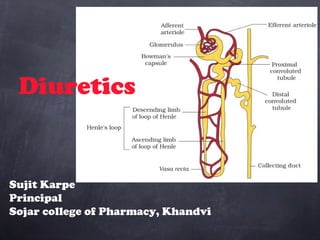
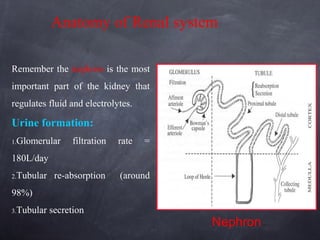
Anatomy of Renal system
Remember the nephron is the most
important part of the kidney that
regulates fluid and electrolytes.
Urine formation:
1.Glomerular filtration rate =
180L/day
2.Tubular re-absorption (around
98%)
3.Tubular secretion
Nephron
• How could urine output be increased ?
↑ Glomerular filtration Vs ↓ Tubular reabsorption (the most
important clinically)
o If you increase the glomerular filtriation  increase tubular
reabsorption (so you cant use glomerular filtiration)
• Purpose of Using Diuretics
1. To maintain urine volume ( e.g.: renal failure)
2. To mobilize edema fluid (e.g.: heart failure,liver failure,
nephrotic syndrome)
3. To control high blood pressure.
Renal Physiology
Summary: Sites of Action
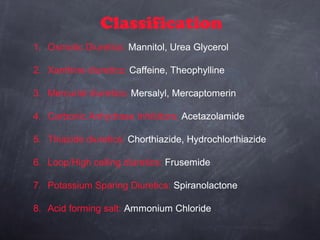
Classification
1. Osmotic Diuretics: Mannitol, Urea Glycerol
2. Xanthine diuretics: Caffeine, Theophylline
3. Mercurial diuretics: Mersalyl, Mercaptomerin
4. Carbonic Anhydrase Inhibitors: Acetazolamide
5. Thiazide diuretics: Chorthiazide, Hydrochlorthiazide
6. Loop/High ceiling diuretics: Frusemide
7. Potassium Sparing Diuretics: Spiranolactone
8. Acid forming salt: Ammonium Chloride
Osmotic Diuretics
Pharmacologically inert, nonmetabolisable.
Freely filtered by Glomerulus.
do not interact with receptors or directly block renal
transport
activity dependent on development of osmotic pressure
Mannitol (prototype)
Urea
Glycerol
Isosorbide
Mechanism of Action
osmotic diuretics are not reabsorbed
increases osmotic pressure specifically in the
proximal tubule and loop of Henle
prevents passive reabsorption of H2O
osmotic force solute in lumen > osmotic force of
reabsorbed Na+
increased H2O and Na+ excretion
Therapeutic Uses
Mannitol
drug of choice: non-toxic, freely filtered, non-reabsorbable
and non-metabolized
administered prophylatically for acute renal failure
secondary to trauma, CVS disease, surgery or nephrotoxic
drugs
short-term treatment of acute glaucoma
infused to lower intracranial pressure
Urea, glycerol and isosorbide are less efficient
can penetrate cell membranes
Side Effects
increased extracellular fluid volume
cardiac failure
pulmonary edema
hypernatremia
hyperkalemia secondary to diabetes or
impaired renal function
headache, nausea, vomiting
Xanthine diuretics
Act by increasing renal Blood flow as well as by
inhibiting tubular reabsorption of Sodium.
This produces net loss of water and electrolytes
diuretic action is not much affected by changes in acid
base balance.
Theophylline is most effective.
Carbonic Anhydrase Inhibitors
Limited uses as diuretics
Acetazolamide
•prototype carbonic anhydrase inhibitor
•developed from sulfanilamide (caused metabolic
acidosis and alkaline urine)
Mechanism of Action
inhibits carbonic anhydrase in renal proximal tubule cells
carbonic anhydrase catalyzes formation of HCO3- and H+ from
H2O and CO2
inhibition of carbonic anhydrase decreases [H+] in tubule lumen
less H+ for Na+/H+
exchange
increased lumen Na+,
increased H2O
retention
Site I
Therapeutic Uses
used to treat chronic open-angle glaucoma
aqueous humor has high [HCO3-]
acute mountain sickness
prevention and treatment
metabolic alkalosis
sometimes epilepsy
mostly used in combination with other diuretics in
resistant patients
Side Effects
rapid tolerance
increased HCO3- excretion causes metabolic
acidosis
drowsiness
fatigue
CNS depression
paresthesia (pins and needles under skin)
nephrolithiasis (renal stones)
K+ wasting
Thiazide Diuretics
active in distal convoluted tubule
Chlorothiazide (prototype)
Hydrochlorothiazide
Chlorthalidone
Metolazone
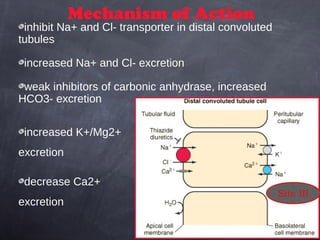
Mechanism of Action
inhibit Na+ and Cl- transporter in distal convoluted
tubules
increased Na+ and Cl- excretion
weak inhibitors of carbonic anhydrase, increased
HCO3- excretion
increased K+/Mg2+
excretion
decrease Ca2+
excretion
Site III
Pharmacokinetics
orally administered
poor absorption
onset of action in ~ 1 hour
wide range of T 1/2 amongst different thiazides, longer
then loop diuretics
free drug enters tubules by filtration and by organic acid
secretion
Therapeutic Uses
hypertension
congestive heart failure
hypercalciuria: prevent excess Ca2+ excretion to form
stones in ducts
osteoperosis
nephrogenic diabetes insipidus
treatment of Li+ toxicity
Side Effects
hypokalemia
increased Na+ exchange in CCD
volume-contraction induced aldosterone release
hyponatremia
hyperglycemia
diminished insulin secretion
elevated plasma lipids
hyperuricemia
hypercalcemia
Loop Diuretics
active in “loop” of Henle
Furosemide (prototype)
Bumetanide
Torsemide
Ethacrynic acid
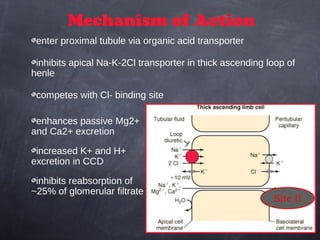
Mechanism of Action
enter proximal tubule via organic acid transporter
inhibits apical Na-K-2Cl transporter in thick ascending loop of
henle
competes with Cl- binding site
enhances passive Mg2+
and Ca2+ excretion
increased K+ and H+
excretion in CCD
inhibits reabsorption of
~25% of glomerular filtrate
Site II
Pharmacokinetics
orally administered, rapid absorption
rapid onset of action
bound to plasma proteins: displaced by warfarin, and
clofibrate
increase toxicity of cephalosporin antibiotics and lithium
additive toxicity with other ototoxic drugs (Drug Interaction)
inhibitors of organic acid ion transport decrease potency
(i.e. probenecid, NSAID’s) (Drug Interaction)
Therapeutic Uses
edema: cardiac, pulmonary or renal
chronic renal failure or nephrosis
hypertension
hypercalcemia
acute and chronic hyperkalemia
Side Effects
hypokalemia
hyperuricemia
metabolic alkalosis
hyponatremia
ototoxicity
Mg2+ depletion
K+ sparing diuretics
three groups
steroid aldosterone antagonists
spironolactone, eplerenone
Pteridines
triamterene
Pyrazinoylguanidines
amiloride
Mechanism of Action
K+ sparing diuretics function in CCD
decrease Na+ transport in collecting tubule
Triamterene/Amiloride
organic bases
secreted into lumen by
proximal tubule cells
inhibit apical Na+
channel
Spironolactone
competitive antagonist for mineralocorticoid receptor
prevents aldosterone stimulated increases in Na+
transporter expression
Site IV
Pharmacokinetics
Spironolactone
orally administered
aldactazide: spironolactone/thiazide combo
Amiloride
•oral administration, 50% effective
•not metabolized
•not bound to plasma proteins
•Triamterine
•oral administration, 50% effective
•60% bound to plasma proteins
•liver metabolism, active metabolites
Therapeutic Uses
primary hyperaldosteronism (adrenal adenoma,
bilateral adrenal hyperplasia)
congestive heart failure
cirrhosis
nephrotic syndrome
in conjunction with K+ wasting diuretics
Side Effects
hyperkalemia: monitor plasma [K+]
spironolactone: gynecomastia
triamterene: megaloblastic anemia in cirrhosis
patients
amiloride: increase in blood urea nitrogen, glucose
intolerance in diabetes mellitus

Diuretics

  • 1.
    Sujit Karpe Principal Sojar collegeof Pharmacy, Khandvi Diuretics
  • 3.
    Outline 1. Sites ofdrug action 2. Osmotic diuretics 3. Carbonic anhydrase inhibitors 4. Thiazide diuretics 5. Loop diuretics 6. Potassium-sparing diuretics
  • 4.
    Definitions Diuretic: Substance that promotesthe excretion of urine •caffeine, nettles, cranberry juice, alcohol •Natriuretic: substance that promotes the renal excretion of Na+
  • 5.
    Anatomy of Renalsystem Remember the nephron is the most important part of the kidney that regulates fluid and electrolytes. Urine formation: 1.Glomerular filtration rate = 180L/day 2.Tubular re-absorption (around 98%) 3.Tubular secretion Nephron
  • 6.
    • How couldurine output be increased ? ↑ Glomerular filtration Vs ↓ Tubular reabsorption (the most important clinically) o If you increase the glomerular filtriation  increase tubular reabsorption (so you cant use glomerular filtiration) • Purpose of Using Diuretics 1. To maintain urine volume ( e.g.: renal failure) 2. To mobilize edema fluid (e.g.: heart failure,liver failure, nephrotic syndrome) 3. To control high blood pressure.
  • 7.
  • 8.
  • 9.
    Classification 1. Osmotic Diuretics:Mannitol, Urea Glycerol 2. Xanthine diuretics: Caffeine, Theophylline 3. Mercurial diuretics: Mersalyl, Mercaptomerin 4. Carbonic Anhydrase Inhibitors: Acetazolamide 5. Thiazide diuretics: Chorthiazide, Hydrochlorthiazide 6. Loop/High ceiling diuretics: Frusemide 7. Potassium Sparing Diuretics: Spiranolactone 8. Acid forming salt: Ammonium Chloride
  • 10.
    Osmotic Diuretics Pharmacologically inert,nonmetabolisable. Freely filtered by Glomerulus. do not interact with receptors or directly block renal transport activity dependent on development of osmotic pressure Mannitol (prototype) Urea Glycerol Isosorbide
  • 11.
    Mechanism of Action osmoticdiuretics are not reabsorbed increases osmotic pressure specifically in the proximal tubule and loop of Henle prevents passive reabsorption of H2O osmotic force solute in lumen > osmotic force of reabsorbed Na+ increased H2O and Na+ excretion
  • 12.
    Therapeutic Uses Mannitol drug ofchoice: non-toxic, freely filtered, non-reabsorbable and non-metabolized administered prophylatically for acute renal failure secondary to trauma, CVS disease, surgery or nephrotoxic drugs short-term treatment of acute glaucoma infused to lower intracranial pressure Urea, glycerol and isosorbide are less efficient can penetrate cell membranes
  • 13.
    Side Effects increased extracellularfluid volume cardiac failure pulmonary edema hypernatremia hyperkalemia secondary to diabetes or impaired renal function headache, nausea, vomiting
  • 14.
    Xanthine diuretics Act byincreasing renal Blood flow as well as by inhibiting tubular reabsorption of Sodium. This produces net loss of water and electrolytes diuretic action is not much affected by changes in acid base balance. Theophylline is most effective.
  • 15.
    Carbonic Anhydrase Inhibitors Limiteduses as diuretics Acetazolamide •prototype carbonic anhydrase inhibitor •developed from sulfanilamide (caused metabolic acidosis and alkaline urine)
  • 16.
    Mechanism of Action inhibitscarbonic anhydrase in renal proximal tubule cells carbonic anhydrase catalyzes formation of HCO3- and H+ from H2O and CO2 inhibition of carbonic anhydrase decreases [H+] in tubule lumen less H+ for Na+/H+ exchange increased lumen Na+, increased H2O retention Site I
  • 17.
    Therapeutic Uses used totreat chronic open-angle glaucoma aqueous humor has high [HCO3-] acute mountain sickness prevention and treatment metabolic alkalosis sometimes epilepsy mostly used in combination with other diuretics in resistant patients
  • 18.
    Side Effects rapid tolerance increasedHCO3- excretion causes metabolic acidosis drowsiness fatigue CNS depression paresthesia (pins and needles under skin) nephrolithiasis (renal stones) K+ wasting
  • 19.
    Thiazide Diuretics active indistal convoluted tubule Chlorothiazide (prototype) Hydrochlorothiazide Chlorthalidone Metolazone
  • 20.
    Mechanism of Action inhibitNa+ and Cl- transporter in distal convoluted tubules increased Na+ and Cl- excretion weak inhibitors of carbonic anhydrase, increased HCO3- excretion increased K+/Mg2+ excretion decrease Ca2+ excretion Site III
  • 21.
    Pharmacokinetics orally administered poor absorption onsetof action in ~ 1 hour wide range of T 1/2 amongst different thiazides, longer then loop diuretics free drug enters tubules by filtration and by organic acid secretion
  • 22.
    Therapeutic Uses hypertension congestive heartfailure hypercalciuria: prevent excess Ca2+ excretion to form stones in ducts osteoperosis nephrogenic diabetes insipidus treatment of Li+ toxicity
  • 23.
    Side Effects hypokalemia increased Na+exchange in CCD volume-contraction induced aldosterone release hyponatremia hyperglycemia diminished insulin secretion elevated plasma lipids hyperuricemia hypercalcemia
  • 24.
    Loop Diuretics active in“loop” of Henle Furosemide (prototype) Bumetanide Torsemide Ethacrynic acid
  • 25.
    Mechanism of Action enterproximal tubule via organic acid transporter inhibits apical Na-K-2Cl transporter in thick ascending loop of henle competes with Cl- binding site enhances passive Mg2+ and Ca2+ excretion increased K+ and H+ excretion in CCD inhibits reabsorption of ~25% of glomerular filtrate Site II
  • 26.
    Pharmacokinetics orally administered, rapidabsorption rapid onset of action bound to plasma proteins: displaced by warfarin, and clofibrate increase toxicity of cephalosporin antibiotics and lithium additive toxicity with other ototoxic drugs (Drug Interaction) inhibitors of organic acid ion transport decrease potency (i.e. probenecid, NSAID’s) (Drug Interaction)
  • 27.
    Therapeutic Uses edema: cardiac,pulmonary or renal chronic renal failure or nephrosis hypertension hypercalcemia acute and chronic hyperkalemia
  • 28.
  • 29.
    K+ sparing diuretics threegroups steroid aldosterone antagonists spironolactone, eplerenone Pteridines triamterene Pyrazinoylguanidines amiloride
  • 30.
    Mechanism of Action K+sparing diuretics function in CCD decrease Na+ transport in collecting tubule Triamterene/Amiloride organic bases secreted into lumen by proximal tubule cells inhibit apical Na+ channel Spironolactone competitive antagonist for mineralocorticoid receptor prevents aldosterone stimulated increases in Na+ transporter expression Site IV
  • 31.
    Pharmacokinetics Spironolactone orally administered aldactazide: spironolactone/thiazidecombo Amiloride •oral administration, 50% effective •not metabolized •not bound to plasma proteins •Triamterine •oral administration, 50% effective •60% bound to plasma proteins •liver metabolism, active metabolites
  • 32.
    Therapeutic Uses primary hyperaldosteronism(adrenal adenoma, bilateral adrenal hyperplasia) congestive heart failure cirrhosis nephrotic syndrome in conjunction with K+ wasting diuretics
  • 33.
    Side Effects hyperkalemia: monitorplasma [K+] spironolactone: gynecomastia triamterene: megaloblastic anemia in cirrhosis patients amiloride: increase in blood urea nitrogen, glucose intolerance in diabetes mellitus