William Stallings
Computer Organization
and Architecture
8th Edition


Chapter 10
Instruction Sets:
Characteristics and Functions
What is an Instruction Set?
• The complete collection of instructions
  that are understood by a CPU
• Machine Code
• Binary
• Usually represented by assembly codes
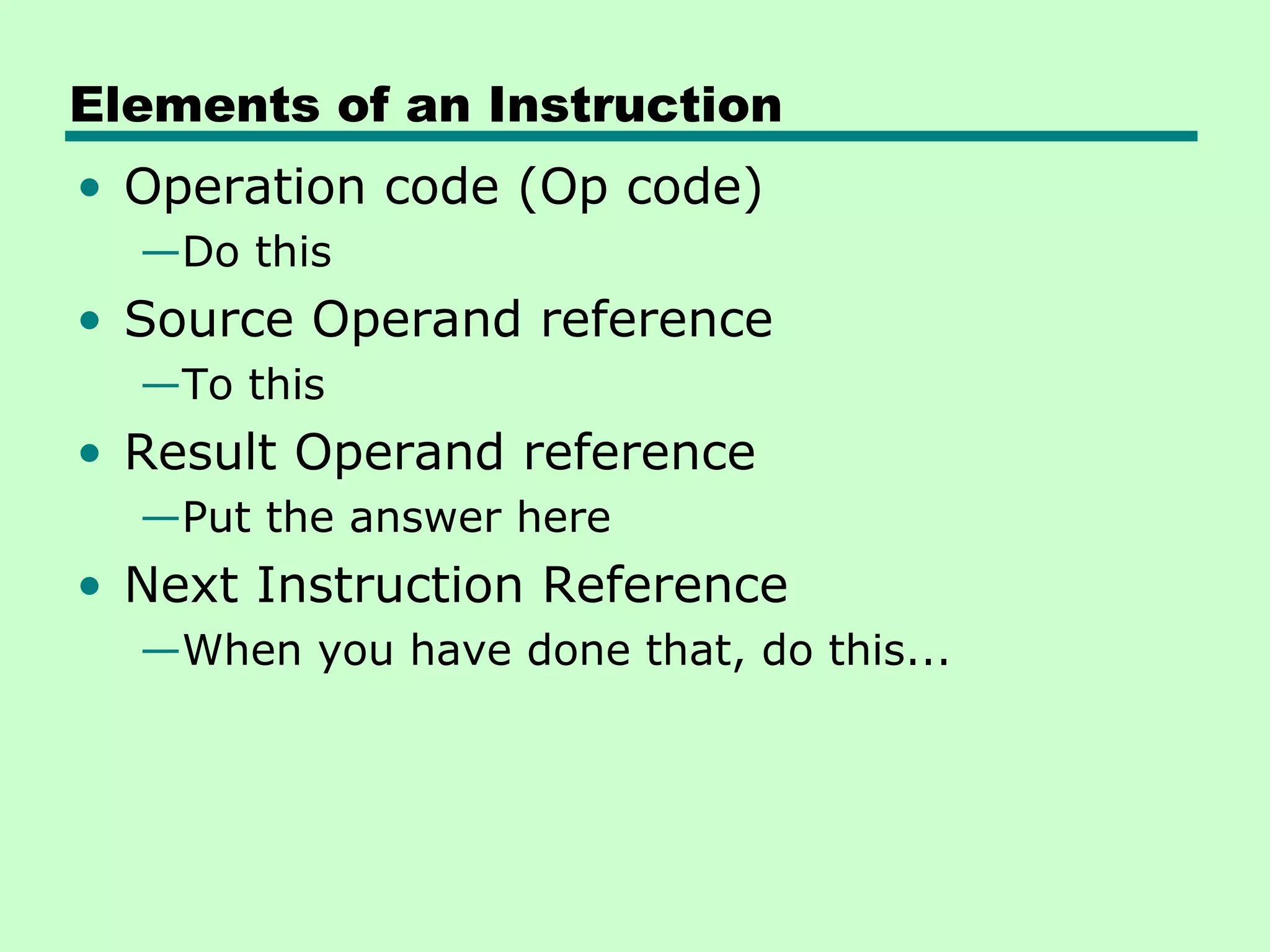
Elements of an Instruction
• Operation code (Op code)
  —Do this
• Source Operand reference
  —To this
• Result Operand reference
  —Put the answer here
• Next Instruction Reference
  —When you have done that, do this...
Where have all the Operands Gone?
• Long time passing….
• (If you don’t understand, you’re too
  young!)
• Main memory (or virtual memory or
  cache)
• CPU register
• I/O device
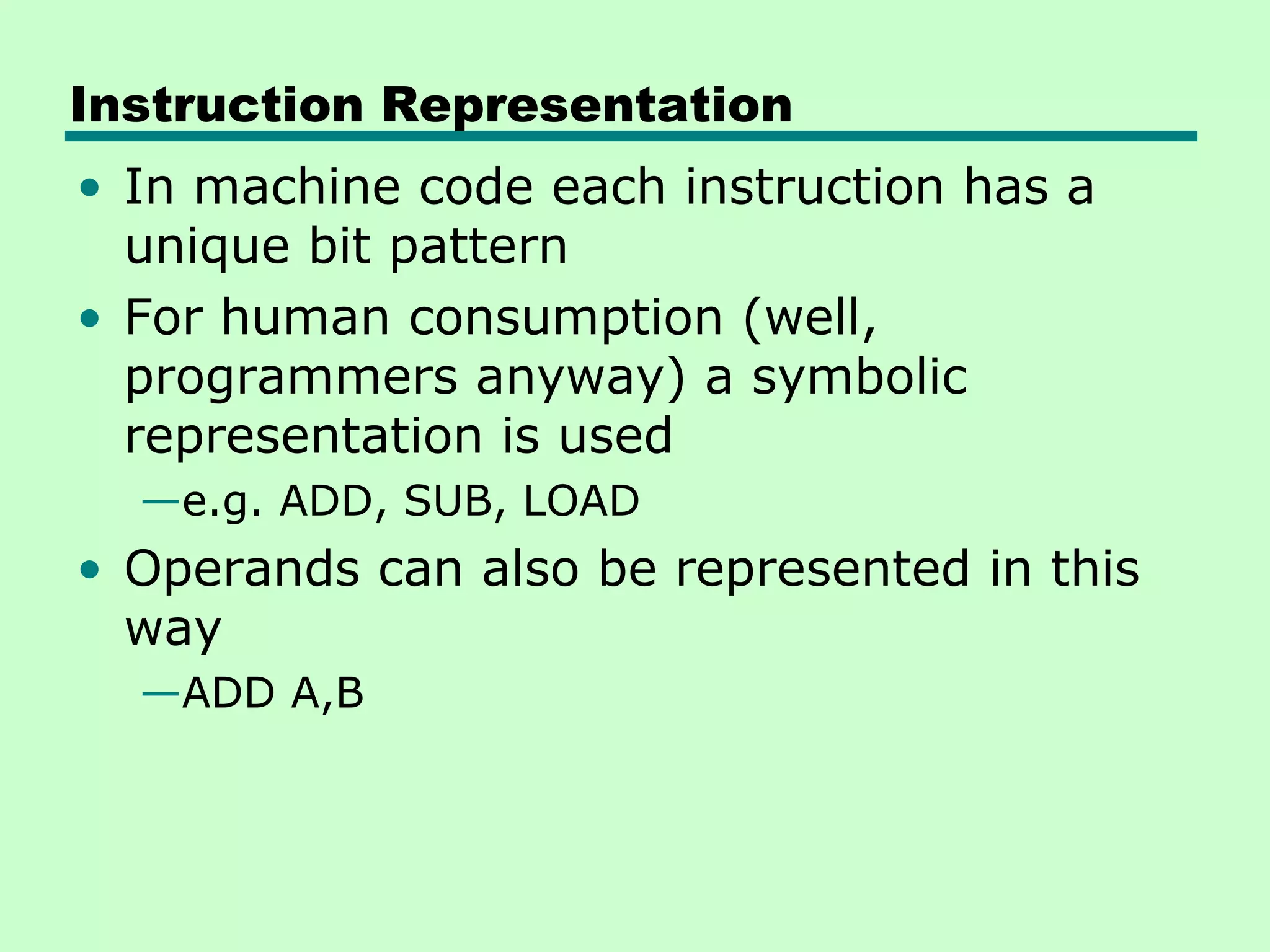
Instruction Cycle State Diagram
Instruction Representation
• In machine code each instruction has a
  unique bit pattern
• For human consumption (well,
  programmers anyway) a symbolic
  representation is used
  —e.g. ADD, SUB, LOAD
• Operands can also be represented in this
  way
  —ADD A,B
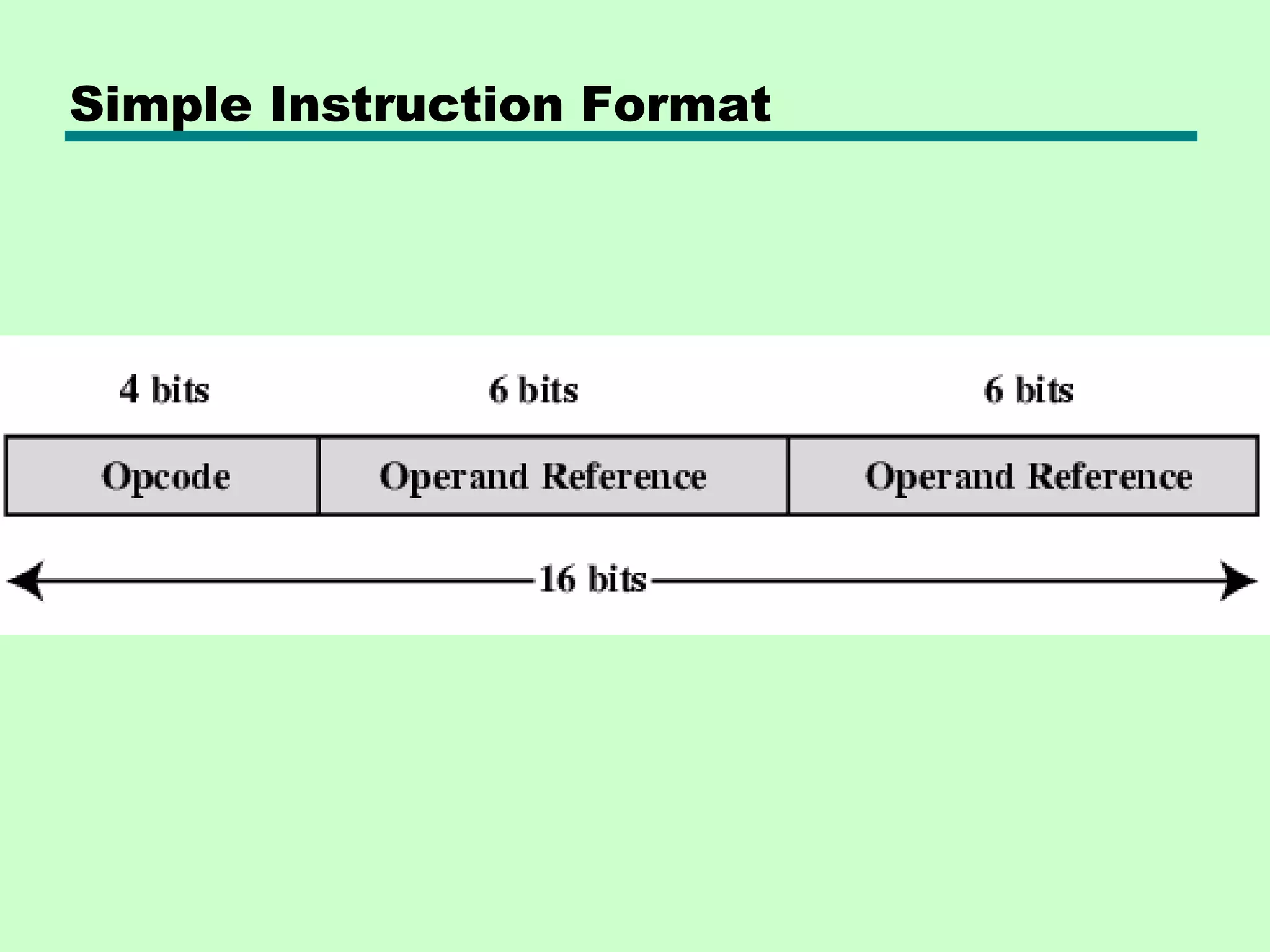
Simple Instruction Format
Instruction Types
•   Data processing
•   Data storage (main memory)
•   Data movement (I/O)
•   Program flow control
Number of Addresses (a)
• 3 addresses
  —Operand 1, Operand 2, Result
  —a = b + c;
  —May be a forth - next instruction (usually
   implicit)
  —Not common
  —Needs very long words to hold everything
Number of Addresses (b)
• 2 addresses
  —One address doubles as operand and result
  —a = a + b
  —Reduces length of instruction
  —Requires some extra work
    – Temporary storage to hold some results
Number of Addresses (c)
• 1 address
  —Implicit second address
  —Usually a register (accumulator)
  —Common on early machines
Number of Addresses (d)
• 0 (zero) addresses
  —All addresses implicit
  —Uses a stack
  —e.g. push a
  —     push b
  —     add
  —     pop c

  —c = a + b
How Many Addresses
• More addresses
  —More complex (powerful?) instructions
  —More registers
    – Inter-register operations are quicker
  —Fewer instructions per program
• Fewer addresses
  —Less complex (powerful?) instructions
  —More instructions per program
  —Faster fetch/execution of instructions
Design Decisions (1)
• Operation repertoire
  —How many ops?
  —What can they do?
  —How complex are they?
• Data types
• Instruction formats
  —Length of op code field
  —Number of addresses
Design Decisions (2)
• Registers
  —Number of CPU registers available
  —Which operations can be performed on which
   registers?
• Addressing modes (later…)

• RISC v CISC
Types of Operand
• Addresses
• Numbers
   —Integer/floating point
• Characters
   —ASCII etc.
• Logical Data
   —Bits or flags
• (Aside: Is there any difference between numbers and
  characters? Ask a C programmer!)
x86 Data Types
• 8 bit Byte
• 16 bit word
• 32 bit double word
• 64 bit quad word
• 128 bit double quadword
• Addressing is by 8 bit unit
• Words do not need to align at even-
  numbered address
• Data accessed across 32 bit bus in units of
  double word read at addresses divisible by
  4
• Little endian
SMID Data Types
• Integer types
   — Interpreted as bit field or integer

• Packed byte and packed byte integer
   — Bytes packed into 64-bit quadword or 128-bit double
     quadword
• Packed word and packed word integer
   — 16-bit words packed into 64-bit quadword or 128-bit double
     quadword
• Packed doubleword and packed doubleword integer
   — 32-bit doublewords packed into 64-bit quadword or 128-bit
     double quadword
• Packed quadword and packed qaudword integer
   — Two 64-bit quadwords packed into 128-bit double quadword

• Packed single-precision floating-point and packed double-
  precision floating-point
   — Four 32-bit floating-point or two 64-bit floating-point values
     packed into a 128-bit double quadword
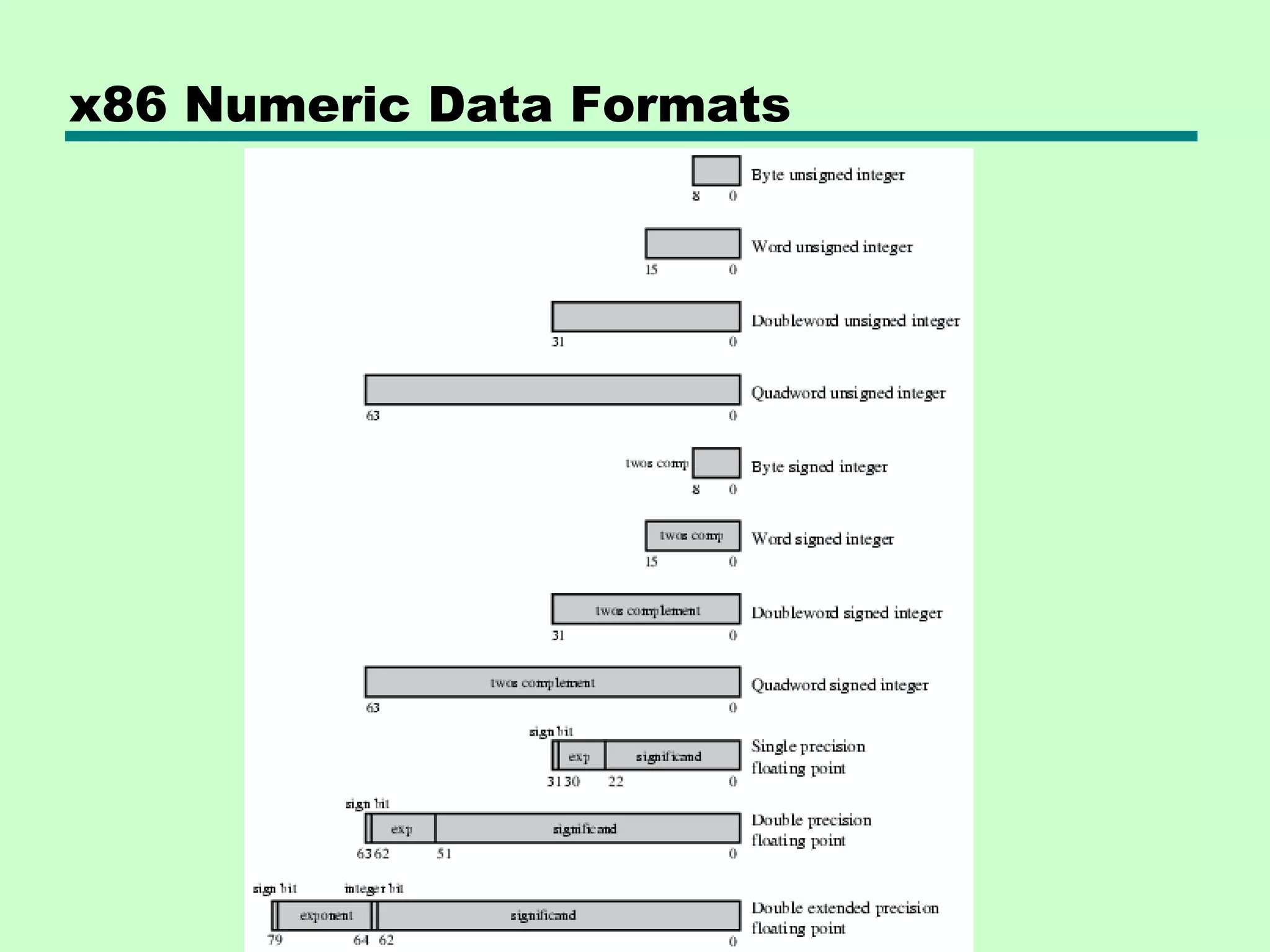
x86 Numeric Data Formats
ARM Data Types
• 8 (byte), 16 (halfword), 32 (word) bits
• Halfword and word accesses should be word aligned
• Nonaligned access alternatives
   — Default
        –   Treated as truncated
        –   Bits[1:0] treated as zero for word
        –   Bit[0] treated as zero for halfword
        –   Load single word instructions rotate right word aligned data transferred by
            non word-aligned address one, two or three bytesAlignment checking
   — Data abort signal indicates alignment fault for attempting unaligned
     access
   — Unaligned access
   — Processor uses one or more memory accesses to generate transfer of
     adjacent bytes transparently to the programmer
• Unsigned integer interpretation supported for all types
• Twos-complement signed integer interpretation supported for all
  types
• Majority of implementations do not provide floating-point
  hardware
   —   Saves power and area
   —   Floating-point arithmetic implemented in software
   —   Optional floating-point coprocessor
   —   Single- and double-precision IEEE 754 floating point data types
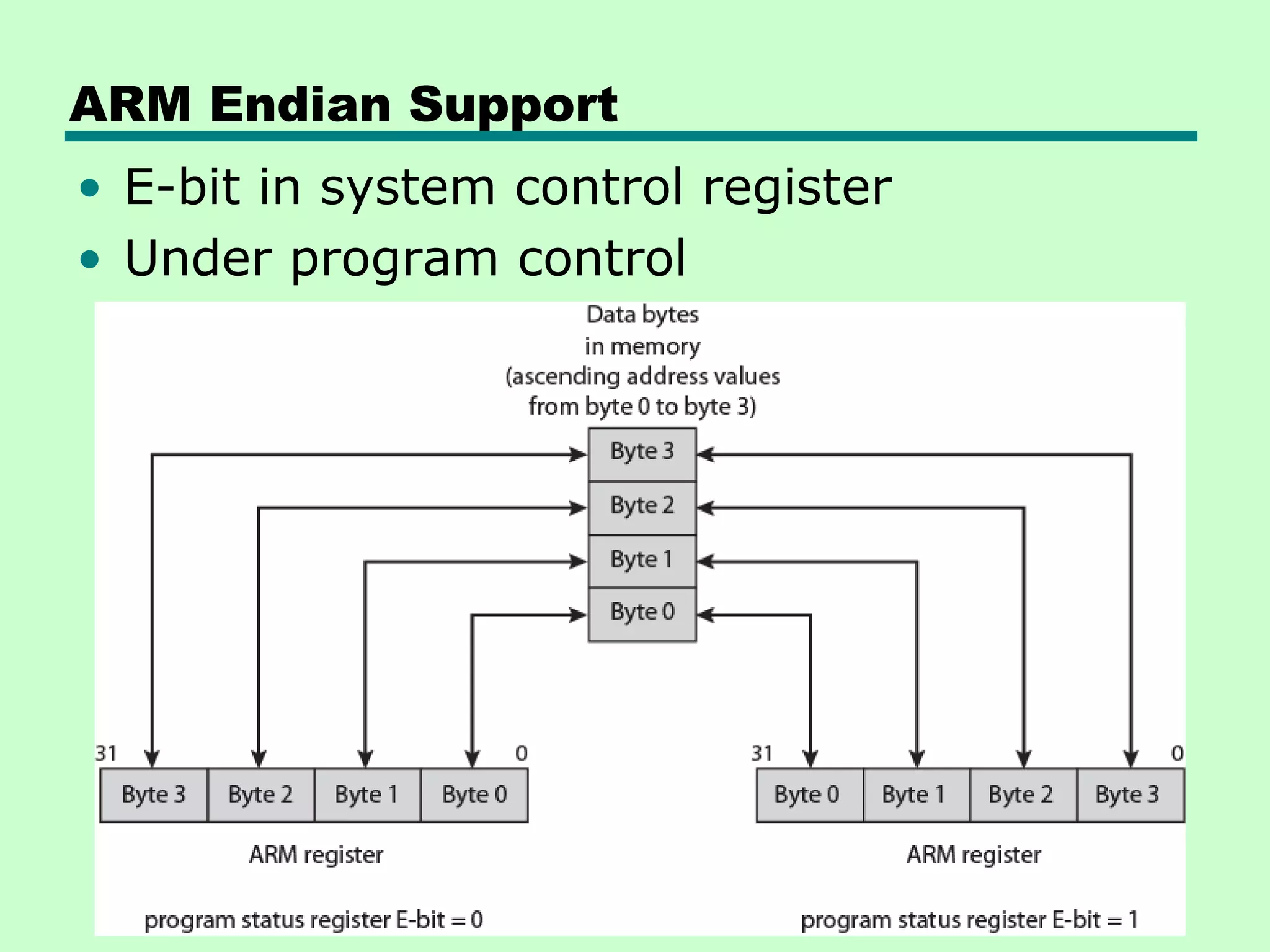
ARM Endian Support
• E-bit in system control register
• Under program control
Types of Operation
•   Data Transfer
•   Arithmetic
•   Logical
•   Conversion
•   I/O
•   System Control
•   Transfer of Control
Data Transfer
• Specify
  —Source
  —Destination
  —Amount of data
• May be different instructions for different
  movements
  —e.g. IBM 370
• Or one instruction and different addresses
  —e.g. VAX
Arithmetic
•   Add, Subtract, Multiply, Divide
•   Signed Integer
•   Floating point ?
•   May include
    —Increment (a++)
    —Decrement (a--)
    —Negate (-a)
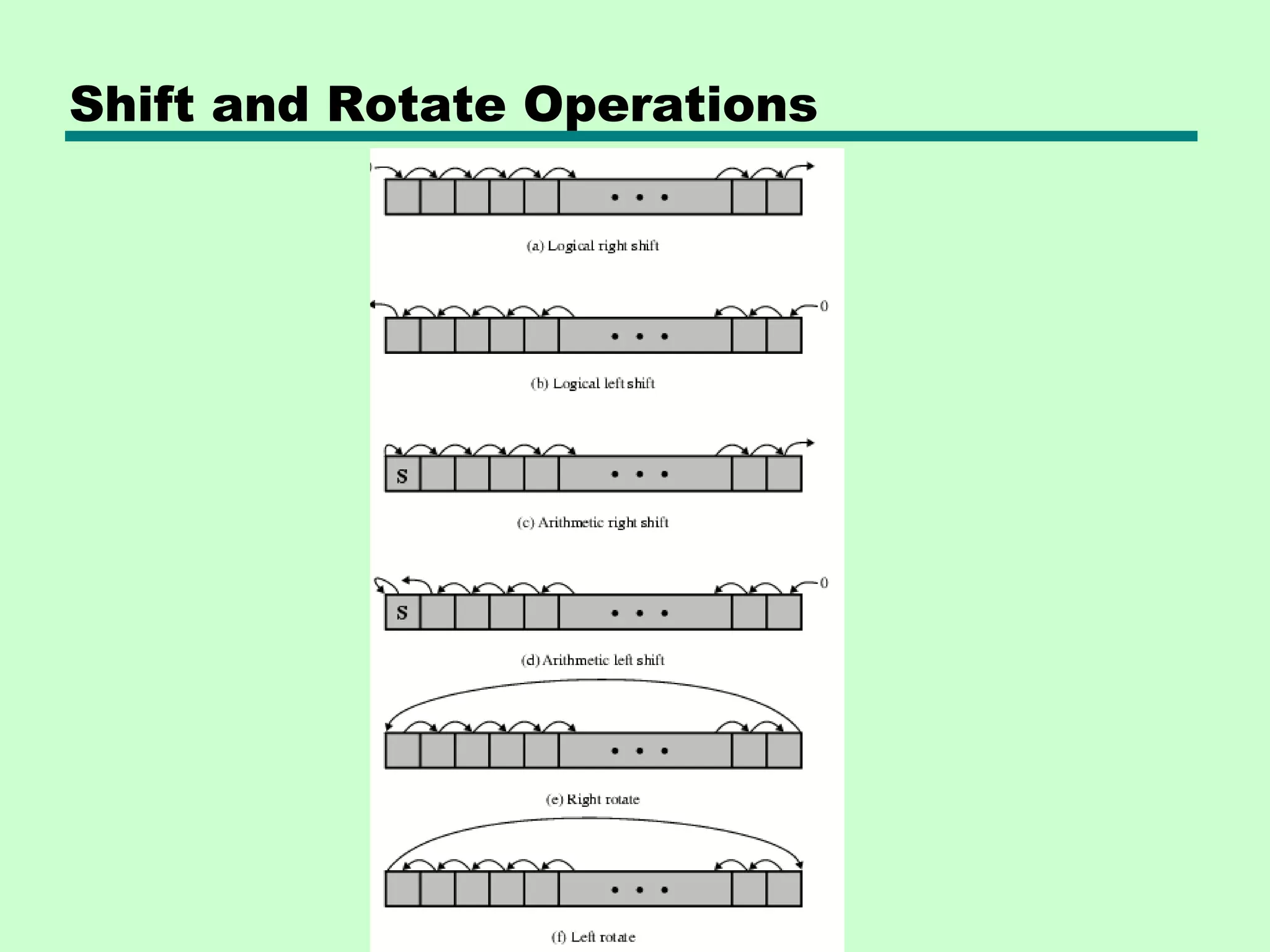
Shift and Rotate Operations
Logical
• Bitwise operations
• AND, OR, NOT
Conversion
• E.g. Binary to Decimal
Input/Output
• May be specific instructions
• May be done using data movement
  instructions (memory mapped)
• May be done by a separate controller
  (DMA)
Systems Control
• Privileged instructions
• CPU needs to be in specific state
  —Ring 0 on 80386+
  —Kernel mode
• For operating systems use
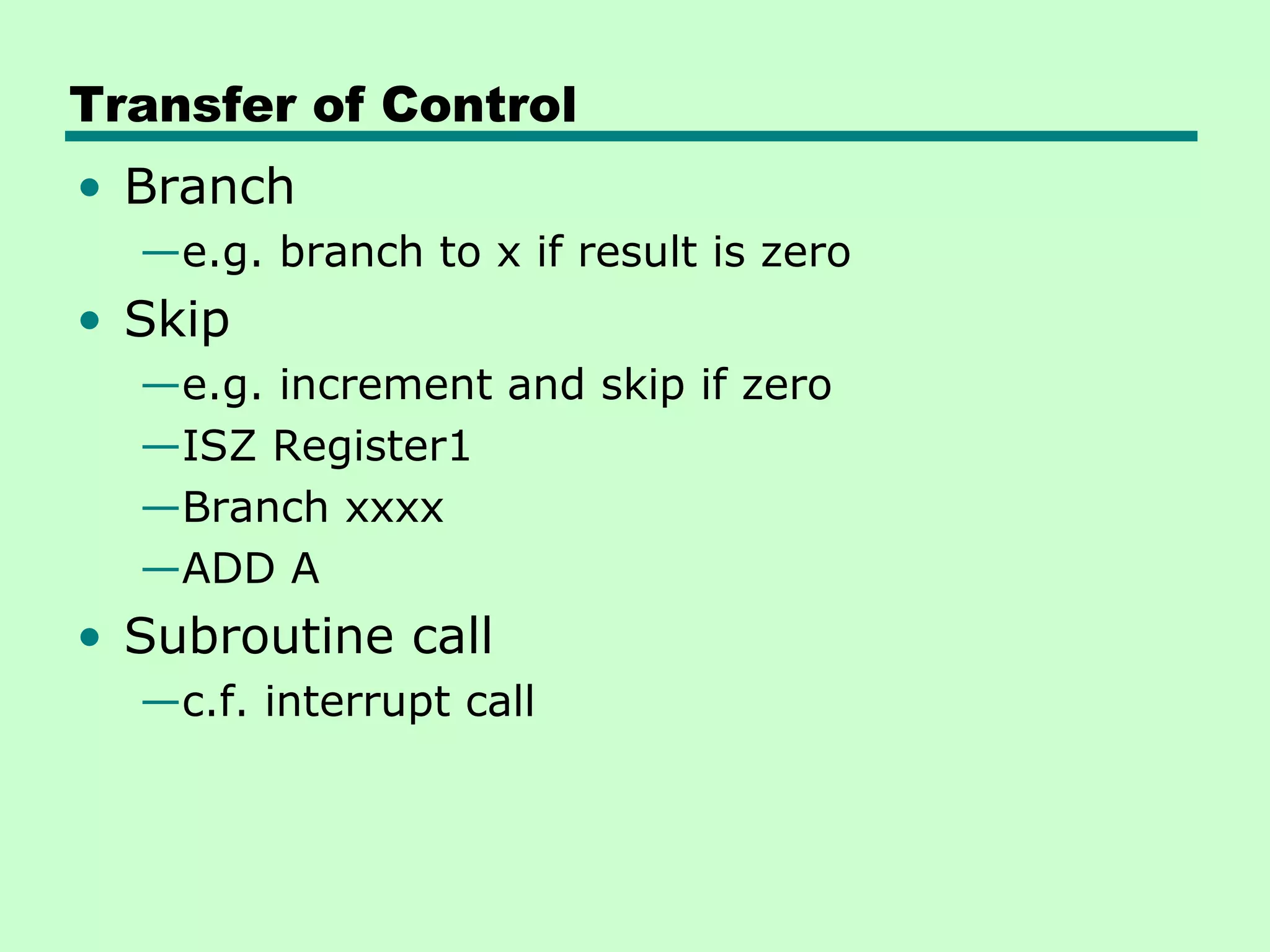
Transfer of Control
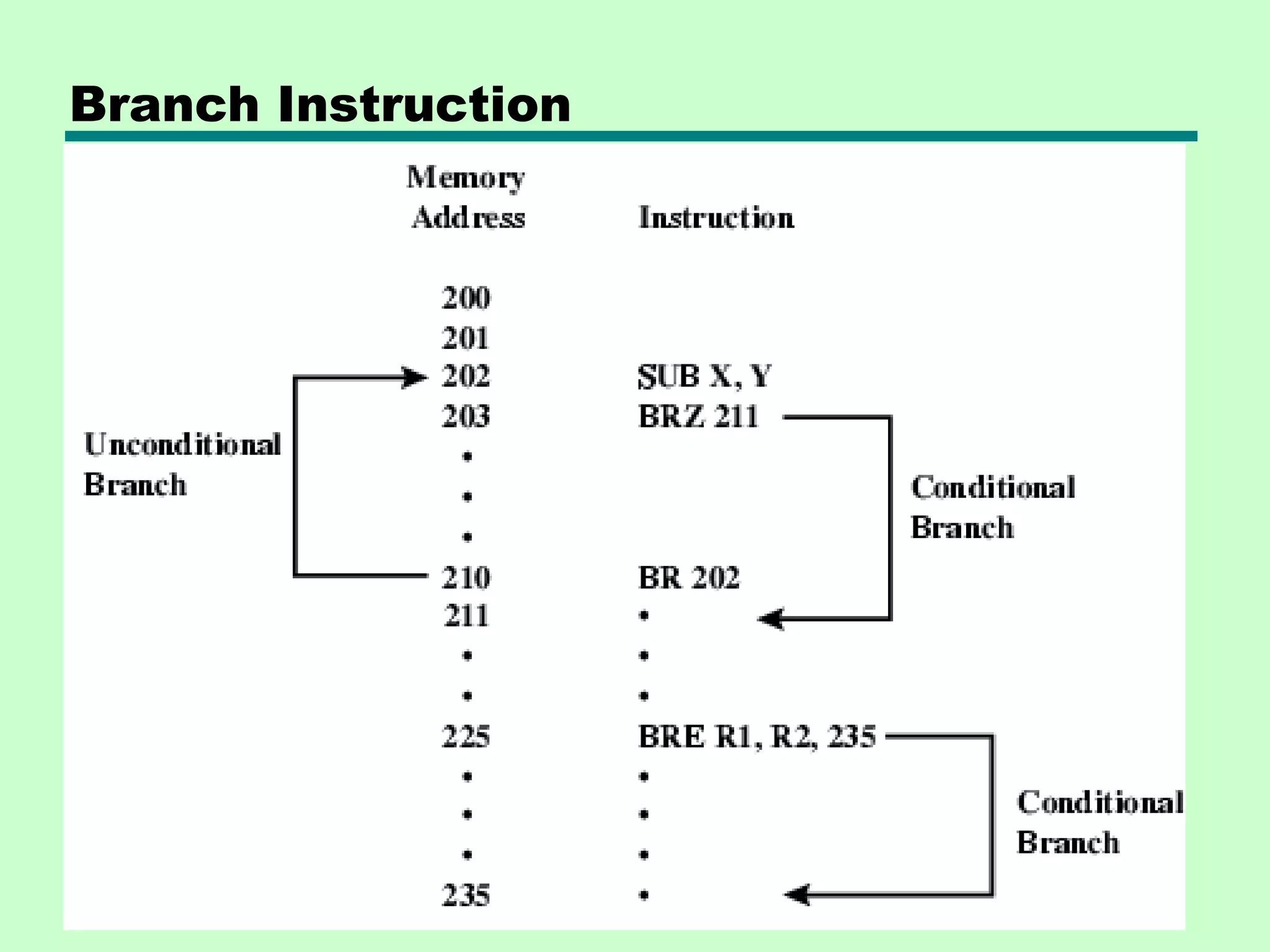
• Branch
  —e.g. branch to x if result is zero
• Skip
  —e.g. increment and skip if zero
  —ISZ Register1
  —Branch xxxx
  —ADD A
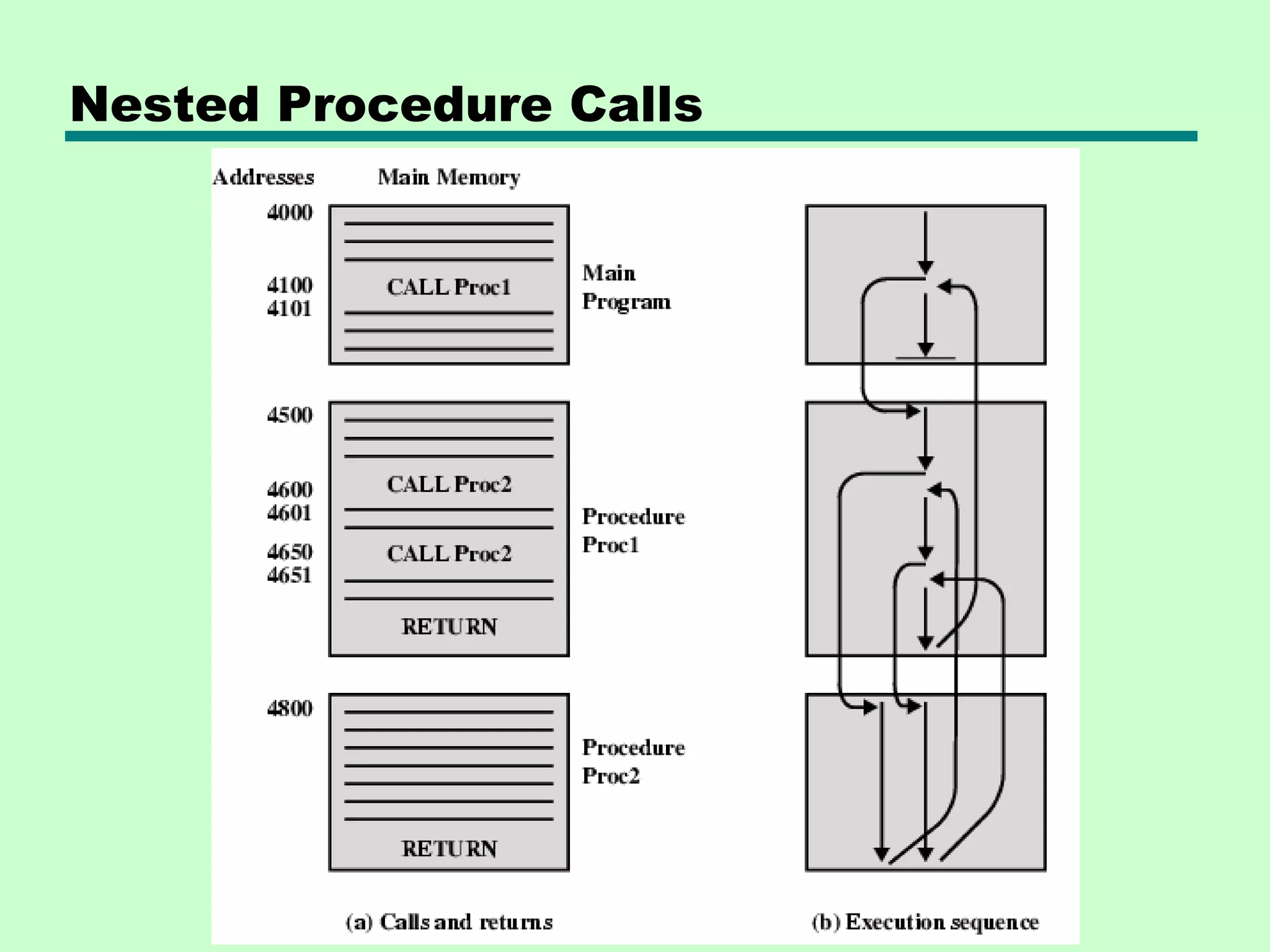
• Subroutine call
  —c.f. interrupt call
Branch Instruction
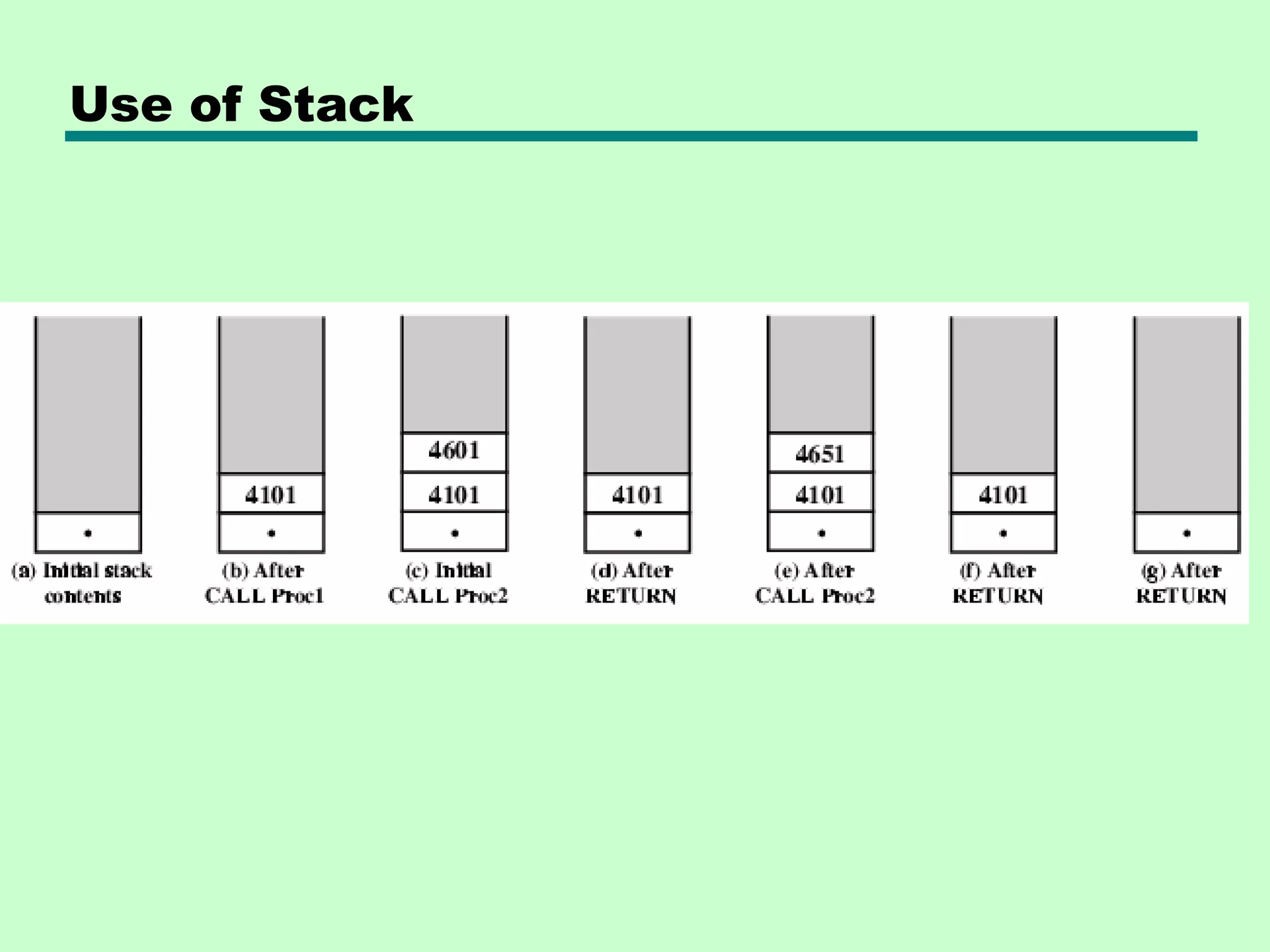
Nested Procedure Calls
Use of Stack
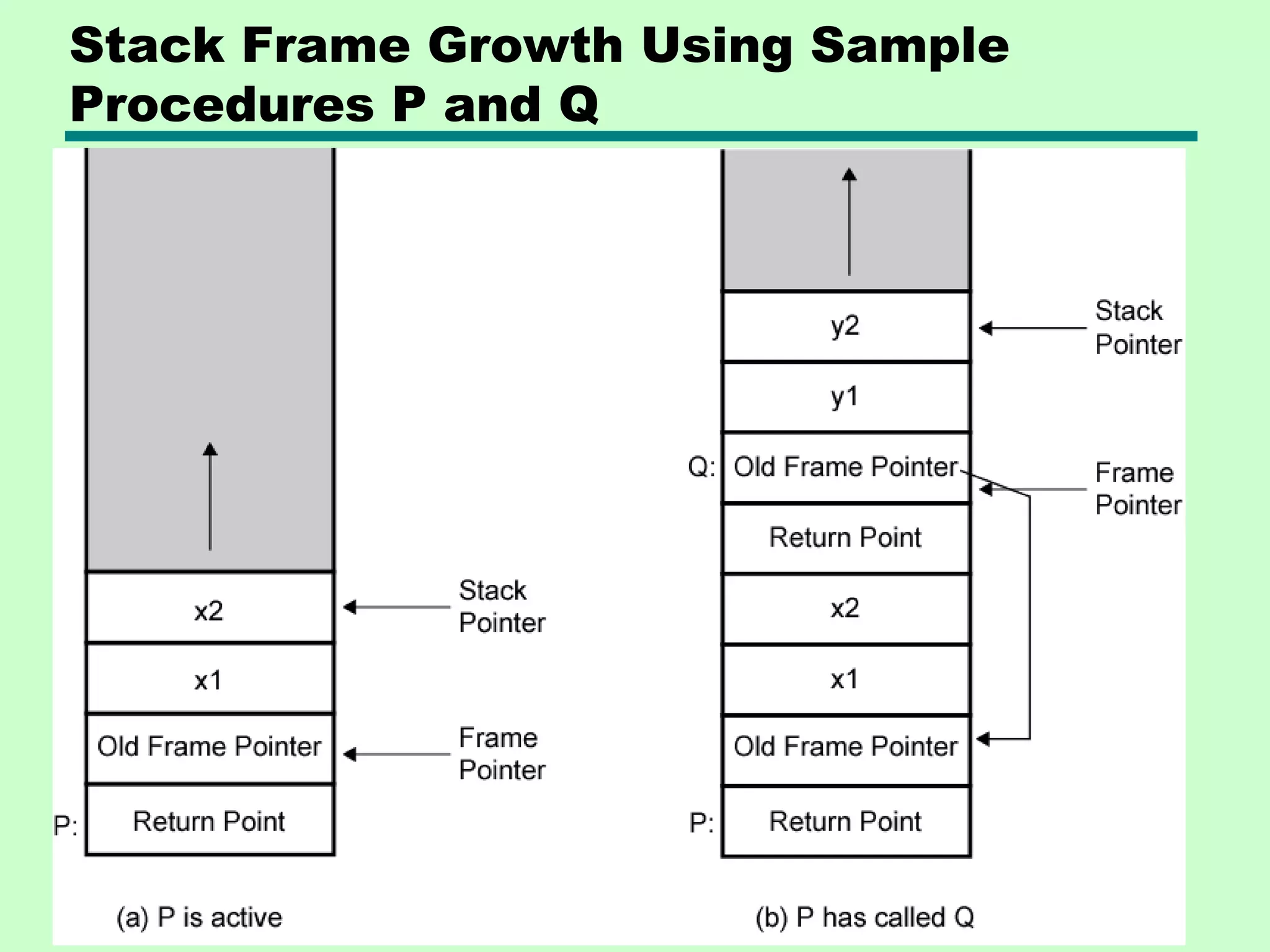
Stack Frame Growth Using Sample
Procedures P and Q
Exercise For Reader
• Find out about instruction set for Pentium
  and ARM
• Start with Stallings
• Visit web sites
Byte Order
(A portion of chips?)
• What order do we read numbers that
  occupy more than one byte
• e.g. (numbers in hex to make it easy to
  read)
• 12345678 can be stored in 4x8bit
  locations as follows
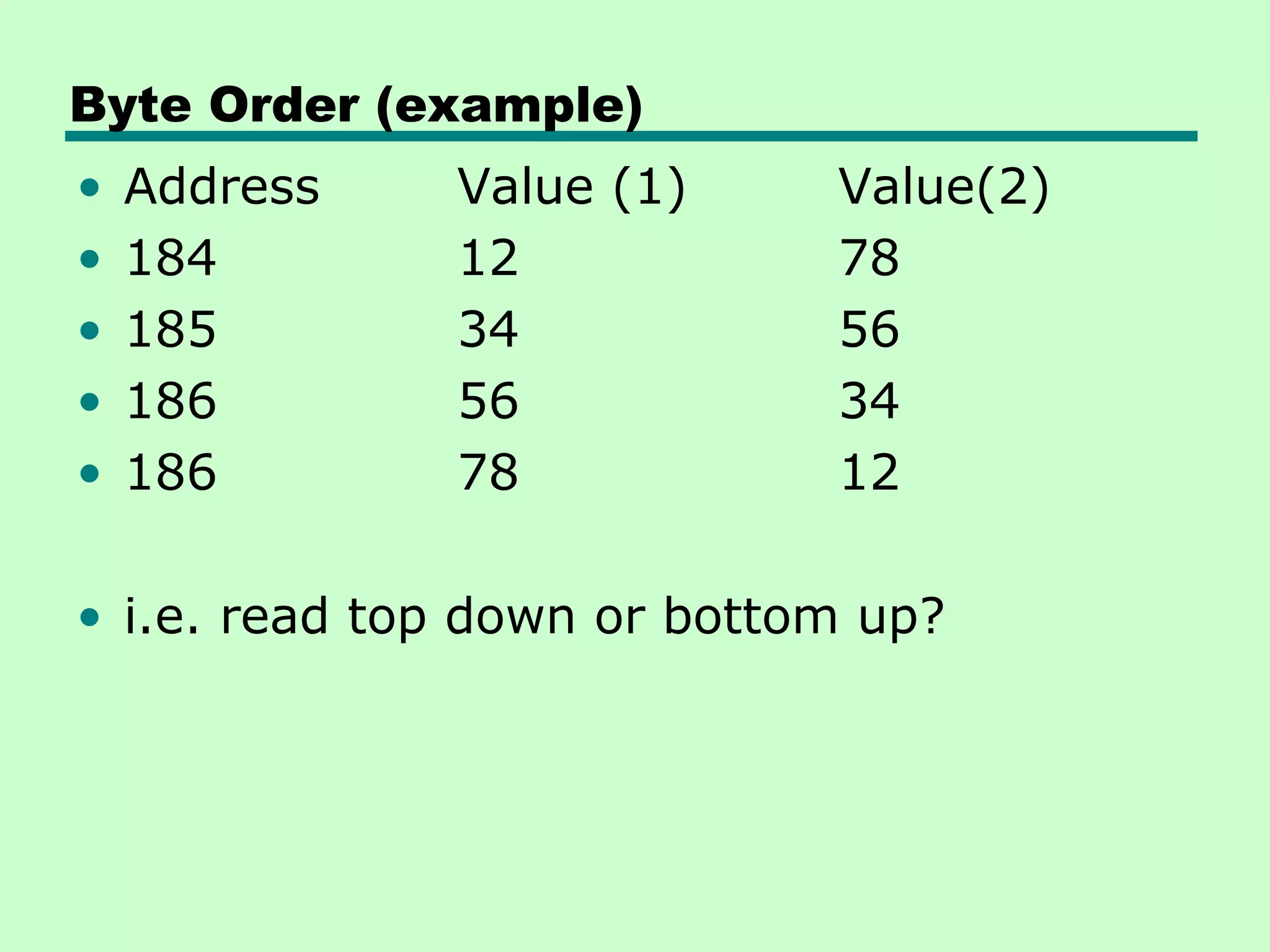
Byte Order (example)
•   Address   Value (1)      Value(2)
•   184       12             78
•   185       34             56
•   186       56             34
•   186       78             12

• i.e. read top down or bottom up?
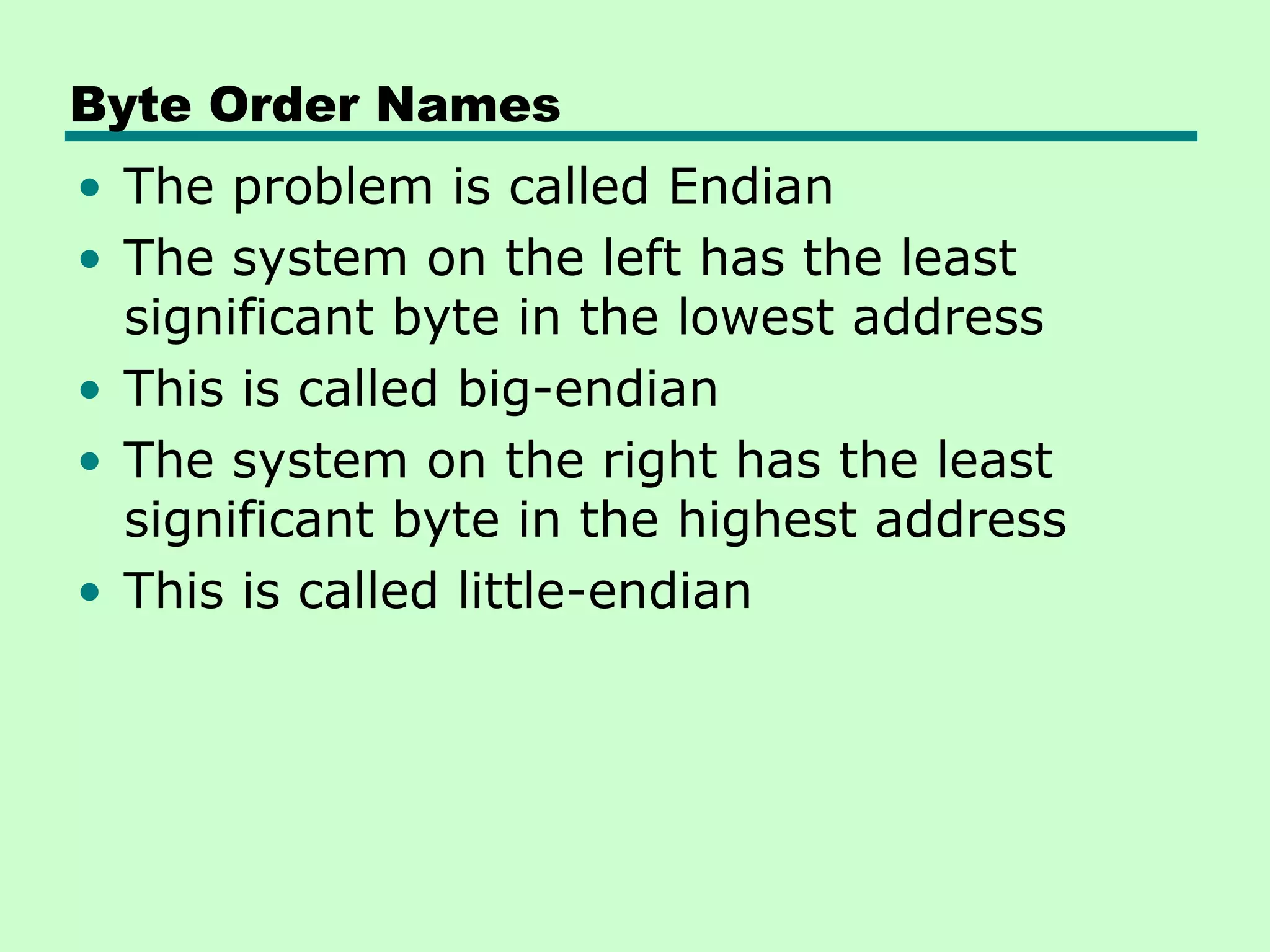
Byte Order Names
• The problem is called Endian
• The system on the left has the least
  significant byte in the lowest address
• This is called big-endian
• The system on the right has the least
  significant byte in the highest address
• This is called little-endian
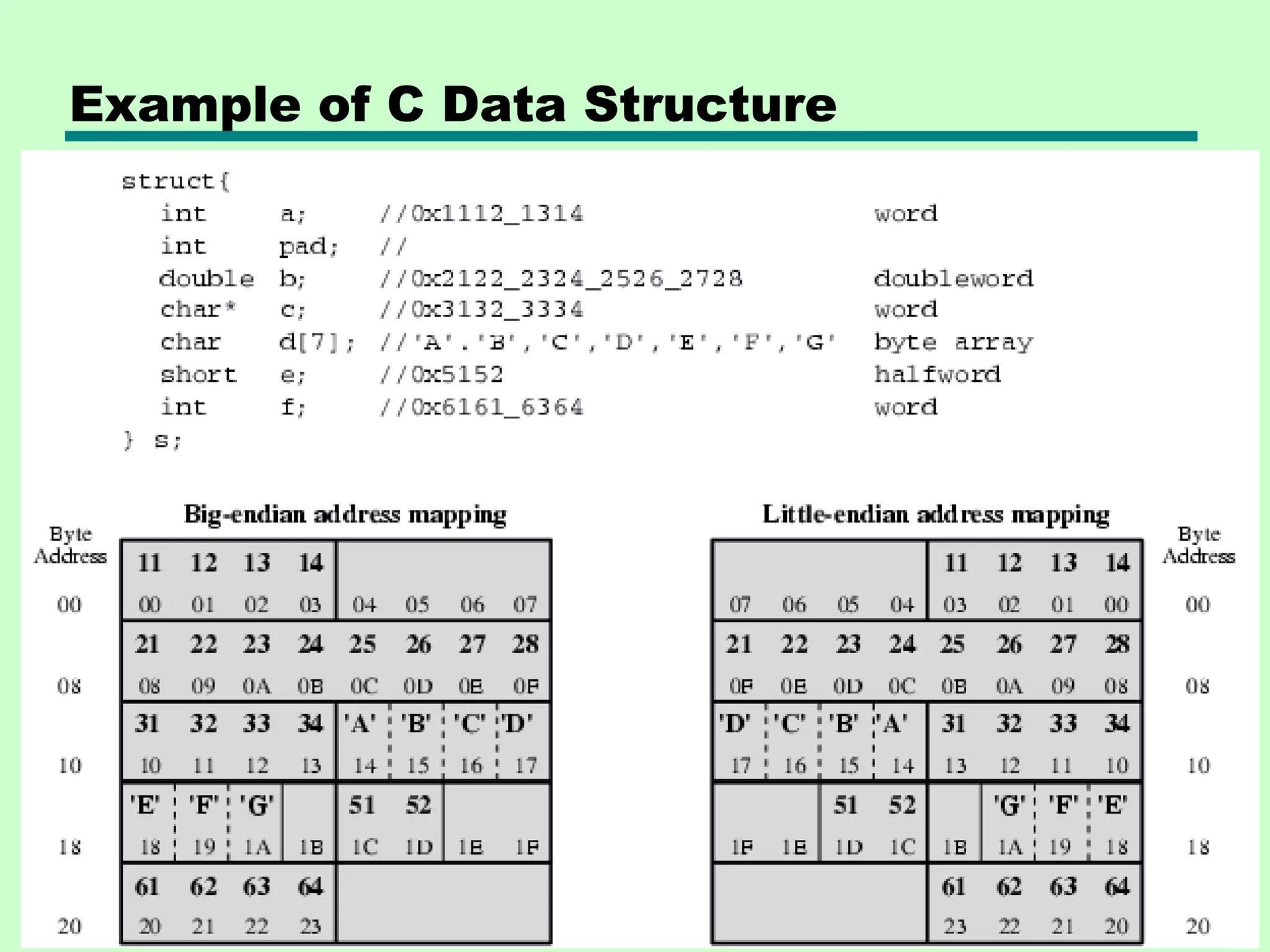
Example of C Data Structure
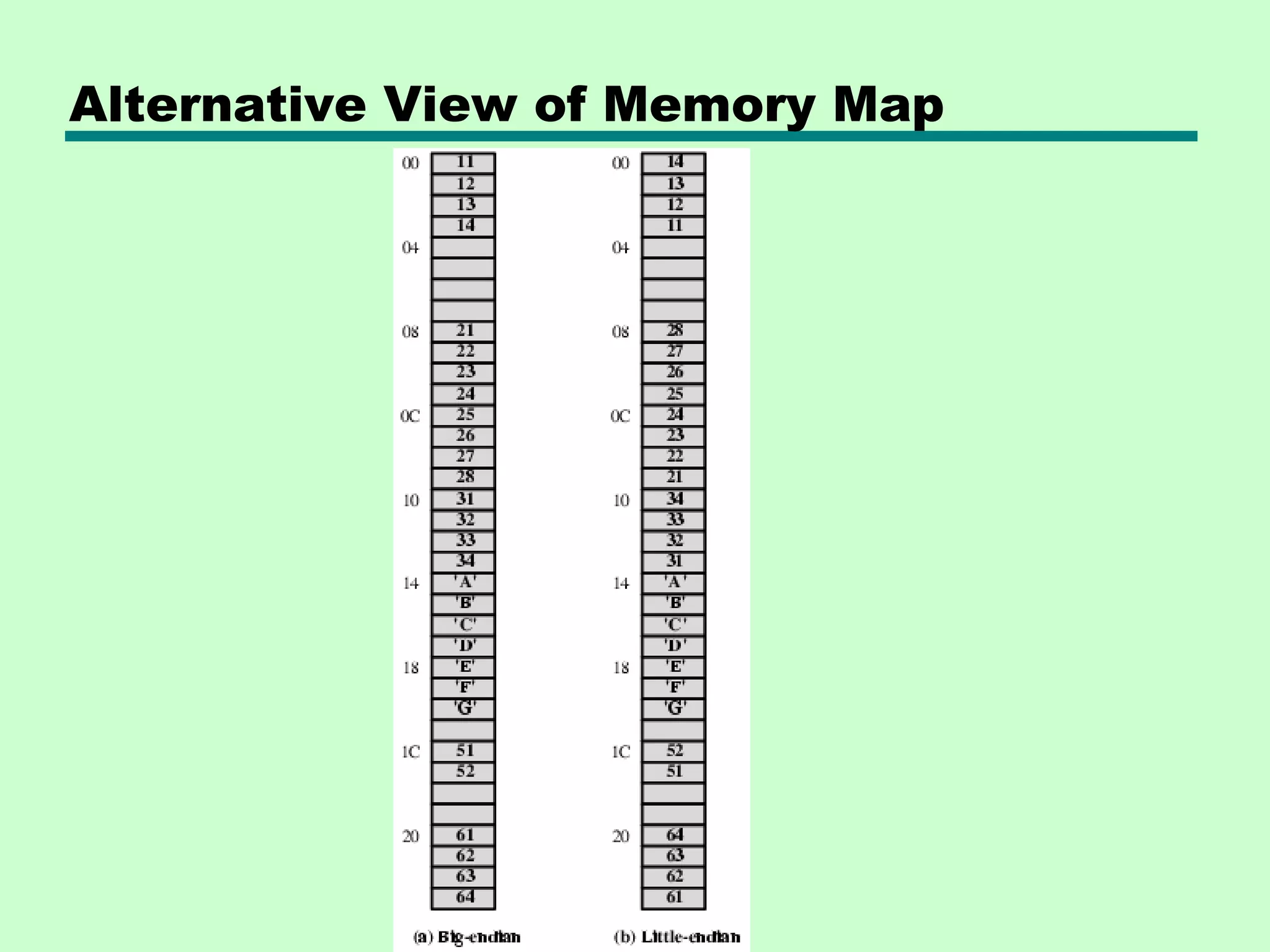
Alternative View of Memory Map
Standard…What Standard?
• Pentium (x86), VAX are little-endian
• IBM 370, Moterola 680x0 (Mac), and most
  RISC are big-endian
• Internet is big-endian
  —Makes writing Internet programs on PC more
   awkward!
  —WinSock provides htoi and itoh (Host to
   Internet & Internet to Host) functions to
   convert

10 instruction sets characteristics

  • 1.
    William Stallings Computer Organization andArchitecture 8th Edition Chapter 10 Instruction Sets: Characteristics and Functions
  • 2.
    What is anInstruction Set? • The complete collection of instructions that are understood by a CPU • Machine Code • Binary • Usually represented by assembly codes
  • 3.
    Elements of anInstruction • Operation code (Op code) —Do this • Source Operand reference —To this • Result Operand reference —Put the answer here • Next Instruction Reference —When you have done that, do this...
  • 4.
    Where have allthe Operands Gone? • Long time passing…. • (If you don’t understand, you’re too young!) • Main memory (or virtual memory or cache) • CPU register • I/O device
  • 5.
  • 6.
    Instruction Representation • Inmachine code each instruction has a unique bit pattern • For human consumption (well, programmers anyway) a symbolic representation is used —e.g. ADD, SUB, LOAD • Operands can also be represented in this way —ADD A,B
  • 7.
  • 8.
    Instruction Types • Data processing • Data storage (main memory) • Data movement (I/O) • Program flow control
  • 9.
    Number of Addresses(a) • 3 addresses —Operand 1, Operand 2, Result —a = b + c; —May be a forth - next instruction (usually implicit) —Not common —Needs very long words to hold everything
  • 10.
    Number of Addresses(b) • 2 addresses —One address doubles as operand and result —a = a + b —Reduces length of instruction —Requires some extra work – Temporary storage to hold some results
  • 11.
    Number of Addresses(c) • 1 address —Implicit second address —Usually a register (accumulator) —Common on early machines
  • 12.
    Number of Addresses(d) • 0 (zero) addresses —All addresses implicit —Uses a stack —e.g. push a — push b — add — pop c —c = a + b
  • 13.
    How Many Addresses •More addresses —More complex (powerful?) instructions —More registers – Inter-register operations are quicker —Fewer instructions per program • Fewer addresses —Less complex (powerful?) instructions —More instructions per program —Faster fetch/execution of instructions
  • 14.
    Design Decisions (1) •Operation repertoire —How many ops? —What can they do? —How complex are they? • Data types • Instruction formats —Length of op code field —Number of addresses
  • 15.
    Design Decisions (2) •Registers —Number of CPU registers available —Which operations can be performed on which registers? • Addressing modes (later…) • RISC v CISC
  • 16.
    Types of Operand •Addresses • Numbers —Integer/floating point • Characters —ASCII etc. • Logical Data —Bits or flags • (Aside: Is there any difference between numbers and characters? Ask a C programmer!)
  • 17.
    x86 Data Types •8 bit Byte • 16 bit word • 32 bit double word • 64 bit quad word • 128 bit double quadword • Addressing is by 8 bit unit • Words do not need to align at even- numbered address • Data accessed across 32 bit bus in units of double word read at addresses divisible by 4 • Little endian
  • 18.
    SMID Data Types •Integer types — Interpreted as bit field or integer • Packed byte and packed byte integer — Bytes packed into 64-bit quadword or 128-bit double quadword • Packed word and packed word integer — 16-bit words packed into 64-bit quadword or 128-bit double quadword • Packed doubleword and packed doubleword integer — 32-bit doublewords packed into 64-bit quadword or 128-bit double quadword • Packed quadword and packed qaudword integer — Two 64-bit quadwords packed into 128-bit double quadword • Packed single-precision floating-point and packed double- precision floating-point — Four 32-bit floating-point or two 64-bit floating-point values packed into a 128-bit double quadword
  • 19.
  • 20.
    ARM Data Types •8 (byte), 16 (halfword), 32 (word) bits • Halfword and word accesses should be word aligned • Nonaligned access alternatives — Default – Treated as truncated – Bits[1:0] treated as zero for word – Bit[0] treated as zero for halfword – Load single word instructions rotate right word aligned data transferred by non word-aligned address one, two or three bytesAlignment checking — Data abort signal indicates alignment fault for attempting unaligned access — Unaligned access — Processor uses one or more memory accesses to generate transfer of adjacent bytes transparently to the programmer • Unsigned integer interpretation supported for all types • Twos-complement signed integer interpretation supported for all types • Majority of implementations do not provide floating-point hardware — Saves power and area — Floating-point arithmetic implemented in software — Optional floating-point coprocessor — Single- and double-precision IEEE 754 floating point data types
  • 21.
    ARM Endian Support •E-bit in system control register • Under program control
  • 22.
    Types of Operation • Data Transfer • Arithmetic • Logical • Conversion • I/O • System Control • Transfer of Control
  • 23.
    Data Transfer • Specify —Source —Destination —Amount of data • May be different instructions for different movements —e.g. IBM 370 • Or one instruction and different addresses —e.g. VAX
  • 24.
    Arithmetic • Add, Subtract, Multiply, Divide • Signed Integer • Floating point ? • May include —Increment (a++) —Decrement (a--) —Negate (-a)
  • 25.
    Shift and RotateOperations
  • 26.
  • 27.
  • 28.
    Input/Output • May bespecific instructions • May be done using data movement instructions (memory mapped) • May be done by a separate controller (DMA)
  • 29.
    Systems Control • Privilegedinstructions • CPU needs to be in specific state —Ring 0 on 80386+ —Kernel mode • For operating systems use
  • 30.
    Transfer of Control •Branch —e.g. branch to x if result is zero • Skip —e.g. increment and skip if zero —ISZ Register1 —Branch xxxx —ADD A • Subroutine call —c.f. interrupt call
  • 31.
  • 32.
  • 33.
  • 34.
    Stack Frame GrowthUsing Sample Procedures P and Q
  • 35.
    Exercise For Reader •Find out about instruction set for Pentium and ARM • Start with Stallings • Visit web sites
  • 36.
    Byte Order (A portionof chips?) • What order do we read numbers that occupy more than one byte • e.g. (numbers in hex to make it easy to read) • 12345678 can be stored in 4x8bit locations as follows
  • 37.
    Byte Order (example) • Address Value (1) Value(2) • 184 12 78 • 185 34 56 • 186 56 34 • 186 78 12 • i.e. read top down or bottom up?
  • 38.
    Byte Order Names •The problem is called Endian • The system on the left has the least significant byte in the lowest address • This is called big-endian • The system on the right has the least significant byte in the highest address • This is called little-endian
  • 39.
    Example of CData Structure
  • 40.
  • 41.
    Standard…What Standard? • Pentium(x86), VAX are little-endian • IBM 370, Moterola 680x0 (Mac), and most RISC are big-endian • Internet is big-endian —Makes writing Internet programs on PC more awkward! —WinSock provides htoi and itoh (Host to Internet & Internet to Host) functions to convert