Difficult Airway
Management : Made
Easy
Dr.Venugopalan P P

DA,DNB,MNAMS,MEM-GW

Director ,Aster DM Health care
PEMAC 29.04.2018 @ Pushpagiri Medical College -Tiruvalla
Making difficult airway easy is difficult.But anticipation,
acquiring skill -Knowledge& Practice and Adequate
preparedness will do it
This session is try to
answer ….
• What is an Difficult airway ?

• What are the causes for Difficulty?

• How will you predict it?

• How will you manage it ? 

• What are the pearls and do’s and
don’ts?
Declaration:
I don’t have any conflict of interest to declare on this presentation and
I am not promoting or supporting any specific company as far as the various
equipment described in the session
What is meant by Difficult
airway ?
The clinical situation in which a conventionally
trained anaesthesiologist experiences difficulty with
FMV of the upper airway, tracheal intubation, or
both.!
Represents a complex interaction between patient
factors, the clinical setting, and the skills of the
practitioner.
Can you predict
difficult airway ?
Congenital airway abnormalities:
e.g. Pierre Robin, Klippel- Feil, Down’s syndromes 

Acquired

Rheumatoid arthritis, Acromegaly, Benign and malignant tumors of 

tongue, larynx etc. 

Iatrogenic 

Oral/pharyngeal radiotherapy, Laryngeal/tracheal surgery, TMJ surgery. 

Reported previous anaesthetic/ Intubation problems

Dental damage, Emergency tracheostomy, Med-alerts from 

the previous record etc. 

History
Adverse anatomical features:
Small mouth, receding chin, high arched 

palate, large tongue, morbid obesity 

Mechanical limitation:
reduced mouth opening, post-radiotherapy fibrosis, poor cervical
spine movement 

Poor dentition:
Prominent/loose teeth 

Orthopaedic/orthodontic equipment. 

Patency of the nasal passage 

GENERAL EXAMINATION
AIRWAY EVALUATION
a) Evaluation of tongue size relative to pharynx 
b) Mandibular space 

c) Assessment of glottic opening. 

d) Mobility of the joints 

1.TMJ

2.Neck mobility 

Basic categories
1.Individual indices
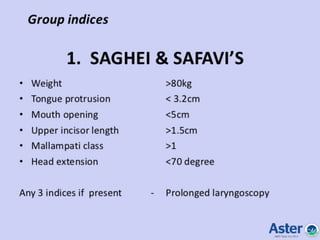
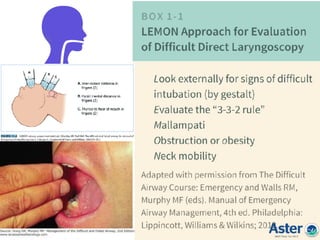
2.Group indices
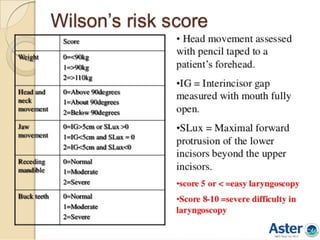
Wilson’s score
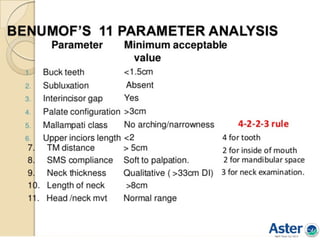
Benumof’s analysis
Saghei & safavi test
Lemon assesment
3.Radiological indices
Airway assessment indices
a)X Ray Neck[Lataral]
b)CT Scan
c)Helical CT
d)USG
4.Advanced
indices
• Flow volume
loop
• Acoustic
response
measurement
• Ultra sound
guided
• CT/MRI
• Flexible
bronchoscope 

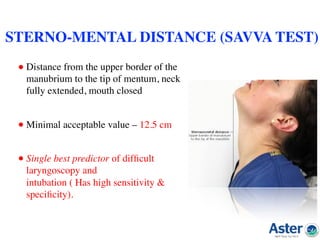
• Distance from the upper border of the
manubrium to the tip of mentum, neck
fully extended, mouth closed 

• Minimal acceptable value – 12.5 cm 

• Single best predictor of difficult
laryngoscopy and 

intubation ( Has high sensitivity &
specificity). 

STERNO-MENTAL DISTANCE (SAVVA TEST)
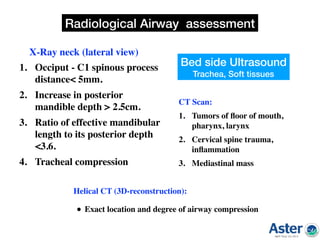
1. Occiput - C1 spinous process
distance< 5mm.
2. Increase in posterior
mandible depth > 2.5cm.
3. Ratio of effective mandibular
length to its posterior depth
<3.6.
4. Tracheal compression 

X-Ray neck (lateral view)
CT Scan:
1. Tumors of floor of mouth,
pharynx, larynx
2. Cervical spine trauma,
inflammation
3. Mediastinal mass

Helical CT (3D-reconstruction):
• Exact location and degree of airway compression
Radiological Airway assessment
Bed side Ultrasound
Trachea, Soft tissues
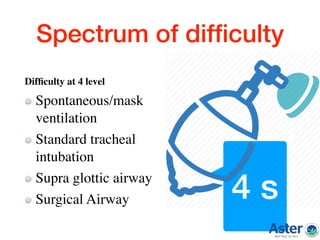
Spectrum of difficulty
Difficulty at 4 level
Spontaneous/mask
ventilation
Standard tracheal
intubation
Supra glottic airway
Surgical Airway 4 s
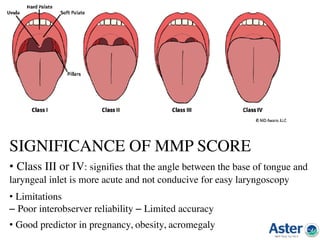
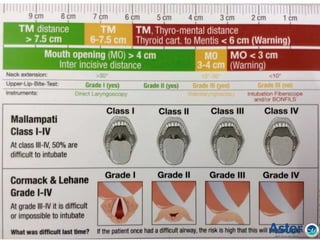
SIGNIFICANCE OF MMP SCORE
• Class III or IV: signifies that the angle between the base of tongue and
laryngeal inlet is more acute and not conducive for easy laryngoscopy
• Limitations

– Poor interobserver reliability – Limited accuracy
• Good predictor in pregnancy, obesity, acromegaly
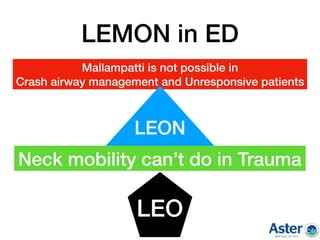
LEMON in ED
Mallampatti is not possible in
Crash airway management and Unresponsive patients
LEON
Neck mobility can’t do in Trauma
LEO
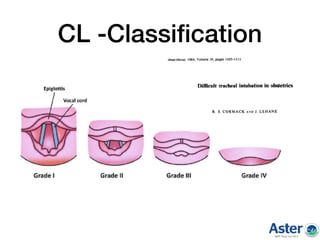
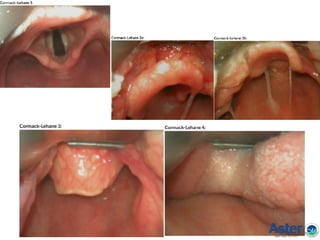
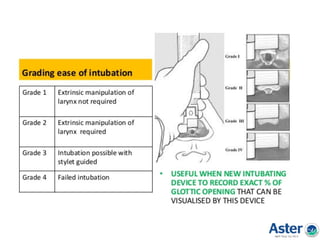
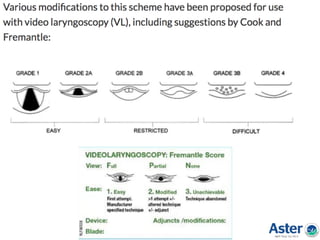
CL -Classification
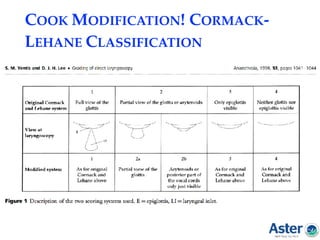
COOK MODIFICATION! CORMACK-
LEHANE CLASSIFICATION
When
putting all
together!!!!
What are the Equipment to
manage Difficult airway ?
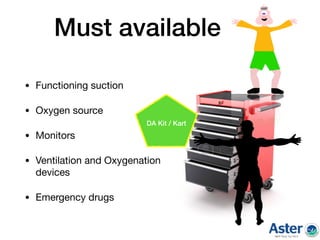
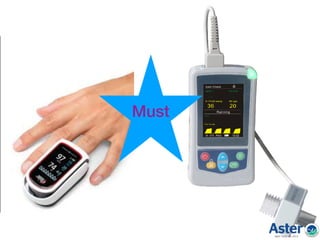
Must available
• Functioning suction 

• Oxygen source

• Monitors 

• Ventilation and Oxygenation
devices 

• Emergency drugs
DA Kit / Kart
Must
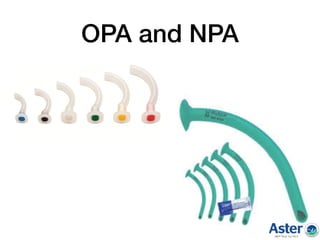
OPA and NPA
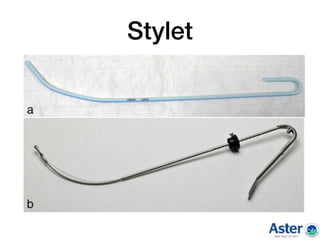
Stylet
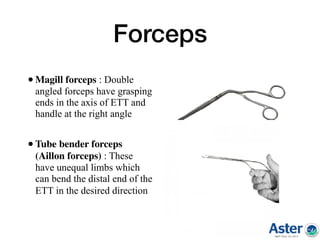
Forceps
•Magill forceps : Double
angled forceps have grasping
ends in the axis of ETT and
handle at the right angle
•Tube bender forceps
(Aillon forceps) : These
have unequal limbs which
can bend the distal end of the
ETT in the desired direction 


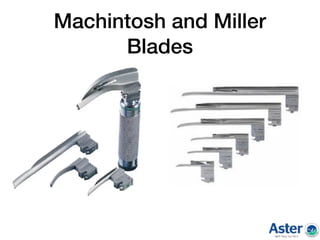
Machintosh and Miller
Blades
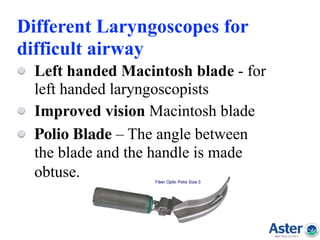
Different Laryngoscopes for
difficult airway
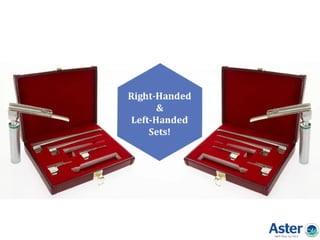
Left handed Macintosh blade - for
left handed laryngoscopists
Improved vision Macintosh blade
Polio Blade – The angle between
the blade and the handle is made
obtuse. 

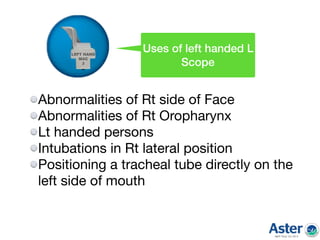
Abnormalities of Rt side of Face 

Abnormalities of Rt Oropharynx

Lt handed persons 

Intubations in Rt lateral position

Positioning a tracheal tube directly on the
left side of mouth

Uses of left handed L
Scope
Different Laryngoscopes for
difficult airway
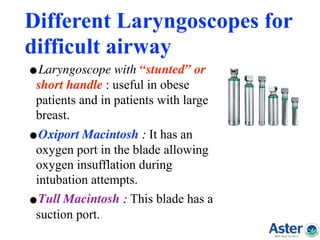
•Laryngoscope with “stunted” or
short handle : useful in obese
patients and in patients with large
breast.
•Oxiport Macintosh : It has an
oxygen port in the blade allowing
oxygen insufflation during
intubation attempts.
•Tull Macintosh : This blade has a
suction port.
Different Laryngoscopes for
difficult airway
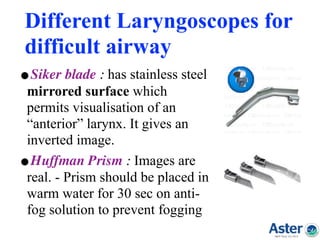
•Siker blade : has stainless steel
mirrored surface which
permits visualisation of an
“anterior” larynx. It gives an
inverted image.
•Huffman Prism : Images are
real. - Prism should be placed in
warm water for 30 sec on anti-
fog solution to prevent fogging
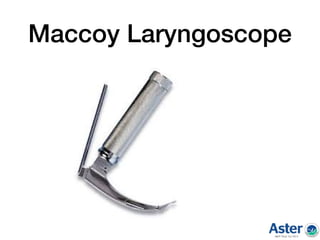
Maccoy Laryngoscope
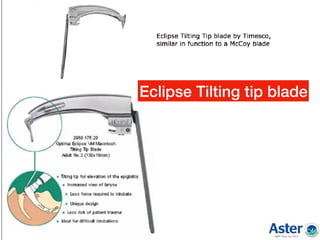
Eclipse Tilting tip blade
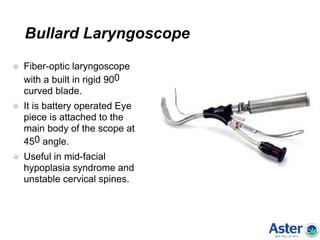
Bullard Laryngoscope
Fiber-optic laryngoscope
with a built in rigid 900
curved blade.
It is battery operated Eye
piece is attached to the
main body of the scope at
450 angle.
Useful in mid-facial
hypoplasia syndrome and
unstable cervical spines.
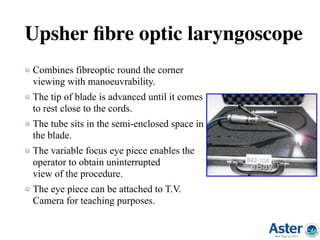
Upsher fibre optic laryngoscope
Combines fibreoptic round the corner
viewing with manoeuvrability.
The tip of blade is advanced until it comes
to rest close to the cords.
The tube sits in the semi-enclosed space in
the blade.
The variable focus eye piece enables the
operator to obtain uninterrupted

view of the procedure.
The eye piece can be attached to T.V.
Camera for teaching purposes.
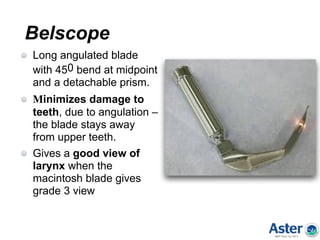
Belscope
Long angulated blade
with 450 bend at midpoint
and a detachable prism.
Minimizes damage to
teeth, due to angulation –
the blade stays away
from upper teeth.
Gives a good view of
larynx when the
macintosh blade gives
grade 3 view
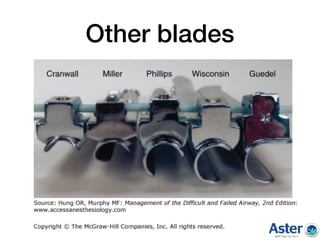
Other blades
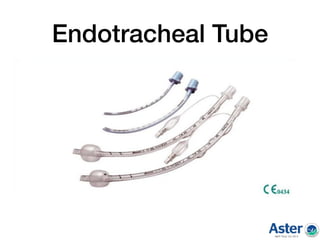
Endotracheal Tube
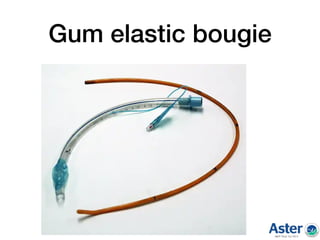
Gum elastic bougie
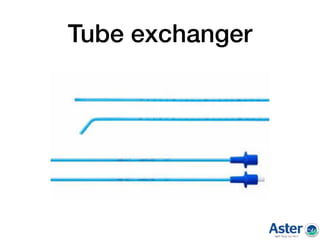
Tube exchanger
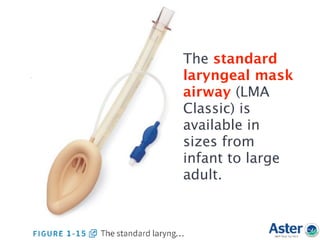
The standard
laryngeal mask
airway (LMA
Classic) is
available in
sizes from
infant to large
adult.
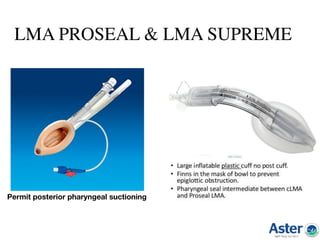
LMA PROSEAL & LMA SUPREME
Permit posterior pharyngeal suctioning
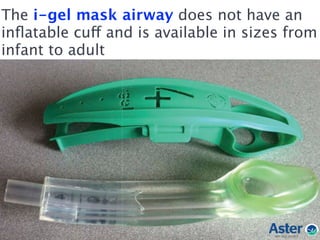
The i-gel mask airway does not have an
inflatable cuff and is available in sizes from
infant to adult
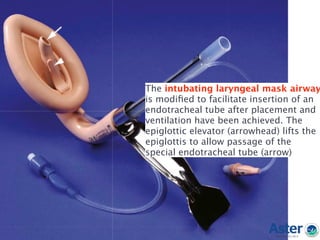
The intubating laryngeal mask airway
is modified to facilitate insertion of an
endotracheal tube after placement and
ventilation have been achieved. The
epiglottic elevator (arrowhead) lifts the
epiglottis to allow passage of the
special endotracheal tube (arrow)
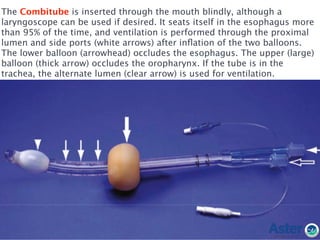
The Combitube is inserted through the mouth blindly, although a
laryngoscope can be used if desired. It seats itself in the esophagus more
than 95% of the time, and ventilation is performed through the proximal
lumen and side ports (white arrows) after inflation of the two balloons.
The lower balloon (arrowhead) occludes the esophagus. The upper (large)
balloon (thick arrow) occludes the oropharynx. If the tube is in the
trachea, the alternate lumen (clear arrow) is used for ventilation.
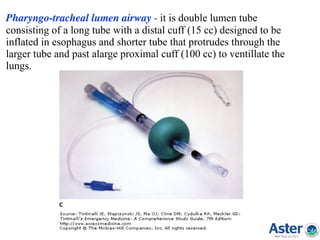
Pharyngo-tracheal lumen airway - it is double lumen tube
consisting of a long tube with a distal cuff (15 cc) designed to be
inflated in esophagus and shorter tube that protrudes through the
larger tube and past alarge proximal cuff (100 cc) to ventillate the
lungs.
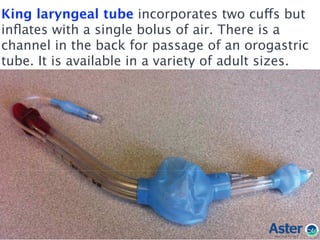
King laryngeal tube incorporates two cuffs but
inflates with a single bolus of air. There is a
channel in the back for passage of an orogastric
tube. It is available in a variety of adult sizes.
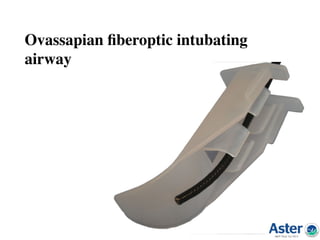
Ovassapian fiberoptic intubating
airway
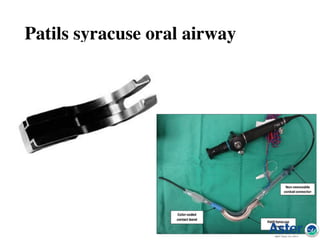
Patils syracuse oral airway
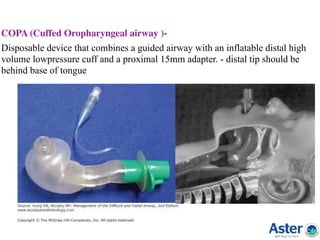
COPA (Cuffed Oropharyngeal airway )-
Disposable device that combines a guided airway with an inflatable distal high
volume lowpressure cuff and a proximal 15mm adapter. - distal tip should be
behind base of tongue
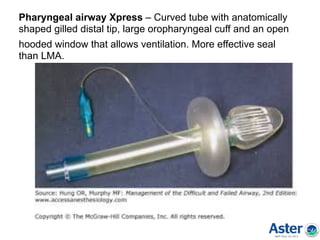
Pharyngeal airway Xpress – Curved tube with anatomically
shaped gilled distal tip, large oropharyngeal cuff and an open
hooded window that allows ventilation. More effective seal
than LMA.
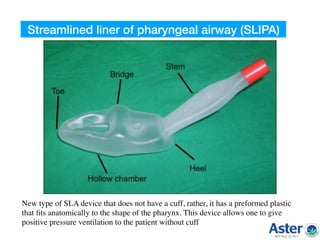
New type of SLA device that does not have a cuff, rather, it has a preformed plastic
that fits anatomically to the shape of the pharynx. This device allows one to give
positive pressure ventilation to the patient without cuff
Streamlined liner of pharyngeal airway (SLIPA)
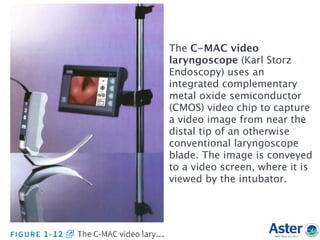
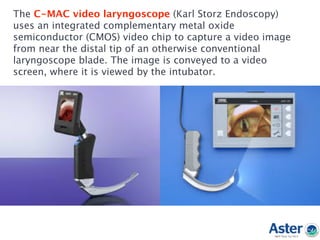
The C-MAC video
laryngoscope (Karl Storz
Endoscopy) uses an
integrated complementary
metal oxide semiconductor
(CMOS) video chip to capture
a video image from near the
distal tip of an otherwise
conventional laryngoscope
blade. The image is conveyed
to a video screen, where it is
viewed by the intubator.
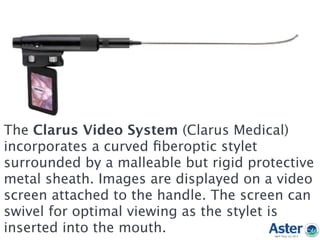
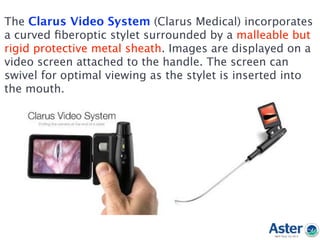
The Clarus Video System (Clarus Medical)
incorporates a curved fiberoptic stylet
surrounded by a malleable but rigid protective
metal sheath. Images are displayed on a video
screen attached to the handle. The screen can
swivel for optimal viewing as the stylet is
inserted into the mouth.
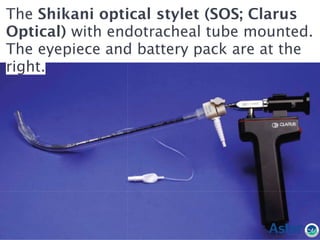
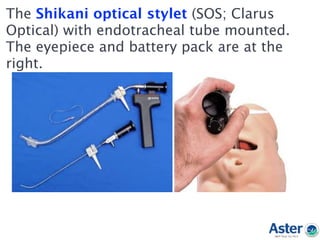
The Shikani optical stylet (SOS; Clarus
Optical) with endotracheal tube mounted.
The eyepiece and battery pack are at the
right.
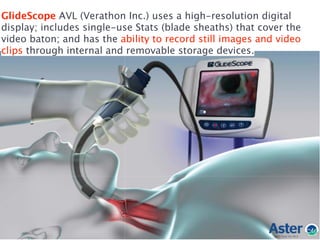
GlideScope AVL (Verathon Inc.) uses a high-resolution digital
display; includes single-use Stats (blade sheaths) that cover the
video baton; and has the ability to record still images and video
clips through internal and removable storage devices.
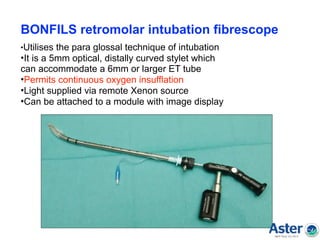
BONFILS retromolar intubation fibrescope
•Utilises the para glossal technique of intubation

•It is a 5mm optical, distally curved stylet which
can accommodate a 6mm or larger ET tube

•Permits continuous oxygen insufflation

•Light supplied via remote Xenon source

•Can be attached to a module with image display
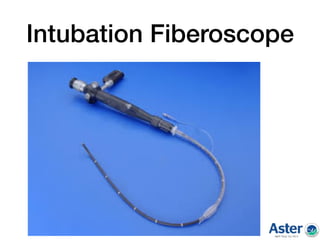
Intubation Fiberoscope
The Clarus Video System (Clarus Medical) incorporates
a curved fiberoptic stylet surrounded by a malleable but
rigid protective metal sheath. Images are displayed on a
video screen attached to the handle. The screen can
swivel for optimal viewing as the stylet is inserted into
the mouth.
The Shikani optical stylet (SOS; Clarus
Optical) with endotracheal tube mounted.
The eyepiece and battery pack are at the
right.
The C-MAC video laryngoscope (Karl Storz Endoscopy)
uses an integrated complementary metal oxide
semiconductor (CMOS) video chip to capture a video image
from near the distal tip of an otherwise conventional
laryngoscope blade. The image is conveyed to a video
screen, where it is viewed by the intubator.
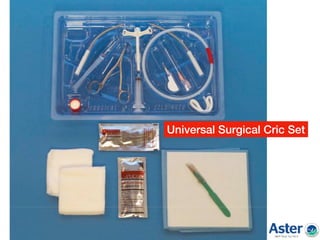
Universal Surgical Cric Set
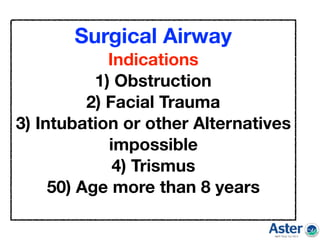
Surgical Airway
Indications
1) Obstruction
2) Facial Trauma
3) Intubation or other Alternatives
impossible
4) Trismus
50) Age more than 8 years
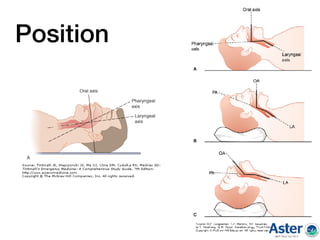
Position
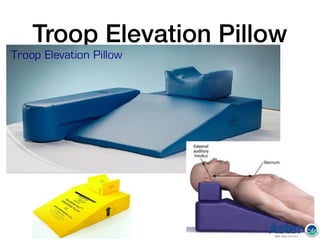
Troop Elevation Pillow
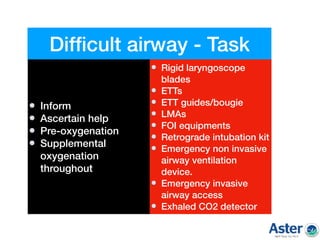
Difficult airway - Task
Inform
Ascertain help
Pre-oxygenation
Supplemental
oxygenation
throughout
Rigid laryngoscope
blades
ETTs
ETT guides/bougie
LMAs
FOI equipments
Retrograde intubation kit
Emergency non invasive
airway ventilation
device.
Emergency invasive
airway access
Exhaled CO2 detector
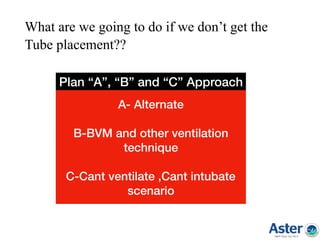
What are we going to do if we don’t get the
Tube placement??

A- Alternate
B-BVM and other ventilation
technique
C-Cant ventilate ,Cant intubate
scenario
Plan “A”, “B” and “C” Approach
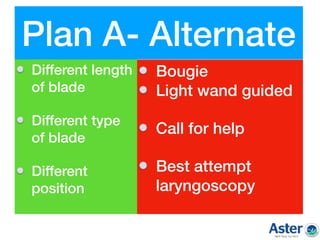
Plan A- Alternate
Different length
of blade 

Different type
of blade 

Different
position 

Bougie
Light wand guided 

Call for help 

Best attempt
laryngoscopy 

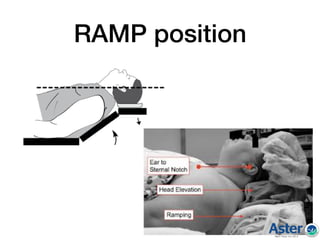
RAMP position
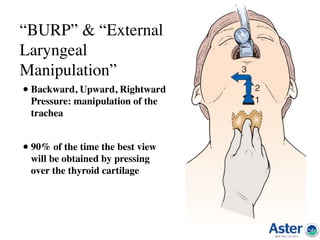
“BURP” & “External
Laryngeal
Manipulation”
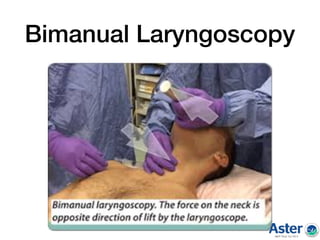
• Backward, Upward, Rightward
Pressure: manipulation of the
trachea 

• 90% of the time the best view
will be obtained by pressing
over the thyroid cartilage 

Bimanual Laryngoscopy
Plan B-BVM and other ventilation strategies
Can we Ventilate with
a BVM? (Consider
two NPA’s or a OPA,
gentle Ventilation)
Two person
ventilation
LMA an Option?
Other supra glottic 

airway ?
ILMA? 

Combi-Tube?
Kings airway

Retrograde
Intubation? 

We should have an assistant at this stage

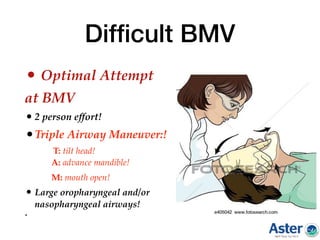
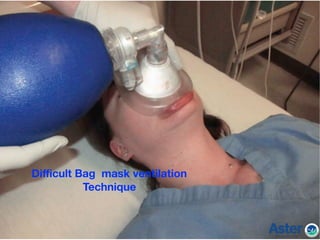
Difficult BMV
• Optimal Attempt
at BMV
•2 person effort!
•Triple Airway Maneuver:!
T: tilt head!

A: advance mandible!
M: mouth open!
•Large oropharyngeal and/or
nasopharyngeal airways!
•
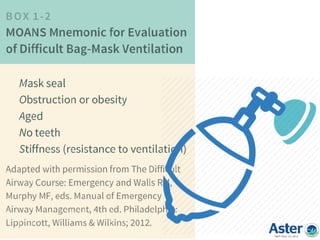
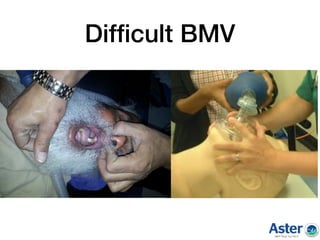
Difficult BMV
Difficult Bag mask ventilation
Technique
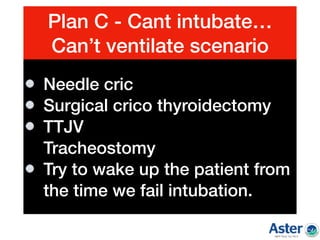
Plan C - Cant intubate…
Can’t ventilate scenario
Needle cric
Surgical crico thyroidectomy
TTJV

Tracheostomy
Try to wake up the patient from
the time we fail intubation.
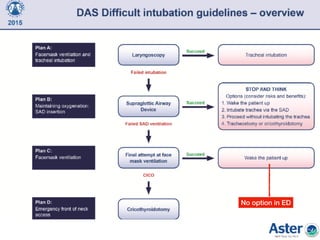
No option in ED
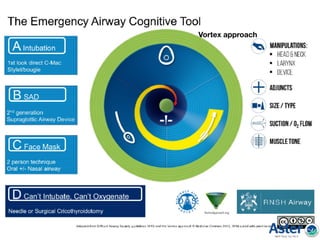
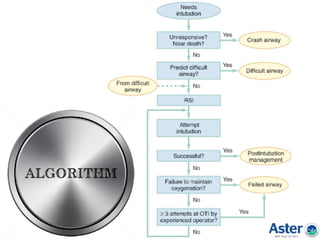
Vortex approach
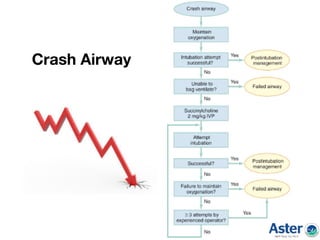
Crash Airway
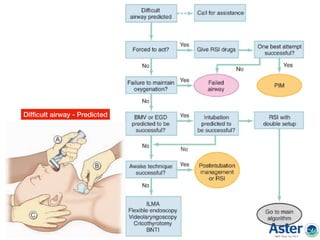
Difficult airway - Predicted
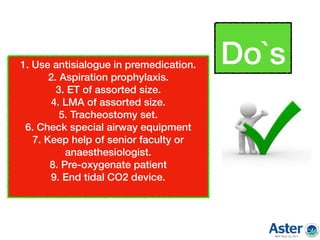
1. Use antisialogue in premedication.
2. Aspiration prophylaxis.
3. ET of assorted size.
4. LMA of assorted size.
5. Tracheostomy set.
6. Check special airway equipment
7. Keep help of senior faculty or
anaesthesiologist.
8. Pre-oxygenate patient
9. End tidal CO2 device.
Do`s
Don’ts
Don't produce deep plane of sedation
Don't use technique that you are not familiar
Avoid multiple attempts
Don't render the patient apnoeic, unless
you are certain that mask ventilation can
be maintained
Pearls
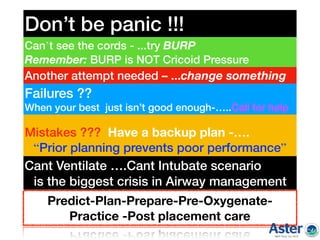
Don’t be panic !!!
Can’t see the cords - ...try BURP
Remember: BURP is NOT Cricoid Pressure
Another attempt needed – ...change something
Failures ??
When your best just isn’t good enough-…..Call for help
Mistakes ??? Have a backup plan -….
“Prior planning prevents poor performance”
Predict-Plan-Prepare-Pre-Oxygenate-
Practice -Post placement care
Cant Ventilate ….Cant Intubate scenario
is the biggest crisis in Airway management
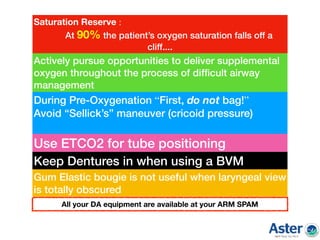
Actively pursue opportunities to deliver supplemental
oxygen throughout the process of difficult airway
management
During Pre-Oxygenation “First, do not bag!”
Avoid “Sellick’s” maneuver (cricoid pressure)
Use ETCO2 for tube positioning
Keep Dentures in when using a BVM
Saturation Reserve :
At 90% the patient’s oxygen saturation falls off a
cliff....
Gum Elastic bougie is not useful when laryngeal view
is totally obscured
All your DA equipment are available at your ARM SPAM
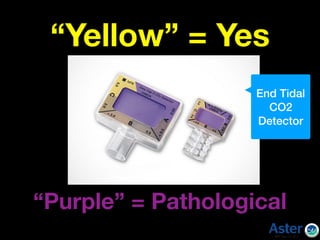
“Yellow” = Yes
“Purple” = Pathological
End Tidal
CO2
Detector
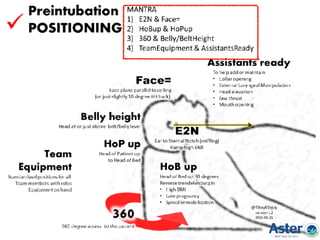
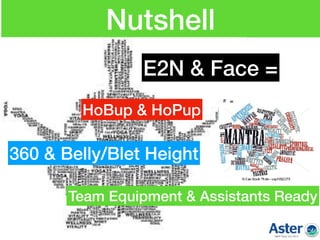
Nutshell
E2N & Face =
HoBup & HoPup
360 & Belly/Blet Height
Team Equipment & Assistants Ready
www.drvenu.blogspot.in
www.drvenu.me

Difficult airway : Made easy

  • 1.
    Difficult Airway Management :Made Easy Dr.Venugopalan P P DA,DNB,MNAMS,MEM-GW Director ,Aster DM Health care PEMAC 29.04.2018 @ Pushpagiri Medical College -Tiruvalla
  • 2.
    Making difficult airwayeasy is difficult.But anticipation, acquiring skill -Knowledge& Practice and Adequate preparedness will do it
  • 3.
    This session istry to answer …. • What is an Difficult airway ? • What are the causes for Difficulty? • How will you predict it? • How will you manage it ? • What are the pearls and do’s and don’ts? Declaration: I don’t have any conflict of interest to declare on this presentation and I am not promoting or supporting any specific company as far as the various equipment described in the session
  • 4.
    What is meantby Difficult airway ? The clinical situation in which a conventionally trained anaesthesiologist experiences difficulty with FMV of the upper airway, tracheal intubation, or both.! Represents a complex interaction between patient factors, the clinical setting, and the skills of the practitioner.
  • 5.
  • 6.
    Congenital airway abnormalities: e.g.Pierre Robin, Klippel- Feil, Down’s syndromes 
 Acquired
 Rheumatoid arthritis, Acromegaly, Benign and malignant tumors of 
 tongue, larynx etc. 
 Iatrogenic 
 Oral/pharyngeal radiotherapy, Laryngeal/tracheal surgery, TMJ surgery. 
 Reported previous anaesthetic/ Intubation problems
 Dental damage, Emergency tracheostomy, Med-alerts from 
 the previous record etc. 
 History
  • 7.
    Adverse anatomical features: Smallmouth, receding chin, high arched 
 palate, large tongue, morbid obesity 
 Mechanical limitation: reduced mouth opening, post-radiotherapy fibrosis, poor cervical spine movement 
 Poor dentition: Prominent/loose teeth 
 Orthopaedic/orthodontic equipment. 
 Patency of the nasal passage 
 GENERAL EXAMINATION
  • 8.
    AIRWAY EVALUATION a) Evaluationof tongue size relative to pharynx 
 b) Mandibular space 
 c) Assessment of glottic opening. 
 d) Mobility of the joints 
 1.TMJ
 2.Neck mobility 
 Basic categories
  • 9.
    1.Individual indices 2.Group indices Wilson’sscore Benumof’s analysis Saghei & safavi test Lemon assesment 3.Radiological indices Airway assessment indices a)X Ray Neck[Lataral] b)CT Scan c)Helical CT d)USG 4.Advanced indices • Flow volume loop • Acoustic response measurement • Ultra sound guided • CT/MRI • Flexible bronchoscope 

  • 10.
    • Distance fromthe upper border of the manubrium to the tip of mentum, neck fully extended, mouth closed 
 • Minimal acceptable value – 12.5 cm 
 • Single best predictor of difficult laryngoscopy and 
 intubation ( Has high sensitivity & specificity). 
 STERNO-MENTAL DISTANCE (SAVVA TEST)
  • 11.
    1. Occiput -C1 spinous process distance< 5mm. 2. Increase in posterior mandible depth > 2.5cm. 3. Ratio of effective mandibular length to its posterior depth <3.6. 4. Tracheal compression 
 X-Ray neck (lateral view) CT Scan: 1. Tumors of floor of mouth, pharynx, larynx 2. Cervical spine trauma, inflammation 3. Mediastinal mass
 Helical CT (3D-reconstruction): • Exact location and degree of airway compression Radiological Airway assessment Bed side Ultrasound Trachea, Soft tissues
  • 15.
    Spectrum of difficulty Difficultyat 4 level Spontaneous/mask ventilation Standard tracheal intubation Supra glottic airway Surgical Airway 4 s
  • 18.
    SIGNIFICANCE OF MMPSCORE • Class III or IV: signifies that the angle between the base of tongue and laryngeal inlet is more acute and not conducive for easy laryngoscopy • Limitations
 – Poor interobserver reliability – Limited accuracy • Good predictor in pregnancy, obesity, acromegaly
  • 19.
    LEMON in ED Mallampattiis not possible in Crash airway management and Unresponsive patients LEON Neck mobility can’t do in Trauma LEO
  • 20.
  • 21.
  • 25.
  • 28.
    What are theEquipment to manage Difficult airway ?
  • 29.
    Must available • Functioningsuction • Oxygen source • Monitors • Ventilation and Oxygenation devices • Emergency drugs DA Kit / Kart
  • 30.
  • 31.
  • 32.
  • 33.
    Forceps •Magill forceps :Double angled forceps have grasping ends in the axis of ETT and handle at the right angle •Tube bender forceps (Aillon forceps) : These have unequal limbs which can bend the distal end of the ETT in the desired direction 
 

  • 34.
  • 35.
    Different Laryngoscopes for difficultairway Left handed Macintosh blade - for left handed laryngoscopists Improved vision Macintosh blade Polio Blade – The angle between the blade and the handle is made obtuse. 

  • 36.
    Abnormalities of Rtside of Face Abnormalities of Rt Oropharynx Lt handed persons Intubations in Rt lateral position Positioning a tracheal tube directly on the left side of mouth Uses of left handed L Scope
  • 38.
    Different Laryngoscopes for difficultairway •Laryngoscope with “stunted” or short handle : useful in obese patients and in patients with large breast. •Oxiport Macintosh : It has an oxygen port in the blade allowing oxygen insufflation during intubation attempts. •Tull Macintosh : This blade has a suction port.
  • 39.
    Different Laryngoscopes for difficultairway •Siker blade : has stainless steel mirrored surface which permits visualisation of an “anterior” larynx. It gives an inverted image. •Huffman Prism : Images are real. - Prism should be placed in warm water for 30 sec on anti- fog solution to prevent fogging
  • 40.
  • 41.
  • 42.
    Bullard Laryngoscope Fiber-optic laryngoscope witha built in rigid 900 curved blade. It is battery operated Eye piece is attached to the main body of the scope at 450 angle. Useful in mid-facial hypoplasia syndrome and unstable cervical spines.
  • 43.
    Upsher fibre opticlaryngoscope Combines fibreoptic round the corner viewing with manoeuvrability. The tip of blade is advanced until it comes to rest close to the cords. The tube sits in the semi-enclosed space in the blade. The variable focus eye piece enables the operator to obtain uninterrupted
 view of the procedure. The eye piece can be attached to T.V. Camera for teaching purposes.
  • 44.
    Belscope Long angulated blade with450 bend at midpoint and a detachable prism. Minimizes damage to teeth, due to angulation – the blade stays away from upper teeth. Gives a good view of larynx when the macintosh blade gives grade 3 view
  • 45.
  • 46.
  • 47.
  • 48.
  • 49.
    The standard laryngeal mask airway(LMA Classic) is available in sizes from infant to large adult.
  • 50.
    LMA PROSEAL &LMA SUPREME Permit posterior pharyngeal suctioning
  • 51.
    The i-gel maskairway does not have an inflatable cuff and is available in sizes from infant to adult
  • 52.
    The intubating laryngealmask airway is modified to facilitate insertion of an endotracheal tube after placement and ventilation have been achieved. The epiglottic elevator (arrowhead) lifts the epiglottis to allow passage of the special endotracheal tube (arrow)
  • 53.
    The Combitube isinserted through the mouth blindly, although a laryngoscope can be used if desired. It seats itself in the esophagus more than 95% of the time, and ventilation is performed through the proximal lumen and side ports (white arrows) after inflation of the two balloons. The lower balloon (arrowhead) occludes the esophagus. The upper (large) balloon (thick arrow) occludes the oropharynx. If the tube is in the trachea, the alternate lumen (clear arrow) is used for ventilation.
  • 54.
    Pharyngo-tracheal lumen airway- it is double lumen tube consisting of a long tube with a distal cuff (15 cc) designed to be inflated in esophagus and shorter tube that protrudes through the larger tube and past alarge proximal cuff (100 cc) to ventillate the lungs.
  • 55.
    King laryngeal tubeincorporates two cuffs but inflates with a single bolus of air. There is a channel in the back for passage of an orogastric tube. It is available in a variety of adult sizes.
  • 56.
  • 57.
  • 58.
    COPA (Cuffed Oropharyngealairway )- Disposable device that combines a guided airway with an inflatable distal high volume lowpressure cuff and a proximal 15mm adapter. - distal tip should be behind base of tongue
  • 59.
    Pharyngeal airway Xpress– Curved tube with anatomically shaped gilled distal tip, large oropharyngeal cuff and an open hooded window that allows ventilation. More effective seal than LMA.
  • 60.
    New type ofSLA device that does not have a cuff, rather, it has a preformed plastic that fits anatomically to the shape of the pharynx. This device allows one to give positive pressure ventilation to the patient without cuff Streamlined liner of pharyngeal airway (SLIPA)
  • 61.
    The C-MAC video laryngoscope(Karl Storz Endoscopy) uses an integrated complementary metal oxide semiconductor (CMOS) video chip to capture a video image from near the distal tip of an otherwise conventional laryngoscope blade. The image is conveyed to a video screen, where it is viewed by the intubator.
  • 62.
    The Clarus VideoSystem (Clarus Medical) incorporates a curved fiberoptic stylet surrounded by a malleable but rigid protective metal sheath. Images are displayed on a video screen attached to the handle. The screen can swivel for optimal viewing as the stylet is inserted into the mouth.
  • 63.
    The Shikani opticalstylet (SOS; Clarus Optical) with endotracheal tube mounted. The eyepiece and battery pack are at the right.
  • 64.
    GlideScope AVL (VerathonInc.) uses a high-resolution digital display; includes single-use Stats (blade sheaths) that cover the video baton; and has the ability to record still images and video clips through internal and removable storage devices.
  • 65.
    BONFILS retromolar intubationfibrescope •Utilises the para glossal technique of intubation
 •It is a 5mm optical, distally curved stylet which can accommodate a 6mm or larger ET tube
 •Permits continuous oxygen insufflation
 •Light supplied via remote Xenon source
 •Can be attached to a module with image display
  • 66.
  • 67.
    The Clarus VideoSystem (Clarus Medical) incorporates a curved fiberoptic stylet surrounded by a malleable but rigid protective metal sheath. Images are displayed on a video screen attached to the handle. The screen can swivel for optimal viewing as the stylet is inserted into the mouth.
  • 68.
    The Shikani opticalstylet (SOS; Clarus Optical) with endotracheal tube mounted. The eyepiece and battery pack are at the right.
  • 69.
    The C-MAC videolaryngoscope (Karl Storz Endoscopy) uses an integrated complementary metal oxide semiconductor (CMOS) video chip to capture a video image from near the distal tip of an otherwise conventional laryngoscope blade. The image is conveyed to a video screen, where it is viewed by the intubator.
  • 70.
  • 71.
    Surgical Airway Indications 1) Obstruction 2)Facial Trauma 3) Intubation or other Alternatives impossible 4) Trismus 50) Age more than 8 years
  • 72.
  • 73.
  • 74.
    Difficult airway -Task Inform Ascertain help Pre-oxygenation Supplemental oxygenation throughout Rigid laryngoscope blades ETTs ETT guides/bougie LMAs FOI equipments Retrograde intubation kit Emergency non invasive airway ventilation device. Emergency invasive airway access Exhaled CO2 detector
  • 75.
    What are wegoing to do if we don’t get the Tube placement??
 A- Alternate B-BVM and other ventilation technique C-Cant ventilate ,Cant intubate scenario Plan “A”, “B” and “C” Approach
  • 76.
    Plan A- Alternate Differentlength of blade 
 Different type of blade 
 Different position 
 Bougie Light wand guided 
 Call for help 
 Best attempt laryngoscopy 

  • 77.
  • 78.
    “BURP” & “External Laryngeal Manipulation” •Backward, Upward, Rightward Pressure: manipulation of the trachea 
 • 90% of the time the best view will be obtained by pressing over the thyroid cartilage 

  • 79.
  • 80.
    Plan B-BVM andother ventilation strategies Can we Ventilate with a BVM? (Consider two NPA’s or a OPA, gentle Ventilation) Two person ventilation LMA an Option? Other supra glottic 
 airway ? ILMA? 
 Combi-Tube? Kings airway
 Retrograde Intubation? 
 We should have an assistant at this stage

  • 81.
    Difficult BMV • OptimalAttempt at BMV •2 person effort! •Triple Airway Maneuver:! T: tilt head!
 A: advance mandible! M: mouth open! •Large oropharyngeal and/or nasopharyngeal airways! •
  • 82.
  • 83.
    Difficult Bag maskventilation Technique
  • 84.
    Plan C -Cant intubate… Can’t ventilate scenario Needle cric Surgical crico thyroidectomy TTJV
 Tracheostomy Try to wake up the patient from the time we fail intubation.
  • 85.
  • 86.
  • 88.
  • 89.
  • 91.
    1. Use antisialoguein premedication. 2. Aspiration prophylaxis. 3. ET of assorted size. 4. LMA of assorted size. 5. Tracheostomy set. 6. Check special airway equipment 7. Keep help of senior faculty or anaesthesiologist. 8. Pre-oxygenate patient 9. End tidal CO2 device. Do`s
  • 92.
    Don’ts Don't produce deepplane of sedation Don't use technique that you are not familiar Avoid multiple attempts Don't render the patient apnoeic, unless you are certain that mask ventilation can be maintained
  • 93.
  • 94.
    Don’t be panic!!! Can’t see the cords - ...try BURP Remember: BURP is NOT Cricoid Pressure Another attempt needed – ...change something Failures ?? When your best just isn’t good enough-…..Call for help Mistakes ??? Have a backup plan -…. “Prior planning prevents poor performance” Predict-Plan-Prepare-Pre-Oxygenate- Practice -Post placement care Cant Ventilate ….Cant Intubate scenario is the biggest crisis in Airway management
  • 95.
    Actively pursue opportunitiesto deliver supplemental oxygen throughout the process of difficult airway management During Pre-Oxygenation “First, do not bag!” Avoid “Sellick’s” maneuver (cricoid pressure) Use ETCO2 for tube positioning Keep Dentures in when using a BVM Saturation Reserve : At 90% the patient’s oxygen saturation falls off a cliff.... Gum Elastic bougie is not useful when laryngeal view is totally obscured All your DA equipment are available at your ARM SPAM
  • 96.
    “Yellow” = Yes “Purple”= Pathological End Tidal CO2 Detector
  • 98.
    Nutshell E2N & Face= HoBup & HoPup 360 & Belly/Blet Height Team Equipment & Assistants Ready
  • 99.