Capnography
Prepared By:
The Anesthesia Team
Al Shifa Medical Complex
Palestine
Zoom
Outlines
• History
• Standards for basic anesthetic monitoring
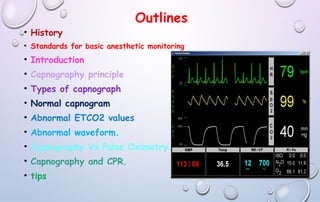
• Introduction
• Capnography principle
• Types of capnograph
• Normal capnogram
• Abnormal ETCO2 values
• Abnormal waveform.
• Capnography Vs Pulse Oximetry.
• Capnography and CPR.
• tips
History
 In 1943, luft developed the principle of capnography based on the fact
that CO2 absorbs infrared light.
 In the 1970s capnography was first studied clinically by smallhout and
kalenda in humans and has since been researched extensively.
 By 1985, capnography was considered the standard of care for basic
anesthesia monitoring by the american society of anesthesiologists.
 In the mid-1990s, co2 monitors (capnographs) became small and
inexpensive enough to be used in veterinary medicine
Capnography minimizes the need for repetitive arterial blood gas
sampling, thus providing an excellent noninvasive monitoring and diagnostic
tool.
Standards for basic anesthetic monitoring
 ASA standard II :
“During all anesthetics, the patient’s oxygenation, ventilation, circulation and
temperature shall be continually evaluated.”
“Every patient receiving general anesthesia shall have the adequacy of
ventilation continually evaluated.
 Qualitative clinical signs such as chest excursion, observation of the reservoir
breathing bag and auscultation of breath sounds are useful.
Continual monitoring for the presence of expired carbon dioxide shall be
performed unless invalidated by the nature of the patient, procedure or
equipment.
 Quantitative monitoring of the volume of expired gas is strongly encouraged.”*
• Developed by: committee on standards and practice parameters (CSPP)
last affirmed: december 13, 2020 (last amended october 20, 2010) (original approval: october 21, 1986)
Introduction
Definitions
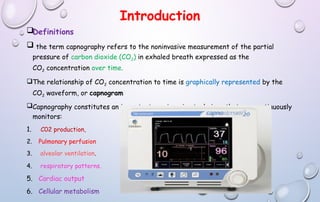
 the term capnography refers to the noninvasive measurement of the partial
pressure of carbon dioxide (CO2) in exhaled breath expressed as the
CO2 concentration over time.
The relationship of CO2 concentration to time is graphically represented by the
CO2 waveform, or capnogram
Capnography constitutes an important non-invasive technique that can continuously
monitors:
1. C02 production,
2. Pulmonary perfusion
3. alveolar ventilation.
4. respiratory patterns.
5. Cardiac output
6. Cellular metabolism
Introduction
 The measurement of c02 in the expired air:
1- Directly indicates:
changes in the elimination of c02 from the lungs
(ventilation)
2- Indirectly it indicates:
 changes in the production of c02 at the tissue
level.(metabolism)
 the delivery of c02 to the lungs by the circulatory
system.(C.O.)
Capnography principle
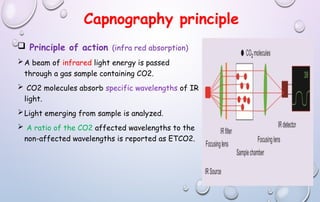
 Principle of action (infra red absorption)
A beam of infrared light energy is passed
through a gas sample containing CO2.
 CO2 molecules absorb specific wavelengths of IR
light.
Light emerging from sample is analyzed.
 A ratio of the CO2 affected wavelengths to the
non-affected wavelengths is reported as ETCO2.
Types of capnograph
1- conventional technology
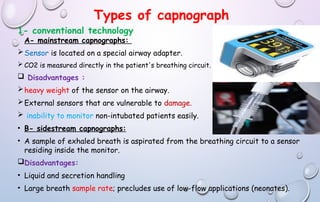
A- mainstream capnographs:
Sensor is located on a special airway adapter.
 CO2 is measured directly in the patient's breathing circuit.
 Disadvantages :
heavy weight of the sensor on the airway.
External sensors that are vulnerable to damage.
 inability to monitor non-intubated patients easily.
• B- sidestream capnographs:
• A sample of exhaled breath is aspirated from the breathing circuit to a sensor
residing inside the monitor.
Disadvantages:
• Liquid and secretion handling
• Large breath sample rate; precludes use of low-flow applications (neonates).
Types of capnograph
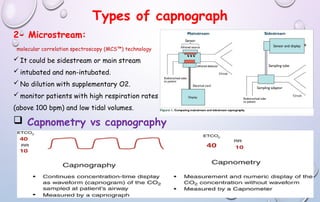
2- Microstream:
molecular correlation spectroscopy (MCS™) technology
 It could be sidestream or main stream
 intubated and non-intubated.
 No dilution with supplementary O2.
 monitor patients with high respiration rates
(above 100 bpm) and low tidal volumes.
 Capnometry vs capnography
Normal capnogram
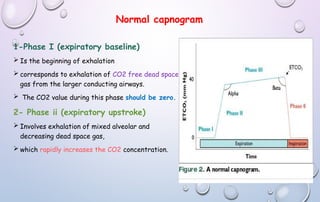
1-Phase I (expiratory baseline)
 Is the beginning of exhalation
 corresponds to exhalation of CO2 free dead space
gas from the larger conducting airways.
 The CO2 value during this phase should be zero.
2- Phase ii (expiratory upstroke)
 Involves exhalation of mixed alveolar and
decreasing dead space gas,
 which rapidly increases the CO2 concentration.
Normal capnogram
3- Phase III (expiratory plateau)
 Occurs when all the dead space gas has been exhaled.
 resulting in exhalation of completely alveolar air.
 The highest point of phase III corresponds with the actual ETCO2 value.
 The plateau has a slight positive slope because of the continuous diffusion of CO2
from the capillaries into the alveolar space.
4- Phase 0 (inspiratory downstroke)
 Because of inhalation of co2-free gas,
 the CO2 concentration rapidly declines­to zero.
 The alpha angle (100°-110°)
• an indirect indication of the VA/Q status of the lungs.
 The beta angle (90°)
• The beta angle is used to assess the degree of rebreathing.
Abnormal ETCO2 values
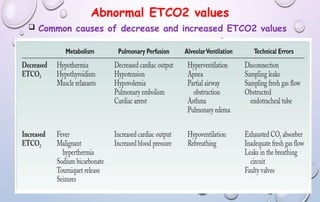
 Common causes of decrease and increased ETCO2 values
Abnormal waveform
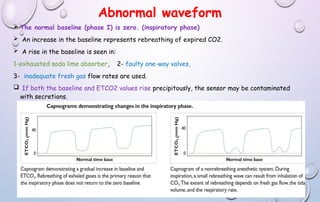
 The normal baseline (phase I) is zero. (inspiratory phase)
 An increase in the baseline represents rebreathing of expired CO2.
 A rise in the baseline is seen in:
1-exhausted soda lime absorber, 2- faulty one-way valves,
3- inadequate fresh gas flow rates are used.
 If both the baseline and ETCO2 values rise precipitously, the sensor may be contaminated
with secretions.
Abnormal waveform
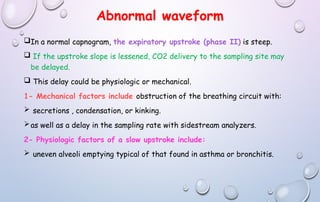
In a normal capnogram, the expiratory upstroke (phase II) is steep.
 If the upstroke slope is lessened, CO2 delivery to the sampling site may
be delayed.
 This delay could be physiologic or mechanical.
1- Mechanical factors include obstruction of the breathing circuit with:
 secretions , condensation, or kinking.
as well as a delay in the sampling rate with sidestream analyzers.
2- Physiologic factors of a slow upstroke include:
 uneven alveoli emptying typical of that found in asthma or bronchitis.
Abnormal waveform
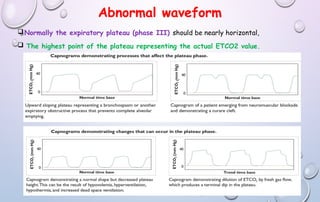
Normally the expiratory plateau (phase III) should be nearly horizontal,
 The highest point of the plateau representing the actual ETCO2 value.
Abnormal waveform
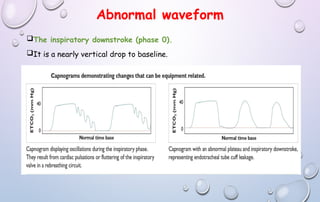
The inspiratory downstroke (phase 0).
It is a nearly vertical drop to baseline.
Capnography Vs Pulse Oximetry
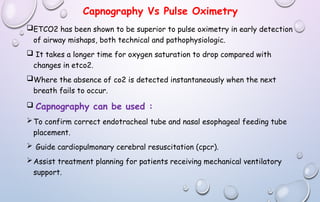
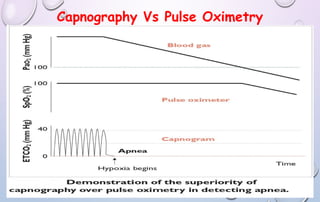
ETCO2 has been shown to be superior to pulse oximetry in early detection
of airway mishaps, both technical and pathophysiologic.
 It takes a longer time for oxygen saturation to drop compared with
changes in etco2.
Where the absence of co2 is detected instantaneously when the next
breath fails to occur.
 Capnography can be used :
To confirm correct endotracheal tube and nasal esophageal feeding tube
placement.
 Guide cardiopulmonary cerebral resuscitation (cpcr).
Assist treatment planning for patients receiving mechanical ventilatory
support.
Capnography Vs Pulse Oximetry
Capnography and CPR
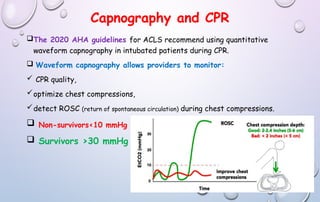
The 2020 AHA guidelines for ACLS recommend using quantitative
waveform capnography in intubated patients during CPR.
 Waveform capnography allows providers to monitor:
 CPR quality,
optimize chest compressions,
detect ROSC (return of spontaneous circulation) during chest compressions.
 Non-survivors<10 mmHg
 Survivors >30 mmHg
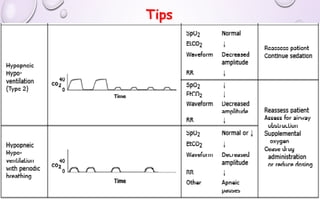
Tips
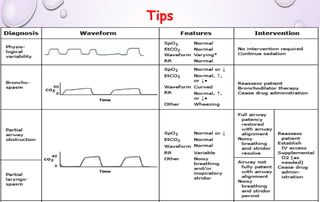
Tips
Tips
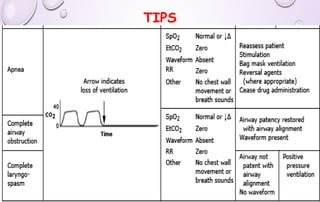
TIPS
capnographyyyyyyyyyyyyyyyyyy (4447).pptx

capnographyyyyyyyyyyyyyyyyyy (4447).pptx

  • 1.
    Capnography Prepared By: The AnesthesiaTeam Al Shifa Medical Complex Palestine Zoom
  • 2.
    Outlines • History • Standardsfor basic anesthetic monitoring • Introduction • Capnography principle • Types of capnograph • Normal capnogram • Abnormal ETCO2 values • Abnormal waveform. • Capnography Vs Pulse Oximetry. • Capnography and CPR. • tips
  • 3.
    History  In 1943,luft developed the principle of capnography based on the fact that CO2 absorbs infrared light.  In the 1970s capnography was first studied clinically by smallhout and kalenda in humans and has since been researched extensively.  By 1985, capnography was considered the standard of care for basic anesthesia monitoring by the american society of anesthesiologists.  In the mid-1990s, co2 monitors (capnographs) became small and inexpensive enough to be used in veterinary medicine Capnography minimizes the need for repetitive arterial blood gas sampling, thus providing an excellent noninvasive monitoring and diagnostic tool.
  • 4.
    Standards for basicanesthetic monitoring  ASA standard II : “During all anesthetics, the patient’s oxygenation, ventilation, circulation and temperature shall be continually evaluated.” “Every patient receiving general anesthesia shall have the adequacy of ventilation continually evaluated.  Qualitative clinical signs such as chest excursion, observation of the reservoir breathing bag and auscultation of breath sounds are useful. Continual monitoring for the presence of expired carbon dioxide shall be performed unless invalidated by the nature of the patient, procedure or equipment.  Quantitative monitoring of the volume of expired gas is strongly encouraged.”* • Developed by: committee on standards and practice parameters (CSPP) last affirmed: december 13, 2020 (last amended october 20, 2010) (original approval: october 21, 1986)
  • 5.
    Introduction Definitions  the termcapnography refers to the noninvasive measurement of the partial pressure of carbon dioxide (CO2) in exhaled breath expressed as the CO2 concentration over time. The relationship of CO2 concentration to time is graphically represented by the CO2 waveform, or capnogram Capnography constitutes an important non-invasive technique that can continuously monitors: 1. C02 production, 2. Pulmonary perfusion 3. alveolar ventilation. 4. respiratory patterns. 5. Cardiac output 6. Cellular metabolism
  • 6.
    Introduction  The measurementof c02 in the expired air: 1- Directly indicates: changes in the elimination of c02 from the lungs (ventilation) 2- Indirectly it indicates:  changes in the production of c02 at the tissue level.(metabolism)  the delivery of c02 to the lungs by the circulatory system.(C.O.)
  • 7.
    Capnography principle  Principleof action (infra red absorption) A beam of infrared light energy is passed through a gas sample containing CO2.  CO2 molecules absorb specific wavelengths of IR light. Light emerging from sample is analyzed.  A ratio of the CO2 affected wavelengths to the non-affected wavelengths is reported as ETCO2.
  • 8.
    Types of capnograph 1-conventional technology A- mainstream capnographs: Sensor is located on a special airway adapter.  CO2 is measured directly in the patient's breathing circuit.  Disadvantages : heavy weight of the sensor on the airway. External sensors that are vulnerable to damage.  inability to monitor non-intubated patients easily. • B- sidestream capnographs: • A sample of exhaled breath is aspirated from the breathing circuit to a sensor residing inside the monitor. Disadvantages: • Liquid and secretion handling • Large breath sample rate; precludes use of low-flow applications (neonates).
  • 9.
    Types of capnograph 2-Microstream: molecular correlation spectroscopy (MCS™) technology  It could be sidestream or main stream  intubated and non-intubated.  No dilution with supplementary O2.  monitor patients with high respiration rates (above 100 bpm) and low tidal volumes.  Capnometry vs capnography
  • 10.
    Normal capnogram 1-Phase I(expiratory baseline)  Is the beginning of exhalation  corresponds to exhalation of CO2 free dead space gas from the larger conducting airways.  The CO2 value during this phase should be zero. 2- Phase ii (expiratory upstroke)  Involves exhalation of mixed alveolar and decreasing dead space gas,  which rapidly increases the CO2 concentration.
  • 11.
    Normal capnogram 3- PhaseIII (expiratory plateau)  Occurs when all the dead space gas has been exhaled.  resulting in exhalation of completely alveolar air.  The highest point of phase III corresponds with the actual ETCO2 value.  The plateau has a slight positive slope because of the continuous diffusion of CO2 from the capillaries into the alveolar space. 4- Phase 0 (inspiratory downstroke)  Because of inhalation of co2-free gas,  the CO2 concentration rapidly declines­to zero.  The alpha angle (100°-110°) • an indirect indication of the VA/Q status of the lungs.  The beta angle (90°) • The beta angle is used to assess the degree of rebreathing.
  • 12.
    Abnormal ETCO2 values Common causes of decrease and increased ETCO2 values
  • 13.
    Abnormal waveform  Thenormal baseline (phase I) is zero. (inspiratory phase)  An increase in the baseline represents rebreathing of expired CO2.  A rise in the baseline is seen in: 1-exhausted soda lime absorber, 2- faulty one-way valves, 3- inadequate fresh gas flow rates are used.  If both the baseline and ETCO2 values rise precipitously, the sensor may be contaminated with secretions.
  • 14.
    Abnormal waveform In anormal capnogram, the expiratory upstroke (phase II) is steep.  If the upstroke slope is lessened, CO2 delivery to the sampling site may be delayed.  This delay could be physiologic or mechanical. 1- Mechanical factors include obstruction of the breathing circuit with:  secretions , condensation, or kinking. as well as a delay in the sampling rate with sidestream analyzers. 2- Physiologic factors of a slow upstroke include:  uneven alveoli emptying typical of that found in asthma or bronchitis.
  • 15.
    Abnormal waveform Normally theexpiratory plateau (phase III) should be nearly horizontal,  The highest point of the plateau representing the actual ETCO2 value.
  • 16.
    Abnormal waveform The inspiratorydownstroke (phase 0). It is a nearly vertical drop to baseline.
  • 17.
    Capnography Vs PulseOximetry ETCO2 has been shown to be superior to pulse oximetry in early detection of airway mishaps, both technical and pathophysiologic.  It takes a longer time for oxygen saturation to drop compared with changes in etco2. Where the absence of co2 is detected instantaneously when the next breath fails to occur.  Capnography can be used : To confirm correct endotracheal tube and nasal esophageal feeding tube placement.  Guide cardiopulmonary cerebral resuscitation (cpcr). Assist treatment planning for patients receiving mechanical ventilatory support.
  • 18.
  • 19.
    Capnography and CPR The2020 AHA guidelines for ACLS recommend using quantitative waveform capnography in intubated patients during CPR.  Waveform capnography allows providers to monitor:  CPR quality, optimize chest compressions, detect ROSC (return of spontaneous circulation) during chest compressions.  Non-survivors<10 mmHg  Survivors >30 mmHg
  • 20.
  • 21.
  • 22.
  • 23.