CAPNOGRAPHY and PULSE OXIMETRY
CAPNOGRAPHIC DEVICES Infrared Absorption Photometry Colorimetric Devices Mass Spectrometry Raman Scattering
INFRARED First developed in 1859. Based on Beer-Lambert law:  Pa = 1 - e -    DC Pa is fraction of light absorbed    is absorption coefficient D is distance light travels   though the gas C is molar gas concentration The higher the CO 2  concentration, the higher the absorption. CO 2  absorption takes place at 4.25 µm N 2 O, H 2 O, and CO can also absorb at this wavelength Two types: side port and mainstream
ABSORPTION BANDS
SIDE PORT Gas is sampled through a small tube Analysis is performed in a separate chamber Very reliable Time delay of 1-60 seconds Less accurate at higher respiratory rates Prone to plugging by water and secretions Ambient air leaks
MAINSTREAM Sensor is located in the airway Response time as little as 40msec Very accurate Difficult to calibrate without disconnecting (makes it hard to detect rebreathing) More prone to the reading being affected by moisture Larger, can kink the tube. Adds dead space to the airway Bigger chance of being damaged by mishandling
COLORIMETRIC Contains a pH sensitive dye which undergoes a color change in the presence of CO 2 The dye is usually metacresol purple and it changes to yellow in the presence of CO 2 Portable and lightweight. Low false positive rate Higher false negative rate Acidic solutions, e.g., epi, atropine, lidocaine, will permanently change the color Dead space relatively high for neonates, so don’t use for long periods of time on those patients.
NORMAL CAPNOGRAM
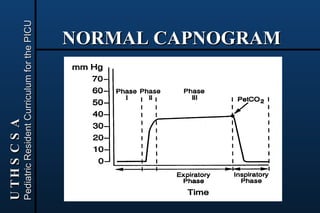
NORMAL CAPNOGRAM Phase I is the beginning of exhalation Phase I represents most of the anatomical dead space Phase II is where the alveolar gas begins to mix with the dead space gas and the CO 2  begins to rapidly rise The anatomic dead space can be calculated using Phase I and II Alveolar dead space can be calculated on the basis of : V D  = V Danat  + V Dalv Significant increase in the alveolar dead space signifies V/Q mismatch
NORMAL CAPNOGRAM Phase III corresponds to the elimination of CO 2  from the alveoli Phase III usually has a slight increase in the slope as “slow” alveoli empty The “slow” alveoli have a lower V/Q ratio and therefore have higher CO 2  concentrations In addition, diffusion of CO 2  into the alveoli is greater during expiration.  More pronounced in infants ET CO 2  is measured at the maximal point of Phase III. Phase IV is the inspirational phase
ABNORMALITIES  Increased Phase III slope Obstructive lung disease Phase III dip Spontaneous resp Horizontal Phase III with large ET-art CO 2  change Pulmonary embolism    cardiac output Hypovolemia Sudden    in ETCO 2  to 0 Dislodged tube Vent malfunction ET obstruction Sudden    in ETCO 2   Partial obstruction Air leak Exponential   Severe hyperventilation Cardiopulmonary event
ABNORMALITIES Gradual     Hyperventilation Decreasing temp Gradual    in volume Sudden increase in ETCO 2 Sodium bicarb administration Release of limb tourniquet Gradual increase Fever Hypoventilation Increased baseline Rebreathing Exhausted CO 2  absorber
PaCO 2 -PetCO 2  gradient Usually <6mm Hg PetCO 2  is usually less Difference depends on the number of underperfused alveoli Tend to mirror each other if the slope of Phase III is horizontal or has a minimal slope Decreased cardiac output will increase the gradient The gradient can be negative when healthy lungs are ventilated with high TV and low rate Decreased FRC also gives a negative gradient by increasing the number of slow alveoli
LIMITATIONS Critically ill patients often have rapidly changing dead space and V/Q mismatch Higher rates and smaller TV can increase the amount of dead space ventilation High mean airway pressures and PEEP restrict alveolar perfusion, leading to falsely decreased readings Low cardiac output will decrease the reading
USES Metabolic Assess energy expenditure Cardiovascular Monitor trend in cardiac output Can use as an indirect Fick method, but actual numbers are hard to quantify Measure of effectiveness in CPR Diagnosis of pulmonary embolism: measure gradient
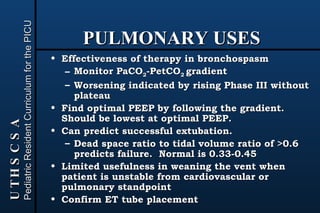
PULMONARY USES Effectiveness of therapy in bronchospasm Monitor PaCO 2 -PetCO 2  gradient Worsening indicated by rising Phase III without plateau Find optimal PEEP by following the gradient.  Should be lowest at optimal PEEP. Can predict successful extubation.  Dead space ratio to tidal volume ratio of >0.6 predicts failure.  Normal is 0.33-0.45 Limited usefulness in weaning the vent when patient is unstable from cardiovascular or pulmonary standpoint Confirm ET tube placement
CAPNOGRAM #1 J Int Care Med, 12(1): 18-32, 1997
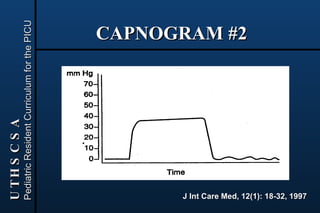
CAPNOGRAM #2 J Int Care Med, 12(1): 18-32, 1997
CAPNOGRAM #3 J Int Care Med, 12(1): 18-32, 1997
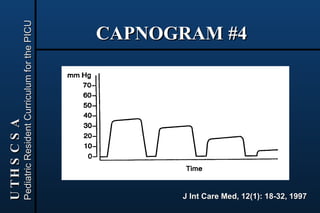
CAPNOGRAM #4 J Int Care Med, 12(1): 18-32, 1997
CAPNOGRAM #5 J Int Care Med, 12(1): 18-32, 1997
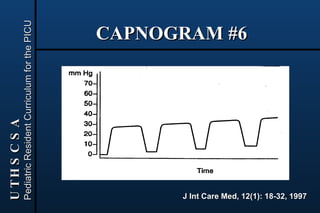
CAPNOGRAM #6 J Int Care Med, 12(1): 18-32, 1997
CAPNOGRAM #7 J Int Care Med, 12(1): 18-32, 1997
CAPNOGRAM #8 J Int Care Med, 12(1): 18-32, 1997
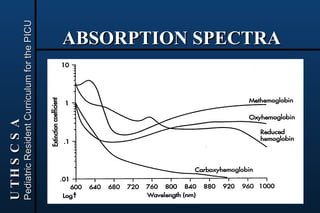
PULSE OXIMETRY Uses spectrophotometry based on the Beer-Lambert law Differentiates oxy- from deoxyhemoglobin by the differences in absorption at 660nm and 940nm Minimizes tissue interference by separating out the pulsatile signal  Estimates heart rate by measuring cyclic changes in light transmission Measures 4 types of hemoglobin: deoxy, oxy, carboxy, and met Estimates functional hemoglobin saturation: oxyhemoglobin/deoxy + oxy
ABSORPTION SPECTRA
SOURCES OF ERROR Sensitive to motion Standard deviation is certified to 4% down to 70% saturation Sats below 85% increase the importance of error in the reading Calibration is performed by company on normal patients breathing various gas mixtures, so calibration is certain only down to 80%
SOURCES OF ERROR Skin Pigmentation Darker color may make the reading more variable due to optical shunting. Dark nail polish has same effect: blue, black, and green polishes underestimate saturations, while red and purple have no effect Hyperbilirubinemia has no effect Low perfusion state Ambient Light Delay in reading of about 12 seconds
SOURCES OF ERROR Methylene blue and indigo carmine underestimate the saturation Dysfunctional hemoglobin Carboxyhgb leads to overestimation of sats because it absorbs at 660nm with an absorption coefficient nearly identical to oxyhgb Methgb can mask the true saturation by absorbing too much light at both 660nm and 940nm.  Saturations are overestimated, but drop no further than 85%, which occurs when methgb reaches 35%.
SOURCES OF ERROR Affect of anemia is debated Oxygen-Hemoglobin Dissociation Curve Shifts in the curve can affect the reading Oximetry reading of 95% could correspond to a P a O 2  of 60mmHg (91% saturation) or 160mmHg (99% saturation)

06 capnography and pulseoximetry

  • 1.
  • 2.
    CAPNOGRAPHIC DEVICES InfraredAbsorption Photometry Colorimetric Devices Mass Spectrometry Raman Scattering
  • 3.
    INFRARED First developedin 1859. Based on Beer-Lambert law: Pa = 1 - e -  DC Pa is fraction of light absorbed  is absorption coefficient D is distance light travels though the gas C is molar gas concentration The higher the CO 2 concentration, the higher the absorption. CO 2 absorption takes place at 4.25 µm N 2 O, H 2 O, and CO can also absorb at this wavelength Two types: side port and mainstream
  • 4.
  • 5.
    SIDE PORT Gasis sampled through a small tube Analysis is performed in a separate chamber Very reliable Time delay of 1-60 seconds Less accurate at higher respiratory rates Prone to plugging by water and secretions Ambient air leaks
  • 6.
    MAINSTREAM Sensor islocated in the airway Response time as little as 40msec Very accurate Difficult to calibrate without disconnecting (makes it hard to detect rebreathing) More prone to the reading being affected by moisture Larger, can kink the tube. Adds dead space to the airway Bigger chance of being damaged by mishandling
  • 7.
    COLORIMETRIC Contains apH sensitive dye which undergoes a color change in the presence of CO 2 The dye is usually metacresol purple and it changes to yellow in the presence of CO 2 Portable and lightweight. Low false positive rate Higher false negative rate Acidic solutions, e.g., epi, atropine, lidocaine, will permanently change the color Dead space relatively high for neonates, so don’t use for long periods of time on those patients.
  • 8.
  • 9.
    NORMAL CAPNOGRAM PhaseI is the beginning of exhalation Phase I represents most of the anatomical dead space Phase II is where the alveolar gas begins to mix with the dead space gas and the CO 2 begins to rapidly rise The anatomic dead space can be calculated using Phase I and II Alveolar dead space can be calculated on the basis of : V D = V Danat + V Dalv Significant increase in the alveolar dead space signifies V/Q mismatch
  • 10.
    NORMAL CAPNOGRAM PhaseIII corresponds to the elimination of CO 2 from the alveoli Phase III usually has a slight increase in the slope as “slow” alveoli empty The “slow” alveoli have a lower V/Q ratio and therefore have higher CO 2 concentrations In addition, diffusion of CO 2 into the alveoli is greater during expiration. More pronounced in infants ET CO 2 is measured at the maximal point of Phase III. Phase IV is the inspirational phase
  • 11.
    ABNORMALITIES IncreasedPhase III slope Obstructive lung disease Phase III dip Spontaneous resp Horizontal Phase III with large ET-art CO 2 change Pulmonary embolism  cardiac output Hypovolemia Sudden  in ETCO 2 to 0 Dislodged tube Vent malfunction ET obstruction Sudden  in ETCO 2 Partial obstruction Air leak Exponential  Severe hyperventilation Cardiopulmonary event
  • 12.
    ABNORMALITIES Gradual  Hyperventilation Decreasing temp Gradual  in volume Sudden increase in ETCO 2 Sodium bicarb administration Release of limb tourniquet Gradual increase Fever Hypoventilation Increased baseline Rebreathing Exhausted CO 2 absorber
  • 13.
    PaCO 2 -PetCO2 gradient Usually <6mm Hg PetCO 2 is usually less Difference depends on the number of underperfused alveoli Tend to mirror each other if the slope of Phase III is horizontal or has a minimal slope Decreased cardiac output will increase the gradient The gradient can be negative when healthy lungs are ventilated with high TV and low rate Decreased FRC also gives a negative gradient by increasing the number of slow alveoli
  • 14.
    LIMITATIONS Critically illpatients often have rapidly changing dead space and V/Q mismatch Higher rates and smaller TV can increase the amount of dead space ventilation High mean airway pressures and PEEP restrict alveolar perfusion, leading to falsely decreased readings Low cardiac output will decrease the reading
  • 15.
    USES Metabolic Assessenergy expenditure Cardiovascular Monitor trend in cardiac output Can use as an indirect Fick method, but actual numbers are hard to quantify Measure of effectiveness in CPR Diagnosis of pulmonary embolism: measure gradient
  • 16.
    PULMONARY USES Effectivenessof therapy in bronchospasm Monitor PaCO 2 -PetCO 2 gradient Worsening indicated by rising Phase III without plateau Find optimal PEEP by following the gradient. Should be lowest at optimal PEEP. Can predict successful extubation. Dead space ratio to tidal volume ratio of >0.6 predicts failure. Normal is 0.33-0.45 Limited usefulness in weaning the vent when patient is unstable from cardiovascular or pulmonary standpoint Confirm ET tube placement
  • 17.
    CAPNOGRAM #1 JInt Care Med, 12(1): 18-32, 1997
  • 18.
    CAPNOGRAM #2 JInt Care Med, 12(1): 18-32, 1997
  • 19.
    CAPNOGRAM #3 JInt Care Med, 12(1): 18-32, 1997
  • 20.
    CAPNOGRAM #4 JInt Care Med, 12(1): 18-32, 1997
  • 21.
    CAPNOGRAM #5 JInt Care Med, 12(1): 18-32, 1997
  • 22.
    CAPNOGRAM #6 JInt Care Med, 12(1): 18-32, 1997
  • 23.
    CAPNOGRAM #7 JInt Care Med, 12(1): 18-32, 1997
  • 24.
    CAPNOGRAM #8 JInt Care Med, 12(1): 18-32, 1997
  • 25.
    PULSE OXIMETRY Usesspectrophotometry based on the Beer-Lambert law Differentiates oxy- from deoxyhemoglobin by the differences in absorption at 660nm and 940nm Minimizes tissue interference by separating out the pulsatile signal Estimates heart rate by measuring cyclic changes in light transmission Measures 4 types of hemoglobin: deoxy, oxy, carboxy, and met Estimates functional hemoglobin saturation: oxyhemoglobin/deoxy + oxy
  • 26.
  • 27.
    SOURCES OF ERRORSensitive to motion Standard deviation is certified to 4% down to 70% saturation Sats below 85% increase the importance of error in the reading Calibration is performed by company on normal patients breathing various gas mixtures, so calibration is certain only down to 80%
  • 28.
    SOURCES OF ERRORSkin Pigmentation Darker color may make the reading more variable due to optical shunting. Dark nail polish has same effect: blue, black, and green polishes underestimate saturations, while red and purple have no effect Hyperbilirubinemia has no effect Low perfusion state Ambient Light Delay in reading of about 12 seconds
  • 29.
    SOURCES OF ERRORMethylene blue and indigo carmine underestimate the saturation Dysfunctional hemoglobin Carboxyhgb leads to overestimation of sats because it absorbs at 660nm with an absorption coefficient nearly identical to oxyhgb Methgb can mask the true saturation by absorbing too much light at both 660nm and 940nm. Saturations are overestimated, but drop no further than 85%, which occurs when methgb reaches 35%.
  • 30.
    SOURCES OF ERRORAffect of anemia is debated Oxygen-Hemoglobin Dissociation Curve Shifts in the curve can affect the reading Oximetry reading of 95% could correspond to a P a O 2 of 60mmHg (91% saturation) or 160mmHg (99% saturation)