Background Hemoglobin Gas Exchange and Respiration
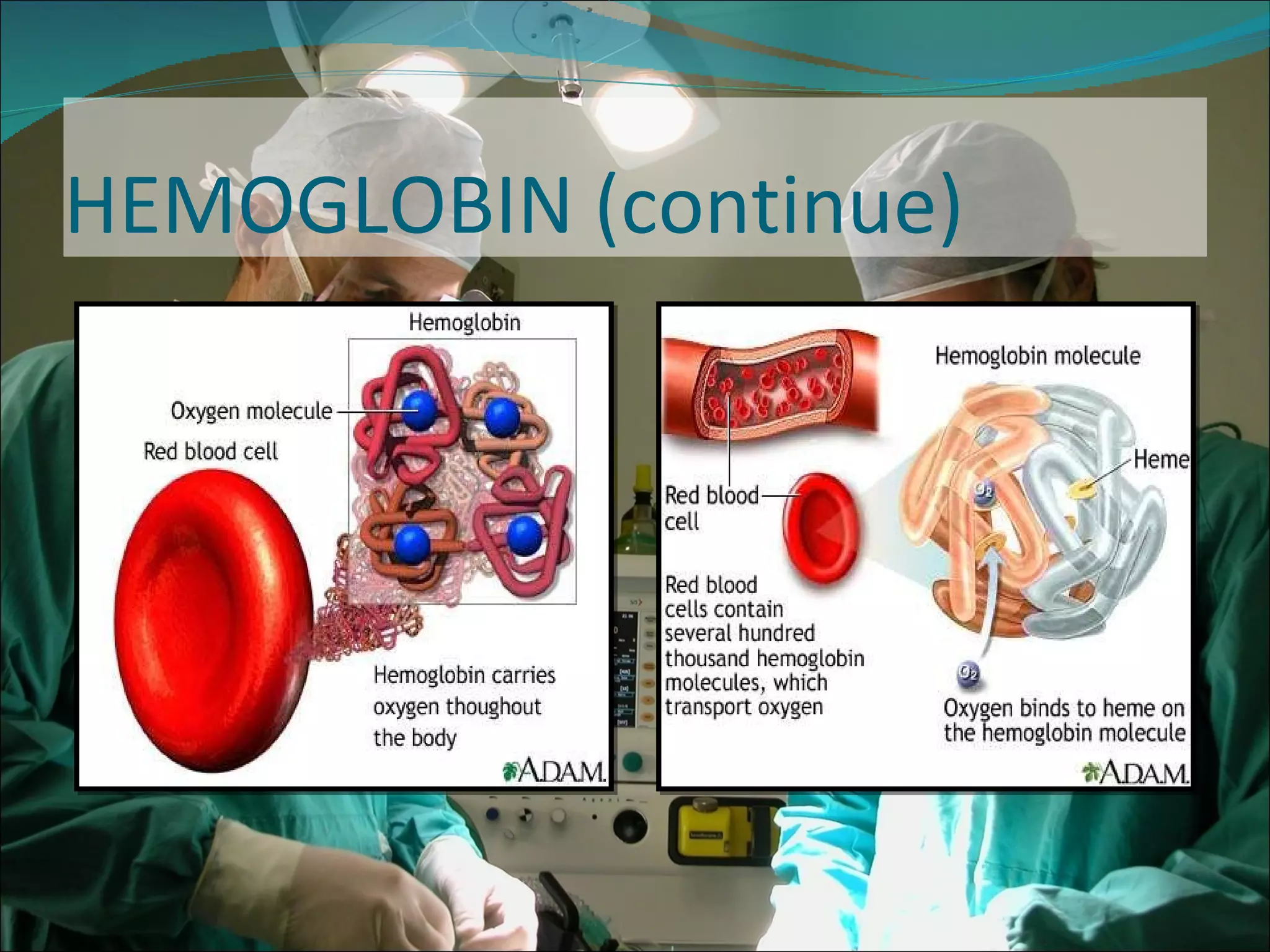
HEMOGLOBIN Hemoglobin (abbreviated Hb) is the iron-containing oxygen-transport metalloprotein in the red blood cells of vertebrates. Hemoglobin transports oxygen from the lungs to the rest of the body, where it releases the oxygen for cell use.
HEMOGLOBIN (continue)
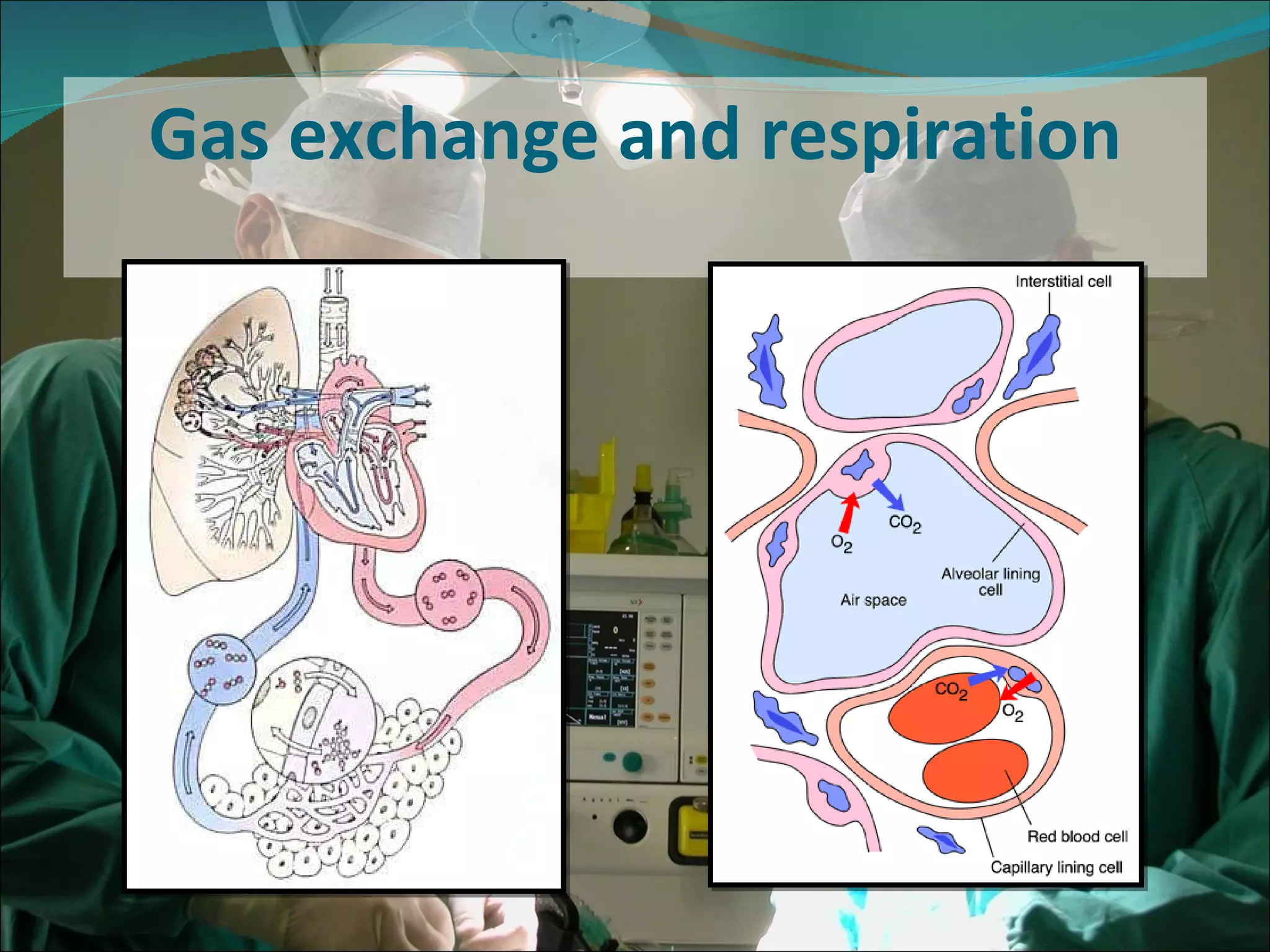
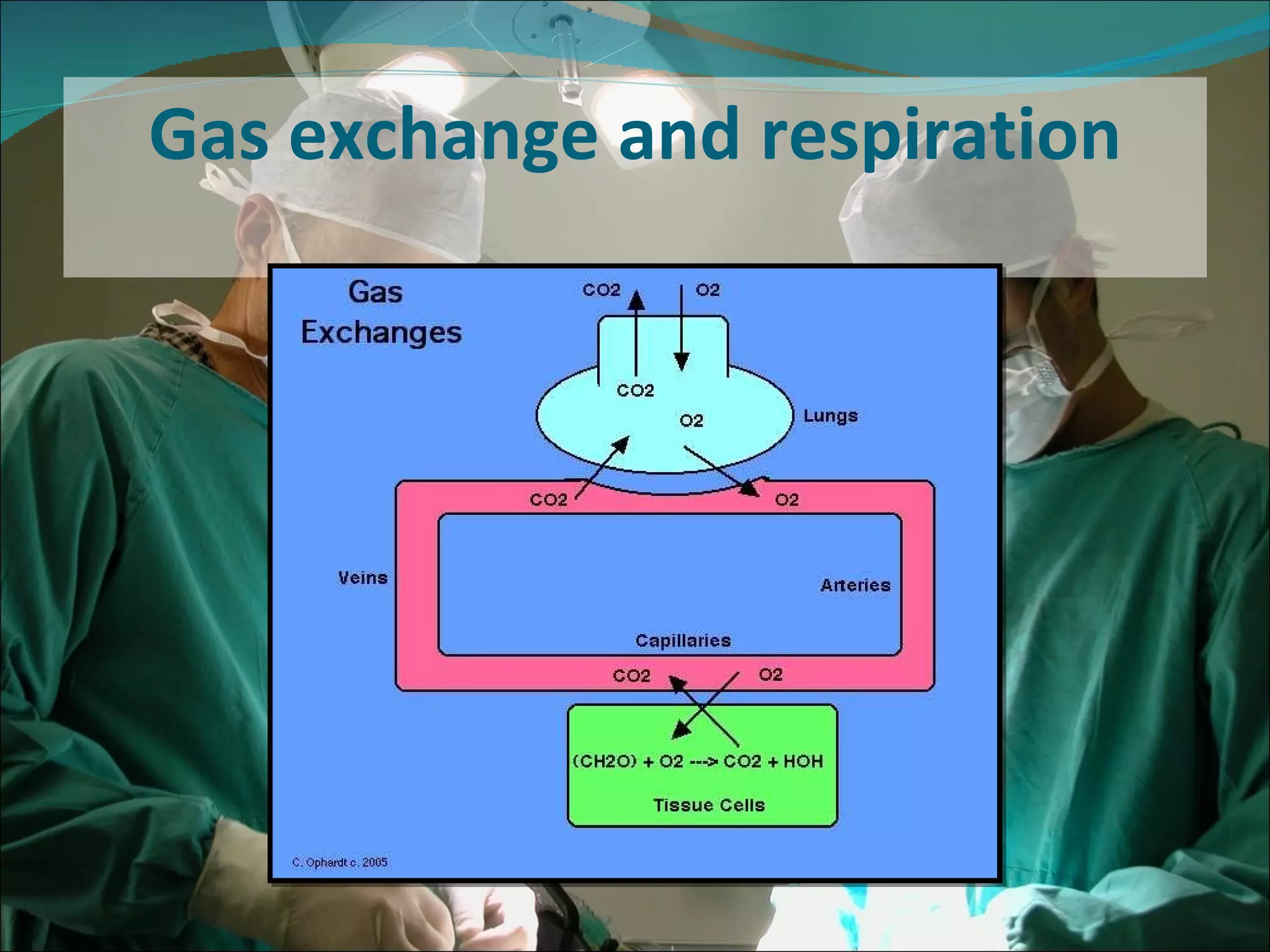
Gas exchange and respiration
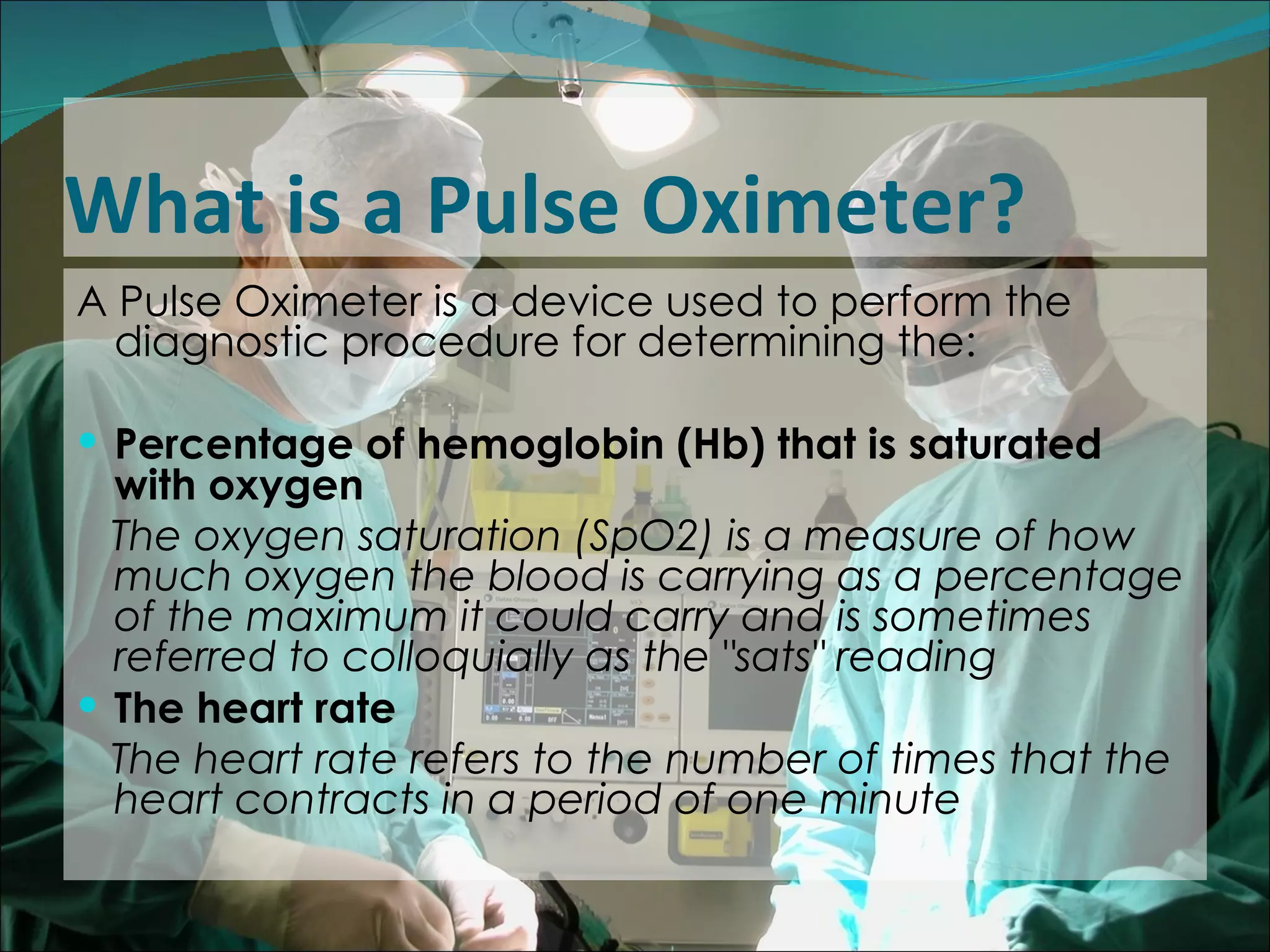
What is a Pulse Oximeter? A Pulse Oximeter is a device used to perform the diagnostic procedure for determining the: Percentage of hemoglobin (Hb) that is saturated with oxygen  The oxygen saturation (SpO2) is a measure of how much oxygen the blood is carrying as a percentage of the maximum it could carry and is sometimes referred to colloquially as the "sats" reading The heart rate The heart rate refers to the number of times that the heart contracts in a period of one minute
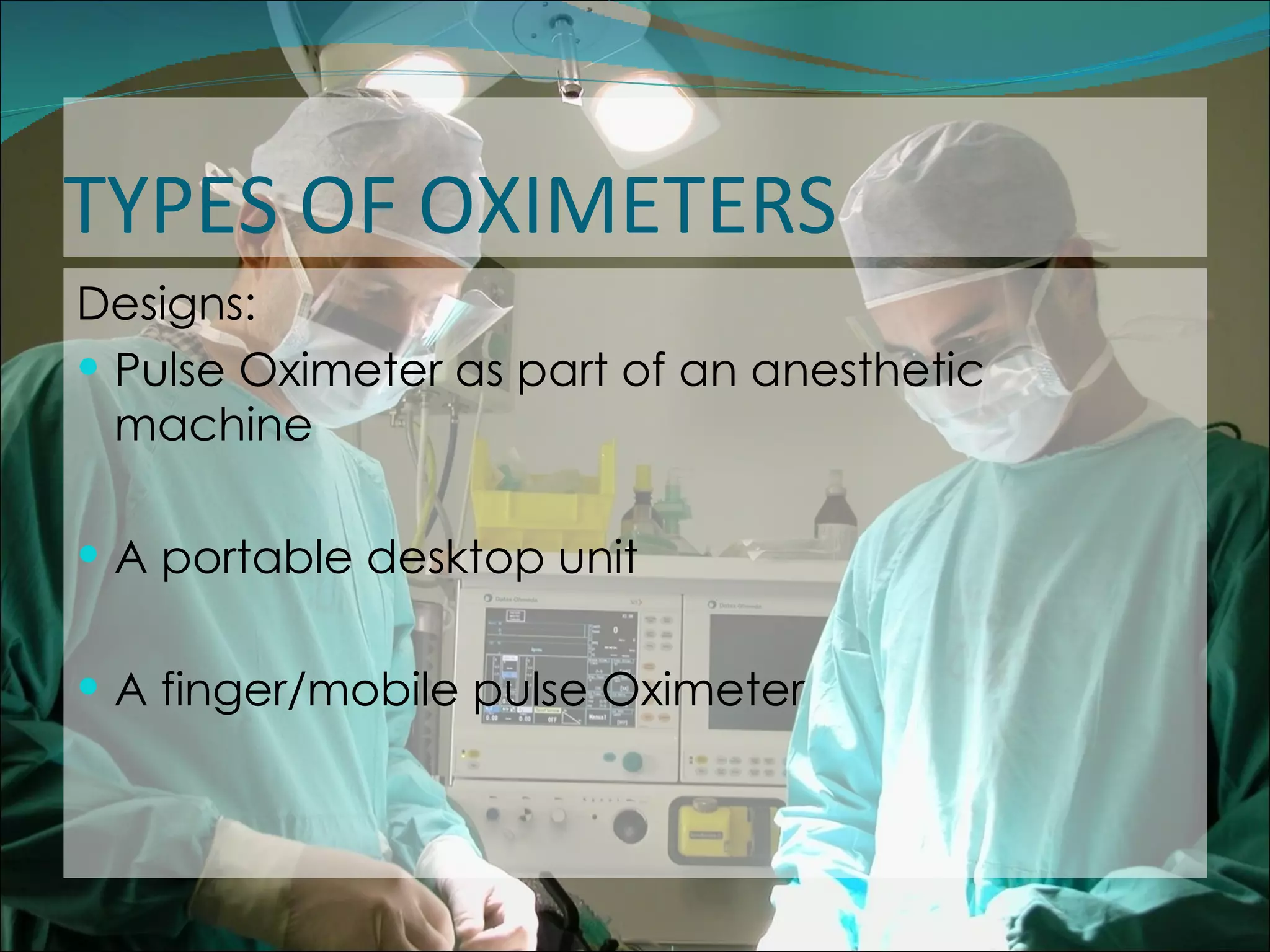
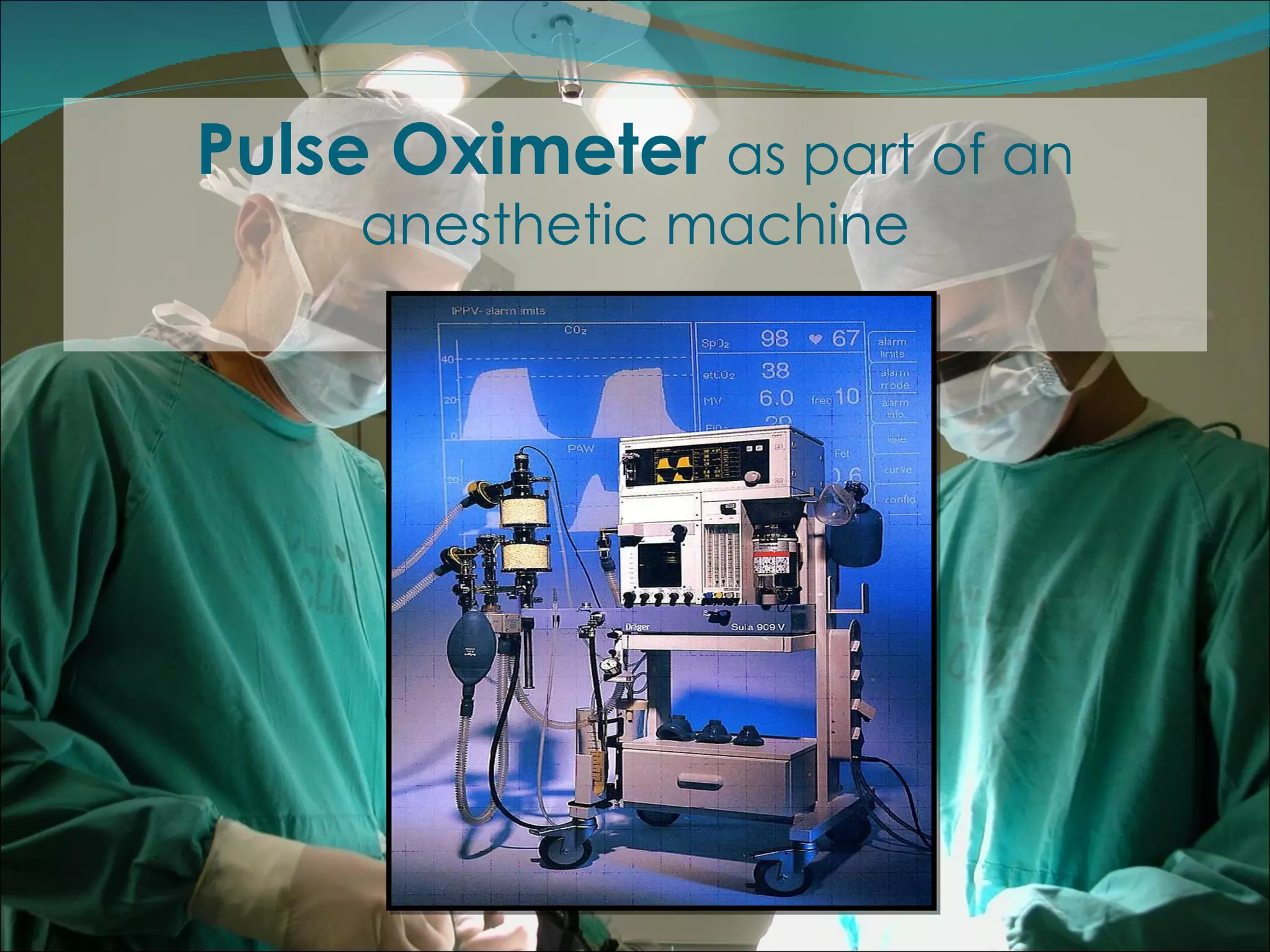
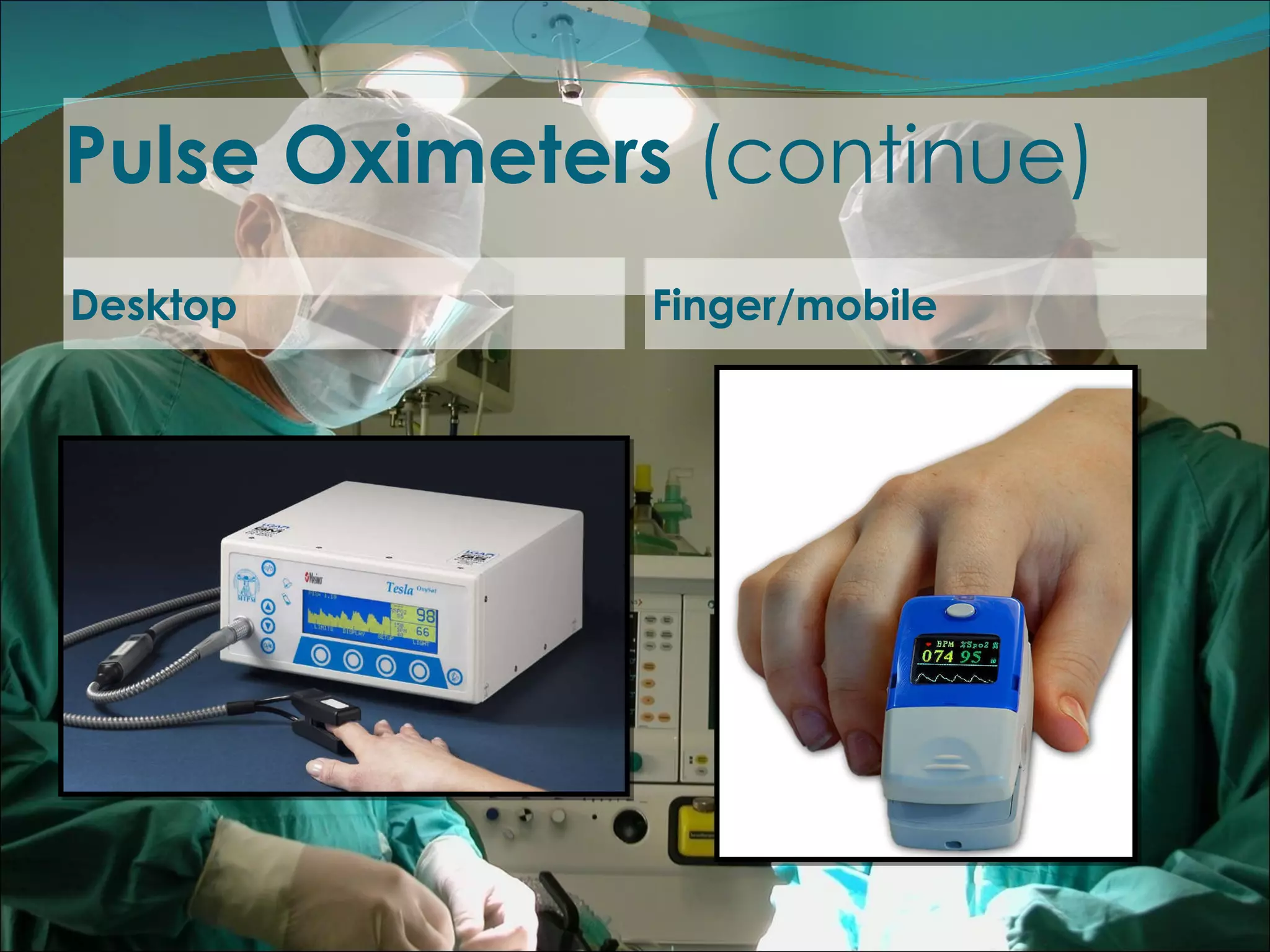
TYPES OF OXIMETERS Designs: Pulse Oximeter as part of an anesthetic machine A portable desktop unit A finger/mobile pulse Oximeter
Pulse Oximeter  as part of an anesthetic machine
Pulse Oximeters  (continue) Desktop Finger/mobile
What does a Pulse Oximeter tell you? A Pulse Oximeter can detect hypoxia (too little oxygen to fulfill the needs of the brain and body) before a patient shows signs of becoming cyanotic (bluish discoloration of the skin and mucous membranes due to not enough oxygen in the blood).
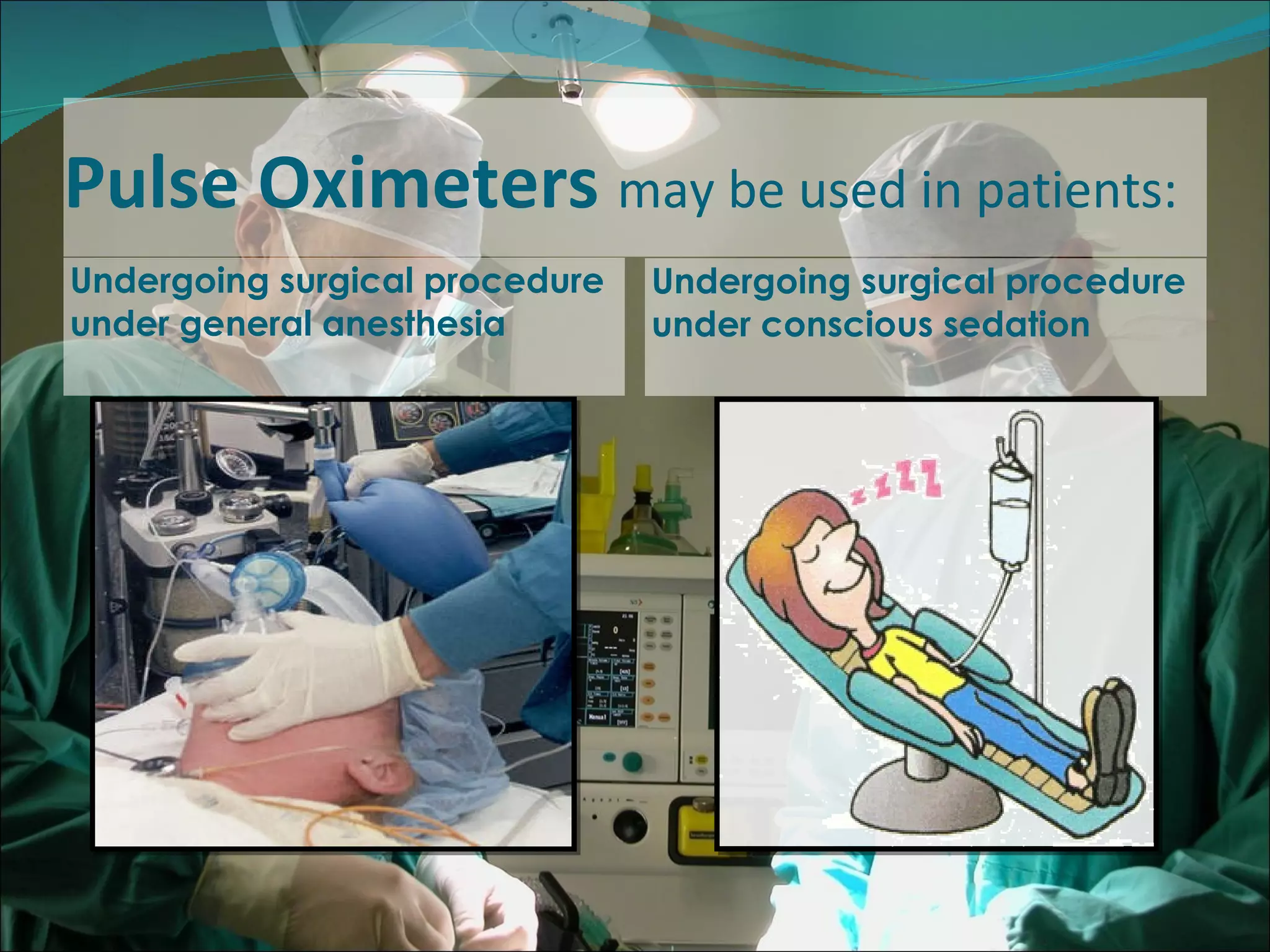
Pulse Oximeters  may be used in patients: Undergoing surgical procedure under general anesthesia  Undergoing surgical procedure under conscious sedation
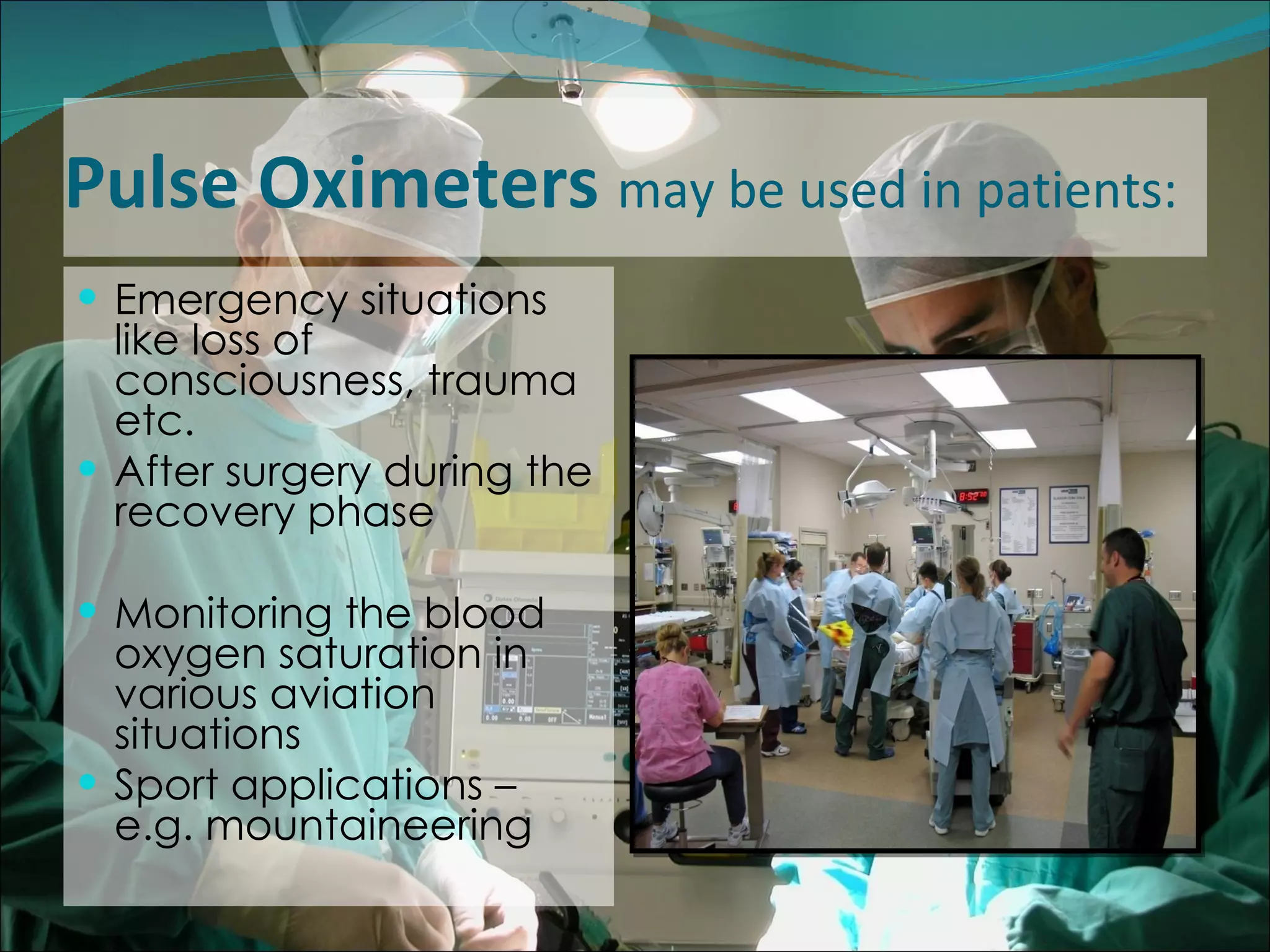
Pulse Oximeters  may be used in patients: Emergency situations like loss of consciousness, trauma etc.  After surgery during the recovery phase Monitoring the blood oxygen saturation in various aviation situations Sport applications – e.g. mountaineering
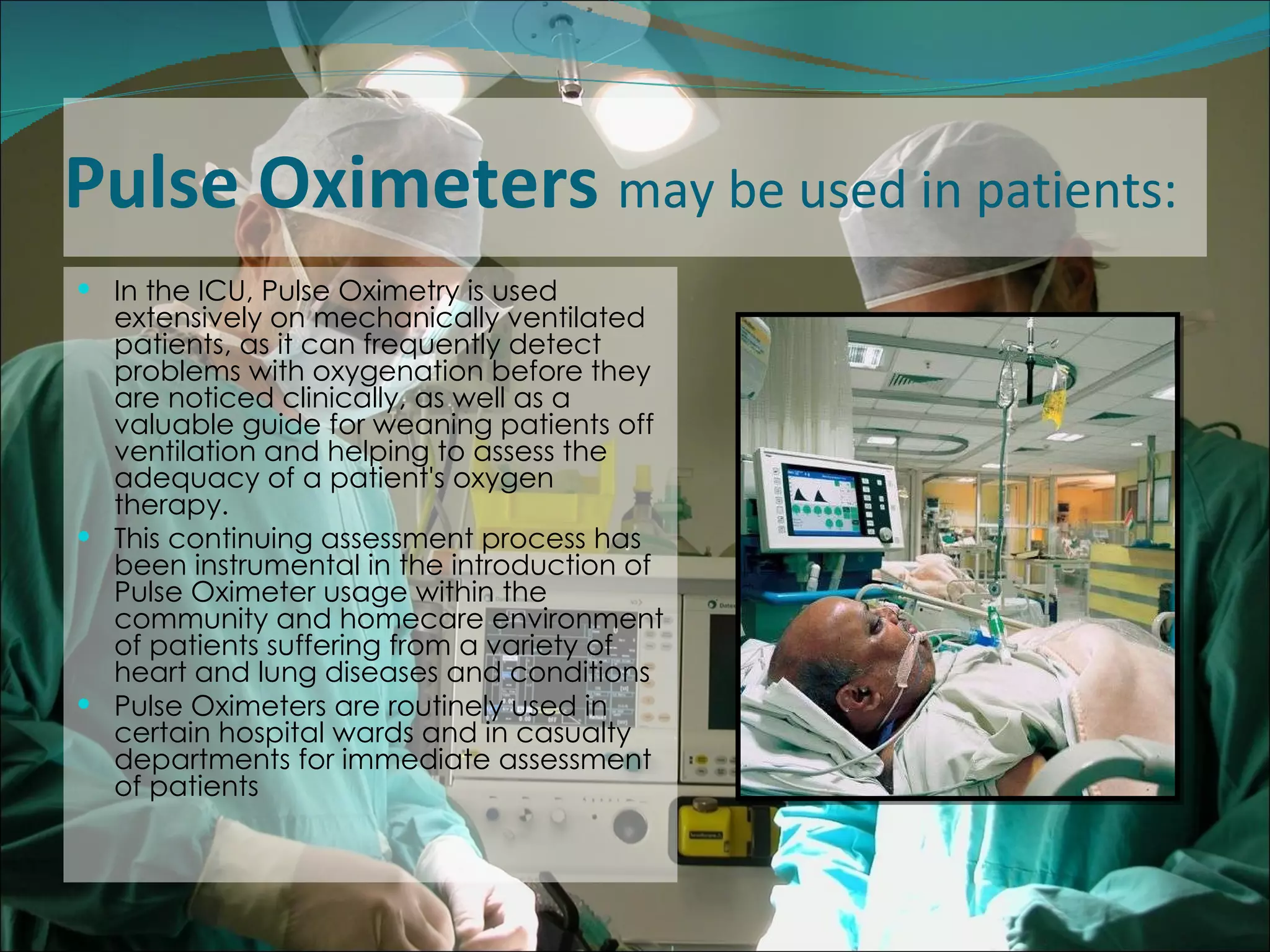
Pulse Oximeters  may be used in patients: In the ICU, Pulse Oximetry is used extensively on mechanically ventilated patients, as it can frequently detect problems with oxygenation before they are noticed clinically, as well as a valuable guide for weaning patients off ventilation and helping to assess the adequacy of a patient's oxygen therapy.  This continuing assessment process has been instrumental in the introduction of Pulse Oximeter usage within the community and homecare environment of patients suffering from a variety of heart and lung diseases and conditions  Pulse Oximeters are routinely used in certain hospital wards and in casualty departments for immediate assessment of patients
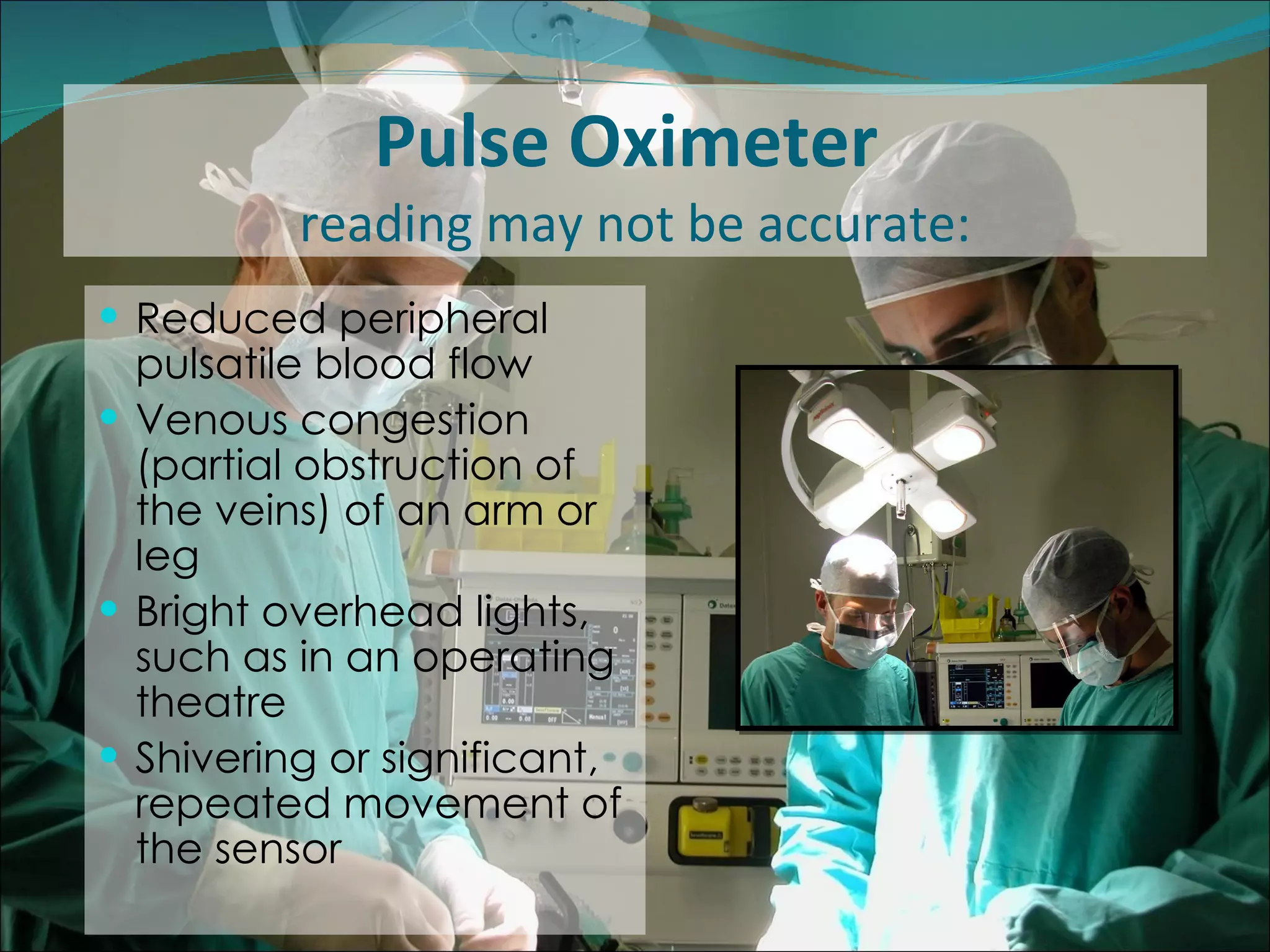
Pulse Oximeter  reading may not be accurate: Reduced peripheral pulsatile blood flow  Venous congestion (partial obstruction of the veins) of an arm or leg  Bright overhead lights, such as in an operating theatre Shivering or significant, repeated movement of the sensor
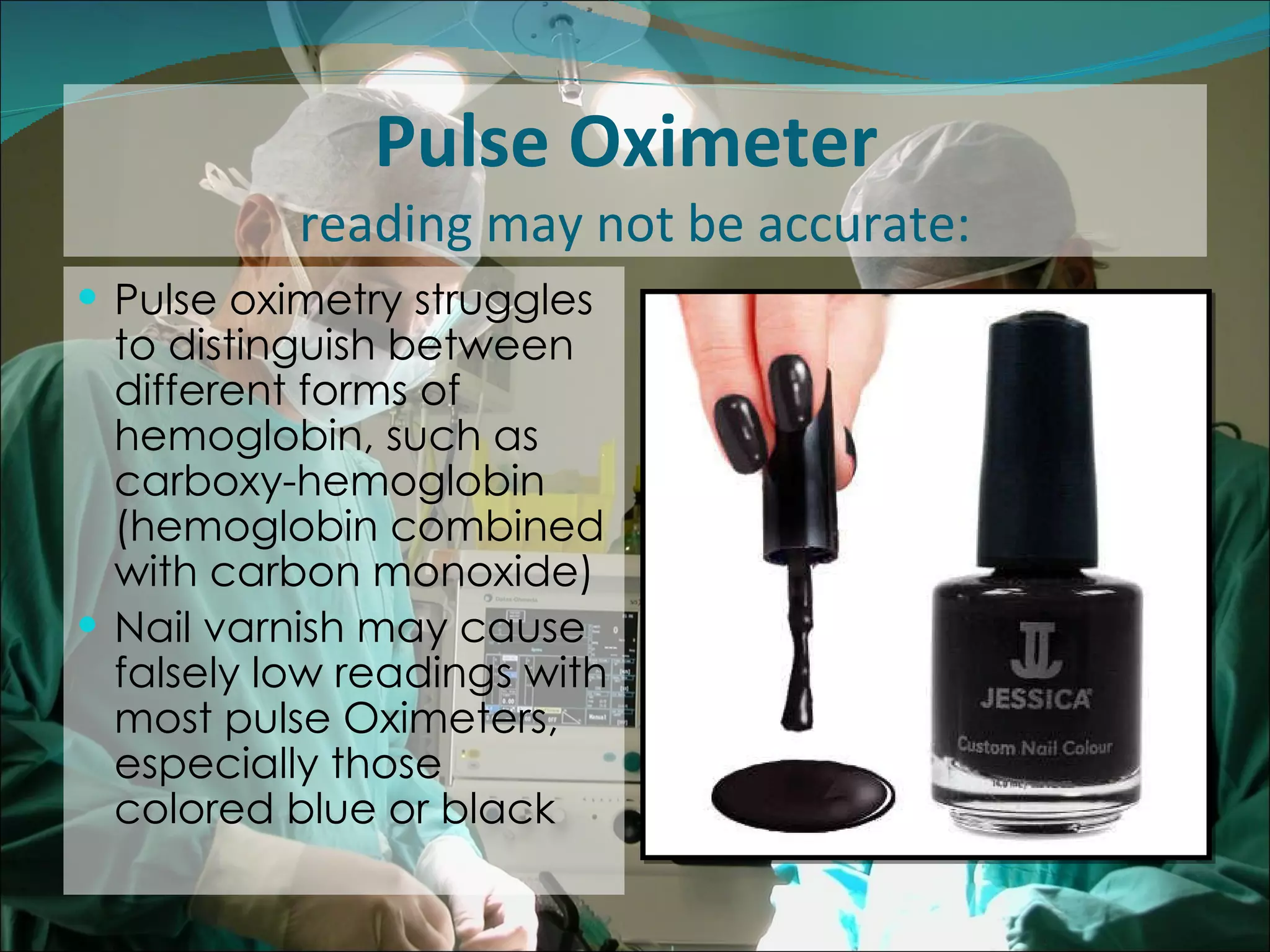
Pulse Oximeter  reading may not be accurate: Pulse oximetry struggles to distinguish between different forms of hemoglobin, such as carboxy-hemoglobin (hemoglobin combined with carbon monoxide)  Nail varnish may cause falsely low readings with most pulse Oximeters, especially those colored blue or black
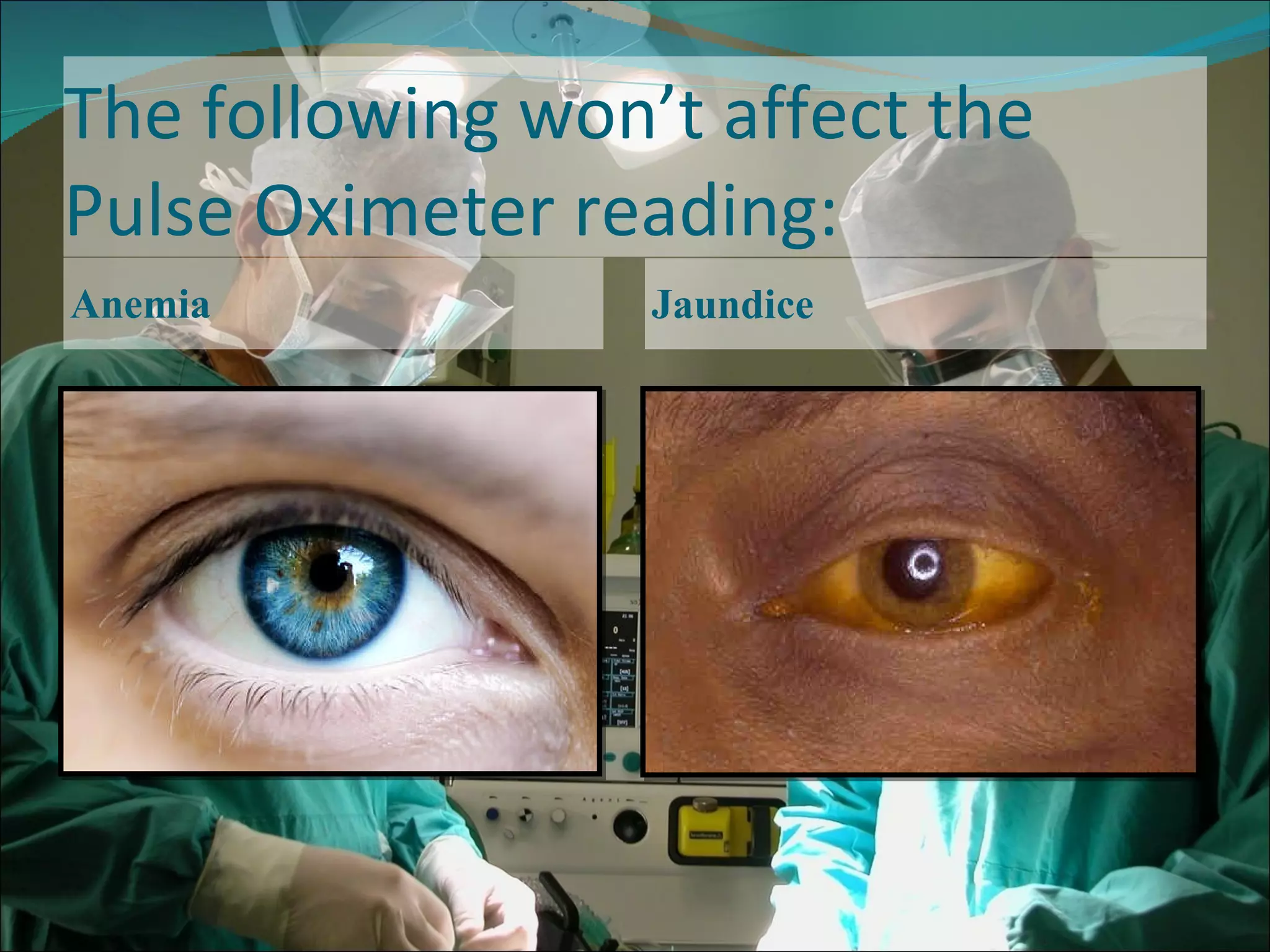
The following won’t affect the Pulse Oximeter reading: Anemia Jaundice
But what is a "normal" reading? Firstly, we would ask "normal for whom"?  A fit, healthy person should have an oxygen saturation level between 95% & 99%. Results lower than this, and especially below 90% may be caused by problems including lung diseases, such as COPD, breathing difficulties, cigarette smoking or circulatory problems such as excessive bleeding or blood vessel problems.
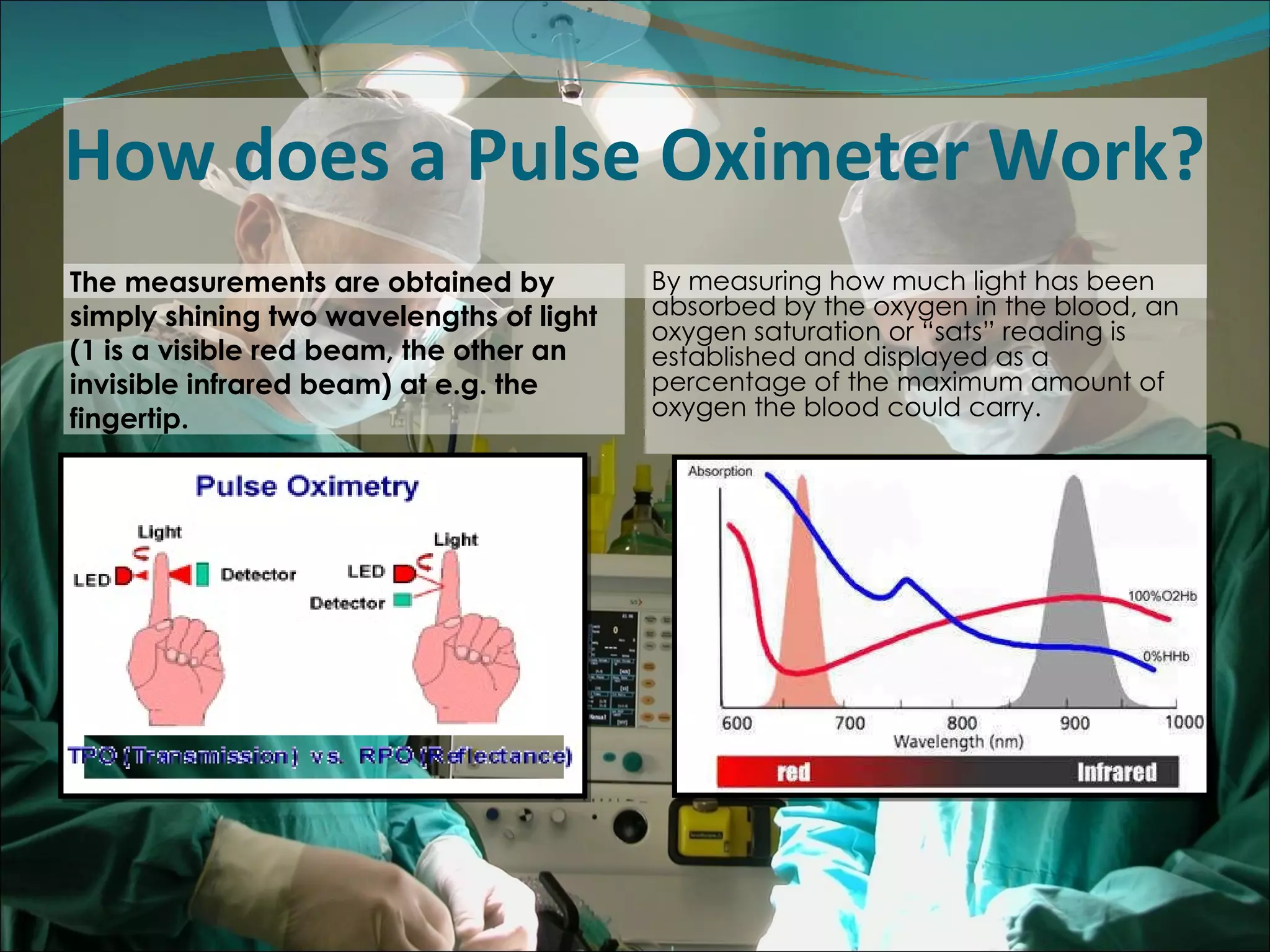
How does a Pulse Oximeter Work? The measurements are obtained by simply shining two wavelengths of light (1 is a visible red beam, the other an invisible infrared beam) at e.g. the fingertip.  By measuring how much light has been absorbed by the oxygen in the blood, an oxygen saturation or “sats” reading is established and displayed as a percentage of the maximum amount of oxygen the blood could carry.
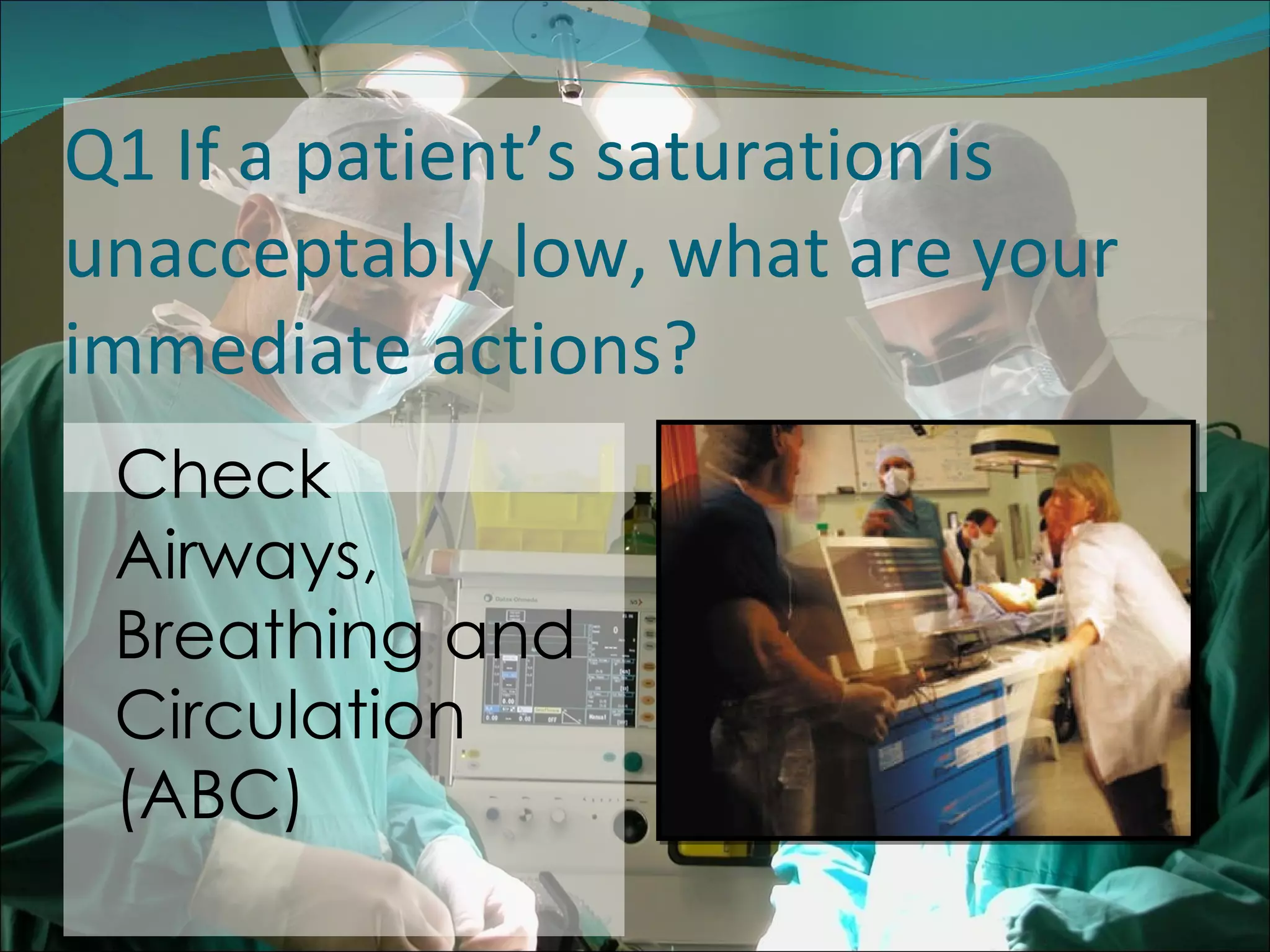
Q1 If a patient’s saturation is unacceptably low, what are your immediate actions? Check Airways, Breathing and Circulation (ABC)
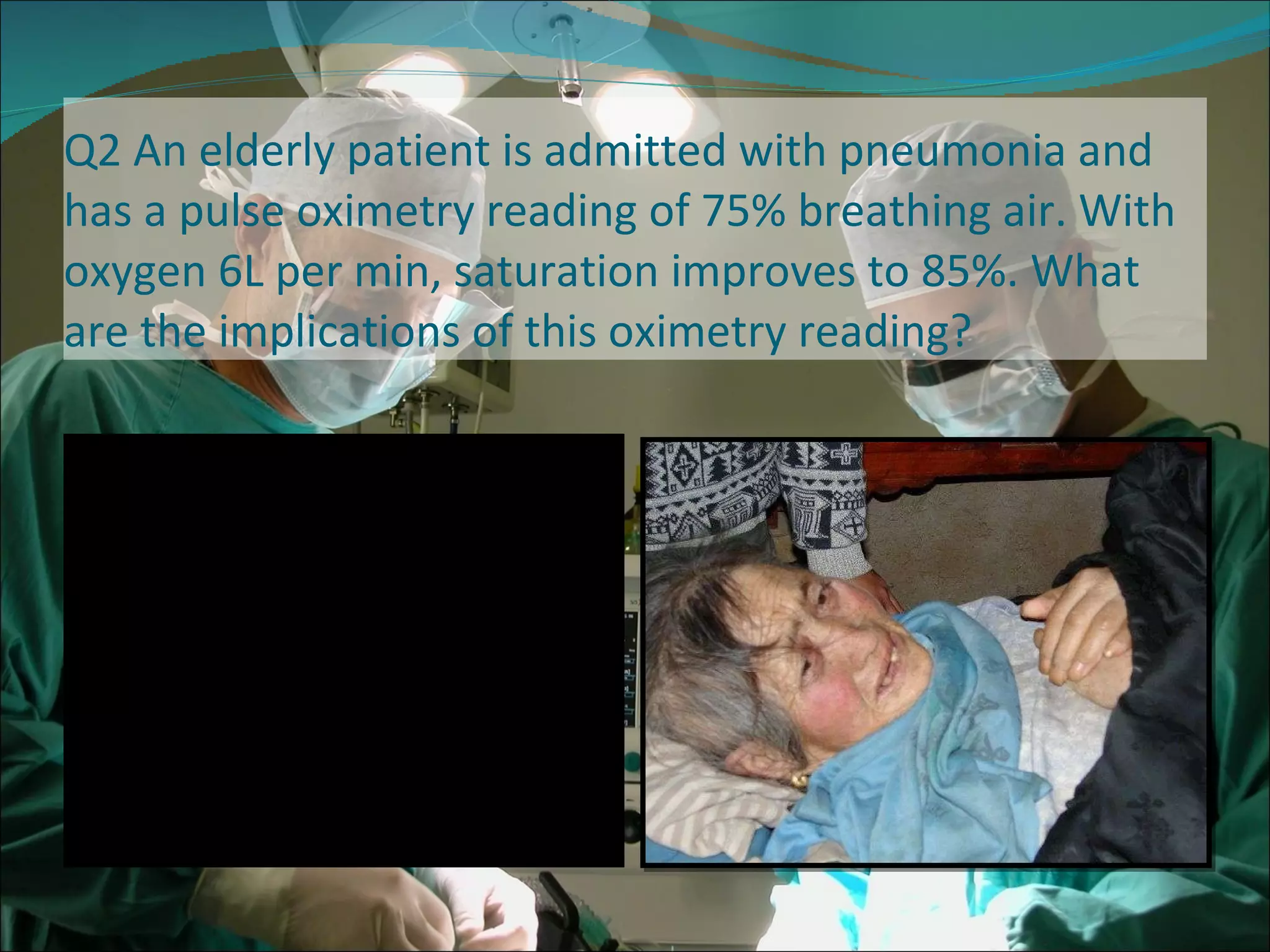
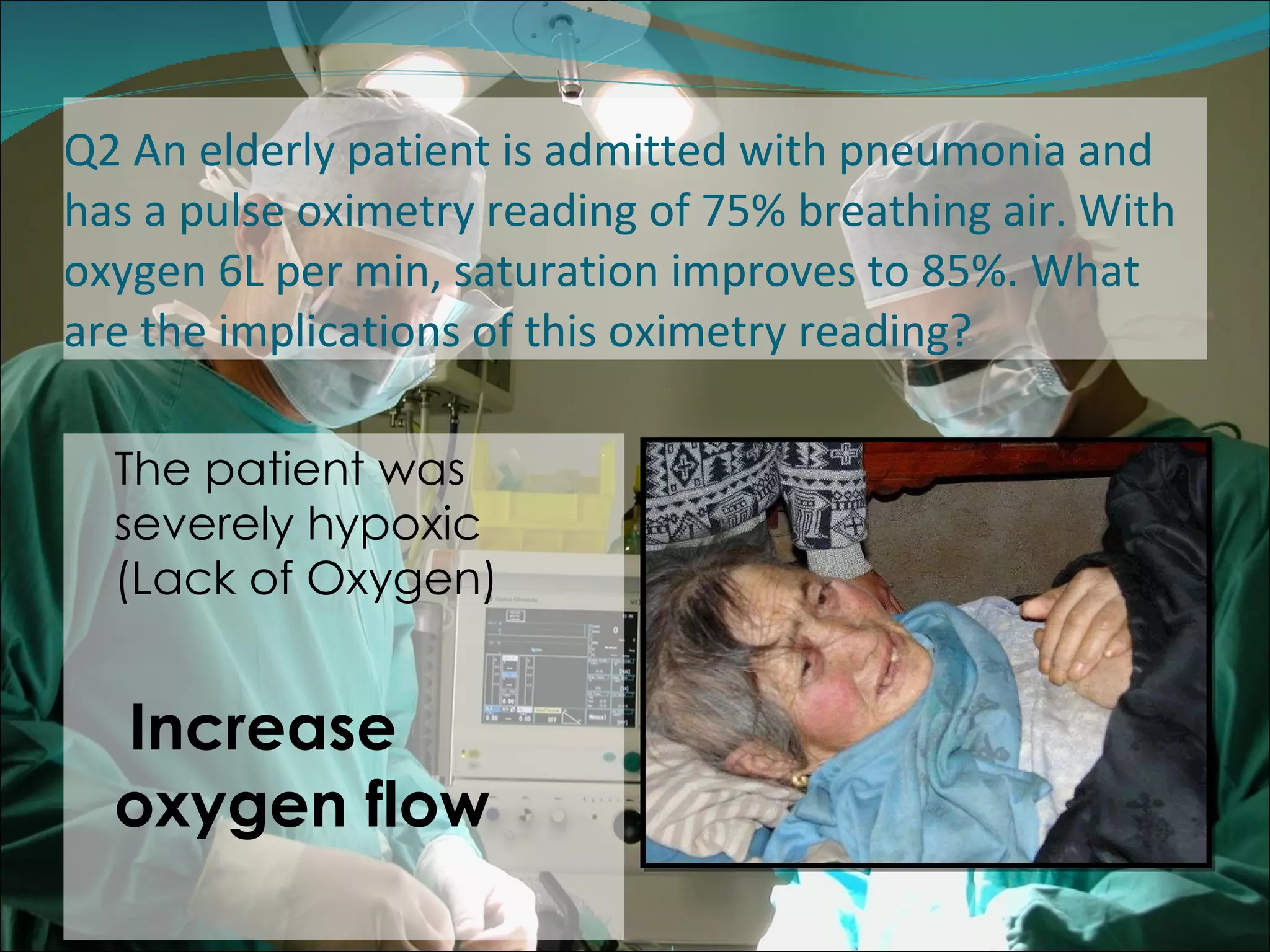
Q2 An elderly patient is admitted with pneumonia and has a pulse oximetry reading of 75% breathing air. With oxygen 6L per min, saturation improves to 85%. What are the implications of this oximetry reading?
Q2 An elderly patient is admitted with pneumonia and has a pulse oximetry reading of 75% breathing air. With oxygen 6L per min, saturation improves to 85%. What are the implications of this oximetry reading? The patient was severely hypoxic (Lack of Oxygen)  Increase oxygen flow
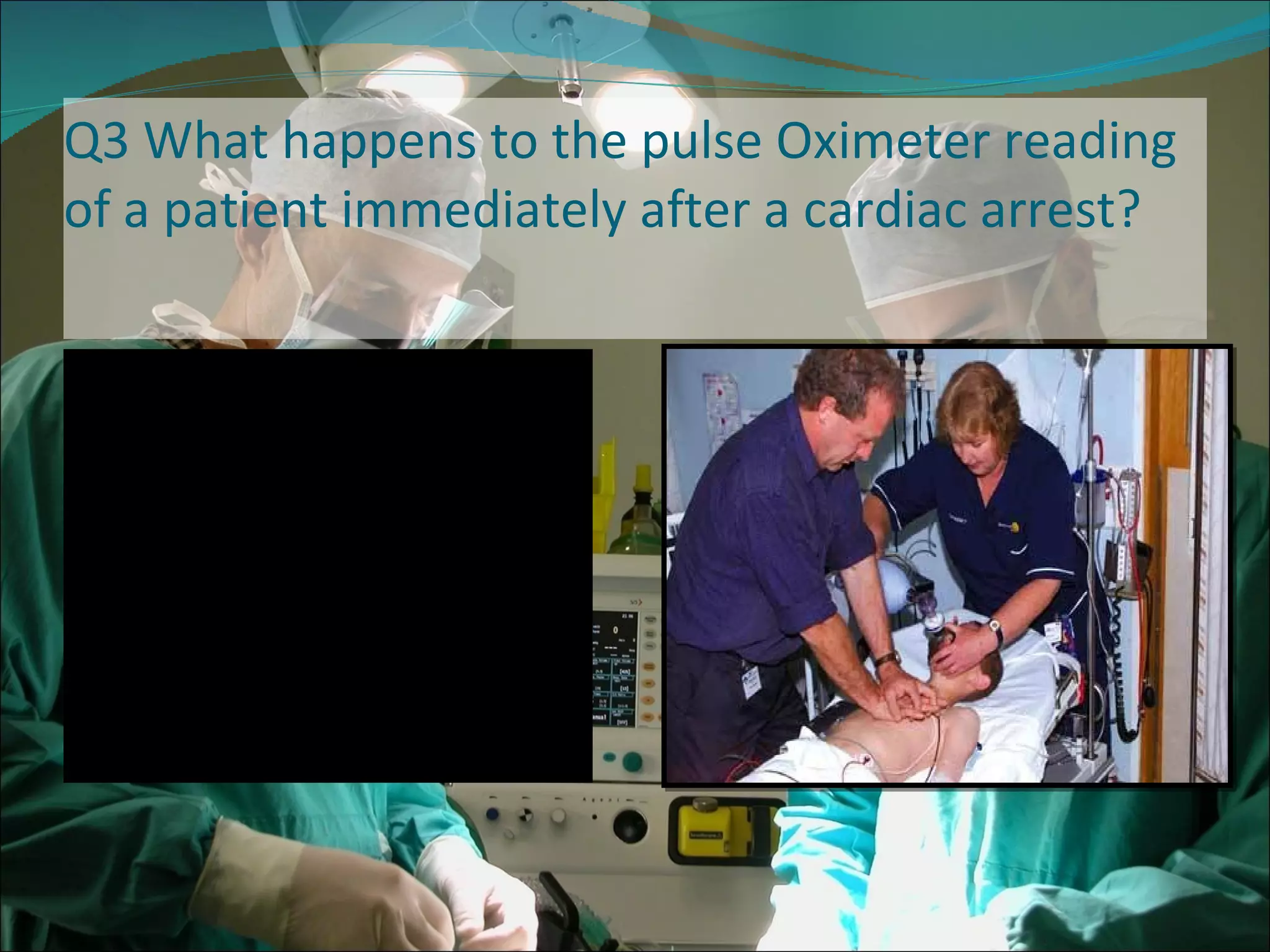
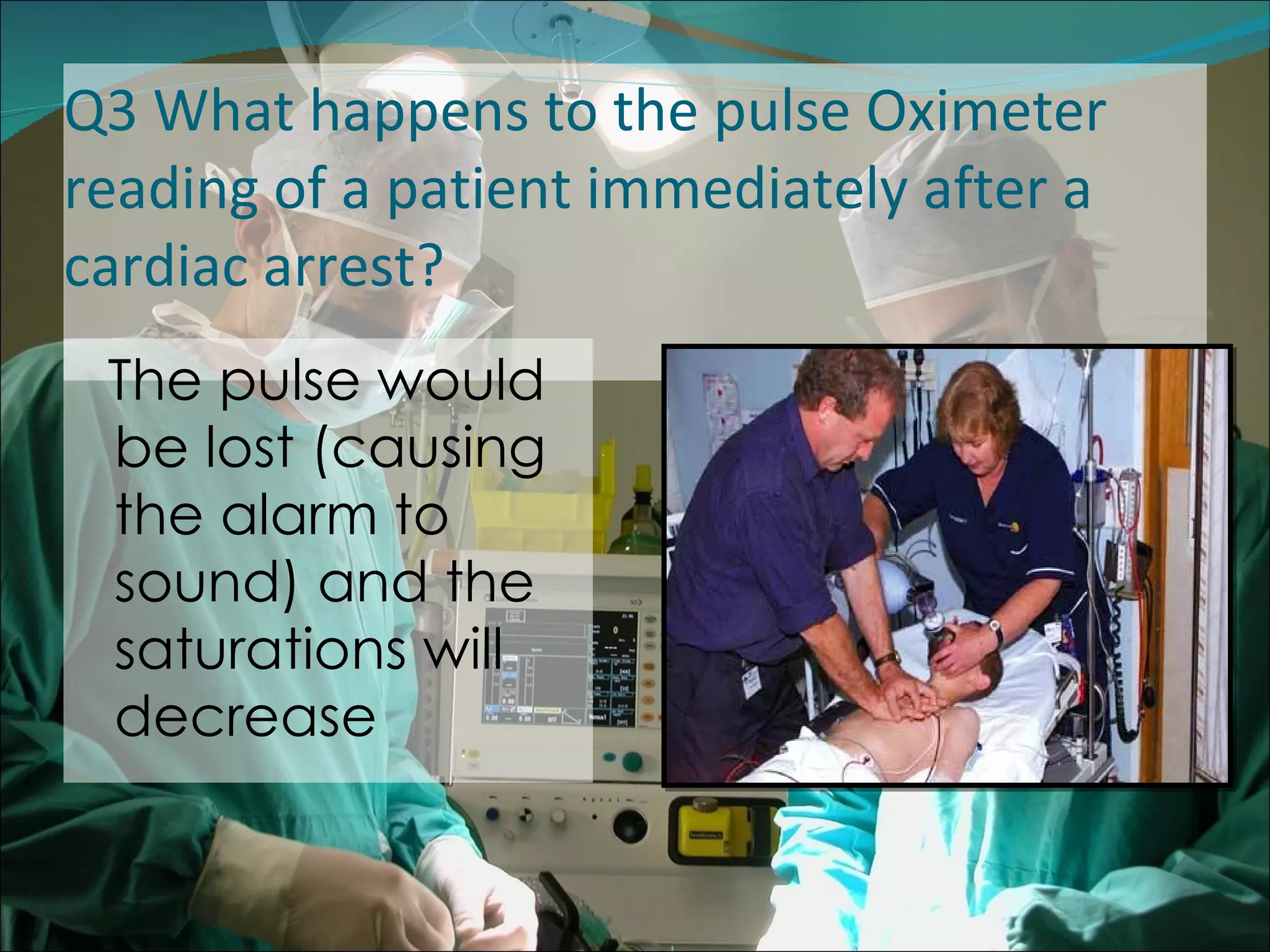
Q3 What happens to the pulse Oximeter reading of a patient immediately after a cardiac arrest?  The pulse would be lost (causing the alarm to sound) and the saturations will decrease
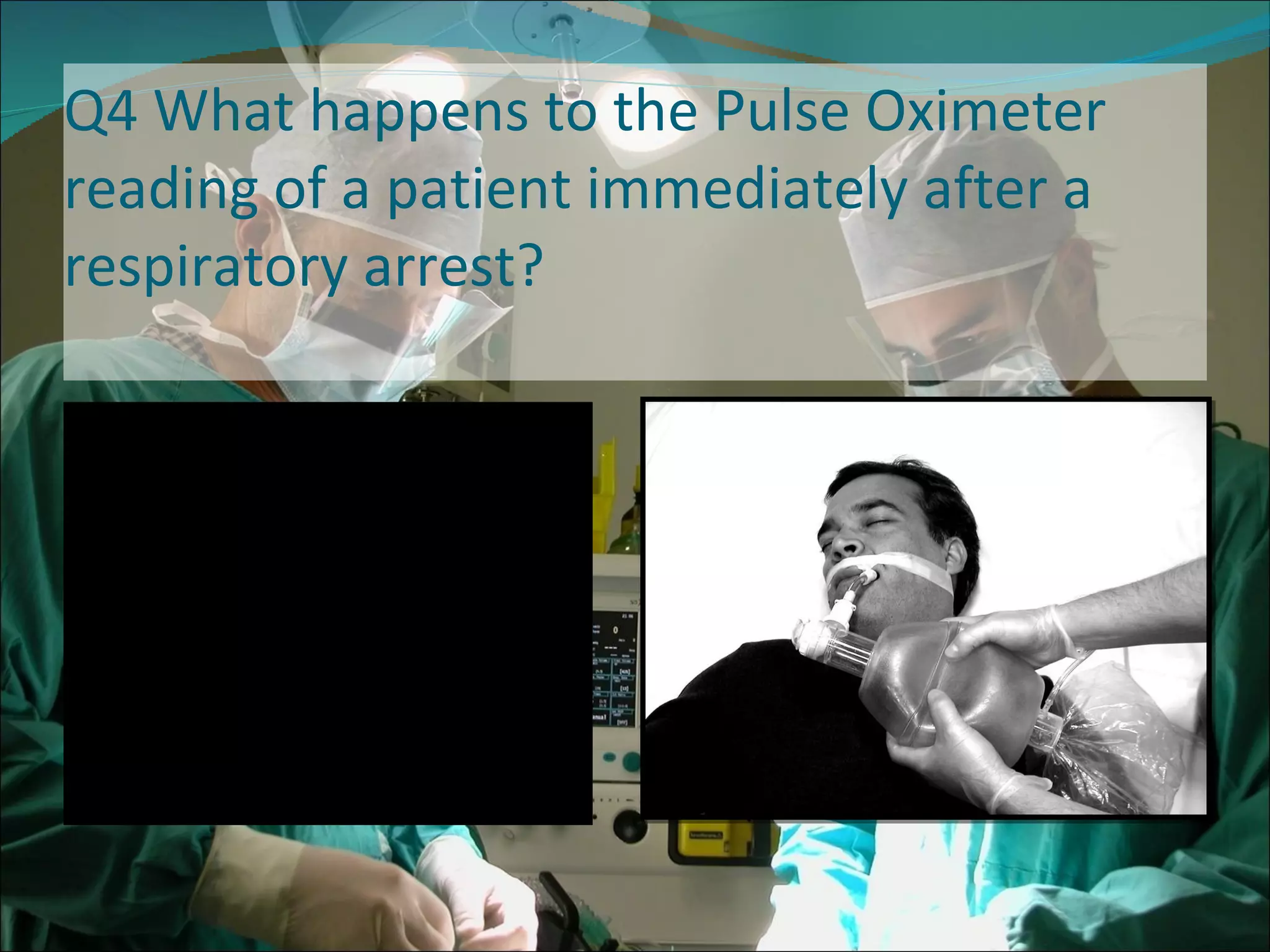
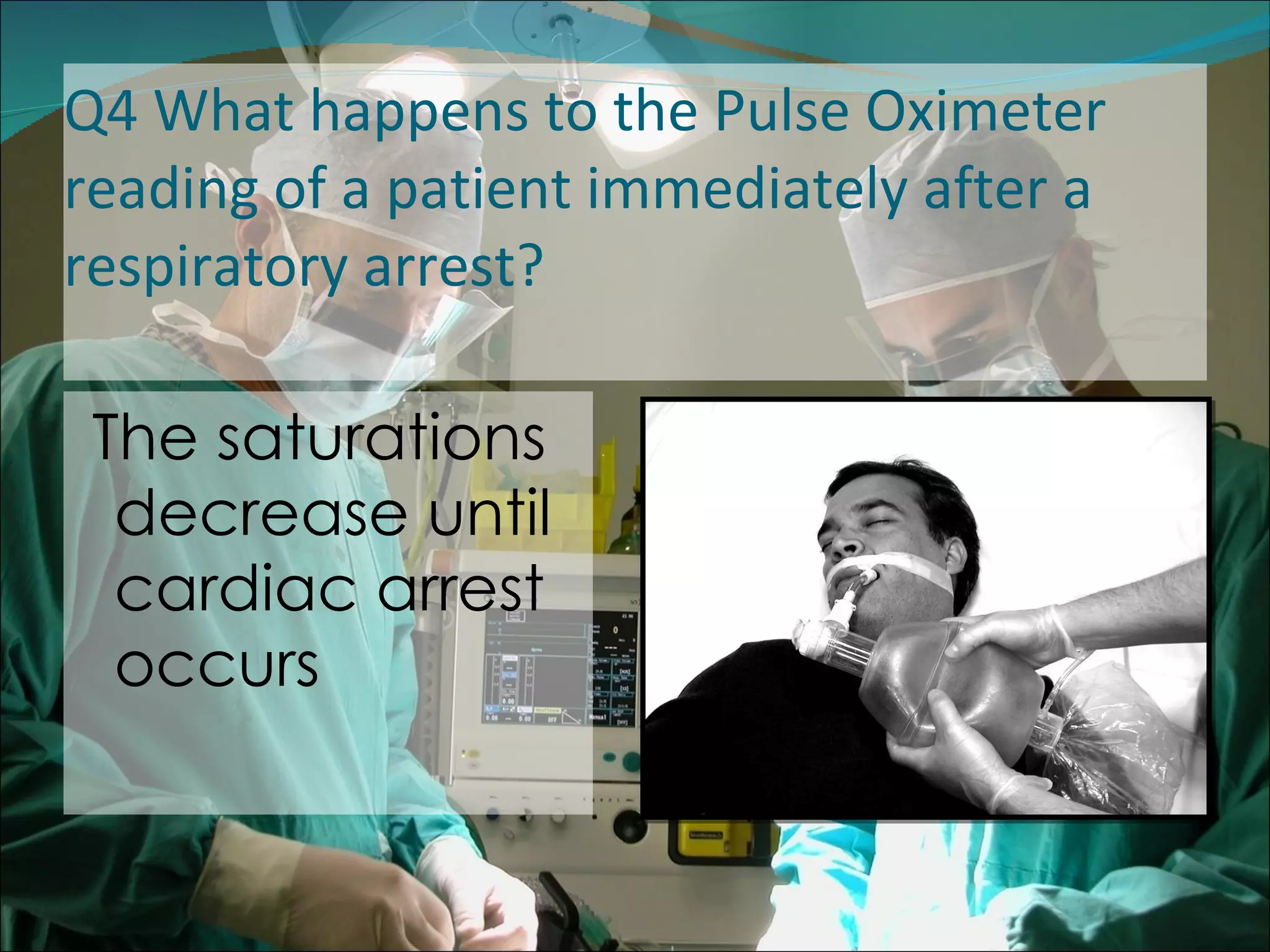
Q4 What happens to the Pulse Oximeter reading of a patient immediately after a respiratory arrest?  The saturations decrease until cardiac arrest occurs
In conclusion… Pulse Oximetry is a useful modality for assessing a patient’s pulse rate and Hemoglobin Oxygen saturation in a number of routine and emergency medical situations The clinician should be aware of the limitations of Pulse Oximetry and the various factors that may produce a falsely low or high reading Always keep the basics principles of medicine in mind, and keep a high level of suspicion  - especially when the figures don’t make sense!
THANK YOU for your undivided attention!!! I appreciate the opportunity to invest into your lives!!
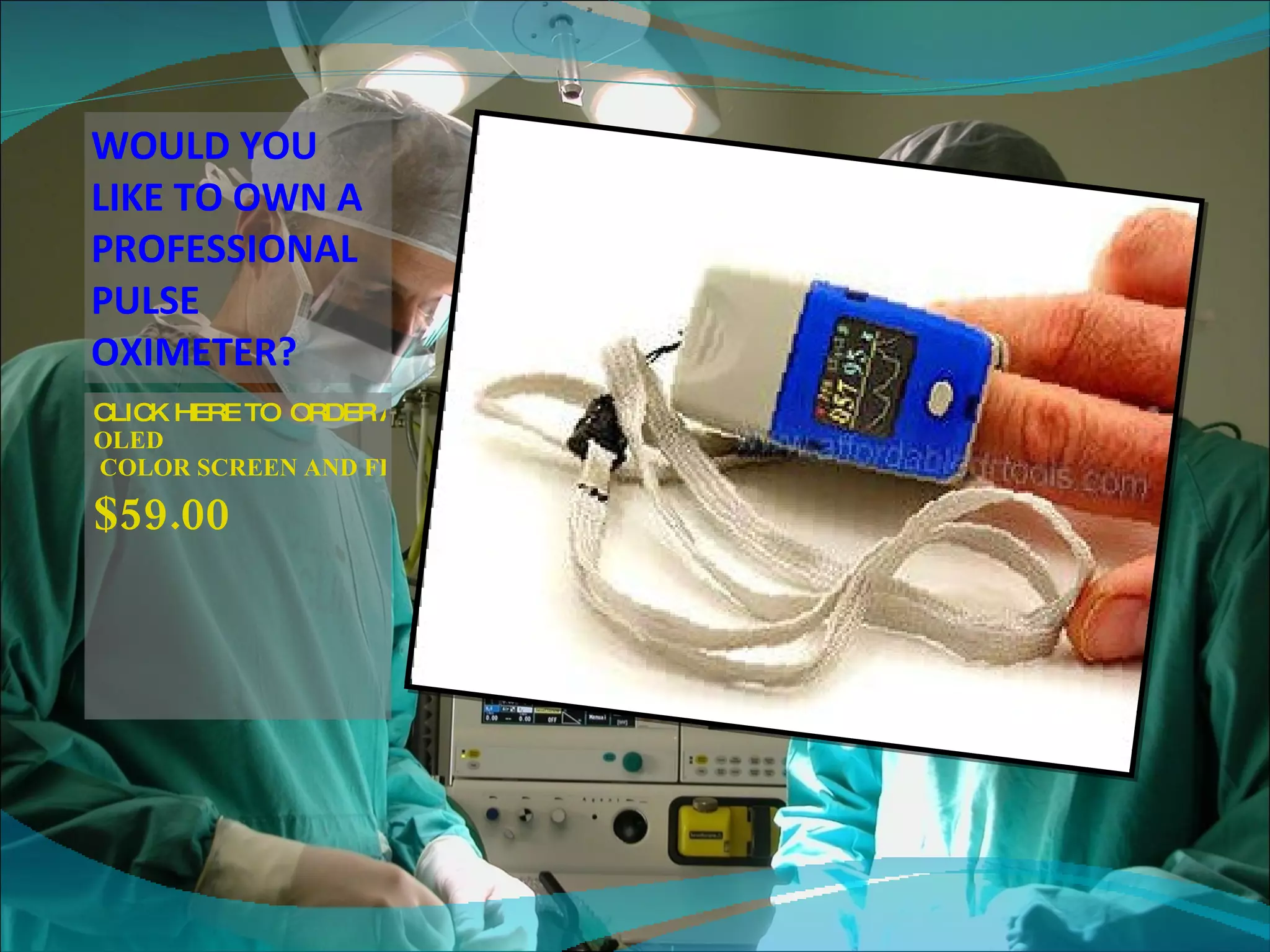
WOULD YOU LIKE TO OWN A PROFESSIONAL PULSE OXIMETER? CLICK HERE TO  ORDER A PROFESSIONAL QUALITY  PULSE OXIMETERAND HEART RATE MONITOR WITH AN  OLED  COLOR SCREEN AND FINGER PULSE WAVE GRAPH! $59.00

Pulse Oximetry

  • 1.
    Background Hemoglobin GasExchange and Respiration
  • 2.
    HEMOGLOBIN Hemoglobin (abbreviatedHb) is the iron-containing oxygen-transport metalloprotein in the red blood cells of vertebrates. Hemoglobin transports oxygen from the lungs to the rest of the body, where it releases the oxygen for cell use.
  • 3.
  • 4.
    Gas exchange andrespiration
  • 5.
    Gas exchange andrespiration
  • 6.
    What is aPulse Oximeter? A Pulse Oximeter is a device used to perform the diagnostic procedure for determining the: Percentage of hemoglobin (Hb) that is saturated with oxygen The oxygen saturation (SpO2) is a measure of how much oxygen the blood is carrying as a percentage of the maximum it could carry and is sometimes referred to colloquially as the "sats" reading The heart rate The heart rate refers to the number of times that the heart contracts in a period of one minute
  • 7.
    TYPES OF OXIMETERSDesigns: Pulse Oximeter as part of an anesthetic machine A portable desktop unit A finger/mobile pulse Oximeter
  • 8.
    Pulse Oximeter as part of an anesthetic machine
  • 9.
    Pulse Oximeters (continue) Desktop Finger/mobile
  • 10.
    What does aPulse Oximeter tell you? A Pulse Oximeter can detect hypoxia (too little oxygen to fulfill the needs of the brain and body) before a patient shows signs of becoming cyanotic (bluish discoloration of the skin and mucous membranes due to not enough oxygen in the blood).
  • 11.
    Pulse Oximeters may be used in patients: Undergoing surgical procedure under general anesthesia Undergoing surgical procedure under conscious sedation
  • 12.
    Pulse Oximeters may be used in patients: Emergency situations like loss of consciousness, trauma etc. After surgery during the recovery phase Monitoring the blood oxygen saturation in various aviation situations Sport applications – e.g. mountaineering
  • 13.
    Pulse Oximeters may be used in patients: In the ICU, Pulse Oximetry is used extensively on mechanically ventilated patients, as it can frequently detect problems with oxygenation before they are noticed clinically, as well as a valuable guide for weaning patients off ventilation and helping to assess the adequacy of a patient's oxygen therapy. This continuing assessment process has been instrumental in the introduction of Pulse Oximeter usage within the community and homecare environment of patients suffering from a variety of heart and lung diseases and conditions Pulse Oximeters are routinely used in certain hospital wards and in casualty departments for immediate assessment of patients
  • 14.
    Pulse Oximeter reading may not be accurate: Reduced peripheral pulsatile blood flow Venous congestion (partial obstruction of the veins) of an arm or leg Bright overhead lights, such as in an operating theatre Shivering or significant, repeated movement of the sensor
  • 15.
    Pulse Oximeter reading may not be accurate: Pulse oximetry struggles to distinguish between different forms of hemoglobin, such as carboxy-hemoglobin (hemoglobin combined with carbon monoxide) Nail varnish may cause falsely low readings with most pulse Oximeters, especially those colored blue or black
  • 16.
    The following won’taffect the Pulse Oximeter reading: Anemia Jaundice
  • 17.
    But what isa "normal" reading? Firstly, we would ask "normal for whom"? A fit, healthy person should have an oxygen saturation level between 95% & 99%. Results lower than this, and especially below 90% may be caused by problems including lung diseases, such as COPD, breathing difficulties, cigarette smoking or circulatory problems such as excessive bleeding or blood vessel problems.
  • 18.
    How does aPulse Oximeter Work? The measurements are obtained by simply shining two wavelengths of light (1 is a visible red beam, the other an invisible infrared beam) at e.g. the fingertip. By measuring how much light has been absorbed by the oxygen in the blood, an oxygen saturation or “sats” reading is established and displayed as a percentage of the maximum amount of oxygen the blood could carry.
  • 19.
    Q1 If apatient’s saturation is unacceptably low, what are your immediate actions? Check Airways, Breathing and Circulation (ABC)
  • 20.
    Q1 If apatient’s saturation is unacceptably low, what are your immediate actions? Check Airways, Breathing and Circulation (ABC)
  • 21.
    Q2 An elderlypatient is admitted with pneumonia and has a pulse oximetry reading of 75% breathing air. With oxygen 6L per min, saturation improves to 85%. What are the implications of this oximetry reading?
  • 22.
    Q2 An elderlypatient is admitted with pneumonia and has a pulse oximetry reading of 75% breathing air. With oxygen 6L per min, saturation improves to 85%. What are the implications of this oximetry reading? The patient was severely hypoxic (Lack of Oxygen) Increase oxygen flow
  • 23.
    Q3 What happensto the pulse Oximeter reading of a patient immediately after a cardiac arrest? The pulse would be lost (causing the alarm to sound) and the saturations will decrease
  • 24.
    Q3 What happensto the pulse Oximeter reading of a patient immediately after a cardiac arrest? The pulse would be lost (causing the alarm to sound) and the saturations will decrease
  • 25.
    Q4 What happensto the Pulse Oximeter reading of a patient immediately after a respiratory arrest? The saturations decrease until cardiac arrest occurs
  • 26.
    Q4 What happensto the Pulse Oximeter reading of a patient immediately after a respiratory arrest? The saturations decrease until cardiac arrest occurs
  • 27.
    In conclusion… PulseOximetry is a useful modality for assessing a patient’s pulse rate and Hemoglobin Oxygen saturation in a number of routine and emergency medical situations The clinician should be aware of the limitations of Pulse Oximetry and the various factors that may produce a falsely low or high reading Always keep the basics principles of medicine in mind, and keep a high level of suspicion - especially when the figures don’t make sense!
  • 28.
    THANK YOU foryour undivided attention!!! I appreciate the opportunity to invest into your lives!!
  • 29.
    WOULD YOU LIKETO OWN A PROFESSIONAL PULSE OXIMETER? CLICK HERE TO ORDER A PROFESSIONAL QUALITY PULSE OXIMETERAND HEART RATE MONITOR WITH AN OLED COLOR SCREEN AND FINGER PULSE WAVE GRAPH! $59.00