VACCINATION :
PROGRAMMES &
IMPLEMENTATION
Dr jj
99
 Introduction
 Immunisation
 Vaccine preventable diseases
 Vaccination
 Types of vaccination
 Routes of administration
 Levels of vaccines
 History
CONTENTS
 Vaccination history in India
 Pulse polio vaccination
 The cold chain
 Hazards of Immunisation
 Precaution
 Vaccination coverge
 Conclusion
 References
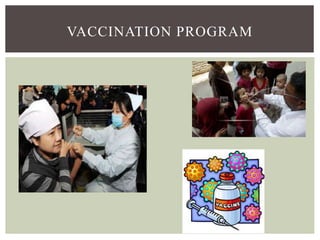
VACCINATION PROGRAM
7
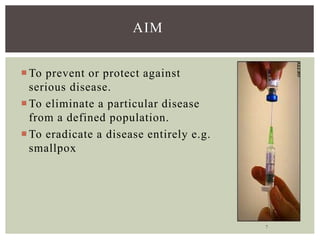
AIM
To prevent or protect against
serious disease.
To eliminate a particular disease
from a defined population.
To eradicate a disease entirely e.g.
smallpox
8
 However it is not possible to eradicate all vaccine-
preventable diseases:
Asymptomatic carriage
Mutating organisms e.g. influenza
Animal reservoirs e.g. SARS, avian influenza
Environmental reservoirs e.g. tetanus
Global travel/mass immigration
9
VACCINE PREVENTABLE DISEASES
(BACTERIAL)
 Diptheria 
 Haemophilus influenzae B (Hib) 
 Meningococcal (meningitis) 
 Pneumococcal disease 
 Tetanus 
 Tuberculosis 
 Whooping cough (pertussis) 
10
VACCINE PREVENTABLE DISEASES
(VIRAL)
 Chickenpox
 Flu
 Measles
 Mumps
 Polio
 Rubella
 HPV
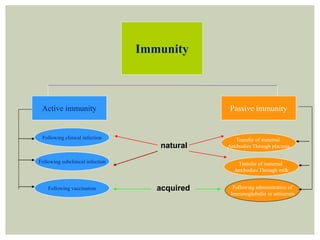
Immunity
Passive immunityActive immunity
Following clinical infection
Following subclinical infection
Following vaccination Following administration of
Immunoglobulin or antiserum
Transfer of maternal
Antibodies Through milk
Transfer of maternal
Antibodies Through placentanatural
acquired
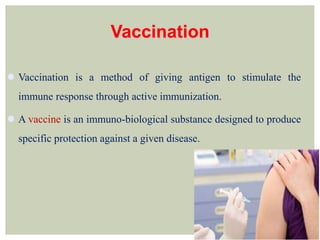
Vaccination
 Vaccination is a method of giving antigen to stimulate the
immune response through active immunization.
 A vaccine is an immuno-biological substance designed to produce
specific protection against a given disease.
Types of vaccines
 Live vaccines
 Attenuated live vaccines
 Inactivated (killed vaccines)
 Toxoids
 Polysaccharide and polypeptide (cellular fraction) vaccines
 Surface antigen (recombinant) vaccines.
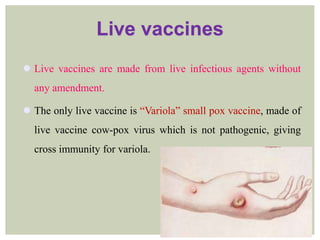
Live vaccines
 Live vaccines are made from live infectious agents without
any amendment.
 The only live vaccine is “Variola” small pox vaccine, made of
live vaccine cow-pox virus which is not pathogenic, giving
cross immunity for variola.
Live attenuated (avirulent)
vaccines
 Virulent pathogenic organisms are treated to become attenuated
and avirulent. They have lost their capacity to induce full-blown
disease but retain their immunogenicity.
 Live attenuated vaccines should not be administered to persons
with suppressed immune response due to:
Leukemia and lymphoma
Other malignancies
Receiving corticosteroids and anti-metabolic agents
Radiation
pregnancy
Inactivated (killed) vaccines
 Organisms are killed or inactivated by heat or chemicals but
remain antigenic.
 They are usually safe but less effective than live attenuated
vaccines.
 The only absolute contraindication to their administration is a
severe local or general reaction to a previous dose.
Toxoids
 They are prepared by detoxifying the exotoxins of some
bacteria rendering them antigenic but not pathogenic.
Adjuvant (e.g. alum precipitation) is used to increase the
potency of vaccine.
 The antibodies produces in the body as a consequence of
toxoid administration neutralize the toxic moiety produced
during infection rather than act upon the organism itself.
 In general, toxoids are highly efficacious and safe
immunizing agents.
Polysaccharide and polypeptide
(cellular fraction) vaccines
 They are prepared from extracted cellular fractions e.g.
meningococcal vaccine from the polysaccharide antigen of the
cell wall, the pneumococcal vaccine from the polysaccharide
contained in the capsule of the organism, and hepatitis B
polypeptide vaccine.
 Their efficacy and safety appear to be high.
Surface antigen (recombinant
protien) vaccines
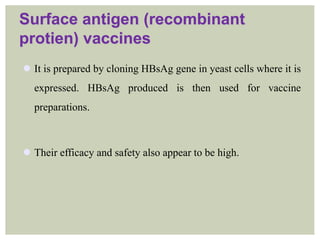
 It is prepared by cloning HBsAg gene in yeast cells where it is
expressed. HBsAg produced is then used for vaccine
preparations.
 Their efficacy and safety also appear to be high.
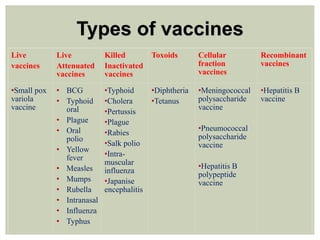
Types of vaccines
Live
vaccines
Live
Attenuated
vaccines
Killed
Inactivated
vaccines
Toxoids Cellular
fraction
vaccines
Recombinant
vaccines
•Small pox
variola
vaccine
• BCG
• Typhoid
oral
• Plague
• Oral
polio
• Yellow
fever
• Measles
• Mumps
• Rubella
• Intranasal
• Influenza
• Typhus
•Typhoid
•Cholera
•Pertussis
•Plague
•Rabies
•Salk polio
•Intra-
muscular
influenza
•Japanise
encephalitis
•Diphtheria
•Tetanus
•Meningococcal
polysaccharide
vaccine
•Pneumococcal
polysaccharide
vaccine
•Hepatitis B
polypeptide
vaccine
•Hepatitis B
vaccine
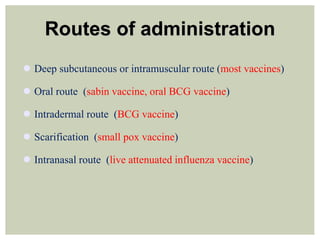
Routes of administration
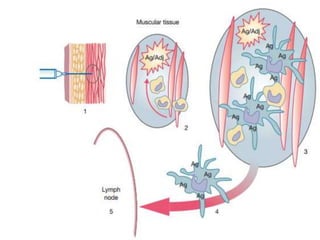
 Deep subcutaneous or intramuscular route (most vaccines)
 Oral route (sabin vaccine, oral BCG vaccine)
 Intradermal route (BCG vaccine)
 Scarification (small pox vaccine)
 Intranasal route (live attenuated influenza vaccine)
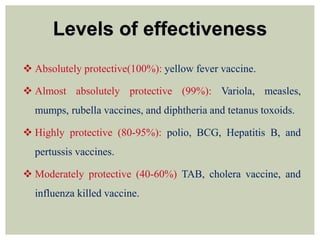
Levels of effectiveness
 Absolutely protective(100%): yellow fever vaccine.
 Almost absolutely protective (99%): Variola, measles,
mumps, rubella vaccines, and diphtheria and tetanus toxoids.
 Highly protective (80-95%): polio, BCG, Hepatitis B, and
pertussis vaccines.
 Moderately protective (40-60%) TAB, cholera vaccine, and
influenza killed vaccine.
HISTORY
25
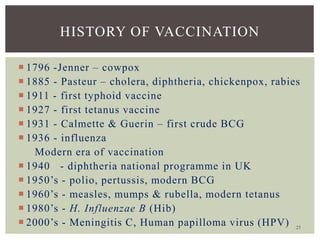
HISTORY OF VACCINATION
 1796 -Jenner – cowpox
 1885 - Pasteur – cholera, diphtheria, chickenpox, rabies
 1911 - first typhoid vaccine
 1927 - first tetanus vaccine
 1931 - Calmette & Guerin – first crude BCG
 1936 - influenza
Modern era of vaccination
 1940 - diphtheria national programme in UK
 1950’s - polio, pertussis, modern BCG
 1960’s - measles, mumps & rubella, modern tetanus
 1980’s - H. Influenzae B (Hib)
 2000’s - Meningitis C, Human papilloma virus (HPV)
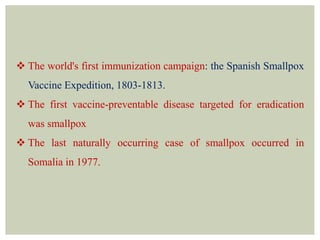
 The world's first immunization campaign: the Spanish Smallpox
Vaccine Expedition, 1803-1813.
 The first vaccine-preventable disease targeted for eradication
was smallpox
 The last naturally occurring case of smallpox occurred in
Somalia in 1977.
According to United Nations Children’s Fund12 (UNICEF)
vaccine preventable diseases (VPDs) cause an estimated 2 million
deaths or more every year, of which approximately 1.5 million
deaths occur amongchildren below five year age.
VACCINATION
HISTORY IN INDIA
Ancient times till first documented smallpox vaccination in India
in 1802
• The history of vaccines and vaccination starts with the first effort to prevent
disease in the society.
• Smallpox was well known since ancient times and believed to have originated in
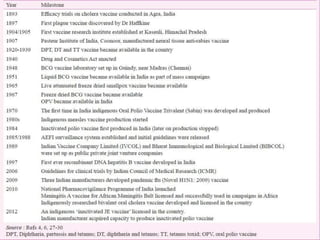
India or Egypt, over 3,000 years ago.
• From India, there are a few descriptions of occurrence of disease; however, one
of the best recorded smallpox epidemics was reported from Goa in 1545 AD,
when an estimated 8,000 children died. Historians and physicians have sometimes
referred smallpox as ‘Indian Plague’, which suggests that the disease might be
widely prevalent in India in the earlier times.
VACCINATION IN INDIA (1802-1899)
• The first doses of smallpox vaccine lymph in India arrived in May
1802.
• Anna Dusthall, a three year old child from Mumbai became the
first person in India to receive smallpox vaccine on June 14, 1802.
• From Bombay, through human chain of vaccinees, the smallpox
vaccine as lymph was sent to Madras, Pune, Hyderabad and Surat.
• The Compulsory Vaccination Act was passed in India in 1892 to
ensure higher coverage with smallpox and reduce the epidemic.
VACCINE AVAILABILITY AND
MANUFACTURING IN INDIA (1802-1899)
.
• In India, till 1850, the vaccine was imported from Great Britain.
• Another important event of this period was a cholera epidemic in
Bengal and other parts of India.
• Dr Haffkine developed plague vaccine in 1897 and it is arguably,
the first vaccine developed in India.
• This laboratory was called Plague Laboratory since 1899, renamed
as Bombay Bacteriological Lab in 1905 and then finally named as
Haffkine Institute in 1925.
VACCINATION IN INDIA (1900-1947)
The beginning of twentieth century witnessed a few socio-scientific-
geopolitical events, which had lasting effect on vaccination efforts in
the country. These changes were:
(i) Outbreak of cholera and plague in India (1896-1907) and the
services of already limited number of vaccinators were diverted to
epidemic control efforts,
(ii) The First World War (1914-1918) started and with coinciding
Influenza Pandemic (which reportedly killed around 17 million
Indians) became a priority for the Government.
(iii) New scientific understanding that two doses of smallpox
vaccine would be needed for long lasting protection. It was a
challenge considering that it meant convincing people to get
vaccinated twice with perceived inconvenient and painful
procedure.
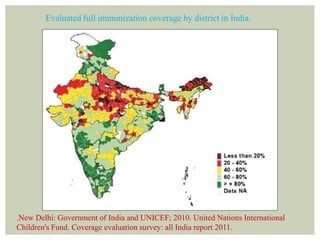
Evaluated full immunization coverage by district in India.
.New Delhi: Government of India and UNICEF; 2010. United Nations International
Children's Fund. Coverage evaluation survey: all India report 2011.
VACCINATION PROGRAMME AND
VACCINES IN INDIA: YEARS AHEAD
• The science of vaccine evolved across the globe in late 19th
century and India was amongst a few countries to have been
involved in these efforts.
• The cholera and typhoid vaccine trials and research and discovery
of plague vaccine took place in the country. Vaccine institutes
were set up in early and whole of twentieth century.
The national vaccine policy of India has suggested that ‘a number
of linkages need to be explored between academia, industry and
international institutions such as National Institute of Health
(NIH), Gates Foundation, the GAVI Alliance, World Health
Organization and the International Centre for Genetic Engineering
and Biotechnology (ICGEB), etc.
• The immunisation programme in India was flagged off in 1978
as Expanded Programme on Immunisation (EPI).
• It gained impetus in 1985 as the Universal Immunisation
Programme (UIP) and was carried out in phased manner to
cover all districts in the country by 1989-90.
• Centrally sponsored programme.
• UIP became a part of the Child Survival and State Motherhood
(CSSM) Programme in 1992 and Reproductive and Child
Health (RCH) Programmein 1997.
• It is currently under National Rural health Mission - NRHM All
the vaccines are procured by central government with 100%
domestic funding.
Universal Immunisation
program (UIP)
• The objective of UIP was to cover at least 85% of all infants
against the six vaccine-preventable diseases by 1990 and to
achieve self-sufficiency in vaccine production and the
manufacture of cold-chain equipment.
• The target now is to achieve 100% immunization coverage
although technically 85% coverage levels would ensure herd
immunity.
• Programme targeted ~ 26 million infants and 30 million
pregnant women in 2009-10.
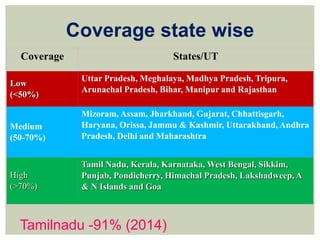
Coverage States/UT
Low
(<50%)
Uttar Pradesh, Meghalaya, Madhya Pradesh, Tripura,
Arunachal Pradesh, Bihar, Manipur and Rajasthan
Medium
(50-70%)
Mizoram, Assam, Jharkhand, Gujarat, Chhattisgarh,
Haryana, Orissa, Jammu & Kashmir, Uttarakhand, Andhra
Pradesh, Delhi and Maharashtra
High
(>70%)
Tamil Nadu, Kerala, Karnataka, West Bengal, Sikkim,
Punjab, Pondicherry, Himachal Pradesh, Lakshadweep, A
& N Islands and Goa
Coverage state wise
Tamilnadu -91% (2014)
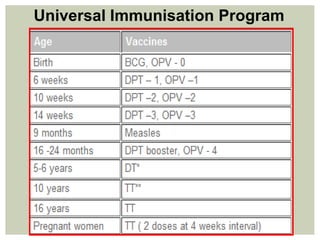
Universal Immunisation Program
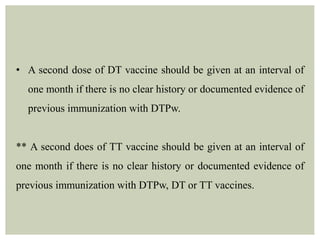
• A second dose of DT vaccine should be given at an interval of
one month if there is no clear history or documented evidence of
previous immunization with DTPw.
** A second does of TT vaccine should be given at an interval of
one month if there is no clear history or documented evidence of
previous immunization with DTPw, DT or TT vaccines.
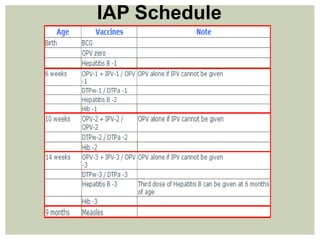
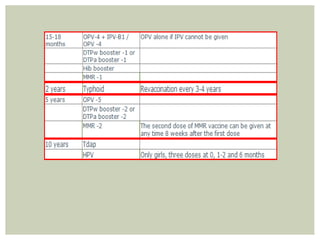
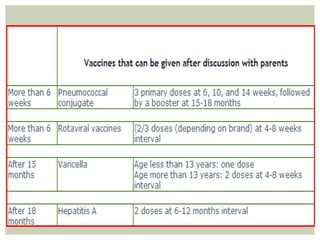
IAP Schedule
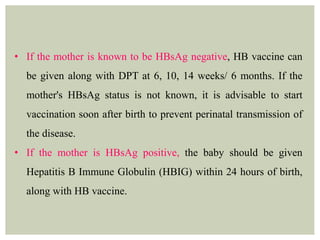
• If the mother is known to be HBsAg negative, HB vaccine can
be given along with DPT at 6, 10, 14 weeks/ 6 months. If the
mother's HBsAg status is not known, it is advisable to start
vaccination soon after birth to prevent perinatal transmission of
the disease.
• If the mother is HBsAg positive, the baby should be given
Hepatitis B Immune Globulin (HBIG) within 24 hours of birth,
along with HB vaccine.
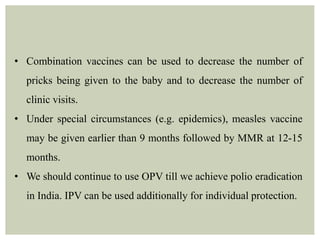
• Combination vaccines can be used to decrease the number of
pricks being given to the baby and to decrease the number of
clinic visits.
• Under special circumstances (e.g. epidemics), measles vaccine
may be given earlier than 9 months followed by MMR at 12-15
months.
• We should continue to use OPV till we achieve polio eradication
in India. IPV can be used additionally for individual protection.
Pulse Polio Immunization
(PPI)
• India launched the Pulse Polio Immunization (PPI) program in
1995 as a result of World Health Organization's (WHO) Global
Polio Eradication Initiative.
• Under this programme, all children under 5 years are given 2
doses of Oral Polio Vaccine (OPV) in December and January
every year until polio is eradicated.
• It aims to reach the unreached children through improved social
mobilization and plan mop-up operations in areas where
poliovirus has almost disappeared.
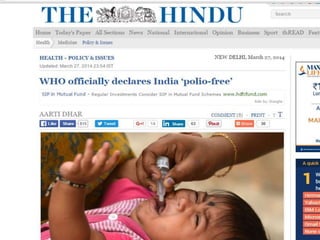
 The last reported cases of wild polio in India were in
West Bengal and Gujarat on 13 January 2011.
The Cold Chain
 The "cold chain" is a system of storage and transport of
vaccines at low temperature from the manufacturer to the
actual vaccination site.
 The cold chain system is necessary because vaccine failure
may occur due to failure to store and transport under strict
temperature controls.
54
COLD CHAIN
 System of transporting and
storing vaccines within the
recommended temperature
range of 2 – 80C
55
WHY IS THE COLD CHAIN
IMPORTANT?
 Effectiveness of vaccines cannot be guaranteed if
exposed to temperature extremes.
 Provides assurance/ confidence in potency of the
product.
 Ensures patient obtains maximum benefit from
immunisation.
The Cold Chain Equipment
Cold chain equipment consists of the following:
(a) Walk in cold rooms: They are located at regional level,
meant to store vaccines up to 3 months and serve districts.
(b) Deep freezers (300 ltr) and Ice lined Refrigerators: supplied
to all districts to store vaccines. Deep freezers are used for
making ice packs and to store OPV and measles vaccines.
(c) Small deep freezers (140 ltr) : One set is provided to PHCs,
and Family Planning Centers.
 (d) Cold boxes: Cold boxes are supplied to all peripheral
centers. These are used mainly for transportation of the vaccines.
 (e) Vaccine carriers: Vaccine carriers are used to carry small
quantities of vaccines (16-20 vials) for the out of reach sessions.
4 fully frozen ice packs are used for lining the sides, and vials of
DPT, DT, TT and diluents should not be placed in direct contact
with frozen ice packs. The carriers should be closed tightly.
 (f) Ice packs: The ice packs contain water and no salt should be
added to it.
 Among the vaccines, polio is the most sensitive to heat,
requiring storage at minus 20 degree C.
 Vaccines which must be stored in the freezer compartment are
: polio and measles.
 Vaccines which must be stored in the COLD PART but never
allowed to freeze are : typhoid, DPT, tetanus toxoid, DT, BCG
and diluents.
HAZARDS OF IMMUNIZATION
• No immune response is entirely free from the risk of adverse
reactions or remote squeal. The adverse reactions that may
occur may be grouped under the following heads:
1. Reactions inherent to inoculation
2. Reactions due to faulty techniques
3. Reactions due to hypersensitivity
4. Neurological involvement
5. Provocative reactions
6. Others
 1. Reactions inherent to inoculation:
These may be local general reactions. The local reactions may
be pain, swelling, redness, tenderness and development of a
small nodule or sterile abscess at the site of injection.
 The general reactions may be fever, malaise, headache and
other constitutional symptoms. Most killed bacterial vaccines
(e.g., typhoid) cause some local and general reactions.
Diphtheria and tetanus toxoids and live polio vaccine cause
little reaction.
 2. Reactions due to faulty techniques:
Faulty techniques may relate to
 faulty production of vaccine (e.g. inadequate inactivation of the microbe,
inadequate detoxication),
 too much vaccine given in one dose,
 improper immunization site or route,
 contraindications ignored (e.g. a child who experienced a severe reaction
after a previous dose of DPT vaccine is immunized with he same vaccine),
 reconstituted vaccine of one session of immunization used again at the
subsequent session.
 3. Reactions due to hypersensitivity:
 Administration of antiserum (e.g., ATS) may occasionally
give rise to anaphylactic shock and serum sickness. Many
viral vaccines contain traces of various antibiotics used in
their preparation and some individuals may be sensitive to the
antibiotic which it contains.
 Anaphylactic shock is a rare but dangerous complication of
injection of antiserum. There is bronchospasm, dyspnoea,
pallor, hypotension and collapse.
 4. Neurological involvement:
 Neuritic manifestations may be seen after the administration
of serum or vaccine. The well-known examples are the post-
vaccinial encephalitis and encephalopathy following
administration of anti -rabies and smallpox vaccines.
 GuillainBarre syndrome in association with the swine
influenza vaccine is another example.
 5. Provocative reactions:
 Occasionally following immunization there may occur a
disease totally unconnected with the immunizing agent (e.g.,
provocative polio after DPT or DT administration against
diphtheria).
 The mechanism seems to be that the individual is harboring
the infectious agent and the administration of the vaccine
shortens the incubation period and produces the disease or
what may have been otherwise only a latent infection is
converted into a clinical attack.
 6. Others:
 These may comprise damage to the fetus (e.g., with rubella
vaccination); displacement in the age-distribution of a disease
(e.g., a potential problem in mass vaccination against measles,
rubella and mumps).
Precautions
The risk of adverse reactions can be reduced by proper
sterilization of syringes and needles, by proper selection of the
subject and the product, and if due care is exercised in carrying out
the procedure.
 Measles and BCG vaccines should be reconstituted only with the
diluent supplied by the manufacturer.
Reconstituted vaccine should be discarded at the end of each
immunization session and NEVER retained for use in
subsequent sessions. In the refrigerator of the immunization
centre, no other drug and substances should be stored beside
vaccines.
Training of immunization worker and their close supervision
to ensure that proper procedures are being followed are
essential to prevent complications and deaths following
immunization.
Vaccination Coverage
 Vaccination coverage is the percent of at risk or susceptible
individuals, or population who have been fully immunized
against particular diseases by vaccines or toxoids.
 To be significantly effective in prevention of disease on mass
or community level at least a satisfactory proportion (75% or
more) of the at risk population must be immunized.
 A caries vaccine is a vaccine to prevent and protect
against tooth decay.
 Development of a vaccine for tooth decay has been under
investigation for more than 50 years. In 1972, a caries
vaccine was said to be in animal testing in England, and that
it would have begun human testing soon.
 Intrinsic difficulties in developing it, coupled with lack of
strong economic interests are the reasons why no such
vaccine is commercially available as of now.
DENTAL CARIES VACCINE
 The International Association for Dental Research and
American Association for Dental Research announced a
study performed by the Chinese Academy of Sciences which
looked at using an inhaled vaccine that uses a protein
filament as a delivery vehicle.
 Trials performed in rats showed an increase in antibody
response along with a decrease in the amount of
Streptococcus mutans adhering to teeth, leading to
significantly fewer cavities observed among the test
population.
Ways of achieving satisfactory
immunization coverage
 Efficient immunization service; urban and rural.
 Health awareness and cooperation of the public.
 Periodic mass immunization campaigns, to cover those who
missed regular immunizations.
 Outreach programs in rural and nomad areas, and home visits.
Vaccination for special occupations
 Health care workers: hepatitis B, influenza, MMR, polio
 Public safety personnel (police, fire fighters) and staff of
institutions for the developmentally disabled: hepatitis B,
influenza
 Vets and animal handlers: rabies, plague and anthrax
 Sewage workers: DT, hepatitis A, polio, TAB
 Food handlers: TAB
 Military troops and camp dwellers: pneumococcal,
meningococcal, influenza, BCG (for non reactors), tetanus.
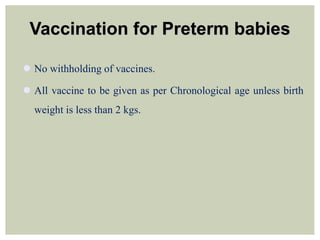
Vaccination for Preterm babies
 No withholding of vaccines.
 All vaccine to be given as per Chronological age unless birth
weight is less than 2 kgs.
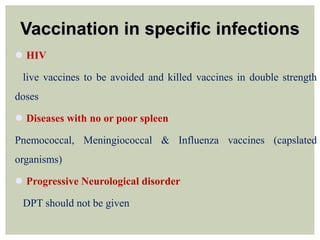
Vaccination in specific infections
 HIV
live vaccines to be avoided and killed vaccines in double strength
doses
 Diseases with no or poor spleen
Pnemococcal, Meningiococcal & Influenza vaccines (capslated
organisms)
 Progressive Neurological disorder
DPT should not be given
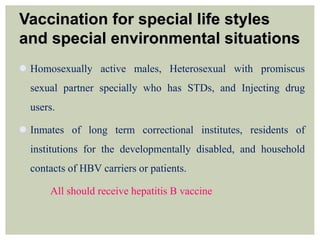
Vaccination for special life styles
and special environmental situations
 Homosexually active males, Heterosexual with promiscus
sexual partner specially who has STDs, and Injecting drug
users.
 Inmates of long term correctional institutes, residents of
institutions for the developmentally disabled, and household
contacts of HBV carriers or patients.
All should receive hepatitis B vaccine
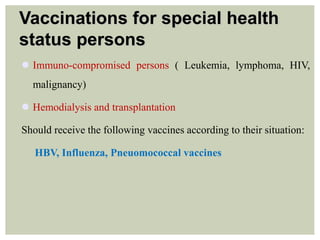
Vaccinations for special health
status persons
 Immuno-compromised persons ( Leukemia, lymphoma, HIV,
malignancy)
 Hemodialysis and transplantation
Should receive the following vaccines according to their situation:
HBV, Influenza, Pneuomococcal vaccines
101
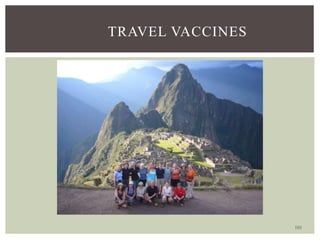
TRAVEL VACCINES
Vaccinations in travel
 Varies according to the country of arrival and departure.
Specific vaccine according to the country traveled to:
 Haj for instance necessates meningococcal vaccination
from all over,
 cholera from places like India.
79
TRAVEL VACCINATION
 Increased risk of transmission of infectious disease due
to dramatic  in global travel.
 Study revealed 67% of travellers to high/medium risk
areas had not taken medical advice.
 Need consultation at least 1 month before travel.
 Are two compulsory vaccinations – yellow fever/
meningitis.
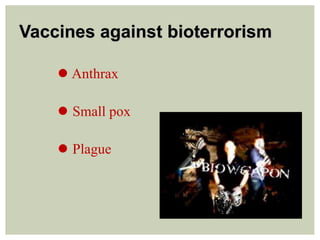
Vaccines against bioterrorism
 Anthrax
 Small pox
 Plague
81
BARRIERS TO IMMUNISATION
UPTAKE
 Poor information/ misconceptions/ myths
 Conflicting advice: family, media etc
 Inconvenience: time, transport, lack of flexibility in
system
 Vaccine supply issues
82
POOR INFORMATION/
MISCONCEPTIONS/ MYTHS
 Misconceptions have always been around e.g
Vaccines can give you the infection e.g flu
Multicomponent vaccines overload the immune system
Giving vaccines singly is safer
Risk from vaccine is worse than the infection – no-one
dies these days from measles!
83
84
VACCINE SUPPLY ISSUES
 Can affect uptake of immunisation
Clinics cancelled – patients forget to return for next dose
Increased number of injections having to be given puts
people off!
85
VACCINE PRODUCTION
 Two main stages
Biological - antigen preparation
Pharmaceutical - ready to use product
 Production cycles are long
Tetanus vaccine - 9-10 months
Diphtheria vaccine - 11 months
99
RISKS ASSOCIATED WITH INCORRECT
VACCINE STORAGE
 Risk to patient
Risk of acquiring infection due to ineffective
vaccination
Risks associated with possible re-vaccination
 Risk to Healthcare professionals
Loss of confidence in service
100
IMMUNISATION ADMINISTRATION
ERRORS
e.g. Administration of the wrong vaccine
Administration of extra/ unnecessary
vaccines.
Administration of out of date vaccines
 All should be reported using medication incident
reporting systems
 Reports should be reviewed and analysed
 The evolution of vaccination efforts in India is far more complex
than presented here and every single event merits a detailed
analysis.
 Though preventive efforts from diseases were practiced in India,
the reluctance, opposition and slow acceptance of vaccination
have been the characteristic of vaccination history. The
operational challenges keep the coverage inequitable in the
country. The lessons from the past events have been analysed
and interpreted to guide immunization efforts.
•REFERENCES
• 1. 3nd ed. Geneva: WHO; 2009. World Health Organization ganization (WHO)
Unicef, World Bank. State of the world's vaccines and immunization.
• 2. Geneva: WHO; 2012. Mar, [accessed on May 30, 2012]. World Health
Organization. Global immunization data 2011. Available from:
www.who.int/hpvcentre/Global_Immunization_Data.pdf .
• 3. Fenner F, Henderson DA, Arita I, Jezek Z, Ladnyi ID. Geneva: World Health
Organization; 1988. Smallpox and its eradication; pp. 369–71.
• 4. New Delhi: Government of India and UNICEF; 2010. United Nations
International Children's Fund. Coverage evaluation survey: all India report 2009.
• Basu RN, Jezek Z, Ward NA. New Delhi, India: World Health
Organization, South-East Asia Regional Office; 1979. The
eradication of smallpox from India.
• 6. Bhattacharya S, Harrison M, Worboys M. Hyderabad: Orient
Longman; 2006. Fractured states: Smallpox, public health and
vaccination policy in British India, 1800-1947.
• 7. Bazin H. San Diego: Academic Press; 2000. The eradication of
smallpox: Edward Jenner and the first and only eradication of a
human infectious disease.
•Janes Kuby, 2007, Vaccines, Immunology, W.H. Freeman and
Company, Newyork, sixth Edition, Pg. 413- 428.
•Satyanarayana U., 2010, Vacines, Biotechnolgy, BOOK’S AND
ALLIED (P) Ltd, Kolkata, sixth edition, Pg. 211-212.
• www.wikipedia.org
• www.britannica.com
• www.pathmicro.med.sc.edu
• www.mpi-magdeburg.mpg.de
• www.sc.edu
• www.niaid.nih.gov
92
 ‘The Green Book’, www.dh.gov.uk
 www.immunisation.nhs.uk
 www.hps.scot.nhs.uk
 www.immunisationscotland.org.uk
 www.uvig.org
 www.hpa.org.uk
THANK YOU

Vaccination programmes
  • 3.
  • 4.
     Introduction  Immunisation Vaccine preventable diseases  Vaccination  Types of vaccination  Routes of administration  Levels of vaccines  History CONTENTS
  • 5.
     Vaccination historyin India  Pulse polio vaccination  The cold chain  Hazards of Immunisation  Precaution  Vaccination coverge  Conclusion  References
  • 6.
  • 7.
    7 AIM To prevent orprotect against serious disease. To eliminate a particular disease from a defined population. To eradicate a disease entirely e.g. smallpox
  • 8.
    8  However itis not possible to eradicate all vaccine- preventable diseases: Asymptomatic carriage Mutating organisms e.g. influenza Animal reservoirs e.g. SARS, avian influenza Environmental reservoirs e.g. tetanus Global travel/mass immigration
  • 9.
    9 VACCINE PREVENTABLE DISEASES (BACTERIAL) Diptheria   Haemophilus influenzae B (Hib)   Meningococcal (meningitis)   Pneumococcal disease   Tetanus   Tuberculosis   Whooping cough (pertussis) 
  • 10.
    10 VACCINE PREVENTABLE DISEASES (VIRAL) Chickenpox  Flu  Measles  Mumps  Polio  Rubella  HPV
  • 11.
    Immunity Passive immunityActive immunity Followingclinical infection Following subclinical infection Following vaccination Following administration of Immunoglobulin or antiserum Transfer of maternal Antibodies Through milk Transfer of maternal Antibodies Through placentanatural acquired
  • 12.
    Vaccination  Vaccination isa method of giving antigen to stimulate the immune response through active immunization.  A vaccine is an immuno-biological substance designed to produce specific protection against a given disease.
  • 13.
    Types of vaccines Live vaccines  Attenuated live vaccines  Inactivated (killed vaccines)  Toxoids  Polysaccharide and polypeptide (cellular fraction) vaccines  Surface antigen (recombinant) vaccines.
  • 14.
    Live vaccines  Livevaccines are made from live infectious agents without any amendment.  The only live vaccine is “Variola” small pox vaccine, made of live vaccine cow-pox virus which is not pathogenic, giving cross immunity for variola.
  • 15.
    Live attenuated (avirulent) vaccines Virulent pathogenic organisms are treated to become attenuated and avirulent. They have lost their capacity to induce full-blown disease but retain their immunogenicity.  Live attenuated vaccines should not be administered to persons with suppressed immune response due to: Leukemia and lymphoma Other malignancies Receiving corticosteroids and anti-metabolic agents Radiation pregnancy
  • 16.
    Inactivated (killed) vaccines Organisms are killed or inactivated by heat or chemicals but remain antigenic.  They are usually safe but less effective than live attenuated vaccines.  The only absolute contraindication to their administration is a severe local or general reaction to a previous dose.
  • 17.
    Toxoids  They areprepared by detoxifying the exotoxins of some bacteria rendering them antigenic but not pathogenic. Adjuvant (e.g. alum precipitation) is used to increase the potency of vaccine.  The antibodies produces in the body as a consequence of toxoid administration neutralize the toxic moiety produced during infection rather than act upon the organism itself.  In general, toxoids are highly efficacious and safe immunizing agents.
  • 18.
    Polysaccharide and polypeptide (cellularfraction) vaccines  They are prepared from extracted cellular fractions e.g. meningococcal vaccine from the polysaccharide antigen of the cell wall, the pneumococcal vaccine from the polysaccharide contained in the capsule of the organism, and hepatitis B polypeptide vaccine.  Their efficacy and safety appear to be high.
  • 19.
    Surface antigen (recombinant protien)vaccines  It is prepared by cloning HBsAg gene in yeast cells where it is expressed. HBsAg produced is then used for vaccine preparations.  Their efficacy and safety also appear to be high.
  • 20.
    Types of vaccines Live vaccines Live Attenuated vaccines Killed Inactivated vaccines ToxoidsCellular fraction vaccines Recombinant vaccines •Small pox variola vaccine • BCG • Typhoid oral • Plague • Oral polio • Yellow fever • Measles • Mumps • Rubella • Intranasal • Influenza • Typhus •Typhoid •Cholera •Pertussis •Plague •Rabies •Salk polio •Intra- muscular influenza •Japanise encephalitis •Diphtheria •Tetanus •Meningococcal polysaccharide vaccine •Pneumococcal polysaccharide vaccine •Hepatitis B polypeptide vaccine •Hepatitis B vaccine
  • 21.
    Routes of administration Deep subcutaneous or intramuscular route (most vaccines)  Oral route (sabin vaccine, oral BCG vaccine)  Intradermal route (BCG vaccine)  Scarification (small pox vaccine)  Intranasal route (live attenuated influenza vaccine)
  • 23.
    Levels of effectiveness Absolutely protective(100%): yellow fever vaccine.  Almost absolutely protective (99%): Variola, measles, mumps, rubella vaccines, and diphtheria and tetanus toxoids.  Highly protective (80-95%): polio, BCG, Hepatitis B, and pertussis vaccines.  Moderately protective (40-60%) TAB, cholera vaccine, and influenza killed vaccine.
  • 24.
  • 25.
    25 HISTORY OF VACCINATION 1796 -Jenner – cowpox  1885 - Pasteur – cholera, diphtheria, chickenpox, rabies  1911 - first typhoid vaccine  1927 - first tetanus vaccine  1931 - Calmette & Guerin – first crude BCG  1936 - influenza Modern era of vaccination  1940 - diphtheria national programme in UK  1950’s - polio, pertussis, modern BCG  1960’s - measles, mumps & rubella, modern tetanus  1980’s - H. Influenzae B (Hib)  2000’s - Meningitis C, Human papilloma virus (HPV)
  • 26.
     The world'sfirst immunization campaign: the Spanish Smallpox Vaccine Expedition, 1803-1813.  The first vaccine-preventable disease targeted for eradication was smallpox  The last naturally occurring case of smallpox occurred in Somalia in 1977.
  • 27.
    According to UnitedNations Children’s Fund12 (UNICEF) vaccine preventable diseases (VPDs) cause an estimated 2 million deaths or more every year, of which approximately 1.5 million deaths occur amongchildren below five year age.
  • 28.
  • 29.
    Ancient times tillfirst documented smallpox vaccination in India in 1802 • The history of vaccines and vaccination starts with the first effort to prevent disease in the society. • Smallpox was well known since ancient times and believed to have originated in India or Egypt, over 3,000 years ago. • From India, there are a few descriptions of occurrence of disease; however, one of the best recorded smallpox epidemics was reported from Goa in 1545 AD, when an estimated 8,000 children died. Historians and physicians have sometimes referred smallpox as ‘Indian Plague’, which suggests that the disease might be widely prevalent in India in the earlier times.
  • 30.
    VACCINATION IN INDIA(1802-1899) • The first doses of smallpox vaccine lymph in India arrived in May 1802. • Anna Dusthall, a three year old child from Mumbai became the first person in India to receive smallpox vaccine on June 14, 1802. • From Bombay, through human chain of vaccinees, the smallpox vaccine as lymph was sent to Madras, Pune, Hyderabad and Surat. • The Compulsory Vaccination Act was passed in India in 1892 to ensure higher coverage with smallpox and reduce the epidemic.
  • 31.
    VACCINE AVAILABILITY AND MANUFACTURINGIN INDIA (1802-1899) . • In India, till 1850, the vaccine was imported from Great Britain. • Another important event of this period was a cholera epidemic in Bengal and other parts of India. • Dr Haffkine developed plague vaccine in 1897 and it is arguably, the first vaccine developed in India. • This laboratory was called Plague Laboratory since 1899, renamed as Bombay Bacteriological Lab in 1905 and then finally named as Haffkine Institute in 1925.
  • 32.
    VACCINATION IN INDIA(1900-1947) The beginning of twentieth century witnessed a few socio-scientific- geopolitical events, which had lasting effect on vaccination efforts in the country. These changes were: (i) Outbreak of cholera and plague in India (1896-1907) and the services of already limited number of vaccinators were diverted to epidemic control efforts,
  • 33.
    (ii) The FirstWorld War (1914-1918) started and with coinciding Influenza Pandemic (which reportedly killed around 17 million Indians) became a priority for the Government. (iii) New scientific understanding that two doses of smallpox vaccine would be needed for long lasting protection. It was a challenge considering that it meant convincing people to get vaccinated twice with perceived inconvenient and painful procedure.
  • 35.
    Evaluated full immunizationcoverage by district in India. .New Delhi: Government of India and UNICEF; 2010. United Nations International Children's Fund. Coverage evaluation survey: all India report 2011.
  • 36.
    VACCINATION PROGRAMME AND VACCINESIN INDIA: YEARS AHEAD • The science of vaccine evolved across the globe in late 19th century and India was amongst a few countries to have been involved in these efforts. • The cholera and typhoid vaccine trials and research and discovery of plague vaccine took place in the country. Vaccine institutes were set up in early and whole of twentieth century.
  • 37.
    The national vaccinepolicy of India has suggested that ‘a number of linkages need to be explored between academia, industry and international institutions such as National Institute of Health (NIH), Gates Foundation, the GAVI Alliance, World Health Organization and the International Centre for Genetic Engineering and Biotechnology (ICGEB), etc.
  • 38.
    • The immunisationprogramme in India was flagged off in 1978 as Expanded Programme on Immunisation (EPI). • It gained impetus in 1985 as the Universal Immunisation Programme (UIP) and was carried out in phased manner to cover all districts in the country by 1989-90.
  • 39.
    • Centrally sponsoredprogramme. • UIP became a part of the Child Survival and State Motherhood (CSSM) Programme in 1992 and Reproductive and Child Health (RCH) Programmein 1997. • It is currently under National Rural health Mission - NRHM All the vaccines are procured by central government with 100% domestic funding. Universal Immunisation program (UIP)
  • 40.
    • The objectiveof UIP was to cover at least 85% of all infants against the six vaccine-preventable diseases by 1990 and to achieve self-sufficiency in vaccine production and the manufacture of cold-chain equipment. • The target now is to achieve 100% immunization coverage although technically 85% coverage levels would ensure herd immunity. • Programme targeted ~ 26 million infants and 30 million pregnant women in 2009-10.
  • 41.
    Coverage States/UT Low (<50%) Uttar Pradesh,Meghalaya, Madhya Pradesh, Tripura, Arunachal Pradesh, Bihar, Manipur and Rajasthan Medium (50-70%) Mizoram, Assam, Jharkhand, Gujarat, Chhattisgarh, Haryana, Orissa, Jammu & Kashmir, Uttarakhand, Andhra Pradesh, Delhi and Maharashtra High (>70%) Tamil Nadu, Kerala, Karnataka, West Bengal, Sikkim, Punjab, Pondicherry, Himachal Pradesh, Lakshadweep, A & N Islands and Goa Coverage state wise Tamilnadu -91% (2014)
  • 42.
  • 43.
    • A seconddose of DT vaccine should be given at an interval of one month if there is no clear history or documented evidence of previous immunization with DTPw. ** A second does of TT vaccine should be given at an interval of one month if there is no clear history or documented evidence of previous immunization with DTPw, DT or TT vaccines.
  • 44.
  • 47.
    • If themother is known to be HBsAg negative, HB vaccine can be given along with DPT at 6, 10, 14 weeks/ 6 months. If the mother's HBsAg status is not known, it is advisable to start vaccination soon after birth to prevent perinatal transmission of the disease. • If the mother is HBsAg positive, the baby should be given Hepatitis B Immune Globulin (HBIG) within 24 hours of birth, along with HB vaccine.
  • 48.
    • Combination vaccinescan be used to decrease the number of pricks being given to the baby and to decrease the number of clinic visits. • Under special circumstances (e.g. epidemics), measles vaccine may be given earlier than 9 months followed by MMR at 12-15 months. • We should continue to use OPV till we achieve polio eradication in India. IPV can be used additionally for individual protection.
  • 49.
  • 50.
    • India launchedthe Pulse Polio Immunization (PPI) program in 1995 as a result of World Health Organization's (WHO) Global Polio Eradication Initiative. • Under this programme, all children under 5 years are given 2 doses of Oral Polio Vaccine (OPV) in December and January every year until polio is eradicated. • It aims to reach the unreached children through improved social mobilization and plan mop-up operations in areas where poliovirus has almost disappeared.
  • 51.
     The lastreported cases of wild polio in India were in West Bengal and Gujarat on 13 January 2011.
  • 53.
    The Cold Chain The "cold chain" is a system of storage and transport of vaccines at low temperature from the manufacturer to the actual vaccination site.  The cold chain system is necessary because vaccine failure may occur due to failure to store and transport under strict temperature controls.
  • 54.
    54 COLD CHAIN  Systemof transporting and storing vaccines within the recommended temperature range of 2 – 80C
  • 55.
    55 WHY IS THECOLD CHAIN IMPORTANT?  Effectiveness of vaccines cannot be guaranteed if exposed to temperature extremes.  Provides assurance/ confidence in potency of the product.  Ensures patient obtains maximum benefit from immunisation.
  • 56.
    The Cold ChainEquipment Cold chain equipment consists of the following: (a) Walk in cold rooms: They are located at regional level, meant to store vaccines up to 3 months and serve districts. (b) Deep freezers (300 ltr) and Ice lined Refrigerators: supplied to all districts to store vaccines. Deep freezers are used for making ice packs and to store OPV and measles vaccines. (c) Small deep freezers (140 ltr) : One set is provided to PHCs, and Family Planning Centers.
  • 57.
     (d) Coldboxes: Cold boxes are supplied to all peripheral centers. These are used mainly for transportation of the vaccines.  (e) Vaccine carriers: Vaccine carriers are used to carry small quantities of vaccines (16-20 vials) for the out of reach sessions. 4 fully frozen ice packs are used for lining the sides, and vials of DPT, DT, TT and diluents should not be placed in direct contact with frozen ice packs. The carriers should be closed tightly.  (f) Ice packs: The ice packs contain water and no salt should be added to it.
  • 58.
     Among thevaccines, polio is the most sensitive to heat, requiring storage at minus 20 degree C.  Vaccines which must be stored in the freezer compartment are : polio and measles.  Vaccines which must be stored in the COLD PART but never allowed to freeze are : typhoid, DPT, tetanus toxoid, DT, BCG and diluents.
  • 59.
    HAZARDS OF IMMUNIZATION •No immune response is entirely free from the risk of adverse reactions or remote squeal. The adverse reactions that may occur may be grouped under the following heads: 1. Reactions inherent to inoculation 2. Reactions due to faulty techniques 3. Reactions due to hypersensitivity 4. Neurological involvement 5. Provocative reactions 6. Others
  • 60.
     1. Reactionsinherent to inoculation: These may be local general reactions. The local reactions may be pain, swelling, redness, tenderness and development of a small nodule or sterile abscess at the site of injection.  The general reactions may be fever, malaise, headache and other constitutional symptoms. Most killed bacterial vaccines (e.g., typhoid) cause some local and general reactions. Diphtheria and tetanus toxoids and live polio vaccine cause little reaction.
  • 61.
     2. Reactionsdue to faulty techniques: Faulty techniques may relate to  faulty production of vaccine (e.g. inadequate inactivation of the microbe, inadequate detoxication),  too much vaccine given in one dose,  improper immunization site or route,  contraindications ignored (e.g. a child who experienced a severe reaction after a previous dose of DPT vaccine is immunized with he same vaccine),  reconstituted vaccine of one session of immunization used again at the subsequent session.
  • 62.
     3. Reactionsdue to hypersensitivity:  Administration of antiserum (e.g., ATS) may occasionally give rise to anaphylactic shock and serum sickness. Many viral vaccines contain traces of various antibiotics used in their preparation and some individuals may be sensitive to the antibiotic which it contains.  Anaphylactic shock is a rare but dangerous complication of injection of antiserum. There is bronchospasm, dyspnoea, pallor, hypotension and collapse.
  • 63.
     4. Neurologicalinvolvement:  Neuritic manifestations may be seen after the administration of serum or vaccine. The well-known examples are the post- vaccinial encephalitis and encephalopathy following administration of anti -rabies and smallpox vaccines.  GuillainBarre syndrome in association with the swine influenza vaccine is another example.
  • 64.
     5. Provocativereactions:  Occasionally following immunization there may occur a disease totally unconnected with the immunizing agent (e.g., provocative polio after DPT or DT administration against diphtheria).  The mechanism seems to be that the individual is harboring the infectious agent and the administration of the vaccine shortens the incubation period and produces the disease or what may have been otherwise only a latent infection is converted into a clinical attack.
  • 65.
     6. Others: These may comprise damage to the fetus (e.g., with rubella vaccination); displacement in the age-distribution of a disease (e.g., a potential problem in mass vaccination against measles, rubella and mumps).
  • 66.
    Precautions The risk ofadverse reactions can be reduced by proper sterilization of syringes and needles, by proper selection of the subject and the product, and if due care is exercised in carrying out the procedure.  Measles and BCG vaccines should be reconstituted only with the diluent supplied by the manufacturer.
  • 67.
    Reconstituted vaccine shouldbe discarded at the end of each immunization session and NEVER retained for use in subsequent sessions. In the refrigerator of the immunization centre, no other drug and substances should be stored beside vaccines. Training of immunization worker and their close supervision to ensure that proper procedures are being followed are essential to prevent complications and deaths following immunization.
  • 68.
    Vaccination Coverage  Vaccinationcoverage is the percent of at risk or susceptible individuals, or population who have been fully immunized against particular diseases by vaccines or toxoids.  To be significantly effective in prevention of disease on mass or community level at least a satisfactory proportion (75% or more) of the at risk population must be immunized.
  • 69.
     A cariesvaccine is a vaccine to prevent and protect against tooth decay.  Development of a vaccine for tooth decay has been under investigation for more than 50 years. In 1972, a caries vaccine was said to be in animal testing in England, and that it would have begun human testing soon.  Intrinsic difficulties in developing it, coupled with lack of strong economic interests are the reasons why no such vaccine is commercially available as of now. DENTAL CARIES VACCINE
  • 70.
     The InternationalAssociation for Dental Research and American Association for Dental Research announced a study performed by the Chinese Academy of Sciences which looked at using an inhaled vaccine that uses a protein filament as a delivery vehicle.  Trials performed in rats showed an increase in antibody response along with a decrease in the amount of Streptococcus mutans adhering to teeth, leading to significantly fewer cavities observed among the test population.
  • 71.
    Ways of achievingsatisfactory immunization coverage  Efficient immunization service; urban and rural.  Health awareness and cooperation of the public.  Periodic mass immunization campaigns, to cover those who missed regular immunizations.  Outreach programs in rural and nomad areas, and home visits.
  • 72.
    Vaccination for specialoccupations  Health care workers: hepatitis B, influenza, MMR, polio  Public safety personnel (police, fire fighters) and staff of institutions for the developmentally disabled: hepatitis B, influenza  Vets and animal handlers: rabies, plague and anthrax  Sewage workers: DT, hepatitis A, polio, TAB  Food handlers: TAB  Military troops and camp dwellers: pneumococcal, meningococcal, influenza, BCG (for non reactors), tetanus.
  • 73.
    Vaccination for Pretermbabies  No withholding of vaccines.  All vaccine to be given as per Chronological age unless birth weight is less than 2 kgs.
  • 74.
    Vaccination in specificinfections  HIV live vaccines to be avoided and killed vaccines in double strength doses  Diseases with no or poor spleen Pnemococcal, Meningiococcal & Influenza vaccines (capslated organisms)  Progressive Neurological disorder DPT should not be given
  • 75.
    Vaccination for speciallife styles and special environmental situations  Homosexually active males, Heterosexual with promiscus sexual partner specially who has STDs, and Injecting drug users.  Inmates of long term correctional institutes, residents of institutions for the developmentally disabled, and household contacts of HBV carriers or patients. All should receive hepatitis B vaccine
  • 76.
    Vaccinations for specialhealth status persons  Immuno-compromised persons ( Leukemia, lymphoma, HIV, malignancy)  Hemodialysis and transplantation Should receive the following vaccines according to their situation: HBV, Influenza, Pneuomococcal vaccines
  • 77.
  • 78.
    Vaccinations in travel Varies according to the country of arrival and departure. Specific vaccine according to the country traveled to:  Haj for instance necessates meningococcal vaccination from all over,  cholera from places like India.
  • 79.
    79 TRAVEL VACCINATION  Increasedrisk of transmission of infectious disease due to dramatic  in global travel.  Study revealed 67% of travellers to high/medium risk areas had not taken medical advice.  Need consultation at least 1 month before travel.  Are two compulsory vaccinations – yellow fever/ meningitis.
  • 80.
    Vaccines against bioterrorism Anthrax  Small pox  Plague
  • 81.
    81 BARRIERS TO IMMUNISATION UPTAKE Poor information/ misconceptions/ myths  Conflicting advice: family, media etc  Inconvenience: time, transport, lack of flexibility in system  Vaccine supply issues
  • 82.
    82 POOR INFORMATION/ MISCONCEPTIONS/ MYTHS Misconceptions have always been around e.g Vaccines can give you the infection e.g flu Multicomponent vaccines overload the immune system Giving vaccines singly is safer Risk from vaccine is worse than the infection – no-one dies these days from measles!
  • 83.
  • 84.
    84 VACCINE SUPPLY ISSUES Can affect uptake of immunisation Clinics cancelled – patients forget to return for next dose Increased number of injections having to be given puts people off!
  • 85.
    85 VACCINE PRODUCTION  Twomain stages Biological - antigen preparation Pharmaceutical - ready to use product  Production cycles are long Tetanus vaccine - 9-10 months Diphtheria vaccine - 11 months
  • 86.
    99 RISKS ASSOCIATED WITHINCORRECT VACCINE STORAGE  Risk to patient Risk of acquiring infection due to ineffective vaccination Risks associated with possible re-vaccination  Risk to Healthcare professionals Loss of confidence in service
  • 87.
    100 IMMUNISATION ADMINISTRATION ERRORS e.g. Administrationof the wrong vaccine Administration of extra/ unnecessary vaccines. Administration of out of date vaccines  All should be reported using medication incident reporting systems  Reports should be reviewed and analysed
  • 88.
     The evolutionof vaccination efforts in India is far more complex than presented here and every single event merits a detailed analysis.  Though preventive efforts from diseases were practiced in India, the reluctance, opposition and slow acceptance of vaccination have been the characteristic of vaccination history. The operational challenges keep the coverage inequitable in the country. The lessons from the past events have been analysed and interpreted to guide immunization efforts.
  • 89.
    •REFERENCES • 1. 3nded. Geneva: WHO; 2009. World Health Organization ganization (WHO) Unicef, World Bank. State of the world's vaccines and immunization. • 2. Geneva: WHO; 2012. Mar, [accessed on May 30, 2012]. World Health Organization. Global immunization data 2011. Available from: www.who.int/hpvcentre/Global_Immunization_Data.pdf . • 3. Fenner F, Henderson DA, Arita I, Jezek Z, Ladnyi ID. Geneva: World Health Organization; 1988. Smallpox and its eradication; pp. 369–71. • 4. New Delhi: Government of India and UNICEF; 2010. United Nations International Children's Fund. Coverage evaluation survey: all India report 2009.
  • 90.
    • Basu RN,Jezek Z, Ward NA. New Delhi, India: World Health Organization, South-East Asia Regional Office; 1979. The eradication of smallpox from India. • 6. Bhattacharya S, Harrison M, Worboys M. Hyderabad: Orient Longman; 2006. Fractured states: Smallpox, public health and vaccination policy in British India, 1800-1947. • 7. Bazin H. San Diego: Academic Press; 2000. The eradication of smallpox: Edward Jenner and the first and only eradication of a human infectious disease.
  • 91.
    •Janes Kuby, 2007,Vaccines, Immunology, W.H. Freeman and Company, Newyork, sixth Edition, Pg. 413- 428. •Satyanarayana U., 2010, Vacines, Biotechnolgy, BOOK’S AND ALLIED (P) Ltd, Kolkata, sixth edition, Pg. 211-212. • www.wikipedia.org • www.britannica.com • www.pathmicro.med.sc.edu • www.mpi-magdeburg.mpg.de • www.sc.edu • www.niaid.nih.gov
  • 92.
    92  ‘The GreenBook’, www.dh.gov.uk  www.immunisation.nhs.uk  www.hps.scot.nhs.uk  www.immunisationscotland.org.uk  www.uvig.org  www.hpa.org.uk
  • 93.