2
Milestones in immunization
1500BC
 Turks introduce
variolation
3000BC
 Evidence of sniffing
powdered small
pox crust in Egypt
2000BC
 Sniffing of small
pox crust in China
1700AD
Introduction of
variolation in England
and later in the US
3
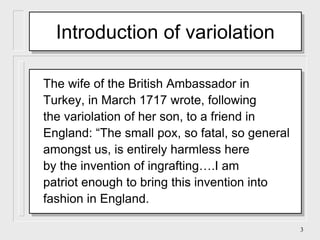
The wife of the British Ambassador in
Turkey, in March 1717 wrote, following
the variolation of her son, to a friend in
England: “The small pox, so fatal, so general
amongst us, is entirely harmless here
by the invention of ingrafting….I am
patriot enough to bring this invention into
fashion in England.
Introduction of variolation
4
Milestones in immunization
1780AD
 Edward Jenner discovers
small pox vaccine
5
Edward Jenner
Discovery of small pox vaccine
6
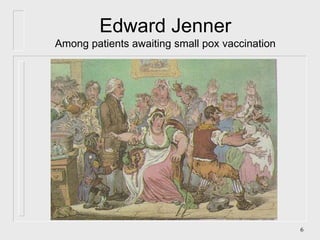
Edward Jenner
Among patients awaiting small pox vaccination
7
1920s
Diphtheria and
Tetanus
1934
Pertussis
1955
Salk polio
Modern era of the vaccine
1885
Rabies vaccine
(Pasteur)
8
1960s
Mumps measles
and rubella virus
Sabin polio
1990s
Hepatitis and
varicella
1985
Haemophilus
Modern era of the vaccine
 2000
Human Papillomavirus
(HPV)
9
Pre- & post-vaccine incidence of
common preventable diseases
10
Different modes of acquiring
immunity
Natural
resistance
Artificial Natural
Passive
Artificial Natural
Active
Immunity
Acquired
11
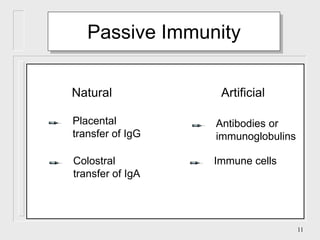
Natural Artificial
Colostral
transfer of IgA
Placental
transfer of IgG
Antibodies or
immunoglobulins
Immune cells
Passive Immunity
12
disease indication
antibody
source
Passive Immunization
human, horse
diphtheria, tetanus prophylaxis, therapy
vericella zoster human immunodeficiencies
gas gangrene,
botulism, snake
bite, scorpion sting
horse post-exposure
rabies, human post-exposure
hypogamma-
globulinemia
human prophylaxis
13
Advantages Disadvantages
serum sickness
immediate
protection
no long term
protection
graft vs. host
disease (cell
graft only)
risk of hepatitis
and Aids
Advantages and Disadvantages
of Passive Immunization
14
Active Immunization
Natural Artificial
exposure to sub-
clinical infections
Attenuated
organisms
killed organisms
sub-cellular
fragments
toxins
others
15
tuberculosis
not used in this
country
polio*
not used in std.
schedule
measles, mumps
& rubella
yellow fever
Military and travelers
Varicella zoster
children with no
history of chicken pox
hepatitis A
standard 2006
Live Attenuated Vaccines
Influenza
selected age group
(5-49)
16
polio
influenza
elderly and at risk
typhoid, cholera, plague
epidemics and travelers
rabies
post exposure
pertussis
replaced by the
acellular vaccine
Killed Whole-Organism Vaccines
Q fever
population at risk
17
Microbial Fragment Vaccines
Bordetella. Pertussis
virulence factor protein
Haemophilus influenzae B
protein conjugated polysaccharide
Streptococcus pneumoniae
Polysaccharide mixture
Neisseria meningitidis
polysaccharide
18
Microbial Fragment Vaccines
Clostridium tetani (tetanus)
inactivated toxin (toxoid)
Corynebacterium diphtheriae
inactivated toxin (toxoid)
Vibrio cholerae
toxin subunits
Hepatitis B virus
cloned in yeast
19
Modification of Toxin to Toxoid
toxin moiety antigenic determinants
chemical
modification
Toxin Toxoid
20
anti-Idiotype Vaccine
Immuno-dominant peptide
Future Vaccines
DNA
21
anti-Idiotype Vaccine
22
Antiidiotype antibody in tolerance
Antiidiotype antibody
production
Antiidiotype mediated
tolerance
23
Adjuvants
• Salts:
• Al(OH)3; AlPO4;
CaPO4
• Be(OH)2
Yes
Yes
No
Human use Mode of action
Slow release of antigen;
TLR interaction and
cytokine induction
Adjuvant type
Slow release of antigen
No
• Mineral oils without
bacteria
Yes
• Bacteria in Mineral
oils (Mycobacteria,
Nocardia) No
Slow release of antigen
TLR interaction and
cytokine induction
24
Adjuvants
Human use Mode of action
Adjuvant type
• Synthetic polymers:
• Liposomes
• ISCOM
• Poly-lactate
Slow release of antigen
No
Yes
• Bacteria:
• Bordetella pertussis
• Mycobacterium bovis
(BCG and others)
No
TLR interaction and
cytokine induction
• Bacterial products:
• Myramyl peptides No
TLR interaction and
cytokine induction
25
Adjuvants
• Poly-nucleotides:
• CpG No*
Human use Mode of action
TLR interaction and
cytokine induction
Adjuvant type
• Cytokines:
• IL-1, IL-2, IL-12,
IFN-γ, etc. No*
Activation of T and B
cells and APC
*Used in experimental immunotherapy of human
malignancies
26
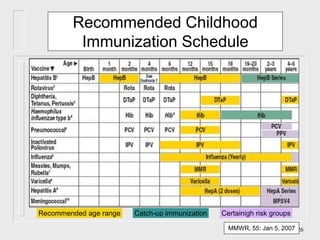
Recommended Childhood
Immunization Schedule
MMWR, 55: Jan 5, 2007
Recommended age range Catch-up immunization Certainigh risk groups
27
Recommended Immunization
Schedule for Ages 7-18
MMWR, 55: Jan 5, 2007
Recommended age range Catch-up immunization Certainigh risk groups
29
Adverse Events Occurring
Within 48 Hours DTP of Vaccination
Event Frequency
local
redness, swelling, pain 1 in 2-3 doses
systemic: Mild/moderate
fever, drowsiness, fretfulness
vomiting
anorexia
1 in 2-3 doses
1 in 5-15 doses
systemic: more serious
persistent crying, fever
collapse, convulsions
acute encephalopathy
permanent neurological deficit
1 in 100-300 doses
1 in 1750 doses
1 in 100,000 doses
1 in 300,000 doses

9-Immunization13.ppt