VACCINE`S HISTORY The Present and the Future Has a Past
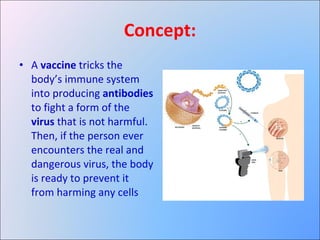
Concept: A  vaccine  tricks the body’s immune system into producing  antibodies  to fight a form of the  virus  that is not harmful. Then, if the person ever encounters the real and dangerous virus, the body is ready to prevent it from harming any cells
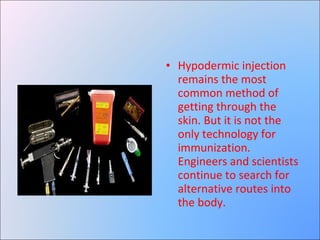
Hypodermic injection remains the most common method of getting through the skin. But it is not the only technology for immunization. Engineers and scientists continue to search for alternative   routes into the body.
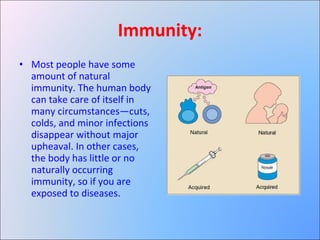
Immunity: Most people have some amount of natural immunity. The human body can take care of itself in many circumstances—cuts, colds, and minor infections disappear without major upheaval. In other cases, the body has little or no naturally occurring immunity, so if you are exposed to diseases.
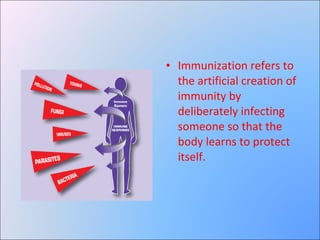
Immunization refers to the artificial creation of immunity by deliberately infecting someone so that the body learns to protect itself.
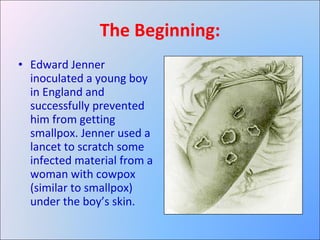
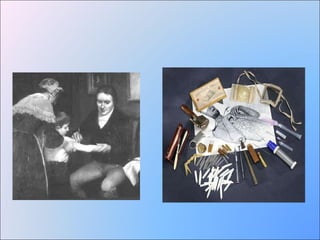
The Beginning: Edward Jenner inoculated a young boy in England and successfully prevented him from getting smallpox. Jenner used a lancet to scratch some infected material from a woman with cowpox (similar to smallpox) under the boy’s skin .
 
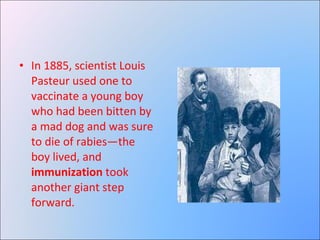
In 1885, scientist Louis Pasteur used one to vaccinate a young boy who had been bitten by a mad dog and was sure to die of rabies—the boy lived, and  immunization  took another giant step forward.
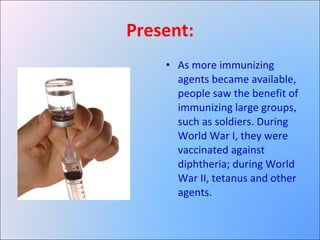
Present: As more immunizing agents became available, people saw the benefit of immunizing large groups, such as soldiers. During World War I, they were vaccinated against diphtheria; during World War II, tetanus and other agents.
Thanks!

Vaccine`s history

  • 1.
    VACCINE`S HISTORY ThePresent and the Future Has a Past
  • 2.
    Concept: A vaccine tricks the body’s immune system into producing antibodies to fight a form of the virus that is not harmful. Then, if the person ever encounters the real and dangerous virus, the body is ready to prevent it from harming any cells
  • 3.
    Hypodermic injection remainsthe most common method of getting through the skin. But it is not the only technology for immunization. Engineers and scientists continue to search for alternative routes into the body.
  • 4.
    Immunity: Most peoplehave some amount of natural immunity. The human body can take care of itself in many circumstances—cuts, colds, and minor infections disappear without major upheaval. In other cases, the body has little or no naturally occurring immunity, so if you are exposed to diseases.
  • 5.
    Immunization refers tothe artificial creation of immunity by deliberately infecting someone so that the body learns to protect itself.
  • 6.
    The Beginning: EdwardJenner inoculated a young boy in England and successfully prevented him from getting smallpox. Jenner used a lancet to scratch some infected material from a woman with cowpox (similar to smallpox) under the boy’s skin .
  • 7.
  • 8.
    In 1885, scientistLouis Pasteur used one to vaccinate a young boy who had been bitten by a mad dog and was sure to die of rabies—the boy lived, and immunization took another giant step forward.
  • 9.
    Present: As moreimmunizing agents became available, people saw the benefit of immunizing large groups, such as soldiers. During World War I, they were vaccinated against diphtheria; during World War II, tetanus and other agents.
  • 10.