VACCINATION
INTRODUCTION
▪ Vaccination is the best known and most successful application of immunological
principles to human health. It exploits the property of immunological memory to
provide long lasting protection against infectious disease.
▪ The first vaccine was named after Vaccinia, the cowpox virus. Jenner pioneered
its use 200 years ago. It was the first deliberate scientific attempt to prevent an
infectious disease.
▪ Finally, with Burnet’s clonal selection theory (1957) and the discovery of T and B
lymphocytes (1965), the key mechanism became clear about the immunological
memory.
▪ In any immune response, the antigen(s) induces clonal expansion in specific T
and/or B cells, leaving behind a population of memory cells. These enable the
next encounter with the same antigen(s) to induce a secondary response, which
is more rapid and effective than the normal primary response.
The principles of vaccination can be summarized as:
• priming of specific lymphocytes to expand the pool of memory
cells;
• use of harmless forms of immunogen – attenuated organisms,
subcellular fragments, toxoids or vectors;
• use of adjuvants to enhance immune responses; and
• production of safe, affordable vaccines to promote herd immunity.
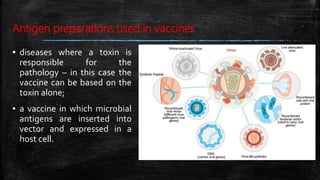
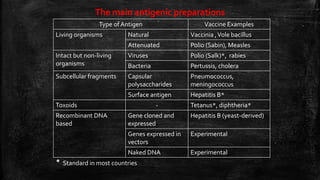
Antigen preparations used in vaccines
▪ diseases where a toxin is
responsible for the
pathology – in this case the
vaccine can be based on the
toxin alone;
▪ a vaccine in which microbial
antigens are inserted into
vector and expressed in a
host cell.
Type ofAntigen Vaccine Examples
Living organisms Natural Vaccinia ,Vole bacillus
Attenuated Polio (Sabin), Measles
Intact but non-living
organisms
Viruses Polio (Salk)*, rabies
Bacteria Pertussis, cholera
Subcellular fragments Capsular
polysaccharides
Pneumococcus,
meningococcus
Surface antigen Hepatitis B*
Toxoids - Tetanus*, diphtheria*
Recombinant DNA
based
Gene cloned and
expressed
Hepatitis B (yeast-derived)
Genes expressed in
vectors
Experimental
Naked DNA Experimental
* Standard in most countries
The main antigenic preparations
Live Vaccines Can Be Natural Or
Attenuated Organisms
Natural live vaccines have rarely been used Apart from vaccinia, no other
completely natural organism has ever come into standard use. However:
▪ bovine and simian rotaviruses have been tried in children;
▪ the vole tubercle bacillus was once popular against tuberculosis, and
▪ in the Middle East and Russia Leishmania infection from mild cases is reputed
to induce immunity.
Although it is possible that another good heterologous vaccine will be found,
safety problems with this approach remain considerable.
Also attenuated microorganisms are less able to cause disease in their natural
host.
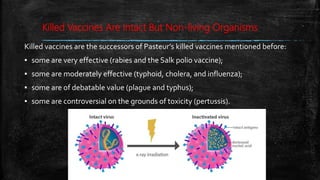
Killed Vaccines Are Intact But Non-living Organisms
Killed vaccines are the successors of Pasteur’s killed vaccines mentioned before:
▪ some are very effective (rabies and the Salk polio vaccine);
▪ some are moderately effective (typhoid, cholera, and influenza);
▪ some are of debatable value (plague and typhus);
▪ some are controversial on the grounds of toxicity (pertussis).
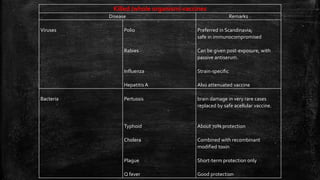
Killed (whole organism) vaccines
Disease Remarks
Viruses Polio
Rabies
Influenza
Hepatitis A
Preferred in Scandinavia;
safe in immunocompromised
Can be given post-exposure, with
passive antiserum.
Strain-specific
Also attenuated vaccine
Bacteria Pertussis
Typhoid
Cholera
Plague
Q fever
brain damage in very rare cases
replaced by safe acellular vaccine.
About 70% protection
Combined with recombinant
modified toxin
Short-term protection only
Good protection
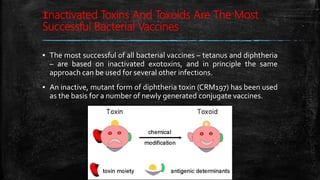
Inactivated Toxins And Toxoids Are The Most
Successful Bacterial Vaccines
▪ The most successful of all bacterial vaccines – tetanus and diphtheria
– are based on inactivated exotoxins, and in principle the same
approach can be used for several other infections.
▪ An inactive, mutant form of diphtheria toxin (CRM197) has been used
as the basis for a number of newly generated conjugate vaccines.
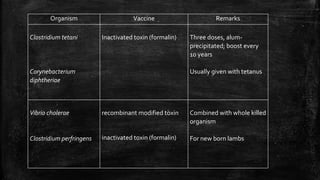
Organism Vaccine Remarks
Clostridium tetani
Corynebacterium
diphtheriae
Inactivated toxin (formalin) Three doses, alum-
precipitated; boost every
10 years
Usually given with tetanus
Vibrio cholerae
Clostridium perfringens
recombinant modified toxin
inactivated toxin (formalin)
Combined with whole killed
organism
For new born lambs
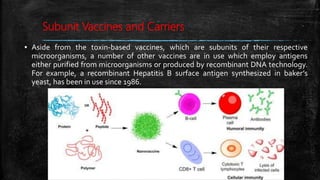
Subunit Vaccines and Carriers
▪ Aside from the toxin-based vaccines, which are subunits of their respective
microorganisms, a number of other vaccines are in use which employ antigens
either purified from microorganisms or produced by recombinant DNA technology.
For example, a recombinant Hepatitis B surface antigen synthesized in baker’s
yeast, has been in use since 1986.
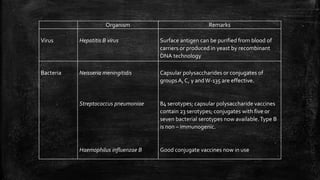
Organism Remarks
Virus Hepatitis B virus Surface antigen can be purified from blood of
carriers or produced in yeast by recombinant
DNA technology
Bacteria Neisseria meningitidis
Streptococcus pneumoniae
Haemophilus influenzae B
Capsular polysaccharides or conjugates of
groups A, C, γ andW-135 are effective.
84 serotypes; capsular polysaccharide vaccines
contain 23 serotypes; conjugates with five or
seven bacterial serotypes now available.Type B
is non – immunogenic.
Good conjugate vaccines now in use
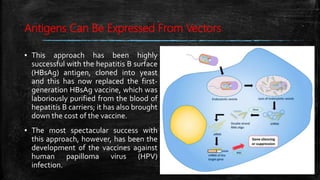
Antigens Can Be Expressed From Vectors
▪ This approach has been highly
successful with the hepatitis B surface
(HBsAg) antigen, cloned into yeast
and this has now replaced the first-
generation HBsAg vaccine, which was
laboriously purified from the blood of
hepatitis B carriers; it has also brought
down the cost of the vaccine.
▪ The most spectacular success with
this approach, however, has been the
development of the vaccines against
human papilloma virus (HPV)
infection.
Adjuvants Enhance Antibody Production
▪ The increasing use of purified or recombinant antigens has refocused
attention on the requirement to boost immune responses through
the use of adjuvants. These are often necessary as the antigens on
their own are insufficiently immunogenic.
▪ Work in the 1920s on the production of animal sera for human
therapy discovered that certain substances, notably aluminum salts
(alum), added to or emulsified with an antigen, greatly enhance
antibody production – that is, they act as adjuvants. Aluminum
hydroxide is still widely used with, for example, diphtheria and
tetanus toxoids.
▪ The difficulty with adjuvants is that they mediate their effect through
stimulating the inflammatory response, generally necessary to
produce a good immune response.
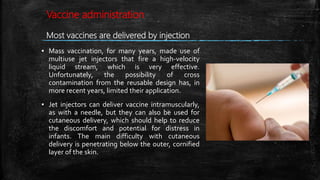
Vaccine administration
▪ Mass vaccination, for many years, made use of
multiuse jet injectors that fire a high-velocity
liquid stream, which is very effective.
Unfortunately, the possibility of cross
contamination from the reusable design has, in
more recent years, limited their application.
▪ Jet injectors can deliver vaccine intramuscularly,
as with a needle, but they can also be used for
cutaneous delivery, which should help to reduce
the discomfort and potential for distress in
infants. The main difficulty with cutaneous
delivery is penetrating below the outer, cornified
layer of the skin.
Most vaccines are delivered by injection
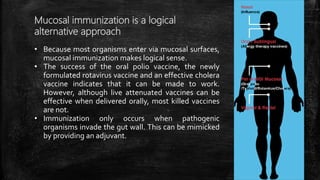
Mucosal immunization is a logical
alternative approach
• Because most organisms enter via mucosal surfaces,
mucosal immunization makes logical sense.
• The success of the oral polio vaccine, the newly
formulated rotavirus vaccine and an effective cholera
vaccine indicates that it can be made to work.
However, although live attenuated vaccines can be
effective when delivered orally, most killed vaccines
are not.
• Immunization only occurs when pathogenic
organisms invade the gut wall. This can be mimicked
by providing an adjuvant.
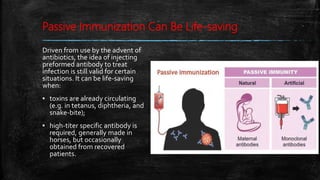
Passive Immunization Can Be Life-saving
Driven from use by the advent of
antibiotics, the idea of injecting
preformed antibody to treat
infection is still valid for certain
situations. It can be life-saving
when:
▪ toxins are already circulating
(e.g. in tetanus, diphtheria, and
snake-bite);
▪ high-titer specific antibody is
required, generally made in
horses, but occasionally
obtained from recovered
patients.
Vaccine Efficacy And Safety
▪ To be introduced and approved, a vaccine must obviously be effective, and
the efficacy of all vaccines is reviewed from time to time.
▪ An effective vaccine must induce the right sort of immunity.
▪ Where the ideal type of response is not clear (as in malaria, for instance),
designing an effective vaccine becomes correspondingly more difficult. An
effective vaccine must also.
▪ Be stable on storage – this is particularly important for living vaccines,
which normally require to be kept cold.
▪ Have sufficient immunogenicity – with non-living vaccines it is often
necessary to boost their immunogenicity with an adjuvant. Live vaccines
are generally more effective than killed vaccines.
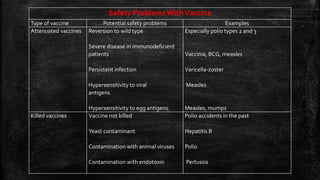
Safety Problems WithVaccine
Type of vaccine Potential safety problems Examples
Attenuated vaccines Reversion to wild type
Severe disease in immunodeficient
patients
Persistent infection
Hypersensitivity to viral
antigens
Hypersensitivity to egg antigens
Especially polio types 2 and 3
Vaccinia, BCG, measles
Varicella-zoster
Measles
Measles, mumps
Killed vaccines Vaccine not killed
Yeast contaminant
Contamination with animal viruses
Contamination with endotoxin
Polio accidents in the past
Hepatitis B
Polio
Pertussis
THANK YOU
PRESENTED BY:
Anshika Sarin
(18BSMBH015)
Samiksha Singh
(18BSMBH018)
Amrit Raj
(18BSMBH021)
Ashley Paul
(18BSMBH035)
Harshit Saurabh
(18BSMBH048)

Vaccination

  • 1.
  • 2.
    INTRODUCTION ▪ Vaccination isthe best known and most successful application of immunological principles to human health. It exploits the property of immunological memory to provide long lasting protection against infectious disease. ▪ The first vaccine was named after Vaccinia, the cowpox virus. Jenner pioneered its use 200 years ago. It was the first deliberate scientific attempt to prevent an infectious disease. ▪ Finally, with Burnet’s clonal selection theory (1957) and the discovery of T and B lymphocytes (1965), the key mechanism became clear about the immunological memory. ▪ In any immune response, the antigen(s) induces clonal expansion in specific T and/or B cells, leaving behind a population of memory cells. These enable the next encounter with the same antigen(s) to induce a secondary response, which is more rapid and effective than the normal primary response.
  • 3.
    The principles ofvaccination can be summarized as: • priming of specific lymphocytes to expand the pool of memory cells; • use of harmless forms of immunogen – attenuated organisms, subcellular fragments, toxoids or vectors; • use of adjuvants to enhance immune responses; and • production of safe, affordable vaccines to promote herd immunity.
  • 4.
    Antigen preparations usedin vaccines ▪ diseases where a toxin is responsible for the pathology – in this case the vaccine can be based on the toxin alone; ▪ a vaccine in which microbial antigens are inserted into vector and expressed in a host cell.
  • 5.
    Type ofAntigen VaccineExamples Living organisms Natural Vaccinia ,Vole bacillus Attenuated Polio (Sabin), Measles Intact but non-living organisms Viruses Polio (Salk)*, rabies Bacteria Pertussis, cholera Subcellular fragments Capsular polysaccharides Pneumococcus, meningococcus Surface antigen Hepatitis B* Toxoids - Tetanus*, diphtheria* Recombinant DNA based Gene cloned and expressed Hepatitis B (yeast-derived) Genes expressed in vectors Experimental Naked DNA Experimental * Standard in most countries The main antigenic preparations
  • 6.
    Live Vaccines CanBe Natural Or Attenuated Organisms Natural live vaccines have rarely been used Apart from vaccinia, no other completely natural organism has ever come into standard use. However: ▪ bovine and simian rotaviruses have been tried in children; ▪ the vole tubercle bacillus was once popular against tuberculosis, and ▪ in the Middle East and Russia Leishmania infection from mild cases is reputed to induce immunity. Although it is possible that another good heterologous vaccine will be found, safety problems with this approach remain considerable. Also attenuated microorganisms are less able to cause disease in their natural host.
  • 7.
    Killed Vaccines AreIntact But Non-living Organisms Killed vaccines are the successors of Pasteur’s killed vaccines mentioned before: ▪ some are very effective (rabies and the Salk polio vaccine); ▪ some are moderately effective (typhoid, cholera, and influenza); ▪ some are of debatable value (plague and typhus); ▪ some are controversial on the grounds of toxicity (pertussis).
  • 8.
    Killed (whole organism)vaccines Disease Remarks Viruses Polio Rabies Influenza Hepatitis A Preferred in Scandinavia; safe in immunocompromised Can be given post-exposure, with passive antiserum. Strain-specific Also attenuated vaccine Bacteria Pertussis Typhoid Cholera Plague Q fever brain damage in very rare cases replaced by safe acellular vaccine. About 70% protection Combined with recombinant modified toxin Short-term protection only Good protection
  • 9.
    Inactivated Toxins AndToxoids Are The Most Successful Bacterial Vaccines ▪ The most successful of all bacterial vaccines – tetanus and diphtheria – are based on inactivated exotoxins, and in principle the same approach can be used for several other infections. ▪ An inactive, mutant form of diphtheria toxin (CRM197) has been used as the basis for a number of newly generated conjugate vaccines.
  • 10.
    Organism Vaccine Remarks Clostridiumtetani Corynebacterium diphtheriae Inactivated toxin (formalin) Three doses, alum- precipitated; boost every 10 years Usually given with tetanus Vibrio cholerae Clostridium perfringens recombinant modified toxin inactivated toxin (formalin) Combined with whole killed organism For new born lambs
  • 11.
    Subunit Vaccines andCarriers ▪ Aside from the toxin-based vaccines, which are subunits of their respective microorganisms, a number of other vaccines are in use which employ antigens either purified from microorganisms or produced by recombinant DNA technology. For example, a recombinant Hepatitis B surface antigen synthesized in baker’s yeast, has been in use since 1986.
  • 12.
    Organism Remarks Virus HepatitisB virus Surface antigen can be purified from blood of carriers or produced in yeast by recombinant DNA technology Bacteria Neisseria meningitidis Streptococcus pneumoniae Haemophilus influenzae B Capsular polysaccharides or conjugates of groups A, C, γ andW-135 are effective. 84 serotypes; capsular polysaccharide vaccines contain 23 serotypes; conjugates with five or seven bacterial serotypes now available.Type B is non – immunogenic. Good conjugate vaccines now in use
  • 13.
    Antigens Can BeExpressed From Vectors ▪ This approach has been highly successful with the hepatitis B surface (HBsAg) antigen, cloned into yeast and this has now replaced the first- generation HBsAg vaccine, which was laboriously purified from the blood of hepatitis B carriers; it has also brought down the cost of the vaccine. ▪ The most spectacular success with this approach, however, has been the development of the vaccines against human papilloma virus (HPV) infection.
  • 14.
    Adjuvants Enhance AntibodyProduction ▪ The increasing use of purified or recombinant antigens has refocused attention on the requirement to boost immune responses through the use of adjuvants. These are often necessary as the antigens on their own are insufficiently immunogenic. ▪ Work in the 1920s on the production of animal sera for human therapy discovered that certain substances, notably aluminum salts (alum), added to or emulsified with an antigen, greatly enhance antibody production – that is, they act as adjuvants. Aluminum hydroxide is still widely used with, for example, diphtheria and tetanus toxoids. ▪ The difficulty with adjuvants is that they mediate their effect through stimulating the inflammatory response, generally necessary to produce a good immune response.
  • 15.
    Vaccine administration ▪ Massvaccination, for many years, made use of multiuse jet injectors that fire a high-velocity liquid stream, which is very effective. Unfortunately, the possibility of cross contamination from the reusable design has, in more recent years, limited their application. ▪ Jet injectors can deliver vaccine intramuscularly, as with a needle, but they can also be used for cutaneous delivery, which should help to reduce the discomfort and potential for distress in infants. The main difficulty with cutaneous delivery is penetrating below the outer, cornified layer of the skin. Most vaccines are delivered by injection
  • 16.
    Mucosal immunization isa logical alternative approach • Because most organisms enter via mucosal surfaces, mucosal immunization makes logical sense. • The success of the oral polio vaccine, the newly formulated rotavirus vaccine and an effective cholera vaccine indicates that it can be made to work. However, although live attenuated vaccines can be effective when delivered orally, most killed vaccines are not. • Immunization only occurs when pathogenic organisms invade the gut wall. This can be mimicked by providing an adjuvant.
  • 17.
    Passive Immunization CanBe Life-saving Driven from use by the advent of antibiotics, the idea of injecting preformed antibody to treat infection is still valid for certain situations. It can be life-saving when: ▪ toxins are already circulating (e.g. in tetanus, diphtheria, and snake-bite); ▪ high-titer specific antibody is required, generally made in horses, but occasionally obtained from recovered patients.
  • 18.
    Vaccine Efficacy AndSafety ▪ To be introduced and approved, a vaccine must obviously be effective, and the efficacy of all vaccines is reviewed from time to time. ▪ An effective vaccine must induce the right sort of immunity. ▪ Where the ideal type of response is not clear (as in malaria, for instance), designing an effective vaccine becomes correspondingly more difficult. An effective vaccine must also. ▪ Be stable on storage – this is particularly important for living vaccines, which normally require to be kept cold. ▪ Have sufficient immunogenicity – with non-living vaccines it is often necessary to boost their immunogenicity with an adjuvant. Live vaccines are generally more effective than killed vaccines.
  • 19.
    Safety Problems WithVaccine Typeof vaccine Potential safety problems Examples Attenuated vaccines Reversion to wild type Severe disease in immunodeficient patients Persistent infection Hypersensitivity to viral antigens Hypersensitivity to egg antigens Especially polio types 2 and 3 Vaccinia, BCG, measles Varicella-zoster Measles Measles, mumps Killed vaccines Vaccine not killed Yeast contaminant Contamination with animal viruses Contamination with endotoxin Polio accidents in the past Hepatitis B Polio Pertussis
  • 20.
    THANK YOU PRESENTED BY: AnshikaSarin (18BSMBH015) Samiksha Singh (18BSMBH018) Amrit Raj (18BSMBH021) Ashley Paul (18BSMBH035) Harshit Saurabh (18BSMBH048)