Disclaimer
This presentation doesnot claim any originality and cannot be used as a substitute
for prescribed textbooks. The information presented here is merely a collection for
teaching assignments for the students of 5th semester B.Tech. of VSSUT, Burla. I
would like to acknowledge various sources like freely available materials from
internet from which the presentation was prepared. The ownership of the
information lies with the respective authors or institutions. Further, this
presentation/document is not intended to be used for commercial purpose.
4.
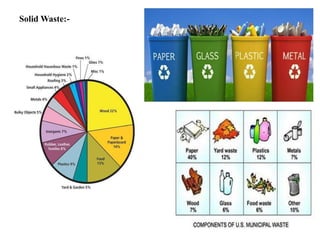
Solid Waste:-
1) Discardedas useless or unwanted things or material arising from human & animal
activities that are normally solid.
2) Substances or objects which are disposed of or are intended to be disposed of or are
required to be disposed of by the provisions of the law.
3) Mismanaged things.
4) United Nations Statistics Division (UNSD):- Wastes are materials that are not prime
products (prime product - products produced for the market) for which the generator has
no further use in terms of his own purposes of production, transformation or consumption,
and of which he wants to dispose. Wastes may be generated during the extraction of raw
materials, the processing of raw materials into intermediate and final products, the
consumption of final products, and other human activities. Residuals recycled or reused at
the place of generation are excluded.
Classification of SolidWaste on the source of generation:-
1) Domestic/ Residential/ House Waste:
Solid waste originates from domestic or residential area.
Waste generated as consequences of household activities such as cooking, cleaning, repairing, etc.
2) Commercial Waste:
Waste originates from offices, stores, hotels, markets, etc.
3) Institutional Waste:
Waste originates from institutes, schools, universities, colleges, etc.
4) Municipal Waste:
Waste originates from municipal activities.
Includes street waste, commercial waste, & market waste, etc.
Term commonly applied in a wider sense to incorporate domestic, institutional & commercial
waste.
5) Street Waste:
Waste that originates from street, walkways, alleys & vacant areas.
Includes paper, plastic, leaves & other matter discarded by road users.
8.
6) Construction &Demolition Waste:
Waste generated by construction, repairing & demolition of building.
Consist of earth stones, concrete, bricks, & other material.
7) Industrial Waste:
Waste arising from industrial activities.
Cover vast range of substances which are unique to each industry.
8) Sewage Waste:
Waste generated from treatment plant.
Mostly organic in nature.
9) Hazardous waste:
Waste that poses great danger to human, animal & Plant b’coz of its toxicity, reactivity, corrosivity
& ignitability.
Requires special handling & good management.
Classification of Wastesaccording to their Properties
Bio-degradable :
can be degraded (paper, wood, fruits and others)
Non-biodegradable:
cannot be degraded (plastics, bottles, old machines, cans, containers and others)
11.
Classification of Wastesaccording to
their Effects on Human Health and the Environment
Hazardous wastes :
Substances unsafe to use commercially, industrially, agriculturally, or economically and
have any of the following properties:-
1) ignitability,
2) corrosivity,
3) reactivity &
4) toxicity.
Non-hazardous :
Substances safe to use commercially, industrially, agriculturally, or economically and do not
have any of those properties mentioned above.
12.
Classification of wastesaccording to their origin and type
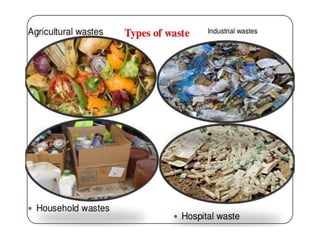
1) Municipal Solid wastes: Solid wastes that include household garbage, rubbish,
construction & demolition debris, sanitation residues, packaging materials, trade refuges
etc. are managed by any municipality.
2) Bio-medical wastes: Solid wastes including containers, intermediate or end products
generated during diagnosis, treatment & research activities of medical sciences.
3) Industrial wastes: wastes that are generated by manufacturing & processing units of
various industries like chemical, petroleum, coal, metal gas, sanitary & paper etc.
4) Agricultural wastes: Wastes generated from farming activities. These substances are
mostly biodegradable.
5) Radioactive wastes: Waste containing radioactive materials. Usually these are
byproducts of nuclear processes. Sometimes industries that are not directly involved in
nuclear activities, may also produce some radioactive wastes, e.g. radio-isotopes,
chemical sludge etc.
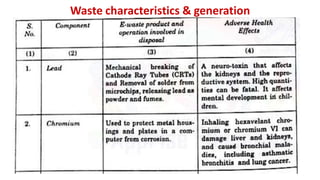
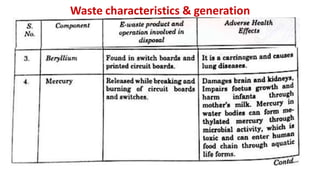
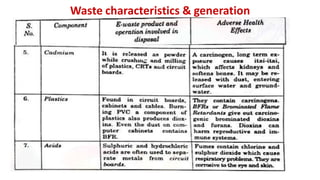
6) E-wastes: Electronic wastes generated from any modern establishments. They may be
described as discarded electrical or electronic devices. Some electronic scrap
components, such as CRTs, may contain contaminants such as Pb, Cd, Be or brominated
flame retardants.
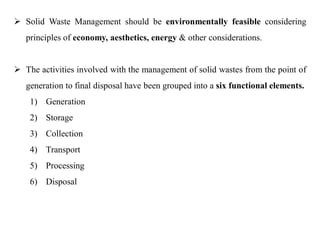
Solid WasteManagement should be environmentally feasible considering
principles of economy, aesthetics, energy & other considerations.
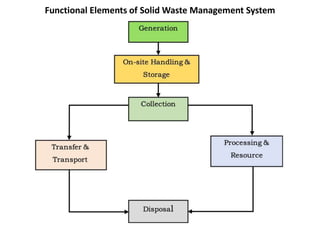
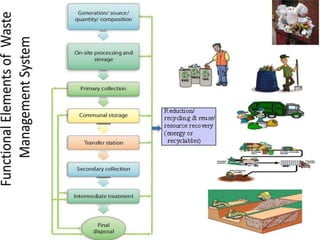
The activities involved with the management of solid wastes from the point of
generation to final disposal have been grouped into a six functional elements.
1) Generation
2) Storage
3) Collection
4) Transport
5) Processing
6) Disposal
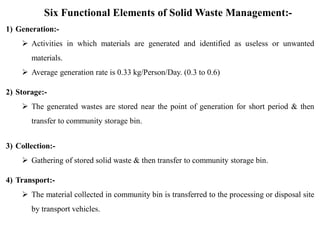
Six Functional Elementsof Solid Waste Management:-
1) Generation:-
Activities in which materials are generated and identified as useless or unwanted
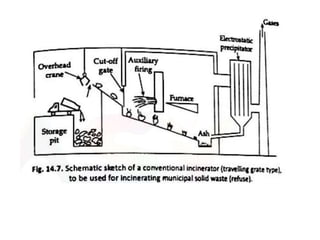
materials.
Average generation rate is 0.33 kg/Person/Day. (0.3 to 0.6)
2) Storage:-
The generated wastes are stored near the point of generation for short period & then
transfer to community storage bin.
3) Collection:-
Gathering of stored solid waste & then transfer to community storage bin.
4) Transport:-
The material collected in community bin is transferred to the processing or disposal site
by transport vehicles.
19.
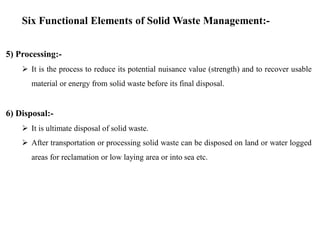
Six Functional Elementsof Solid Waste Management:-
5) Processing:-
It is the process to reduce its potential nuisance value (strength) and to recover usable
material or energy from solid waste before its final disposal.
6) Disposal:-
It is ultimate disposal of solid waste.
After transportation or processing solid waste can be disposed on land or water logged
areas for reclamation or low laying area or into sea etc.
20.
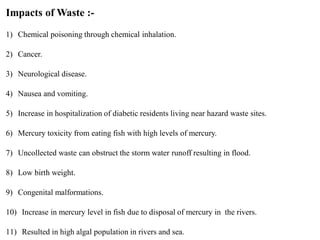
Impacts of Waste:-
1) Chemical poisoning through chemical inhalation.
2) Cancer.
3) Neurological disease.
4) Nausea and vomiting.
5) Increase in hospitalization of diabetic residents living near hazard waste sites.
6) Mercury toxicity from eating fish with high levels of mercury.
7) Uncollected waste can obstruct the storm water runoff resulting in flood.
8) Low birth weight.
9) Congenital malformations.
10) Increase in mercury level in fish due to disposal of mercury in the rivers.
11) Resulted in high algal population in rivers and sea.
21.
Impacts of wasteon Environment
13) Waste breaks down in landfills to form methane, a potent greenhouse gas.
14) Change in climate and destruction of ozone layer due to waste biodegradable.
15) Littering, due to waste pollutions, illegal dumping, Leaching: is a process by which
solid waste enter soil and ground water and contaminating them.
Generation:-
1) Rate mayvary widely from place to place.
2) In US – 2 Kg/C/Day
3) Japan – 1 Kg/C/Day
4) Canada – 3 Kg/C/ Day
5) India – 0.3 to 0.5 Kg/C/Day
6) Data includes refuse from residential, commercial, institutional & industrial
sources.
7) Actual generation tare must be carefully determined for management.
8) Generation rate expected to be double by 2025.
9) Higher the income level greater will be generation rate.
24.
Factors causing variation
•As we know, wastes cause pollution. While the nature of
wastes determines the type and intensity of pollution, it
also helps us decide on the appropriate application,
engineering design and technology for management.
• For example, the nature of wastes has implications for
collection, transport and recycling. For effective SWM,
therefore, we not only need information about the present
but also the expected future quantity and composition of
wastes.
• There are several factors, which affect the present as well
as the future waste quantity and composition
(Tchobanoglous, et al., 1977), and some of which are
listed below:
25.
• Geographic location:The influence of geographic location is
related primarily to different climates that can influence both
the amount of certain types of solid wastes generated and the
collection operation.
• Seasons: Seasons of the year have implications for the quantities
and composition of certain types of solid wastes. For example,
the growing season of vegetables and fruits affect the quantities
of food wastes.
• Collection frequency: A general observation is that in localities,
where there are ultimate collection services, more wastes are
collected. Note that this does not mean that more wastes are
generated.
• Population diversity: The characteristics of the population
influence the quantity and composition of waste generated.
The amount of waste generated is more in low-income areas
compared to that in high-income areas. Similarly, the composition
differs in terms of paper and other recyclables, which are
typically more in high-income areas as against low-income areas
26.
• Extent ofsalvaging and recycling: The existence of
salvaging and recycling operation within a community
definitely affects the quantity of wastes collected.
• Public attitude: Significant reduction in the quantity of
solid waste is possible, if and when people are willing to
change – on their own volition – their habits and lifestyles
to conserve the natural resources and to reduce the
economic burden associated with the management of solid
wastes.
• Legislation: This refers to the existence of local and state
regulations concerning the use and disposal of specific
materials and is an important factor that influences the
composition and generation of certain types of wastes. The
Indian legislation dealing with packing and beverage
container materials is an example.
27.
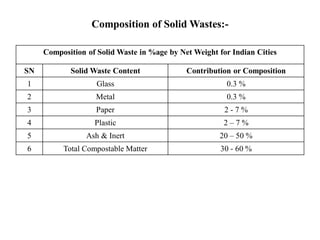
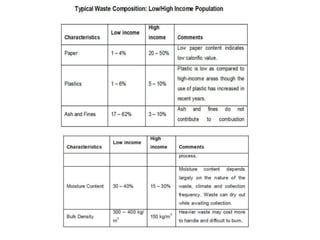
Composition of SolidWastes:-
Composition of Solid Waste in %age by Net Weight for Indian Cities
SN Solid Waste Content Contribution or Composition
1 Glass 0.3 %
2 Metal 0.3 %
3 Paper 2 - 7 %
4 Plastic 2 – 7 %
5 Ash & Inert 20 – 50 %
6 Total Compostable Matter 30 - 60 %
29.
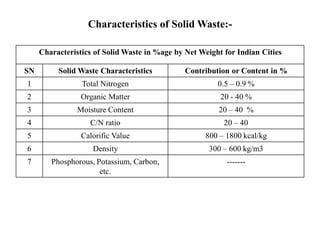
Characteristics of SolidWaste:-
Characteristics of Solid Waste in %age by Net Weight for Indian Cities
SN Solid Waste Characteristics Contribution or Content in %
1 Total Nitrogen 0.5 – 0.9 %
2 Organic Matter 20 - 40 %
3 Moisture Content 20 – 40 %
4 C/N ratio 20 – 40
5 Calorific Value 800 – 1800 kcal/kg
6 Density 300 – 600 kg/m3
7 Phosphorous, Potassium, Carbon,
etc.
-------
30.
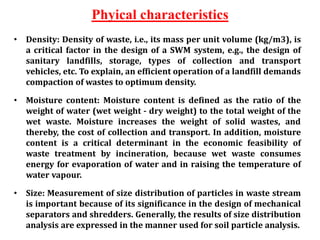
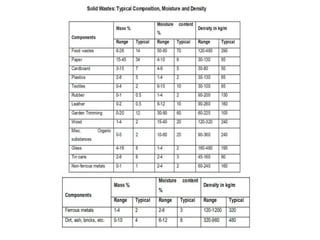
Phyical characteristics
• Density:Density of waste, i.e., its mass per unit volume (kg/m3), is
a critical factor in the design of a SWM system, e.g., the design of
sanitary landfills, storage, types of collection and transport
vehicles, etc. To explain, an efficient operation of a landfill demands
compaction of wastes to optimum density.
• Moisture content: Moisture content is defined as the ratio of the
weight of water (wet weight - dry weight) to the total weight of the
wet waste. Moisture increases the weight of solid wastes, and
thereby, the cost of collection and transport. In addition, moisture
content is a critical determinant in the economic feasibility of
waste treatment by incineration, because wet waste consumes
energy for evaporation of water and in raising the temperature of
water vapour.
• Size: Measurement of size distribution of particles in waste stream
is important because of its significance in the design of mechanical
separators and shredders. Generally, the results of size distribution
analysis are expressed in the manner used for soil particle analysis.
31.
Chemical characteristics
• Knowledgeof the classification of chemical
compounds and their characteristics is essential
for the proper understanding of the behaviour of
waste, as it moves through the waste management
system.
• The products of decomposition and heating values
are two examples of chemical characteristics. If solid
wastes are to be used as fuel, or are used for any other
purpose, we must know their chemical characteristics,
including the following:
32.
(i) Lipids:
Thisclass of compounds includes fats, oils and grease,
and the principal sources of lipids are garbage,
cooking oils and fats. Lipids have high heating values,
about 38,000 kJ/kg (kilojoules per kilogram), which
makes waste with high lipid content suitable for
energy recovery.
Since lipids become liquid at temperatures slightly
above ambient, they add to the liquid content during
waste decomposition. Though they are biodegradable,
the rate of biodegradation is relatively slow because
lipids have a low solubility in water.
33.
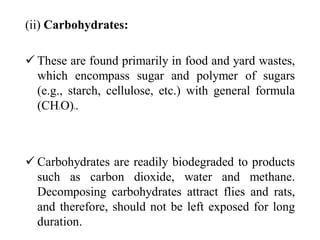
(ii) Carbohydrates:
Theseare found primarily in food and yard wastes,
which encompass sugar and polymer of sugars
(e.g., starch, cellulose, etc.) with general formula
(CH2O)x.
Carbohydrates are readily biodegraded to products
such as carbon dioxide, water and methane.
Decomposing carbohydrates attract flies and rats,
and therefore, should not be left exposed for long
duration.
34.
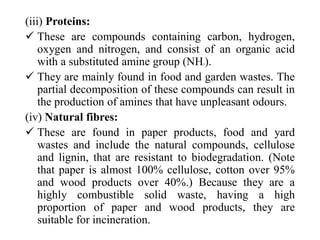
(iii) Proteins:
Theseare compounds containing carbon, hydrogen,
oxygen and nitrogen, and consist of an organic acid
with a substituted amine group (NH2).
They are mainly found in food and garden wastes. The
partial decomposition of these compounds can result in
the production of amines that have unpleasant odours.
(iv) Natural fibres:
These are found in paper products, food and yard
wastes and include the natural compounds, cellulose
and lignin, that are resistant to biodegradation. (Note
that paper is almost 100% cellulose, cotton over 95%
and wood products over 40%.) Because they are a
highly combustible solid waste, having a high
proportion of paper and wood products, they are
suitable for incineration.
35.
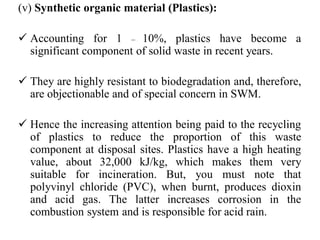
(v) Synthetic organicmaterial (Plastics):
Accounting for 1 – 10%, plastics have become a
significant component of solid waste in recent years.
They are highly resistant to biodegradation and, therefore,
are objectionable and of special concern in SWM.
Hence the increasing attention being paid to the recycling
of plastics to reduce the proportion of this waste
component at disposal sites. Plastics have a high heating
value, about 32,000 kJ/kg, which makes them very
suitable for incineration. But, you must note that
polyvinyl chloride (PVC), when burnt, produces dioxin
and acid gas. The latter increases corrosion in the
combustion system and is responsible for acid rain.
36.
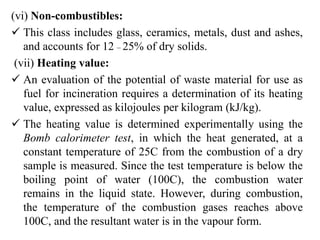
(vi) Non-combustibles:
Thisclass includes glass, ceramics, metals, dust and ashes,
and accounts for 12 – 25% of dry solids.
(vii) Heating value:
An evaluation of the potential of waste material for use as
fuel for incineration requires a determination of its heating
value, expressed as kilojoules per kilogram (kJ/kg).
The heating value is determined experimentally using the
Bomb calorimeter test, in which the heat generated, at a
constant temperature of 25C from the combustion of a dry
sample is measured. Since the test temperature is below the
boiling point of water (100C), the combustion water
remains in the liquid state. However, during combustion,
the temperature of the combustion gases reaches above
100C, and the resultant water is in the vapour form.
37.
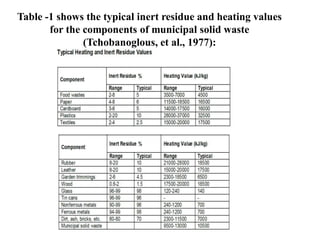
Table -1 showsthe typical inert residue and heating values
for the components of municipal solid waste
(Tchobanoglous, et al., 1977):
38.
(viii) Ultimate analysis:
This refers to an analysis of waste to determine the
proportion of carbon, hydrogen, oxygen, nitrogen and
sulphur, and the analysis is done to make mass balance
calculation for a chemical or thermal process.
Besides, it is necessary to determine ash fraction because
of its potentially harmful environmental effects, brought
about by the presence of toxic metals such as cadmium,
chromium, mercury, nickel, lead, tin and zinc.
Note that other metals (e.g., iron, magnesium, etc.) may
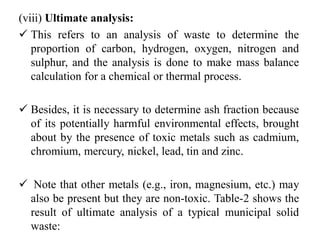
also be present but they are non-toxic. Table-2 shows the
result of ultimate analysis of a typical municipal solid
waste:
39.
(ix) Proximate analysis:
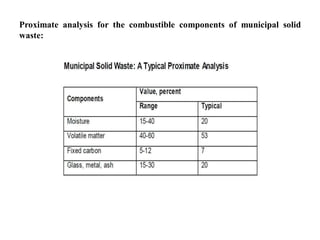
This is important in evaluating the combustion properties of wastes or a waste
or refuse derived fuel. The fractions of interest are:
moisture content, which adds weight to the waste without increasing its heating
value, and the evaporation of water reduces the heat released from the fuel;
ash, which adds weight without generating any heat during combustion;
volatile matter, i.e., that portion of the waste that is converted to gases before
and during combustion;
fixed carbon, which represents the carbon remaining on the surface grates as
charcoal. A waste or fuel with a high proportion of fixed carbon requires a
longer retention time on the furnace grates to achieve complete combustion
than a waste or fuel with a low proportion of fixed carbon.
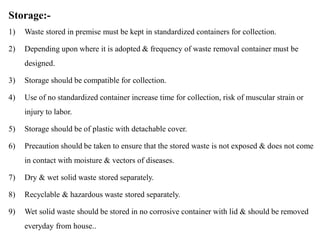
Storage:-
1) Waste storedin premise must be kept in standardized containers for collection.
2) Depending upon where it is adopted & frequency of waste removal container must be
designed.
3) Storage should be compatible for collection.
4) Use of no standardized container increase time for collection, risk of muscular strain or
injury to labor.
5) Storage should be of plastic with detachable cover.
6) Precaution should be taken to ensure that the stored waste is not exposed & does not come
in contact with moisture & vectors of diseases.
7) Dry & wet solid waste stored separately.
8) Recyclable & hazardous waste stored separately.
9) Wet solid waste should be stored in no corrosive container with lid & should be removed
everyday from house..
45.
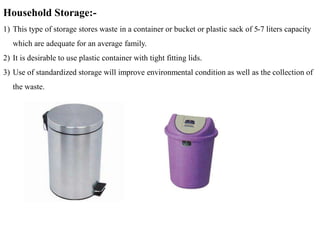
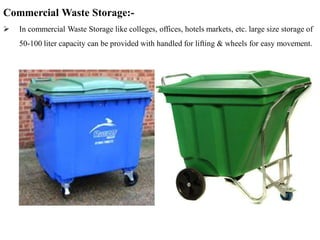
Household Storage:-
1) Thistype of storage stores waste in a container or bucket or plastic sack of 5-7 liters capacity
which are adequate for an average family.
2) It is desirable to use plastic container with tight fitting lids.
3) Use of standardized storage will improve environmental condition as well as the collection of
the waste.
46.
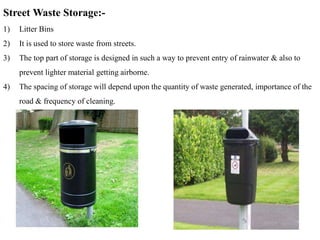
Commercial Waste Storage:-
In commercial Waste Storage like colleges, offices, hotels markets, etc. large size storage of
50-100 liter capacity can be provided with handled for lifting & wheels for easy movement.
47.
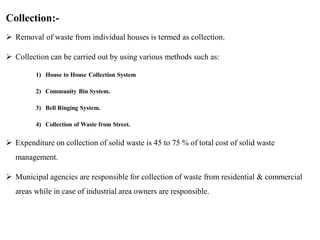
Street Waste Storage:-
1)Litter Bins
2) It is used to store waste from streets.
3) The top part of storage is designed in such a way to prevent entry of rainwater & also to
prevent lighter material getting airborne.
4) The spacing of storage will depend upon the quantity of waste generated, importance of the
road & frequency of cleaning.
48.
Collection:-
Removal ofwaste from individual houses is termed as collection.
Collection can be carried out by using various methods such as:
1) House to House Collection System
2) Community Bin System.
3) Bell Ringing System.
4) Collection of Waste from Street.
Expenditure on collection of solid waste is 45 to 75 % of total cost of solid waste
management.
Municipal agencies are responsible for collection of waste from residential & commercial
areas while in case of industrial area owners are responsible.
49.
Collection of wastefrom street:-
1) In this system, workers sweep the roads & collect the material at specific points.
2) In addition to the waste generated in the premises, waste is also generated along the
street.
3) Collection from street is deposited in storage bin from where separated vehicle
collect and transport to processing or disposal site.
50.
Community Bin System:-
1)This system commonly adopted in India.
2) Community bins are located at street corner and at specific frequencies along the roads.
3) Residents are expected to bring their waste & deposit the same in the community bin.
4) Locations of community bins are fixed according to convenience of local citizens.
5) The capacity of community bins are should be 50% in excess when collection is daily and
100% in excess when collection is weekly.
6) Spacing should be fixed on the basis of per capita quantity & Population contributing the
waste.
7) However distance between community bins should not be more than 100m.
51.
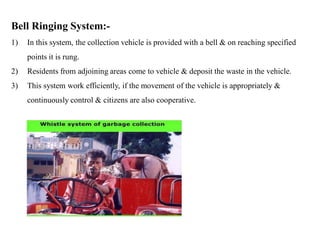
Bell Ringing System:-
1)In this system, the collection vehicle is provided with a bell & on reaching specified
points it is rung.
2) Residents from adjoining areas come to vehicle & deposit the waste in the vehicle.
3) This system work efficiently, if the movement of the vehicle is appropriately &
continuously control & citizens are also cooperative.
52.
House to HouseCollection System:-
In this method, generated & stored waste in individual premises is collected by
following ways:
1) Curb Service.
2) Alley Service.
3) Set out, Set Out Back Service.
4) Set Out Service.
5) Backyard Service.
53.
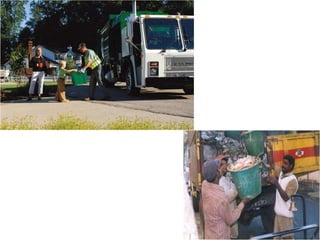
A) Set OutSet Back Service:-
In this system, set out men go to individual houses, collect the container & empty them in
the vehicle.
Another group of persons return them to house owner yard.
B) Set Out Service:-
In this system, the worker will collect the container from individual houses & empty them
in vehicles.
The house owner is required to take back the empty container.
C) Curb Service:-
In this system, the house owner is responsible for placing the containers at the curb on the
scheduled day.
Workmen collect & empty the container in the vehicle & place them at the curb.
The house owner is required to take back the empty containers to his house.
54.
D) Alley Service:-
In this system, The containers are placed at the alley line from where they are taken by
workmen & deposited in the vehicle.
E) Backyard Service:-
In this system, The worker carry a bin or handcart or sack to the yard and empty the solid
waste container in it.
The handcart or bin or sack is subsequently taken to solid waste collection vehicles where
it is emptied.
56.
Tools & EquipmentsUsed in Collection of Solid Waste:-
Collection & transportation of solid waste involves use of a variety of tools, equipments &
facilities.
It is essential that these are selected with due care so as to ensure optimum performance of the
system.
Most of the tools & equipments that are currently being used have not been specifically designed
for solid waste collection work and are often adopted because they are readily available for some
other service.
To improve performance of the system following tools & equipments should be used for storage,
collection & transfer of solid waste.
1. Brooms
2. Shovels
3. Mechanical sweepers
4. Handcarts
5. Household Storage
6. Commercial storage
7. Street waste Storage
8. Community Bins (Stationary & Moveable)
57.
Brooms:-
These aremainly of two types short handled & long handled.
1. Short Handled Brooms:-
It has wooden handled to which large number of short tufts are bound.
For dislodging heavy deposit of dirt a large force has to be exerted which leads to the dust getting
airborne & its consequent inhalation adversely affects health.
It also strains the back of worker due to the stooping posture adopted by him for sweeping.
58.
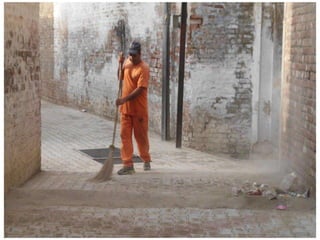
Brooms:-
These aremainly of two types short handled & long handled.
2. Long Handled Brooms:-
It consists of a bunch of long flexible fibers attached to a bamboo handled
& are used by workers while standing erect.
The brooms are used with long strokes to sweep the material on the roads.
It clear most of the light material such as paper, plastic, etc.
This broom is safer from the health point of view & hence preferred.
60.
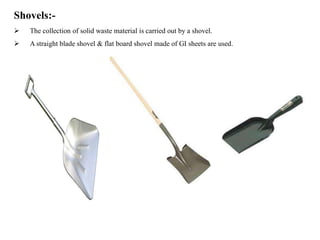
Shovels:-
The collectionof solid waste material is carried out by a shovel.
A straight blade shovel & flat board shovel made of GI sheets are used.
61.
Mechanical Sweepers:-
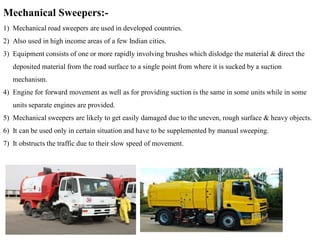
1) Mechanicalroad sweepers are used in developed countries.
2) Also used in high income areas of a few Indian cities.
3) Equipment consists of one or more rapidly involving brushes which dislodge the material & direct the
deposited material from the road surface to a single point from where it is sucked by a suction
mechanism.
4) Engine for forward movement as well as for providing suction is the same in some units while in some
units separate engines are provided.
5) Mechanical sweepers are likely to get easily damaged due to the uneven, rough surface & heavy objects.
6) It can be used only in certain situation and have to be supplemented by manual sweeping.
7) It obstructs the traffic due to their slow speed of movement.
62.
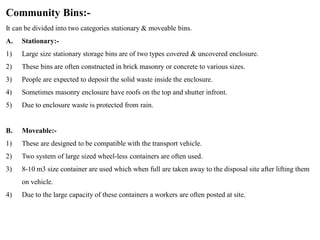
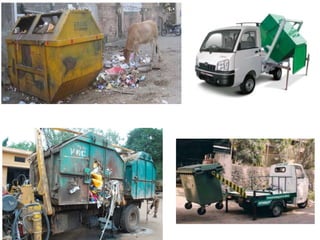
Community Bins:-
It canbe divided into two categories stationary & moveable bins.
A. Stationary:-
1) Large size stationary storage bins are of two types covered & uncovered enclosure.
2) These bins are often constructed in brick masonry or concrete to various sizes.
3) People are expected to deposit the solid waste inside the enclosure.
4) Sometimes masonry enclosure have roofs on the top and shutter infront.
5) Due to enclosure waste is protected from rain.
B. Moveable:-
1) These are designed to be compatible with the transport vehicle.
2) Two system of large sized wheel-less containers are often used.
3) 8-10 m3 size container are used which when full are taken away to the disposal site after lifting them
on vehicle.
4) Due to the large capacity of these containers a workers are often posted at site.
64.
Handcart:-
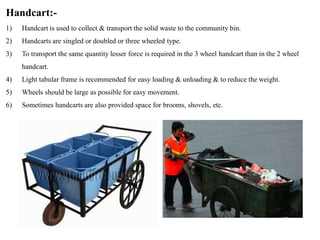
1) Handcart isused to collect & transport the solid waste to the community bin.
2) Handcarts are singled or doubled or three wheeled type.
3) To transport the same quantity lesser force is required in the 3 wheel handcart than in the 2 wheel
handcart.
4) Light tabular frame is recommended for easy loading & unloading & to reduce the weight.
5) Wheels should be large as possible for easy movement.
6) Sometimes handcarts are also provided space for brooms, shovels, etc.
Planning of SolidWaste Collection Program.
Routing system of collection
1. Micro-routing is:
―the routing of a vehicle within its assigned collection
zone.
―concerned with how to route a truck through a series
of one or two way streets so that the total distance
traveled is minimized.
―very difficult to design and execute.
2. Macro-routing is:
―large scale routing to the disposal site and the
establishment of the individual route boundaries.
68.
Labor requirements forthe collection of solid waste depend on both
the type of service provided and the collection system used:
a) For hauled container system:
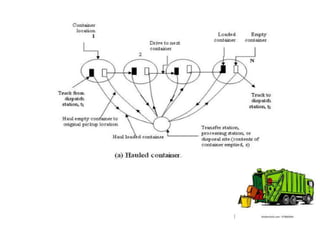
• Collection systems in which the containers used for the storage of
wastes are hauled to the processing, transfer or disposal site, emptied
and returned to either their original location or some other location
are defined as hauled container systems.
• one person, two for safety, and a driver to drive the vehicle load and
unload containers and empty the container at the disposal site.
b) For stationary container system :
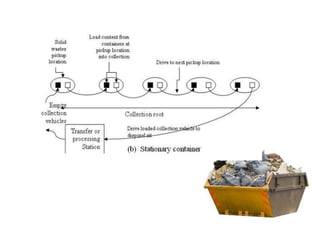
• Collection systems in which the containers used for the storage of wastes
remain at the point of waste generation, except when moved for
collection are defined as stationary container system
• the labor requirement for mechanically loaded ones are essentially the
same with hauled container system. Occasionally, a driver and two
helpers are used.
69.
Modes of operationin solid waste collection
Unit operations
1. Pick-up - refers to the time spent driving to the next container after an
empty container has been deposited.
2. Haul - represents the time required to reach the disposal site starting
after a container whose contents are to be emptied has been loaded on
the truck plus the time spent after leaving the disposal site until the truck
arrives at the location where the empty container is to be deposited.
3. At-site- refers to the time spent at the disposal site and includes the
time spent waiting to unload as well as the time spent in loading.
4. Off-site - includes the time spent on activities that are non-productive
from the point of view of the overall collection system.
Frequency of solidwaste collection
The frequency of collection depends on the quantity of solid waste,
time of year, socioeconomic status of the area served, and municipal
or contractor responsibility. In business districts, refuse, including
garbage from hotels and restaurants, should be collected daily except
on Sundays.
In residential areas, twice-a-week for refuse collection during warm
months of the year and once a week at other times should be the
maximum permissible interval. Slum areas usually require at least
twice-a-week collection. The receptacle should be either emptied
directly into the garbage truck or carted away and replaced with a
clean container.
• Refuse transferred from can to can will cause spilling, which results in
pollution of the ground and attraction of flies. If other than curb
pickup is provided, the cost of collection will be high.
• Some property owners are willing to pay for this extra service. Bulky
wastes should be collected every 3 months.
73.
• Garbage -should be collected at least two times weekly in
residential sections in summer and winter. However, most
commercial establishments should be accorded daily collection
service throughout the year.
• Rubbish - is generally collected weekly in residential areas and
daily in business sections.
• Mixed refuse - should be collected twice daily from most
commercial concerns.
• The provision of frequent collection services is important in the
prevention of fly breeding in garbage, because irregular collections
can contribute to the nuisances and hazards which result under poor
storage conditions and in chances the amount greater than the
expected requirement from households.
74.
Collection equipment
• Mechanicalcollection systems have been developed to reduce collection
cost. The system requires use of a special container, truck container pick-up
equipment, and replacement of the container.
• Collection equipment that simplifies the collection of refuse and practically
eliminates cause for legitimate complaint is available. The tight-body open
truck with a canvas or metal cover has been replaced in most instances by
the automatic loading truck with packer to compact refuse dumped in the
truck during collection, except for the collection of bulky items.
• Compaction-type bodies have twice the capacity of open trucks and a
convenient loading height. Low-level closed-body trailers to eliminate the
strain of lifting cans are also available.
• The number and size of the collection vehicles and the number of pickups in
residential and business areas for communities of different population will vary
with location, affluence, and other factors. The average refuse truck holds
6,000 to 8,000 kilograms.
• The solid waste collection vehicle should be covered and able to compact the
refuse collected. It may load from the rear, side, or top. The storage areas in
these vehicles should be kept relatively clean and water-tight.
75.
Organization of solidwaste collection program
• Many cities and towns require homeowners to use certain
types of receptacles. In some neighborhoods the collectors
pick up the receptacles in the backyard, as the people who live
there consider receptacles too bulky to handle and unsightly in
front of their dwellings.
• Haul distance to the disposal facility must be taken into
consideration in making a cost analysis. In some highly
urbanized areas it is economical to reduce haul distance
by providing large, specially designed trailers at transfer
stations.
• In suburban and rural areas, container stations can be
established at central locations. These stations may include
a stationary compactor for ordinary refuse and a bin for tires
and bulky items. Separate bins for paper, glass, and aluminum
may also be provided.
Transport:-
The waste collectedin storage containers or community bins are carried to the processing or
disposal site by using a variety of vehicles.
I. Vehicles which moves through narrow streets & after travelling a short distance discharge
their contents into another vehicle (big) at the transfer station or directly at the processing or
disposal site.
II. Vehicles which move through wider roads and after travelling over long distance discharge
their contents at the processing or disposal site.
If transportation vehicles are selected properly then transportation cost can be reduced
substantially by 20 – 45%
78.
Transport:-
The vehicles shouldsatisfy the following requirements:-
1. The loading height should not exceed 1.5 m.
2. Vehicles should have tipping gear arrangement for fast & efficient unloading.
3. Vehicles should have covered body.
4. When fully loaded, they should be able to climb a gradient of upto 1:10.
5. Sufficient carriage capacity.
6. Reliable & economic.
7. Their bodies should have atleast two coats of anti corrosive paint of distinct color for easy
identification.
8. The body should not have sharp corner where material accumulates & should facilitates
easy cleansing.
9. Satisfy the prevailing motor vehicle rules.
79.
Transport:-
The types oftransportation vehicles:-
1. Animal cart
2. Tractor Trailer
3. 3 wheeled Auto Rickshaws
4. Trucks
5. Pedal Tricycle
6. Dumper Placer
7. Container Carriage System
8. Special Municipality Vehicles, etc.
80.
Transfer and Transport
•Transfer stations are used to collect the refuse at a central location and
to reload the wastes into a vehicle where the cost per kilogram-kilometer
ton-mile will be less for the movement of the ultimate waste to the disposal
site. Transfer stations are employed when the disposal site is situated
at significant distance from the point of collection.
• A transfer station can reduce the cost of transporting refuse by
reducing manpower requirement and total kilometers. When a collection
vehicle goes directly to the disposal site, the entire crew, driver plus laborers,
are idle. For a transfer vehicle, only one driver is needed. As the distance
from the centers of solid waste generation increases, the cost of direct haul
to a site increases. Ideally, the transfer station should be located at the
center of the collection service area.
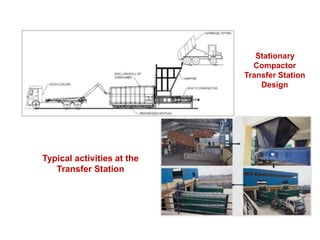
• A transfer station may include stationary compactors, recycling bins,
material recovery facility, transfer containers and trailers, transfer
packer trailers, or mobile equipment.
81.
• A transferstation should be located and designed with drainage of
paved areas and adequate water hydrants for maintenance of
cleanliness and fire control and other concerns like land scaling, weight
scales, traffic, odor, dust, litter, and noise control.
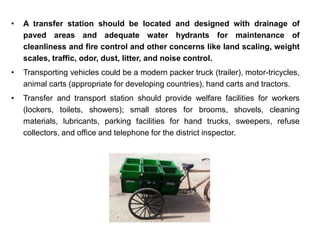
• Transporting vehicles could be a modern packer truck (trailer), motor-tricycles,
animal carts (appropriate for developing countries), hand carts and tractors.
• Transfer and transport station should provide welfare facilities for workers
(lockers, toilets, showers); small stores for brooms, shovels, cleaning
materials, lubricants, parking facilities for hand trucks, sweepers, refuse
collectors, and office and telephone for the district inspector.
Resource Recovery andProcessing
• Resource recovery is a partial solid waste disposal and
reclamation process. It can be expected to achieve about 60%
reductions in future landfill volume requirements. Resource
recovery must recognize what is worth recovering and the
environmental benefits.
• Resource recovery and processing is a complex, economical
and technical system with social and political implications, all
of which require critical analysis and evaluation before a
commitment is made. They demand capital cost, operating
cost, market value of reclaimed materials and material quality,
potential minimum reliable energy sales, assured quantity of
solid wastes, continued need for a sanitary landfill for the
disposal of excess and remaining unwanted materials and
incinerator residue, a site location close to the center of the
generators of solid wastes.
85.
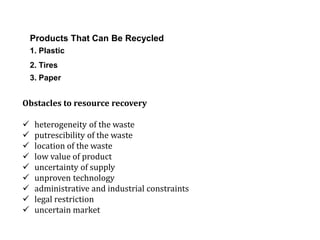
Products That CanBe Recycled
1. Plastic
2. Tires
3. Paper
Obstacles to resource recovery
heterogeneity of the waste
putrescibility of the waste
location of the waste
low value of product
uncertainty of supply
unproven technology
administrative and industrial constraints
legal restriction
uncertain market
86.
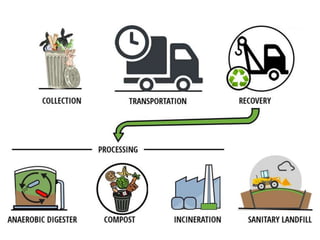
Processing of SolidWaste:-
1) Perform a series of mechanical or chemical operations on (something) in order to change
it.
1) It is the process to reduce its potential nuisance value (strength) and to recover usable
material or energy from solid waste before its final disposal.
2) Solid waste contain various ingredients however these ingredients can be used as a raw
material to produce some useful form of material or as source of energy.
3) Objective of a processing is to utilize the recycling potential of solid waste &
simultaneously reduce the load on solid waste management system especially on the
disposal.
87.
Processing of SolidWaste:-
1) Physical Processing Technology
2) Biological Processing Technology
3) Thermal Processing Technology
Composition of solid waste varies place to place & country to country. This aspect is
important while selecting processing technology for above objectives.
89.
Physical Processing Technology:-
Itinvolves altering the physical characteristics of a solid waste.
These solid waste may be shredded, separated & dried.
1) Mechanical Separation
2) Densification
3) Size Reduction
4) RDF (Refused Derived Fuel)
90.
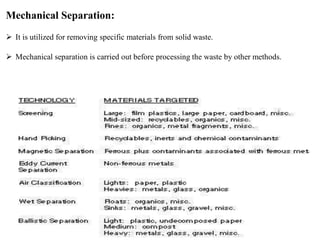
Mechanical Separation:
Itis utilized for removing specific materials from solid waste.
Mechanical separation is carried out before processing the waste by other methods.
91.
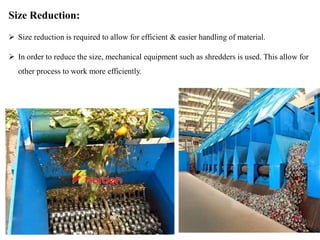
Size Reduction:
Sizereduction is required to allow for efficient & easier handling of material.
In order to reduce the size, mechanical equipment such as shredders is used. This allow for
other process to work more efficiently.
93.
Aerobic Composting orIndore Method of Composting:-
1) During aerobic composting aerobic micro-organism oxidize organic compounds to CO2, NO2, & NO3.
2) Carbon from organic compounds is used as source of energy while nitrogen is recycled.
3) Due to exothermic reaction, temp. of the mass rises.
4) Indore Method, conventionally carried out in pits.
5) Initially a layer of coarse solid waste is placed at the bottom of a pit to a depth of 15 to 25 cm & then
night soil is put to a thickness of 5cm again layer of solid waste is placed over night soil.
6) In this way, a night soil is sandwiched between two layers of MSW.
7) Solid waste & night soils are place in alternate layers till it rises to a height of 30cm above the pit edge.
8) The final layer of solid waste is atleast 25 to 30 cm thick.
9) The top of deposited material is rounded off to avoid rain water entry into the mass or pit.
94.
Anaerobic Composting orBangalore Method of Composting:-
1) During anaerobic process, the anaerobic micro-organism, while metabolizing the nutrients
break down the organic compounds through a process of reduction.
2) A very small amount of energy is released during the process and the temp. of composting
mass does not rise much.
3) The gases evolved are mainly CH4 & CO2.
4) Anaerobic process is a reduction process & the final product is subjected to some minor
oxidation when applied to the land.
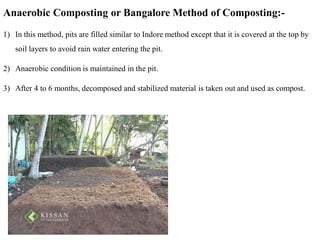
95.
Anaerobic Composting orBangalore Method of Composting:-
1) In this method, pits are filled similar to Indore method except that it is covered at the top by
soil layers to avoid rain water entering the pit.
2) Anaerobic condition is maintained in the pit.
3) After 4 to 6 months, decomposed and stabilized material is taken out and used as compost.
96.
Anaerobic Composting/Anaerobic Digestion:Salient Points
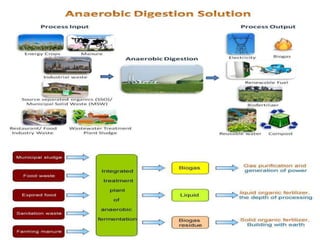
1) It is Composting : absence of oxygen, closed reactor system & high moisture.
2) Organics from MSW are first separated from the inorganic and then after size reduction are digested
anaerobically in large size digesters.
3) The generated gas is either directly used as a source of energy or fed to dual fuel engines for generation
of electricity.
4) The digested residue is commonly used as a manure.
5) In conventional anaerobic digestion, the solids concentration is kept at about 1%.
6) The pH is continuously monitored & maintained between 6.5 to 7.5.
7) The volatile acid conc. is not normally allowed to exceed 2000 mg/l.
8) The contents of the reactor are continuously stirred and the digested sludge is withdrawn from the
bottom and put on drying beds.
9) The drainage liquid from the bottom of drying beds is again added to the plant influent.
10) The digester may have either a fixed dome or a floating dome for the collection of gas.
98.
Factors Affecting CompostingProcess:-
1) Organism: different micro-organism are known to play predominant role in the breakdown of solid
waste
2) Use of culture: the required forms of micro-organisms are indigenous to solid waste
3) Moisture: 50-60%
4) Temperature: 30-600c
5) C/N ratio: 26 - 31
6) Aeration: 1-2 cum/day/kg of volatile solid
7) Addition of sludge or sewage:
8) Types of solid waste or composition of solid waste:
99.
Vermi-composting:-
1) Organic solidwaste is converted through earthworm consumption.
2) Decomposition of organic matter in the earthworm occurs in alimentary tract by micro-organism
inhabiting the gut.
3) Ingested organic matter is first subjected to size reduction in anterior part of the worms, gut followed by
decomposition.
4) These species survive in the temp. range of 20-400c & moisture range of 40-70.
5) They don’t survive in pure organic substrate containing more than 40% fermentable organic substances.
Hence, fresh waste is mixed with partially or fully stabilized waste before it can be vermi-composted.
6) Worms are adversely affected by high conce. Of heavy metals such as Cd, Cr, Pb, & Zn.
7) Vermi-compost has high nutrient content.
8) Generally Vermicompost is used for agricultural waste.
9) Houses & colonies often use this method for the organic household waste, however it has not yet been
successfully used for MSW.
101.
Thermal Processing Technology:-
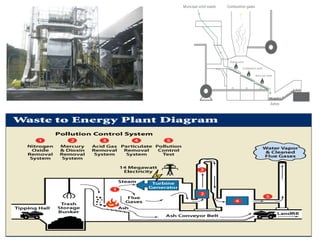
a)The various constituents of solid waste give it a good thermal value, when solid waste is
completely or partially burnt, heat energy is released.
b) The residue after combustion requires less volume and is hygienic to handle.
c) It is that process which generates energy in the form of electricity, fuel or heat from thermo-
chemical process such as combustion or gasification of solid waste.
d) Solid waste Thermal Technology is also referred to as waste to energy transformation.
e) There are following thermal processing technologies:-
1) Incineration
2) Pyrolysis
3) Gasification
102.
Incineration:-
1) It involvescontrolled combustion of the waste with specific amount of air to ensure that complete
combustion occurs in a specific range of temperature is an enclosed space.
2) During the process of incineration the combustible portion is burnt to final residue and ash, which is
comparatively less in volume (10-20% of original).
3) Residue can be used for landfilling or some other suitable purpose.
4) Incineration plant requires much less space as compared to other disposal facilities.
5) The plant can be located in the city area itself, so that the cost of transportation is reduced.
6) Large amount of heat can be made available from incineration.
7) Incineration is not commonly used due to various reason mainly due to low calorific value and high
operation & maintenance.
8) Types of incineration according to purpose:
Domestic (low capacity upto 50 kg/hr)
Commercial (capacity between 50 to 500 kg/hr)
Municipal (above 500 kg/hr)
110.
Pyrolysis:-
1) It isan endothermic reaction and heat must be supplied to the waste to distill off volatile matter.
2) Whereas incineration is an exothermic process wherein the waste is fully burnt and heat is released.
3) Pyrolysis is an irreversible chemical change brought by action of heat in an atmosphere devoid of
oxygen.
4) This is also referred to as thermal decomposition or destructive distillation or carbonization.
5) 500 – 900 0C.
6) Normally pyrolysis is carried out in two ranges: low temp. in which avg. reaction temp. is around 500
0C & high temp in which the avg. temp. is around 900 0C.
7) Pyrolysis of solid waste produces three types of products.
1) Gas
2) Liquid
3) Char
8) According to the temp. at which the solid waste are pyrolysed, the % of these products vary.
111.
Pyrolysis:-
Pyrolysis ofsolid waste produces three types of products.
1) Gas : mixture of gases such as hydrogen, carbon monoxide, methane, carbon dioxide & other
hydrocarbons
2) Liquid : contains tar, pitch, light oil, low organic chemicals like acetic acid, acetone, methanol,
etc.
3) Char : consist of elemental carbon along with the inert material in the waste feed.
All the three component have high calorific values & can be used as fuels after making necessary
modification in the design of burning equipment.
Different Pyrolysis Methods Recently Developed :
1) Destrugs system
2) Garetts Flash Pyrolysis Process
3) Process Developed by Energy Research Center of Bureau of Mines.
112.
Gasification:-
1) It isa important technology for renewable energy. > 700 0C
2) Now days, gasification is main technology for solid waste conversion to energy & effective
alternative for incineration.
3) It is achieved by reacting the material at high temp.
4) Limited amount of air is introduced to allow some organic waste to be burned to produce energy
which drives a second reaction.
5) This process is largely exothermic but some heat may be required to initialize & sustain the
gasification process.
6) It is a method for extracting energy from different types of organic materials.
7) The resulting gas mixture is called syngas or producer gas & itself as fuel.
8) Syngas can be valuable commercial product such as transportation fuel, chemicals & fertilizers
instead of making just heat & electricity.
9) The main products are CO, CH4, H2, etc.
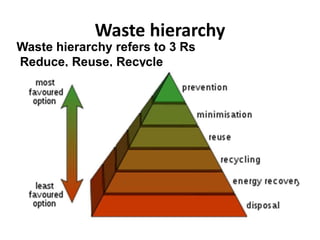
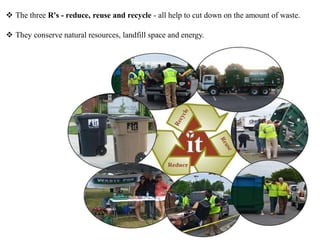
The threeR's - reduce, reuse and recycle - all help to cut down on the amount of waste.
They conserve natural resources, landfill space and energy.
115.
REDUCE
1) The bestway to manage waste is to not produce it. This can be done by
shopping carefully and being aware of a few guidelines:
2) Buy products in bulk. Larger, economy-size products or ones in concentrated
form use less packaging and usually cost less per ounce.
3) Avoid over-packaged goods, especially ones packed with several materials
such as foil, paper, and plastic. They are difficult to recycle, plus you pay more
for the package.
4) Avoid disposable goods, such as paper plates, cups, napkins, razors, and
lighters. Throwaways contribute to the problem, and cost more because they
must be replaced again and again.
5) Buy durable goods - ones that are well-built or that carry good warranties.
They will last longer, save money in the long run and save landfill space.
6) At work, make two-sided copies when ever possible.
7) Maintain central files rather than using several files for individuals.
8) Use electronic mail or main bulletin board.
9) Use cloth napkins instead of paper napkins.
10) Use a dish cloth instead of paper towels.
116.
REUSE
It makes economicand environmental sense to reuse products. Sometimes it
takes creativity:
1) Reuse products for the same purpose. Save paper and plastic bags, and repair
broken appliances, furniture and toys.
2) Reuse products in different ways. Use a coffee can to pack a lunch; use plastic
microwave dinner trays as picnic dishes.
3) Sell old clothes, appliances, toys, and furniture in garage sales or ads, or donate
them to charities.
4) Use re-sealable containers rather than plastic wrap.
5) Use a ceramic coffee mug instead of paper cups.
6) Reuse grocery bags or bring your own cloth bags to the store. Do not take a bag
from the store unless you need one.
117.
RECYCLE
Recycling is aseries of steps that takes a used material and processes,
remanufactures, and sells it as a new product. Begin recycling at home and
at work:
1) Buy products made from recycled material. Look for the recycling symbol or
ask store managers or salesmen. The recycling symbol means one of two things
- either the product is made of recycled material, or the item can be recycled.
For instance, many plastic containers have a recycling symbol with a numbered
code the identifies what type of plastic resin it is made from. However, just
because the container has this code does not mean it can be easily recycled
locally.
2) Check collection centers and curbside pickup services to see what they accept,
and begin collecting those materials. These can include metal cans, newspapers,
paper products, glass, plastics and oil.
3) Consider purchasing recycled materials at work when purchasing material for
office supply, office equipment or manufacturing.
4) Speak to store managers and ask for products and packaging that help cut down
on waste, such as recycled products and products that are not over packaged.
5) Buy products made from material that is collected for recycling in your
community.
6) Use recycled paper for letterhead, copier paper and newsletters.
118.
118
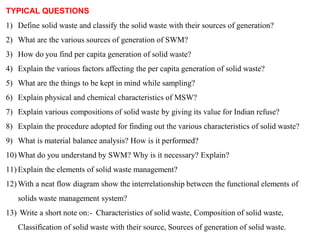
TYPICAL QUESTIONS
1) Definesolid waste and classify the solid waste with their sources of generation?
2) What are the various sources of generation of SWM?
3) How do you find per capita generation of solid waste?
4) Explain the various factors affecting the per capita generation of solid waste?
5) What are the things to be kept in mind while sampling?
6) Explain physical and chemical characteristics of MSW?
7) Explain various compositions of solid waste by giving its value for Indian refuse?
8) Explain the procedure adopted for finding out the various characteristics of solid waste?
9) What is material balance analysis? How is it performed?
10) What do you understand by SWM? Why is it necessary? Explain?
11) Explain the elements of solid waste management?
12) With a neat flow diagram show the interrelationship between the functional elements of
solids waste management system?
13) Write a short note on:- Characteristics of solid waste, Composition of solid waste,
Classification of solid waste with their source, Sources of generation of solid waste.
Source
• NPTEL Material
•Lecture note by Dr. M Venkataraman
• Environmental Engg. (Vol.II) – S K Garg
• Environmental Engineering – Peavy, Rowe &
Tchobanolgus
• Internet sources
142.
Source
• NPTEL Material
•Environmental Engg. (Vol.II) – S K Garg
• Environmental Engineering – Peavy, Rowe &
Tchobanolgus
• Internet sources
• Guidelines on Implementation of E-Waste
(Management) Rules, 2016
Disclaimer
This presentation doesnot claim any originality and cannot be used as a substitute for
prescribed textbooks. The information presented here is merely a collection for
teaching assignments for the students of 5th semester B.Tech. Civil Engineering of
VSSUT, Burla. I would like to acknowledge various sources like freely available
materials from internet from which the presentation was prepared. The ownership of
the information lies with the respective authors or institutions. Further, this
presentation/document is not intended to be used for commercial purpose.
145.
Definition
Wastes that exhibitmeasurable properties posing sufficient
threats to warrant regulation. For a waste to be deemed a
characteristic hazardous waste, it must cause, or significantly
contribute to, an increased mortality or an increase in serious
irreversible or incapacitating reversible illness, or pose a
substantial hazard or threat of a hazard to human health or the
environment, when it is improperly treated, stored, transported,
disposed of, or otherwise mismanaged.
146.
Identification
By using eitheror both of the following criteria, we can identify
as to whether or not a waste is hazardous:
(i) Characteristics such as ignitibility, corrosivity, reactivity and
toxicity of the substance.
(ii) The list provided by government agencies declaring that
substance as hazardous.
147.
Characteristics/Properties
(i) Ignitability: Awaste is an ignitable hazardous waste, if it has a flash point of
less than 60°C; readily catches fire and burns so vigorously as to create a hazard;
or is an ignitable compressed gas or an oxidiser. Naphtha, lacquer thinner, epoxy
resins, adhesives and oil based paints are all examples of ignitable hazardous
wastes.
(ii) Corrosivity: A liquid waste which has a pH of less than or equal to 2 or greater
than or equal to 12.5 is considered to be a corrosive hazardous waste. Sodium
hydroxide, a caustic solution with a high pH, is often used by many industries to
clean or degrease metal parts. Hydrochloric acid, a solution with a low pH, is used
by many industries to clean metal parts prior to painting. When these caustic or
acid solutions are disposed of, the waste is a corrosive hazardous waste.
148.
Characteristics/Properties
(iii) Reactivity: Amaterial is considered a reactive hazardous waste, if it is
unstable, reacts violently with water, generates toxic gases when exposed to
water or corrosive materials, or if it is capable of detonation or explosion when
exposed to heat or a flame. Examples of reactive wastes would be waste
gunpowder, sodium metal or wastes containing cyanides or sulphides.
(iv) Toxicity: To determine if a waste is a toxic hazardous waste, a representative
sample of the material must be subjected to a test conducted in a certified
laboratory. The toxic characteristic identifies wastes that are likely to leach
dangerous concentrations of toxic chemicals into ground water.
149.
Listed hazardous wastes
Aspecific list showing certain materials as hazardous wastes minimises the need to
test wastes as well as simplifies waste determination. In other words, any waste
that fits the definition of a listed waste is considered a hazardous waste.
F-list: The F-list contains hazardous wastes from non-specific sources, that is,
various industrial processes that may have generated the waste. The list consists
of solvents commonly used in degreasing, metal treatment baths and sludges,
wastewaters from metal plating operations and dioxin containing chemicals or
their precursors. Examples of solvents that are F-listed hazardous wastes, along
with their code numbers, include benzene (F005), carbon tetrachloride (F001),
cresylic acid (F004), methyl ethyl ketone (F005), methylene chloride (F001), 1,1,1,
trichloroethane (F001), toluene (F005) and trichloroethylene (F001). Solvent
mixtures or blends, which contain greater than 10% of one or more of the solvents
listed in F001, F002, F003, F004 and F005 are also considered F-listed wastes.
150.
Listed hazardous wastes
K-list:The K-list contains hazardous wastes generated by specific industrial processes.
Examples of industries, which generate K-listed wastes include wood preservation, pigment
production, chemical production, petroleum refining, iron and steel production, explosive
manufacturing and pesticide production.
P and U lists: The P and U lists contain discarded commercial chemical products, off-
specification chemicals, container residues and residues from the spillage of materials.
These two lists include commercial pure grades of the chemical, any technical grades of the
chemical that are produced or marketed, and all formulations in which the chemical is the
sole active ingredient. An example of a P or U listed hazardous waste is a pesticide, which is
not used during its shelf-life and requires to be disposed in bulk. The primary distinction
between the two lists is the quantity at which the chemical is regulated. The P-list consists of
acutely toxic wastes that are regulated when the quantity generated per month, or
accumulated at any time, exceeds one kilogram (2.2 pounds), while U-listed hazardous
wastes are regulated when the quantity generated per month exceeds 25 kilograms (55
pounds). Examples of businesses that typically generate P or U listed wastes include pesticide
applicators, laboratories and chemical formulators.
151.
Classification of hazardouswastes
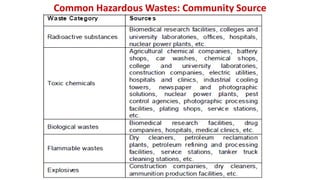
Radioactive substance: Substances that emit ionising radiation are radioactive. Such
substances are hazardous because prolonged exposure to radiation often results in damage
to living organisms. Radioactive substances are of special concern because they persist for a
long period. The period in which radiation occurs is commonly measured and expressed as
half-life, i.e., the time required for the radioactivity of a given amount of the substance to
decay to half its initial value. For example, uranium Municipal Solid Waste Management 390
compounds have half-lives that range from 72 years for U232 to 23,420,000 years for U236.
The management of radioactive wastes is highly controlled by national and state regulatory
agencies. Disposal sites that are used for the long-term storage of radioactive wastes are not
used for the disposal of any other solid waste.
Chemicals: Most hazardous chemical wastes can be classified into four groups: synthetic
organics, inorganic metals, salts, acids & bases, and flammables & explosives. Some of the
chemicals are hazardous because they are highly toxic to most life forms. When such
hazardous compounds are present in a waste stream at levels equal to, or greater than, their
threshold levels, the entire waste stream is identified as hazardous.
152.
Classification of hazardouswastes
Biomedical wastes: The principal sources of hazardous biological wastes are
hospitals and biological research facilities. The ability to infect other living
organisms and the ability to produce toxins are the most significant characteristics
of hazardous biological wastes. This group mainly includes malignant tissues
discarded during surgical procedures and contaminated materials, such as
hypodermic needles, bandages and outdated drugs. This waste can also be
generated as a by-product of industrial biological conversion processes.
Flammable wastes: Most flammable wastes are also identified as hazardous
chemical wastes. This dual grouping is necessary because of the high potential
hazard in storing, collecting and disposing of flammable wastes. These wastes may
be liquid, gaseous or solid, but most often they are liquids. Typical examples include
organic solvents, oils, plasticisers and organic sludges.
153.
Classification of hazardouswastes
Explosives: Explosive hazardous wastes are mainly ordnance (artillery) materials,
i.e., the wastes resulting from ordnance manufacturing and some industrial gases.
Similar to flammables, these wastes also have a high potential for hazard in storage,
collection and disposal, and therefore, they should be considered separately in
addition to being listed as hazardous chemicals. These wastes may exist in solid,
liquid or gaseous form.
Household hazardous wastes: Household wastes such as cleaning chemicals,
batteries, nail polish etc in MSW constitute hazardous waste. Especially batteries
contain mercury which are alkaline which is dangerous enough to kill people.
Generic household hazardous material include non chlorinated organic, chlorinated
organic, pesticides, latex paint, oil based paints, waste oil, automobile battery and
household battery.
Regulations
HAZARDOUS WASTES (MANAGEMENT& HANDLING) RULES, 1989.
The Ministry of Environment & Forests, Govt. of India has notified rules, vide Gazette
notification no. S.O. 694 (E) DT. 28th July '89, under title Hazardous Wastes (Management &
Handling) Rules, 1989 to deal with various environmental aspects related with hazardous
wastes. The salient features of the rules are as follows:
The occupier generating hazardous wastes shall take all practical steps to ensure proper
handling and disposal of hazardous wastes in environment friendly manner.
The occupier generating hazardous wastes, subject to the quantity specified in the schedule,
shall apply to the State Pollution Control Board, in Form–1 for necessary authorisation.
The State Pollution Control Board, shall grant authorisation having satisfied that the
operator of a facility or an occupier, as the case may be, possesses appropriate facility,
technical capabilities and equipment to handle hazardous wastes.
The Authorisation, unless suspended or cancelled, shall remain in force for a period of two
year from the date of issue or from the date of renewal.
164.
Regulations
The occupier shallapply for the renewal of authorisation before its expiry.
The authorisation shall continue to be in force until it is renewed or revoked.
The State PCB may, after giving reasonable opportunity of being heard to the application
refuse to grant any authorisation.
The authorised person shall maintain the record of returns in Form-3 and shall communicate
it to the SPCB annually in Form -4.
Accident occurred at the facility or on a hazardous wastes site shall be reported to the SPCB
in Form 5.
Import of hazardous wastes to be allowed only for processing or re-use as raw material.
The importers of hazardous wastes is required to furnish information country shall
communicate in Form 6 to the Central Ministry.
The Central Govt. shall after examining the matter and on being satisfied on various
environmental implications, grant permission or may refuse permission to import such
hazardous wastes.
The importer is required to maintain the record in specified Form 7.
165.
Source
• NPTEL Material
•Tchobaanoglous, G., Theisen, H., and Samuel A Vigil, 1993.
Integrated Solid Waste Management, McGraw-Hill, Inc., New
Delhi.
• Environmental Engg. (Vol.II) – S K Garg
• Environmental Engineering – Peavy, Rowe & Tchobanolgus
• Internet sources
Disclaimer
This presentation doesnot claim any originality and cannot be used as a substitute for
prescribed textbooks. The information presented here is merely a collection for
teaching assignments for the students of 5th semester B.Tech. Civil Engineering of
VSSUT, Burla. I would like to acknowledge various sources like freely available
materials from internet from which the presentation was prepared. The ownership of
the information lies with the respective authors or institutions. Further, this
presentation/document is not intended to be used for commercial purpose.
168.
Definition
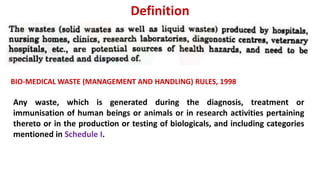
BIO-MEDICAL WASTE (MANAGEMENTAND HANDLING) RULES, 1998
Any waste, which is generated during the diagnosis, treatment or
immunisation of human beings or animals or in research activities pertaining
thereto or in the production or testing of biologicals, and including categories
mentioned in Schedule I.
169.
SOURCES
Hospitals • Nursinghomes • Clinics • Medical laboratories
Blood banks • Mortuaries • Medical research & training centers
Biotechnology institution/production units • Animal houses etc.
Such a waste can also be generated at home if health care is
being provided there to a patient (e.g. injection, dressing
material etc.)
170.
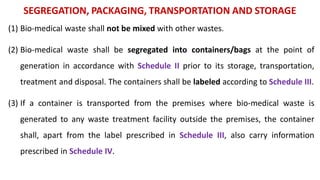
SEGREGATION, PACKAGING, TRANSPORTATIONAND STORAGE
(1) Bio-medical waste shall not be mixed with other wastes.
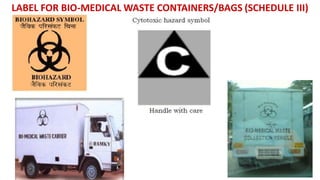
(2) Bio-medical waste shall be segregated into containers/bags at the point of
generation in accordance with Schedule II prior to its storage, transportation,
treatment and disposal. The containers shall be labeled according to Schedule III.
(3) If a container is transported from the premises where bio-medical waste is
generated to any waste treatment facility outside the premises, the container
shall, apart from the label prescribed in Schedule III, also carry information
prescribed in Schedule IV.
171.
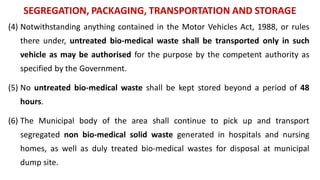
SEGREGATION, PACKAGING, TRANSPORTATIONAND STORAGE
(4) Notwithstanding anything contained in the Motor Vehicles Act, 1988, or rules
there under, untreated bio-medical waste shall be transported only in such
vehicle as may be authorised for the purpose by the competent authority as
specified by the Government.
(5) No untreated bio-medical waste shall be kept stored beyond a period of 48
hours.
(6) The Municipal body of the area shall continue to pick up and transport
segregated non bio-medical solid waste generated in hospitals and nursing
homes, as well as duly treated bio-medical wastes for disposal at municipal
dump site.
172.
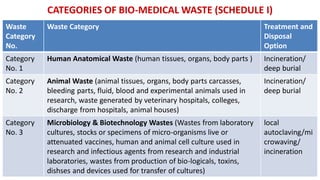
CATEGORIES OF BIO-MEDICALWASTE (SCHEDULE I)
Waste
Category
No.
Waste Category Treatment and
Disposal
Option
Category
No. 1
Human Anatomical Waste (human tissues, organs, body parts ) Incineration/
deep burial
Category
No. 2
Animal Waste (animal tissues, organs, body parts carcasses,
bleeding parts, fluid, blood and experimental animals used in
research, waste generated by veterinary hospitals, colleges,
discharge from hospitals, animal houses)
Incineration/
deep burial
Category
No. 3
Microbiology & Biotechnology Wastes (Wastes from laboratory
cultures, stocks or specimens of micro-organisms live or
attenuated vaccines, human and animal cell culture used in
research and infectious agents from research and industrial
laboratories, wastes from production of bio-logicals, toxins,
dishses and devices used for transfer of cultures)
local
autoclaving/mi
crowaving/
incineration
173.
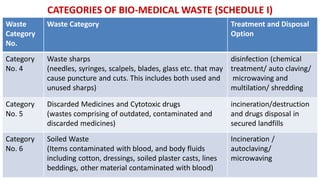
CATEGORIES OF BIO-MEDICALWASTE (SCHEDULE I)
Waste
Category
No.
Waste Category Treatment and Disposal
Option
Category
No. 4
Waste sharps
(needles, syringes, scalpels, blades, glass etc. that may
cause puncture and cuts. This includes both used and
unused sharps)
disinfection (chemical
treatment/ auto claving/
microwaving and
multilation/ shredding
Category
No. 5
Discarded Medicines and Cytotoxic drugs
(wastes comprising of outdated, contaminated and
discarded medicines)
incineration/destruction
and drugs disposal in
secured landfills
Category
No. 6
Soiled Waste
(Items contaminated with blood, and body fluids
including cotton, dressings, soiled plaster casts, lines
beddings, other material contaminated with blood)
Incineration /
autoclaving/
microwaving
174.
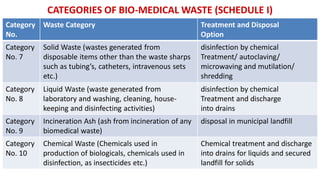
CATEGORIES OF BIO-MEDICALWASTE (SCHEDULE I)
Category
No.
Waste Category Treatment and Disposal
Option
Category
No. 7
Solid Waste (wastes generated from
disposable items other than the waste sharps
such as tubing’s, catheters, intravenous sets
etc.)
disinfection by chemical
Treatment/ autoclaving/
microwaving and mutilation/
shredding
Category
No. 8
Liquid Waste (waste generated from
laboratory and washing, cleaning, house-
keeping and disinfecting activities)
disinfection by chemical
Treatment and discharge
into drains
Category
No. 9
Incineration Ash (ash from incineration of any
biomedical waste)
disposal in municipal landfill
Category
No. 10
Chemical Waste (Chemicals used in
production of biologicals, chemicals used in
disinfection, as insecticides etc.)
Chemical treatment and discharge
into drains for liquids and secured
landfill for solids
175.
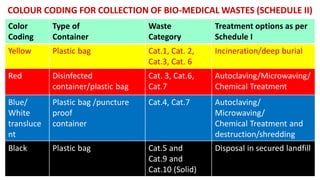
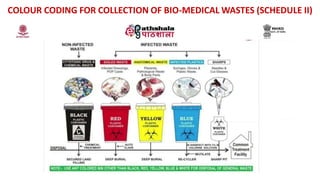
COLOUR CODING FORCOLLECTION OF BIO-MEDICAL WASTES (SCHEDULE II)
Color
Coding
Type of
Container
Waste
Category
Treatment options as per
Schedule I
Yellow Plastic bag Cat.1, Cat. 2,
Cat.3, Cat. 6
Incineration/deep burial
Red Disinfected
container/plastic bag
Cat. 3, Cat.6,
Cat.7
Autoclaving/Microwaving/
Chemical Treatment
Blue/
White
transluce
nt
Plastic bag /puncture
proof
container
Cat.4, Cat.7 Autoclaving/
Microwaving/
Chemical Treatment and
destruction/shredding
Black Plastic bag Cat.5 and
Cat.9 and
Cat.10 (Solid)
Disposal in secured landfill
DEEP BURIAL
1. Apit or trench should be dug about 2 metres deep. It should be half filled with waste,
then covered with lime within 50 cm of the surface, before filling the rest of the pit with
soil.
2. It must be ensured that animals do not have any access to burial sites. Covers of
galvanized iron/wire meshes may be used.
3. On each occasion, when wastes are added to the pit, a layer of 10 cm of soil shall be
added to cover the wastes.
4. Burial must be performed under close and dedicated supervision.
5. The deep burial site should be relatively impermeable and no shallow well should be close
to the site.
6. The pits should be distant from habitation, and sited so as to ensure that no
contamination occurs of any surface water or groundwater. The area should not be prone
to flooding or erosion.
7. The location of the deep burial site will be authorized by the prescribed authority.
8. The institution shall maintain a record of all pits for deep burial.
Disclaimer
This presentation doesnot claim any originality and cannot be used as a substitute for
prescribed textbooks. The information presented here is merely a collection for
teaching assignments for the students of 5th semester B.Tech. Civil Engineering of
VSSUT, Burla. I would like to acknowledge various sources like freely available
materials from internet from which the presentation was prepared. The ownership of
the information lies with the respective authors or institutions. Further, this
presentation/document is not intended to be used for commercial purpose.
187.
Definition
Radioactive waste isa type of hazardous waste that
contains radioactive material. Radioactive waste is a by-product of
various nuclear technology processes. Radioactive (or nuclear)
waste is a by-product from nuclear reactors, fuel processing plants,
hospitals and research facilities. Radioactive waste is also generated
while decommissioning and dismantling nuclear reactors and other
nuclear facilities.
188.
SOURCES
• Nuclear powerplants
• Nuclear armament
• Nuclear fuel treatment plants
• Nuclear fuel cycle
• Nuclear weapons reprocessing
• Medical and industrial wastes
• Naturally occurring radioactive materials (NORM) that can be
concentrated as a result of the processing or consumption of coal, oil and
gas, and some minerals
• Cosmic rays
• Radionuclide present within the bodies of organisms
189.
High-level waste
• High-levelwaste (HLW) is produced by nuclear reactors. High-level waste (HLW)
is a type of nuclear waste created by the reprocessing of spent nuclear fuel.
• High-level radioactive waste primarily is uranium fuel that has been used in a
nuclear power reactor and is "spent," or no longer efficient in producing
electricity. Spent fuel is thermally hot as well as highly radioactive and requires
remote handling and shielding.
190.
High-level waste
• High-levelwastes are hazardous because they produce fatal radiation doses
during short periods of direct exposure. If isotopes from these high-level wastes
get into groundwater or rivers, they may enter food chains. The dose produced
through this indirect exposure would be much smaller than a direct-exposure
dose, but a much larger population could be exposed.
• Reprocessing separates residual uranium and plutonium from the fission
products. The uranium and plutonium can be used again as fuel.
• Radioactive isotopes eventually decay, or disintegrate, to harmless materials.
Some isotopes decay in hours or even minutes, but others decay very slowly.
Strontium-90 and cesium-137 have half-lives of about 30 years (half the
radioactivity will decay in 30 years). Plutonium-239 has a half-life of 24,000
years.
191.
High-level waste
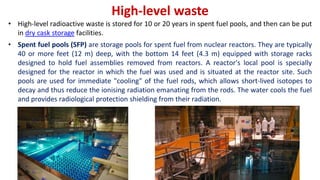
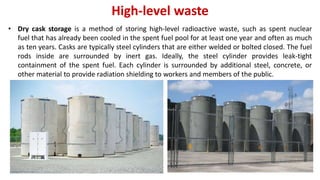
• High-levelradioactive waste is stored for 10 or 20 years in spent fuel pools, and then can be put
in dry cask storage facilities.
• Spent fuel pools (SFP) are storage pools for spent fuel from nuclear reactors. They are typically
40 or more feet (12 m) deep, with the bottom 14 feet (4.3 m) equipped with storage racks
designed to hold fuel assemblies removed from reactors. A reactor's local pool is specially
designed for the reactor in which the fuel was used and is situated at the reactor site. Such
pools are used for immediate "cooling" of the fuel rods, which allows short-lived isotopes to
decay and thus reduce the ionising radiation emanating from the rods. The water cools the fuel
and provides radiological protection shielding from their radiation.
192.
High-level waste
• Drycask storage is a method of storing high-level radioactive waste, such as spent nuclear
fuel that has already been cooled in the spent fuel pool for at least one year and often as much
as ten years. Casks are typically steel cylinders that are either welded or bolted closed. The fuel
rods inside are surrounded by inert gas. Ideally, the steel cylinder provides leak-tight
containment of the spent fuel. Each cylinder is surrounded by additional steel, concrete, or
other material to provide radiation shielding to workers and members of the public.
193.
Low-level waste
• Lowlevel waste (LLW) is generated from hospitals and industry, as well as the nuclear fuel
cycle. Low-level wastes include paper, rags, tools, clothing, filters, and other materials
which contain small amounts of mostly short-lived radioactivity. Materials that originate
from any region of an Active Area are commonly designated as LLW as a precautionary
measure even if there is only a remote possibility of being contaminated with radioactive
materials. Such LLW typically exhibits no higher radioactivity than one would expect from
the same material disposed of in a non-active area, such as a normal office block.
• Low-level waste includes items that have become contaminated with radioactive material
or have become radioactive through exposure to neutron radiation. This waste typically
consists of contaminated protective shoe covers and clothing, wiping rags, mops, filters,
reactor water treatment residues, equipment and tools, luminous dials, medical tubes,
swabs, injection needles, syringes, and laboratory animal carcasses and tissues. The
radioactivity can range from just above background levels found in nature to much higher
levels in certain cases, such as from parts from inside the reactor vessel in a nuclear power
plant.
194.
Low-level waste
• Low-levelwaste is typically stored on-site by licensees, either until it has decayed
away and can be disposed of as ordinary trash, or until amounts are large enough
for shipment to a low-level waste disposal site in approved containers.
Source
• NPTEL Material
•Environmental Engg. (Vol.II) – S K Garg
• Environmental Engineering – Peavy, Rowe & Tchobanolgus
• Internet sources
198.
Waste Management:
Module 5
E-waste &
Soil contamination and site remediation
5th Semester – Dept. of Civil Engineering, VSSUT
Dr. R R Dash
199.
Disclaimer
This presentation doesnot claim any originality and cannot be used as a substitute for
prescribed textbooks. The information presented here is merely a collection for
teaching assignments for the students of 5th semester B.Tech. Civil Engineering of
VSSUT, Burla. I would like to acknowledge various sources like freely available
materials from internet from which the presentation was prepared. The ownership of
the information lies with the respective authors or institutions. Further, this
presentation/document is not intended to be used for commercial purpose.
Guidelines on Implementationof E-Waste (Management) Rules, 2016
• These rules are applicable to every producer, consumer or bulk consumer, collection
centre, dismantler and recycler of e-waste involved in the manufacture, sale, purchase
and processing of electrical and electronic equipment or components specified in
schedule –I of these Rules.
• Two categories of electrical and electronic equipment namely (i) IT and
Telecommunication Equipment and (ii) Consumer Electricals and Electronics such as
TVs, Washing Machines, Refrigerators Air Conditioners including fluorescent and other
mercury containing lamps are covered under these Rules.
• Stipulate phase wise collection target to producers for the collection of e-waste, either
in number or weight, which shall be 30% of the estimated quantity of waste generation
during first two year of implementation of rules followed by 40% during third and fourth
years, 50% during fifth and sixth years and 70% during seventh year onwards.
206.
Guidelines for Collectionand Storage of E-Waste
• After assessing their requirement of collection of e-waste, producers may device a
collection mechanism which may include take-back through dealers, collection centres
or directly through authorised dismantlers/recyclers.
• Producer may manage a system directly for collection of e-waste by involving relevant
stakeholders such as consumer, bulk consumer, informal sector, resident associations,
retailers and dealers, etc.
• Producers may also have an arrangement of collection of e-waste from individual
consumers and bulk consumers as well.
• The producers may publicize their collection system which may include details of their
collection points, bins and collection vans linked to collection centres, take-back
system, deposit refund scheme, e-waste exchange, retailers/dealers etc.
• Details of authorised dismantlers/recyclers who can take-back e-waste on behalf of the
producer if dismantlers/recyclers should be provided.
207.
Guidelines for Collectionand Storage of E-Waste
• Every Producer, collection centre, dealer, dismantler, recycler and refurbisher may
store the e-waste for a period not exceeding one hundred and eighty (180) days.
• During storage of e-waste care may be taken:(i) To avoid damage to refrigerators
and air-conditioner so as to prevent release of refrigerant gases such as CFC, HFS,
HCFC etc. and to prevent spillage of oils (mineral or synthetic oil)and other
emissions (ii)To avoid damage to Cathode Ray Tube (iii)To avoid damage to
fluorescent and other mercury containing lamps (iv)To avoid damage to
equipment containing asbestos or ceramic fibres to avoid release of asbestos or
ceramic fibres in the environment.
• After collection of fluorescent and other mercury containing lamps, it should be
sent only to a recycler or to a TSDF in case no recycler is available.
• Loading, transportation, unloading and storage of E-Waste / end of life products
should be carried out in such a way that its end use such as re-use after
refurbishing or recycling or recovery is unaffected.
208.
Guidelines for CollectionCentre
• Collection centre or collection points are part of E-waste channelisation, and can be
established by producers, refurbishers, dismantlers and recyclers.
• Collection Centre may collect and store e-waste, on behalf of producer / dismantler /
recycler /refurbisher and transfer the same to authorised dismantlers / recyclers.
• The collection points/bins can be at designated places where e-waste can be collected
from residential areas, office complexes, commercial complexes, retail outlets, customer
care stores, educational and research institutions, resident welfare associations(RWAs).
• These collection points have to be part of producer’s collection and channelisation plan.
• Mobile collection vans can be used for door to door collection of e-waste from
institutions/ individuals/small enterprises and such vans shall be linked to collection
centres, and if provided by producers, shall be part of their EPR Plan.
• Material from collection centres should be send only to the authorised dismantlers and
Recyclers except in case of used Fluorescent and other mercury containing lamps, which
can be sent to TSDF in case recyclers are not available.
209.
Guidelines for Transportationof E-Waste
• The sender of E-Waste, that may be a producer, manufacturer, recyclers,
dismantler, bulk-consumer, refurbisher and collection centre should
identify transporter or make arrangements for a transporting e-waste in
such a manner that environmental consequences of hazards associated
with its transport could be kept at minimum.
• The responsibility of safe transportation of E-waste shall be with the
sender of E-Waste.
• The manufacturers and recyclers while transporting waste generated from
manufacturing or recycling destined for final disposal to a treatment,
storage and disposal facility will follow the provisions under Hazardous and
Other Wastes (Management and Transboundary Movement) Rules, 2016.
210.
Guidelines for Disposal- Dismantler
• Any person or organisation or registered society or a designated agency
or a company or an association can engage in dismantling of e-waste
into their components by obtaining authorisation from the respective
SPCBs/PCCs. Dismantlers may set up their collection centre, details of
which shall be entered in their authorisation. These collection centres
shall not require separate authorisation.
• Dismantling operation is essentially manual operation for segregating
various components/ parts and sending them to respective users/
recyclers. Directly usable components can be sent only to an authorised
refurbisher.
211.
Guidelines for Disposal- Recycler
• As per these rules any person who is engaged in recycling and reprocessing of waste electrical and
electronic equipment or assemblies or their component is a recycler.
• Recyclers can obtain raw material such as waste electrical and electronic assemblies or components
or used components from producers/e-waste exchange/dismantlers and consumers/bulk consumers.
• The functions of the recyclers include dismantling along with recovery operation.
• The following processes should be employed by recyclers:
– (i)Manual / semi-automatic/ automatic dismantling operations
– (ii)Shredding / crushing / fine grinding/wet grinding/ enrichment operations, gravity/ magnetic/density/eddy
current separation
– (iii)Pyrometallurgical operations -Smelting furnace
– (iv)Hydro metallurgical operations
– (v)Electro-metallurgical operations
– (vi)Chemical leaching
– (vii)CRT/LCD/Plasma processing
– (viii)Toner cartridge recycling
– (ix)Melting, casting, moulding operations (for metals and plastics)
212.
Guidelines for Disposal-Refurbisher
•Refurbishment means repairing of used electrical and
electronic equipment and it should be carried out in
such a way that there should not be any damage to
health and environment.
• Any e-waste generated during refurbishment should be
collected separately and sent to collection centre
/authorised recycler. In case of refurbisher not having
own collection centre, the e-waste so generated may be
channelized to an authorised recycler.
Soil pollution -Definition
Soil pollution is defined as the presence of toxic chemicals (pollutants or
contaminants) in soil, in high enough concentrations to pose a risk to human
health and/or the ecosystem.
In the case of contaminants which occur naturally in soil, even when their
levels are not high enough to pose a risk, soil pollution is still said to occur if
the levels of the contaminants in soil exceed the levels that should naturally
be present.
215.
Soil Pollution
Allsoils, whether polluted or unpolluted, contain a variety of compounds
(contaminants) which are naturally present.
Such contaminants include metals, inorganic ions and salts (e.g. phosphates,
carbonates, sulfates, nitrates), and many organic compounds (such as lipids, proteins,
DNA, fatty acids, hydrocarbons, PAHs, alcohols, etc.).
These compounds are mainly formed through soil microbial activity and decomposition
of organisms (e.g., plants and animals).
Additionally, various compounds get into the soil from the atmosphere.
For instance with precipitation water, as well as by wind activity or other types of soil
disturbances, and from surface water bodies and shallow groundwater flowing through
the soil.
216.
Soil Pollution
Whenthe amounts of soil contaminants exceed natural levels (what is naturally
present in various soils), pollution is generated.
There are two main causes through which soil pollution is generated: anthropogenic
(man-made) causes and natural causes.
217.
Natural Pollutants
Naturalaccumulation of compounds in soil due to imbalances between
atmospheric deposition and leaking away with precipitation water (e.g.,
concentration and accumulation of perchlorate in soils in arid environments)
Natural production in soil under certain environmental conditions (e.g.,
natural formation of perchlorate in soil in the presence of a chlorine source,
metallic object and using the energy generated by a thunderstorm)
218.
Anthropogenic Pollutants
Anthropogenic (man-made)soil pollution originates in several types of processes,
some deliberate (industrial) and some accidental. Human-caused soil pollution
can work in conjunction with natural processes to increase the toxic
contamination levels in the soil.
Accidental spills and leaks during storage, transport or use of chemicals (e.g.
leaks and spills of gasoline and diesel at gas stations);
Foundry activities and manufacturing processes that involve furnaces or other
processes resulting in the possible dispersion of contaminants in the
environment;
Mining activities involving the crushing and processing of raw materials, for
instance, heavy metals, emitting toxic substances;
219.
Anthropogenic Pollutants
Constructionactivities Construction sites are the most important triggers of soil pollution
in urban areas, due to their almost ubiquitous nature. Almost any chemical substance
handled at construction sites may pollute the soil. However, the higher risk comes from
those chemicals that can travel more easily through the air as fine particulate matter. The
chemicals that travel as particulate matter are more resistant to degradation and
bioaccumulate in living organisms, such as PAHs.
Agricultural activities involving the diffusion of herbicides, pesticides and/or insecticides
and fertilizers;
Transportation activities, releasing toxic vehicle emissions
Chemical waste dumping, whether accidental or deliberate – such as illegal dumping;
The storage of waste in landfills, as the waste products may leak into groundwater or
generate polluted vapors
Cracked paint chips falling from building walls, especially lead-based paint.
Leaks from sewer lines into subsurface (e.g., adding chlorine which could generate
trihalomethanes such as chloroform).
220.
Types of SoilPollutants
Soil pollution consists of pollutants and contaminants. The main pollutants of
the soil are the biological agents and some of the human activities. Soil
contaminants are all products of soil pollutants that contaminate the soil.
Human activities that pollute the soil range from agricultural practices that
infest the crops with pesticide chemicals to urban or industrial wastes or
radioactive emissions that contaminate the soil with various toxic substances.
Biological Agents: Biological agents work inside the soil to introduce manures
and digested sludge (coming from the human, bird and animal excreta) into
the soil.
221.
Types of SoilPollutants
Agricultural Practices: The soil of the crops is polluted to a large extent with
pesticides, fertilizers, herbicides, slurry, debris, and manure.
Radioactive Pollutants: Radioactive substances such as Radium, Thorium,
Uranium, Nitrogen, etc. can infiltrate the soil and create toxic effects.
Urban Waste: Urban waste consists of garbage and rubbish materials, dried
sludge and sewage from domestic and commercial waste.
Industrial Waste: Steel, pesticides, textiles, drugs, glass, cement, petroleum,
etc. are produced by paper mills, oil refineries, sugar factories, petroleum
industries and others as such.
222.
Examples of SoilContaminants
Lead (Pb) Potential sources: lead paint, mining, foundry activities, vehicle
exhaust, construction activities, agriculture activities
Mercury (Hg) Potential sources: mining, incineration of coal, alkali and metal
processing, medical waste, volcanoes and geologic deposits, accumulation in
plants & vegetables grown on polluted soils
Arsenic (As) Potential sources: mining, coal-fired power plants, lumber
facilities, electronics industry, foundry activities, agriculture, natural
accumulation
Copper (Cu) Potential sources: mining, foundry activities; construction
activities
Effect of SoilPollution
Loss of soil fertility & Inferior Crop Quality: It can decrease the quality of the
crop. Regular use of chemical fertilizers, inorganic fertilizers, pesticides will
decrease the fertility of the soil at a rapid rate and alter the structure of the
soil. This will lead to decrease in soil quality and poor quality of crops. Over the
time the soil will become less productive due to the accumulation of toxic
chemicals in large quantity.
Harmful Effect on Human Health: It will increase the exposure to toxic and
harmful chemicals thus increasing health threats to people living nearby and
on the degraded land. Living, working or playing in the contaminated soil can
lead to respiratory diseases, skin diseases, and other diseases. Moreover, it can
cause other health problems.
Climate change: Deforestation causes a change in the rain cycle and this is a
contributing factor to global warming and loss of ecosystems.
225.
Effect of SoilPollution
Water Sources Contamination: The surface run-off after raining will carry the
polluted soil and enter into different water resource. Thus, it can cause
underground water contamination thereby causing water pollution. This water
after contamination is not fit for human as well as animal use due to the presence
of toxic chemicals.
Negative Impact on Ecosystem and Biodiversity: Soil pollution can cause an
imbalance of the ecosystem of the soil. The soil is an important habitat and is the
house of different type of microorganisms, animals, reptiles, mammals, birds, and
insects. Thus, soil pollution can negatively impact the lives of the living organisms
and can result in the gradual death of many organisms. It can cause health threats
to animals grazing in the contaminated soil or microorganisms residing in the soil.
226.
Site Remediation
Basedon the toxic level of contaminants and the risk it pose to the environment,
a suitable remediation method is selected.
It must be noted that the remediation does not aim for entire decontamination.
The major focus is to bring the contamination level well below the regulatory
toxic limit.
This is done by removing the toxic contaminants and/or immobilizing the
contaminant that prevents its movement through subsurface geo-environment.
The remediation methods are broadly classified as physico-chemical, biological,
electrical, thermal and combination of these methods.
227.
Physico-chemical methods -Removal and replacing of contaminated soil
One of the simplest physical methods for remediation is by removing the
contaminated soil and replacing it with clean soil.
Essentially it is a dig, dump and replace procedure.
Such a method is practically possible only if the spatial extent and depth of
the contaminated region is small.
228.
Soil washing
Physicalremoval of contaminated soil, followed by treatment at a
plant or off-site. After the contamination is removed through the
treatment process, the soil can be deposited back into the ground.
229.
Soil vapor extraction
This method is used for soil contamination above the water table. It
involves the installation of wells and pipes in the soil, through which
soil contaminants are extracted in vapor form.
230.
Solidification and stabilization
This is the process of immobilizing toxic contaminants so that it does not have any
effect temporally and spatially.
Stabilization-solidification (SS) is performed in single step or in two steps.
In single step, the polluted soil is mixed with a special binder so that polluted soil
is fixed and rendered insoluble.
In two step process, the polluted soil is first made insoluble and non-reactive and
in the second step it is solidified.
SS process is mostly justified for highly toxic pollutants.
In-situ SS process is mostly influenced by the transmissivity characteristics of the
soil, viscosity and setting time of the binder.
Well compacted soil, high clay and organic content do not favour in-situ SS.
231.
Chemical decontamination
Thismethod is mostly applicable for those soils which have high sorbed
concentration of inorganic heavy metals (IHM).
The first process in this method is to understand the nature of bonding between
the pollutant and the soil surface.
A suitable extractant need to be selected for selective sequential extraction (SSE)
of IHM from the soil mass.
The extractants include electrolytes, weak acids, complexing agents, oxidizing and
reducing agents, strong acids etc.
The use of these extractants in single or in combination will depend upon the
concentration of IHM and nature of the soil mass.
232.
Electro-kinetic methods
Electro-kineticmethods are popular field method for decontaminating a particular site by
using electrical principles.
The procedure is more effective for granular type of soils.
Two metal electrodes are inserted into the soil mass which acts as anode and cathode.
An electric field is established across these electrodes that produces electronic conduction
as well as charge transfer between electrodes and solids in the soil-water system.
This is achieved by applying a low intensity direct current across electrode pairs which are
positioned on each side of the contaminated soil.
The electric current results in electrosmosis and ion migration resulting in the movement
of contaminants from one electrode to the other.
Contaminants in the soil water or those which are desorbed from the soil surface are
transported to the electrodes depending upon their charges.
Contaminants are then collected by a recovery system or deposited at the electrodes.
This method is commercially used for the removal of heavy metals such as uranium,
mercury etc from the soil.
233.
Thermal methods
Thermalmethods include both high temperature (>500oC) and low temperature
(<500oC) methods and are mostly useful for contaminants with high volatilization
potential.
High temperature processes include incineration, electric pyrolysis, and in-situ
vitrification.
Low temperature treatments include low temperature incineration, thermal
aeration, infrared furnace treatment, thermal stripping.
High temperature treatment involves complete destruction of contaminants
through oxidation.
Low temperature treatment increases the rate of phase transfer of contaminants
from liquid to gaseous phase there by causing contaminant separation from the
soil.
234.
Biological methods -Bioremediation
Remediation by biological treatment is mostly applicable for soil contaminated
with organic pollutants and the process is termed as bio remediation.
In this method, certain soil microorganisms/ plants are used to degrade organic
chemical compounds.
Microbial remediation:
In the process these microorganisms degrade the contaminant.
If naturally occurring microorganisms such as bacteria, virus or fungi is not
capable of producing enzymes required for bioremediation, then genetically
engineered microorganisms would be required.
At the same time, it should be ensured that such microorganisms do not produce
any undesirable effect on the geo-environment (such as toxins).
235.
Microbial remediation
Theprocess of bioremediation is dependent on reactions such as microbial
degradation, hydrolysis, aerobic and anaerobic transformation, redox reaction,
volatalization etc.
Utilizes microbes in degrading contaminants into a less toxic form. This technique
can be very effective in the treatment of hydrocarbons, polycyclic aromatic
hydrocarbons (PAHs), pesticides, and polychlorinated biphenyls (PCBs).
236.
Bioremediation technologies canbe generally classified as in situ or ex situ. In situ bioremediation involves treating the
contaminated material at the site while ex situ involves the removal of the contaminated material to be treated
elsewhere. Some examples of bioremediation technologies
Bioventing is an on site remediation technology that uses microorganisms to biodegrade organic constituents in
the groundwater system. Bioventing enhances the activity of indigenous bacteria and archaea and stimulates the
natural in situ biodegradation of hydrocarbons by inducing air or oxygen flow into the unsaturated zone and, if
necessary, by adding nutrients.
Biostimulation involves the modification of the environment to stimulate existing bacteria capable of
bioremediation. This can be done by addition of various forms of rate limiting nutrients and electron acceptors,
such as phosphorus, nitrogen, oxygen, or carbon (e.g. in the form of molasses).
Biological augmentation is the addition of archaea or bacterial cultures required to speed up the rate of
degradation of a contaminant. Organisms that originate from contaminated areas may already be able to break
down waste, but perhaps inefficiently and slowly.
Landfarming is an ex-situ waste treatment process that is performed in the upper soil zone or in biotreatment
cells. Contaminated soils, sediments, or sludges are transported to the land farming site, incorporated into the soil
surface and periodically turned over (tilled) to aerate the mixture.
Biosparging is an in situ remediation technology that uses indigenous microorganisms to biodegrade organic
constituents in the saturated zone. In biosparging, air (or oxygen) and nutrients (if needed) are injected into the
saturated zone to increase the biological activity of the indigenous microorganisms.
237.
Phytoremediation
A methodof planting species that can degrade contaminants around their roots,
or species that draw up contaminants from the soil into shoots and leaves, which
must then be disposed of.
238.
Phyto-volatilization isthe removal of substances from soil or water with
release into the air, sometimes as a result of phyto-transformation to
more volatile and/or less polluting substances. In this process,
contaminants are taken up by the plant and through transpiration,
evaporate into the atmosphere.
Phyto-degradation uses plants to degrade organic pollutants in the soil
or within the body of the plant. The organic compounds are broken
down by enzymes that the plant roots secrete and these molecules are
then taken up by the plant and released through transpiration.
Phyto-extraction exploits the ability of plants or algae to remove
contaminants from soil or water into harvestable plant biomass. The
roots take up substances from the soil or water and concentrate it
above ground in the plant biomass`
Phyto-stabilization reduces the mobility of substances in the
environment, for example, by limiting the leaching of substances from
the soil. It focuses on the long term stabilization and containment of the
pollutant.
Phytostimulation (or rhizodegradation) is the enhancement of soil microbial activity for the degradation of organic contaminants,
typically by organisms that associate with roots.
Rhizofiltration is a process that filters water through a mass of roots to remove toxic substances or excess nutrients. The pollutants
remain absorbed in or adsorbed to the roots. This process is often used to clean up contaminated groundwater through planting directly
in the contaminated site or through removing the contaminated water and providing it to these plants in an off-site location.
239.
Monitoring of DisposalSites
Site characterization or contaminated site assessment (CSA) is important for
a) Determining concentration and spatial distribution of harmful pollutants under
consideration.
b) Determining the extent of site remediation (zonation) based on which the suitable
remediation technique is selected.
c) For assessing environmental and human health risk due to contamination.
More specifically, CSA is required to answer the following questions:
a) What is the source of contaminants?
b) What is the type and physical form of contaminants
c) Spatial and depth wise extent of contamination
d) Whether the contaminants are stationery or movable?
e) If they are movable, then identify the significant pathways.
f) Identify the potential receptors of contaminants