Team-
KOZHIKODE KAUTILYAS
Aashirwad Bomboriya
Anupama Prakash
Pankaj Singh Bhati
Ojasvita Parate
Sandesh Patil
Scaling Existing Technologies for a
Cleaner and Water-Rich India
Manthan Topic: Providing Clean Drinking Water and Proper Sanitation Facility to All
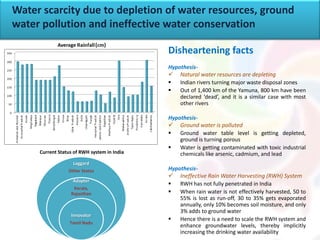
Current Status of RWH system in India
Disheartening facts
Hypothesis-
 Natural water resources are depleting
 Indian rivers turning major waste disposal zones
 Out of 1,400 km of the Yamuna, 800 km have been
declared ‘dead’, and it is a similar case with most
other rivers
Hypothesis-
 Ground water is polluted
 Ground water table level is getting depleted,
ground is turning porous
 Water is getting contaminated with toxic industrial
chemicals like arsenic, cadmium, and lead
Hypothesis-
 Ineffective Rain Water Harvesting (RWH) System
 RWH has not fully penetrated in India
 When rain water is not effectively harvested, 50 to
55% is lost as run-off, 30 to 35% gets evaporated
annually, only 10% becomes soil moisture, and only
3% adds to ground water
 Hence there is a need to scale the RWH system and
enhance groundwater levels, thereby implicitly
increasing the drinking water availability
Water scarcity due to depletion of water resources, ground
water pollution and ineffective water conservation
Laggard
Other States
Adapter
Kerala,
Rajasthan
Innovator
Tamil Nadu
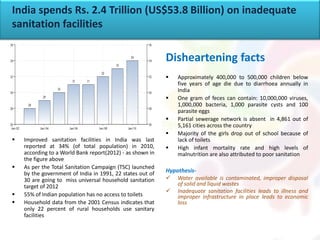
 Improved sanitation facilities in India was last
reported at 34% (of total population) in 2010,
according to a World Bank report(2012) - as shown in
the figure above
 As per the Total Sanitation Campaign (TSC) launched
by the government of India in 1991, 22 states out of
30 are going to miss universal household sanitation
target of 2012
 55% of Indian population has no access to toilets
 Household data from the 2001 Census indicates that
only 22 percent of rural households use sanitary
facilities
Disheartening facts
 Approximately 400,000 to 500,000 children below
five years of age die due to diarrhoea annually in
India
 One gram of feces can contain: 10,000,000 viruses,
1,000,000 bacteria, 1,000 parasite cysts and 100
parasite eggs
 Partial sewerage network is absent in 4,861 out of
5,161 cities across the country
 Majority of the girls drop out of school because of
lack of toilets
 High infant mortality rate and high levels of
malnutrition are also attributed to poor sanitation
Hypothesis-
 Water available is contaminated, improper disposal
of solid and liquid wastes
 Inadequate sanitation facilities leads to illness and
improper infrastructure in place leads to economic
loss
India spends Rs. 2.4 Trillion (US$53.8 Billion) on inadequate
sanitation facilities
Snapshot of Proposed Solution
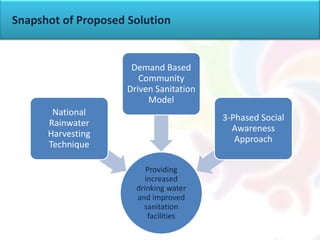
Providing
increased
drinking water
and improved
sanitation
facilities
National
Rainwater
Harvesting
Technique
Demand Based
Community
Driven Sanitation
Model
3-Phased Social
Awareness
Approach
Rainwater Harvesting Methodology Proposal
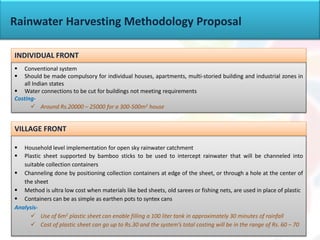
 Conventional system
 Should be made compulsory for individual houses, apartments, multi-storied building and industrial zones in
all Indian states
 Water connections to be cut for buildings not meeting requirements
Costing-
 Around Rs.20000 – 25000 for a 300-500m2 house
<Any policies?>
INDIVIDUAL FRONT
 Household level implementation for open sky rainwater catchment
 Plastic sheet supported by bamboo sticks to be used to intercept rainwater that will be channeled into
suitable collection containers
 Channeling done by positioning collection containers at edge of the sheet, or through a hole at the center of
the sheet
 Method is ultra low cost when materials like bed sheets, old sarees or fishing nets, are used in place of plastic
 Containers can be as simple as earthen pots to syntex cans
Analysis-
 Use of 6m2 plastic sheet can enable filling a 100 liter tank in approximately 30 minutes of rainfall
 Cost of plastic sheet can go up to Rs.30 and the system’s total costing will be in the range of Rs. 60 – 70
VILLAGE FRONT
Rainwater Harvesting Methodology Proposal (Contd..)
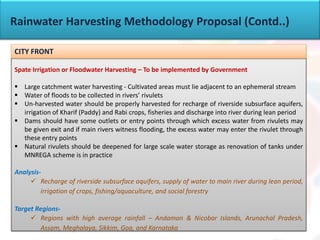
Spate Irrigation or Floodwater Harvesting – To be implemented by Government
 Large catchment water harvesting - Cultivated areas must lie adjacent to an ephemeral stream
 Water of floods to be collected in rivers’ rivulets
 Un-harvested water should be properly harvested for recharge of riverside subsurface aquifers,
irrigation of Kharif (Paddy) and Rabi crops, fisheries and discharge into river during lean period
 Dams should have some outlets or entry points through which excess water from rivulets may
be given exit and if main rivers witness flooding, the excess water may enter the rivulet through
these entry points
 Natural rivulets should be deepened for large scale water storage as renovation of tanks under
MNREGA scheme is in practice
Analysis-
 Recharge of riverside subsurface aquifers, supply of water to main river during lean period,
irrigation of crops, fishing/aquaculture, and social forestry
Target Regions-
 Regions with high average rainfall – Andaman & Nicobar Islands, Arunachal Pradesh,
Assam, Meghalaya, Sikkim, Goa, and Karnataka
CITY FRONT
 City level household projects will be funded by
loans from financial institutions
 Revolving loan funds and smart subsidies to be
arranged in association with Micro Finance
Institutions, banks and social investors
 Liaising will be done through private bodies and
NGOs
 Water credit system can be introduced where
apartments are given ratings of the range 1 – 10
based on water saving level
 Subsidies on water taxes can be given out based
on the ratings
 Water Credit system is already being successfully
implemented in UK and Thailand
 Water is getting contaminated with toxic
industrial chemicals like arsenic, cadmium, and
lead
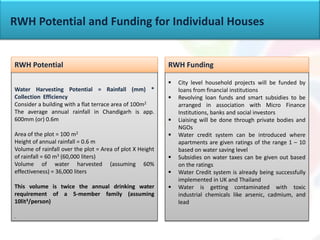
Water Harvesting Potential = Rainfall (mm) *
Collection Efficiency
Consider a building with a flat terrace area of 100m2
The average annual rainfall in Chandigarh is app.
600mm (or) 0.6m
Area of the plot = 100 m2
Height of annual rainfall = 0.6 m
Volume of rainfall over the plot = Area of plot X Height
of rainfall = 60 m3 (60,000 liters)
Volume of water harvested (assuming 60%
effectiveness) = 36,000 liters
This volume is twice the annual drinking water
requirement of a 5-member family (assuming
10lit3/person)
.
RWH Potential RWH Funding
RWH Potential and Funding for Individual Houses
Sanitation Improvement Measures
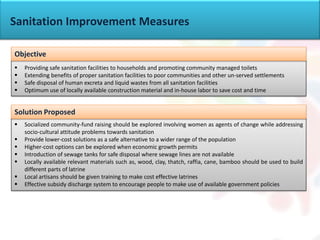
 Providing safe sanitation facilities to households and promoting community managed toilets
 Extending benefits of proper sanitation facilities to poor communities and other un-served settlements
 Safe disposal of human excreta and liquid wastes from all sanitation facilities
 Optimum use of locally available construction material and in-house labor to save cost and time
<Any policies?>
Objective
 Socialized community-fund raising should be explored involving women as agents of change while addressing
socio-cultural attitude problems towards sanitation
 Provide lower-cost solutions as a safe alternative to a wider range of the population
 Higher-cost options can be explored when economic growth permits
 Introduction of sewage tanks for safe disposal where sewage lines are not available
 Locally available relevant materials such as, wood, clay, thatch, raffia, cane, bamboo should be used to build
different parts of latrine
 Local artisans should be given training to make cost effective latrines
 Effective subsidy discharge system to encourage people to make use of available government policies
Solution Proposed
Sanitation Improvement – Implementation Plan
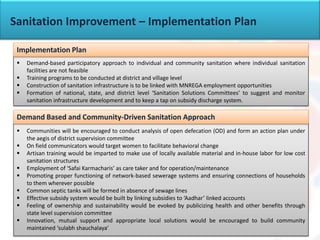
 Demand-based participatory approach to individual and community sanitation where individual sanitation
facilities are not feasible
 Training programs to be conducted at district and village level
 Construction of sanitation infrastructure is to be linked with MNREGA employment opportunities
 Formation of national, state, and district level ‘Sanitation Solutions Committees’ to suggest and monitor
sanitation infrastructure development and to keep a tap on subsidy discharge system.
<Any policies?>
Implementation Plan
 Communities will be encouraged to conduct analysis of open defecation (OD) and form an action plan under
the aegis of district supervision committee
 On field communicators would target women to facilitate behavioral change
 Artisan training would be imparted to make use of locally available material and in-house labor for low cost
sanitation structures
 Employment of ‘Safai Karmacharis’ as care taker and for operation/maintenance
 Promoting proper functioning of network-based sewerage systems and ensuring connections of households
to them wherever possible
 Common septic tanks will be formed in absence of sewage lines
 Effective subsidy system would be built by linking subsidies to ‘Aadhar’ linked accounts
 Feeling of ownership and sustainability would be evoked by publicizing health and other benefits through
state level supervision committee
 Innovation, mutual support and appropriate local solutions would be encouraged to build community
maintained ‘sulabh shauchalaya’
Demand Based and Community-Driven Sanitation Approach
Challenges and Mitigation Factors
<Any policies?>
 Acceptability: It is difficult to convince communities to
shell out money for sanitation when they have other
essentials to consider such as, food, education and health
 Build Trust: It is becoming hard to trust on subsidy
discharge system after some default cases
 Technology: Limited technology availability makes it
difficult to provide a wide range of price affordable latrine
 Lack of knowledge: Communities fail to link health and
other benefits due to lack of knowledge
Challenges
National level Supervision Committee
State level Supervision Committee
District level Supervision Committee
Training Supervision Committee
On field communicators
Organizational Structure
<Any policies?>
 Providing sanitation facilities has become one the top
priorities for every government
 Increasing support from international bodies
 Wider participation of communities
Mitigation Factors
PHASE 1
Awareness raising
•Raise visibility of
the importance of
good sanitation and
hygiene behaviors
•Increase awareness
of the benefits of
Rainwater
harvesting (RWH)
and how it’s the
way going forward
PHASE 2
Promotion
•To provide
influencers and
decision makers
with the
information they
need, encourage
them to speak up
take action for
positive change
•Get Support &
create an enabling
environment for
change
PHASE 3
Dynamics of Change
•To empower
individuals and
families to make
decisions based on
correct information
•Stigmatize risky
practices, promote
healthy norms and
practices
•Promote RWH and
demand driven
sanitation as a key
to future
generations
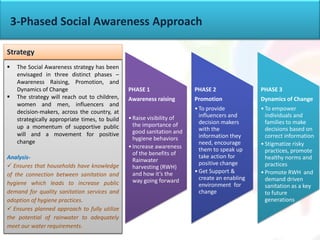
 The Social Awareness strategy has been
envisaged in three distinct phases –
Awareness Raising, Promotion, and
Dynamics of Change
 The strategy will reach out to children,
women and men, influencers and
decision-makers, across the country, at
strategically appropriate times, to build
up a momentum of supportive public
will and a movement for positive
change
Analysis-
 Ensures that households have knowledge
of the connection between sanitation and
hygiene which leads to increase public
demand for quality sanitation services and
adoption of hygiene practices.
 Ensures planned approach to fully utilize
the potential of rainwater to adequately
meet our water requirements.
Strategy
3-Phased Social Awareness Approach
• The Political Economy of Sanitation – WSP
• Open Sky Rainwater Harvesting – United Nations Environment
Programme
• EPA United States Environmental Protection Agency - Rainwater
Harvesting Case Studies
• Use of Rainwater Harvesting System – Environment Agency
• An overview of status of drinking water and sanitation in schools in
India
• National urban sanitation policy Ministry of Urban Development
Government of India
• Creating acceptable, affordable and appropriate sanitation options
for rural areas B. A. Darteh & E. K. Appiah, Ghana
• Household Water Delivery Options in Urban and Rural India by
David McKenzie* and Isha Ray
References

Kozhikode-Kautilyas

  • 1.
    Team- KOZHIKODE KAUTILYAS Aashirwad Bomboriya AnupamaPrakash Pankaj Singh Bhati Ojasvita Parate Sandesh Patil Scaling Existing Technologies for a Cleaner and Water-Rich India Manthan Topic: Providing Clean Drinking Water and Proper Sanitation Facility to All
  • 2.
    Current Status ofRWH system in India Disheartening facts Hypothesis-  Natural water resources are depleting  Indian rivers turning major waste disposal zones  Out of 1,400 km of the Yamuna, 800 km have been declared ‘dead’, and it is a similar case with most other rivers Hypothesis-  Ground water is polluted  Ground water table level is getting depleted, ground is turning porous  Water is getting contaminated with toxic industrial chemicals like arsenic, cadmium, and lead Hypothesis-  Ineffective Rain Water Harvesting (RWH) System  RWH has not fully penetrated in India  When rain water is not effectively harvested, 50 to 55% is lost as run-off, 30 to 35% gets evaporated annually, only 10% becomes soil moisture, and only 3% adds to ground water  Hence there is a need to scale the RWH system and enhance groundwater levels, thereby implicitly increasing the drinking water availability Water scarcity due to depletion of water resources, ground water pollution and ineffective water conservation Laggard Other States Adapter Kerala, Rajasthan Innovator Tamil Nadu
  • 3.
     Improved sanitationfacilities in India was last reported at 34% (of total population) in 2010, according to a World Bank report(2012) - as shown in the figure above  As per the Total Sanitation Campaign (TSC) launched by the government of India in 1991, 22 states out of 30 are going to miss universal household sanitation target of 2012  55% of Indian population has no access to toilets  Household data from the 2001 Census indicates that only 22 percent of rural households use sanitary facilities Disheartening facts  Approximately 400,000 to 500,000 children below five years of age die due to diarrhoea annually in India  One gram of feces can contain: 10,000,000 viruses, 1,000,000 bacteria, 1,000 parasite cysts and 100 parasite eggs  Partial sewerage network is absent in 4,861 out of 5,161 cities across the country  Majority of the girls drop out of school because of lack of toilets  High infant mortality rate and high levels of malnutrition are also attributed to poor sanitation Hypothesis-  Water available is contaminated, improper disposal of solid and liquid wastes  Inadequate sanitation facilities leads to illness and improper infrastructure in place leads to economic loss India spends Rs. 2.4 Trillion (US$53.8 Billion) on inadequate sanitation facilities
  • 4.
    Snapshot of ProposedSolution Providing increased drinking water and improved sanitation facilities National Rainwater Harvesting Technique Demand Based Community Driven Sanitation Model 3-Phased Social Awareness Approach
  • 5.
    Rainwater Harvesting MethodologyProposal  Conventional system  Should be made compulsory for individual houses, apartments, multi-storied building and industrial zones in all Indian states  Water connections to be cut for buildings not meeting requirements Costing-  Around Rs.20000 – 25000 for a 300-500m2 house <Any policies?> INDIVIDUAL FRONT  Household level implementation for open sky rainwater catchment  Plastic sheet supported by bamboo sticks to be used to intercept rainwater that will be channeled into suitable collection containers  Channeling done by positioning collection containers at edge of the sheet, or through a hole at the center of the sheet  Method is ultra low cost when materials like bed sheets, old sarees or fishing nets, are used in place of plastic  Containers can be as simple as earthen pots to syntex cans Analysis-  Use of 6m2 plastic sheet can enable filling a 100 liter tank in approximately 30 minutes of rainfall  Cost of plastic sheet can go up to Rs.30 and the system’s total costing will be in the range of Rs. 60 – 70 VILLAGE FRONT
  • 6.
    Rainwater Harvesting MethodologyProposal (Contd..) Spate Irrigation or Floodwater Harvesting – To be implemented by Government  Large catchment water harvesting - Cultivated areas must lie adjacent to an ephemeral stream  Water of floods to be collected in rivers’ rivulets  Un-harvested water should be properly harvested for recharge of riverside subsurface aquifers, irrigation of Kharif (Paddy) and Rabi crops, fisheries and discharge into river during lean period  Dams should have some outlets or entry points through which excess water from rivulets may be given exit and if main rivers witness flooding, the excess water may enter the rivulet through these entry points  Natural rivulets should be deepened for large scale water storage as renovation of tanks under MNREGA scheme is in practice Analysis-  Recharge of riverside subsurface aquifers, supply of water to main river during lean period, irrigation of crops, fishing/aquaculture, and social forestry Target Regions-  Regions with high average rainfall – Andaman & Nicobar Islands, Arunachal Pradesh, Assam, Meghalaya, Sikkim, Goa, and Karnataka CITY FRONT
  • 7.
     City levelhousehold projects will be funded by loans from financial institutions  Revolving loan funds and smart subsidies to be arranged in association with Micro Finance Institutions, banks and social investors  Liaising will be done through private bodies and NGOs  Water credit system can be introduced where apartments are given ratings of the range 1 – 10 based on water saving level  Subsidies on water taxes can be given out based on the ratings  Water Credit system is already being successfully implemented in UK and Thailand  Water is getting contaminated with toxic industrial chemicals like arsenic, cadmium, and lead Water Harvesting Potential = Rainfall (mm) * Collection Efficiency Consider a building with a flat terrace area of 100m2 The average annual rainfall in Chandigarh is app. 600mm (or) 0.6m Area of the plot = 100 m2 Height of annual rainfall = 0.6 m Volume of rainfall over the plot = Area of plot X Height of rainfall = 60 m3 (60,000 liters) Volume of water harvested (assuming 60% effectiveness) = 36,000 liters This volume is twice the annual drinking water requirement of a 5-member family (assuming 10lit3/person) . RWH Potential RWH Funding RWH Potential and Funding for Individual Houses
  • 8.
    Sanitation Improvement Measures Providing safe sanitation facilities to households and promoting community managed toilets  Extending benefits of proper sanitation facilities to poor communities and other un-served settlements  Safe disposal of human excreta and liquid wastes from all sanitation facilities  Optimum use of locally available construction material and in-house labor to save cost and time <Any policies?> Objective  Socialized community-fund raising should be explored involving women as agents of change while addressing socio-cultural attitude problems towards sanitation  Provide lower-cost solutions as a safe alternative to a wider range of the population  Higher-cost options can be explored when economic growth permits  Introduction of sewage tanks for safe disposal where sewage lines are not available  Locally available relevant materials such as, wood, clay, thatch, raffia, cane, bamboo should be used to build different parts of latrine  Local artisans should be given training to make cost effective latrines  Effective subsidy discharge system to encourage people to make use of available government policies Solution Proposed
  • 9.
    Sanitation Improvement –Implementation Plan  Demand-based participatory approach to individual and community sanitation where individual sanitation facilities are not feasible  Training programs to be conducted at district and village level  Construction of sanitation infrastructure is to be linked with MNREGA employment opportunities  Formation of national, state, and district level ‘Sanitation Solutions Committees’ to suggest and monitor sanitation infrastructure development and to keep a tap on subsidy discharge system. <Any policies?> Implementation Plan  Communities will be encouraged to conduct analysis of open defecation (OD) and form an action plan under the aegis of district supervision committee  On field communicators would target women to facilitate behavioral change  Artisan training would be imparted to make use of locally available material and in-house labor for low cost sanitation structures  Employment of ‘Safai Karmacharis’ as care taker and for operation/maintenance  Promoting proper functioning of network-based sewerage systems and ensuring connections of households to them wherever possible  Common septic tanks will be formed in absence of sewage lines  Effective subsidy system would be built by linking subsidies to ‘Aadhar’ linked accounts  Feeling of ownership and sustainability would be evoked by publicizing health and other benefits through state level supervision committee  Innovation, mutual support and appropriate local solutions would be encouraged to build community maintained ‘sulabh shauchalaya’ Demand Based and Community-Driven Sanitation Approach
  • 10.
    Challenges and MitigationFactors <Any policies?>  Acceptability: It is difficult to convince communities to shell out money for sanitation when they have other essentials to consider such as, food, education and health  Build Trust: It is becoming hard to trust on subsidy discharge system after some default cases  Technology: Limited technology availability makes it difficult to provide a wide range of price affordable latrine  Lack of knowledge: Communities fail to link health and other benefits due to lack of knowledge Challenges National level Supervision Committee State level Supervision Committee District level Supervision Committee Training Supervision Committee On field communicators Organizational Structure <Any policies?>  Providing sanitation facilities has become one the top priorities for every government  Increasing support from international bodies  Wider participation of communities Mitigation Factors
  • 11.
    PHASE 1 Awareness raising •Raisevisibility of the importance of good sanitation and hygiene behaviors •Increase awareness of the benefits of Rainwater harvesting (RWH) and how it’s the way going forward PHASE 2 Promotion •To provide influencers and decision makers with the information they need, encourage them to speak up take action for positive change •Get Support & create an enabling environment for change PHASE 3 Dynamics of Change •To empower individuals and families to make decisions based on correct information •Stigmatize risky practices, promote healthy norms and practices •Promote RWH and demand driven sanitation as a key to future generations  The Social Awareness strategy has been envisaged in three distinct phases – Awareness Raising, Promotion, and Dynamics of Change  The strategy will reach out to children, women and men, influencers and decision-makers, across the country, at strategically appropriate times, to build up a momentum of supportive public will and a movement for positive change Analysis-  Ensures that households have knowledge of the connection between sanitation and hygiene which leads to increase public demand for quality sanitation services and adoption of hygiene practices.  Ensures planned approach to fully utilize the potential of rainwater to adequately meet our water requirements. Strategy 3-Phased Social Awareness Approach
  • 12.
    • The PoliticalEconomy of Sanitation – WSP • Open Sky Rainwater Harvesting – United Nations Environment Programme • EPA United States Environmental Protection Agency - Rainwater Harvesting Case Studies • Use of Rainwater Harvesting System – Environment Agency • An overview of status of drinking water and sanitation in schools in India • National urban sanitation policy Ministry of Urban Development Government of India • Creating acceptable, affordable and appropriate sanitation options for rural areas B. A. Darteh & E. K. Appiah, Ghana • Household Water Delivery Options in Urban and Rural India by David McKenzie* and Isha Ray References