Noah Mundt
Senior Program Manager
Energy and Environmental Solutions;
Siemens Industry Inc.
Jim Dodenhoff,
Regional Business Development Director,
IPERC
WASTEWATER TREATMENT PLANTS:
ENHANCING THE WATER/ENERGY NEXUS
AT THE MOST CRITICAL POINT
Where we’ve been
in previous research
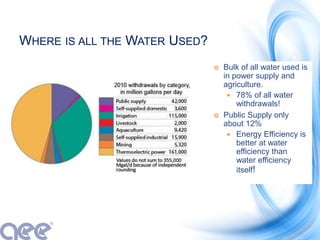
WHERE IS ALL THE WATER USED?
 Bulk of all water used is
in power supply and
agriculture.
 78% of all water
withdrawals!
 Public Supply only
about 12%
 Energy Efficiency is
better at water
efficiency than
water efficiency
itself!
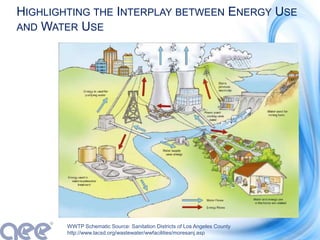
HIGHLIGHTING THE INTERPLAY BETWEEN ENERGY USE
AND WATER USE
WWTP Schematic Source: Sanitation Districts of Los Angeles County
http://www.lacsd.org/wastewater/wwfacilities/moresanj.asp
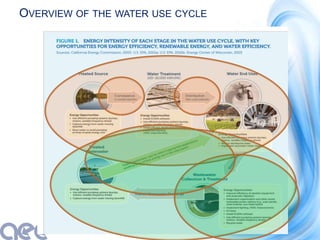
OVERVIEW OF THE WATER USE CYCLE
An Overview of the
U.S. WWTP Industry
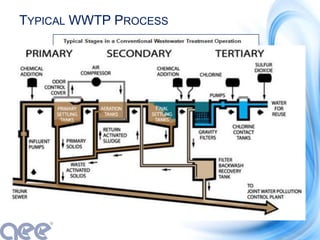
TYPICAL WWTP PROCESS
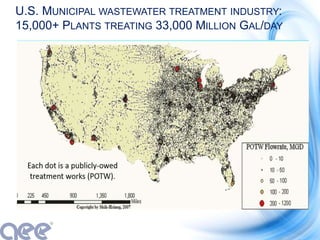
U.S. MUNICIPAL WASTEWATER TREATMENT INDUSTRY:
15,000+ PLANTS TREATING 33,000 MILLION GAL/DAY
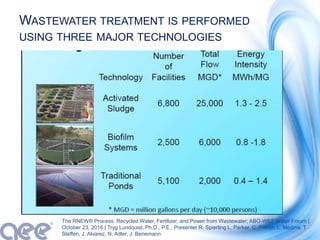
WASTEWATER TREATMENT IS PERFORMED
USING THREE MAJOR TECHNOLOGIES
The RNEW® Process: Recycled Water, Fertilizer, and Power from Wastewater; ABO-WEF Water Forum |
October 23, 2016 | Tryg Lundquist, Ph.D., P.E., Presenter R. Spierling L. Parker, C. Pittner, L. Medina, T.
Steffen, J. Alvarez, N. Adler, J. Benemann
KEY REGULATORY DRIVER FOR WWTP
RELATES TO QUALITY OF DISCHARGE
WWTP’s: Energy Use, Energy
Intensity, and Energy Resiliency
WWTP ENERGY LOAD PROFILES
Source: Opportunities for Energy Efficiency and Open Automated Demand Response in Wastewater Treatment Facilities in
California – Phase I Report; Lawrence Berkeley National Lab; A. Lekov, L. Thompson, A. McKane, K. Song, M.A. Piette;
2009
TYPICAL ENERGY USE IN WASTEWATER TREATMENT
PLANTS
Source: Hazen & Sawyer, Electricity Use and Management in the Municipal Water
Supply and Wastewater Industries; Water Research Foundation and EPRI;
November 2013
ENERGY USE INTENSITY AT WWTP’S
Source: U.S. EPA, Energy Star Portfolio Manager; Energy
Use in Wastewater Treatment Plants; January 2015
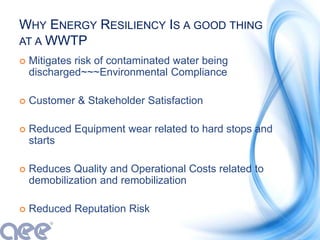
WHY ENERGY RESILIENCY IS A GOOD THING
AT A WWTP
 Mitigates risk of contaminated water being
discharged~~~Environmental Compliance
 Customer & Stakeholder Satisfaction
 Reduced Equipment wear related to hard stops and
starts
 Reduces Quality and Operational Costs related to
demobilization and remobilization
 Reduced Reputation Risk
Bio-treatment: An Opportunity to
Enhance the Water Energy-Nexus
BIOLOGICAL TREATMENT WITH ALGAE
Nutrients
• From
Nitrogen and
Phosphorous
Carbon
Capture • As CO2
Energy
• From
Sunlight
Oxygen
• Produced as
a waste
product
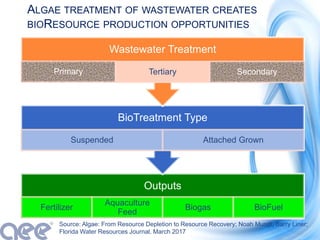
ALGAE TREATMENT OF WASTEWATER CREATES
BIORESOURCE PRODUCTION OPPORTUNITIES
Source: Algae: From Resource Depletion to Resource Recovery; Noah Mundt, Barry Liner;
Florida Water Resources Journal, March 2017
Outputs
Fertilizer
Aquaculture
Feed
Biogas BioFuel
BioTreatment Type
Suspended Attached Grown
Wastewater Treatment
Primary Tertiary SecondarySecondary
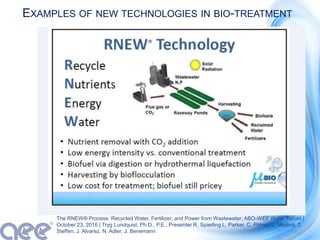
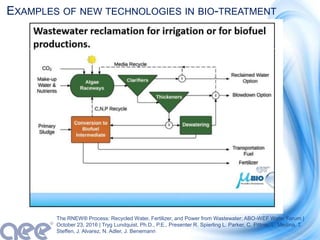
EXAMPLES OF NEW TECHNOLOGIES IN BIO-TREATMENT
The RNEW® Process: Recycled Water, Fertilizer, and Power from Wastewater; ABO-WEF Water Forum |
October 23, 2016 | Tryg Lundquist, Ph.D., P.E., Presenter R. Spierling L. Parker, C. Pittner, L. Medina, T.
Steffen, J. Alvarez, N. Adler, J. Benemann
EXAMPLES OF NEW TECHNOLOGIES IN BIO-TREATMENT
The RNEW® Process: Recycled Water, Fertilizer, and Power from Wastewater; ABO-WEF Water Forum |
October 23, 2016 | Tryg Lundquist, Ph.D., P.E., Presenter R. Spierling L. Parker, C. Pittner, L. Medina, T.
Steffen, J. Alvarez, N. Adler, J. Benemann
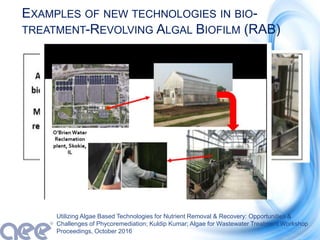
EXAMPLES OF NEW TECHNOLOGIES IN BIO-
TREATMENT-REVOLVING ALGAL BIOFILM (RAB)
Utilizing Algae Based Technologies for Nutrient Removal & Recovery: Opportunities &
Challenges of Phycoremediation; Kuldip Kumar; Algae for Wastewater Treatment Workshop
Proceedings, October 2016
WHY TRENDS IN BIO-TREATMENT CREATE
VALUE OPPORTUNITIES
The RNEW® Process: Recycled Water, Fertilizer, and Power from Wastewater; ABO-WEF Water Forum |
October 23, 2016 | Tryg Lundquist, Ph.D., P.E., Presenter R. Spierling L. Parker, C. Pittner, L. Medina, T.
Steffen, J. Alvarez, N. Adler, J. Benemann
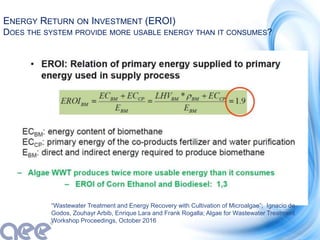
ENERGY RETURN ON INVESTMENT (EROI)
DOES THE SYSTEM PROVIDE MORE USABLE ENERGY THAN IT CONSUMES?
 Noah Lead
“Wastewater Treatment and Energy Recovery with Cultivation of Microalgae”; Ignacio de
Godos, Zouhayr Arbib, Enrique Lara and Frank Rogalla; Algae for Wastewater Treatment
Workshop Proceedings, October 2016
Benefits of On-Site Renewables &
Storage Technologies
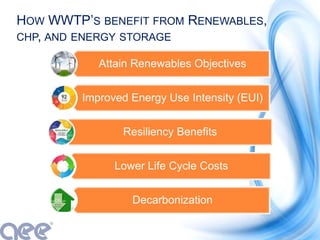
HOW WWTP’S BENEFIT FROM RENEWABLES,
CHP, AND ENERGY STORAGE
Attain Renewables Objectives
Improved Energy Use Intensity (EUI)
Resiliency Benefits
Lower Life Cycle Costs
Decarbonization
Beneficial Use of
Treated Wastewater
ISN’T BENEFICIAL WATER REUSE AT THE HEART OF
THE WATER ENERGY NEXUS
WWTPRaw
Sewage
BioGas
BioFuels
Fertilizer
Compost
Feedstock
On-Site
Water
Reuse
Off-Site
Water
Reuse
Evaporation
Aquifer
Recharge
Surface
Water
Recharge
(Freshwater)
Saltwater
Discharge
X
Produced
Consistently, at
Required Quality
Levels
How Consideration of WWTP
Water-Energy Nexus Addresses
Barriers and Challenges
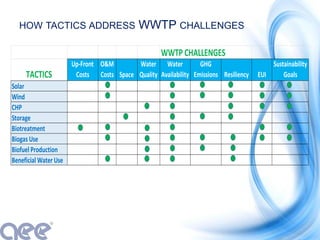
HOW TACTICS ADDRESS WWTP CHALLENGES
WWTP CHALLENGES
TACTICS
Up-Front
Costs
O&M
Costs Space
Water
Quality
Water
Availability
GHG
Emissions Resiliency EUI
Sustainability
Goals
Solar
Wind
CHP
Storage
Biotreatment
Biogas Use
Biofuel Production
Beneficial Water Use
RECOMMENDATIONS FOR CONTINUING TO UNLOCK
WATER-ENERGY NEXUS BENEFITS
1. Broader Use of Biotreatment Wastewater processing
2. Increased adoption of on-site renewables, storage, and
combined heat and power (CHP) modules
3. Environmental Regulatory Policy that recognizes biogas,
biofuels, and algae products as renewables
4. Greater Beneficial Use of Treated Wastewater
5. International Technology Transfer
RECOMMENDATIONS CONTINUED:
ACT LOCALLY, THINK GLOBALLY
 1.8 Billion people globally consume contaminated drinking
water
 In low income countries only 8% of wastewater is treated
 Water Scarcity affects more than 40% of world population
 > 40 Countries are “water stressed”
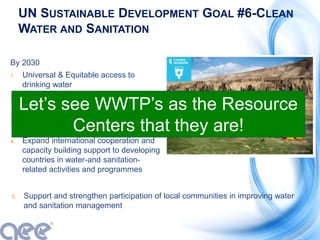
UN SUSTAINABLE DEVELOPMENT GOAL #6-CLEAN
WATER AND SANITATION
By 2030
1. Universal & Equitable access to
drinking water
2. Access to adequate and equitable
sanitation and hygiene for all
3. Halve proportion of untreated
wastewater
4. Expand international cooperation and
capacity building support to developing
countries in water-and sanitation-
related activities and programmes
5. Support and strengthen participation of local communities in improving water
and sanitation management
Let’s see WWTP’s as the Resource
Centers that they are!
THANK YOU!
CONTACT INFO:
Noah Mundt
Noah.Mundt@siemens.com
920-737-8154
Jim Dodenhoff
Jim.Dodenhoff@iperc.com
310-936-9456

2017 wwtp presentation y20170524 final linkedinnonotes

  • 1.
    Noah Mundt Senior ProgramManager Energy and Environmental Solutions; Siemens Industry Inc. Jim Dodenhoff, Regional Business Development Director, IPERC WASTEWATER TREATMENT PLANTS: ENHANCING THE WATER/ENERGY NEXUS AT THE MOST CRITICAL POINT
  • 2.
    Where we’ve been inprevious research
  • 3.
    WHERE IS ALLTHE WATER USED?  Bulk of all water used is in power supply and agriculture.  78% of all water withdrawals!  Public Supply only about 12%  Energy Efficiency is better at water efficiency than water efficiency itself!
  • 4.
    HIGHLIGHTING THE INTERPLAYBETWEEN ENERGY USE AND WATER USE WWTP Schematic Source: Sanitation Districts of Los Angeles County http://www.lacsd.org/wastewater/wwfacilities/moresanj.asp
  • 5.
    OVERVIEW OF THEWATER USE CYCLE
  • 6.
    An Overview ofthe U.S. WWTP Industry
  • 7.
  • 8.
    U.S. MUNICIPAL WASTEWATERTREATMENT INDUSTRY: 15,000+ PLANTS TREATING 33,000 MILLION GAL/DAY
  • 9.
    WASTEWATER TREATMENT ISPERFORMED USING THREE MAJOR TECHNOLOGIES The RNEW® Process: Recycled Water, Fertilizer, and Power from Wastewater; ABO-WEF Water Forum | October 23, 2016 | Tryg Lundquist, Ph.D., P.E., Presenter R. Spierling L. Parker, C. Pittner, L. Medina, T. Steffen, J. Alvarez, N. Adler, J. Benemann
  • 10.
    KEY REGULATORY DRIVERFOR WWTP RELATES TO QUALITY OF DISCHARGE
  • 11.
    WWTP’s: Energy Use,Energy Intensity, and Energy Resiliency
  • 12.
    WWTP ENERGY LOADPROFILES Source: Opportunities for Energy Efficiency and Open Automated Demand Response in Wastewater Treatment Facilities in California – Phase I Report; Lawrence Berkeley National Lab; A. Lekov, L. Thompson, A. McKane, K. Song, M.A. Piette; 2009
  • 13.
    TYPICAL ENERGY USEIN WASTEWATER TREATMENT PLANTS Source: Hazen & Sawyer, Electricity Use and Management in the Municipal Water Supply and Wastewater Industries; Water Research Foundation and EPRI; November 2013
  • 14.
    ENERGY USE INTENSITYAT WWTP’S Source: U.S. EPA, Energy Star Portfolio Manager; Energy Use in Wastewater Treatment Plants; January 2015
  • 15.
    WHY ENERGY RESILIENCYIS A GOOD THING AT A WWTP  Mitigates risk of contaminated water being discharged~~~Environmental Compliance  Customer & Stakeholder Satisfaction  Reduced Equipment wear related to hard stops and starts  Reduces Quality and Operational Costs related to demobilization and remobilization  Reduced Reputation Risk
  • 16.
    Bio-treatment: An Opportunityto Enhance the Water Energy-Nexus
  • 17.
    BIOLOGICAL TREATMENT WITHALGAE Nutrients • From Nitrogen and Phosphorous Carbon Capture • As CO2 Energy • From Sunlight Oxygen • Produced as a waste product
  • 18.
    ALGAE TREATMENT OFWASTEWATER CREATES BIORESOURCE PRODUCTION OPPORTUNITIES Source: Algae: From Resource Depletion to Resource Recovery; Noah Mundt, Barry Liner; Florida Water Resources Journal, March 2017 Outputs Fertilizer Aquaculture Feed Biogas BioFuel BioTreatment Type Suspended Attached Grown Wastewater Treatment Primary Tertiary SecondarySecondary
  • 19.
    EXAMPLES OF NEWTECHNOLOGIES IN BIO-TREATMENT The RNEW® Process: Recycled Water, Fertilizer, and Power from Wastewater; ABO-WEF Water Forum | October 23, 2016 | Tryg Lundquist, Ph.D., P.E., Presenter R. Spierling L. Parker, C. Pittner, L. Medina, T. Steffen, J. Alvarez, N. Adler, J. Benemann
  • 20.
    EXAMPLES OF NEWTECHNOLOGIES IN BIO-TREATMENT The RNEW® Process: Recycled Water, Fertilizer, and Power from Wastewater; ABO-WEF Water Forum | October 23, 2016 | Tryg Lundquist, Ph.D., P.E., Presenter R. Spierling L. Parker, C. Pittner, L. Medina, T. Steffen, J. Alvarez, N. Adler, J. Benemann
  • 21.
    EXAMPLES OF NEWTECHNOLOGIES IN BIO- TREATMENT-REVOLVING ALGAL BIOFILM (RAB) Utilizing Algae Based Technologies for Nutrient Removal & Recovery: Opportunities & Challenges of Phycoremediation; Kuldip Kumar; Algae for Wastewater Treatment Workshop Proceedings, October 2016
  • 22.
    WHY TRENDS INBIO-TREATMENT CREATE VALUE OPPORTUNITIES The RNEW® Process: Recycled Water, Fertilizer, and Power from Wastewater; ABO-WEF Water Forum | October 23, 2016 | Tryg Lundquist, Ph.D., P.E., Presenter R. Spierling L. Parker, C. Pittner, L. Medina, T. Steffen, J. Alvarez, N. Adler, J. Benemann
  • 23.
    ENERGY RETURN ONINVESTMENT (EROI) DOES THE SYSTEM PROVIDE MORE USABLE ENERGY THAN IT CONSUMES?  Noah Lead “Wastewater Treatment and Energy Recovery with Cultivation of Microalgae”; Ignacio de Godos, Zouhayr Arbib, Enrique Lara and Frank Rogalla; Algae for Wastewater Treatment Workshop Proceedings, October 2016
  • 24.
    Benefits of On-SiteRenewables & Storage Technologies
  • 25.
    HOW WWTP’S BENEFITFROM RENEWABLES, CHP, AND ENERGY STORAGE Attain Renewables Objectives Improved Energy Use Intensity (EUI) Resiliency Benefits Lower Life Cycle Costs Decarbonization
  • 26.
  • 27.
    ISN’T BENEFICIAL WATERREUSE AT THE HEART OF THE WATER ENERGY NEXUS WWTPRaw Sewage BioGas BioFuels Fertilizer Compost Feedstock On-Site Water Reuse Off-Site Water Reuse Evaporation Aquifer Recharge Surface Water Recharge (Freshwater) Saltwater Discharge X Produced Consistently, at Required Quality Levels
  • 28.
    How Consideration ofWWTP Water-Energy Nexus Addresses Barriers and Challenges
  • 29.
    HOW TACTICS ADDRESSWWTP CHALLENGES WWTP CHALLENGES TACTICS Up-Front Costs O&M Costs Space Water Quality Water Availability GHG Emissions Resiliency EUI Sustainability Goals Solar Wind CHP Storage Biotreatment Biogas Use Biofuel Production Beneficial Water Use
  • 30.
    RECOMMENDATIONS FOR CONTINUINGTO UNLOCK WATER-ENERGY NEXUS BENEFITS 1. Broader Use of Biotreatment Wastewater processing 2. Increased adoption of on-site renewables, storage, and combined heat and power (CHP) modules 3. Environmental Regulatory Policy that recognizes biogas, biofuels, and algae products as renewables 4. Greater Beneficial Use of Treated Wastewater 5. International Technology Transfer
  • 31.
    RECOMMENDATIONS CONTINUED: ACT LOCALLY,THINK GLOBALLY  1.8 Billion people globally consume contaminated drinking water  In low income countries only 8% of wastewater is treated  Water Scarcity affects more than 40% of world population  > 40 Countries are “water stressed”
  • 32.
    UN SUSTAINABLE DEVELOPMENTGOAL #6-CLEAN WATER AND SANITATION By 2030 1. Universal & Equitable access to drinking water 2. Access to adequate and equitable sanitation and hygiene for all 3. Halve proportion of untreated wastewater 4. Expand international cooperation and capacity building support to developing countries in water-and sanitation- related activities and programmes 5. Support and strengthen participation of local communities in improving water and sanitation management Let’s see WWTP’s as the Resource Centers that they are!
  • 33.
    THANK YOU! CONTACT INFO: NoahMundt Noah.Mundt@siemens.com 920-737-8154 Jim Dodenhoff Jim.Dodenhoff@iperc.com 310-936-9456

Editor's Notes

  • #4 Our past research focused broadly on the Water Energy Nexus-----with particular focus on the linkage between energy conservation and water conservation measures at Water Distribution facilities. We also noted that the Water-Energy Nexus quickly becomes a three-legged stool as it is virtually impossible to discuss water without also discussing food. In California, agriculture comprises X% of overall water consumption. In Arizona, agriculture comprises Y% of the overall water consumption.
  • #5 Over the past 3 decades, water conservation and energy efficiency have been concurrently operating at achieving their specific goals while symbiotically achieving the goals of the other. Water Savings = Energy Savings and Energy Savings = Water Savings This schematic demonstrates the interplay of water flows and energy flows. (Blue Arrows Water, Red Arrow Energy) EPA estimates 3-4 percent of national electricity consumption, equivalent to approximately 56 billion kilowatts (kW), or $4 billion, is used in providing drinking water and wastewater services each year. -Water and wastewater utilities are typically the largest consumers of energy in municipalities, often accounting for 30-40 percent of total energy consumed.
  • #6 Our initial research focused on Water Distribution Systems, and what we determined was that a Systems Approach was critical to understanding Water Distribution Systems and that the greatest opportunity for energy-water savings was in conveyance of supply and distribution of of treated water to end uses. Today’s presentation focuses broadly on Wastewater Treatment and the opportunities for Energy and Water Conservation. We also take a peek at the importance of factoring in the beneficial use of treated wastewater.
  • #8 At a high level, Wastewater Treatment has three primary objectives Remove pathogens that could be dangerous to drinking water Remove Nutrients (namely Phosphorus and Nitrogen) that could result in algae accumulation Remove organics that contribute to low dissolved oxygen levels in water Pause at the Primary, Secondary, Tertiary Graphic………. This type of process, which is the most widely used in the industry, has many mechanical elementss: Pumps, mechanical aerators, blowers, diffusers, compressors, filters, and tanks. It also speaks to a paradigm where “dirty wastewater’ is “treated” primarily through addition of “cleaning chemicals” to “remove” the bad stuff and bad smells…..with the end product being cleaned water and “sludge” which might require additional treatment…………a Wastewater Treatment Plant. We’ll come back to this “old paradigm”.
  • #9  *From EPA-This is # of Facilities that treat domestic wastewater from residential and commercial establishments …..an additional 500+in older cities and major urban areas collect rainwater in the same pipes as domestic wastewater 15,000 + WWTP facilities in the U.S.* Total flow of 33,000 MM Gallons/day Serve 75% of U.S. Population Vast Majority of WWTP’s publicly owned WWTP Electricity Use 1-2% of Total U.S. consumption Energy Use can range from 20-40% of the overall cost to operate a WWTP WWTP Energy Costs key driver for muni/county budgets----a potential “budget breaker”
  • #10 -Provide a brief overview of each Major Technology -Note differences in Energy Intensity
  • #11 40 CFR Part 503 for Biosolids………..(also applicable to algae solids from Wastewater Treatment) -Minimum national requirements applicable to the use/disposal of sewage sludge -Part 503 includes, for Class A and Class B -Sewage Sludge quality limits - Management practice requirements -Monitoring/Recordkeeping/Reporting Requirements -Additional State, local requirements --Applicable to algae solids from Wastewater
  • #13 “Typical” Energy Use Daily Cycle for WWTP roughly corresponds to timing of water use, although there can be delays based upon the distance between the collection system and the WWTP. Notable that Energy Load Profile for WWTP doesn’t necessarily correspond to energy profile of utility….might be interesting to have an overlay slide which I’ll pull together.
  • #19 Noah, Please confirm that most Biotreatment is applied at the Tertiary Stage
  • #22 Features & Advantages Inexpensive Harvest Efficient Space Utilization Reduced Light Limitation Enhanced CO2 Mass Transfer Enhance Algal productivity Adsorption of N, P, and Metals
  • #23 1) Potential for Lower Operational Costs, inclusive of lower energy use intensity 2) Reduced GHG footprint
  • #26 Pictures to be added
  • #30 Action: Review this Chart by line item to assure alignment……and bring in source excel spreadsheet.
  • #31 Broader Use of Biotreatment Wastewater processing-While Biotreatment cannot be used everywhere all of the time, it certainly can be used to a greater degree to execute upon targeted processes at existing and new WWTP’s. Has inertia set in with Activated Sludge technology? Increased adoption of on-site renewables, storage, and combined heat and power (CHP) modules. They bring many benefits to WWTP’s inclusive of lower EUI, greater resource recovery, and enhanced local control Environmental Regulatory Policy that recognizes biogas, biofuels, and algae products as renewables. In some cases environmental policy, incentive programs, tax credits don’t recognize resources recoverable from WWTP’s as being renewable. This is a cognitive distortion that should be remedied to help level the playing field for these resources---taking into account proportional GHG impacts. Greater Beneficial Use of Treated Wastewater-All “clean” wastewater is not equal. That which provides a beneficial use is making greater use of the resources required to “make it”----all things being equal. International Technology Transfer-WWTP in the U.S. is generally accepted as a mandatory public service, and we’ve grown accustomed to having this service available in virtually all of the U.S.---on a reliable basis. Not so for much of the rest of the world---especially in developing countries. As it turns outs, the recommendations we offer are uniquely suited to addressing stand-alone or remote WWTP requirements in developing countries. We have a unique opportunity to provide technology transfer along a declining cost curve to nations which currently do not treat their sewage.
  • #32 Only 8% of Wastewater Treated in Low Income Countries, vs 70% in high income countries Latin America, Asia, and Africa wastewater pollution impacts 1/3 of rivers Water stress occurs when the demand for water exceeds the available amount during a certain period or when poor quality restricts its use. Water stress causes deterioration of freshwater resources in terms of quantity (aquifer over-exploitation, dry rivers, etc.)