Wastewater Reclamation
        Sarah Craddock, Jessica Holberg, Brad
                                       Rutzel
Introduction
• Struggle to meet the demand for clean water
  – Desalination
  – Wastewater Reclamation
• Objectives
  – Explore how wastewater reclamation works
  – Analyze pros and cons
  – Recommendations for Future Development
How it works
• Wastewater Reclamation: potable vs
  nonpotable
• 10%
• More economical
• SUSTAINABLE!
History
• Early 1500s
    – Sewerage
    – Water sanitation
•   1960s: Era of Wastewater Reclamation
•   1969: Namibia
•   1974 SWDA
•   1977 CWA
•   Early 1980s-present day
Process

   •   Primary
   •   Secondary
   •   Tertiary
   •   Post-Tertiary
Process
Who Uses it?

• United States (California, Virginia, New
  Mexico, Colorado)
• Namibia
• Singapore
• Australia (parts)
• And Beyond!
Analysis of Issues
The BIGGEST Issue

• Most people think “YUCK”!

• Even though it’s certified clean

• How do you convince people it’s ok?
More common than you know!
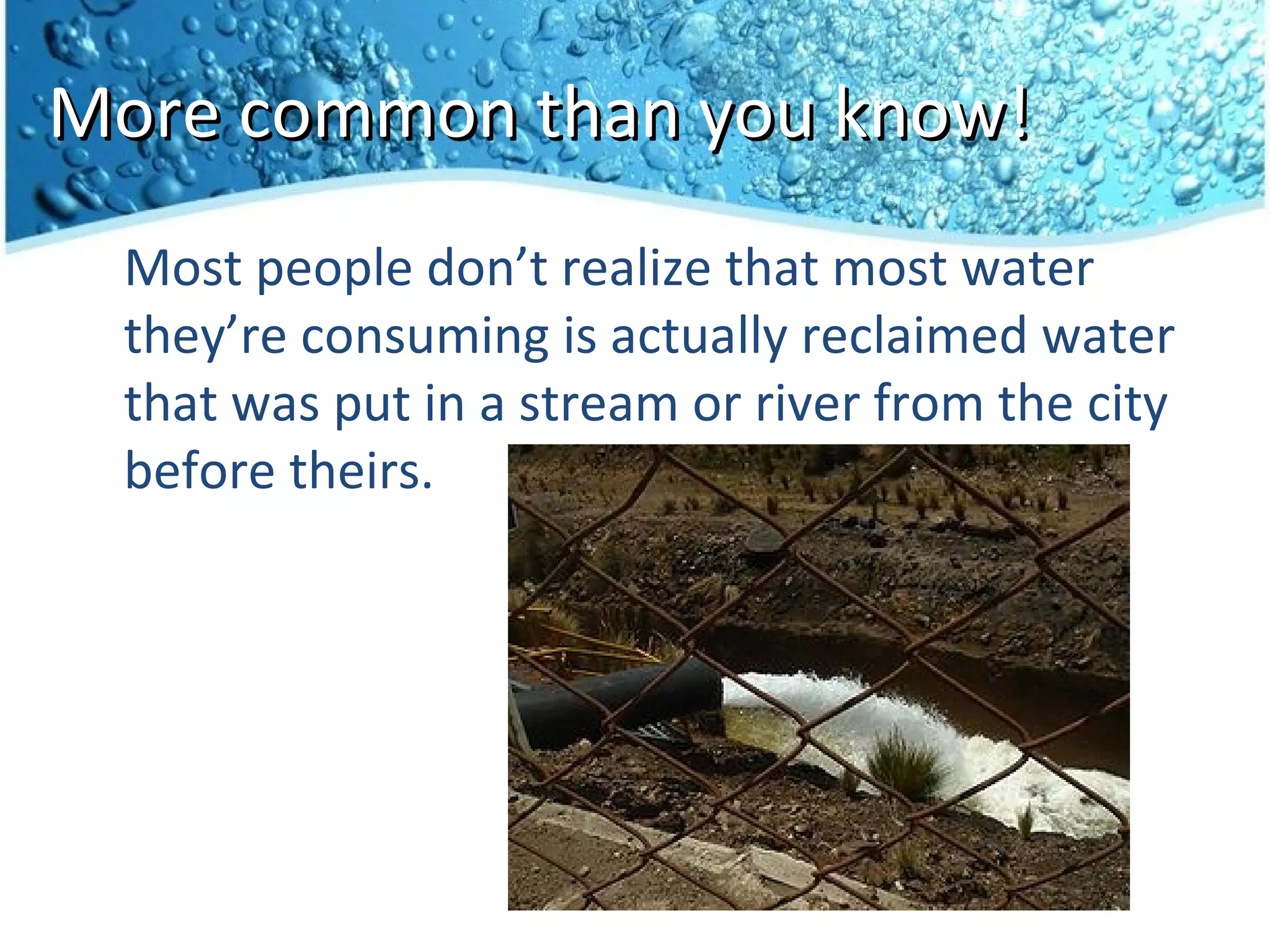
  Most people don’t realize that most water
  they’re consuming is actually reclaimed water
  that was put in a stream or river from the city
  before theirs.
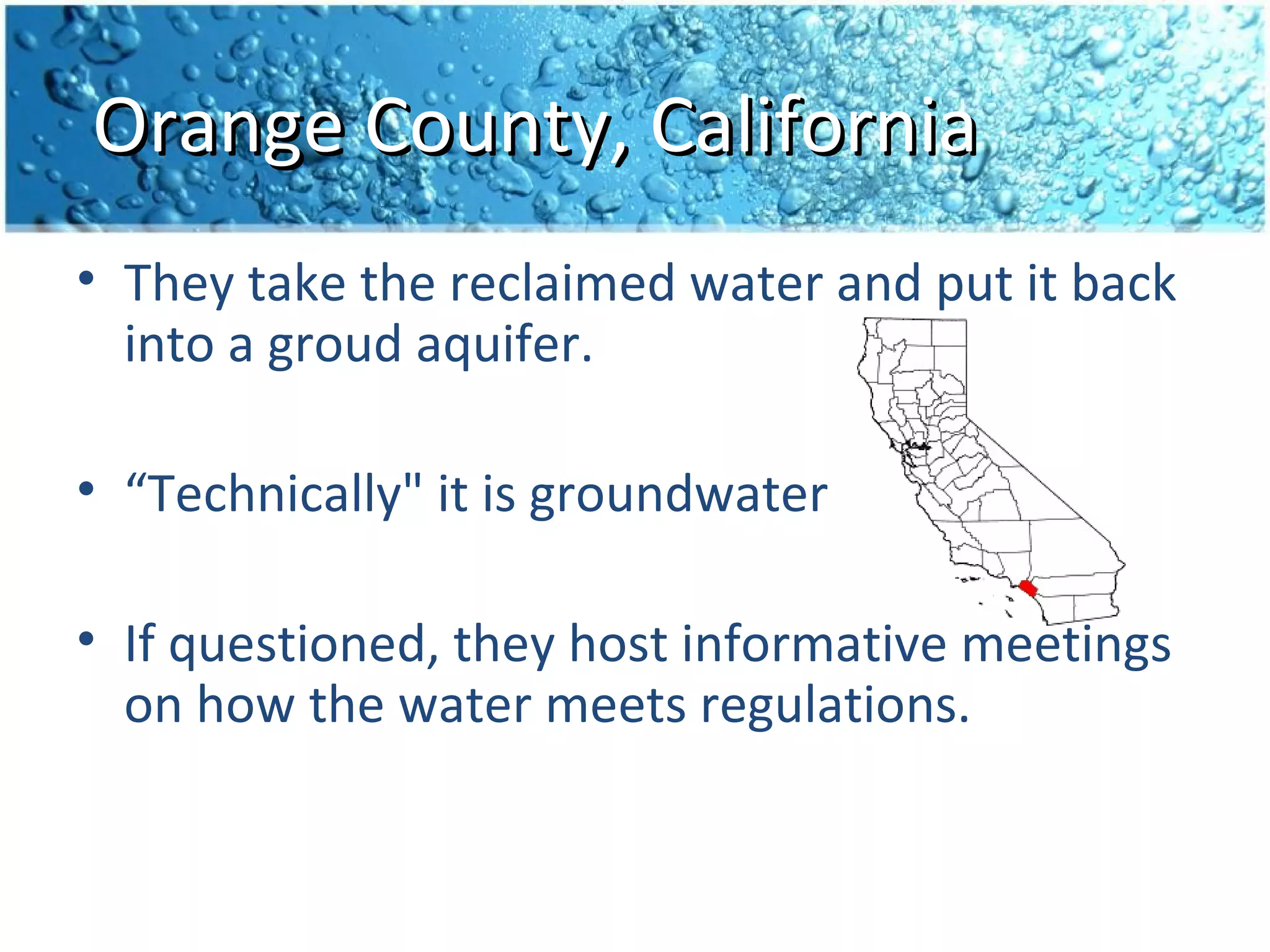
Orange County, California
• They take the reclaimed water and put it back
  into a groud aquifer.

• “Technically" it is groundwater

• If questioned, they host informative meetings
  on how the water meets regulations.
Interviews

Three Employees from the City of Howell
  Wastewater Department.
• Not really informed on how it works.
• Not one finds the system necessary for Michigan
• They DO find it smart and beneficial for places
  who don’t have great water amounts.
• They have problems with just putting reclaimed
  water into the river, let alone having people drink
  it.
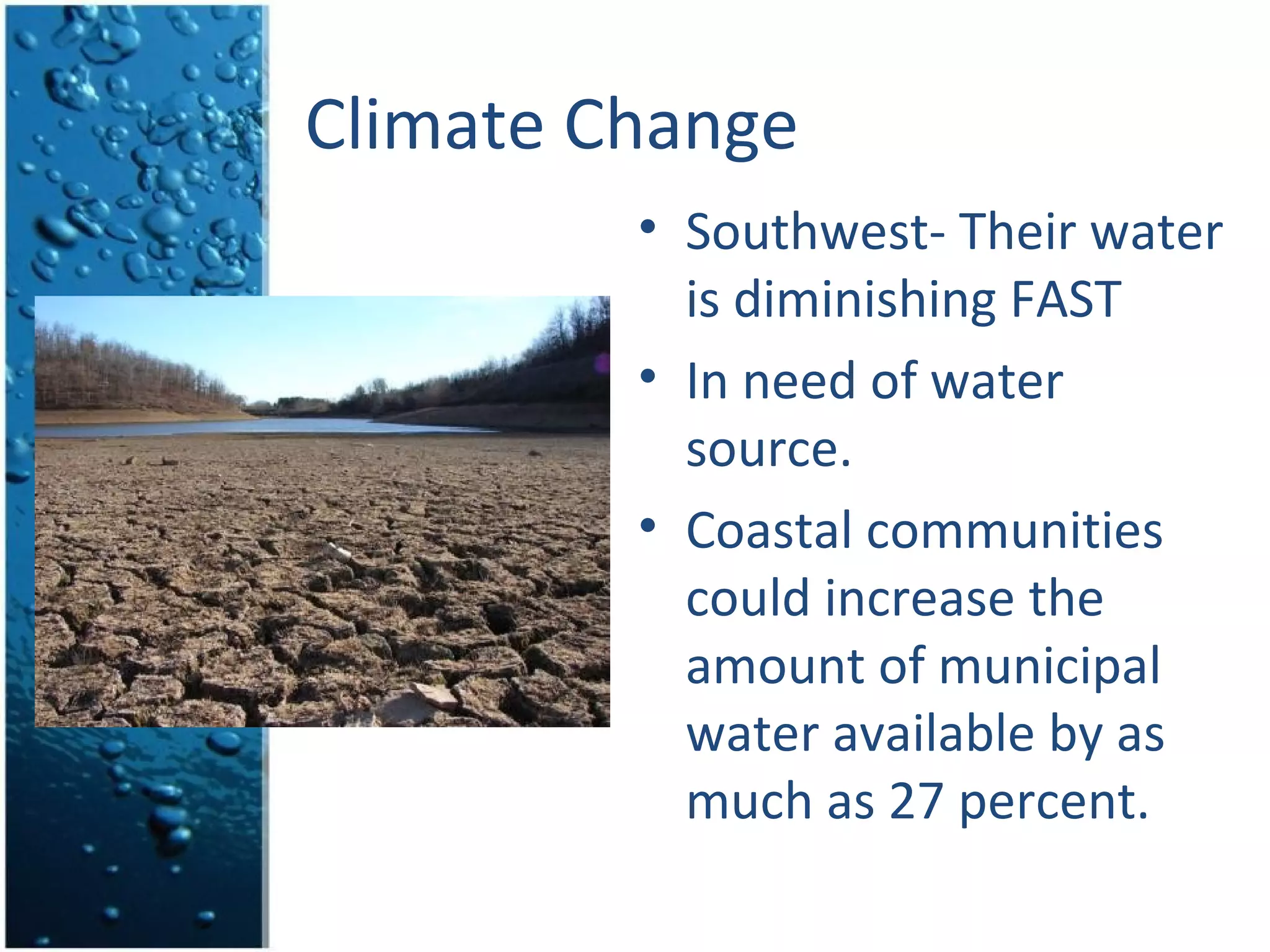
Climate Change
         • Southwest- Their water
           is diminishing FAST
         • In need of water
           source.
         • Coastal communities
           could increase the
           amount of municipal
           water available by as
           much as 27 percent.
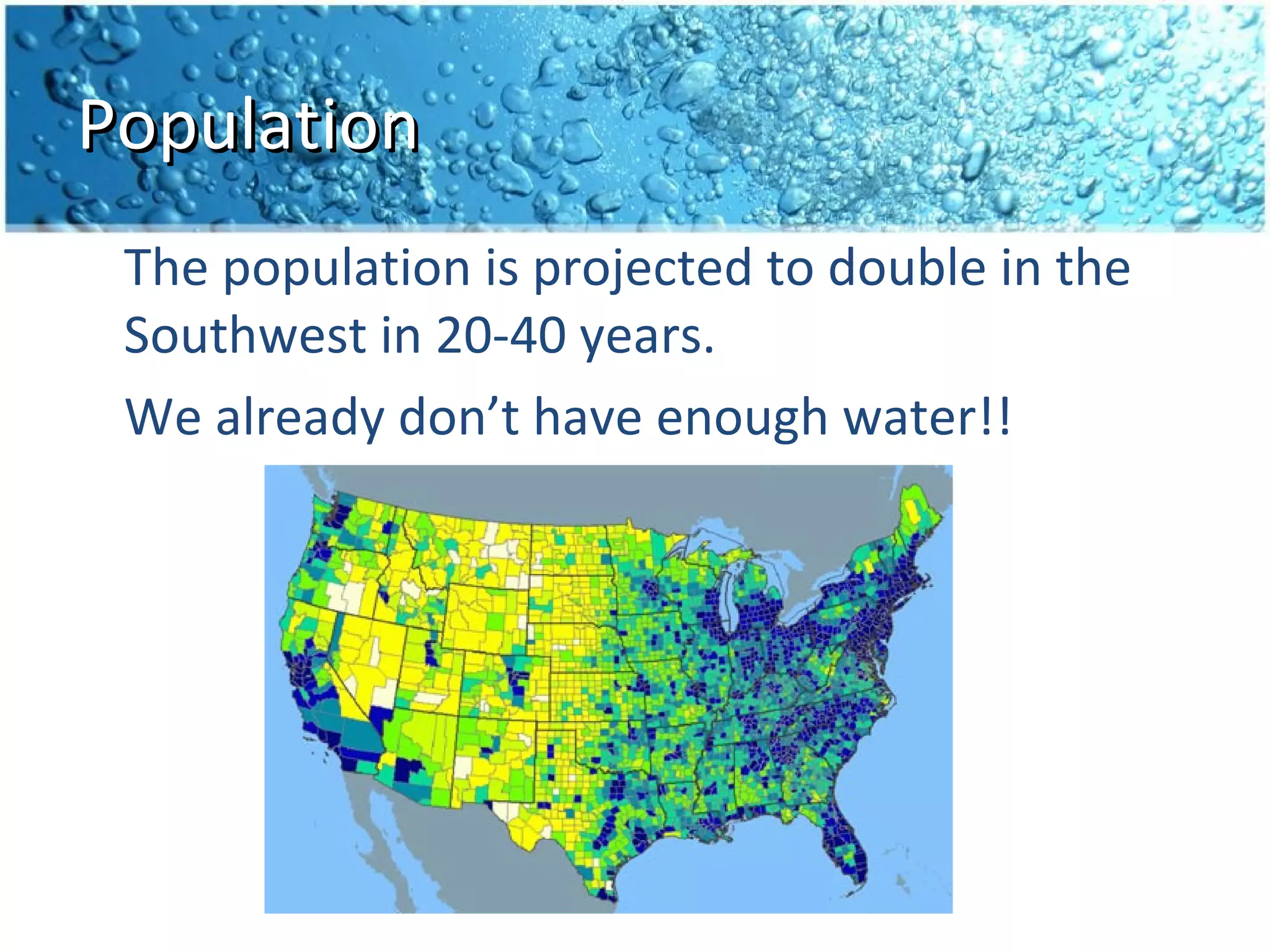
Population
 The population is projected to double in the
 Southwest in 20-40 years.
 We already don’t have enough water!!
Pros
• The water is less expensive to use or to treat
  and users benefit from the savings.
• The end use is located close to the source
  thereby eliminating the need for costly
  distribution systems.
• Reclaimed water is a drought-proof source of
  water, which is probably the biggest upside to
  the system.
Pros
• It is the only source of water that
  automatically increases with increased
  economic activity and population growth,
  which helps with the economic drought.

• One last major pro to the system is it helps
  conserve traditional sources of water such as
  groundwater and surface water.
Cons
• The water reuse may be
  seasonal in nature, resulting
  in the overloading of
  treatment and disposal
  facilities during off seasons.
• Need to pay for a new
  treatment system. (Terrible
  economy, and money is
  EVERYTHING to many)
Recommendations
• Use reclaimed
  wastewater!
  – Virtually nothing to
    worry about
  – More economically
    feasible
  – Stable water supply
• WHY?
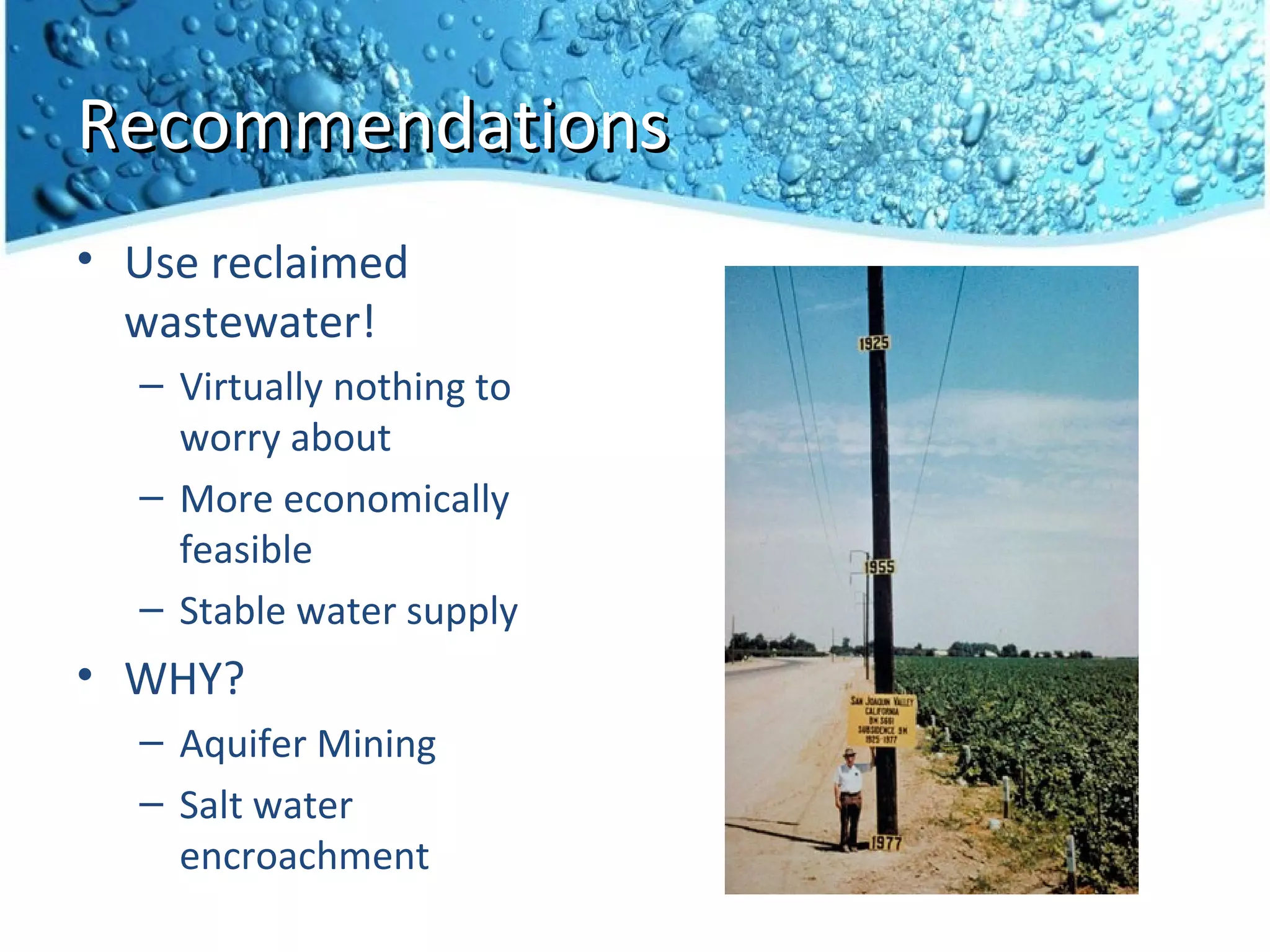
  – Aquifer Mining
  – Salt water
    encroachment
Biggest Hurdle

           • Education!
           • Education!
           • Education!
How can we educate effectively?

• Three groups control
  public opinion
  – Politicians
  – Advocacy Groups/
    Interested Organizations
  – Media
Effective Education
• Visual Information
• Reach out to everybody everywhere
• Be straightforward
  – Share all relevant information
  – Use recognizable terms
• Education Works!
Recommendations

• Combined sewers
  – Make sure facility has
    enough capacity

• Personal Care Products
  – Further research
  – Wastewater reclamation
    process more effective?
Other Options

• Storm water as drinking water
• Singapore
  – Import water from Malaysia
  – Rainwater catchment
  – Reservoir in ocean
  – Desalination
  – Wastewater Reclamation

Wastewater Reclamation

  • 1.
    Wastewater Reclamation Sarah Craddock, Jessica Holberg, Brad Rutzel
  • 2.
    Introduction • Struggle tomeet the demand for clean water – Desalination – Wastewater Reclamation • Objectives – Explore how wastewater reclamation works – Analyze pros and cons – Recommendations for Future Development
  • 3.
    How it works •Wastewater Reclamation: potable vs nonpotable • 10% • More economical • SUSTAINABLE!
  • 4.
    History • Early 1500s – Sewerage – Water sanitation • 1960s: Era of Wastewater Reclamation • 1969: Namibia • 1974 SWDA • 1977 CWA • Early 1980s-present day
  • 5.
    Process • Primary • Secondary • Tertiary • Post-Tertiary
  • 6.
  • 7.
    Who Uses it? •United States (California, Virginia, New Mexico, Colorado) • Namibia • Singapore • Australia (parts) • And Beyond!
  • 8.
    Analysis of Issues TheBIGGEST Issue • Most people think “YUCK”! • Even though it’s certified clean • How do you convince people it’s ok?
  • 9.
    More common thanyou know! Most people don’t realize that most water they’re consuming is actually reclaimed water that was put in a stream or river from the city before theirs.
  • 10.
    Orange County, California •They take the reclaimed water and put it back into a groud aquifer. • “Technically" it is groundwater • If questioned, they host informative meetings on how the water meets regulations.
  • 11.
    Interviews Three Employees fromthe City of Howell Wastewater Department. • Not really informed on how it works. • Not one finds the system necessary for Michigan • They DO find it smart and beneficial for places who don’t have great water amounts. • They have problems with just putting reclaimed water into the river, let alone having people drink it.
  • 12.
    Climate Change • Southwest- Their water is diminishing FAST • In need of water source. • Coastal communities could increase the amount of municipal water available by as much as 27 percent.
  • 13.
    Population The populationis projected to double in the Southwest in 20-40 years. We already don’t have enough water!!
  • 14.
    Pros • The wateris less expensive to use or to treat and users benefit from the savings. • The end use is located close to the source thereby eliminating the need for costly distribution systems. • Reclaimed water is a drought-proof source of water, which is probably the biggest upside to the system.
  • 15.
    Pros • It isthe only source of water that automatically increases with increased economic activity and population growth, which helps with the economic drought. • One last major pro to the system is it helps conserve traditional sources of water such as groundwater and surface water.
  • 16.
    Cons • The waterreuse may be seasonal in nature, resulting in the overloading of treatment and disposal facilities during off seasons. • Need to pay for a new treatment system. (Terrible economy, and money is EVERYTHING to many)
  • 17.
    Recommendations • Use reclaimed wastewater! – Virtually nothing to worry about – More economically feasible – Stable water supply • WHY? – Aquifer Mining – Salt water encroachment
  • 18.
    Biggest Hurdle • Education! • Education! • Education!
  • 19.
    How can weeducate effectively? • Three groups control public opinion – Politicians – Advocacy Groups/ Interested Organizations – Media
  • 20.
    Effective Education • VisualInformation • Reach out to everybody everywhere • Be straightforward – Share all relevant information – Use recognizable terms • Education Works!
  • 21.
    Recommendations • Combined sewers – Make sure facility has enough capacity • Personal Care Products – Further research – Wastewater reclamation process more effective?
  • 22.
    Other Options • Stormwater as drinking water • Singapore – Import water from Malaysia – Rainwater catchment – Reservoir in ocean – Desalination – Wastewater Reclamation