11
How to Boost 100x
Performance for Real
World Application w/
Apache Spark
Jie.huang@intel.com
Jiangang.duan@Intel.com
June 2015
22
Agenda
• Self introduction
• Problem statement
• What we did?
• Case study
• Summary
This is team work!
Thank Hao, Daoyuan, Saisai, Mingfei, Jiayin, Liye,
Carson, Alex, Lex, Rui, Qi…
33
Self introduction
•Intel software team @China Shanghai
•Open source focus
•Start to work on Spark from early UCB days
•Working closely with end customers
• Baidu, iqiyi, Tecent, Qihoo, JD, Sina, paypal…
•Technology and innovation oriented
– Real-time, in-memory, complex analytics
– Structure and unstructured data
– Agility, Multitenancy, Scalability and elasticity
– Bridging advanced research and real-world applications
44
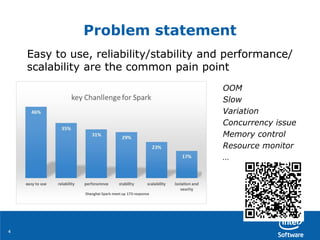
Problem statement
Easy to use, reliability/stability and performance/
scalability are the common pain point
Easy to use, reliability/stability and performance/
scalability are the common pain point
OOM
Slow
Variation
Concurrency issue
Memory control
Resource monitor
…
55
What we did?
• Define a better workload
– HiBench
• Provide a better profiling tool
– HiMeter (Dew)
• Regression testing and share w/ community
– SparkScore Web portal
• Work with customers to solve problems
– User case study
66
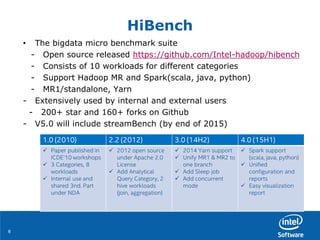
HiBench
• The bigdata micro benchmark suite
- Open source released https://github.com/Intel-hadoop/hibench
- Consists of 10 workloads for different categories
- Support Hadoop MR and Spark(scala, java, python)
- MR1/standalone, Yarn
- Extensively used by internal and external users
- 200+ star and 160+ forks on Github
- V5.0 will include streamBench (by end of 2015)
77
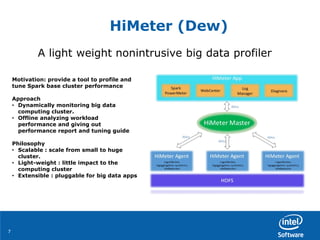
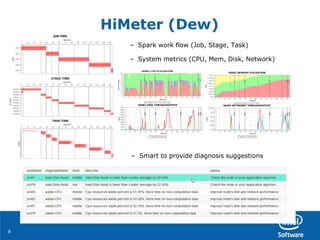
HiMeter (Dew)
A light weight nonintrusive big data profiler
Motivation: provide a tool to profile and
tune Spark base cluster performance
Approach
• Dynamically monitoring big data
computing cluster.
• Offline analyzing workload
performance and giving out
performance report and tuning guide
Philosophy
• Scalable : scale from small to huge
cluster.
• Light-weight : little impact to the
computing cluster
• Extensible : pluggable for big data apps
88
HiMeter (Dew)
– Spark work flow (Job, Stage, Task)
– System metrics (CPU, Mem, Disk, Network)
– Smart to provide diagnosis suggestions
99
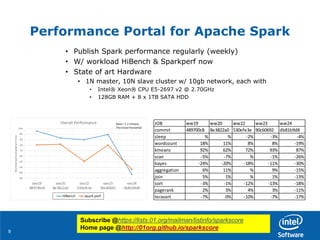
Performance Portal for Apache Spark
• Publish Spark performance regularly (weekly)
• W/ workload HiBench & Sparkperf now
• State of art Hardware
• 1N master, 10N slave cluster w/ 10gb network, each with
• Intel® Xeon® CPU E5-2697 v2 @ 2.70GHz
• 128GB RAM + 8 x 1TB SATA HDD
Subscribe @https://lists.01.org/mailman/listinfo/sparkscore
Home page @http://01org.github.io/sparkscore
JOB ww19 ww20 ww22 ww23 ww24
commit 489700c8 8e3822a0 530efe3e 90c60692 db81b9d8
sleep % % -2% -3% -4%
wordcount 18% 11% 8% 8% -19%
kmeans 92% 62% 72% 93% 87%
scan -5% -7% % -1% -26%
bayes -24% -20% -18% -11% -30%
aggregation 6% 11% % 9% -15%
join 5% 1% % 1% -13%
sort -3% -1% -12% -13% -18%
pagerank 2% 3% 4% 3% -11%
terasort -7% 0% -10% -7% -17%
1010
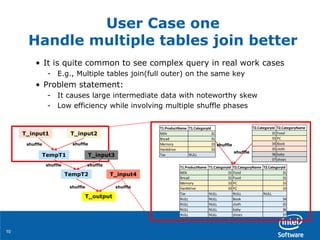
• It is quite common to see complex query in real work cases
- E.g., Multiple tables join(full outer) on the same key
• Problem statement:
- It causes large intermediate data with noteworthy skew
- Low efficiency while involving multiple shuffle phases
User Case one
Handle multiple tables join better
T_input1 T_input2
TempT1 T_input3
TempT2 T_input4
T_output
shuffleshuffle
shuffleshuffle
shuffle shuffle
T1.ProductName T1.CategoryId
Milk 31
Bread 31
Memory 33
Harddrive 33
Tax NULL
T2.CategoryId T2.CategoryName
31 Food
33 PC
34 Book
35 cloth
36 baby
37 shoes
T1.ProductName T1.CategoryId T2.CategoryName T2.CategoryId
Milk 31 Food 31
Bread 31 Food 31
Memory 33 PC 33
Harddrive 33 PC 33
Tax NULL NULL NULL
NULL NULL Book 34
NULL NULL cloth 35
NULL NULL baby 36
NULL NULL shoes 37
shuffle
shuffle
1111
• To combine multiple shuffle outputs into one single stage
[SPARK-7871]
– Avoid data skew which may be accumulated by previous full outer join
outputs
– Save unnecessary shuffle costs
• Make job done and with 2x speedup vs. Hive.
T_input1 T_input2
TempT1 T_input3
TempT2 T_input4
T_output
shuffleshuffle
shuffleshuffle
shuffle
T_input1 T_input2
shuffleshuffle
T_input3 T_input4
T_output
shuffle shuffle
SPARK-7871
User Case one
Handle multiple tables join better
1212
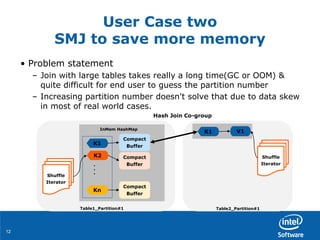
• Problem statement
– Join with large tables takes really a long time(GC or OOM) &
quite difficult for end user to guess the partition number
– Increasing partition number doesn't solve that due to data skew
in most of real world cases.
User Case two
SMJ to save more memory
InMem HashMap
Shuffle
Iterator
K1
Compact
Buffer
K2 Compact
Buffer
Table1_Partition#1
Kn
Compact
Buffer
。。。
Shuffle
Iterator
Table2_Partition#1
K1
Hash Join Co-group
V1
1313
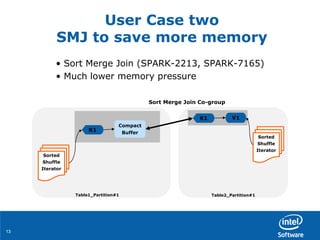
• Sort Merge Join (SPARK-2213, SPARK-7165)
• Much lower memory pressure
Sorted
Shuffle
Iterator
K1
Compact
Buffer
Table1_Partition#1
Sorted
Shuffle
Iterator
Table2_Partition#1
K1
Sort Merge Join Co-group
V1
User Case two
SMJ to save more memory
1414
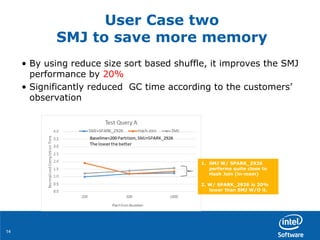
• By using reduce size sort based shuffle, it improves the SMJ
performance by 20%
• Significantly reduced GC time according to the customers’
observation
1. SMJ W/ SPARK_2926
performs quite close to
Hash Join (in-mem)
2. W/ SPARK_2926 is 20%
lower than SMJ W/O it.
User Case two
SMJ to save more memory
1515
User Case Three
Manage the memory in a smart way
• Commonly use Bagel/GraphX for graph analytics
– The present iteration only depends on its previous step, I.e.,
RDD[n] is only used in RDD[n+1] computation
• Problem statement:
– Memory space is continuously increased in Bagel app
1616
User Case Two
Manage the memory in a smart way
• Free those obsolete RDDs not be used anymore
– I.e., To un-persist RDD[n-1] after RDD[n] is done SPARK-2661
• The total memory usage is > 50% off
See more tuning @https://databricks.com/blog/2015/05/28/tuning-java-garbage-collection-for-spark-
applications.html
1717
User Case Three
Save the IO bandwidth
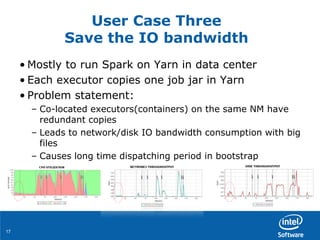
• Mostly to run Spark on Yarn in data center
• Each executor copies one job jar in Yarn
• Problem statement:
– Co-located executors(containers) on the same NM have
redundant copies
– Leads to network/disk IO bandwidth consumption with big
files
– Causes long time dispatching period in bootstrap
1818
User Case Three
Save the IO bandwidth
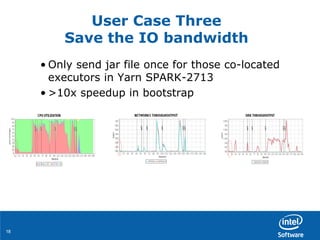
• Only send jar file once for those co-located
executors in Yarn SPARK-2713
• >10x speedup in bootstrap
1919
Summary
• Spark team inside Intel
• Scalability, reliability and stability @ spark
• projects we did to solve the problem
• Working with partners together to
improve spark performance
• Intel wants to work with industry and
community to make Spark better
Checking our demo booth for more details
2020
Notices and Disclaimers
• INFORMATION IN THIS DOCUMENT IS PROVIDED IN CONNECTION WITH INTEL PRODUCTS. NO LICENSE, EXPRESS OR IMPLIED, BY
ESTOPPEL OR OTHERWISE, TO ANY INTELLECTUAL PROPERTY RIGHTS IS GRANTED BY THIS DOCUMENT. EXCEPT AS PROVIDED IN
INTEL'S TERMS AND CONDITIONS OF SALE FOR SUCH PRODUCTS, INTEL ASSUMES NO LIABILITY WHATSOEVER AND INTEL
DISCLAIMS ANY EXPRESS OR IMPLIED WARRANTY, RELATING TO SALE AND/OR USE OF INTEL PRODUCTS INCLUDING LIABILITY OR
WARRANTIES RELATING TO FITNESS FOR A PARTICULAR PURPOSE, MERCHANTABILITY, OR INFRINGEMENT OF ANY PATENT,
COPYRIGHT OR OTHER INTELLECTUAL PROPERTY RIGHT.
A "Mission Critical Application" is any application in which failure of the Intel Product could result, directly or indirectly, in personal
injury or death. SHOULD YOU PURCHASE OR USE INTEL'S PRODUCTS FOR ANY SUCH MISSION CRITICAL APPLICATION, YOU SHALL
INDEMNIFY AND HOLD INTEL AND ITS SUBSIDIARIES, SUBCONTRACTORS AND AFFILIATES, AND THE DIRECTORS, OFFICERS, AND
EMPLOYEES OF EACH, HARMLESS AGAINST ALL CLAIMS COSTS, DAMAGES, AND EXPENSES AND REASONABLE ATTORNEYS' FEES
ARISING OUT OF, DIRECTLY OR INDIRECTLY, ANY CLAIM OF PRODUCT LIABILITY, PERSONAL INJURY, OR DEATH ARISING IN ANY
WAY OUT OF SUCH MISSION CRITICAL APPLICATION, WHETHER OR NOT INTEL OR ITS SUBCONTRACTOR WAS NEGLIGENT IN THE
DESIGN, MANUFACTURE, OR WARNING OF THE INTEL PRODUCT OR ANY OF ITS PARTS.
• Intel may make changes to specifications and product descriptions at any time, without notice. Designers must not rely on the
absence or characteristics of any features or instructions marked "reserved" or "undefined". Intel reserves these for future definition
and shall have no responsibility whatsoever for conflicts or incompatibilities arising from future changes to them. The information here
is subject to change without notice. Do not finalize a design with this information.
• The products described in this document may contain design defects or errors known as errata which may cause the product to
deviate from published specifications. Current characterized errata are available on request.
• Contact your local Intel sales office or your distributor to obtain the latest specifications and before placing your product order.
• Copies of documents which have an order number and are referenced in this document, or other Intel literature, may be obtained by
calling 1-800-548-4725, or go to: http://www.intel.com/design/literature.htm
• Intel, the Intel logo, Intel Xeon, and Xeon logos are trademarks of Intel Corporation in the U.S. and/or other countries.
• Intel processor numbers are not a measure of performance. Processor numbers differentiate features within each processor family, not
across different processor families: Go to: Learn About Intel® Processor Numbers http://www.intel.com/products/processor_number
• All the performance data are collected from our internal testing. Some results have been estimated based on internal Intel analysis
and are provided for informational purposes only. Any difference in system hardware or software design or configuration may affect
actual performance.
• *Other names and brands may be claimed as the property of others.
• Copyright © 2015 Intel Corporation. All rights reserved.

How to Boost 100x Performance for Real World Application with Apache Spark-(Grace Huang and Jiangang Duan, Intel)

  • 1.
    11 How to Boost100x Performance for Real World Application w/ Apache Spark Jie.huang@intel.com Jiangang.duan@Intel.com June 2015
  • 2.
    22 Agenda • Self introduction •Problem statement • What we did? • Case study • Summary This is team work! Thank Hao, Daoyuan, Saisai, Mingfei, Jiayin, Liye, Carson, Alex, Lex, Rui, Qi…
  • 3.
    33 Self introduction •Intel softwareteam @China Shanghai •Open source focus •Start to work on Spark from early UCB days •Working closely with end customers • Baidu, iqiyi, Tecent, Qihoo, JD, Sina, paypal… •Technology and innovation oriented – Real-time, in-memory, complex analytics – Structure and unstructured data – Agility, Multitenancy, Scalability and elasticity – Bridging advanced research and real-world applications
  • 4.
    44 Problem statement Easy touse, reliability/stability and performance/ scalability are the common pain point Easy to use, reliability/stability and performance/ scalability are the common pain point OOM Slow Variation Concurrency issue Memory control Resource monitor …
  • 5.
    55 What we did? •Define a better workload – HiBench • Provide a better profiling tool – HiMeter (Dew) • Regression testing and share w/ community – SparkScore Web portal • Work with customers to solve problems – User case study
  • 6.
    66 HiBench • The bigdatamicro benchmark suite - Open source released https://github.com/Intel-hadoop/hibench - Consists of 10 workloads for different categories - Support Hadoop MR and Spark(scala, java, python) - MR1/standalone, Yarn - Extensively used by internal and external users - 200+ star and 160+ forks on Github - V5.0 will include streamBench (by end of 2015)
  • 7.
    77 HiMeter (Dew) A lightweight nonintrusive big data profiler Motivation: provide a tool to profile and tune Spark base cluster performance Approach • Dynamically monitoring big data computing cluster. • Offline analyzing workload performance and giving out performance report and tuning guide Philosophy • Scalable : scale from small to huge cluster. • Light-weight : little impact to the computing cluster • Extensible : pluggable for big data apps
  • 8.
    88 HiMeter (Dew) – Sparkwork flow (Job, Stage, Task) – System metrics (CPU, Mem, Disk, Network) – Smart to provide diagnosis suggestions
  • 9.
    99 Performance Portal forApache Spark • Publish Spark performance regularly (weekly) • W/ workload HiBench & Sparkperf now • State of art Hardware • 1N master, 10N slave cluster w/ 10gb network, each with • Intel® Xeon® CPU E5-2697 v2 @ 2.70GHz • 128GB RAM + 8 x 1TB SATA HDD Subscribe @https://lists.01.org/mailman/listinfo/sparkscore Home page @http://01org.github.io/sparkscore JOB ww19 ww20 ww22 ww23 ww24 commit 489700c8 8e3822a0 530efe3e 90c60692 db81b9d8 sleep % % -2% -3% -4% wordcount 18% 11% 8% 8% -19% kmeans 92% 62% 72% 93% 87% scan -5% -7% % -1% -26% bayes -24% -20% -18% -11% -30% aggregation 6% 11% % 9% -15% join 5% 1% % 1% -13% sort -3% -1% -12% -13% -18% pagerank 2% 3% 4% 3% -11% terasort -7% 0% -10% -7% -17%
  • 10.
    1010 • It isquite common to see complex query in real work cases - E.g., Multiple tables join(full outer) on the same key • Problem statement: - It causes large intermediate data with noteworthy skew - Low efficiency while involving multiple shuffle phases User Case one Handle multiple tables join better T_input1 T_input2 TempT1 T_input3 TempT2 T_input4 T_output shuffleshuffle shuffleshuffle shuffle shuffle T1.ProductName T1.CategoryId Milk 31 Bread 31 Memory 33 Harddrive 33 Tax NULL T2.CategoryId T2.CategoryName 31 Food 33 PC 34 Book 35 cloth 36 baby 37 shoes T1.ProductName T1.CategoryId T2.CategoryName T2.CategoryId Milk 31 Food 31 Bread 31 Food 31 Memory 33 PC 33 Harddrive 33 PC 33 Tax NULL NULL NULL NULL NULL Book 34 NULL NULL cloth 35 NULL NULL baby 36 NULL NULL shoes 37 shuffle shuffle
  • 11.
    1111 • To combinemultiple shuffle outputs into one single stage [SPARK-7871] – Avoid data skew which may be accumulated by previous full outer join outputs – Save unnecessary shuffle costs • Make job done and with 2x speedup vs. Hive. T_input1 T_input2 TempT1 T_input3 TempT2 T_input4 T_output shuffleshuffle shuffleshuffle shuffle T_input1 T_input2 shuffleshuffle T_input3 T_input4 T_output shuffle shuffle SPARK-7871 User Case one Handle multiple tables join better
  • 12.
    1212 • Problem statement –Join with large tables takes really a long time(GC or OOM) & quite difficult for end user to guess the partition number – Increasing partition number doesn't solve that due to data skew in most of real world cases. User Case two SMJ to save more memory InMem HashMap Shuffle Iterator K1 Compact Buffer K2 Compact Buffer Table1_Partition#1 Kn Compact Buffer 。。。 Shuffle Iterator Table2_Partition#1 K1 Hash Join Co-group V1
  • 13.
    1313 • Sort MergeJoin (SPARK-2213, SPARK-7165) • Much lower memory pressure Sorted Shuffle Iterator K1 Compact Buffer Table1_Partition#1 Sorted Shuffle Iterator Table2_Partition#1 K1 Sort Merge Join Co-group V1 User Case two SMJ to save more memory
  • 14.
    1414 • By usingreduce size sort based shuffle, it improves the SMJ performance by 20% • Significantly reduced GC time according to the customers’ observation 1. SMJ W/ SPARK_2926 performs quite close to Hash Join (in-mem) 2. W/ SPARK_2926 is 20% lower than SMJ W/O it. User Case two SMJ to save more memory
  • 15.
    1515 User Case Three Managethe memory in a smart way • Commonly use Bagel/GraphX for graph analytics – The present iteration only depends on its previous step, I.e., RDD[n] is only used in RDD[n+1] computation • Problem statement: – Memory space is continuously increased in Bagel app
  • 16.
    1616 User Case Two Managethe memory in a smart way • Free those obsolete RDDs not be used anymore – I.e., To un-persist RDD[n-1] after RDD[n] is done SPARK-2661 • The total memory usage is > 50% off See more tuning @https://databricks.com/blog/2015/05/28/tuning-java-garbage-collection-for-spark- applications.html
  • 17.
    1717 User Case Three Savethe IO bandwidth • Mostly to run Spark on Yarn in data center • Each executor copies one job jar in Yarn • Problem statement: – Co-located executors(containers) on the same NM have redundant copies – Leads to network/disk IO bandwidth consumption with big files – Causes long time dispatching period in bootstrap
  • 18.
    1818 User Case Three Savethe IO bandwidth • Only send jar file once for those co-located executors in Yarn SPARK-2713 • >10x speedup in bootstrap
  • 19.
    1919 Summary • Spark teaminside Intel • Scalability, reliability and stability @ spark • projects we did to solve the problem • Working with partners together to improve spark performance • Intel wants to work with industry and community to make Spark better Checking our demo booth for more details
  • 20.
    2020 Notices and Disclaimers •INFORMATION IN THIS DOCUMENT IS PROVIDED IN CONNECTION WITH INTEL PRODUCTS. NO LICENSE, EXPRESS OR IMPLIED, BY ESTOPPEL OR OTHERWISE, TO ANY INTELLECTUAL PROPERTY RIGHTS IS GRANTED BY THIS DOCUMENT. EXCEPT AS PROVIDED IN INTEL'S TERMS AND CONDITIONS OF SALE FOR SUCH PRODUCTS, INTEL ASSUMES NO LIABILITY WHATSOEVER AND INTEL DISCLAIMS ANY EXPRESS OR IMPLIED WARRANTY, RELATING TO SALE AND/OR USE OF INTEL PRODUCTS INCLUDING LIABILITY OR WARRANTIES RELATING TO FITNESS FOR A PARTICULAR PURPOSE, MERCHANTABILITY, OR INFRINGEMENT OF ANY PATENT, COPYRIGHT OR OTHER INTELLECTUAL PROPERTY RIGHT. A "Mission Critical Application" is any application in which failure of the Intel Product could result, directly or indirectly, in personal injury or death. SHOULD YOU PURCHASE OR USE INTEL'S PRODUCTS FOR ANY SUCH MISSION CRITICAL APPLICATION, YOU SHALL INDEMNIFY AND HOLD INTEL AND ITS SUBSIDIARIES, SUBCONTRACTORS AND AFFILIATES, AND THE DIRECTORS, OFFICERS, AND EMPLOYEES OF EACH, HARMLESS AGAINST ALL CLAIMS COSTS, DAMAGES, AND EXPENSES AND REASONABLE ATTORNEYS' FEES ARISING OUT OF, DIRECTLY OR INDIRECTLY, ANY CLAIM OF PRODUCT LIABILITY, PERSONAL INJURY, OR DEATH ARISING IN ANY WAY OUT OF SUCH MISSION CRITICAL APPLICATION, WHETHER OR NOT INTEL OR ITS SUBCONTRACTOR WAS NEGLIGENT IN THE DESIGN, MANUFACTURE, OR WARNING OF THE INTEL PRODUCT OR ANY OF ITS PARTS. • Intel may make changes to specifications and product descriptions at any time, without notice. Designers must not rely on the absence or characteristics of any features or instructions marked "reserved" or "undefined". Intel reserves these for future definition and shall have no responsibility whatsoever for conflicts or incompatibilities arising from future changes to them. The information here is subject to change without notice. Do not finalize a design with this information. • The products described in this document may contain design defects or errors known as errata which may cause the product to deviate from published specifications. Current characterized errata are available on request. • Contact your local Intel sales office or your distributor to obtain the latest specifications and before placing your product order. • Copies of documents which have an order number and are referenced in this document, or other Intel literature, may be obtained by calling 1-800-548-4725, or go to: http://www.intel.com/design/literature.htm • Intel, the Intel logo, Intel Xeon, and Xeon logos are trademarks of Intel Corporation in the U.S. and/or other countries. • Intel processor numbers are not a measure of performance. Processor numbers differentiate features within each processor family, not across different processor families: Go to: Learn About Intel® Processor Numbers http://www.intel.com/products/processor_number • All the performance data are collected from our internal testing. Some results have been estimated based on internal Intel analysis and are provided for informational purposes only. Any difference in system hardware or software design or configuration may affect actual performance. • *Other names and brands may be claimed as the property of others. • Copyright © 2015 Intel Corporation. All rights reserved.