Download to read offline
![IOSR Journal of Mathematics (IOSR-JM)
e-ISSN: 2278-5728,p-ISSN: 2319-765X, Volume 6, Issue 4 (May. - Jun. 2013), PP 09-12
www.iosrjournals.org
www.iosrjournals.org 9 | Page
Chebyshev Collocation Approach for a Continuous Formulation
of Implicit Hybrid Methods for Vips In Second Order Odes
R.B. Adeniyi1
, E.O. Adeyefa2
1
Department Of Mathematics, University Of Ilorin, Ilorin, Nigeria.
2
Department Of Mathematics/Statistics, Federal University Wukari, Taraba State, Nigeria.
Abstract: In this paper, an implicit one-step method for numerical solution of second order Initial Value
Problems of Ordinary Differential Equations has been developed by collocation and interpolation technique.
The one-step method was developed using Chebyshev polynomial as basis function and, the method was
augmented by the introduction of offstep points in order to bring about zero stability and upgrade the order of
consistency of the new method. An advantage of the derived continuous scheme is that it can produce several
outputs of solution at the off-grid points without requiring additional interpolation. Numerical examples are
presented to portray the applicability and the efficiency of the method.
Keywords:Interpolation, Chebyshev polynomial, Collocation,continuous scheme.
I. Introduction
The general second order Initial Value Problems (IVPs) of Ordinary Differential Equations (ODEs) of
the form:
)1(],[,)(,)('),',,('' baxyayzayyyxfy oo
where f is continuous in [a,b], is often encountered in areas such as satellite tracking/warning systems,
celestial mechanics, mass action kinetics, solar systems and molecular biology [1]. Many of such problems may
not be easily solved analytically, hence numerical schemes are developed to solve (1). These equations are
usually reduced to a system of two first order ODEs and numerical methods for first order differential equations
are used to solve it. For such systems of first order ODEs, Linear Multistep Methods (LMMs) are powerful
numerical methods.
Some researchers have attempted the solution of (1) using LMMs without reduction to system of first
order ODEs. They include [2], [3], [4], [5] to mention a few. [6], proposed a continuous scheme based on
collocation which was found to have better error estimate and provided approximation at all interior points of
the interval of consideration. The main setback of the scheme proposed by [6] is in the need to develop
computer sub-programs needed to initialize the starting values; hence, much time is lost and the cost of
implementation is high. In view of these disadvantages, many researchers concentrated efforts on advancing the
numerical solution of IVPs in ODEs. One of the outcomes is the development of a class of methods called Block
method. The method, which shall briefly be discussed in the next section simultaneously generates
approximations at different grid points in the interval of integration and is less expensive in terms of the number
of function evaluations compared to the LMMs or Runge-Kutta methods.
II. Block Methods
Block methods are formulated in terms of LMMs. They provide the traditional advantage of one-step
methods, e.g., Runge-Kutta methods, of being self-starting and permitting easy change of step length [7].
Another important feature of the block approach is that all the discrete schemes are of uniform order and are
obtained from a single continuous formula in contrast to the non-self starting predictor-corrector approach.
In what now immediately follows, we shall develop the new method with Chebyshev polynomial as basis
function.
III. Development Of The Method
In this section, we intend to derive a continuous representation of a one-step method which will be used
to generate the main method and other methods required to set up the block method. We set out by
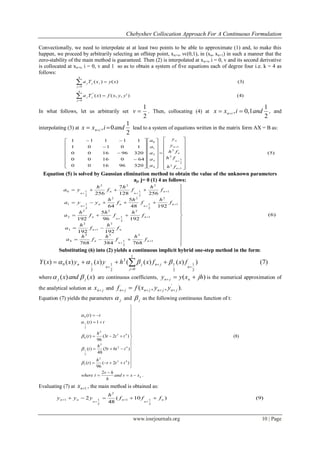
approximating the analytical solution of problem (1) with a Chebyshev polynomial of the form:
k
j
jj xyxTaxY
0
)2()()()(
on the partition
a = x0<xI< … <xn< xn+1< …<xN = b
on the integration interval [a,b], with a constant step size h, given by h = xn+1 – xn; n = 0, 1, …, N-1.](https://image.slidesharecdn.com/b0640912-150428023901-conversion-gate02/85/Chebyshev-Collocation-Approach-for-a-Continuous-Formulation-of-Implicit-Hybrid-Methods-for-Vips-In-Second-Order-Odes-1-320.jpg)
![IOSR Journal of Mathematics (IOSR-JM)
e-ISSN: 2278-5728,p-ISSN: 2319-765X, Volume 6, Issue 4 (May. - Jun. 2013), PP 09-12
www.iosrjournals.org
www.iosrjournals.org 9 | Page
Chebyshev Collocation Approach for a Continuous Formulation
of Implicit Hybrid Methods for Vips In Second Order Odes
R.B. Adeniyi1
, E.O. Adeyefa2
1
Department Of Mathematics, University Of Ilorin, Ilorin, Nigeria.
2
Department Of Mathematics/Statistics, Federal University Wukari, Taraba State, Nigeria.
Abstract: In this paper, an implicit one-step method for numerical solution of second order Initial Value
Problems of Ordinary Differential Equations has been developed by collocation and interpolation technique.
The one-step method was developed using Chebyshev polynomial as basis function and, the method was
augmented by the introduction of offstep points in order to bring about zero stability and upgrade the order of
consistency of the new method. An advantage of the derived continuous scheme is that it can produce several
outputs of solution at the off-grid points without requiring additional interpolation. Numerical examples are
presented to portray the applicability and the efficiency of the method.
Keywords:Interpolation, Chebyshev polynomial, Collocation,continuous scheme.
I. Introduction
The general second order Initial Value Problems (IVPs) of Ordinary Differential Equations (ODEs) of
the form:
)1(],[,)(,)('),',,('' baxyayzayyyxfy oo
where f is continuous in [a,b], is often encountered in areas such as satellite tracking/warning systems,
celestial mechanics, mass action kinetics, solar systems and molecular biology [1]. Many of such problems may
not be easily solved analytically, hence numerical schemes are developed to solve (1). These equations are
usually reduced to a system of two first order ODEs and numerical methods for first order differential equations
are used to solve it. For such systems of first order ODEs, Linear Multistep Methods (LMMs) are powerful
numerical methods.
Some researchers have attempted the solution of (1) using LMMs without reduction to system of first
order ODEs. They include [2], [3], [4], [5] to mention a few. [6], proposed a continuous scheme based on
collocation which was found to have better error estimate and provided approximation at all interior points of
the interval of consideration. The main setback of the scheme proposed by [6] is in the need to develop
computer sub-programs needed to initialize the starting values; hence, much time is lost and the cost of
implementation is high. In view of these disadvantages, many researchers concentrated efforts on advancing the
numerical solution of IVPs in ODEs. One of the outcomes is the development of a class of methods called Block
method. The method, which shall briefly be discussed in the next section simultaneously generates
approximations at different grid points in the interval of integration and is less expensive in terms of the number
of function evaluations compared to the LMMs or Runge-Kutta methods.
II. Block Methods
Block methods are formulated in terms of LMMs. They provide the traditional advantage of one-step
methods, e.g., Runge-Kutta methods, of being self-starting and permitting easy change of step length [7].
Another important feature of the block approach is that all the discrete schemes are of uniform order and are
obtained from a single continuous formula in contrast to the non-self starting predictor-corrector approach.
In what now immediately follows, we shall develop the new method with Chebyshev polynomial as basis
function.
III. Development Of The Method
In this section, we intend to derive a continuous representation of a one-step method which will be used
to generate the main method and other methods required to set up the block method. We set out by
approximating the analytical solution of problem (1) with a Chebyshev polynomial of the form:
k
j
jj xyxTaxY
0
)2()()()(
on the partition
a = x0<xI< … <xn< xn+1< …<xN = b
on the integration interval [a,b], with a constant step size h, given by h = xn+1 – xn; n = 0, 1, …, N-1.](https://image.slidesharecdn.com/b0640912-150428023901-conversion-gate02/75/Chebyshev-Collocation-Approach-for-a-Continuous-Formulation-of-Implicit-Hybrid-Methods-for-Vips-In-Second-Order-Odes-1-2048.jpg)
![Chebyshev Collocation Approach For A Continuous Formulation
www.iosrjournals.org 11 | Page
To derive the block method, additional equations are needed since equation (9) alone will not be sufficient for
the solution at
2
1
n
x and 1nx to be obtained simultaneously. The additional methods can be obtained from
evaluating the first derivative of equation (7):
1
0 2
1
'
2
1
'
2
1
'
2
1
'
0
'
)10())()((])()([
1
)(
j
n
jnj
n
n fxfxhyxyx
h
xY
at 1
2
1,
n
n
n xandxx respectively. This yields the following discrete derivative schemes:
)13()269(969648
)12()310(969648
)11()76(969648
2
11
2
2
1
'
1
2
11
2
2
1
'
2
1
2
11
2
2
1
'
n
n
nn
n
n
n
n
nn
nn
n
n
nn
n
n
fffhyyhy
fffhyyhy
fffhyyhy
Equations (9), (11), (12) and (13) are then solved simultaneously to obtain the following explicit results:
)14(
)4(
6
)85(
24
)2(
6
)67(
962
1
1
2
1
''
1
1
2
1
''
2
1
2
1
2
'
1
1
2
1
2
'
2
1
n
n
nnn
n
n
nn
n
n
nnnn
n
n
nnn
n
fff
h
yy
fff
h
yy
ff
h
hyyy
fff
h
hyyy
IV. Numerical Examples
We consider here two test problems for the efficiency and accuracy of the one-step method
implemented as a block method.
]5[:
)exp(1)(:
1.0,1)0(',0)0(,'''.1
Source
xxySolutionExact
hyyyy
]8[:
)exp()(:
05.0,1)0(',1)0(,01000'1001''.2
Source
xxySolutionExact
hyyyyy
Table 1a: Showing the exact solutions and the computed results from the proposed methods for problem
1
X Exact Solution The New Method(TNM)
0.1 -0.105170918 -0.105170902
0.2 -0.221402758 -0.221402723
0.3 -0.349858807 -0.34985857
0.4 -0.491824697 -0.491824433
0.5 -0.64872127 -0.648720974
0.6 -0.8221188 -0.822118466
0.7 -1.013752707 -1.013752329
0.8 -1.225540928 -1.225540498
0.9 -1.459603111 -1.45960262
1.0 -1.718281828 -1.718281267
Table 1b: Comparing the absolute errors in The New Method (TNM) to error in [5] in problem 1
X Error in TNM, p=4, k=1 Error in [5],p=4, k=2
0.1 0.160756E-07 0.87931600E-04
0.2 0.351602E-07 0.32671800-03
0.3 0.237576E-06 0.22155640E-02
0.4 0.2646413E-06 0.48570930E-02
0.5 0.2967001E-06 0.90977340E-02](https://image.slidesharecdn.com/b0640912-150428023901-conversion-gate02/85/Chebyshev-Collocation-Approach-for-a-Continuous-Formulation-of-Implicit-Hybrid-Methods-for-Vips-In-Second-Order-Odes-3-320.jpg)
![Chebyshev Collocation Approach For A Continuous Formulation
www.iosrjournals.org 12 | Page
0.6 0.3343905E-06 0.14391394E-01
0.7 0.3784705E-06 0.21437918E-01
0.8 0.4304925E-06 0.29898724E-01
0.9 0.4911569E-06 0.40300719E-01
1.0 0.561459E-06 0.52552130E-01
V. Table of Results
Table 2a: Showing the exact solutions and the computed results from the proposed methods for problem
2
X Exact Solution The New Method
0.1 0.90483742E+00 0.90483742+00
0.2 0.81873075E+00 0.81873075E+00
0.3 0.74081822E+00 0.74081822E+00
0.4 0.67032005E+00 0.67032005E+00
0.5 0.60653066E+00 0.60653066E+00
0.6 0.54881163E+00 0.54881164E+00
0.7 0.49658530E+00 0.49658530E+00
0.8 0.44932896E+00 0.44932896E+00
0.9 0.40656965E+00 0.40656966E+00
1.0 0.36787944E+00 0.36787944E+00
Table 2b: Comparing the absolute errors in the New Method to error in [8] in problem 2
X Error in TNM, p=4, k=1 Error in [8],p=6, k=5
0.1 0.23596E-09 0.698677E-11
0.2 0.47798E-09 0.100275E-11
0.3 0.58172E-09 0.785878E-11
0.4 0.73564E-09 0.104778E-10
0.5 0.81263E-09 0.632212E-10
0.6 0.89403E-09 0.100508E-10
0.7 0.99141E-09 0.936336E-11
0.8 0.101722E-08 0.264766E-11
0.9 0.10406E-08 0.106793E-10
1.0 0.107144E-08 0.232731E-10
VI. Conclusion
The desirable property of a numerical solution is to behave like the theoretical solution of the problem
which can be seen in the result above. It is obvious from TABLE 1 that the new method is more efficient and
accurate. However, even though the multiple finite difference method of [8] seemed to have produced a better
results at most of the points of evaluation in TABLE 2b, it should be noticed that the method had step number k
= 5 against the new method of step number k = 1.
Also, the investigation, through the new method reveals the viability of this approach to solve higher order
problems. In view of this, we intend to extend the work to step number k = 2 and also consider more offstep
points.
References
[1] Aladeselu, V.A., Improved family of block method for special second orderinitial value problems (I.V.Ps). Journal of the Nigerian
Association ofMathematical Physics, 11, 2007,153-158.
[2] Lambert, J.D., Numerical Methods for Ordinary Differential Systems(John Wiley, New York, 1991).
[3] Kayode S. J., An Improved Numerov method for Direct Solution of GeneralSecond Order Initial Value Problems of Ordinary
Equations, National MathsCentre proceedings 2005.
[4] Adesanya, A.O., Anake T.A. and Oghonyon, G.J., Continuous implicit method for the solution of general second order ordinary
differential equations. J. Nig. Assoc. of Math. Phys. 15, 2009, 71-78.
[5] Yahaya, Y. A. and Badmus, A. M., A Class of Collocation Methods for General Second Order Ordinary Differential Equations.
African Journal ofMathematics and Computer Science research vol. 2(4), 2009, 069-072.
[6] Awoyemi, D.O., A class of Continuous Methods for general second orderinitial value problems in ordinary differential equation.
International Journal of Computational Mathematics, 72, 1999, 29-37.
[7] Lambert, J.D., Computational Methods in Ordinary Differential Equations. John Wiley, New York, 1973.
[8] Jator, S.N., A Sixth Order Linear Multistep Method for the Direct Solutionof y'' = f(x, y, y’). International Journal of Pure and
Applied Mathematics,40(4), 2007, 457-472.](https://image.slidesharecdn.com/b0640912-150428023901-conversion-gate02/85/Chebyshev-Collocation-Approach-for-a-Continuous-Formulation-of-Implicit-Hybrid-Methods-for-Vips-In-Second-Order-Odes-4-320.jpg)

The document presents a Chebyshev collocation approach for developing an implicit one-step method tailored for solving second-order initial value problems in ordinary differential equations. This new numerical method utilizes Chebyshev polynomials and incorporates off-step points to enhance stability and consistency, while providing multiple output solutions without extra interpolation. Numerical examples demonstrate the method's effectiveness and accuracy compared to existing approaches.


![Polymer [ बहुलक ] Chemistry Notes PDF - Irfanullah Mehar - JJ Sir Chemistry.pdf](https://cdn.slidesharecdn.com/ss_thumbnails/polymerchemistrynotespdf-irfanullahmehar-jjsirchemistry-260210172118-3f9b37f7-thumbnail.jpg?width=640&height=640&fit=bounds)


