Example
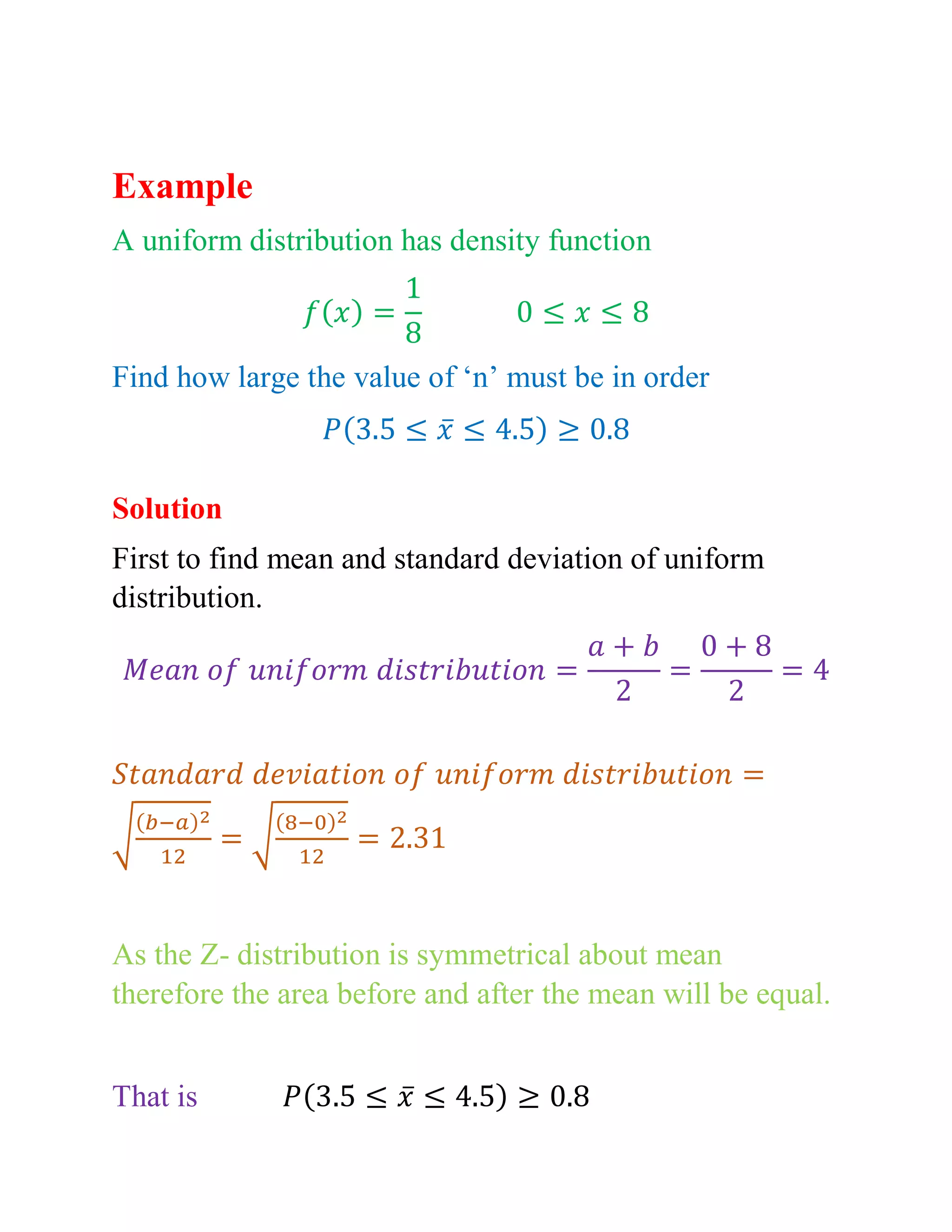
A uniform distribution has density function
𝑓(𝑥) =
1
8
0 ≤ 𝑥 ≤ 8
Find how large the value of ‘n’ must be in order
𝑃(3.5 ≤ 𝑥̅ ≤ 4.5) ≥ 0.8
Solution
First to find mean and standard deviation of uniform
distribution.
𝑀𝑒𝑎𝑛 𝑜𝑓 𝑢𝑛𝑖𝑓𝑜𝑟𝑚 𝑑𝑖𝑠𝑡𝑟𝑖𝑏𝑢𝑡𝑖𝑜𝑛 =
𝑎 + 𝑏
2
=
0 + 8
2
= 4
𝑆𝑡𝑎𝑛𝑑𝑎𝑟𝑑 𝑑𝑒𝑣𝑖𝑎𝑡𝑖𝑜𝑛 𝑜𝑓 𝑢𝑛𝑖𝑓𝑜𝑟𝑚 𝑑𝑖𝑠𝑡𝑟𝑖𝑏𝑢𝑡𝑖𝑜𝑛 =
√
(𝑏−𝑎)2
12
= √
(8−0)2
12
= 2.31
As the Z- distribution is symmetrical about mean
therefore the area before and after the mean will be equal.
That is 𝑃(3.5 ≤ 𝑥̅ ≤ 4.5) ≥ 0.8
𝑃 (
3.5−𝜇
𝜎
√𝑛
⁄
≤
𝑥̅−𝜇
𝜎
√𝑛
⁄
≤
4.5−𝜇
𝜎
√𝑛
⁄
) ≥ 0.8
𝑃 (
3.5−4
2.31
√𝑛
⁄
≤
𝑥̅−𝜇
𝜎
√𝑛
⁄
≤
4.5−4
2.31
√𝑛
⁄
) ≥ 0.8
The value of Z at 𝑃(𝑥̅ ≤ 3.5) = 0.1000 𝑖𝑠 − 1.28
By comparing
3.5 − 4
2.31
√𝑛
⁄
= −1.28
𝑛 = (
−1.28 × 2.31
−0.5
)
2
𝑛 = 34.97 ≃ 35

A uniform distribution has density function find n (1)

  • 1.
    Example A uniform distributionhas density function 𝑓(𝑥) = 1 8 0 ≤ 𝑥 ≤ 8 Find how large the value of ‘n’ must be in order 𝑃(3.5 ≤ 𝑥̅ ≤ 4.5) ≥ 0.8 Solution First to find mean and standard deviation of uniform distribution. 𝑀𝑒𝑎𝑛 𝑜𝑓 𝑢𝑛𝑖𝑓𝑜𝑟𝑚 𝑑𝑖𝑠𝑡𝑟𝑖𝑏𝑢𝑡𝑖𝑜𝑛 = 𝑎 + 𝑏 2 = 0 + 8 2 = 4 𝑆𝑡𝑎𝑛𝑑𝑎𝑟𝑑 𝑑𝑒𝑣𝑖𝑎𝑡𝑖𝑜𝑛 𝑜𝑓 𝑢𝑛𝑖𝑓𝑜𝑟𝑚 𝑑𝑖𝑠𝑡𝑟𝑖𝑏𝑢𝑡𝑖𝑜𝑛 = √ (𝑏−𝑎)2 12 = √ (8−0)2 12 = 2.31 As the Z- distribution is symmetrical about mean therefore the area before and after the mean will be equal. That is 𝑃(3.5 ≤ 𝑥̅ ≤ 4.5) ≥ 0.8
  • 2.
    𝑃 ( 3.5−𝜇 𝜎 √𝑛 ⁄ ≤ 𝑥̅−𝜇 𝜎 √𝑛 ⁄ ≤ 4.5−𝜇 𝜎 √𝑛 ⁄ ) ≥0.8 𝑃 ( 3.5−4 2.31 √𝑛 ⁄ ≤ 𝑥̅−𝜇 𝜎 √𝑛 ⁄ ≤ 4.5−4 2.31 √𝑛 ⁄ ) ≥ 0.8 The value of Z at 𝑃(𝑥̅ ≤ 3.5) = 0.1000 𝑖𝑠 − 1.28 By comparing 3.5 − 4 2.31 √𝑛 ⁄ = −1.28 𝑛 = ( −1.28 × 2.31 −0.5 ) 2 𝑛 = 34.97 ≃ 35