Gaussian Elimination in Engineering Mathematics.pptx
1.
Solution of simultaneouslinear equations
Gaussian Elimination
(MTH 211)
Dr Nisha Singhal
INDIAN INSTITUTE OF INFORMATION TECHNOLOGY , BHOPAL
2.
Solution of simultaneouslinear equations
of the form [A][X]=[B]
Two Types of method to solve simultaneous
linear equations of the form [A][X]=[B]
(i) Direct method - These methods yield the exact
solution after a finite no. of steps in absence of round
-off errors. the amount of computation involved can
be specified in advance
(ii) Indirect method - These methods give a sequence
of approximations which converges when the no. of
steps tend to infinity.
* In some cases, both the direct and indirect methods
are combined. first we use a direct method and then
the solution may be improved by using iterative
Gaussian Elimination
A methodto solve simultaneous linear equations
of the form [A][X]=[B]
This is a direct method with a fixed no. of arithmetic
operations.
it is Quite efficient and straight forward but a round
off errors becomes significant for a large set of
equations.
Forward Elimination
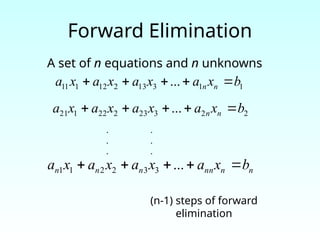
A setof n equations and n unknowns
1
1
3
13
2
12
1
11 ... b
x
a
x
a
x
a
x
a n
n
2
2
3
23
2
22
1
21 ... b
x
a
x
a
x
a
x
a n
n
n
n
nn
n
n
n b
x
a
x
a
x
a
x
a
...
3
3
2
2
1
1
. .
. .
. .
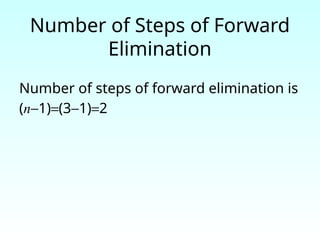
(n-1) steps of forward
elimination
7.
Forward Elimination
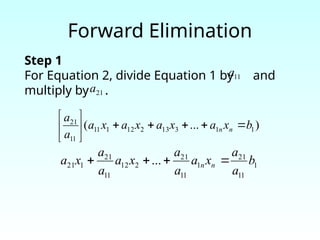
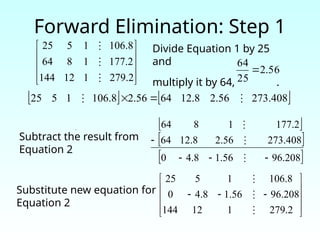
Step 1
ForEquation 2, divide Equation 1 by and
multiply by .
)
...
( 1
1
3
13
2
12
1
11
11
21
b
x
a
x
a
x
a
x
a
a
a
n
n
1
11
21
1
11
21
2
12
11
21
1
21 ... b
a
a
x
a
a
a
x
a
a
a
x
a n
n
11
a
21
a
8.
Forward Elimination
1
11
21
1
11
21
2
12
11
21
1
21 ...b
a
a
x
a
a
a
x
a
a
a
x
a n
n
1
11
21
2
1
11
21
2
2
12
11
21
22 ... b
a
a
b
x
a
a
a
a
x
a
a
a
a n
n
n
'
2
'
2
2
'
22 ... b
x
a
x
a n
n
2
2
3
23
2
22
1
21 ... b
x
a
x
a
x
a
x
a n
n
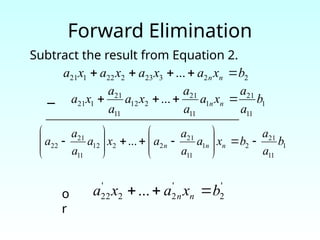
Subtract the result from Equation 2.
−
_________________________________________________
o
r
9.
Forward Elimination
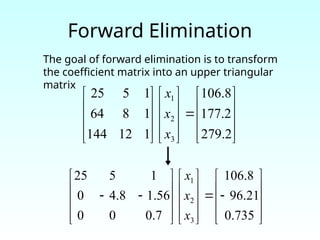
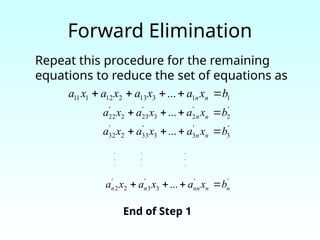
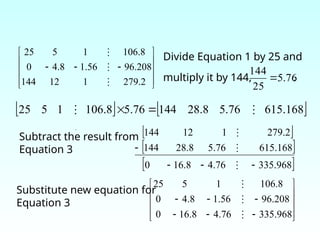
Repeat thisprocedure for the remaining
equations to reduce the set of equations as
1
1
3
13
2
12
1
11 ... b
x
a
x
a
x
a
x
a n
n
'
2
'
2
3
'
23
2
'
22 ... b
x
a
x
a
x
a n
n
'
3
'
3
3
'
33
2
'
32 ... b
x
a
x
a
x
a n
n
'
'
3
'
3
2
'
2 ... n
n
nn
n
n b
x
a
x
a
x
a
. . .
. . .
. . .
End of Step 1
10.
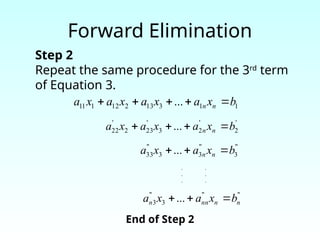
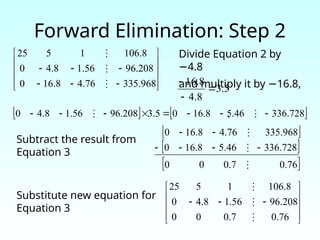
Step 2
Repeat thesame procedure for the 3rd
term
of Equation 3.
Forward Elimination
1
1
3
13
2
12
1
11 ... b
x
a
x
a
x
a
x
a n
n
'
2
'
2
3
'
23
2
'
22 ... b
x
a
x
a
x
a n
n
"
3
"
3
3
"
33 ... b
x
a
x
a n
n
"
"
3
"
3 ... n
n
nn
n b
x
a
x
a
. .
. .
. .
End of Step 2
11.
Forward Elimination
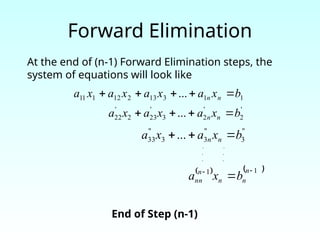
At theend of (n-1) Forward Elimination steps, the
system of equations will look like
'
2
'
2
3
'
23
2
'
22 ... b
x
a
x
a
x
a n
n
"
3
"
3
3
"
33 ... b
x
a
x
a n
n
1
1
n
n
n
n
nn b
x
a
. .
. .
. .
1
1
3
13
2
12
1
11 ... b
x
a
x
a
x
a
x
a n
n
End of Step (n-1)
12.
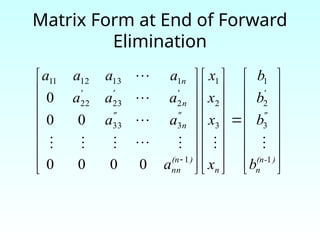
Matrix Form atEnd of Forward
Elimination
)
(n-
n
"
'
n
)
(n
nn
"
n
"
'
n
'
'
n
b
b
b
b
x
x
x
x
a
a
a
a
a
a
a
a
a
a
1
3
2
1
3
2
1
1
3
33
2
23
22
1
13
12
11
0
0
0
0
0
0
0
13.
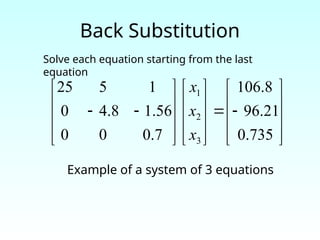
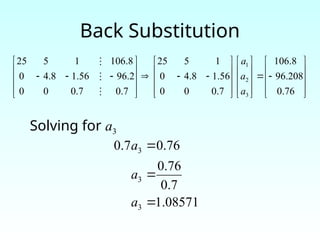
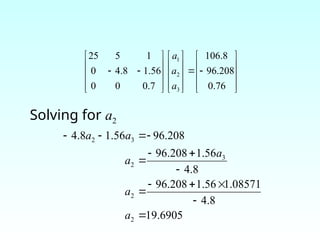
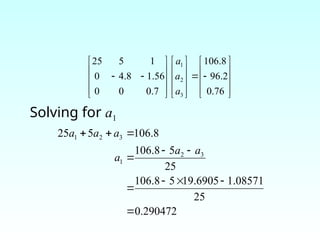
Back Substitution
Solve eachequation starting from the last
equation
Example of a system of 3 equations
735
.
0
21
.
96
8
.
106
7
.
0
0
0
56
.
1
8
.
4
0
1
5
25
3
2
1
x
x
x
14.
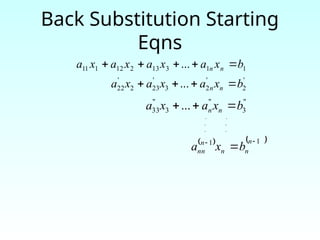
Back Substitution Starting
Eqns
'
2
'
2
3
'
23
2
'
22... b
x
a
x
a
x
a n
n
"
3
"
3
"
33 ... b
x
a
x
a n
n
1
1
n
n
n
n
nn b
x
a
. .
. .
. .
1
1
3
13
2
12
1
11 ... b
x
a
x
a
x
a
x
a n
n
15.
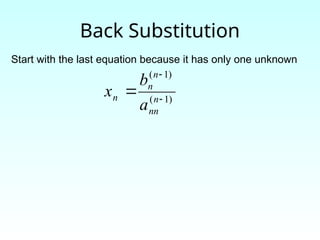
Back Substitution
Start withthe last equation because it has only one unknown
)
1
(
)
1
(
n
nn
n
n
n
a
b
x
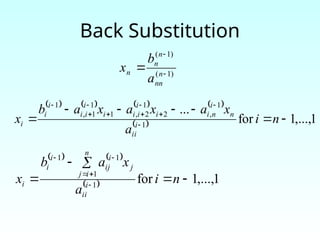
16.
Back Substitution
1
,...,
1
for
1
1
1
1
n
i
a
x
a
b
x i
ii
n
i
j
j
i
ij
i
i
i
)
1
(
)
1
(
n
nn
n
n
n
a
b
x
1
,...,
1
for
...
1
1
,
2
1
2
,
1
1
1
,
1
n
i
a
x
a
x
a
x
a
b
x i
ii
n
i
n
i
i
i
i
i
i
i
i
i
i
i
i
17.
Example
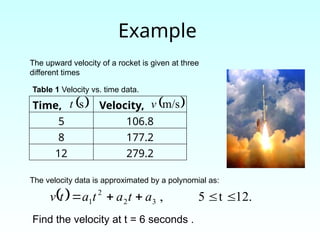
The upward velocityof a rocket is given at three
different times
Time, Velocity,
5 106.8
8 177.2
12 279.2
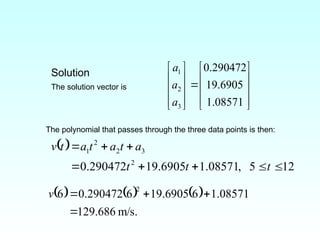
The velocity data is approximated by a polynomial as:
12.
t
5
,
3
2
2
1
a
t
a
t
a
t
v
Find the velocity at t = 6 seconds .
s
t
m/s
v
Table 1 Velocity vs. time data.
18.
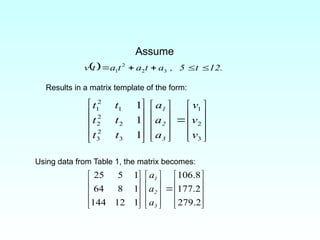
Assume
12.
t
5
,
a
t
a
t
a
t
v
3
2
2
1
3
2
1
3
2
3
2
2
2
1
2
1
1
1
1
v
v
v
a
a
a
t
t
t
t
t
t
3
2
1
Results in a matrix template of the form:
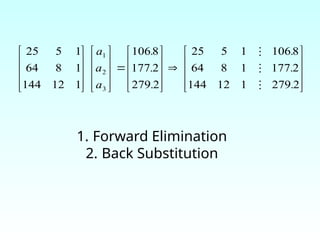
Using data from Table 1, the matrix becomes:
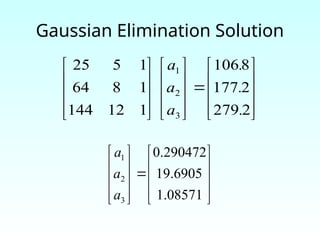
2
.
279
2
.
177
8
.
106
1
12
144
1
8
64
1
5
25
3
2
1
a
a
a

![Solution of simultaneous linear equations
of the form [A][X]=[B]
Two Types of method to solve simultaneous
linear equations of the form [A][X]=[B]
(i) Direct method - These methods yield the exact
solution after a finite no. of steps in absence of round
-off errors. the amount of computation involved can
be specified in advance
(ii) Indirect method - These methods give a sequence
of approximations which converges when the no. of
steps tend to infinity.
* In some cases, both the direct and indirect methods
are combined. first we use a direct method and then
the solution may be improved by using iterative](https://image.slidesharecdn.com/gaussianelimination-251107085229-b63494cf/85/Gaussian-Elimination-in-Engineering-Mathematics-pptx-2-320.jpg)
![Gaussian Elimination
A method to solve simultaneous linear equations
of the form [A][X]=[B]
This is a direct method with a fixed no. of arithmetic
operations.
it is Quite efficient and straight forward but a round
off errors becomes significant for a large set of
equations.](https://image.slidesharecdn.com/gaussianelimination-251107085229-b63494cf/85/Gaussian-Elimination-in-Engineering-Mathematics-pptx-4-320.jpg)