Prabir Basu
FUELS & COMBUSTION
CALCULATIONS
Unit 5
TYPES OF FUELS
 FOSSIL FUELS
Solid fuels (COAL)
Liquid fuels (OIL)
Gaseous fuels (NATURAL GAS)
 NUCLEAR FUELS
 RENEWABLE FUELS (BIOMASS)
 WASTE FUELS (MUNICIPAL WASTES)
SOLID FUELS PROPERTIES
 HEATING VALUE
 ULTIMATE ANALYSIS
 PROXIMATE ANALYSIS
 ASH DEFORMATION POINTS
Initial deformation temp.
Softening temp.
Hemispherical temp
Fluid temp.
LIQUID FUELS PROPERTIES
 HEATING VALUE
 FLASH POINT
 IGNITION POINT (SELF, FORCED)
 VISCOSITY
 POUR POINT
 SULFUR
 ASH
Refinery process
Distillation
GASEOUS FUEL
PROPERTIES
 HEATING VALUE
 COMPOSITION
 DENSITY
BASIS OF ANALYSIS
 AS RECEIVED
Ultimate C +H +O +N +S +A +M =100
Proximate VM +FC +M +A = 100
 AIR DRY [100C/(100-Ma)]
 DRY ASH FREE [100C/(100-M-A)]
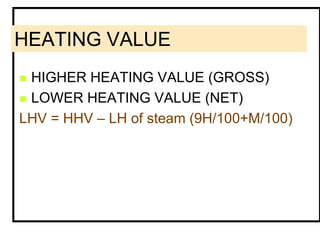
HEATING VALUE
 HIGHER HEATING VALUE (GROSS)
 LOWER HEATING VALUE (NET)
LHV = HHV – LH of steam (9H/100+M/100)
II-1 CHEMICAL REACTIONS
 Combustion
C + O2 = CO2 + 32,790 kJ/kg of carbon,
Heat of formation at 25C is 393.7 kJ/mol [Perry p-2-188]
mCn Hm + (n +m/4)O2 = nCO2 + m/2 H2O + Q
S + O2 = SO2 + 9260 kJ/kg of sulfur
 Calcination
CaCO3 = CaO + CO2 – 1830 kJ/kg of CaCO3gCO3
= MgO + CO2 – 1183 kJ/kg of MgCO3.
 Sulfation
 CaO + SO2 + 1/2 O2 = CaSO4 + 15141 kJ/kg S.
Basic Stoichiometry
 C + O2 = CO2 + q
 1 kmol of carbon combines with 1 kmol of oxygen
to produce 1 kmol of carbon dioxide and release q
amount of heat.
 1 kmol of reactant = M kg of the reactant
when M is the molecular weight of the reactant.
So mass of one kmol of oxygen (O2) is
2x16 = 32 kg
 1 kmol of a gas occupies 22.4 nm3 at 00C 1 atm
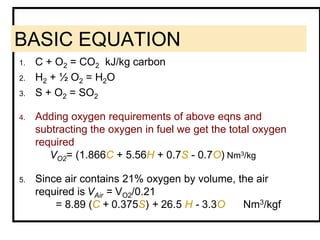
BASIC EQUATION
1. C + O2 = CO2 kJ/kg carbon
2. H2 + ½ O2 = H2O
3. S + O2 = SO2
4. Adding oxygen requirements of above eqns and
subtracting the oxygen in fuel we get the total oxygen
required
VO2= (1.866C + 5.56H + 0.7S - 0.7O) Nm3/kg
5. Since air contains 21% oxygen by volume, the air
required is VAir = VO2/0.21
= 8.89 (C + 0.375S) + 26.5 H - 3.3O Nm3/kgf
Limestone required for S capture
 Limestone required for
unit mass of fuel
[R = Calcium to Sulfur molar
ratio]
 If appreciable amount
of CaO is present in
coal ash replace R
with R’
R
X
S
Lq
caco332
100
S
X
RR cao
56
32
'
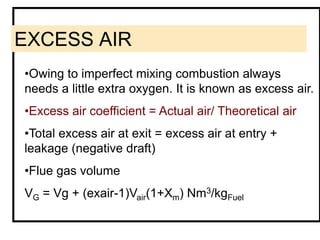
EXCESS AIR
•Owing to imperfect mixing combustion always
needs a little extra oxygen. It is known as excess air.
•Excess air coefficient = Actual air/ Theoretical air
•Total excess air at exit = excess air at entry +
leakage (negative draft)
•Flue gas volume
VG = Vg + (exair-1)Vair(1+Xm) Nm3/kgFuel
AIR REQUIRED/mass fuel burnt
 Theoretical dry air requirement
 Mda= [11.53 C + 34.34 (H – O/8) + 4.34 S+ A.S]
kg/kg coal
where A = 2.38 for S-capture;
= 0 for no S-capture
 Actual dry air required
 Tda = Excess air Coeff. X Mda kg/kg
 Actual wet air required
 Mwa = Tda (1 + Xm).
TYPICAL EXCESS AIR COEFFICIENT
PF Slag tap Bubbling CFB Oil & Gas Oil & Gas
Anthracite Bituminus All fuels All fuel Negative
pressure
Positive
pressure
1.2-1.25 1.15-1.2 1.3-1.5 1.2 1.08-1.07 1.05-1.07
SOLID WASTE PRODUCED
 Solid residues = Ash + Spent sorbents
 Spent sorbents = CaSO4+CaO+MgO+inert


Wa = [Lw + ASH + (1 – Ec) – Xcao],
 Gas product = CO2+H2O+N2+O2+SO2+Fly ash
inert
mgcosorcaco
sor LqX
LqXSELqX
E
S
Lw
84
40
32100
56
32
136
33
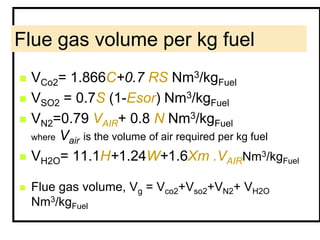
Flue gas volume per kg fuel
 VCo2= 1.866C+0.7 RS Nm3/kgFuel
 VSO2 = 0.7S (1-Esor) Nm3/kgFuel
 VN2=0.79 VAIR+ 0.8 N Nm3/kgFuel
where Vair is the volume of air required per kg fuel
 VH2O= 11.1H+1.24W+1.6Xm .VAIRNm3/kgFuel
 Flue gas volume, Vg = Vco2+Vso2+VN2+ VH2O
Nm3/kgFuel
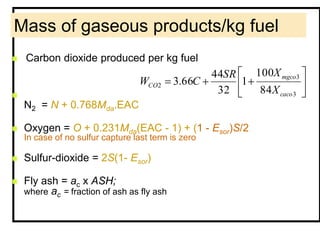
Mass of gaseous products/kg fuel
 Carbon dioxide produced per kg fuel

N2 = N + 0.768Mda.EAC
 Oxygen = O + 0.231Mda(EAC - 1) + (1 - Esor)S/2
In case of no sulfur capture last term is zero
 Sulfur-dioxide = 2S(1- Esor)
 Fly ash = ac x ASH;
where ac = fraction of ash as fly ash
3
3
2
84
100
1
32
44
66.3
caco
mgco
CO
X
XSR
CW
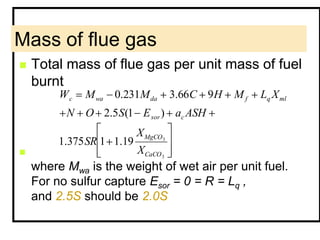
Mass of flue gas
 Total mass of flue gas per unit mass of fuel
burnt

where Mwa is the weight of wet air per unit fuel.
For no sulfur capture Esor = 0 = R = Lq ,
and 2.5S should be 2.0S
Wc Mwa 0.231Mda 3.66C 9H Mf Lq Xml
N O 2.5S(1 Esor) ac ASH
1.375SR 1 1.19
XMgCO3
XCaCO3
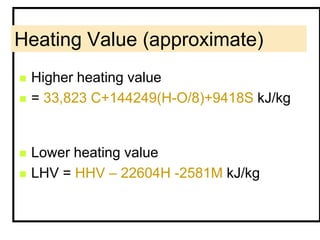
Heating Value (approximate)
 Higher heating value
 = 33,823 C+144249(H-O/8)+9418S kJ/kg
 Lower heating value
 LHV = HHV – 22604H -2581M kJ/kg
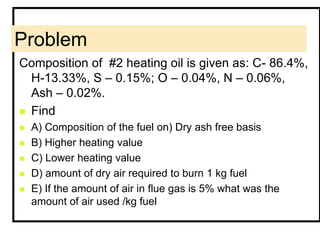
Problem
Composition of #2 heating oil is given as: C- 86.4%,
H-13.33%, S – 0.15%; O – 0.04%, N – 0.06%,
Ash – 0.02%.
 Find
 A) Composition of the fuel on) Dry ash free basis
 B) Higher heating value
 C) Lower heating value
 D) amount of dry air required to burn 1 kg fuel
 E) If the amount of air in flue gas is 5% what was the
amount of air used /kg fuel

04 fuels & combustion calculation09

  • 1.
    Prabir Basu FUELS &COMBUSTION CALCULATIONS Unit 5
  • 2.
    TYPES OF FUELS FOSSIL FUELS Solid fuels (COAL) Liquid fuels (OIL) Gaseous fuels (NATURAL GAS)  NUCLEAR FUELS  RENEWABLE FUELS (BIOMASS)  WASTE FUELS (MUNICIPAL WASTES)
  • 3.
    SOLID FUELS PROPERTIES HEATING VALUE  ULTIMATE ANALYSIS  PROXIMATE ANALYSIS  ASH DEFORMATION POINTS Initial deformation temp. Softening temp. Hemispherical temp Fluid temp.
  • 4.
    LIQUID FUELS PROPERTIES HEATING VALUE  FLASH POINT  IGNITION POINT (SELF, FORCED)  VISCOSITY  POUR POINT  SULFUR  ASH
  • 5.
  • 6.
  • 7.
    GASEOUS FUEL PROPERTIES  HEATINGVALUE  COMPOSITION  DENSITY
  • 8.
    BASIS OF ANALYSIS AS RECEIVED Ultimate C +H +O +N +S +A +M =100 Proximate VM +FC +M +A = 100  AIR DRY [100C/(100-Ma)]  DRY ASH FREE [100C/(100-M-A)]
  • 9.
    HEATING VALUE  HIGHERHEATING VALUE (GROSS)  LOWER HEATING VALUE (NET) LHV = HHV – LH of steam (9H/100+M/100)
  • 10.
    II-1 CHEMICAL REACTIONS Combustion C + O2 = CO2 + 32,790 kJ/kg of carbon, Heat of formation at 25C is 393.7 kJ/mol [Perry p-2-188] mCn Hm + (n +m/4)O2 = nCO2 + m/2 H2O + Q S + O2 = SO2 + 9260 kJ/kg of sulfur  Calcination CaCO3 = CaO + CO2 – 1830 kJ/kg of CaCO3gCO3 = MgO + CO2 – 1183 kJ/kg of MgCO3.  Sulfation  CaO + SO2 + 1/2 O2 = CaSO4 + 15141 kJ/kg S.
  • 11.
    Basic Stoichiometry  C+ O2 = CO2 + q  1 kmol of carbon combines with 1 kmol of oxygen to produce 1 kmol of carbon dioxide and release q amount of heat.  1 kmol of reactant = M kg of the reactant when M is the molecular weight of the reactant. So mass of one kmol of oxygen (O2) is 2x16 = 32 kg  1 kmol of a gas occupies 22.4 nm3 at 00C 1 atm
  • 12.
    BASIC EQUATION 1. C+ O2 = CO2 kJ/kg carbon 2. H2 + ½ O2 = H2O 3. S + O2 = SO2 4. Adding oxygen requirements of above eqns and subtracting the oxygen in fuel we get the total oxygen required VO2= (1.866C + 5.56H + 0.7S - 0.7O) Nm3/kg 5. Since air contains 21% oxygen by volume, the air required is VAir = VO2/0.21 = 8.89 (C + 0.375S) + 26.5 H - 3.3O Nm3/kgf
  • 13.
    Limestone required forS capture  Limestone required for unit mass of fuel [R = Calcium to Sulfur molar ratio]  If appreciable amount of CaO is present in coal ash replace R with R’ R X S Lq caco332 100 S X RR cao 56 32 '
  • 14.
    EXCESS AIR •Owing toimperfect mixing combustion always needs a little extra oxygen. It is known as excess air. •Excess air coefficient = Actual air/ Theoretical air •Total excess air at exit = excess air at entry + leakage (negative draft) •Flue gas volume VG = Vg + (exair-1)Vair(1+Xm) Nm3/kgFuel
  • 15.
    AIR REQUIRED/mass fuelburnt  Theoretical dry air requirement  Mda= [11.53 C + 34.34 (H – O/8) + 4.34 S+ A.S] kg/kg coal where A = 2.38 for S-capture; = 0 for no S-capture  Actual dry air required  Tda = Excess air Coeff. X Mda kg/kg  Actual wet air required  Mwa = Tda (1 + Xm).
  • 16.
    TYPICAL EXCESS AIRCOEFFICIENT PF Slag tap Bubbling CFB Oil & Gas Oil & Gas Anthracite Bituminus All fuels All fuel Negative pressure Positive pressure 1.2-1.25 1.15-1.2 1.3-1.5 1.2 1.08-1.07 1.05-1.07
  • 17.
    SOLID WASTE PRODUCED Solid residues = Ash + Spent sorbents  Spent sorbents = CaSO4+CaO+MgO+inert   Wa = [Lw + ASH + (1 – Ec) – Xcao],  Gas product = CO2+H2O+N2+O2+SO2+Fly ash inert mgcosorcaco sor LqX LqXSELqX E S Lw 84 40 32100 56 32 136 33
  • 18.
    Flue gas volumeper kg fuel  VCo2= 1.866C+0.7 RS Nm3/kgFuel  VSO2 = 0.7S (1-Esor) Nm3/kgFuel  VN2=0.79 VAIR+ 0.8 N Nm3/kgFuel where Vair is the volume of air required per kg fuel  VH2O= 11.1H+1.24W+1.6Xm .VAIRNm3/kgFuel  Flue gas volume, Vg = Vco2+Vso2+VN2+ VH2O Nm3/kgFuel
  • 19.
    Mass of gaseousproducts/kg fuel  Carbon dioxide produced per kg fuel  N2 = N + 0.768Mda.EAC  Oxygen = O + 0.231Mda(EAC - 1) + (1 - Esor)S/2 In case of no sulfur capture last term is zero  Sulfur-dioxide = 2S(1- Esor)  Fly ash = ac x ASH; where ac = fraction of ash as fly ash 3 3 2 84 100 1 32 44 66.3 caco mgco CO X XSR CW
  • 20.
    Mass of fluegas  Total mass of flue gas per unit mass of fuel burnt  where Mwa is the weight of wet air per unit fuel. For no sulfur capture Esor = 0 = R = Lq , and 2.5S should be 2.0S Wc Mwa 0.231Mda 3.66C 9H Mf Lq Xml N O 2.5S(1 Esor) ac ASH 1.375SR 1 1.19 XMgCO3 XCaCO3
  • 21.
    Heating Value (approximate) Higher heating value  = 33,823 C+144249(H-O/8)+9418S kJ/kg  Lower heating value  LHV = HHV – 22604H -2581M kJ/kg
  • 22.
    Problem Composition of #2heating oil is given as: C- 86.4%, H-13.33%, S – 0.15%; O – 0.04%, N – 0.06%, Ash – 0.02%.  Find  A) Composition of the fuel on) Dry ash free basis  B) Higher heating value  C) Lower heating value  D) amount of dry air required to burn 1 kg fuel  E) If the amount of air in flue gas is 5% what was the amount of air used /kg fuel