V.D. PRASADA RAO
MEMORIAL HIGH SCHOOL.
CLASS:VIII,SEC:A&B.
SUBJECT:PHYSICS.
UNIT.NO:7
COMBUSTION,FUEL
AND FLAME.
COMBUSTION,FUELS AND
FLAME
INTRODUCTION:
We use different kinds of materials as fuels for various
Purpose at home. You might have observed or heard
about how people are used to burn wood , coal ,
cake
of cowdung,e.t.c., for cooking food at home.
Both in urban and rural areas, now a day’s,
LPG is used as fuel for cooking the food.
we use the light from the burning candle or
coal. What difference do you notice in the
burning process?........
DO ALL MATERIALS BURN?
o Do all materials burn or not ?. So, here
there is an experimental video.
COMBUSTION:
A chemical process in which a material
reacts with oxygen present in the air to generate
heat is called ‘combustion’. The material which
burn when brought near a flame are called
‘ combustible materials’. Some of them can
also be used as fuels. The materials which
do not burn are called Non-combustible
materials.
TESTING THE NECESSITY OF
AIR FOR BURNING:
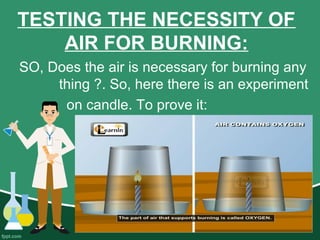
SO, Does the air is necessary for burning any
thing ?. So, here there is an experiment
on candle. To prove it:
EXPERIMENTAL VIDEO ON
AIR IS NECESSARY FOR
BURNING
So , we can that putting the glass tumbler
Over the candle cuts off the supply of air and
the candle flame goes off. This experiment
Proves that air is needed to burn a material.
some other experiments needed to be
conducted to prove that the oxygen
present in air supports the combustion.
IGNITION TEMPERATURE:
The substances which catch initially heated
catch fire or burn. The lowest temperature at
which a substance catches fire is called its
‘ignition temperature’. When a substance
starts burning heat is produced and it
help to burn substance continuously.
The ignition temperature is different
substance decides quickness of
catching fire.
BURNING A PAPER WITH
SUN RAYS:
So , A paper can burn with sun rays? ,so there is
an experimental video on it:
INFLAMMABLE SUBSTANCE:
The substance which have very low
Ignition temperature and easily catch fire are
called ‘inflammable substance’.
Example of inflammable substances are
petrol, alcohol, liquid petroleum gas
are the example of inflammable object.
UNDERSTANDING IGNITION
TEMPERATURE:
Experimental video on
understanding
ignition temperature:
TYPES OF COMBUSTION
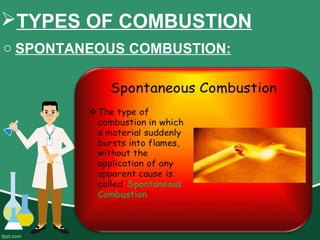
o SPONTANEOUS COMBUSTION:
o RAPID COMBUSTION:
The type of combustion in which material
burns
Rapidly and produces heat and light is
called
rapid combustion.
FUELS:
We know that combustion gives heat and
light.The sources of heafordomestic,automobile
and Industrial purposes
wood,petro,LPG,CNG.
These substances are fuels. We not only
use fossil fuels and their use in various
ways. We not only use fossile fuels for
different purposes at homes.
In general, there are several factors
that have to be kept in mind
while
choosing a fuel,like purpose of use,
fuel efficiency and availability and safe
to store,easy to ignite and put off.
CALORIFIC VALUE:CALORIFIC VALUE:
Suppose 1kg of coal and 1kg of cow dung are
burnt. Which produced more heat ?......
Different substances produce different amounts
of heat on burning. Heat is measured in
kilo joules. Calorific value of a fuel is
the amount of heat energy produced
on complete combustion of 1kg of that
fuel. It is measured in kilo joules per kg.
FIRE CONTROL:FIRE CONTROL:
You must have seen or heard about fire breaking
out in houses, shops, factories, e.t.c.
o How can we put off the fire if it breaks out?......
We use many methods to extinguish a
fire but they all follow one principle,
which is the principle of elimination
of factors which support the
combustion
• Let us recall the factors which support the
combustion:
(a)Presence of a combustible material or the
fuel
(b) Supply of air (oxygen)
(c) High temperature (more than the
ignition temperature)
so, elimination of any one of the three
factors will help in controlling the fire.
FIRE EXTENSTION:FIRE EXTENSTION:
FLAME:FLAME:
OBSERVING THE BEHAVIOUR OF DIFFERENTOBSERVING THE BEHAVIOUR OF DIFFERENT
SOLID FUELS:SOLID FUELS:
Collect some fuels like candle,
coal, domestic gas, char coal and mag-
nesium ribbon, wood, cakes of cow dung
e.t.c. burn each of them one by one
with the help of spirit lamp and note the
time they take to catch fire. And also
observe how do they burn?.........
You may observe that a candle burns with flame
Where as charcoal does not. Some materials
burn with flame, some do not. Kerosine oil and
molten wax rise through the wick become gas
and form flames. But charcoal cannot be vapori-
zed.so it does not produce a flame. A
fuel catches fire immediately if it is in
the form of gas. Cooking gas catches
fire immediately. Spirit and petrol turn
into gas at room temperature. Hence ,
they catch fire quickly.
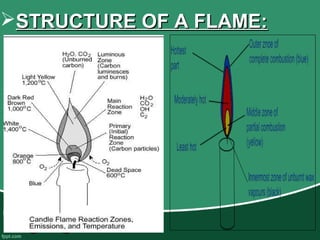
STRUCTURE OF A FLAME:STRUCTURE OF A FLAME:
Light a wax candle and watch the flame.
Carefully note the difference coloured zones in
the flame. How many coloures are there in
flame?
starting from the base of the flame, how
many flame zones do you observe ?..........
what is the colour of the outer most zone
of the flame?................
observe the innermost zone which is
dark. What do you observe there?........
Is there combustion takes place? In this zones
Wax gets vaporized. This is a dark zone. See
The figure?.........
observe near the base of the flame. Vaprized
wax gets completely oxidized and burns with
a blue flame. It is the blue zone.
Observing what happens inObserving what happens in
different zones of candle flamedifferent zones of candle flame
Light a candle. Hold a glass tube with a pair
Of tongs and introduced its one end in the
Of a non flickering candle flame. Keep a
lighted match stick near the other end
of the glass tube. What do you obs-
erve? Do you see a flame? If so what
is it that produces a flame?
Notice that the wax near the heated wick melts
Quickly.
when the candle’s flame is stedy,
introduced a clean glass slide into the lumino-
us zone(yellow zone) of the flame and hold
for 10 seconds.what do you observe?...
A blakish circular ring is formed on the
glass slide. What is it? It indicates the
deposition of un-burnt carbon particles
present in the luminous zone of the
flame.
In complete combustion takes place in
Zone.
Hold a thin long copper wire just inside
the flame for about half a minute as shown.
what do you observe? The copper wire
just out side the flame gets red hot. It
indicates that the non-luminious zo-
ne of the flame has high temperature.
It is the hottest part of the flame.
It is blue in colour and complete combustion
Takes place due to good supply of oxygen.

COMBUSTION ,FUEL AND FLAME

  • 1.
    V.D. PRASADA RAO MEMORIALHIGH SCHOOL. CLASS:VIII,SEC:A&B. SUBJECT:PHYSICS. UNIT.NO:7 COMBUSTION,FUEL AND FLAME.
  • 2.
  • 3.
    INTRODUCTION: We use differentkinds of materials as fuels for various Purpose at home. You might have observed or heard about how people are used to burn wood , coal , cake of cowdung,e.t.c., for cooking food at home. Both in urban and rural areas, now a day’s, LPG is used as fuel for cooking the food. we use the light from the burning candle or coal. What difference do you notice in the burning process?........
  • 4.
    DO ALL MATERIALSBURN? o Do all materials burn or not ?. So, here there is an experimental video.
  • 5.
    COMBUSTION: A chemical processin which a material reacts with oxygen present in the air to generate heat is called ‘combustion’. The material which burn when brought near a flame are called ‘ combustible materials’. Some of them can also be used as fuels. The materials which do not burn are called Non-combustible materials.
  • 6.
    TESTING THE NECESSITYOF AIR FOR BURNING: SO, Does the air is necessary for burning any thing ?. So, here there is an experiment on candle. To prove it:
  • 7.
    EXPERIMENTAL VIDEO ON AIRIS NECESSARY FOR BURNING
  • 8.
    So , wecan that putting the glass tumbler Over the candle cuts off the supply of air and the candle flame goes off. This experiment Proves that air is needed to burn a material. some other experiments needed to be conducted to prove that the oxygen present in air supports the combustion.
  • 9.
    IGNITION TEMPERATURE: The substanceswhich catch initially heated catch fire or burn. The lowest temperature at which a substance catches fire is called its ‘ignition temperature’. When a substance starts burning heat is produced and it help to burn substance continuously. The ignition temperature is different substance decides quickness of catching fire.
  • 10.
    BURNING A PAPERWITH SUN RAYS: So , A paper can burn with sun rays? ,so there is an experimental video on it:
  • 11.
    INFLAMMABLE SUBSTANCE: The substancewhich have very low Ignition temperature and easily catch fire are called ‘inflammable substance’. Example of inflammable substances are petrol, alcohol, liquid petroleum gas are the example of inflammable object.
  • 12.
    UNDERSTANDING IGNITION TEMPERATURE: Experimental videoon understanding ignition temperature:
  • 13.
    TYPES OF COMBUSTION oSPONTANEOUS COMBUSTION:
  • 14.
    o RAPID COMBUSTION: Thetype of combustion in which material burns Rapidly and produces heat and light is called rapid combustion.
  • 15.
    FUELS: We know thatcombustion gives heat and light.The sources of heafordomestic,automobile and Industrial purposes wood,petro,LPG,CNG. These substances are fuels. We not only use fossil fuels and their use in various ways. We not only use fossile fuels for different purposes at homes.
  • 16.
    In general, thereare several factors that have to be kept in mind while choosing a fuel,like purpose of use, fuel efficiency and availability and safe to store,easy to ignite and put off.
  • 17.
    CALORIFIC VALUE:CALORIFIC VALUE: Suppose1kg of coal and 1kg of cow dung are burnt. Which produced more heat ?...... Different substances produce different amounts of heat on burning. Heat is measured in kilo joules. Calorific value of a fuel is the amount of heat energy produced on complete combustion of 1kg of that fuel. It is measured in kilo joules per kg.
  • 18.
    FIRE CONTROL:FIRE CONTROL: Youmust have seen or heard about fire breaking out in houses, shops, factories, e.t.c. o How can we put off the fire if it breaks out?...... We use many methods to extinguish a fire but they all follow one principle, which is the principle of elimination of factors which support the combustion
  • 19.
    • Let usrecall the factors which support the combustion: (a)Presence of a combustible material or the fuel (b) Supply of air (oxygen) (c) High temperature (more than the ignition temperature) so, elimination of any one of the three factors will help in controlling the fire.
  • 20.
  • 21.
    FLAME:FLAME: OBSERVING THE BEHAVIOUROF DIFFERENTOBSERVING THE BEHAVIOUR OF DIFFERENT SOLID FUELS:SOLID FUELS: Collect some fuels like candle, coal, domestic gas, char coal and mag- nesium ribbon, wood, cakes of cow dung e.t.c. burn each of them one by one with the help of spirit lamp and note the time they take to catch fire. And also observe how do they burn?.........
  • 22.
    You may observethat a candle burns with flame Where as charcoal does not. Some materials burn with flame, some do not. Kerosine oil and molten wax rise through the wick become gas and form flames. But charcoal cannot be vapori- zed.so it does not produce a flame. A fuel catches fire immediately if it is in the form of gas. Cooking gas catches fire immediately. Spirit and petrol turn into gas at room temperature. Hence , they catch fire quickly.
  • 23.
    STRUCTURE OF AFLAME:STRUCTURE OF A FLAME:
  • 24.
    Light a waxcandle and watch the flame. Carefully note the difference coloured zones in the flame. How many coloures are there in flame? starting from the base of the flame, how many flame zones do you observe ?.......... what is the colour of the outer most zone of the flame?................ observe the innermost zone which is dark. What do you observe there?........
  • 25.
    Is there combustiontakes place? In this zones Wax gets vaporized. This is a dark zone. See The figure?......... observe near the base of the flame. Vaprized wax gets completely oxidized and burns with a blue flame. It is the blue zone.
  • 26.
    Observing what happensinObserving what happens in different zones of candle flamedifferent zones of candle flame Light a candle. Hold a glass tube with a pair Of tongs and introduced its one end in the Of a non flickering candle flame. Keep a lighted match stick near the other end of the glass tube. What do you obs- erve? Do you see a flame? If so what is it that produces a flame?
  • 27.
    Notice that thewax near the heated wick melts Quickly. when the candle’s flame is stedy, introduced a clean glass slide into the lumino- us zone(yellow zone) of the flame and hold for 10 seconds.what do you observe?... A blakish circular ring is formed on the glass slide. What is it? It indicates the deposition of un-burnt carbon particles present in the luminous zone of the flame.
  • 28.
    In complete combustiontakes place in Zone. Hold a thin long copper wire just inside the flame for about half a minute as shown. what do you observe? The copper wire just out side the flame gets red hot. It indicates that the non-luminious zo- ne of the flame has high temperature. It is the hottest part of the flame.
  • 29.
    It is bluein colour and complete combustion Takes place due to good supply of oxygen.

Editor's Notes

  • #18 calorific value so i can say3