1
COMBUSTION PROCESSES CEFCHA2
Chemical Engineering Fundamentals 2A
V Naidoo
JOB 4134
vizellen@uj.ac.za
2
Objectives
Stoichiometric combustion
Excess air combustion
Excess fuel combustion
Mass vs Volume air content
Wet and Dry basis analysis
Be able to apply all these principles in mass balances
Understand the difference between:
3
What is combustion?
Rapid oxidation of a fuel accompanied by the release of heat and/or light together with the formation of combustion
products
Fuel + oxidant heat/light + combustion products
Definition of combustion as quoted from Webster’s dictionary
“rapid oxidation generating heat, or both heat and light ; also, slow oxidation
accompanied by relatively little heat and no light”
4
Fossil Fuel Combustion
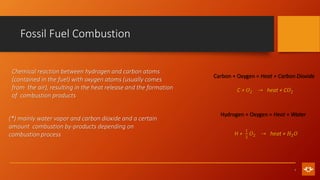
Chemical reaction between hydrogen and carbon atoms
(contained in the fuel) with oxygen atoms (usually comes
from the air), resulting in the heat release and the formation
of combustion products
(*) mainly water vapor and carbon dioxide and a certain
amount combustion by-products depending on
combustion process
Carbon + Oxygen = Heat + Carbon Dioxide
Hydrogen + Oxygen = Heat + Water
C + 𝑂2 → heat + C𝑂2
H +
1
2
𝑂2 → heat + 𝐻2𝑂
5
Categories of Combustion Processes
Complete combustion
The reaction goes to completion (Stoichiometrically correct)
Excess air or fuel lean
Does not go to completion (Excess & limiting reactants)
Incomplete or partial combustion
Excess fuel or fuel rich or deficient air
In practice, combustion will never be complete even though at stoichiometric or excess air
conditions, due to non-uniformity of fuel and air mixture and complexity of combustion reaction
6
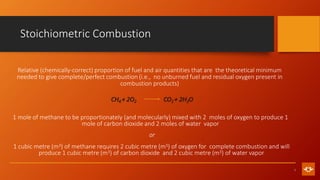
Stoichiometric Combustion
Relative (chemically-correct) proportion of fuel and air quantities that are the theoretical minimum
needed to give complete/perfect combustion (i.e., no unburned fuel and residual oxygen present in
combustion products)
CH4 + 2O2 CO2 + 2H2O
1 mole of methane to be proportionately (and molecularly) mixed with 2 moles of oxygen to produce 1
mole of carbon dioxide and 2 moles of water vapor
or
1 cubic metre (m3) of methane requires 2 cubic metre (m3) of oxygen for complete combustion and will
produce 1 cubic metre (m3) of carbon dioxide and 2 cubic metre (m3) of water vapor
7
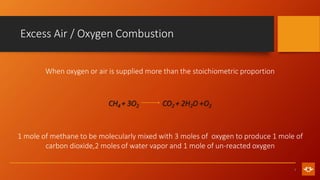
Excess Air / Oxygen Combustion
When oxygen or air is supplied more than the stoichiometric proportion
CH4 + 3O2 CO2 + 2H2O +O2
1 mole of methane to be molecularly mixed with 3 moles of oxygen to produce 1 mole of
carbon dioxide,2 moles of water vapor and 1 mole of un-reacted oxygen
8
Incomplete/ Partial Combustion
When fuel is supplied more than the stoichiometric proportion
Insufficient amount of oxygen or air available to burn in the fuel-rich mixture caused incomplete
combustion
CH4 + O2 CO+ 2H2O + (other products of incomplete combustion)
1 mole of methane to be molecularly mixed with 1 mole of oxygen to produce 1 mole of carbon monoxide,
2 moles of water vapor and other products of incomplete combustion such as unburned fuel, aldehydes
etc
9
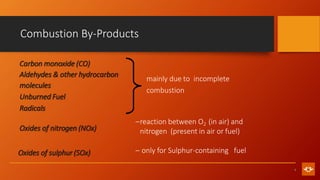
Combustion By-Products
Carbon monoxide (CO)
Aldehydes & other hydrocarbon
molecules
Unburned Fuel
Radicals
Oxides of nitrogen (NOx)
Oxides of sulphur (SOx)
mainly due to incomplete
combustion
–reaction between O2 (in air) and
nitrogen (present in air or fuel)
– only for Sulphur-containing fuel
10
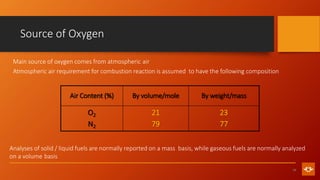
Source of Oxygen
Main source of oxygen comes from atmospheric air
Atmospheric air requirement for combustion reaction is assumed to have the following composition
Analyses of solid / liquid fuels are normally reported on a mass basis, while gaseous fuels are normally analyzed
on a volume basis
Air Content (%) By volume/mole By weight/mass
O2 21 23
N2 79 77
11
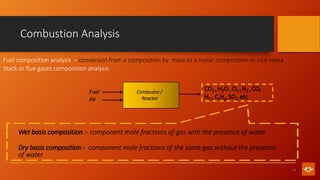
Combustion Analysis
Fuel composition analysis – conversion from a composition by mass to a molar composition or vice-versa
Stack or flue gases composition analysis
Wet basis composition :- component mole fractions of gas with the presence of water
Dry basis composition:- component mole fractions of the same gas without the presence
of water
Combustor/
Reactor
Fuel
Air
CO2 ,H2O ,O2 ,N2 ,CO,
H2 , CxHy, SO2 etc
12
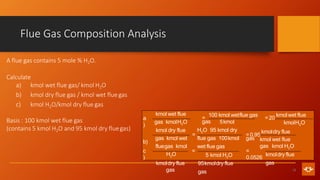
Flue Gas Composition Analysis
A flue gas contains 5 mole % H2O.
Calculate
a) kmol wet flue gas/ kmol H2O
b) kmol dry flue gas / kmol wet flue gas
c) kmol H2O/kmol dry flue gas
Basis : 100 kmol wet flue gas
(contains 5 kmol H2O and 95 kmol dry fluegas)
=
100 kmol wetflue gas
=20
kmolwet flue
gas kmolH2O
a
)
b)
= =0.95
kmoldry flue
gas kmol wet flue
gas
c
)
= =
0.0526
kmol wet flue
gas kmolH2O
kmol dry flue
gas kmol wet
fluegas kmol
H2O
kmoldry flue
gas
5kmol
H2O 95 kmol dry
flue gas 100kmol
wet flue gas
5 kmol H2O
95kmoldry flue
gas
kmol H2O
kmoldry flue
gas
13
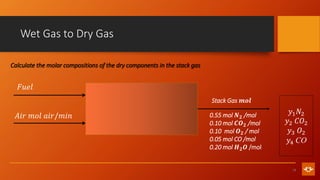
Wet Gas to Dry Gas
𝐹𝑢𝑒𝑙
𝐴𝑖𝑟 𝑚𝑜𝑙 𝑎𝑖𝑟/𝑚𝑖𝑛
Stack Gas 𝒎𝒐𝒍
𝑦1𝑁2
𝑦2 𝐶𝑂2
𝑦3 𝑂2
𝑦4 CO
0.55 mol 𝑵𝟐 /mol
0.10 mol 𝑪𝑶𝟐 /mol
0.10 mol 𝑶𝟐 / mol
0.05 mol CO /mol
0.20 mol 𝑯𝟐𝑶 /mol
Calculate the molar compositions of the dry components in the stack gas
14
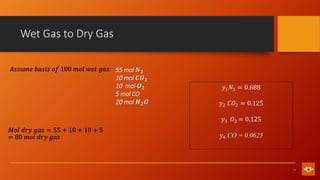
𝐴𝑠𝑠𝑢𝑚𝑒 𝑏𝑎𝑠𝑖𝑠 𝑜𝑓 100 𝑚𝑜𝑙 𝑤𝑒𝑡 𝑔𝑎𝑠:
Wet Gas to Dry Gas
55 mol 𝑵𝟐
10 mol 𝑪𝑶𝟐
10 mol 𝑶𝟐
5 mol CO
20 mol 𝑯𝟐𝑶
𝑀𝑜𝑙 𝑑𝑟𝑦 𝑔𝑎𝑠 = 55 + 10 + 10 + 5
= 80 𝑚𝑜𝑙 𝑑𝑟𝑦 𝑔𝑎𝑠
𝑦1𝑁2 = 0.688
𝑦2 𝐶𝑂2 = 0.125
𝑦3 𝑂2 = 0.125
𝑦4 CO = 0.0625
15
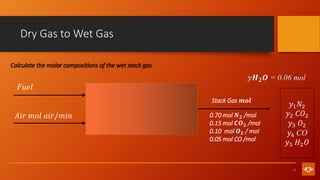
Dry Gas to Wet Gas
𝐹𝑢𝑒𝑙
𝐴𝑖𝑟 𝑚𝑜𝑙 𝑎𝑖𝑟/𝑚𝑖𝑛
Stack Gas 𝒎𝒐𝒍
𝑦1𝑁2
𝑦2 𝐶𝑂2
𝑦3 𝑂2
𝑦4 CO
𝑦5 𝐻2𝑂
0.70 mol 𝑵𝟐 /mol
0.15 mol 𝑪𝑶𝟐 /mol
0.10 mol 𝑶𝟐 / mol
0.05 mol CO /mol
Calculate the molar compositions of the wet stack gas
𝑦𝑯𝟐𝑶 = 0.06 mol
16
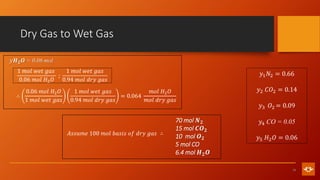
Dry Gas to Wet Gas
1 𝑚𝑜𝑙 𝑤𝑒𝑡 𝑔𝑎𝑠
0.06 𝑚𝑜𝑙 𝐻2𝑂
;
1 𝑚𝑜𝑙 𝑤𝑒𝑡 𝑔𝑎𝑠
0.94 𝑚𝑜𝑙 𝑑𝑟𝑦 𝑔𝑎𝑠
𝑦𝑯𝟐𝑶 = 0.06 mol
∴
0.06 𝑚𝑜𝑙 𝐻2𝑂
1 𝑚𝑜𝑙 𝑤𝑒𝑡 𝑔𝑎𝑠
1 𝑚𝑜𝑙 𝑤𝑒𝑡 𝑔𝑎𝑠
0.94 𝑚𝑜𝑙 𝑑𝑟𝑦 𝑔𝑎𝑠
= 0.064
𝑚𝑜𝑙 𝐻2𝑂
𝑚𝑜𝑙 𝑑𝑟𝑦 𝑔𝑎𝑠
𝐴𝑠𝑠𝑢𝑚𝑒 100 𝑚𝑜𝑙 𝑏𝑎𝑠𝑖𝑠 𝑜𝑓 𝑑𝑟𝑦 𝑔𝑎𝑠 ∴
70 mol 𝑵𝟐
15 mol 𝑪𝑶𝟐
10 mol 𝑶𝟐
5 mol CO
6.4 mol 𝑯𝟐𝑶
𝑦1𝑁2 = 0.66
𝑦2 𝐶𝑂2 = 0.14
𝑦3 𝑂2 = 0.09
𝑦4 CO = 0.05
𝑦5 𝐻2𝑂 = 0.06
17
Theoretical & Excess Oxygen (Air)
Theoretical Oxygen (Air)
The amount of chemically-correct (stoichiometric) oxygen (air) required for complete combustion of a given quantity of
a specific fuel
Excess Oxygen (Air)
The amount of oxygen (air) fed to the reactor which exceeds the theoretical oxygen
The theoretical oxygen (air) required to burn a given quantity of fuel does not depend on how much fuel is actually burned. The
fuel may not react completely and it may react to form both CO and CO2, but the theoretical air is still that which would be
required to react with all of the fuel to form CO2 only.
18
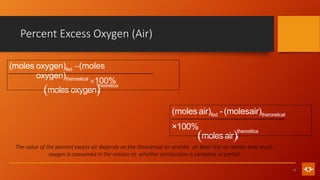
Percent Excess Oxygen (Air)
theoretica
l
(molesair)fed -(molesair)theroretical
×100%
molesair
theoretica
l
(moles oxygen)fed (moles
oxygen)theroretical
100%
moles oxygen
The value of the percent excess air depends on the theoretical air andthe air feed rate no matter how much
oxygen is consumed in the reactor or whether combustion is complete orpartial

Lecture 6combustion at higher temperatures.pptx

  • 1.
    1 COMBUSTION PROCESSES CEFCHA2 ChemicalEngineering Fundamentals 2A V Naidoo JOB 4134 vizellen@uj.ac.za
  • 2.
    2 Objectives Stoichiometric combustion Excess aircombustion Excess fuel combustion Mass vs Volume air content Wet and Dry basis analysis Be able to apply all these principles in mass balances Understand the difference between:
  • 3.
    3 What is combustion? Rapidoxidation of a fuel accompanied by the release of heat and/or light together with the formation of combustion products Fuel + oxidant heat/light + combustion products Definition of combustion as quoted from Webster’s dictionary “rapid oxidation generating heat, or both heat and light ; also, slow oxidation accompanied by relatively little heat and no light”
  • 4.
    4 Fossil Fuel Combustion Chemicalreaction between hydrogen and carbon atoms (contained in the fuel) with oxygen atoms (usually comes from the air), resulting in the heat release and the formation of combustion products (*) mainly water vapor and carbon dioxide and a certain amount combustion by-products depending on combustion process Carbon + Oxygen = Heat + Carbon Dioxide Hydrogen + Oxygen = Heat + Water C + 𝑂2 → heat + C𝑂2 H + 1 2 𝑂2 → heat + 𝐻2𝑂
  • 5.
    5 Categories of CombustionProcesses Complete combustion The reaction goes to completion (Stoichiometrically correct) Excess air or fuel lean Does not go to completion (Excess & limiting reactants) Incomplete or partial combustion Excess fuel or fuel rich or deficient air In practice, combustion will never be complete even though at stoichiometric or excess air conditions, due to non-uniformity of fuel and air mixture and complexity of combustion reaction
  • 6.
    6 Stoichiometric Combustion Relative (chemically-correct)proportion of fuel and air quantities that are the theoretical minimum needed to give complete/perfect combustion (i.e., no unburned fuel and residual oxygen present in combustion products) CH4 + 2O2 CO2 + 2H2O 1 mole of methane to be proportionately (and molecularly) mixed with 2 moles of oxygen to produce 1 mole of carbon dioxide and 2 moles of water vapor or 1 cubic metre (m3) of methane requires 2 cubic metre (m3) of oxygen for complete combustion and will produce 1 cubic metre (m3) of carbon dioxide and 2 cubic metre (m3) of water vapor
  • 7.
    7 Excess Air /Oxygen Combustion When oxygen or air is supplied more than the stoichiometric proportion CH4 + 3O2 CO2 + 2H2O +O2 1 mole of methane to be molecularly mixed with 3 moles of oxygen to produce 1 mole of carbon dioxide,2 moles of water vapor and 1 mole of un-reacted oxygen
  • 8.
    8 Incomplete/ Partial Combustion Whenfuel is supplied more than the stoichiometric proportion Insufficient amount of oxygen or air available to burn in the fuel-rich mixture caused incomplete combustion CH4 + O2 CO+ 2H2O + (other products of incomplete combustion) 1 mole of methane to be molecularly mixed with 1 mole of oxygen to produce 1 mole of carbon monoxide, 2 moles of water vapor and other products of incomplete combustion such as unburned fuel, aldehydes etc
  • 9.
    9 Combustion By-Products Carbon monoxide(CO) Aldehydes & other hydrocarbon molecules Unburned Fuel Radicals Oxides of nitrogen (NOx) Oxides of sulphur (SOx) mainly due to incomplete combustion –reaction between O2 (in air) and nitrogen (present in air or fuel) – only for Sulphur-containing fuel
  • 10.
    10 Source of Oxygen Mainsource of oxygen comes from atmospheric air Atmospheric air requirement for combustion reaction is assumed to have the following composition Analyses of solid / liquid fuels are normally reported on a mass basis, while gaseous fuels are normally analyzed on a volume basis Air Content (%) By volume/mole By weight/mass O2 21 23 N2 79 77
  • 11.
    11 Combustion Analysis Fuel compositionanalysis – conversion from a composition by mass to a molar composition or vice-versa Stack or flue gases composition analysis Wet basis composition :- component mole fractions of gas with the presence of water Dry basis composition:- component mole fractions of the same gas without the presence of water Combustor/ Reactor Fuel Air CO2 ,H2O ,O2 ,N2 ,CO, H2 , CxHy, SO2 etc
  • 12.
    12 Flue Gas CompositionAnalysis A flue gas contains 5 mole % H2O. Calculate a) kmol wet flue gas/ kmol H2O b) kmol dry flue gas / kmol wet flue gas c) kmol H2O/kmol dry flue gas Basis : 100 kmol wet flue gas (contains 5 kmol H2O and 95 kmol dry fluegas) = 100 kmol wetflue gas =20 kmolwet flue gas kmolH2O a ) b) = =0.95 kmoldry flue gas kmol wet flue gas c ) = = 0.0526 kmol wet flue gas kmolH2O kmol dry flue gas kmol wet fluegas kmol H2O kmoldry flue gas 5kmol H2O 95 kmol dry flue gas 100kmol wet flue gas 5 kmol H2O 95kmoldry flue gas kmol H2O kmoldry flue gas
  • 13.
    13 Wet Gas toDry Gas 𝐹𝑢𝑒𝑙 𝐴𝑖𝑟 𝑚𝑜𝑙 𝑎𝑖𝑟/𝑚𝑖𝑛 Stack Gas 𝒎𝒐𝒍 𝑦1𝑁2 𝑦2 𝐶𝑂2 𝑦3 𝑂2 𝑦4 CO 0.55 mol 𝑵𝟐 /mol 0.10 mol 𝑪𝑶𝟐 /mol 0.10 mol 𝑶𝟐 / mol 0.05 mol CO /mol 0.20 mol 𝑯𝟐𝑶 /mol Calculate the molar compositions of the dry components in the stack gas
  • 14.
    14 𝐴𝑠𝑠𝑢𝑚𝑒 𝑏𝑎𝑠𝑖𝑠 𝑜𝑓100 𝑚𝑜𝑙 𝑤𝑒𝑡 𝑔𝑎𝑠: Wet Gas to Dry Gas 55 mol 𝑵𝟐 10 mol 𝑪𝑶𝟐 10 mol 𝑶𝟐 5 mol CO 20 mol 𝑯𝟐𝑶 𝑀𝑜𝑙 𝑑𝑟𝑦 𝑔𝑎𝑠 = 55 + 10 + 10 + 5 = 80 𝑚𝑜𝑙 𝑑𝑟𝑦 𝑔𝑎𝑠 𝑦1𝑁2 = 0.688 𝑦2 𝐶𝑂2 = 0.125 𝑦3 𝑂2 = 0.125 𝑦4 CO = 0.0625
  • 15.
    15 Dry Gas toWet Gas 𝐹𝑢𝑒𝑙 𝐴𝑖𝑟 𝑚𝑜𝑙 𝑎𝑖𝑟/𝑚𝑖𝑛 Stack Gas 𝒎𝒐𝒍 𝑦1𝑁2 𝑦2 𝐶𝑂2 𝑦3 𝑂2 𝑦4 CO 𝑦5 𝐻2𝑂 0.70 mol 𝑵𝟐 /mol 0.15 mol 𝑪𝑶𝟐 /mol 0.10 mol 𝑶𝟐 / mol 0.05 mol CO /mol Calculate the molar compositions of the wet stack gas 𝑦𝑯𝟐𝑶 = 0.06 mol
  • 16.
    16 Dry Gas toWet Gas 1 𝑚𝑜𝑙 𝑤𝑒𝑡 𝑔𝑎𝑠 0.06 𝑚𝑜𝑙 𝐻2𝑂 ; 1 𝑚𝑜𝑙 𝑤𝑒𝑡 𝑔𝑎𝑠 0.94 𝑚𝑜𝑙 𝑑𝑟𝑦 𝑔𝑎𝑠 𝑦𝑯𝟐𝑶 = 0.06 mol ∴ 0.06 𝑚𝑜𝑙 𝐻2𝑂 1 𝑚𝑜𝑙 𝑤𝑒𝑡 𝑔𝑎𝑠 1 𝑚𝑜𝑙 𝑤𝑒𝑡 𝑔𝑎𝑠 0.94 𝑚𝑜𝑙 𝑑𝑟𝑦 𝑔𝑎𝑠 = 0.064 𝑚𝑜𝑙 𝐻2𝑂 𝑚𝑜𝑙 𝑑𝑟𝑦 𝑔𝑎𝑠 𝐴𝑠𝑠𝑢𝑚𝑒 100 𝑚𝑜𝑙 𝑏𝑎𝑠𝑖𝑠 𝑜𝑓 𝑑𝑟𝑦 𝑔𝑎𝑠 ∴ 70 mol 𝑵𝟐 15 mol 𝑪𝑶𝟐 10 mol 𝑶𝟐 5 mol CO 6.4 mol 𝑯𝟐𝑶 𝑦1𝑁2 = 0.66 𝑦2 𝐶𝑂2 = 0.14 𝑦3 𝑂2 = 0.09 𝑦4 CO = 0.05 𝑦5 𝐻2𝑂 = 0.06
  • 17.
    17 Theoretical & ExcessOxygen (Air) Theoretical Oxygen (Air) The amount of chemically-correct (stoichiometric) oxygen (air) required for complete combustion of a given quantity of a specific fuel Excess Oxygen (Air) The amount of oxygen (air) fed to the reactor which exceeds the theoretical oxygen The theoretical oxygen (air) required to burn a given quantity of fuel does not depend on how much fuel is actually burned. The fuel may not react completely and it may react to form both CO and CO2, but the theoretical air is still that which would be required to react with all of the fuel to form CO2 only.
  • 18.
    18 Percent Excess Oxygen(Air) theoretica l (molesair)fed -(molesair)theroretical ×100% molesair theoretica l (moles oxygen)fed (moles oxygen)theroretical 100% moles oxygen The value of the percent excess air depends on the theoretical air andthe air feed rate no matter how much oxygen is consumed in the reactor or whether combustion is complete orpartial