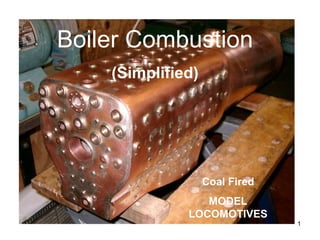
Boiler Combustion (Simplified) Coal Fired MODEL LOCOMOTIVES
HEAT INTO POWER Fuel and Air combustion :-  Chemical Reaction Mechanical work :-  Useful Work
Solid Fuel (Coal)
Anthracite Almost consist of pure carbon Smokeless Ignites with difficulty Burns slowly Requires a thin fire Requires strong draft The larger the grate-area the more efficient the combustion Effective radiant heat properties Generally contains low moister content  (average 1 ½ %)
Dry Welsh steam coal Semi Anthracite  Requires a reasonable forced draft  Contains high % of Carbon  Burns off % of volatile gases Hydro-carbons produce a luminous flame Excellent radiant heat transmitting properties  High heat value ratio compared with non-luminous gases
Bituminous   Low in carbon content  High in volatile matter (gases) Generally high in moister content (average 7%) Burns freely produces a long flame  Emits smoke if not carefully handled ie:-correct drafting techniques  Cakes becomes very pasty Produces volatile hydro-carbons
Effects of impurities in Coal Ash  None combustible material in certain temperature conditions forms a semi- molten liquid  (silicate of iron) Clinker Sulphur  Introduced to excessive heat is converted to Sulphide Dioxide (SO 2 ) When absorbed by water it forms Sulphurous Acid (H 2 SO 3 ) In certain circumstances can oxidise further to become Sulphuric Acid (H 2 SO 4 ) Chemically corrosive !!
COMPOSITION  of AIR 23 parts Oxygen :- 77 parts Nitrogen in every 100 parts of air by weight.  21 parts Oxygen and 79 parts Nitrogen by volume.
Primary Air Secondary Air Primary Air Fire Box Air intake in fire box Blast nozzle  blower ring
Three stages of combustion Distillation of the coal gasses  (hydrocarbons)  For complete combustion to burn gasses:-  Sufficient supply oxygen  Sufficient high temperatures  Solid fuel remains behind as (carbon)
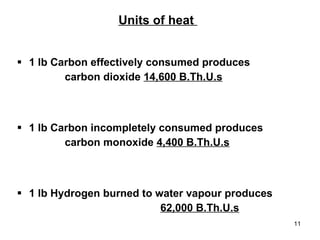
Units of heat  1 lb Carbon effectively consumed produces  carbon dioxide   14,600 B.Th.U.s 1 lb Carbon incompletely consumed produces  carbon monoxide   4,400 B.Th.U.s 1 lb Hydrogen burned to water vapour produces  62,000 B.Th.U.s
Primary Air  Below the fire bed Combustion of the volatiles  hydrogen  ( H )  combines with the  oxygen  (O 2 )  and forms water vapour  steam  (H 2 O) The  oxygen  combines with the  carbon  (C)   burns off forming a colourless gas known as  carbon dioxide  ( CO2 ) Passing through the fire bed looses part of its  oxygen  unites with the upper layers of  carbon   (C)  and forms  carbon monoxide   (CO)
Secondary Air  Above the fire bed Insufficient oxygen incomplete combustion Heat losses 70% Example :- carbon  consumed  to  ( CO 2 ) 14,600  B.Th.U.s  per 1lb  carbon  unconsumed  to  ( CO) 4,400  B.Th.U.s per 1lb  Carbon Monoxide   (CO)  vapours  re-ignite at 1200ºF
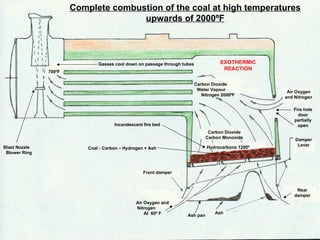
Hydrocarbons 1200 º Carbon Dioxide Carbon Monoxide Damper Lever Front damper Rear damper Ash Air Oxygen and Nitrogen  At  60 º F Carbon Dioxide  Water Vapour  Nitrogen 2000 ºF Ash pan Air Oxygen and Nitrogen 700 ºF Blast Nozzle  Blower Ring Coal -   Carbon  -  Hydrogen + Ash Complete combustion of the coal at high temperatures upwards of 2000 ºF Gasses cool down on passage through tubes EXOTHERMIC REACTION Fire hole door partially open Incandescent fire bed
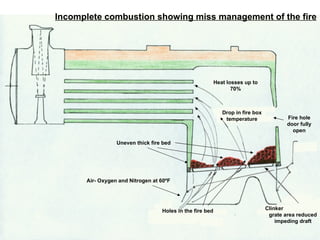
Incomplete combustion showing miss management of the fire Air- Oxygen and Nitrogen at 60 ºF Fire hole door fully open Holes in the fire bed Drop in fire box temperature Uneven thick fire bed Heat losses up to 70 % Clinker  grate area reduced impeding draft
Deflector plate Stainless steel arch Promotes combustion absorbs  the heat from the volatile gasses before being discharged  reduces temperature drop Directs the path of air Other  uses' of absorbing heat  Volatile gasses
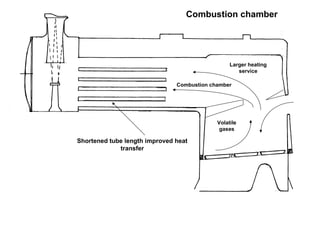
Combustion chamber Shortened tube length improved heat transfer Volatile gases Combustion chamber Larger heating service

Boiler combustion

  • 1.
    Boiler Combustion (Simplified)Coal Fired MODEL LOCOMOTIVES
  • 2.
    HEAT INTO POWERFuel and Air combustion :- Chemical Reaction Mechanical work :- Useful Work
  • 3.
  • 4.
    Anthracite Almost consistof pure carbon Smokeless Ignites with difficulty Burns slowly Requires a thin fire Requires strong draft The larger the grate-area the more efficient the combustion Effective radiant heat properties Generally contains low moister content (average 1 ½ %)
  • 5.
    Dry Welsh steamcoal Semi Anthracite Requires a reasonable forced draft Contains high % of Carbon Burns off % of volatile gases Hydro-carbons produce a luminous flame Excellent radiant heat transmitting properties High heat value ratio compared with non-luminous gases
  • 6.
    Bituminous Low in carbon content High in volatile matter (gases) Generally high in moister content (average 7%) Burns freely produces a long flame Emits smoke if not carefully handled ie:-correct drafting techniques Cakes becomes very pasty Produces volatile hydro-carbons
  • 7.
    Effects of impuritiesin Coal Ash None combustible material in certain temperature conditions forms a semi- molten liquid (silicate of iron) Clinker Sulphur Introduced to excessive heat is converted to Sulphide Dioxide (SO 2 ) When absorbed by water it forms Sulphurous Acid (H 2 SO 3 ) In certain circumstances can oxidise further to become Sulphuric Acid (H 2 SO 4 ) Chemically corrosive !!
  • 8.
    COMPOSITION ofAIR 23 parts Oxygen :- 77 parts Nitrogen in every 100 parts of air by weight. 21 parts Oxygen and 79 parts Nitrogen by volume.
  • 9.
    Primary Air SecondaryAir Primary Air Fire Box Air intake in fire box Blast nozzle blower ring
  • 10.
    Three stages ofcombustion Distillation of the coal gasses (hydrocarbons) For complete combustion to burn gasses:- Sufficient supply oxygen Sufficient high temperatures Solid fuel remains behind as (carbon)
  • 11.
    Units of heat 1 lb Carbon effectively consumed produces carbon dioxide 14,600 B.Th.U.s 1 lb Carbon incompletely consumed produces carbon monoxide 4,400 B.Th.U.s 1 lb Hydrogen burned to water vapour produces 62,000 B.Th.U.s
  • 12.
    Primary Air Below the fire bed Combustion of the volatiles hydrogen ( H ) combines with the oxygen (O 2 ) and forms water vapour steam (H 2 O) The oxygen combines with the carbon (C) burns off forming a colourless gas known as carbon dioxide ( CO2 ) Passing through the fire bed looses part of its oxygen unites with the upper layers of carbon (C) and forms carbon monoxide (CO)
  • 13.
    Secondary Air Above the fire bed Insufficient oxygen incomplete combustion Heat losses 70% Example :- carbon consumed to ( CO 2 ) 14,600 B.Th.U.s per 1lb carbon unconsumed to ( CO) 4,400 B.Th.U.s per 1lb Carbon Monoxide (CO) vapours re-ignite at 1200ºF
  • 14.
    Hydrocarbons 1200 ºCarbon Dioxide Carbon Monoxide Damper Lever Front damper Rear damper Ash Air Oxygen and Nitrogen At 60 º F Carbon Dioxide Water Vapour Nitrogen 2000 ºF Ash pan Air Oxygen and Nitrogen 700 ºF Blast Nozzle Blower Ring Coal - Carbon - Hydrogen + Ash Complete combustion of the coal at high temperatures upwards of 2000 ºF Gasses cool down on passage through tubes EXOTHERMIC REACTION Fire hole door partially open Incandescent fire bed
  • 15.
    Incomplete combustion showingmiss management of the fire Air- Oxygen and Nitrogen at 60 ºF Fire hole door fully open Holes in the fire bed Drop in fire box temperature Uneven thick fire bed Heat losses up to 70 % Clinker grate area reduced impeding draft
  • 16.
    Deflector plate Stainlesssteel arch Promotes combustion absorbs the heat from the volatile gasses before being discharged reduces temperature drop Directs the path of air Other uses' of absorbing heat Volatile gasses
  • 17.
    Combustion chamber Shortenedtube length improved heat transfer Volatile gases Combustion chamber Larger heating service