Downloaded 38 times
![CHECAL2
Dr. Susan A. Roces INTRODUCTION
1
Combustion:
unit process in which oxidation reaction takes place.
accompanied by evolution of light and heat, and thus the
industries used in the generation of heat to supply energy
to the process industries.
chemical reaction in which one of the reactants is oxygen
from the air and the other is a fuel (gaseous, liquid, solid).
Air
HC Fuel Stack Gas/Flue Gas
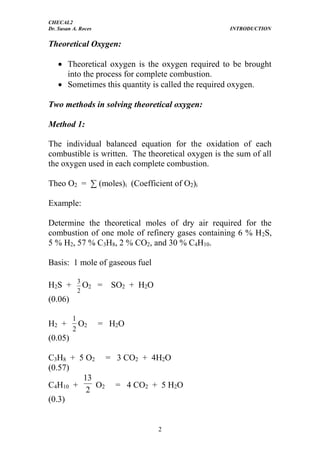
Complete Combustion:
The complete combustion of a fuel means that all of its
combustible components are gasified: all of the carbon is burned
to carbon dioxide, all of the hydrogen is converted to water and
all sulfur to sulfur dioxide.
C + O2 CO2
H2 +
2
1
O2 H2O
S + O2 SO2
The complete combustion of any organic fuel is represented by:
CwHxOySz +
2
1
[ 2w +
2
x
+ 2z - y ]O2
w CO2 +
2
x
H2O + z SO2](https://image.slidesharecdn.com/i-160209120729/85/Introduction-combustion-1-320.jpg)
![CHECAL2
Dr. Susan A. Roces INTRODUCTION
1
Combustion:
unit process in which oxidation reaction takes place.
accompanied by evolution of light and heat, and thus the
industries used in the generation of heat to supply energy
to the process industries.
chemical reaction in which one of the reactants is oxygen
from the air and the other is a fuel (gaseous, liquid, solid).
Air
HC Fuel Stack Gas/Flue Gas
Complete Combustion:
The complete combustion of a fuel means that all of its
combustible components are gasified: all of the carbon is burned
to carbon dioxide, all of the hydrogen is converted to water and
all sulfur to sulfur dioxide.
C + O2 CO2
H2 +
2
1
O2 H2O
S + O2 SO2
The complete combustion of any organic fuel is represented by:
CwHxOySz +
2
1
[ 2w +
2
x
+ 2z - y ]O2
w CO2 +
2
x
H2O + z SO2](https://image.slidesharecdn.com/i-160209120729/75/Introduction-combustion-1-2048.jpg)
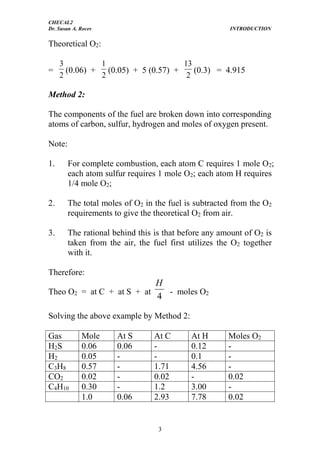
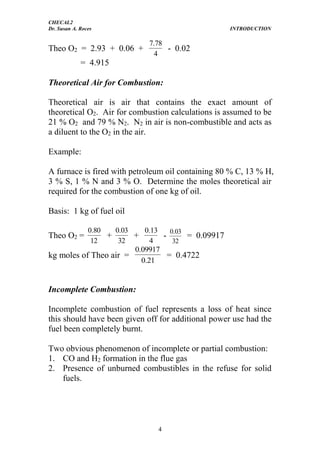
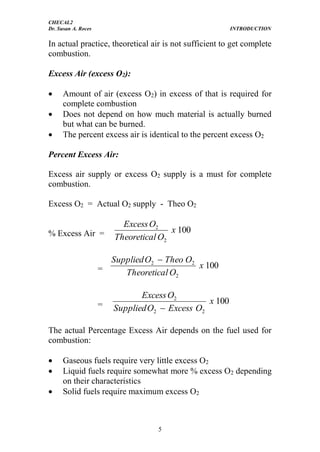
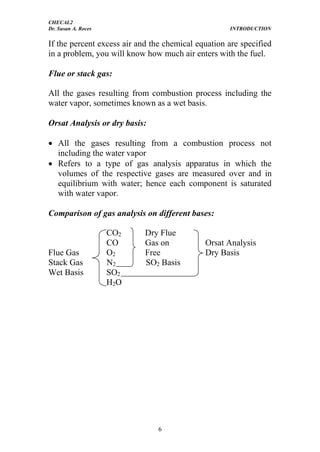

This document discusses combustion and combustion calculations. It defines combustion as a chemical reaction between a fuel and oxygen that produces heat and light. Complete combustion means all carbon is converted to CO2, hydrogen to H2O, and sulfur to SO2. Theoretical oxygen is the amount of oxygen needed for complete combustion, calculated two ways. Theoretical air is the amount of air needed to supply the theoretical oxygen. Excess air above the theoretical amount is required for practical combustion to ensure completeness. Flue or stack gas refers to all gases from combustion, while Orsat analysis refers only to dry gases excluding water vapor.


