ENGI 8676 Design of Natural Gas Handling Equipment
ENGI 9120 Advanced Natural Gas Processing
Chapter 3
Natural Gas Processing
by
Dr. Amer Aborig
Process Engineering
Memorial University of Newfoundland
amaborig@Mun.ca
Contents
 Introduction
 Inlet receiving
 Dehydration processes
 Gas treating and sulfur recovery
 Environmental considerations
3.1 Introduction
 Purposes of Processing
 Purification. Removal of materials, valuable or not, that inhibit the use of
the gas as an industrial or residential fuel
 Separation. Splitting out of components that have greater value as
petrochemical feedstocks, stand alone fuels (e.g., propane), or industrial
gases (e.g., ethane, helium)
 Liquefaction. Increase of the energy density of the gas for storage or
transportation
 Principle Products: methane , ethane, propane, isobutane, n-butane,
natural gas liquids, natural gasoline, sulphur
3.1 Introduction
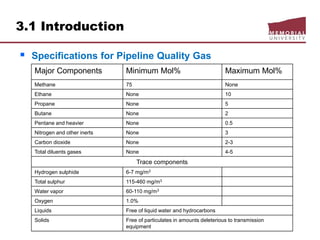
 Specifications for Pipeline Quality Gas
Major Components Minimum Mol% Maximum Mol%
Methane 75 None
Ethane None 10
Propane None 5
Butane None 2
Pentane and heavier None 0.5
Nitrogen and other inerts None 3
Carbon dioxide None 2-3
Total diluents gases None 4-5
Trace components
Hydrogen sulphide 6-7 mg/m3
Total sulphur 115-460 mg/m3
Water vapor 60-110 mg/m3
Oxygen 1.0%
Liquids Free of liquid water and hydrocarbons
Solids Free of particulates in amounts deleterious to transmission
equipment
3.1 Introduction
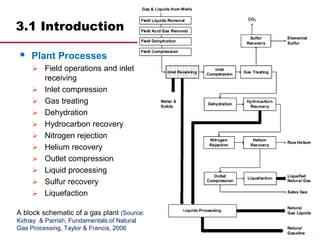
A block schematic of a gas plant (Source:
Kidnay & Parrish, Fundamentals of Natural
Gas Processing, Taylor & Francis, 2006
 Plant Processes
 Field operations and inlet
receiving
 Inlet compression
 Gas treating
 Dehydration
 Hydrocarbon recovery
 Nitrogen rejection
 Helium recovery
 Outlet compression
 Liquid processing
 Sulfur recovery
 Liquefaction
 Important Support Components
 Utilities
 Including power, heating fluids, cooling water, instrument air,
nitrogen-purge gas and fuel gas
 Cogeneration plants are becoming more attractive options
 Process control
 Digital control systems (DCS) are widely used for individual units to
provide both process control and operations history
 Supervisory control and data acquisition (SCADA)) is also applied for
monitoring of field operations
 Safety systems
 Emergency shutdown of inlet gas
 Relief valves and vent systems
 The Engineering Data Book provides criteria for sizing relief systems and
flares
3.1 Introduction
3.2 Inlet Receiving
 Gas-Liquid Separation
 Objectives
 A primary phase separation of the mostly liquid hydrocarbons from the
gas stream
 Refining the primary separation by further removing most of the
entrained liquid mist from the gas
 Refining the separation by further removing the entrained gas from the
liquid stream
 Discharging the separated gas and liquid from vessel and preventing
the re-entrainment of one into the other
 Separation principles:
 Primary separation
 By utilizing the differences in momentum between gas and liquid
 Larger liquid droplets impinge by momentum and then drop by gravity
 To separate a major portion of incoming liquid
3.2 Inlet Receiving
 Secondary separation
 Gravity separation of smaller droplets as vapor flow through the
disengagement area
 Gravity separation can be aided by using baffle that creates an even
velocity distribution in the fluid
 Mist elimination
 The coalescing section contains an inserts (mist extractor) that forces the
gas through torturous path to bring small mist particles together as they
collect on the insert
 The inserts can be mesh pads, vane packs or cyclone devices
 Separation types:
 Horizontal
 Vertical
 Spherical
3.2 Inlet Receiving
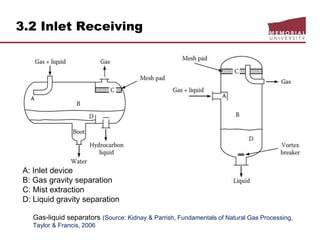
A: Inlet device
B: Gas gravity separation
C: Mist extraction
D: Liquid gravity separation
Gas-liquid separators (Source: Kidnay & Parrish, Fundamentals of Natural Gas Processing,
Taylor & Francis, 2006
3.2 Inlet Receiving
 Selection of separator types
 Horizontal
 Applications
o Large volumes of gas and/or liquids
o High-to-intermediate Gas/Oil ratio (GOR) streams
o 3-phase separation
 Advantages:
o Smaller diameter for similar gas capacity as compared to vertical
vessels
o Large liquid surface area for foam dispersion, reducing turbulence
o Larger surge volume capacity
 Disadvantages:
o Only part of shell available for passage of gas
o Occupied more space unless stack mounted
o Liquid level control is more critical
o More difficult to clean produced sand, mud, wax paraffin, etc.
3.2 Inlet Receiving
 Vertical
 More suitable to be used in following conditions
o Small flow rates of gas and /or liquids
o Low to intermediate GOR streams
o Plot space is limited
o Ease of level control is desired
 Advantages:
o Good bottom-drain and clean-out facilities
o Can handle more sand, mud, paraffin and wax without plugging
o Less tendency for re-entrainment
o Full diameter for gas flow at top and oil flow at bottom
o Occupies smaller plot area
 Disadvantages:
o Require larger diameter for a given gas capacity
o Not recommended when there is a large slug potential
o More difficult to reach and service top-mounted instruments and safety
devices
3.2 Inlet Receiving
 Factors affecting separation
 Important factors
 Separator operating pressure
 Separator operating temperature
 Fluid stream composition
 For a given fluid stream in a specified separator, change in any of
these factors will change the amount of gas and liquid leaving the
separator
 An increase in operating pressure or a decrease in operating
temperature generally increases the liquid covered in the separator
 For gas condensate system, increasing operating pressure will not
add to liquid recovery
 High liquid recovery is always desirable
3.2 Inlet Receiving
 Separator design
 Separator designers need to know pressure, temperature, flow rates
and physical properties of the streams as well as the degree of
separation required
 3 main factors in design
 Gas capacity determines the cross-sectional area necessary for
gravitational forces to remove the liquid from gas
 Liquid capacity is typically set by determining the volume required
to provide adequate residence time to degas the liquid or allow
immiscible liquid phases to separate
 Operability issues include the separator’s ability to deal with solids
if present, unsteady flow/liquid slugs, turndown etc
 An iterative approach to calculations is needed for the optimal design
which satisfies these requirements
3.2 Inlet Receiving
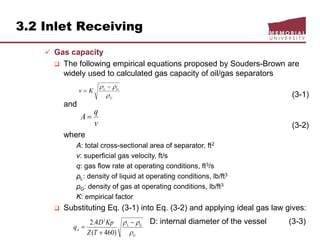
 Gas capacity
 The following empirical equations proposed by Souders-Brown are
widely used to calculated gas capacity of oil/gas separators
(3-1)
and
(3-2)
where
A: total cross-sectional area of separator, ft2
v: superficial gas velocity, ft/s
q: gas flow rate at operating conditions, ft3/s
ρL: density of liquid at operating conditions, lb/ft3
ρG: density of gas at operating conditions, lb/ft3
K: empirical factor
 Substituting Eq. (3-1) into Eq. (3-2) and applying ideal gas law gives:
D: internal diameter of the vessel (3-3)
G
GL
Kv

 

v
q
A 
G
GL
st
TZ
KpD
q

 


)460(
4.2 2
3.2 Inlet Receiving
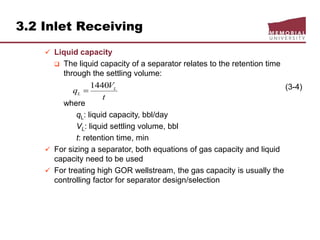
 Liquid capacity
 The liquid capacity of a separator relates to the retention time
through the settling volume:
(3-4)
where
qL: liquid capacity, bbl/day
VL: liquid settling volume, bbl
t: retention time, min
 For sizing a separator, both equations of gas capacity and liquid
capacity need to be used
 For treating high GOR wellstream, the gas capacity is usually the
controlling factor for separator design/selection
t
V
q L
L
1440

Separator Design Problem
 Calculate the minimum required size of a standard oil/gas
separator for the following conditions. Consider both vertical
and horizontal separators.
Gas flowrate: 5.0 MMscfd
Gas specific gravity: 0.7
Condensate flow rate: 20 bbl/MMscf
Condensate gravity: 60˚API
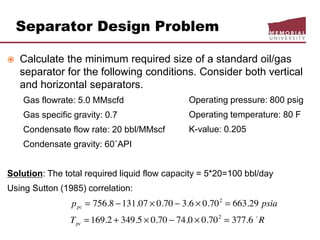
Solution: The total required liquid flow capacity = 5*20=100 bbl/day
Using Sutton (1985) correlation:
Operating pressure: 800 psig
Operating temperature: 80 F
K-value: 0.205
Separator Design Problem
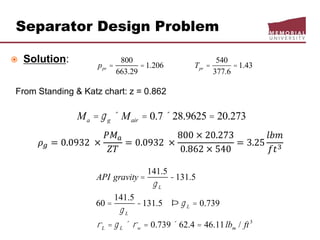
 Solution:
From Standing & Katz chart: z = 0.862
𝜌 𝑔 = 0.0932 ×
𝑃𝑀 𝑎
𝑍𝑇
= 0.0932 ×
800 × 20.273
0.862 × 540
= 3.25
𝑙𝑏𝑚
𝑓𝑡3
ppr =
800
663.29
=1.206 Tpr =
540
377.6
=1.43
Ma = g g ´ Mair = 0.7 ´ 28.9625 = 20.273
API gravity =
141.5
g L
-131.5
60 =
141.5
g L
-131.5 Þg L = 0.739
rL = g L ´ rw = 0.739 ´ 62.4 = 46.11lbm / ft3
Separator Design Problem
Calculation of Internal Diameter of the Vessel:
Selection of Vertical Separator:
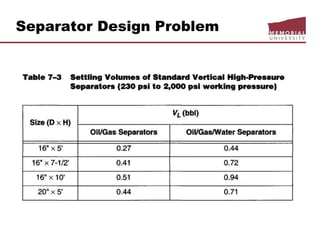
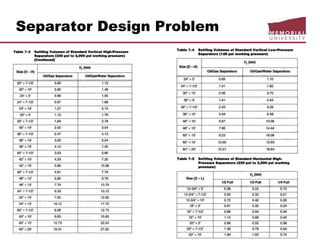
So, the minimum diameter of the separator should be 15.31 in. From Table
7.3, we select the standard size of oil/gas vertical separator.
Minimum Vertical Separator size (D×H)= 16’’ ×5’
qst =
2.4 ´ D2
KP
z T + 460( )
rL - rg
rg
5 =
2.4 ´ D2
´ 0.205 ´ 800
0.862 80 + 460( )
46.11- 3.25
3.25
D = 1.276 ft
D = 15.31inch
Separator Design Problem
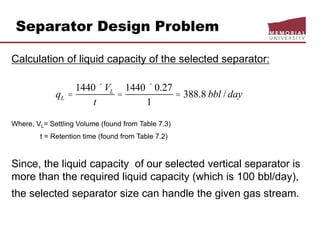
Calculation of liquid capacity of the selected separator:
Where, VL= Settling Volume (found from Table 7.3)
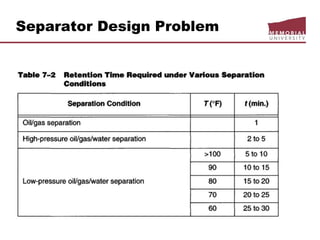
t = Retention time (found from Table 7.2)
Since, the liquid capacity of our selected vertical separator is
more than the required liquid capacity (which is 100 bbl/day),
the selected separator size can handle the given gas stream.
qL =
1440 ´VL
t
=
1440 ´ 0.27
1
= 388.8 bbl / day
Separator Design Problem
Selection of Horizontal Separator:
Internal Diameter of the Vessel = 15.31 in (same for both)
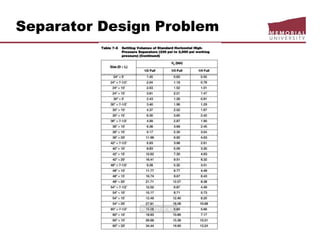
From the Table 7.5, we select the standard size of oil/gas vertical
separator.
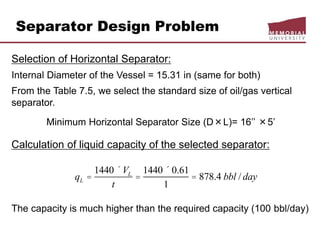
Minimum Horizontal Separator Size (D×L)= 16’’ ×5’
Calculation of liquid capacity of the selected separator:
The capacity is much higher than the required capacity (100 bbl/day)
qL =
1440 ´VL
t
=
1440 ´ 0.61
1
= 878.4 bbl / day
3.3 Dehydration
 Gas Hydrate and Hydrate Inhibition
 Gas hydrate
 Ice-like solids composed of water and hydrocarbons, HCs ranging
from methane to cyclopentane are known to form hydrates
 The formation of hydrates depending on pressure, temperature,
molecular size and concentration of component
 Easily formed at high pressure and low temperature
 Hydrate formation prediction
 Thermodynamics provides a powerful tool for prediction of the
temperature and pressure for hydrate formation on the basis of gas
composition.
 Even when hydrates are thermodynamically possible, they may never
form.
 Hydrate formation kinetics is complex and poorly understood
 Complex statistical thermodynamic model is available to predict the
hydrate formation temperatures
3.3 Dehydration
 Empirical correlations are
available
 Gas gravity correlation is widely
used to estimate the conditions at
which hydrate will form
 For pressure below 1000 psi, the
figure can be approximated by:
(3-5)
)](ln[8.13
83.6
5.16)( 2
psipFt 


)](ln[68.7
79.3
44.6)( 2
barpCt 


Pressure-temperature curves for
estimation of hydrate formation condition
as a function of gas specific gravity
(Adapted from Engineering Data Book, 2004d)
3.3 Dehydration
 Hydrate inhibition
 Three ways to avoid hydrate formation
 Operate outside of the hydrate formation region
 Dehydrate the gas
 Add hydrate inhibitors
 Types of inhibitors
 Thermodynamic
o Mainly methanol and ethylene glycol
o Methanol is more widely used than ethylene glycol
o Both inhibitors are hydrophilic and remain predominantly with a
condensed water phase
o Methanol is volatile, mass loss of methanol needs to be
considered
o Ethylene glycol is relatively easy to recover, it is viscous and
must be either diluted or kept in a warm storage vessel in cold
weather
3.3 Dehydration
 Antiagglomerates (AA)
o Alkyl aromatic sulphonate
o Prevent small hydrate particles from agglomerating
o Reside in the liquid hydrocarbon phase and are most often used in
pipelines where gas is dissolved in oil
o Require testing to ensure proper concentrations
 Kinetic inhibitor (KHI)
o Slow crystal formation
o Can be used at concentrations in the 1 wt% range in the aqueous phase
o Nonvolatile
o Proper dosage must be determined empirically
o Typical KHIs: n-vinylpyrrolidone, saccharides, n-vinylcaprolactam
 Problems in using hydrate inhibitors
 The proper inhibitor dosage must be known to avoid plugging or needless
chemical costs,
 The reliability of inhibitor injection can be a problem because of
malfunctioning injection pumps and depleted inhibitor reservoirs, especially
at remote sites
 The possible interaction between inhibitors and other additives
3.3 Dehydration
 Gas Dehydration
 Purpose
 Removal of water from gas stream so that products meet the
requirement for transportation and storage
 Increasing the heating value of the gas
 Necessity
 Water in gas condensates to form ice or gas hydrates which cause
corrosion or erosion problems in pipeline or equipment
 When CO2 and H2S are present in the gas, sour and acid gases can
hold more water, the stream becomes more corrosive
 Water contents of gas
 Use empirical chart to determine water content of gas
 Gas analysis will give more accurate results
 Methods
 Absorption
 Adsorption
 Membrane
3.3 Dehydration
 Dehydration Processes
 Absorption processes
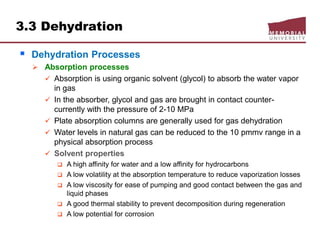
 Absorption is using organic solvent (glycol) to absorb the water vapor
in gas
 In the absorber, glycol and gas are brought in contact counter-
currently with the pressure of 2-10 MPa
 Plate absorption columns are generally used for gas dehydration
 Water levels in natural gas can be reduced to the 10 pmmv range in a
physical absorption process
 Solvent properties
 A high affinity for water and a low affinity for hydrocarbons
 A low volatility at the absorption temperature to reduce vaporization losses
 A low viscosity for ease of pumping and good contact between the gas and
liquid phases
 A good thermal stability to prevent decomposition during regeneration
 A low potential for corrosion
3.3 Dehydration
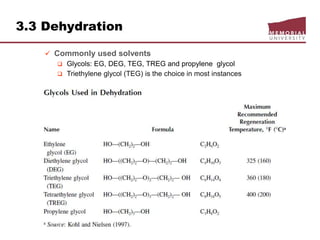
 Commonly used solvents
 Glycols: EG, DEG, TEG, TREG and propylene glycol
 Triethylene glycol (TEG) is the choice in most instances
3.3 Dehydration
3.3 Dehydration
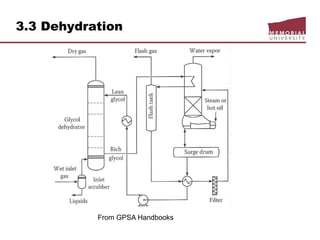
 Process description
 A two-step process, water is firstly absorbed from the gas in a staged
tower; the solvent is regenerated in a second column for recycle
 Process components
 Inlet separator: two or three phase separator
 Absorber
o Be made up of a number of equilibrium stages, enough to ensure mass
transfer from the gas phase to the liquid such that the outlet gas is at
the desired water specification
o The actual stages could be either trays like bubble caps, valve trays, or
sieve trays, or a suitable packing material
 Flash tank: dissolved gas is removed
 Lean-rich exchanger: hot, lean glycol from the regeneration is cooled with
rich glycol from the contactor
 Stripper: stripping column to regenerate solvent
 Glycol pump: circulate glycol
3.3 Dehydration
From GPSA Handbooks
3.3 Dehydration
 Design and operating considerations
 Absorber
 The incoming wet gas and the lean glycol are contacted counter-currently in
the absorber to reduce the water content of the gas to the required
specifications
 The key design parameters for the absorber are:
o Gas flow rate and specific gravity
o Gas temperature
o Operating pressure
o Outlet dew point or water content required
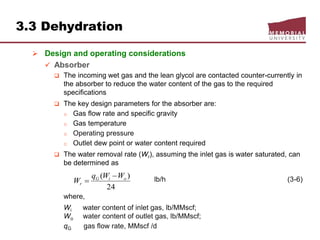
 The water removal rate (Wr), assuming the inlet gas is water saturated, can
be determined as
lb/h (3-6)
where,
Wi water content of inlet gas, lb/MMscf;
Wo water content of outlet gas, lb/MMscf;
qG gas flow rate, MMscf /d
24
)( oiG
r
WWq
W


3.3 Dehydration
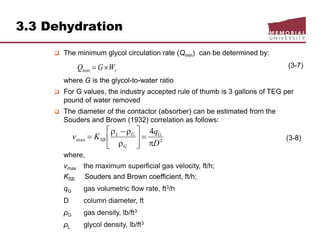
 The minimum glycol circulation rate (Qmin) can be determined by:
(3-7)
where G is the glycol-to-water ratio
 For G values, the industry accepted rule of thumb is 3 gallons of TEG per
pound of water removed
 The diameter of the contactor (absorber) can be estimated from the
Souders and Brown (1932) correlation as follows:
(3-8)
where,
vmax the maximum superficial gas velocity, ft/h;
KSB Souders and Brown coefficient, ft/h;
qG gas volumetric flow rate, ft3/h
D column diameter, ft
ρG gas density, lb/ft3
ρL glycol density, lb/ft3
rWGQ min
2max
4
D
q
Kv G
G
GL
SB










3.3 Dehydration
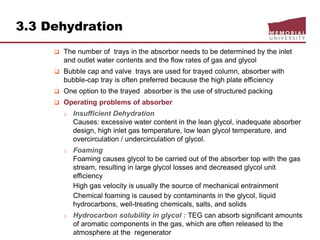
 The number of trays in the absorbor needs to be determined by the inlet
and outlet water contents and the flow rates of gas and glycol
 Bubble cap and valve trays are used for trayed column, absorber with
bubble-cap tray is often preferred because the high plate efficiency
 One option to the trayed absorber is the use of structured packing
 Operating problems of absorber
o Insufficient Dehydration
Causes: excessive water content in the lean glycol, inadequate absorber
design, high inlet gas temperature, low lean glycol temperature, and
overcirculation / undercirculation of glycol.
o Foaming
Foaming causes glycol to be carried out of the absorber top with the gas
stream, resulting in large glycol losses and decreased glycol unit
efficiency
High gas velocity is usually the source of mechanical entrainment
Chemical foaming is caused by contaminants in the glycol, liquid
hydrocarbons, well-treating chemicals, salts, and solids
o Hydrocarbon solubility in glycol : TEG can absorb significant amounts
of aromatic components in the gas, which are often released to the
atmosphere at the regenerator
3.3 Dehydration
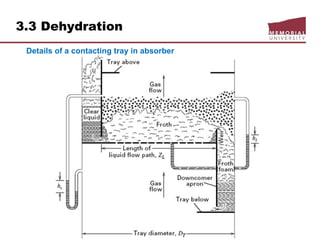
Details of a contacting tray in absorber
3.3 Dehydration
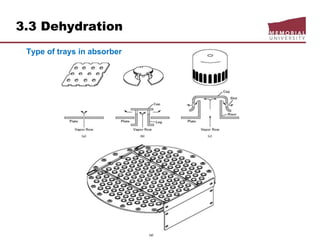
Type of trays in absorber
3.3 Dehydration
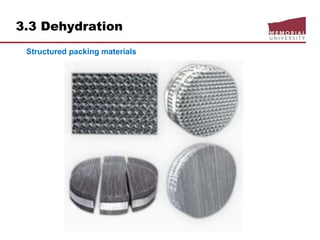
Structured packing materials
3.3 Dehydration
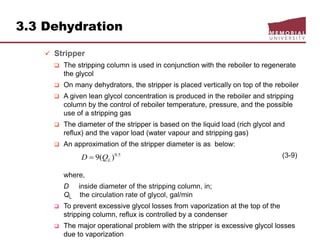
 Stripper
 The stripping column is used in conjunction with the reboiler to regenerate
the glycol
 On many dehydrators, the stripper is placed vertically on top of the reboiler
 A given lean glycol concentration is produced in the reboiler and stripping
column by the control of reboiler temperature, pressure, and the possible
use of a stripping gas
 The diameter of the stripper is based on the liquid load (rich glycol and
reflux) and the vapor load (water vapour and stripping gas)
 An approximation of the stripper diameter is as below:
(3-9)
where,
D inside diameter of the stripping column, in;
QL the circulation rate of glycol, gal/min
 To prevent excessive glycol losses from vaporization at the top of the
stripping column, reflux is controlled by a condenser
 The major operational problem with the stripper is excessive glycol losses
due to vaporization
5.0
)(9 LQD 
3.3 Dehydration
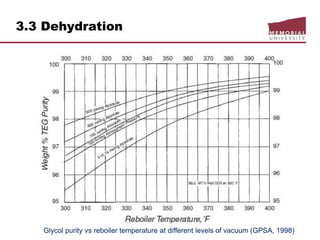
Glycol purity vs reboiler temperature at different levels of vacuum (GPSA, 1998)
3.3 Dehydration
 Adsorption for dehydration
 Overview of adsorption
 Adsorption involves a form of adhesion between the surface of solid phase
(adsorbent) and the water vapor in the gas
 The bonding between the adsorbed species and the solid phase is called
van der Waals forces, the attractive and repulsive forces that hold liquids
and solids together and give them their structure
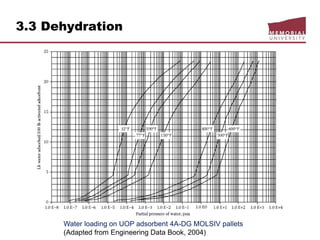
 Adsorption is an equilibrium process, for a given vapor-phase concentration
(partial pressure) and temperature, an equilibrium concentration exists on
the adsorbent surface that is the maximum concentration of the condensed
component (adsorbate) on the surface
 The equilibrium relationship between the adsorbed molecules on the
surface of solid phase with the partial pressure of the water vapor is called
adsorption isotherm
 Two steps involved for gas adsorption
o Adsorbate contacting the solid surface
o Adsorbate diffusing within the pores of the adsorbent
o Second step is usually very slow
3.3 Dehydration
Water loading on UOP adsorbent 4A-DG MOLSIV pallets
(Adapted from Engineering Data Book, 2004)
3.3 Dehydration
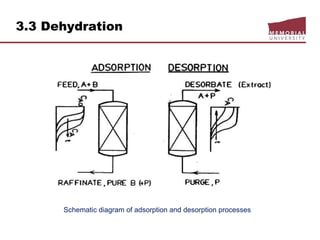
Schematic diagram of adsorption and desorption processes
3.3 Dehydration
 Dehydration is achieved in this case by the strong affinity of water molecule
to the solid phase
 In commercial practice, adsorption is carried out in a vertical, fixed-bed
adsorption column, with the feed gas flowing down through the bed.
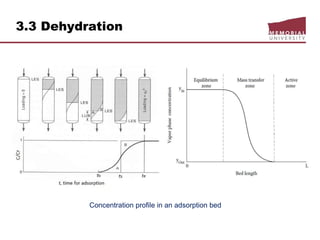
 Three zones in a adsorption bed
o The equilibrium zone
o The mass transfer zone (MTZ)
o The active zone
 The length of mass transfer zone is usually 0.5 to 6 ft.To maximize the bed
capacity, the MTZ needs to be as small as possible
 Adsorption dehydration is typically more effective than glycol absorption as
it can dry a gas to less than 0.1 ppmV
 Disadvantages of adsorption dehydration
o It require two more beds for continuous operation
o It has limited capacity and usually impractical for removing a large
amount of impurities
3.3 Dehydration
Concentration profile in an adsorption bed
3.3 Dehydration
 Properties of adsorbent
 Typical adsorbents used in gas processing plant
o Silica gel
• Made of pure SiO2
• Commonly used when a high concentration of water (>1 mol%)
present in the feed gas
o Activated alumina
• Made of Al2O3
• Very polar and strongly attract water and acid gases
• Used for moderate levels of water in the feed
• Having the highest mechanical strength
o Molecular sieve
• Made of alkali aluminosilicates and can be altered to affect adsorption
characteristics
• Very uniform small pore size, 3-10 Å
• Capable of dehydration to less than 0.1 ppmV water content
3.3 Dehydration
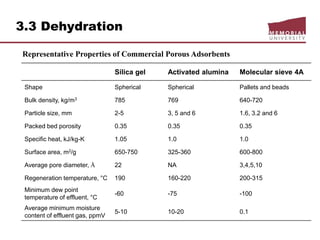
Representative Properties of Commercial Porous Adsorbents
Silica gel Activated alumina Molecular sieve 4A
Shape Spherical Spherical Pallets and beads
Bulk density, kg/m3 785 769 640-720
Particle size, mm 2-5 3, 5 and 6 1.6, 3.2 and 6
Packed bed porosity 0.35 0.35 0.35
Specific heat, kJ/kg-K 1.05 1.0 1.0
Surface area, m2/g 650-750 325-360 600-800
Average pore diameter, Å 22 NA 3,4,5,10
Regeneration temperature, °C 190 160-220 200-315
Minimum dew point
temperature of effluent, °C
-60 -75 -100
Average minimum moisture
content of effluent gas, ppmV
5-10 10-20 0.1
3.3 Dehydration
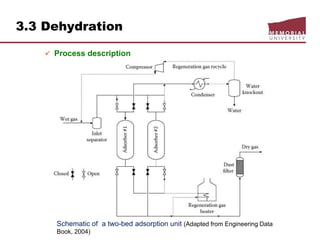
 Process description
Schematic of a two-bed adsorption unit (Adapted from Engineering Data
Book, 2004)
3.3 Dehydration
 The process is conducted alternately and periodically, with each bed going
through successive steps of adsorption and desorption
 One bed, adsorber #1 dries gas while the other bed, adsorber #2, goes
through a regeneration cycle.
 The wet feed goes through an inlet separator that will catch any entrained
liquids before the gas enters the top of the active bed.
 Flow is top-down to avoid bed fluidization
 The dried gas then goes through a dust filter that will catch fines before the
gas exits the unit
 Regeneration involves heating the bed, removing the water, and cooling
 Regeneration gas enters at the bottom of the bed (countercurrent to flow
during adsorption) to ensure that the lower part of the bed is the driest and
that any contaminants trapped in the upper section of the bed stay out of
the lower section.
 The high temperature required makes this step (regeneration) energy
intensive
 The hot, wet regeneration gas then goes through a cooler and inlet
separator to remove the water before being recompressed and mixed with
incoming wet feed.
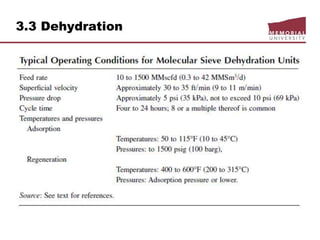
3.3 Dehydration
3.3 Dehydration
 Design considerations
 Allowable gas velocity
o Generally, as the gas velocity in the adsorption column decreases, the
ability of the adsorbent to dehydrate the gas increases
o But lower velocities require columns with large cross-sectional area to
handle a given gas flow and allow the wet gas to channel through the
fixed bed with incomplete dehydration
o A compromise must be made between the column diameter and the
maximum use of the adsorbent
o In addition, higher velocities increase pressure drop through the bed, the
design gas velocity is therefore a trade-off between the maximum gas
velocity and the acceptable pressure drop
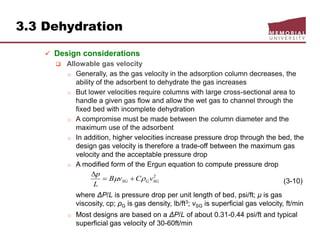
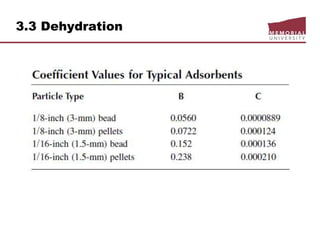
o A modified form of the Ergun equation to compute pressure drop
(3-10)
where ΔP/L is pressure drop per unit length of bed, psi/ft; μ is gas
viscosity, cp; ρG is gas density, lb/ft3; vSG is superficial gas velocity, ft/min
o Most designs are based on a ΔP/L of about 0.31-0.44 psi/ft and typical
superficial gas velocity of 30-60ft/min
2
SGGSG vCvB
L
p
 

3.3 Dehydration
3.3 Dehydration
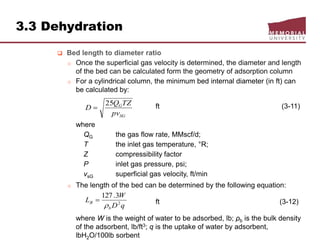
 Bed length to diameter ratio
o Once the superficial gas velocity is determined, the diameter and length
of the bed can be calculated form the geometry of adsorption column
o For a cylindrical column, the minimum bed internal diameter (in ft) can
be calculated by:
ft (3-11)
where
QG the gas flow rate, MMscf/d;
T the inlet gas temperature, °R;
Z compressibility factor
P inlet gas pressure, psi;
vsG superficial gas velocity, ft/min
o The length of the bed can be determined by the following equation:
ft (3-12)
where W is the weight of water to be adsorbed, lb; ρb is the bulk density
of the adsorbent, lb/ft3; q is the uptake of water by adsorbent,
lbH2O/100lb sorbent
SG
G
pv
TZQ
D
25

qD
W
L
b
B 2
3.127


3.3 Dehydration
o A bed length to diameter ratio is higher than 2.5. the minimum length to
diameter ratio is 1.
 MTZ length
o MTZ length depends on gas composition, flow rate, relative saturation of
the water in the gas, and the loading capability of the adsorbent
o For silica gel, the MTZ length may be estimated from the following
equation
(3-13)
where LMTZ is MTZ length, inch; mw is water loading, lb/(hr.ft2); VSG is the
superficial gas velocity, ft/min; RS is percentage relative saturation of
inlet gas
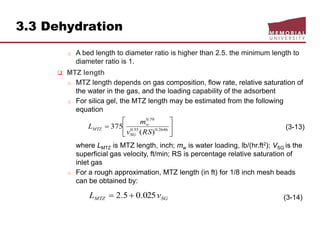
o For a rough approximation, MTZ length (in ft) for 1/8 inch mesh beads
can be obtained by:
(3-14)






 2646.055.0
79.0
)(
375
RSv
m
L
SG
w
MTZ
SGMTZ vL 025.05.2 
3.3 Dehydration
 Breakthrough time
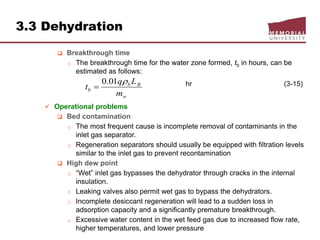
o The breakthrough time for the water zone formed, tb in hours, can be
estimated as follows:
hr (3-15)
 Operational problems
 Bed contamination
o The most frequent cause is incomplete removal of contaminants in the
inlet gas separator.
o Regeneration separators should usually be equipped with filtration levels
similar to the inlet gas to prevent recontamination
 High dew point
o “Wet” inlet gas bypasses the dehydrator through cracks in the internal
insulation.
o Leaking valves also permit wet gas to bypass the dehydrators.
o Incomplete desiccant regeneration will lead to a sudden loss in
adsorption capacity and a significantly premature breakthrough.
o Excessive water content in the wet feed gas due to increased flow rate,
higher temperatures, and lower pressure
w
Bb
b
m
Lq
t
01.0

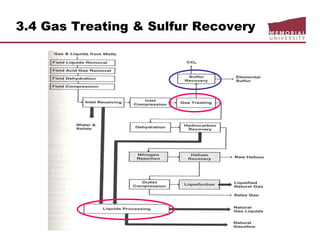
3.4 Gas Treating & Sulfur Recovery
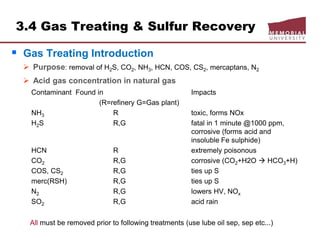
 Gas Treating Introduction
 Purpose: removal of H2S, CO2, NH3, HCN, COS, CS2, mercaptans, N2
 Acid gas concentration in natural gas
Contaminant Found in Impacts
(R=refinery G=Gas plant)
NH3 R toxic, forms NOx
H2S R,G fatal in 1 minute @1000 ppm,
corrosive (forms acid and
insoluble Fe sulphide)
HCN R extremely poisonous
CO2 R,G corrosive (CO2+H2O  HCO3+H)
COS, CS2 R,G ties up S
merc(RSH) R,G ties up S
N2 R,G lowers HV, NOx
SO2 R,G acid rain
All must be removed prior to following treatments (use lube oil sep, sep etc...)
3.4 Gas Treating & Sulfur Recovery
 Treating Processes
 Physical or chemical absorption: separation occurs by the transfer of
contaminant from gas to liquid phase through phase boundary
 Combo (physical and chemical absorption)
 Adsorption: vapor or liquid contaminants are adsorbed on solids due to
molecular attraction to solid surface
 Membrane: CO2 removal using hollow fiber membranes
 Non-regenerable H2S scavengers: a batch process for H2S removal
3.4 Gas Treating & Sulfur Recovery
 Chemical Absorption for Gas Treating
 Chemical absorption: absorption with chemical reactions for acid gas
removal, reaction can be either reversible or irreversible
 Reversible: removal CO2/H2S at high pressure and/or low temperature,
reversed at low pressure and high temperature in stripper
 Irreversible: removal CO2/H2S requires continuous make-up of absorbent
 Advantages:
 Reduce equipment size and energy savings because of the fast mass transfer
rates
 Some designed to slip larger portion CO2, H2S<4 ppm
 Typical solvents:
 Amines: categorized on a chemical basis as being primary (MEA, DGA, RNH2),
secondary (DEA, DIPA, RNHR), and tertiary (MDEA, TEA, RNR) depending on
the number of substitutions onto a central N
 Salts: K2CO3 for high CO2 natural gas
3.4 Gas Treating & Sulfur Recovery
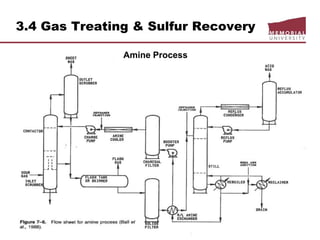
Amine Process
3.4 Gas Treating & Sulfur Recovery
 Absorption process
 Inlet scrubber:removes entrained liquids and drops of condensed hydrocarbons,
produced water, corrosion inhibitors and well treating chemicals
 Absorber (contactor): equipment where acid gases are absorbed by amine
 Outlet separator: removes any liquid carryover from the sweet gas and prevents
contamination of downstream equipment
 Regeneration process
 Flash tank
 Rich/lean amine heat exchanger
 Stripping still: contains trays or packing for stripping the H2S out of rich amine
 Re-boiler filters
 Aerial cooler & reflux condenser
 Reflux booster pumps
 Amine re-boilers
 Reclaimer: an equipment where additional regeneration of amines is performed
using Soda ash
3.4 Gas Treating & Sulfur Recovery
 Physical and Combo Absorption Processes
 Physical absorption
 Solvents: Selexol, Sulfinol, Propylene Carbonate
 Advantages
 Low regeneration energy (multi-stage flash to lower P, stripping gas is steam)
 Simultaneous dehydration and acid gas removal
 Noncorrosive
 Low chemical losses
 Disadvantages: large contactor and many trays
 Combo (physical-chemical ) absorption
 Solvents: a combination of physical solvent (sulfolane) with DIPA or MEDA
 Advantages: low energy, low foam and corrosion, high acid gas load
 Disadvantages: high heavy HC co-adsorption, need reclaimer
3.4 Gas Treating & Sulfur Recovery
 Selection Criteria for Absorption Processes
 Determined by the pressure and composition of raw natural gas, the trace
components and the desired quality of marketable natural gas
 Investment and operating cost
 Design of the absorber and the amount of solvent required
 Key factors
 Raw gas composition: physical absorbents are generally not used for the
purification of natural gas that contains higher hydrocarbons
 Gas throughput: chemical scrubbers are more economical for small gas streams
if no side reactions with the chemical absorbent occur. For large plant, the
operating cost for physical absorption processes outweigh the higher investment
cost
 Pressure: lower P for chemical absorption process
 Sales gas: in case H2S and CO2 must be simultaneously and completely
removed, chemical or physical-chemical scrubbing processes can be attractive
3.4 Gas Treating & Sulfur Recovery
 H2S Scavenger Processes
 H2S liquid scavengers:
 Used Fe sponge but FeS product is pyrophoric(hazardous)
 Amine, nitrates, triazine  injected directly into gas stream, continuous or batch
 Expensive, $1.98-3.43/L scavenger but low cap costs
 Maximum 50 kg/day H2S removed
 H2S solid scavengers:
 Granulated Fe based which forms FeS2 (iron pyrite)  not hazardous
 To be most effective gas stream must be saturated with H2O (check)
 Affect not gas flow rate, but mass flow rate of H2S over bed  no turndown
problems
 Capacity 0.11 kg H2S/kg solid, optimal cost $6.65/kg H2S vs. l scav $20/kg 
higher capital cost
 Treat 50-200 kg/day H2S
 Solid must be disposed
3.4 Gas Treating & Sulfur Recovery
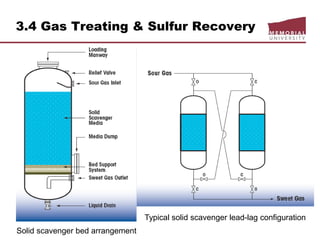
Solid scavenger bed arrangement
Typical solid scavenger lead-lag configuration
3.4 Gas Treating & Sulfur Recovery
 Liquid Treating
 LPG, NGLs, gasoline for mercury, H2S, CO2, S removal
 Continuous process
 Regenerated caustic – countercurrent contact HC w/10% NaOH solution
o treats methyl-ethyl mercs, reduces total S content,
o handles large volumes but corrosive potential
 Merox: catalyst solution, mercs
 Perco solid copper chloride sweetening
o use treat high [merc] gasoline, low flows, [H2O] < saturation, H2S must
removed prior
o low corrosion
o overall S content not reduced
 Batch process
 Caustic Wash: treat low merc LPG/gasoline, trace removal H2S, m/e mercs
 Solid KOH: trace removal H2S, low cost and act as a desiccant
 Molecular sieve
o reduces total S content (H2S, mercs, org S) and dehydrates
o regeneration gas slightly sour
3.4 Gas Treating & Sulfur Recovery
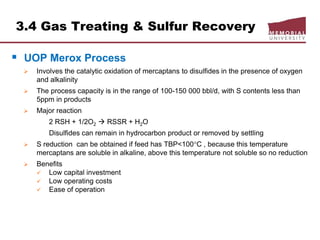
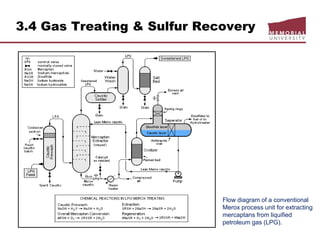
 UOP Merox Process
 Involves the catalytic oxidation of mercaptans to disulfides in the presence of oxygen
and alkalinity
 The process capacity is in the range of 100-150 000 bbl/d, with S contents less than
5ppm in products
 Major reaction
2 RSH + 1/2O2  RSSR + H2O
Disulfides can remain in hydrocarbon product or removed by settling
 S reduction can be obtained if feed has TBP<100C , because this temperature
mercaptans are soluble in alkaline, above this temperature not soluble so no reduction
 Benefits
 Low capital investment
 Low operating costs
 Ease of operation
3.4 Gas Treating & Sulfur Recovery
Flow diagram of a conventional
Merox process unit for extracting
mercaptans from liquified
petroleum gas (LPG).
3.4 Gas Treating & Sulfur Recovery
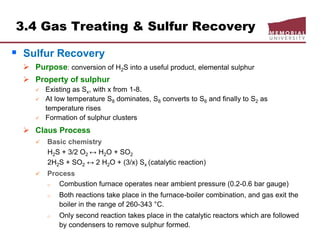
 Sulfur Recovery
 Purpose: conversion of H2S into a useful product, elemental sulphur
 Property of sulphur
 Existing as Sx, with x from 1-8.
 At low temperature S8 dominates, S8 converts to S6 and finally to S2 as
temperature rises
 Formation of sulphur clusters
 Claus Process
 Basic chemistry
H2S + 3/2 O2 ↔ H2O + SO2
2H2S + SO2 ↔ 2 H2O + (3/x) Sx (catalytic reaction)
 Process
o Combustion furnace operates near ambient pressure (0.2-0.6 bar gauge)
o Both reactions take place in the furnace-boiler combination, and gas exit the
boiler in the range of 260-343 °C.
o Only second reaction takes place in the catalytic reactors which are followed
by condensers to remove sulphur formed.
3.4 Gas Treating & Sulfur Recovery
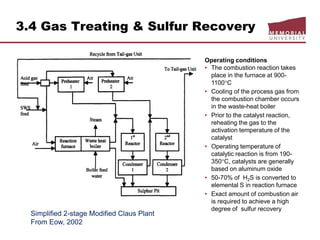
Simplified 2-stage Modified Claus Plant
From Eow, 2002
Operating conditions
• The combustion reaction takes
place in the furnace at 900-
1100C
• Cooling of the process gas from
the combustion chamber occurs
in the waste-heat boiler
• Prior to the catalyst reaction,
reheating the gas to the
activation temperature of the
catalyst
• Operating temperature of
catalytic reaction is from 190-
350C, catalysts are generally
based on aluminum oxide
• 50-70% of H2S is converted to
elemental S in reaction furnace
• Exact amount of combustion air
is required to achieve a high
degree of sulfur recovery
3.4 Gas Treating & Sulfur Recovery
 Claus Tail Gas Cleanup Unit
 Purpose: For higher sulfur recovery (removal >98%)
 Three categories
 Direct oxidation of H2S to sulfur
o A three-staged catalytic reactor to oxide the remaining H2S to element sulfur
o Reactors 1 and 2 use the standard Claus catalyst, whereas the third reactor
contains the selective oxidation catalyst
o Oxygen level at the exit of the second reactor is keeping in the 0.5-2 vol%
range, a total recovery rate of 99% or higher can be reached
 Sub-dew point Claus process
o Cold-bed adsorption process, the most widely used process
o Sub-dew point process takes place in the final two catalytic convertors, with
one in service the other being regenerated
o The convertor is operated at a temperature well below the sulfur dew point.
o Both separation and reaction occur within the convertor which lead to a
higher reaction conversion
3.4 Gas Treating & Sulfur Recovery
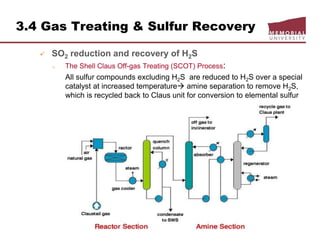
 SO2 reduction and recovery of H2S
o The Shell Claus Off-gas Treating (SCOT) Process:
All sulfur compounds excluding H2S are reduced to H2S over a special
catalyst at increased temperature amine separation to remove H2S,
which is recycled back to Claus unit for conversion to elemental sulfur
 Pollutants from Natural Gas Processing
 Pollutants: substance present in a particular location (ecosystem), has a
detrimental effect on the environment, in part or in total.
 Sources
 Primary pollutants: emitted directly from source
e.g.: atmospheric pollutants including CO/CO2, SO2, NO /NO2
 Secondary pollutants: produced by interaction of a primary pollutant with
another chemical,
e.g.: constituent of acid rain, H2SO3, H2SO4, HNO2 and HNO3
 Types
 Gaseous
 Liquid
 Solid
 Necessity for pollution control
 High quality product demand has created a substantial increase in the sources
and types of wastes
 If these chemical wastes are not processed in a timely manner, they can
become pollutants, causing pollution to the environment
3.5 Environmental Considerations
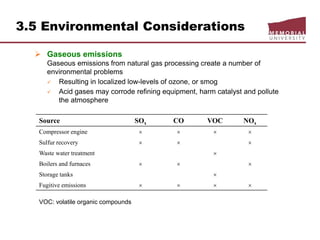
 Gaseous emissions
Gaseous emissions from natural gas processing create a number of
environmental problems
 Resulting in localized low-levels of ozone, or smog
 Acid gases may corrode refining equipment, harm catalyst and pollute
the atmosphere
Source SOx CO VOC NOx
Compressor engine    
Sulfur recovery   
Waste water treatment 
Boilers and furnaces   
Storage tanks 
Fugitive emissions    
VOC: volatile organic compounds
3.5 Environmental Considerations
 Carbon monoxide (CO)
 Formed by incomplete combustion in boilers, process heaters, and power
plants
 Toxic
 Sulfur oxides
 Produced by the combustion of sulfur-containing fuels
 Irritate the respiratory tract
 React with water vapor in the atmosphere and return to earth as acid rain
 Nitrogen oxides and VOC
 NOx also produced by the fired heaters and/or power plant
 NOx also damage respiratory tissues and contribute to acid rain
 VOCs react with ozone to form a series of substances which are toxic to
humans, animals and plants
 Greenhouse gases
 CO2, CH4 and N2O
 Global warming
3.5 Environmental Considerations
 Liquid wastes
 Contaminants
o H2S and mercaptans
o Cyanides
o Ammonium compounds
o Hydrocarbons
 Sour water: from NH3, sulfur compounds
 Solid wastes
 Sources
o Gas and liquid treating
o Waste water treatment
 Types
o Sludge from hydrocarbon treating
o Sludge from the bottom of storage tanks
o Sludge from waste water treatment
3.5 Environmental Considerations
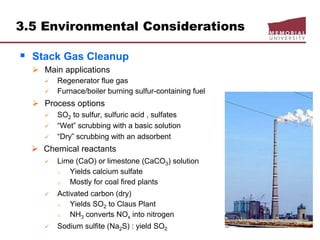
 Stack Gas Cleanup
 Main applications
 Regenerator flue gas
 Furnace/boiler burning sulfur-containing fuel
 Process options
 SO2 to sulfur, sulfuric acid , sulfates
 “Wet” scrubbing with a basic solution
 “Dry” scrubbing with an adsorbent
 Chemical reactants
 Lime (CaO) or limestone (CaCO3) solution
o Yields calcium sulfate
o Mostly for coal fired plants
 Activated carbon (dry)
o Yields SO2 to Claus Plant
o NH3 converts NOx into nitrogen
 Sodium sulfite (Na2S) : yield SO2
3.5 Environmental Considerations
 Waste Water Treatment
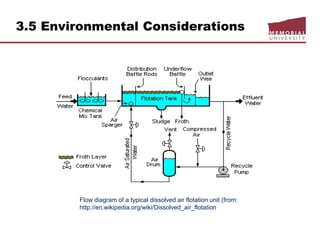
 Coagulation, flocculation and dissolved air flotation (DAF*)
 Coagulation: additives break colloidal suspensions, allow coalescence
 Flocculation: additives help oily ‘floc’ or sludge to form
 DAF: tiny air bubbles thicken sludge for easier removal
 Aerobic biological treatment
Remove water soluble materials, such as HC’s, phenol, miscellaneous
soluble biochemical oxygen demand (BOD) and COD (chemical oxygen
demand) compounds
 Solid Water Treatment
 Incineration
 Land treating off-site
 Land filling onsite
 Land filling off-site
 Chemical fixation
 Neutralization
3.5 Environmental Considerations
Flow diagram of a typical dissolved air flotation unit (from:
http://en.wikipedia.org/wiki/Dissolved_air_flotation

Dr. Aborig Lecture- Chapter 3 natural gas processing

  • 1.
    ENGI 8676 Designof Natural Gas Handling Equipment ENGI 9120 Advanced Natural Gas Processing Chapter 3 Natural Gas Processing by Dr. Amer Aborig Process Engineering Memorial University of Newfoundland amaborig@Mun.ca
  • 2.
    Contents  Introduction  Inletreceiving  Dehydration processes  Gas treating and sulfur recovery  Environmental considerations
  • 3.
    3.1 Introduction  Purposesof Processing  Purification. Removal of materials, valuable or not, that inhibit the use of the gas as an industrial or residential fuel  Separation. Splitting out of components that have greater value as petrochemical feedstocks, stand alone fuels (e.g., propane), or industrial gases (e.g., ethane, helium)  Liquefaction. Increase of the energy density of the gas for storage or transportation  Principle Products: methane , ethane, propane, isobutane, n-butane, natural gas liquids, natural gasoline, sulphur
  • 4.
    3.1 Introduction  Specificationsfor Pipeline Quality Gas Major Components Minimum Mol% Maximum Mol% Methane 75 None Ethane None 10 Propane None 5 Butane None 2 Pentane and heavier None 0.5 Nitrogen and other inerts None 3 Carbon dioxide None 2-3 Total diluents gases None 4-5 Trace components Hydrogen sulphide 6-7 mg/m3 Total sulphur 115-460 mg/m3 Water vapor 60-110 mg/m3 Oxygen 1.0% Liquids Free of liquid water and hydrocarbons Solids Free of particulates in amounts deleterious to transmission equipment
  • 5.
    3.1 Introduction A blockschematic of a gas plant (Source: Kidnay & Parrish, Fundamentals of Natural Gas Processing, Taylor & Francis, 2006  Plant Processes  Field operations and inlet receiving  Inlet compression  Gas treating  Dehydration  Hydrocarbon recovery  Nitrogen rejection  Helium recovery  Outlet compression  Liquid processing  Sulfur recovery  Liquefaction
  • 6.
     Important SupportComponents  Utilities  Including power, heating fluids, cooling water, instrument air, nitrogen-purge gas and fuel gas  Cogeneration plants are becoming more attractive options  Process control  Digital control systems (DCS) are widely used for individual units to provide both process control and operations history  Supervisory control and data acquisition (SCADA)) is also applied for monitoring of field operations  Safety systems  Emergency shutdown of inlet gas  Relief valves and vent systems  The Engineering Data Book provides criteria for sizing relief systems and flares 3.1 Introduction
  • 7.
    3.2 Inlet Receiving Gas-Liquid Separation  Objectives  A primary phase separation of the mostly liquid hydrocarbons from the gas stream  Refining the primary separation by further removing most of the entrained liquid mist from the gas  Refining the separation by further removing the entrained gas from the liquid stream  Discharging the separated gas and liquid from vessel and preventing the re-entrainment of one into the other  Separation principles:  Primary separation  By utilizing the differences in momentum between gas and liquid  Larger liquid droplets impinge by momentum and then drop by gravity  To separate a major portion of incoming liquid
  • 8.
    3.2 Inlet Receiving Secondary separation  Gravity separation of smaller droplets as vapor flow through the disengagement area  Gravity separation can be aided by using baffle that creates an even velocity distribution in the fluid  Mist elimination  The coalescing section contains an inserts (mist extractor) that forces the gas through torturous path to bring small mist particles together as they collect on the insert  The inserts can be mesh pads, vane packs or cyclone devices  Separation types:  Horizontal  Vertical  Spherical
  • 9.
    3.2 Inlet Receiving A:Inlet device B: Gas gravity separation C: Mist extraction D: Liquid gravity separation Gas-liquid separators (Source: Kidnay & Parrish, Fundamentals of Natural Gas Processing, Taylor & Francis, 2006
  • 10.
    3.2 Inlet Receiving Selection of separator types  Horizontal  Applications o Large volumes of gas and/or liquids o High-to-intermediate Gas/Oil ratio (GOR) streams o 3-phase separation  Advantages: o Smaller diameter for similar gas capacity as compared to vertical vessels o Large liquid surface area for foam dispersion, reducing turbulence o Larger surge volume capacity  Disadvantages: o Only part of shell available for passage of gas o Occupied more space unless stack mounted o Liquid level control is more critical o More difficult to clean produced sand, mud, wax paraffin, etc.
  • 11.
    3.2 Inlet Receiving Vertical  More suitable to be used in following conditions o Small flow rates of gas and /or liquids o Low to intermediate GOR streams o Plot space is limited o Ease of level control is desired  Advantages: o Good bottom-drain and clean-out facilities o Can handle more sand, mud, paraffin and wax without plugging o Less tendency for re-entrainment o Full diameter for gas flow at top and oil flow at bottom o Occupies smaller plot area  Disadvantages: o Require larger diameter for a given gas capacity o Not recommended when there is a large slug potential o More difficult to reach and service top-mounted instruments and safety devices
  • 12.
    3.2 Inlet Receiving Factors affecting separation  Important factors  Separator operating pressure  Separator operating temperature  Fluid stream composition  For a given fluid stream in a specified separator, change in any of these factors will change the amount of gas and liquid leaving the separator  An increase in operating pressure or a decrease in operating temperature generally increases the liquid covered in the separator  For gas condensate system, increasing operating pressure will not add to liquid recovery  High liquid recovery is always desirable
  • 13.
    3.2 Inlet Receiving Separator design  Separator designers need to know pressure, temperature, flow rates and physical properties of the streams as well as the degree of separation required  3 main factors in design  Gas capacity determines the cross-sectional area necessary for gravitational forces to remove the liquid from gas  Liquid capacity is typically set by determining the volume required to provide adequate residence time to degas the liquid or allow immiscible liquid phases to separate  Operability issues include the separator’s ability to deal with solids if present, unsteady flow/liquid slugs, turndown etc  An iterative approach to calculations is needed for the optimal design which satisfies these requirements
  • 14.
    3.2 Inlet Receiving Gas capacity  The following empirical equations proposed by Souders-Brown are widely used to calculated gas capacity of oil/gas separators (3-1) and (3-2) where A: total cross-sectional area of separator, ft2 v: superficial gas velocity, ft/s q: gas flow rate at operating conditions, ft3/s ρL: density of liquid at operating conditions, lb/ft3 ρG: density of gas at operating conditions, lb/ft3 K: empirical factor  Substituting Eq. (3-1) into Eq. (3-2) and applying ideal gas law gives: D: internal diameter of the vessel (3-3) G GL Kv     v q A  G GL st TZ KpD q      )460( 4.2 2
  • 15.
    3.2 Inlet Receiving Liquid capacity  The liquid capacity of a separator relates to the retention time through the settling volume: (3-4) where qL: liquid capacity, bbl/day VL: liquid settling volume, bbl t: retention time, min  For sizing a separator, both equations of gas capacity and liquid capacity need to be used  For treating high GOR wellstream, the gas capacity is usually the controlling factor for separator design/selection t V q L L 1440 
  • 16.
    Separator Design Problem Calculate the minimum required size of a standard oil/gas separator for the following conditions. Consider both vertical and horizontal separators. Gas flowrate: 5.0 MMscfd Gas specific gravity: 0.7 Condensate flow rate: 20 bbl/MMscf Condensate gravity: 60˚API Solution: The total required liquid flow capacity = 5*20=100 bbl/day Using Sutton (1985) correlation: Operating pressure: 800 psig Operating temperature: 80 F K-value: 0.205
  • 17.
    Separator Design Problem Solution: From Standing & Katz chart: z = 0.862 𝜌 𝑔 = 0.0932 × 𝑃𝑀 𝑎 𝑍𝑇 = 0.0932 × 800 × 20.273 0.862 × 540 = 3.25 𝑙𝑏𝑚 𝑓𝑡3 ppr = 800 663.29 =1.206 Tpr = 540 377.6 =1.43 Ma = g g ´ Mair = 0.7 ´ 28.9625 = 20.273 API gravity = 141.5 g L -131.5 60 = 141.5 g L -131.5 Þg L = 0.739 rL = g L ´ rw = 0.739 ´ 62.4 = 46.11lbm / ft3
  • 18.
    Separator Design Problem Calculationof Internal Diameter of the Vessel: Selection of Vertical Separator: So, the minimum diameter of the separator should be 15.31 in. From Table 7.3, we select the standard size of oil/gas vertical separator. Minimum Vertical Separator size (D×H)= 16’’ ×5’ qst = 2.4 ´ D2 KP z T + 460( ) rL - rg rg 5 = 2.4 ´ D2 ´ 0.205 ´ 800 0.862 80 + 460( ) 46.11- 3.25 3.25 D = 1.276 ft D = 15.31inch
  • 19.
  • 20.
  • 21.
  • 22.
  • 23.
    Separator Design Problem Calculationof liquid capacity of the selected separator: Where, VL= Settling Volume (found from Table 7.3) t = Retention time (found from Table 7.2) Since, the liquid capacity of our selected vertical separator is more than the required liquid capacity (which is 100 bbl/day), the selected separator size can handle the given gas stream. qL = 1440 ´VL t = 1440 ´ 0.27 1 = 388.8 bbl / day
  • 24.
    Separator Design Problem Selectionof Horizontal Separator: Internal Diameter of the Vessel = 15.31 in (same for both) From the Table 7.5, we select the standard size of oil/gas vertical separator. Minimum Horizontal Separator Size (D×L)= 16’’ ×5’ Calculation of liquid capacity of the selected separator: The capacity is much higher than the required capacity (100 bbl/day) qL = 1440 ´VL t = 1440 ´ 0.61 1 = 878.4 bbl / day
  • 25.
    3.3 Dehydration  GasHydrate and Hydrate Inhibition  Gas hydrate  Ice-like solids composed of water and hydrocarbons, HCs ranging from methane to cyclopentane are known to form hydrates  The formation of hydrates depending on pressure, temperature, molecular size and concentration of component  Easily formed at high pressure and low temperature  Hydrate formation prediction  Thermodynamics provides a powerful tool for prediction of the temperature and pressure for hydrate formation on the basis of gas composition.  Even when hydrates are thermodynamically possible, they may never form.  Hydrate formation kinetics is complex and poorly understood  Complex statistical thermodynamic model is available to predict the hydrate formation temperatures
  • 26.
    3.3 Dehydration  Empiricalcorrelations are available  Gas gravity correlation is widely used to estimate the conditions at which hydrate will form  For pressure below 1000 psi, the figure can be approximated by: (3-5) )](ln[8.13 83.6 5.16)( 2 psipFt    )](ln[68.7 79.3 44.6)( 2 barpCt    Pressure-temperature curves for estimation of hydrate formation condition as a function of gas specific gravity (Adapted from Engineering Data Book, 2004d)
  • 27.
    3.3 Dehydration  Hydrateinhibition  Three ways to avoid hydrate formation  Operate outside of the hydrate formation region  Dehydrate the gas  Add hydrate inhibitors  Types of inhibitors  Thermodynamic o Mainly methanol and ethylene glycol o Methanol is more widely used than ethylene glycol o Both inhibitors are hydrophilic and remain predominantly with a condensed water phase o Methanol is volatile, mass loss of methanol needs to be considered o Ethylene glycol is relatively easy to recover, it is viscous and must be either diluted or kept in a warm storage vessel in cold weather
  • 28.
    3.3 Dehydration  Antiagglomerates(AA) o Alkyl aromatic sulphonate o Prevent small hydrate particles from agglomerating o Reside in the liquid hydrocarbon phase and are most often used in pipelines where gas is dissolved in oil o Require testing to ensure proper concentrations  Kinetic inhibitor (KHI) o Slow crystal formation o Can be used at concentrations in the 1 wt% range in the aqueous phase o Nonvolatile o Proper dosage must be determined empirically o Typical KHIs: n-vinylpyrrolidone, saccharides, n-vinylcaprolactam  Problems in using hydrate inhibitors  The proper inhibitor dosage must be known to avoid plugging or needless chemical costs,  The reliability of inhibitor injection can be a problem because of malfunctioning injection pumps and depleted inhibitor reservoirs, especially at remote sites  The possible interaction between inhibitors and other additives
  • 29.
    3.3 Dehydration  GasDehydration  Purpose  Removal of water from gas stream so that products meet the requirement for transportation and storage  Increasing the heating value of the gas  Necessity  Water in gas condensates to form ice or gas hydrates which cause corrosion or erosion problems in pipeline or equipment  When CO2 and H2S are present in the gas, sour and acid gases can hold more water, the stream becomes more corrosive  Water contents of gas  Use empirical chart to determine water content of gas  Gas analysis will give more accurate results  Methods  Absorption  Adsorption  Membrane
  • 30.
    3.3 Dehydration  DehydrationProcesses  Absorption processes  Absorption is using organic solvent (glycol) to absorb the water vapor in gas  In the absorber, glycol and gas are brought in contact counter- currently with the pressure of 2-10 MPa  Plate absorption columns are generally used for gas dehydration  Water levels in natural gas can be reduced to the 10 pmmv range in a physical absorption process  Solvent properties  A high affinity for water and a low affinity for hydrocarbons  A low volatility at the absorption temperature to reduce vaporization losses  A low viscosity for ease of pumping and good contact between the gas and liquid phases  A good thermal stability to prevent decomposition during regeneration  A low potential for corrosion
  • 31.
    3.3 Dehydration  Commonlyused solvents  Glycols: EG, DEG, TEG, TREG and propylene glycol  Triethylene glycol (TEG) is the choice in most instances
  • 32.
  • 33.
    3.3 Dehydration  Processdescription  A two-step process, water is firstly absorbed from the gas in a staged tower; the solvent is regenerated in a second column for recycle  Process components  Inlet separator: two or three phase separator  Absorber o Be made up of a number of equilibrium stages, enough to ensure mass transfer from the gas phase to the liquid such that the outlet gas is at the desired water specification o The actual stages could be either trays like bubble caps, valve trays, or sieve trays, or a suitable packing material  Flash tank: dissolved gas is removed  Lean-rich exchanger: hot, lean glycol from the regeneration is cooled with rich glycol from the contactor  Stripper: stripping column to regenerate solvent  Glycol pump: circulate glycol
  • 34.
  • 36.
    3.3 Dehydration  Designand operating considerations  Absorber  The incoming wet gas and the lean glycol are contacted counter-currently in the absorber to reduce the water content of the gas to the required specifications  The key design parameters for the absorber are: o Gas flow rate and specific gravity o Gas temperature o Operating pressure o Outlet dew point or water content required  The water removal rate (Wr), assuming the inlet gas is water saturated, can be determined as lb/h (3-6) where, Wi water content of inlet gas, lb/MMscf; Wo water content of outlet gas, lb/MMscf; qG gas flow rate, MMscf /d 24 )( oiG r WWq W  
  • 37.
    3.3 Dehydration  Theminimum glycol circulation rate (Qmin) can be determined by: (3-7) where G is the glycol-to-water ratio  For G values, the industry accepted rule of thumb is 3 gallons of TEG per pound of water removed  The diameter of the contactor (absorber) can be estimated from the Souders and Brown (1932) correlation as follows: (3-8) where, vmax the maximum superficial gas velocity, ft/h; KSB Souders and Brown coefficient, ft/h; qG gas volumetric flow rate, ft3/h D column diameter, ft ρG gas density, lb/ft3 ρL glycol density, lb/ft3 rWGQ min 2max 4 D q Kv G G GL SB          
  • 38.
    3.3 Dehydration  Thenumber of trays in the absorbor needs to be determined by the inlet and outlet water contents and the flow rates of gas and glycol  Bubble cap and valve trays are used for trayed column, absorber with bubble-cap tray is often preferred because the high plate efficiency  One option to the trayed absorber is the use of structured packing  Operating problems of absorber o Insufficient Dehydration Causes: excessive water content in the lean glycol, inadequate absorber design, high inlet gas temperature, low lean glycol temperature, and overcirculation / undercirculation of glycol. o Foaming Foaming causes glycol to be carried out of the absorber top with the gas stream, resulting in large glycol losses and decreased glycol unit efficiency High gas velocity is usually the source of mechanical entrainment Chemical foaming is caused by contaminants in the glycol, liquid hydrocarbons, well-treating chemicals, salts, and solids o Hydrocarbon solubility in glycol : TEG can absorb significant amounts of aromatic components in the gas, which are often released to the atmosphere at the regenerator
  • 39.
    3.3 Dehydration Details ofa contacting tray in absorber
  • 40.
    3.3 Dehydration Type oftrays in absorber
  • 41.
  • 42.
    3.3 Dehydration  Stripper The stripping column is used in conjunction with the reboiler to regenerate the glycol  On many dehydrators, the stripper is placed vertically on top of the reboiler  A given lean glycol concentration is produced in the reboiler and stripping column by the control of reboiler temperature, pressure, and the possible use of a stripping gas  The diameter of the stripper is based on the liquid load (rich glycol and reflux) and the vapor load (water vapour and stripping gas)  An approximation of the stripper diameter is as below: (3-9) where, D inside diameter of the stripping column, in; QL the circulation rate of glycol, gal/min  To prevent excessive glycol losses from vaporization at the top of the stripping column, reflux is controlled by a condenser  The major operational problem with the stripper is excessive glycol losses due to vaporization 5.0 )(9 LQD 
  • 43.
    3.3 Dehydration Glycol purityvs reboiler temperature at different levels of vacuum (GPSA, 1998)
  • 44.
    3.3 Dehydration  Adsorptionfor dehydration  Overview of adsorption  Adsorption involves a form of adhesion between the surface of solid phase (adsorbent) and the water vapor in the gas  The bonding between the adsorbed species and the solid phase is called van der Waals forces, the attractive and repulsive forces that hold liquids and solids together and give them their structure  Adsorption is an equilibrium process, for a given vapor-phase concentration (partial pressure) and temperature, an equilibrium concentration exists on the adsorbent surface that is the maximum concentration of the condensed component (adsorbate) on the surface  The equilibrium relationship between the adsorbed molecules on the surface of solid phase with the partial pressure of the water vapor is called adsorption isotherm  Two steps involved for gas adsorption o Adsorbate contacting the solid surface o Adsorbate diffusing within the pores of the adsorbent o Second step is usually very slow
  • 45.
    3.3 Dehydration Water loadingon UOP adsorbent 4A-DG MOLSIV pallets (Adapted from Engineering Data Book, 2004)
  • 46.
    3.3 Dehydration Schematic diagramof adsorption and desorption processes
  • 47.
    3.3 Dehydration  Dehydrationis achieved in this case by the strong affinity of water molecule to the solid phase  In commercial practice, adsorption is carried out in a vertical, fixed-bed adsorption column, with the feed gas flowing down through the bed.  Three zones in a adsorption bed o The equilibrium zone o The mass transfer zone (MTZ) o The active zone  The length of mass transfer zone is usually 0.5 to 6 ft.To maximize the bed capacity, the MTZ needs to be as small as possible  Adsorption dehydration is typically more effective than glycol absorption as it can dry a gas to less than 0.1 ppmV  Disadvantages of adsorption dehydration o It require two more beds for continuous operation o It has limited capacity and usually impractical for removing a large amount of impurities
  • 48.
  • 49.
    3.3 Dehydration  Propertiesof adsorbent  Typical adsorbents used in gas processing plant o Silica gel • Made of pure SiO2 • Commonly used when a high concentration of water (>1 mol%) present in the feed gas o Activated alumina • Made of Al2O3 • Very polar and strongly attract water and acid gases • Used for moderate levels of water in the feed • Having the highest mechanical strength o Molecular sieve • Made of alkali aluminosilicates and can be altered to affect adsorption characteristics • Very uniform small pore size, 3-10 Å • Capable of dehydration to less than 0.1 ppmV water content
  • 50.
    3.3 Dehydration Representative Propertiesof Commercial Porous Adsorbents Silica gel Activated alumina Molecular sieve 4A Shape Spherical Spherical Pallets and beads Bulk density, kg/m3 785 769 640-720 Particle size, mm 2-5 3, 5 and 6 1.6, 3.2 and 6 Packed bed porosity 0.35 0.35 0.35 Specific heat, kJ/kg-K 1.05 1.0 1.0 Surface area, m2/g 650-750 325-360 600-800 Average pore diameter, Å 22 NA 3,4,5,10 Regeneration temperature, °C 190 160-220 200-315 Minimum dew point temperature of effluent, °C -60 -75 -100 Average minimum moisture content of effluent gas, ppmV 5-10 10-20 0.1
  • 51.
    3.3 Dehydration  Processdescription Schematic of a two-bed adsorption unit (Adapted from Engineering Data Book, 2004)
  • 52.
    3.3 Dehydration  Theprocess is conducted alternately and periodically, with each bed going through successive steps of adsorption and desorption  One bed, adsorber #1 dries gas while the other bed, adsorber #2, goes through a regeneration cycle.  The wet feed goes through an inlet separator that will catch any entrained liquids before the gas enters the top of the active bed.  Flow is top-down to avoid bed fluidization  The dried gas then goes through a dust filter that will catch fines before the gas exits the unit  Regeneration involves heating the bed, removing the water, and cooling  Regeneration gas enters at the bottom of the bed (countercurrent to flow during adsorption) to ensure that the lower part of the bed is the driest and that any contaminants trapped in the upper section of the bed stay out of the lower section.  The high temperature required makes this step (regeneration) energy intensive  The hot, wet regeneration gas then goes through a cooler and inlet separator to remove the water before being recompressed and mixed with incoming wet feed.
  • 53.
  • 54.
    3.3 Dehydration  Designconsiderations  Allowable gas velocity o Generally, as the gas velocity in the adsorption column decreases, the ability of the adsorbent to dehydrate the gas increases o But lower velocities require columns with large cross-sectional area to handle a given gas flow and allow the wet gas to channel through the fixed bed with incomplete dehydration o A compromise must be made between the column diameter and the maximum use of the adsorbent o In addition, higher velocities increase pressure drop through the bed, the design gas velocity is therefore a trade-off between the maximum gas velocity and the acceptable pressure drop o A modified form of the Ergun equation to compute pressure drop (3-10) where ΔP/L is pressure drop per unit length of bed, psi/ft; μ is gas viscosity, cp; ρG is gas density, lb/ft3; vSG is superficial gas velocity, ft/min o Most designs are based on a ΔP/L of about 0.31-0.44 psi/ft and typical superficial gas velocity of 30-60ft/min 2 SGGSG vCvB L p   
  • 55.
  • 56.
    3.3 Dehydration  Bedlength to diameter ratio o Once the superficial gas velocity is determined, the diameter and length of the bed can be calculated form the geometry of adsorption column o For a cylindrical column, the minimum bed internal diameter (in ft) can be calculated by: ft (3-11) where QG the gas flow rate, MMscf/d; T the inlet gas temperature, °R; Z compressibility factor P inlet gas pressure, psi; vsG superficial gas velocity, ft/min o The length of the bed can be determined by the following equation: ft (3-12) where W is the weight of water to be adsorbed, lb; ρb is the bulk density of the adsorbent, lb/ft3; q is the uptake of water by adsorbent, lbH2O/100lb sorbent SG G pv TZQ D 25  qD W L b B 2 3.127  
  • 57.
    3.3 Dehydration o Abed length to diameter ratio is higher than 2.5. the minimum length to diameter ratio is 1.  MTZ length o MTZ length depends on gas composition, flow rate, relative saturation of the water in the gas, and the loading capability of the adsorbent o For silica gel, the MTZ length may be estimated from the following equation (3-13) where LMTZ is MTZ length, inch; mw is water loading, lb/(hr.ft2); VSG is the superficial gas velocity, ft/min; RS is percentage relative saturation of inlet gas o For a rough approximation, MTZ length (in ft) for 1/8 inch mesh beads can be obtained by: (3-14)        2646.055.0 79.0 )( 375 RSv m L SG w MTZ SGMTZ vL 025.05.2 
  • 58.
    3.3 Dehydration  Breakthroughtime o The breakthrough time for the water zone formed, tb in hours, can be estimated as follows: hr (3-15)  Operational problems  Bed contamination o The most frequent cause is incomplete removal of contaminants in the inlet gas separator. o Regeneration separators should usually be equipped with filtration levels similar to the inlet gas to prevent recontamination  High dew point o “Wet” inlet gas bypasses the dehydrator through cracks in the internal insulation. o Leaking valves also permit wet gas to bypass the dehydrators. o Incomplete desiccant regeneration will lead to a sudden loss in adsorption capacity and a significantly premature breakthrough. o Excessive water content in the wet feed gas due to increased flow rate, higher temperatures, and lower pressure w Bb b m Lq t 01.0 
  • 59.
    3.4 Gas Treating& Sulfur Recovery
  • 60.
    3.4 Gas Treating& Sulfur Recovery  Gas Treating Introduction  Purpose: removal of H2S, CO2, NH3, HCN, COS, CS2, mercaptans, N2  Acid gas concentration in natural gas Contaminant Found in Impacts (R=refinery G=Gas plant) NH3 R toxic, forms NOx H2S R,G fatal in 1 minute @1000 ppm, corrosive (forms acid and insoluble Fe sulphide) HCN R extremely poisonous CO2 R,G corrosive (CO2+H2O  HCO3+H) COS, CS2 R,G ties up S merc(RSH) R,G ties up S N2 R,G lowers HV, NOx SO2 R,G acid rain All must be removed prior to following treatments (use lube oil sep, sep etc...)
  • 61.
    3.4 Gas Treating& Sulfur Recovery  Treating Processes  Physical or chemical absorption: separation occurs by the transfer of contaminant from gas to liquid phase through phase boundary  Combo (physical and chemical absorption)  Adsorption: vapor or liquid contaminants are adsorbed on solids due to molecular attraction to solid surface  Membrane: CO2 removal using hollow fiber membranes  Non-regenerable H2S scavengers: a batch process for H2S removal
  • 62.
    3.4 Gas Treating& Sulfur Recovery  Chemical Absorption for Gas Treating  Chemical absorption: absorption with chemical reactions for acid gas removal, reaction can be either reversible or irreversible  Reversible: removal CO2/H2S at high pressure and/or low temperature, reversed at low pressure and high temperature in stripper  Irreversible: removal CO2/H2S requires continuous make-up of absorbent  Advantages:  Reduce equipment size and energy savings because of the fast mass transfer rates  Some designed to slip larger portion CO2, H2S<4 ppm  Typical solvents:  Amines: categorized on a chemical basis as being primary (MEA, DGA, RNH2), secondary (DEA, DIPA, RNHR), and tertiary (MDEA, TEA, RNR) depending on the number of substitutions onto a central N  Salts: K2CO3 for high CO2 natural gas
  • 63.
    3.4 Gas Treating& Sulfur Recovery Amine Process
  • 64.
    3.4 Gas Treating& Sulfur Recovery  Absorption process  Inlet scrubber:removes entrained liquids and drops of condensed hydrocarbons, produced water, corrosion inhibitors and well treating chemicals  Absorber (contactor): equipment where acid gases are absorbed by amine  Outlet separator: removes any liquid carryover from the sweet gas and prevents contamination of downstream equipment  Regeneration process  Flash tank  Rich/lean amine heat exchanger  Stripping still: contains trays or packing for stripping the H2S out of rich amine  Re-boiler filters  Aerial cooler & reflux condenser  Reflux booster pumps  Amine re-boilers  Reclaimer: an equipment where additional regeneration of amines is performed using Soda ash
  • 65.
    3.4 Gas Treating& Sulfur Recovery  Physical and Combo Absorption Processes  Physical absorption  Solvents: Selexol, Sulfinol, Propylene Carbonate  Advantages  Low regeneration energy (multi-stage flash to lower P, stripping gas is steam)  Simultaneous dehydration and acid gas removal  Noncorrosive  Low chemical losses  Disadvantages: large contactor and many trays  Combo (physical-chemical ) absorption  Solvents: a combination of physical solvent (sulfolane) with DIPA or MEDA  Advantages: low energy, low foam and corrosion, high acid gas load  Disadvantages: high heavy HC co-adsorption, need reclaimer
  • 66.
    3.4 Gas Treating& Sulfur Recovery  Selection Criteria for Absorption Processes  Determined by the pressure and composition of raw natural gas, the trace components and the desired quality of marketable natural gas  Investment and operating cost  Design of the absorber and the amount of solvent required  Key factors  Raw gas composition: physical absorbents are generally not used for the purification of natural gas that contains higher hydrocarbons  Gas throughput: chemical scrubbers are more economical for small gas streams if no side reactions with the chemical absorbent occur. For large plant, the operating cost for physical absorption processes outweigh the higher investment cost  Pressure: lower P for chemical absorption process  Sales gas: in case H2S and CO2 must be simultaneously and completely removed, chemical or physical-chemical scrubbing processes can be attractive
  • 67.
    3.4 Gas Treating& Sulfur Recovery  H2S Scavenger Processes  H2S liquid scavengers:  Used Fe sponge but FeS product is pyrophoric(hazardous)  Amine, nitrates, triazine  injected directly into gas stream, continuous or batch  Expensive, $1.98-3.43/L scavenger but low cap costs  Maximum 50 kg/day H2S removed  H2S solid scavengers:  Granulated Fe based which forms FeS2 (iron pyrite)  not hazardous  To be most effective gas stream must be saturated with H2O (check)  Affect not gas flow rate, but mass flow rate of H2S over bed  no turndown problems  Capacity 0.11 kg H2S/kg solid, optimal cost $6.65/kg H2S vs. l scav $20/kg  higher capital cost  Treat 50-200 kg/day H2S  Solid must be disposed
  • 68.
    3.4 Gas Treating& Sulfur Recovery Solid scavenger bed arrangement Typical solid scavenger lead-lag configuration
  • 69.
    3.4 Gas Treating& Sulfur Recovery  Liquid Treating  LPG, NGLs, gasoline for mercury, H2S, CO2, S removal  Continuous process  Regenerated caustic – countercurrent contact HC w/10% NaOH solution o treats methyl-ethyl mercs, reduces total S content, o handles large volumes but corrosive potential  Merox: catalyst solution, mercs  Perco solid copper chloride sweetening o use treat high [merc] gasoline, low flows, [H2O] < saturation, H2S must removed prior o low corrosion o overall S content not reduced  Batch process  Caustic Wash: treat low merc LPG/gasoline, trace removal H2S, m/e mercs  Solid KOH: trace removal H2S, low cost and act as a desiccant  Molecular sieve o reduces total S content (H2S, mercs, org S) and dehydrates o regeneration gas slightly sour
  • 70.
    3.4 Gas Treating& Sulfur Recovery  UOP Merox Process  Involves the catalytic oxidation of mercaptans to disulfides in the presence of oxygen and alkalinity  The process capacity is in the range of 100-150 000 bbl/d, with S contents less than 5ppm in products  Major reaction 2 RSH + 1/2O2  RSSR + H2O Disulfides can remain in hydrocarbon product or removed by settling  S reduction can be obtained if feed has TBP<100C , because this temperature mercaptans are soluble in alkaline, above this temperature not soluble so no reduction  Benefits  Low capital investment  Low operating costs  Ease of operation
  • 71.
    3.4 Gas Treating& Sulfur Recovery Flow diagram of a conventional Merox process unit for extracting mercaptans from liquified petroleum gas (LPG).
  • 72.
    3.4 Gas Treating& Sulfur Recovery  Sulfur Recovery  Purpose: conversion of H2S into a useful product, elemental sulphur  Property of sulphur  Existing as Sx, with x from 1-8.  At low temperature S8 dominates, S8 converts to S6 and finally to S2 as temperature rises  Formation of sulphur clusters  Claus Process  Basic chemistry H2S + 3/2 O2 ↔ H2O + SO2 2H2S + SO2 ↔ 2 H2O + (3/x) Sx (catalytic reaction)  Process o Combustion furnace operates near ambient pressure (0.2-0.6 bar gauge) o Both reactions take place in the furnace-boiler combination, and gas exit the boiler in the range of 260-343 °C. o Only second reaction takes place in the catalytic reactors which are followed by condensers to remove sulphur formed.
  • 73.
    3.4 Gas Treating& Sulfur Recovery Simplified 2-stage Modified Claus Plant From Eow, 2002 Operating conditions • The combustion reaction takes place in the furnace at 900- 1100C • Cooling of the process gas from the combustion chamber occurs in the waste-heat boiler • Prior to the catalyst reaction, reheating the gas to the activation temperature of the catalyst • Operating temperature of catalytic reaction is from 190- 350C, catalysts are generally based on aluminum oxide • 50-70% of H2S is converted to elemental S in reaction furnace • Exact amount of combustion air is required to achieve a high degree of sulfur recovery
  • 74.
    3.4 Gas Treating& Sulfur Recovery  Claus Tail Gas Cleanup Unit  Purpose: For higher sulfur recovery (removal >98%)  Three categories  Direct oxidation of H2S to sulfur o A three-staged catalytic reactor to oxide the remaining H2S to element sulfur o Reactors 1 and 2 use the standard Claus catalyst, whereas the third reactor contains the selective oxidation catalyst o Oxygen level at the exit of the second reactor is keeping in the 0.5-2 vol% range, a total recovery rate of 99% or higher can be reached  Sub-dew point Claus process o Cold-bed adsorption process, the most widely used process o Sub-dew point process takes place in the final two catalytic convertors, with one in service the other being regenerated o The convertor is operated at a temperature well below the sulfur dew point. o Both separation and reaction occur within the convertor which lead to a higher reaction conversion
  • 75.
    3.4 Gas Treating& Sulfur Recovery  SO2 reduction and recovery of H2S o The Shell Claus Off-gas Treating (SCOT) Process: All sulfur compounds excluding H2S are reduced to H2S over a special catalyst at increased temperature amine separation to remove H2S, which is recycled back to Claus unit for conversion to elemental sulfur
  • 76.
     Pollutants fromNatural Gas Processing  Pollutants: substance present in a particular location (ecosystem), has a detrimental effect on the environment, in part or in total.  Sources  Primary pollutants: emitted directly from source e.g.: atmospheric pollutants including CO/CO2, SO2, NO /NO2  Secondary pollutants: produced by interaction of a primary pollutant with another chemical, e.g.: constituent of acid rain, H2SO3, H2SO4, HNO2 and HNO3  Types  Gaseous  Liquid  Solid  Necessity for pollution control  High quality product demand has created a substantial increase in the sources and types of wastes  If these chemical wastes are not processed in a timely manner, they can become pollutants, causing pollution to the environment 3.5 Environmental Considerations
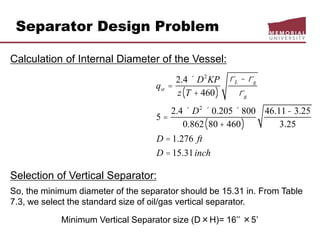
  • 77.
    3.5 Environmental Considerations Gaseous emissions Gaseous emissions from natural gas processing create a number of environmental problems  Resulting in localized low-levels of ozone, or smog  Acid gases may corrode refining equipment, harm catalyst and pollute the atmosphere Source SOx CO VOC NOx Compressor engine     Sulfur recovery    Waste water treatment  Boilers and furnaces    Storage tanks  Fugitive emissions     VOC: volatile organic compounds
  • 78.
    3.5 Environmental Considerations Carbon monoxide (CO)  Formed by incomplete combustion in boilers, process heaters, and power plants  Toxic  Sulfur oxides  Produced by the combustion of sulfur-containing fuels  Irritate the respiratory tract  React with water vapor in the atmosphere and return to earth as acid rain  Nitrogen oxides and VOC  NOx also produced by the fired heaters and/or power plant  NOx also damage respiratory tissues and contribute to acid rain  VOCs react with ozone to form a series of substances which are toxic to humans, animals and plants  Greenhouse gases  CO2, CH4 and N2O  Global warming
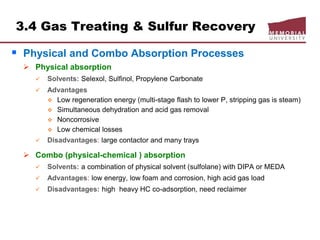
  • 79.
    3.5 Environmental Considerations Liquid wastes  Contaminants o H2S and mercaptans o Cyanides o Ammonium compounds o Hydrocarbons  Sour water: from NH3, sulfur compounds  Solid wastes  Sources o Gas and liquid treating o Waste water treatment  Types o Sludge from hydrocarbon treating o Sludge from the bottom of storage tanks o Sludge from waste water treatment
  • 80.
    3.5 Environmental Considerations Stack Gas Cleanup  Main applications  Regenerator flue gas  Furnace/boiler burning sulfur-containing fuel  Process options  SO2 to sulfur, sulfuric acid , sulfates  “Wet” scrubbing with a basic solution  “Dry” scrubbing with an adsorbent  Chemical reactants  Lime (CaO) or limestone (CaCO3) solution o Yields calcium sulfate o Mostly for coal fired plants  Activated carbon (dry) o Yields SO2 to Claus Plant o NH3 converts NOx into nitrogen  Sodium sulfite (Na2S) : yield SO2
  • 81.
    3.5 Environmental Considerations Waste Water Treatment  Coagulation, flocculation and dissolved air flotation (DAF*)  Coagulation: additives break colloidal suspensions, allow coalescence  Flocculation: additives help oily ‘floc’ or sludge to form  DAF: tiny air bubbles thicken sludge for easier removal  Aerobic biological treatment Remove water soluble materials, such as HC’s, phenol, miscellaneous soluble biochemical oxygen demand (BOD) and COD (chemical oxygen demand) compounds  Solid Water Treatment  Incineration  Land treating off-site  Land filling onsite  Land filling off-site  Chemical fixation  Neutralization
  • 82.
    3.5 Environmental Considerations Flowdiagram of a typical dissolved air flotation unit (from: http://en.wikipedia.org/wiki/Dissolved_air_flotation